Fuzzy Logic System
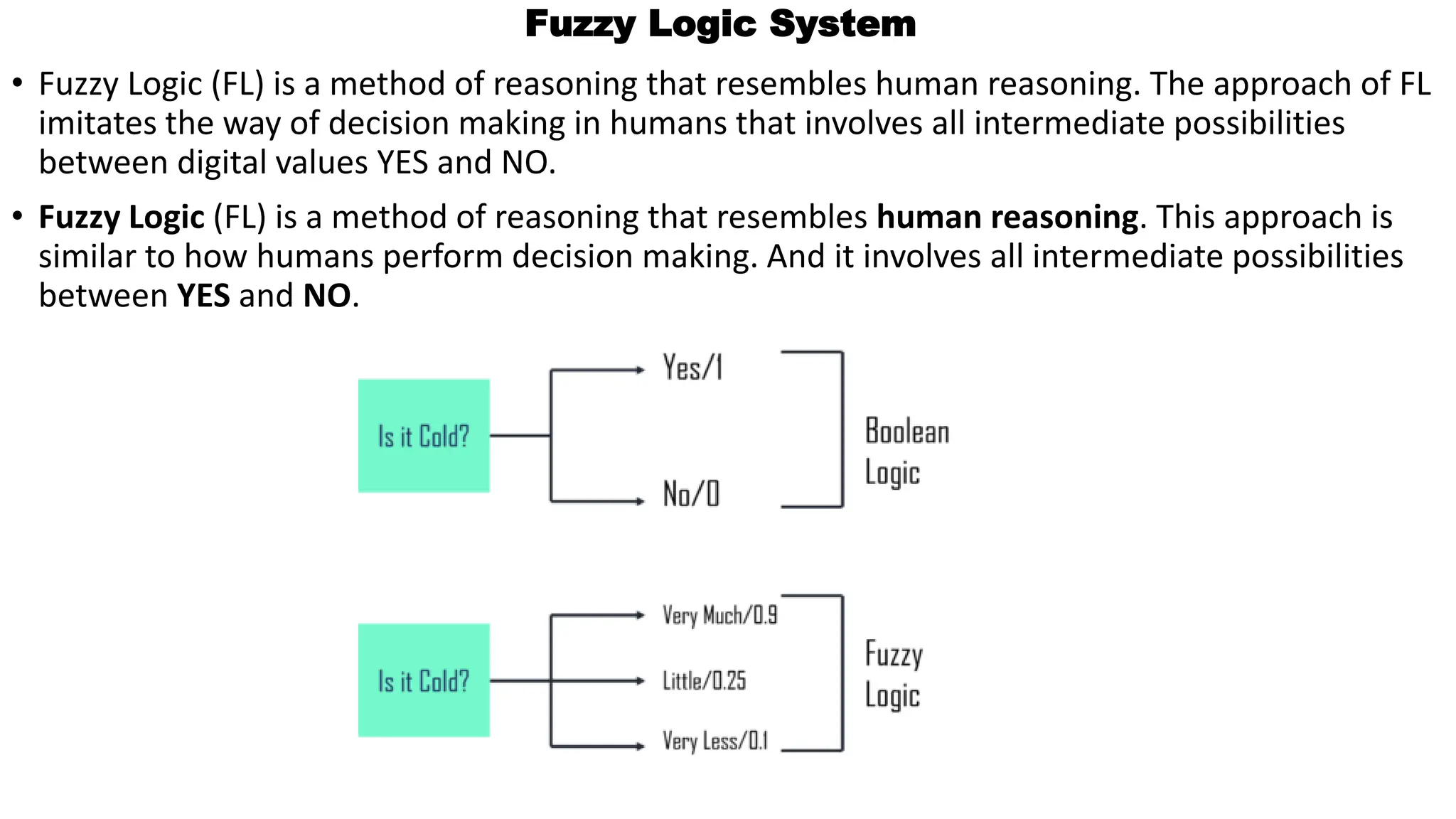
• Fuzzy Logic (FL) is a method of reasoning that resembles human reasoning. The approach of FL
imitates the way of decision making in humans that involves all intermediate possibilities
between digital values YES and NO.
• Fuzzy Logic (FL) is a method of reasoning that resembles human reasoning. This approach is
similar to how humans perform decision making. And it involves all intermediate possibilities
between YES and NO.
Why Fuzzy Logic
Fuzzy logic is useful for commercial and practical purposes.
• It can control machines and consumer products.
• It may not give accurate reasoning, but acceptable reasoning.
• Fuzzy logic helps to deal with the uncertainty in engineering
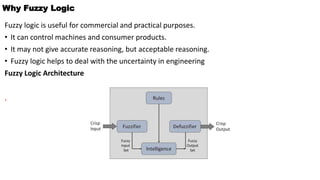
Fuzzy Logic Architecture
.
Fuzzy Logic Architecture
• FLC mainly consists of three components:
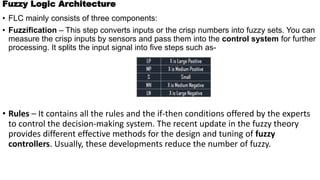
• Fuzzification – This step converts inputs or the crisp numbers into fuzzy sets. You can
measure the crisp inputs by sensors and pass them into the control system for further
processing. It splits the input signal into five steps such as-
• Rules – It contains all the rules and the if-then conditions offered by the experts
to control the decision-making system. The recent update in the fuzzy theory
provides different effective methods for the design and tuning of fuzzy
controllers. Usually, these developments reduce the number of fuzzy.
Components of FLC
Inference Engine – It determines the degree of match between fuzzy input and the rules.
According to the input field, it will decide the rules that are to be fired. Combining the fired rules,
form the control actions
Defuzzification – The Defuzzification process converts the fuzzy sets into a crisp value. There are
different types of techniques available, and you need to select the best-suited one with an expert
system.
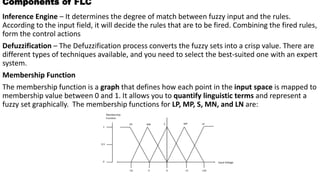
Membership Function
The membership function is a graph that defines how each point in the input space is mapped to
membership value between 0 and 1. It allows you to quantify linguistic terms and represent a
fuzzy set graphically. The membership functions for LP, MP, S, MN, and LN are:
Applications of Fuzzy Logic
Fuzzy logic is used in various fields such as automotive systems, domestic goods, environment control, etc. Some of
the common applications are:
• It is used in the aerospace field for altitude control of spacecraft and satellite.
• This controls the speed and traffic in the automotive systems.
• It is used for decision making support systems and personal evaluation in the large company business.
• It also controls the pH, drying, chemical distillation process in the chemical industry.
• Fuzzy logic is used in Natural language processing and various intensive applications in Artificial Intelligence.
Advantages & Disadvantages of Fuzzy Logic
The structure of Fuzzy Logic Systems is easy and understandable
Fuzzy logic is widely used for commercial and practical purposes
It helps you to control machines and consumer products
It helps you to deal with the uncertainty in engineering
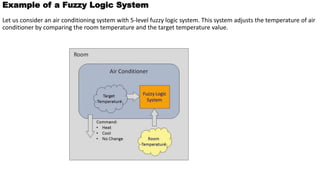
Example of a Fuzzy Logic System
Let us consider an air conditioning system with 5-level fuzzy logic system. This system adjusts the temperature of air
conditioner by comparing the room temperature and the target temperature value.
Steps to design Fuzzy Logic System
:
• Step 1 − Define linguistic variables and terms
• Linguistic variables are input and output variables in the form of simple words or sentences. For room
temperature, cold, warm, hot, etc., are linguistic terms.
• Temperature (t) = {very-cold, cold, warm, very-warm, hot}
• Every member of this set is a linguistic term and it can cover some portion of overall temperature values.
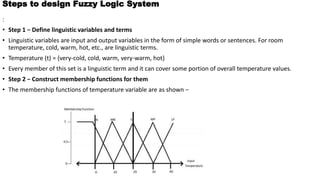
• Step 2 − Construct membership functions for them
• The membership functions of temperature variable are as shown −
Steps to Design Fuzzy Logic System
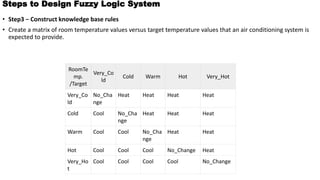
• Step3 − Construct knowledge base rules
• Create a matrix of room temperature values versus target temperature values that an air conditioning system is
expected to provide.
RoomTe
mp.
/Target
Very_Co
ld
Cold Warm Hot Very_Hot
Very_Co
ld
No_Cha
nge
Heat Heat Heat Heat
Cold Cool No_Cha
nge
Heat Heat Heat
Warm Cool Cool No_Cha
nge
Heat Heat
Hot Cool Cool Cool No_Change Heat
Very_Ho
t
Cool Cool Cool Cool No_Change
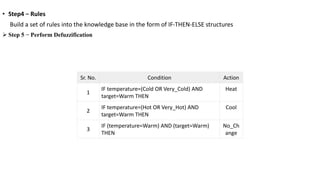
• Step4 − Rules
Build a set of rules into the knowledge base in the form of IF-THEN-ELSE structures
 Step 5 − Perform Defuzzification
Sr. No. Condition Action
1
IF temperature=(Cold OR Very_Cold) AND
target=Warm THEN
Heat
2
IF temperature=(Hot OR Very_Hot) AND
target=Warm THEN
Cool
3
IF (temperature=Warm) AND (target=Warm)
THEN
No_Ch
ange

Week 8.pptx

  • 1.
    Fuzzy Logic System •Fuzzy Logic (FL) is a method of reasoning that resembles human reasoning. The approach of FL imitates the way of decision making in humans that involves all intermediate possibilities between digital values YES and NO. • Fuzzy Logic (FL) is a method of reasoning that resembles human reasoning. This approach is similar to how humans perform decision making. And it involves all intermediate possibilities between YES and NO.
  • 2.
    Why Fuzzy Logic Fuzzylogic is useful for commercial and practical purposes. • It can control machines and consumer products. • It may not give accurate reasoning, but acceptable reasoning. • Fuzzy logic helps to deal with the uncertainty in engineering Fuzzy Logic Architecture .
  • 3.
    Fuzzy Logic Architecture •FLC mainly consists of three components: • Fuzzification – This step converts inputs or the crisp numbers into fuzzy sets. You can measure the crisp inputs by sensors and pass them into the control system for further processing. It splits the input signal into five steps such as- • Rules – It contains all the rules and the if-then conditions offered by the experts to control the decision-making system. The recent update in the fuzzy theory provides different effective methods for the design and tuning of fuzzy controllers. Usually, these developments reduce the number of fuzzy.
  • 4.
    Components of FLC InferenceEngine – It determines the degree of match between fuzzy input and the rules. According to the input field, it will decide the rules that are to be fired. Combining the fired rules, form the control actions Defuzzification – The Defuzzification process converts the fuzzy sets into a crisp value. There are different types of techniques available, and you need to select the best-suited one with an expert system. Membership Function The membership function is a graph that defines how each point in the input space is mapped to membership value between 0 and 1. It allows you to quantify linguistic terms and represent a fuzzy set graphically. The membership functions for LP, MP, S, MN, and LN are:
  • 5.
    Applications of FuzzyLogic Fuzzy logic is used in various fields such as automotive systems, domestic goods, environment control, etc. Some of the common applications are: • It is used in the aerospace field for altitude control of spacecraft and satellite. • This controls the speed and traffic in the automotive systems. • It is used for decision making support systems and personal evaluation in the large company business. • It also controls the pH, drying, chemical distillation process in the chemical industry. • Fuzzy logic is used in Natural language processing and various intensive applications in Artificial Intelligence. Advantages & Disadvantages of Fuzzy Logic The structure of Fuzzy Logic Systems is easy and understandable Fuzzy logic is widely used for commercial and practical purposes It helps you to control machines and consumer products It helps you to deal with the uncertainty in engineering
  • 6.
    Example of aFuzzy Logic System Let us consider an air conditioning system with 5-level fuzzy logic system. This system adjusts the temperature of air conditioner by comparing the room temperature and the target temperature value.
  • 7.
    Steps to designFuzzy Logic System : • Step 1 − Define linguistic variables and terms • Linguistic variables are input and output variables in the form of simple words or sentences. For room temperature, cold, warm, hot, etc., are linguistic terms. • Temperature (t) = {very-cold, cold, warm, very-warm, hot} • Every member of this set is a linguistic term and it can cover some portion of overall temperature values. • Step 2 − Construct membership functions for them • The membership functions of temperature variable are as shown −
  • 8.
    Steps to DesignFuzzy Logic System • Step3 − Construct knowledge base rules • Create a matrix of room temperature values versus target temperature values that an air conditioning system is expected to provide. RoomTe mp. /Target Very_Co ld Cold Warm Hot Very_Hot Very_Co ld No_Cha nge Heat Heat Heat Heat Cold Cool No_Cha nge Heat Heat Heat Warm Cool Cool No_Cha nge Heat Heat Hot Cool Cool Cool No_Change Heat Very_Ho t Cool Cool Cool Cool No_Change
  • 9.
    • Step4 −Rules Build a set of rules into the knowledge base in the form of IF-THEN-ELSE structures  Step 5 − Perform Defuzzification Sr. No. Condition Action 1 IF temperature=(Cold OR Very_Cold) AND target=Warm THEN Heat 2 IF temperature=(Hot OR Very_Hot) AND target=Warm THEN Cool 3 IF (temperature=Warm) AND (target=Warm) THEN No_Ch ange