Fuzzy logic
• The term fuzzy refers to things that are not clear or are
vague. In the real world many times we encounter a
situation when we can’t determine whether the state is
true or false, their fuzzy logic provides very valuable
flexibility for reasoning. Fuzzy Logic is a form of many-
valued logic in which the truth values of variables may be
any real number between 0 and 1, instead of just the
traditional values of true or false. It is used to deal with
imprecise or uncertain information and is a mathematical
method for representing vagueness and uncertainty in
decision-making.
• Fuzzy Logic is based on the idea that in many cases,
the concept of true or false is too restrictive, and
that there are many shades of gray in between. It
allows for partial truths, where a statement can be
partially true or false, rather than fully true or false.
• Fuzzy Logic is used in a wide range of applications,
such as control systems, image processing, natural
language processing, medical diagnosis, and
artificial intelligence.
Membership function
• The fundamental concept of Fuzzy Logic is the
membership function, which defines the
degree of membership of an input value to a
certain set or category. The membership
function is a mapping from an input value to a
membership degree between 0 and 1, where
0 represents non-membership and 1
represents full membership.
• Fuzzy Logic is implemented using Fuzzy Rules, which are
if-then statements that express the relationship between
input variables and output variables in a fuzzy way. The
output of a Fuzzy Logic system is a fuzzy set, which is a set
of membership degrees for each possible output value.
• In summary, Fuzzy Logic is a mathematical method for
representing vagueness and uncertainty in decision-
making, it allows for partial truths, and it is used in a wide
range of applications. It is based on the concept of
membership function and the implementation is done
using Fuzzy rules.
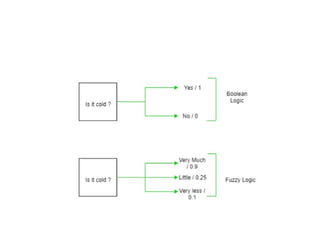
• In the boolean system truth value, 1.0
represents the absolute truth value and 0.0
represents the absolute false value. But in the
fuzzy system, there is no logic for the absolute
truth and absolute false value. But in fuzzy
logic, there is an intermediate value too
present which is partially true and partially
false.
Architecture
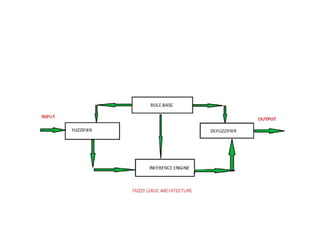
• Its Architecture contains four parts :
• RULE BASE: It contains the set of rules and the IF-THEN conditions provided by
the experts to govern the decision-making system, on the basis of linguistic
information. Recent developments in fuzzy theory offer several effective
methods for the design and tuning of fuzzy controllers. Most of these
developments reduce the number of fuzzy rules.
• FUZZIFICATION: It is used to convert inputs i.e. crisp numbers into fuzzy sets.
Crisp inputs are basically the exact inputs measured by sensors and passed into
the control system for processing, such as temperature, pressure, rpm’s, etc.
• INFERENCE ENGINE: It determines the matching degree of the current fuzzy
input with respect to each rule and decides which rules are to be fired according
to the input field. Next, the fired rules are combined to form the control actions.
• DEFUZZIFICATION: It is used to convert the fuzzy sets obtained by the inference
engine into a crisp value. There are several defuzzification methods available
and the best-suited one is used with a specific expert system to reduce the
error.
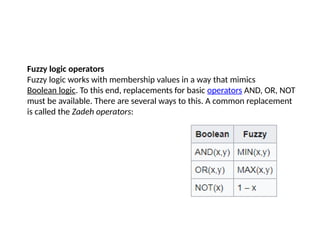
Fuzzy logic operators
Fuzzy logic works with membership values in a way that mimics
Boolean logic. To this end, replacements for basic operators AND, OR, NOT
must be available. There are several ways to this. A common replacement
is called the Zadeh operators:
• IF-THEN rules
IF-THEN rules map input or computed truth values to desired
output truth values. Example:
• IF temperature IS very cold THEN fan_speed is stopped
• IF temperature IS cold THEN fan_speed is slow
• IF temperature IS warm THEN fan_speed is moderate
• IF temperature IS hot THEN fan_speed is high
Given a certain temperature, the fuzzy variable hot has a certain truth
value, which is copied to the high variable.
Should an output variable occur in several THEN parts, then the values
from the respective IF parts are combined using the OR operator.
• Defuzzification
• The goal is to get a continuous variable from fuzzy truth
values.
• This would be easy if the output truth values were exactly
those obtained from fuzzification of a given number. Since,
however, all output truth values are computed independently,
in most cases they do not represent such a set of
numbers. One has then to decide for a number that matches
best the "intention" encoded in the truth value. For example,
for several truth values of fan_speed, an actual speed must be
found that best fits the computed truth values of the variables
'slow', 'moderate' and so on.

Fuzzy logicgccccccccccccccccccccccc.pptx

  • 1.
  • 2.
    • The termfuzzy refers to things that are not clear or are vague. In the real world many times we encounter a situation when we can’t determine whether the state is true or false, their fuzzy logic provides very valuable flexibility for reasoning. Fuzzy Logic is a form of many- valued logic in which the truth values of variables may be any real number between 0 and 1, instead of just the traditional values of true or false. It is used to deal with imprecise or uncertain information and is a mathematical method for representing vagueness and uncertainty in decision-making.
  • 3.
    • Fuzzy Logicis based on the idea that in many cases, the concept of true or false is too restrictive, and that there are many shades of gray in between. It allows for partial truths, where a statement can be partially true or false, rather than fully true or false. • Fuzzy Logic is used in a wide range of applications, such as control systems, image processing, natural language processing, medical diagnosis, and artificial intelligence.
  • 4.
    Membership function • Thefundamental concept of Fuzzy Logic is the membership function, which defines the degree of membership of an input value to a certain set or category. The membership function is a mapping from an input value to a membership degree between 0 and 1, where 0 represents non-membership and 1 represents full membership.
  • 5.
    • Fuzzy Logicis implemented using Fuzzy Rules, which are if-then statements that express the relationship between input variables and output variables in a fuzzy way. The output of a Fuzzy Logic system is a fuzzy set, which is a set of membership degrees for each possible output value. • In summary, Fuzzy Logic is a mathematical method for representing vagueness and uncertainty in decision- making, it allows for partial truths, and it is used in a wide range of applications. It is based on the concept of membership function and the implementation is done using Fuzzy rules.
  • 6.
    • In theboolean system truth value, 1.0 represents the absolute truth value and 0.0 represents the absolute false value. But in the fuzzy system, there is no logic for the absolute truth and absolute false value. But in fuzzy logic, there is an intermediate value too present which is partially true and partially false.
  • 8.
    Architecture • Its Architecturecontains four parts : • RULE BASE: It contains the set of rules and the IF-THEN conditions provided by the experts to govern the decision-making system, on the basis of linguistic information. Recent developments in fuzzy theory offer several effective methods for the design and tuning of fuzzy controllers. Most of these developments reduce the number of fuzzy rules. • FUZZIFICATION: It is used to convert inputs i.e. crisp numbers into fuzzy sets. Crisp inputs are basically the exact inputs measured by sensors and passed into the control system for processing, such as temperature, pressure, rpm’s, etc. • INFERENCE ENGINE: It determines the matching degree of the current fuzzy input with respect to each rule and decides which rules are to be fired according to the input field. Next, the fired rules are combined to form the control actions. • DEFUZZIFICATION: It is used to convert the fuzzy sets obtained by the inference engine into a crisp value. There are several defuzzification methods available and the best-suited one is used with a specific expert system to reduce the error.
  • 10.
    Fuzzy logic operators Fuzzylogic works with membership values in a way that mimics Boolean logic. To this end, replacements for basic operators AND, OR, NOT must be available. There are several ways to this. A common replacement is called the Zadeh operators:
  • 11.
    • IF-THEN rules IF-THENrules map input or computed truth values to desired output truth values. Example: • IF temperature IS very cold THEN fan_speed is stopped • IF temperature IS cold THEN fan_speed is slow • IF temperature IS warm THEN fan_speed is moderate • IF temperature IS hot THEN fan_speed is high Given a certain temperature, the fuzzy variable hot has a certain truth value, which is copied to the high variable. Should an output variable occur in several THEN parts, then the values from the respective IF parts are combined using the OR operator.
  • 12.
    • Defuzzification • Thegoal is to get a continuous variable from fuzzy truth values. • This would be easy if the output truth values were exactly those obtained from fuzzification of a given number. Since, however, all output truth values are computed independently, in most cases they do not represent such a set of numbers. One has then to decide for a number that matches best the "intention" encoded in the truth value. For example, for several truth values of fan_speed, an actual speed must be found that best fits the computed truth values of the variables 'slow', 'moderate' and so on.