The Structure of Agents
• There are two parts in agents
1. Architecture: Hardware with sensors and actuators.
2. Program: Convert percepts into actions.
Agents are classified into 5 classes, based on their agent programs.
Lets us discuss them
1. Simple Reflex (SR) Agents
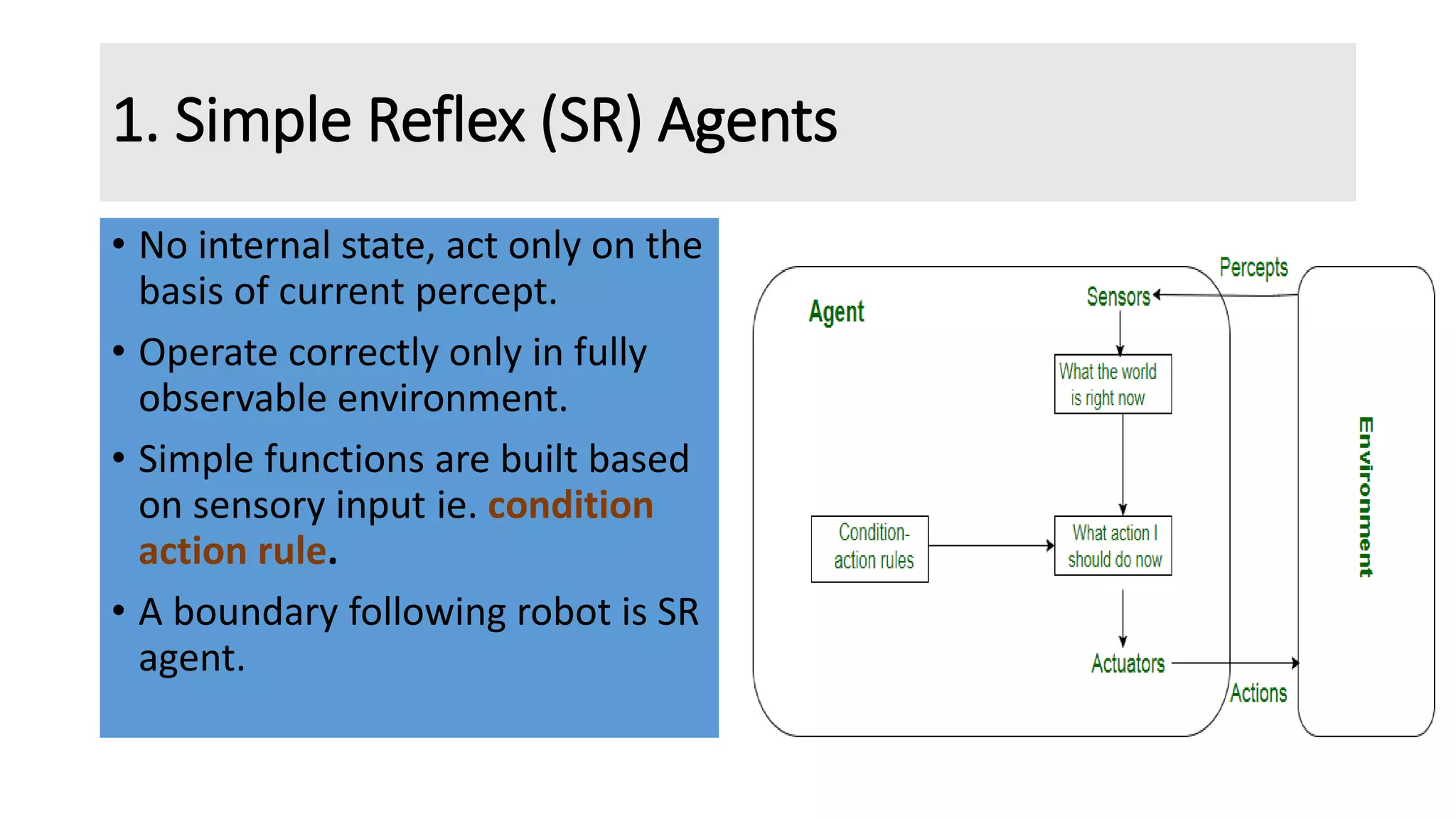
• No internal state, act only on the
basis of current percept.
• Operate correctly only in fully
observable environment.
• Simple functions are built based
on sensory input ie. condition
action rule.
• A boundary following robot is SR
agent.
Simple Reflex (SR) Agents Limitations
• Very limited intelligence.
• Usually too big to generate and store.
• Not flexible, need to update the rules if any change occurs in
environment.
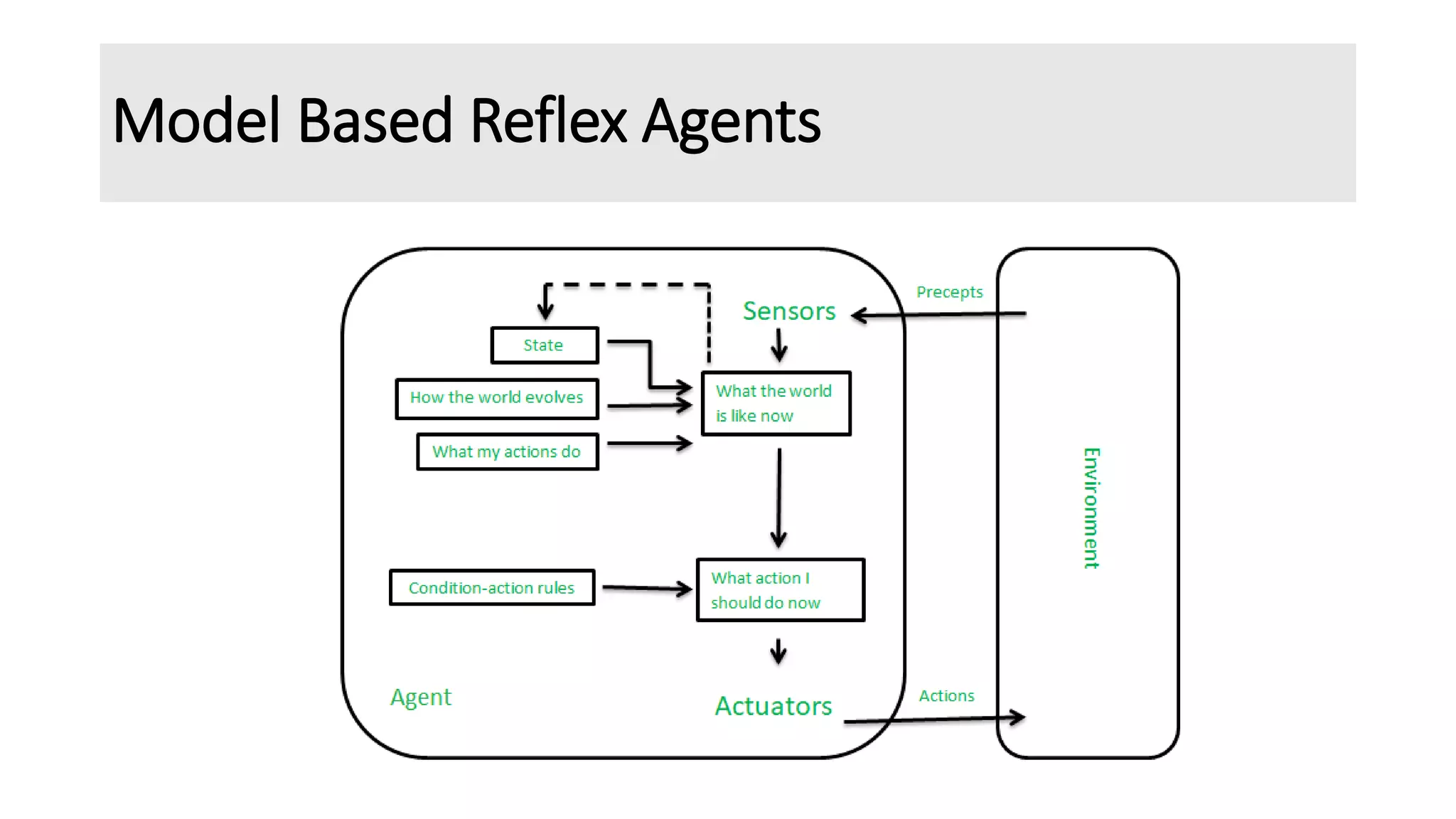
2. Model Based Agents
• Find a rule whose condition matches the current situation.
• Handle partially observable environments by using model.
• The agent has internal state, adjusted by each percept and that
depends on the percept history.
• Current state stored inside the agents, describing the part of the
world which cannot be seen.
• Updating the state requires information about :
• how the world evolves in-dependently from the agent, and
• how the agent actions affects the world.
Model Based Reflex Agents
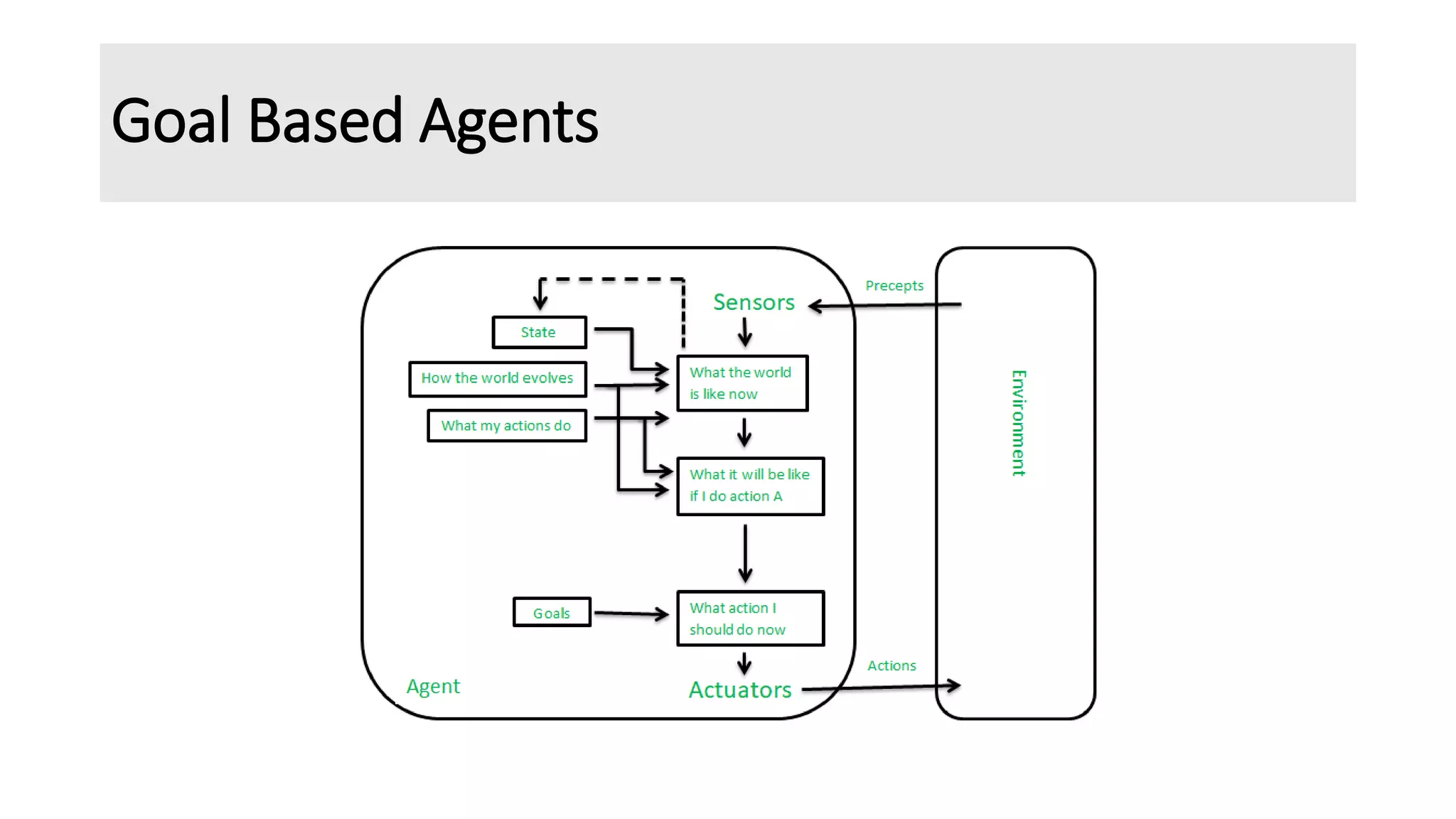
3. Goal Based Agents
• Extension of model based agents.
• Take decision based on how far they are currently from their goal.
• Every action is intended to reduce its distance from the goal.
• Agent choose a way among multiple possibilities, selecting the one
which reaches a goal state.
• Searching and planning.
• Agent needs some sort of looking into future.
Goal Based Agents
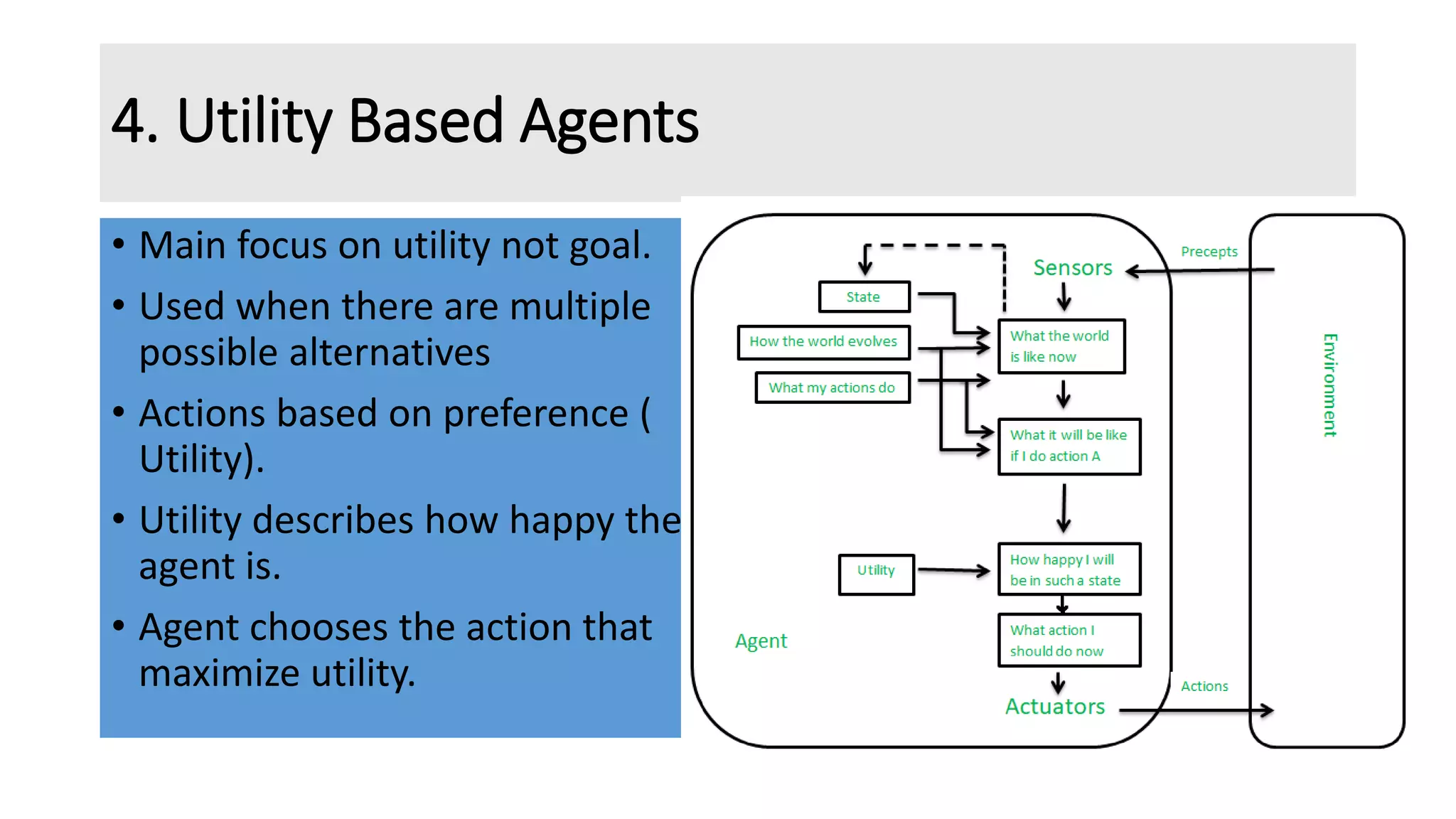
4. Utility Based Agents
• Main focus on utility not goal.
• Used when there are multiple
possible alternatives
• Actions based on preference (
Utility).
• Utility describes how happy the
agent is.
• Agent chooses the action that
maximize utility.
5. Learning Agent
• Learn from past experiences
• It start with knowledge then able to act and adapt automatically.
• It has 4 components
1. Learning element: It is responsible for making improvements by
learning from the environment
2. Critic: Learning element takes feedback from critic which describes
how well the agent is doing with respect to a fixed performance
standard.
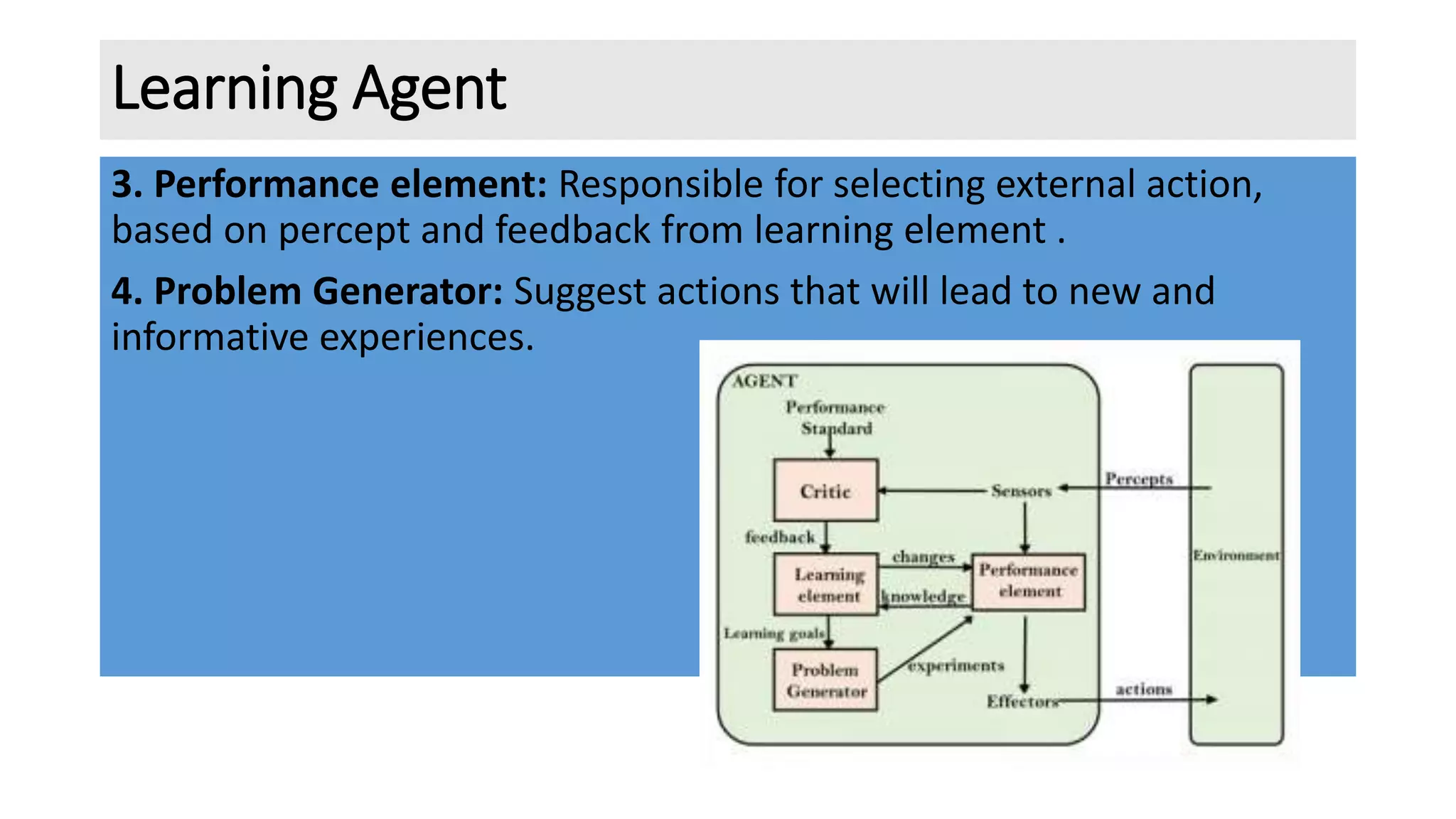
Learning Agent
3. Performance element: Responsible for selecting external action,
based on percept and feedback from learning element .
4. Problem Generator: Suggest actions that will lead to new and
informative experiences.
Different forms of learning
• Rote learning or memorization.
• Least amount of inferencing.
• Knowledge is copied in knowledge base.
• Learning through instructions
• Learning by analogy
• Development of new concepts through already known similar concepts
• Learning by induction
• Conclusion drawn based on large number of examples.
Different forms of learning
• Learning by deduction
• Irrefutable form of reasoning.
• Concepts drawn always already correct, if given facts are correct.
• Learning based on feedback
• Supervised
• Unsupervised
• Reinforcement learning

Agents in Artificial intelligence

  • 1.
    The Structure ofAgents • There are two parts in agents 1. Architecture: Hardware with sensors and actuators. 2. Program: Convert percepts into actions. Agents are classified into 5 classes, based on their agent programs. Lets us discuss them
  • 2.
    1. Simple Reflex(SR) Agents • No internal state, act only on the basis of current percept. • Operate correctly only in fully observable environment. • Simple functions are built based on sensory input ie. condition action rule. • A boundary following robot is SR agent.
  • 3.
    Simple Reflex (SR)Agents Limitations • Very limited intelligence. • Usually too big to generate and store. • Not flexible, need to update the rules if any change occurs in environment.
  • 4.
    2. Model BasedAgents • Find a rule whose condition matches the current situation. • Handle partially observable environments by using model. • The agent has internal state, adjusted by each percept and that depends on the percept history. • Current state stored inside the agents, describing the part of the world which cannot be seen. • Updating the state requires information about : • how the world evolves in-dependently from the agent, and • how the agent actions affects the world.
  • 5.
  • 6.
    3. Goal BasedAgents • Extension of model based agents. • Take decision based on how far they are currently from their goal. • Every action is intended to reduce its distance from the goal. • Agent choose a way among multiple possibilities, selecting the one which reaches a goal state. • Searching and planning. • Agent needs some sort of looking into future.
  • 7.
  • 8.
    4. Utility BasedAgents • Main focus on utility not goal. • Used when there are multiple possible alternatives • Actions based on preference ( Utility). • Utility describes how happy the agent is. • Agent chooses the action that maximize utility.
  • 9.
    5. Learning Agent •Learn from past experiences • It start with knowledge then able to act and adapt automatically. • It has 4 components 1. Learning element: It is responsible for making improvements by learning from the environment 2. Critic: Learning element takes feedback from critic which describes how well the agent is doing with respect to a fixed performance standard.
  • 10.
    Learning Agent 3. Performanceelement: Responsible for selecting external action, based on percept and feedback from learning element . 4. Problem Generator: Suggest actions that will lead to new and informative experiences.
  • 11.
    Different forms oflearning • Rote learning or memorization. • Least amount of inferencing. • Knowledge is copied in knowledge base. • Learning through instructions • Learning by analogy • Development of new concepts through already known similar concepts • Learning by induction • Conclusion drawn based on large number of examples.
  • 12.
    Different forms oflearning • Learning by deduction • Irrefutable form of reasoning. • Concepts drawn always already correct, if given facts are correct. • Learning based on feedback • Supervised • Unsupervised • Reinforcement learning