Adaptive
Neuro-Fuzzy
Inference
System
A set is an unordered collection of different elements
THE CLASSICAL SET THEORY
Example
A set of all positive integers
A set of all the planets in the solar system
A set of all the states in India
MATHEMATICAL REPRESENTATION OF A
CLASSICAL SET
Roster or Tabular Form
Set of vowels in English alphabet, A = {a,e,i,o,u}
Set of odd numbers less than 10, B = {1,3,5,7,9}
Set Builder Form
Example 1 − The set {a,e,i,o,u} is written as
A = {x: x is a vowel in English alphabet}
Example 2 − The set {1,3,5,7,9} is written as
B = {x:1 ≤ x < 10 and (x%2) ≠ 0}
Cardinality of a Set
MORE ABOUT CLASSICAL/CRISP SETS
Cardinality of a set S, denoted by |S|, is
the number of elements of the set.
Example
|{1,4,3,5}| = 4
Types of Sets
Finite Set
Infinite Set
Subset
Proper Subset
Universal Set
Equal Set
Equivalent Set
Overlapping Set
A = [1,2,3,4,5,6]
B = [5,6,7,8,9,0]
U = [1,2,3,4,5,6,7,8,9,0]
Operations on Classical Sets
UNION INTERSECTION
AUB = [1,2,3,4,5,6,7,8,9,0] A∩B = [5,6]
DIFFERENCE
COMPLEMENT OF A SET
A-B = [1,2,3,4] B-A = [7,8,9,0]
A’ = [7,8,9,0]
What is Fuzzy Logic?
FUZZY refers to things which are
NOT CLEAR
VAGUE
UNQUANTIFIABLE
INDEFINITE
ROUGH
SUBJECTIVE
Words like young, tall, good, shades of a colour,
high are Fuzzy
What are Fuzzy Sets?
U =
CRISP SET
[ ]
Distinguish Apples
U =
CRISP SET
[ ]
Set (Apples) =
CRISP SET
[ ]
Distinguish Apples
ASSIGN DEGREES OF MEMBERSHIP
[1] [0] [0] [0] [1] [0] [1]
Distinguish Red Apples
FUZZY SET
Distinguish Red Apples
1
2 3
4
5
6
7
8
9
10
Distinguish Red Apples
1
2 3
4
5
6
7
8
9
10
(Assign membership functions)
MEMBERSHIP FUNCTION
DEGREE OF BELONGINGNESS
PROBABILITY OF AN ELEMENT BELONGING TO A SET
VARY BETWEEN 0 AND 1
DENOTED BY µ
SET (RED APPLES)
1
2 3
4
5
6
7
8
9
10
(0.1)
(0.2)
(0.3)
(0.4)
(0.5)
(0.6)
(0.7)
(0.8)
(0.9)
(1.0)
[(1,0.1), (2,0.8), (3,1), (4,0.2), (5,0.5), (6,0.3),
(7,0.6), (8,0.7), (9,0.9), (10,4)]
à =
Representation of a FUZZY SET
= {(x, µ(x)), x є X }
Ã
Here, µ = membership function
SOME MORE EXAMPLES
OF
FUZZY SETS
AND
SITUATIONS
20, 40, 60, 80, 100
Conventional Logic:
HOT ≥ 80
Membership Functions:
HOT = 1
NOT HOT = 0
Let set of temperatures qualified as Hot be H
Crisp Set Representation:
H = [80, 100]
U= [ 20, 40, 60, 80, 100 ]
[0] [0] [0] [1] [1]
Fuzzy Logic:
Hotness defined by degrees of membership
Membership Functions:
20 (NOT HOT) = 0.2
40 (SOMEWHAT HOT) = 0.4
60 (HOT) = 0.6
80 (VERY HOT) = 0.8
100 (EXTREMELY HOT) = 1
Let set of temperatures qualified as Hot be H
Fuzzy Set Representation:
{(x, µ(x)), x є U }
H= [ (20,0.2), (40,0.4), (60,0.6), (80,0.8), (100,1) ]
U= [ 20, 40, 60, 80, 100 ]
[0.2] [0.4] [0.6] [0.8] [1]
LINGUISTIC VARIABLE
HEIGHT
WEIGHT
AGE
EDUCATION
LINGUISTIC TERM
TALL, VERY TALL, SHORT,
SOMEWHAT SHORT
HEAVY, LIGHT, VERY HEAVY, VERY
LIGHT
YOUNG, OLD, NOT OLD, VERY
YOUNG
PRIMARY, SECONDARY, 10, 10+2,
GRADUATE, POST GRADUATE, PhD
FUZZY INFERENCE SYSTEM
key unit of a fuzzy logic system
having decision making as its
primary work
output from FIS is always a fuzzy
set irrespective of its input which
can be fuzzy or crisp
A de-fuzzification unit would be
there with FIS to convert fuzzy
variables into crisp variables
Functional Blocks of Fuzzy
Inference System
Fuzzification Interface Unit − converts
the crisp quantities into fuzzy quantities
Rule Base − contains fuzzy IF-THEN rules
Database − defines the membership
functions of fuzzy sets used in fuzzy rules
Decision-making Unit − performs
operation on rules
De-fuzzification Interface Unit −
converts the fuzzy quantities into crisp
quantities
Fuzzification unit - converts the
crisp input into fuzzy input
Knowledge base - collection of
rule base and database is formed
upon the conversion of crisp input
into fuzzy input
De-fuzzification unit - fuzzy
input is finally converted into crisp
output
Working of Fuzzy Inference System
Determine the best circulation level
Inputs are the current temperature and moisture level
FUZZY RULES
IF the room is hot THEN circulate the air a lot
IF the room is cool THEN do not circulate the air
IF the room is cool and moist THEN circulate the
air slightly
If an input does not precisely correspond to an IF THEN
rule, partial matching of the input data is used to
interpolate an answer
Fuzzy IF - THEN Rules
RULE BASE
Rule 1: IF x is low AND y is low THEN z is high
Rule 2: IF x is low AND y is high THEN z is low
Rule 3: IF x is high AND y is low THEN z is low
Rule 4: IF x is high AND y is high THEN z is high
Adaptive Neuro-Fuzzy Inference System
Integration system in which neural networks
are applied to optimize the fuzzy inference
system
Constructs a series of fuzzy if–then rules with
appropriate membership functions
Initial fuzzy rules and membership functions
are first set by using human expertise about
the outputs to be modeled
Then, ANFIS can modify these fuzzy if–then
rules and membership functions to minimize
the output error measure
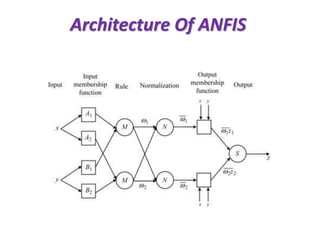
Architecture Of ANFIS
Two fuzzy if–then rules are considered
Rule 1: If (x is A1) and (y is B1) then (z1 = p1x + q1y+r1)
Rule 2: If (x is A2) and (y is B2) then (z2 = p2x + q2y+r2)
Where,
x and y are the inputs
Ai and Bi are the fuzzy sets
zi (i = 1,2) are the outputs within the fuzzy region
pi, qi, and ri are the parameters determined during
the training process
Layer 1: Input membership function
first layer is used to fuzzificate the inputs, and all
the nodes of this layer are adaptive. Its outputs
are the membership grade of the inputs.
Layer 2: Rule
The nodes of this layer are fixed nodes. They
are labeled with M, which indicates that they
perform as multipliers. The outputs of this
layer represent the fuzzy strengths ωi of each
rule.
Layer 3: Normalization
the nodes are also fixed. These nodes are
labeled with N, which means that they
play a normalization role to the fuzzy
strengths from the previous layer. The
normalization factor is computed by the
sum of the weight functions. The outputs
of this layer are called normalized fuzzy
strengths
Layer 5: Output
Only one single fixed node, labeled with
S, is in this layer. This node performs the
sum of the incoming signals
Layer 4: Output membership
function
The nodes of this layer are adaptive ones
Why use Fuzzy Logic in Neural Network?
Fuzzy logic is largely used to define the
weights, from fuzzy sets, in neural
networks.
When crisp values are not possible to
apply, then fuzzy values are used.
We have already studied that training
and learning help neural networks
perform better in unexpected
situations. At that time fuzzy values
would be more applicable than crisp
values.
When we use fuzzy logic in neural
networks then the values must not be
crisp and the processing can be done in
parallel.
ANFIS

ANFIS

  • 1.
  • 2.
    A set isan unordered collection of different elements THE CLASSICAL SET THEORY Example A set of all positive integers A set of all the planets in the solar system A set of all the states in India
  • 3.
    MATHEMATICAL REPRESENTATION OFA CLASSICAL SET Roster or Tabular Form Set of vowels in English alphabet, A = {a,e,i,o,u} Set of odd numbers less than 10, B = {1,3,5,7,9} Set Builder Form Example 1 − The set {a,e,i,o,u} is written as A = {x: x is a vowel in English alphabet} Example 2 − The set {1,3,5,7,9} is written as B = {x:1 ≤ x < 10 and (x%2) ≠ 0}
  • 4.
    Cardinality of aSet MORE ABOUT CLASSICAL/CRISP SETS Cardinality of a set S, denoted by |S|, is the number of elements of the set. Example |{1,4,3,5}| = 4
  • 5.
    Types of Sets FiniteSet Infinite Set Subset Proper Subset Universal Set Equal Set Equivalent Set Overlapping Set
  • 6.
    A = [1,2,3,4,5,6] B= [5,6,7,8,9,0] U = [1,2,3,4,5,6,7,8,9,0]
  • 7.
    Operations on ClassicalSets UNION INTERSECTION AUB = [1,2,3,4,5,6,7,8,9,0] A∩B = [5,6]
  • 8.
    DIFFERENCE COMPLEMENT OF ASET A-B = [1,2,3,4] B-A = [7,8,9,0] A’ = [7,8,9,0]
  • 9.
    What is FuzzyLogic? FUZZY refers to things which are NOT CLEAR VAGUE UNQUANTIFIABLE INDEFINITE ROUGH SUBJECTIVE
  • 10.
    Words like young,tall, good, shades of a colour, high are Fuzzy
  • 11.
  • 12.
    U = CRISP SET [] Distinguish Apples
  • 13.
    U = CRISP SET [] Set (Apples) = CRISP SET [ ] Distinguish Apples ASSIGN DEGREES OF MEMBERSHIP [1] [0] [0] [0] [1] [0] [1]
  • 14.
  • 15.
  • 16.
    Distinguish Red Apples 1 23 4 5 6 7 8 9 10 (Assign membership functions)
  • 17.
    MEMBERSHIP FUNCTION DEGREE OFBELONGINGNESS PROBABILITY OF AN ELEMENT BELONGING TO A SET VARY BETWEEN 0 AND 1 DENOTED BY µ
  • 18.
    SET (RED APPLES) 1 23 4 5 6 7 8 9 10 (0.1) (0.2) (0.3) (0.4) (0.5) (0.6) (0.7) (0.8) (0.9) (1.0)
  • 19.
    [(1,0.1), (2,0.8), (3,1),(4,0.2), (5,0.5), (6,0.3), (7,0.6), (8,0.7), (9,0.9), (10,4)] Ã = Representation of a FUZZY SET = {(x, µ(x)), x є X } Ã Here, µ = membership function
  • 20.
    SOME MORE EXAMPLES OF FUZZYSETS AND SITUATIONS
  • 21.
    20, 40, 60,80, 100
  • 22.
    Conventional Logic: HOT ≥80 Membership Functions: HOT = 1 NOT HOT = 0 Let set of temperatures qualified as Hot be H Crisp Set Representation: H = [80, 100] U= [ 20, 40, 60, 80, 100 ] [0] [0] [0] [1] [1]
  • 23.
    Fuzzy Logic: Hotness definedby degrees of membership Membership Functions: 20 (NOT HOT) = 0.2 40 (SOMEWHAT HOT) = 0.4 60 (HOT) = 0.6 80 (VERY HOT) = 0.8 100 (EXTREMELY HOT) = 1 Let set of temperatures qualified as Hot be H Fuzzy Set Representation: {(x, µ(x)), x є U } H= [ (20,0.2), (40,0.4), (60,0.6), (80,0.8), (100,1) ] U= [ 20, 40, 60, 80, 100 ] [0.2] [0.4] [0.6] [0.8] [1]
  • 25.
    LINGUISTIC VARIABLE HEIGHT WEIGHT AGE EDUCATION LINGUISTIC TERM TALL,VERY TALL, SHORT, SOMEWHAT SHORT HEAVY, LIGHT, VERY HEAVY, VERY LIGHT YOUNG, OLD, NOT OLD, VERY YOUNG PRIMARY, SECONDARY, 10, 10+2, GRADUATE, POST GRADUATE, PhD
  • 26.
    FUZZY INFERENCE SYSTEM keyunit of a fuzzy logic system having decision making as its primary work output from FIS is always a fuzzy set irrespective of its input which can be fuzzy or crisp A de-fuzzification unit would be there with FIS to convert fuzzy variables into crisp variables
  • 28.
    Functional Blocks ofFuzzy Inference System Fuzzification Interface Unit − converts the crisp quantities into fuzzy quantities Rule Base − contains fuzzy IF-THEN rules Database − defines the membership functions of fuzzy sets used in fuzzy rules Decision-making Unit − performs operation on rules De-fuzzification Interface Unit − converts the fuzzy quantities into crisp quantities
  • 29.
    Fuzzification unit -converts the crisp input into fuzzy input Knowledge base - collection of rule base and database is formed upon the conversion of crisp input into fuzzy input De-fuzzification unit - fuzzy input is finally converted into crisp output Working of Fuzzy Inference System
  • 30.
    Determine the bestcirculation level Inputs are the current temperature and moisture level FUZZY RULES IF the room is hot THEN circulate the air a lot IF the room is cool THEN do not circulate the air IF the room is cool and moist THEN circulate the air slightly If an input does not precisely correspond to an IF THEN rule, partial matching of the input data is used to interpolate an answer Fuzzy IF - THEN Rules
  • 31.
    RULE BASE Rule 1:IF x is low AND y is low THEN z is high Rule 2: IF x is low AND y is high THEN z is low Rule 3: IF x is high AND y is low THEN z is low Rule 4: IF x is high AND y is high THEN z is high
  • 32.
    Adaptive Neuro-Fuzzy InferenceSystem Integration system in which neural networks are applied to optimize the fuzzy inference system Constructs a series of fuzzy if–then rules with appropriate membership functions Initial fuzzy rules and membership functions are first set by using human expertise about the outputs to be modeled Then, ANFIS can modify these fuzzy if–then rules and membership functions to minimize the output error measure
  • 33.
  • 34.
    Two fuzzy if–thenrules are considered Rule 1: If (x is A1) and (y is B1) then (z1 = p1x + q1y+r1) Rule 2: If (x is A2) and (y is B2) then (z2 = p2x + q2y+r2) Where, x and y are the inputs Ai and Bi are the fuzzy sets zi (i = 1,2) are the outputs within the fuzzy region pi, qi, and ri are the parameters determined during the training process
  • 35.
    Layer 1: Inputmembership function first layer is used to fuzzificate the inputs, and all the nodes of this layer are adaptive. Its outputs are the membership grade of the inputs. Layer 2: Rule The nodes of this layer are fixed nodes. They are labeled with M, which indicates that they perform as multipliers. The outputs of this layer represent the fuzzy strengths ωi of each rule.
  • 36.
    Layer 3: Normalization thenodes are also fixed. These nodes are labeled with N, which means that they play a normalization role to the fuzzy strengths from the previous layer. The normalization factor is computed by the sum of the weight functions. The outputs of this layer are called normalized fuzzy strengths
  • 37.
    Layer 5: Output Onlyone single fixed node, labeled with S, is in this layer. This node performs the sum of the incoming signals Layer 4: Output membership function The nodes of this layer are adaptive ones
  • 38.
    Why use FuzzyLogic in Neural Network? Fuzzy logic is largely used to define the weights, from fuzzy sets, in neural networks. When crisp values are not possible to apply, then fuzzy values are used. We have already studied that training and learning help neural networks perform better in unexpected situations. At that time fuzzy values would be more applicable than crisp values. When we use fuzzy logic in neural networks then the values must not be crisp and the processing can be done in parallel.