THE FUTURE
 Future time vs Future tenses
Future time vs Future tenses


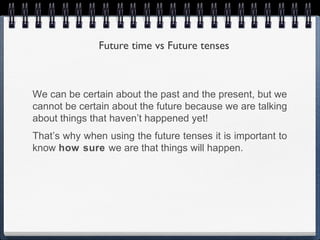
We can be certain about the past and the present, but we
cannot be certain about the future because we are talking
about things that haven’t happened yet!
That’s why when using the future tenses it is important to
know how sure we are that things will happen.
Future time vs Future tenses


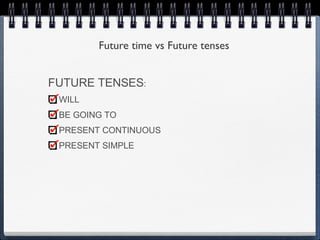
FUTURE TENSES:
 WILL
 BE GOING TO
 PRESENT CONTINUOUS
 PRESENT SIMPLE
Future time vs Future tenses


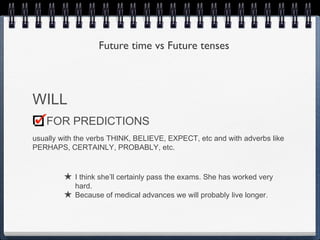
WILL
   FOR PREDICTIONS
usually with the verbs THINK, BELIEVE, EXPECT, etc and with adverbs like
PERHAPS, CERTAINLY, PROBABLY, etc.


         ★ I think she’ll certainly pass the exams. She has worked very
             hard.
         ★   Because of medical advances we will probably live longer.
Future time vs Future tenses


WILL
  FOR OFFERS AND DECISIONS TAKEN ON
THE SPOT


    ★ I’ll take it. It suits me perfectly.
    ★ I’ll help you with your homework.
Future time vs Future tenses


WILL
 FOR ACTIONS, SITUATIONS AND EVENTS
WHICH WILL CERTAINLY TAKE PLACE

    ★ She’ll be 18 next month.
Future time vs Future tenses


BE GOING TO
  FOR PLANS AND INTENTIONS


★ I’m going to study harder next term.
★ They are going to travel around the world for their honeymoon.
Future time vs Future tenses


BE GOING TO
  FOR PREDICTIONS WHEN THERE IS
EVIDENCE THAT SOMETHING WILL HAPPEN

    ★ Look at the sky! It’s going to rain.
    ★ She’s going to have a baby.
Future time vs Future tenses


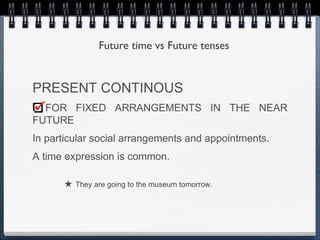
PRESENT CONTINOUS
  FOR FIXED ARRANGEMENTS IN THE NEAR
FUTURE
In particular social arrangements and appointments.
A time expression is common.

      ★ They are going to the museum tomorrow.
Future time vs Future tenses


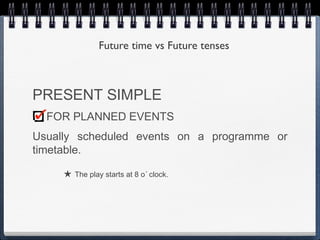
PRESENT SIMPLE
  FOR PLANNED EVENTS
Usually scheduled events on a programme or
timetable.

     ★ The play starts at 8 o´ clock.
Future time vs Future tenses


PROBLEMS?
 WILL OR BE GOING TO?
  BE   GOING       TO       OR       PRESENT
CONTINUOUS?
Future time vs Future tenses


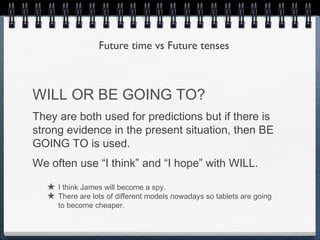
WILL OR BE GOING TO?
They are both used for predictions but if there is
strong evidence in the present situation, then BE
GOING TO is used.
We often use “I think” and “I hope” with WILL.

   ★ I think James will become a spy.
   ★ There are lots of different models nowadays so tablets are going
      to become cheaper.
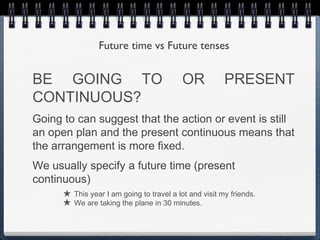
Future time vs Future tenses


BE GOING TO                                OR           PRESENT
CONTINUOUS?
Going to can suggest that the action or event is still
an open plan and the present continuous means that
the arrangement is more fixed.
We usually specify a future time (present
continuous)
      ★ This year I am going to travel a lot and visit my friends.
      ★ We are taking the plane in 30 minutes.
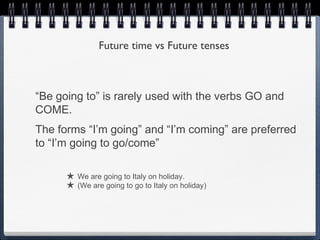
Future time vs Future tenses


“Be going to” is rarely used with the verbs GO and
COME.
The forms “I’m going” and “I’m coming” are preferred
to “I’m going to go/come”

      ★ We are going to Italy on holiday.
      ★ (We are going to go to Italy on holiday)
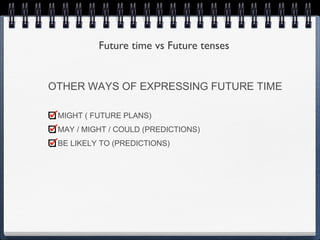
Future time vs Future tenses


OTHER WAYS OF EXPRESSING FUTURE TIME

 MIGHT ( FUTURE PLANS)
 MAY / MIGHT / COULD (PREDICTIONS)
 BE LIKELY TO (PREDICTIONS)
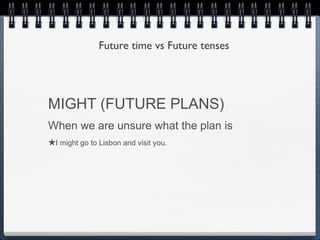
Future time vs Future tenses


MIGHT (FUTURE PLANS)
When we are unsure what the plan is
★I might go to Lisbon and visit you.
Future time vs Future tenses


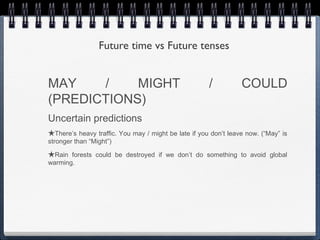
MAY    /    MIGHT                                     /          COULD
(PREDICTIONS)
Uncertain predictions
★There’s heavy traffic. You may / might be late if you don’t leave now. (“May” is
stronger than “Might”)

★Rain forests could be destroyed if we don’t do something to avoid global
warming.
Future time vs Future tenses


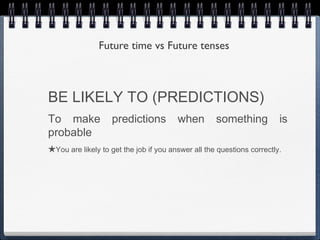
BE LIKELY TO (PREDICTIONS)
To make            predictions          when        something           is
probable
★You are likely to get the job if you answer all the questions correctly.
Future time vs Future tenses

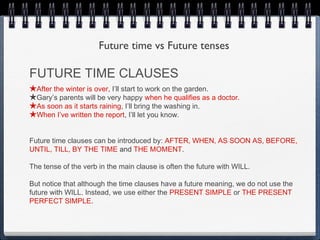
FUTURE TIME CLAUSES
★After the winter is over, I’ll start to work on the garden.
★Gary’s parents will be very happy when he qualifies as a doctor.
★As soon as it starts raining, I’ll bring the washing in.
★When I’ve written the report, I’ll let you know.

Future time clauses can be introduced by: AFTER, WHEN, AS SOON AS, BEFORE,
UNTIL, TILL, BY THE TIME and THE MOMENT.

The tense of the verb in the main clause is often the future with WILL.

But notice that although the time clauses have a future meaning, we do not use the
future with WILL. Instead, we use either the PRESENT SIMPLE or THE PRESENT
PERFECT SIMPLE.
Future time vs Future tenses


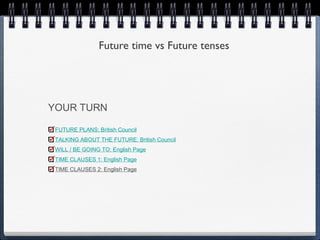
YOUR TURN

 FUTURE PLANS: British Council
 TALKING ABOUT THE FUTURE: British Council
 WILL / BE GOING TO: English Page
 TIME CLAUSES 1: English Page
 TIME CLAUSES 2: English Page

Future Time vs Future Tense

  • 1.
    THE FUTURE Futuretime vs Future tenses
  • 2.
    Future time vsFuture tenses We can be certain about the past and the present, but we cannot be certain about the future because we are talking about things that haven’t happened yet! That’s why when using the future tenses it is important to know how sure we are that things will happen.
  • 3.
    Future time vsFuture tenses FUTURE TENSES: WILL BE GOING TO PRESENT CONTINUOUS PRESENT SIMPLE
  • 4.
    Future time vsFuture tenses WILL FOR PREDICTIONS usually with the verbs THINK, BELIEVE, EXPECT, etc and with adverbs like PERHAPS, CERTAINLY, PROBABLY, etc. ★ I think she’ll certainly pass the exams. She has worked very hard. ★ Because of medical advances we will probably live longer.
  • 5.
    Future time vsFuture tenses WILL FOR OFFERS AND DECISIONS TAKEN ON THE SPOT ★ I’ll take it. It suits me perfectly. ★ I’ll help you with your homework.
  • 6.
    Future time vsFuture tenses WILL FOR ACTIONS, SITUATIONS AND EVENTS WHICH WILL CERTAINLY TAKE PLACE ★ She’ll be 18 next month.
  • 7.
    Future time vsFuture tenses BE GOING TO FOR PLANS AND INTENTIONS ★ I’m going to study harder next term. ★ They are going to travel around the world for their honeymoon.
  • 8.
    Future time vsFuture tenses BE GOING TO FOR PREDICTIONS WHEN THERE IS EVIDENCE THAT SOMETHING WILL HAPPEN ★ Look at the sky! It’s going to rain. ★ She’s going to have a baby.
  • 9.
    Future time vsFuture tenses PRESENT CONTINOUS FOR FIXED ARRANGEMENTS IN THE NEAR FUTURE In particular social arrangements and appointments. A time expression is common. ★ They are going to the museum tomorrow.
  • 10.
    Future time vsFuture tenses PRESENT SIMPLE FOR PLANNED EVENTS Usually scheduled events on a programme or timetable. ★ The play starts at 8 o´ clock.
  • 11.
    Future time vsFuture tenses PROBLEMS? WILL OR BE GOING TO? BE GOING TO OR PRESENT CONTINUOUS?
  • 12.
    Future time vsFuture tenses WILL OR BE GOING TO? They are both used for predictions but if there is strong evidence in the present situation, then BE GOING TO is used. We often use “I think” and “I hope” with WILL. ★ I think James will become a spy. ★ There are lots of different models nowadays so tablets are going to become cheaper.
  • 13.
    Future time vsFuture tenses BE GOING TO OR PRESENT CONTINUOUS? Going to can suggest that the action or event is still an open plan and the present continuous means that the arrangement is more fixed. We usually specify a future time (present continuous) ★ This year I am going to travel a lot and visit my friends. ★ We are taking the plane in 30 minutes.
  • 14.
    Future time vsFuture tenses “Be going to” is rarely used with the verbs GO and COME. The forms “I’m going” and “I’m coming” are preferred to “I’m going to go/come” ★ We are going to Italy on holiday. ★ (We are going to go to Italy on holiday)
  • 15.
    Future time vsFuture tenses OTHER WAYS OF EXPRESSING FUTURE TIME MIGHT ( FUTURE PLANS) MAY / MIGHT / COULD (PREDICTIONS) BE LIKELY TO (PREDICTIONS)
  • 16.
    Future time vsFuture tenses MIGHT (FUTURE PLANS) When we are unsure what the plan is ★I might go to Lisbon and visit you.
  • 17.
    Future time vsFuture tenses MAY / MIGHT / COULD (PREDICTIONS) Uncertain predictions ★There’s heavy traffic. You may / might be late if you don’t leave now. (“May” is stronger than “Might”) ★Rain forests could be destroyed if we don’t do something to avoid global warming.
  • 18.
    Future time vsFuture tenses BE LIKELY TO (PREDICTIONS) To make predictions when something is probable ★You are likely to get the job if you answer all the questions correctly.
  • 19.
    Future time vsFuture tenses FUTURE TIME CLAUSES ★After the winter is over, I’ll start to work on the garden. ★Gary’s parents will be very happy when he qualifies as a doctor. ★As soon as it starts raining, I’ll bring the washing in. ★When I’ve written the report, I’ll let you know. Future time clauses can be introduced by: AFTER, WHEN, AS SOON AS, BEFORE, UNTIL, TILL, BY THE TIME and THE MOMENT. The tense of the verb in the main clause is often the future with WILL. But notice that although the time clauses have a future meaning, we do not use the future with WILL. Instead, we use either the PRESENT SIMPLE or THE PRESENT PERFECT SIMPLE.
  • 20.
    Future time vsFuture tenses YOUR TURN FUTURE PLANS: British Council TALKING ABOUT THE FUTURE: British Council WILL / BE GOING TO: English Page TIME CLAUSES 1: English Page TIME CLAUSES 2: English Page