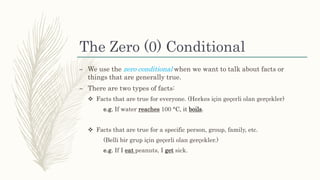
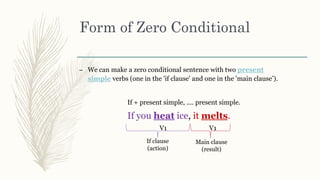
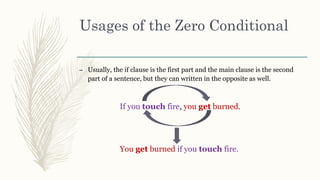
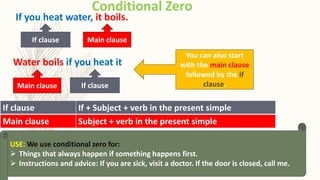
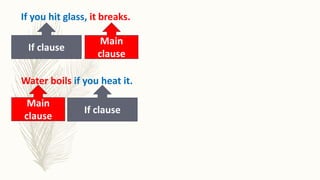
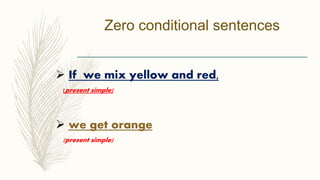
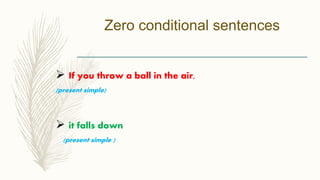
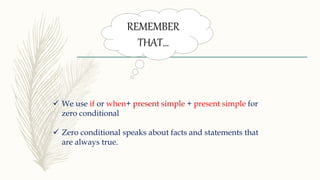
The document discusses the zero conditional, which is used to talk about facts or things that are generally true. There are two types of facts: those true for everyone, like "if water reaches 100°C, it boils"; and those true for a specific group, like "if I eat peanuts, I get sick." Zero conditional sentences use the present simple tense in both the if-clause and main clause, such as "if you heat ice, it melts." The if-clause can come first or second. "If" can often be replaced by "when" without changing the meaning. Examples are provided to illustrate zero conditional grammar rules and usage.