UNIVERSIDAD NACIONAL EXPERIMENTAL“FRANCISCO DE MIRANDA”PROGRAMA CIENCIAS DE LA EDUCACIÓNMENCIÓN INGLÉSReal Conditional SentencesAcosta, B. y Colina, I. 2009
IntroductionHello Students! You already know what Conditional Sentences are, the structures you have to follow to form them and also, you have an idea about the types of Conditional Sentences. But an idea is not enough, you have to master each one of them in an adequate way in order to use them in any communicative situation.Because of this, the current unit is about Real Conditional  Sentences, as you can see, one of the types of this complex structures. So pay attention to the explanation to improve your knowledge…
Objective of the unitBefore starting to  study the content you have to know that at the end of the thematic unit, you will be able to express information related to situations which are possible in the present or the future.
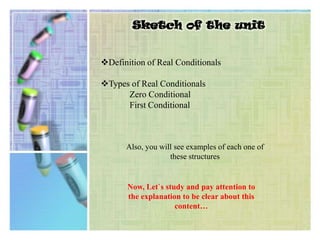
Sketch of the unitDefinition of Real Conditionals
Types of Real Conditionals             Zero Conditional             First ConditionalAlso, you will see examples of each one of these structuresNow, Let`s study and pay attention to the explanation to be clear about this content…
Real Conditionals are used to express a cause and a result that are likely to happen. It means, they are sentences that express a condition and a result which is possible to occur, that’s why they are called Real conditionals.
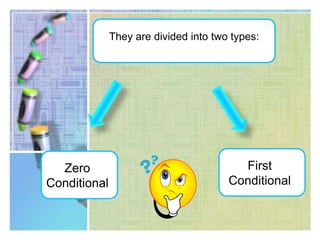
They are divided into two types:First ConditionalZero Conditional
Zero Conditional.This type of conditional is used to express a general truth, it means; it expresses a cause and its result that will always be the same.Zero conditional sentences can be used to communicate scientific facts.
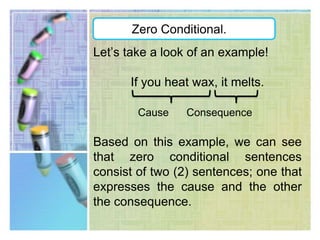
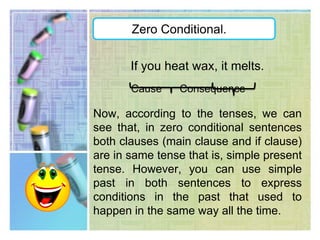
Zero Conditional.Let’s take a look of an example!If you heat wax, it melts.Cause      ConsequenceBased on this example, we can see that zero conditional sentences consist of two (2) sentences; one that expresses the cause and the other the consequence.
Zero Conditional.If you heat wax, it melts.Cause      ConsequenceNow, according to the tenses, we can see that, in zero conditional sentences both clauses (main clause and if clause) are in same tense that is, simple present tense. However, you can use simple past in both sentences to express conditions in the past that used to happen in the same way all the time.
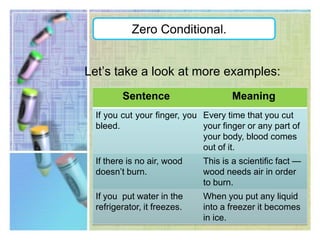
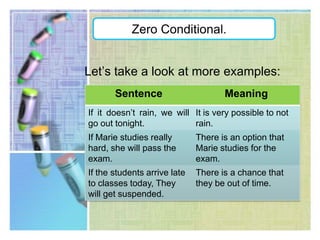
Zero Conditional.Let’s take a look at more examples:
First Conditional.This type of conditional expresses conditions and their possible results whether be in the present or in the future.
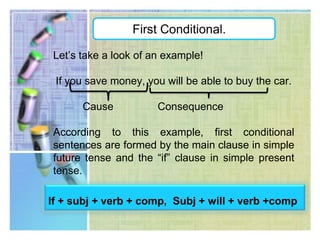
FirstConditional.Let’s take a look of an example!If you save money, you will be able to buy the car.          Cause               ConsequenceAccording to this example, first conditional sentences are formed by the main clause in simple future tense and the “if” clause in simple present tense.If +subj+ verb + comp,  Subj+ will + verb +comp
Zero Conditional.Let’s take a look at more examples:

Real Conditional

  • 1.
    UNIVERSIDAD NACIONAL EXPERIMENTAL“FRANCISCODE MIRANDA”PROGRAMA CIENCIAS DE LA EDUCACIÓNMENCIÓN INGLÉSReal Conditional SentencesAcosta, B. y Colina, I. 2009
  • 2.
    IntroductionHello Students! Youalready know what Conditional Sentences are, the structures you have to follow to form them and also, you have an idea about the types of Conditional Sentences. But an idea is not enough, you have to master each one of them in an adequate way in order to use them in any communicative situation.Because of this, the current unit is about Real Conditional Sentences, as you can see, one of the types of this complex structures. So pay attention to the explanation to improve your knowledge…
  • 3.
    Objective of theunitBefore starting to study the content you have to know that at the end of the thematic unit, you will be able to express information related to situations which are possible in the present or the future.
  • 4.
    Sketch of theunitDefinition of Real Conditionals
  • 5.
    Types of RealConditionals Zero Conditional First ConditionalAlso, you will see examples of each one of these structuresNow, Let`s study and pay attention to the explanation to be clear about this content…
  • 6.
    Real Conditionals areused to express a cause and a result that are likely to happen. It means, they are sentences that express a condition and a result which is possible to occur, that’s why they are called Real conditionals.
  • 7.
    They are dividedinto two types:First ConditionalZero Conditional
  • 8.
    Zero Conditional.This typeof conditional is used to express a general truth, it means; it expresses a cause and its result that will always be the same.Zero conditional sentences can be used to communicate scientific facts.
  • 9.
    Zero Conditional.Let’s takea look of an example!If you heat wax, it melts.Cause ConsequenceBased on this example, we can see that zero conditional sentences consist of two (2) sentences; one that expresses the cause and the other the consequence.
  • 10.
    Zero Conditional.If youheat wax, it melts.Cause ConsequenceNow, according to the tenses, we can see that, in zero conditional sentences both clauses (main clause and if clause) are in same tense that is, simple present tense. However, you can use simple past in both sentences to express conditions in the past that used to happen in the same way all the time.
  • 11.
    Zero Conditional.Let’s takea look at more examples:
  • 12.
    First Conditional.This typeof conditional expresses conditions and their possible results whether be in the present or in the future.
  • 13.
    FirstConditional.Let’s take alook of an example!If you save money, you will be able to buy the car. Cause ConsequenceAccording to this example, first conditional sentences are formed by the main clause in simple future tense and the “if” clause in simple present tense.If +subj+ verb + comp, Subj+ will + verb +comp
  • 14.
    Zero Conditional.Let’s takea look at more examples: