Future Tense
The future tense of verbs expresses
events or actions that have not yet
happened and that will happen at some
point in the future.
Future Tense Forms
 There are three forms of the future tense. They
include:
 Simple future
 future progressive
 future perfect
 future perfect progressive
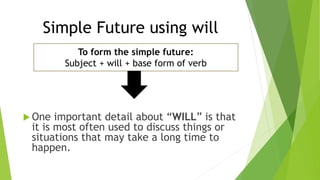
Simple Future using will
 One important detail about “WILL” is that
it is most often used to discuss things or
situations that may take a long time to
happen.
To form the simple future:
Subject + will + base form of verb
 Dreams – ex. Someday I will learn another language.
 Promises – ex. I promise I’ll call you tonight!
 To express actions that are far into the future – ex. I will get
married someday.
 Requests – ex. Will you buy a hamburger for me? Thank you!
 To discuss a fact – ex. I’ll graduate from college next year
 After making a decision – ex. Yes! I will marry you!
 Help/Volunteer – ex. I’ll volunteer at this event tonight!
We may use will in different situations
like:
Future using ´´ Be going to´´
 One important detail about “GOING TO” is
that it is most often used to discuss things or
situations that might happen soon. The
expression “GOING TO” is used in the
following situations:
To form the simple future:
Subject + be going to + base form of verb
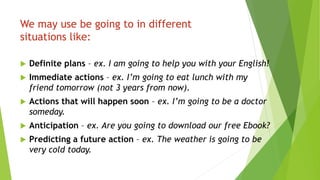
We may use be going to in different
situations like:
 Definite plans – ex. I am going to help you with your English!
 Immediate actions – ex. I’m going to eat lunch with my
friend tomorrow (not 3 years from now).
 Actions that will happen soon – ex. I’m going to be a doctor
someday.
 Anticipation – ex. Are you going to download our free Ebook?
 Predicting a future action – ex. The weather is going to be
very cold today.
Future using present continous
We use the present continuous tense to talk
about the future when an action or situation
is part of a:
 plan
 an arrangement
 intention.
For future actions or situations using the present
continuous, all the common future time words and
phrases can be used:
 this afternoon
 tonight
 tomorrow
 tomorrow morning / afternoon/ evening / night, etc.
 next week / month/ December / year, etc.
 the day after tomorrow
 the week / month / year, etc. after next
 in ___ hours / days / weeks / months, etc.
 ___ hours / days / weeks / months, etc. from now
 in 2020 (or other year)
 on Christmas day / November 24th (future date)
EXAMPLES
 Mary’s studying in the library. (now)
She’s studying at Bethan’s house this evening. (future)
 Stan’s arriving. (now) He’s just called from the airport
He’s arriving tomorrow morning about 7.30 (future)
 We’re driving to Manchester. (now)
We’re driving to Glasgow next week. (future)
 We’re doing a physics exam. (now)
We’re doing a History exam in two days. (future)
 They’re swimming in the pool. (now)
They’re swimming across the bay tomorrow. (future)
Future progressive
To form the future progressive:
 Subject + will be + present participle (and “-ing” to end of the verb)
Example: Meteorologists will be watching the sky, and they are urging the public
to observe along with them.
It indicates continuing action, something that will be
happening, going on, at some point in the future.
Future Perfect
To form the future perfect:
 Subject + will have + past participle of verb
Examples:
1. I will have finished this book.
2. You will have studied the English tenses.
The future perfect tense expresses actions that will be finished at
some point in the future or those that will be finished before another
future event.

Future tense

  • 1.
    Future Tense The futuretense of verbs expresses events or actions that have not yet happened and that will happen at some point in the future.
  • 2.
    Future Tense Forms There are three forms of the future tense. They include:  Simple future  future progressive  future perfect  future perfect progressive
  • 3.
    Simple Future usingwill  One important detail about “WILL” is that it is most often used to discuss things or situations that may take a long time to happen. To form the simple future: Subject + will + base form of verb
  • 4.
     Dreams –ex. Someday I will learn another language.  Promises – ex. I promise I’ll call you tonight!  To express actions that are far into the future – ex. I will get married someday.  Requests – ex. Will you buy a hamburger for me? Thank you!  To discuss a fact – ex. I’ll graduate from college next year  After making a decision – ex. Yes! I will marry you!  Help/Volunteer – ex. I’ll volunteer at this event tonight! We may use will in different situations like:
  • 6.
    Future using ´´Be going to´´  One important detail about “GOING TO” is that it is most often used to discuss things or situations that might happen soon. The expression “GOING TO” is used in the following situations: To form the simple future: Subject + be going to + base form of verb
  • 7.
    We may usebe going to in different situations like:  Definite plans – ex. I am going to help you with your English!  Immediate actions – ex. I’m going to eat lunch with my friend tomorrow (not 3 years from now).  Actions that will happen soon – ex. I’m going to be a doctor someday.  Anticipation – ex. Are you going to download our free Ebook?  Predicting a future action – ex. The weather is going to be very cold today.
  • 8.
    Future using presentcontinous We use the present continuous tense to talk about the future when an action or situation is part of a:  plan  an arrangement  intention.
  • 9.
    For future actionsor situations using the present continuous, all the common future time words and phrases can be used:  this afternoon  tonight  tomorrow  tomorrow morning / afternoon/ evening / night, etc.  next week / month/ December / year, etc.  the day after tomorrow  the week / month / year, etc. after next  in ___ hours / days / weeks / months, etc.  ___ hours / days / weeks / months, etc. from now  in 2020 (or other year)  on Christmas day / November 24th (future date)
  • 10.
    EXAMPLES  Mary’s studyingin the library. (now) She’s studying at Bethan’s house this evening. (future)  Stan’s arriving. (now) He’s just called from the airport He’s arriving tomorrow morning about 7.30 (future)  We’re driving to Manchester. (now) We’re driving to Glasgow next week. (future)  We’re doing a physics exam. (now) We’re doing a History exam in two days. (future)  They’re swimming in the pool. (now) They’re swimming across the bay tomorrow. (future)
  • 11.
    Future progressive To formthe future progressive:  Subject + will be + present participle (and “-ing” to end of the verb) Example: Meteorologists will be watching the sky, and they are urging the public to observe along with them. It indicates continuing action, something that will be happening, going on, at some point in the future.
  • 12.
    Future Perfect To formthe future perfect:  Subject + will have + past participle of verb Examples: 1. I will have finished this book. 2. You will have studied the English tenses. The future perfect tense expresses actions that will be finished at some point in the future or those that will be finished before another future event.