CAN AND CAN´T AND OTHER MODALS USED TO EXPRESS  POSSIBILITY AND ABILITY
ABILITY When we talk about ability, we mean two things. First, we mean  general ability . This is something that once you have learned you can do any time you want, like being able to read or swim or speak a language, for example. The other kind of ability is  specific ability . This mean something that you can or can't do in one particiular situation.  For example, being able to lift something heavy, or find somewhere you are looking for.
Present :  can / can’t (for both general and specific ability)   I can play the piano. She can speak English. He can’t drive – he’s too tired. We can’t come now. We use 'can' and 'could' to talk about a skill or ability.
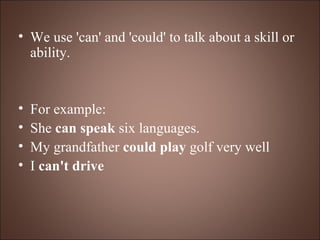
We use 'can' and 'could' to talk about a skill or ability. For example:  She  can speak  six languages. My grandfather  could play  golf very well I  can't drive
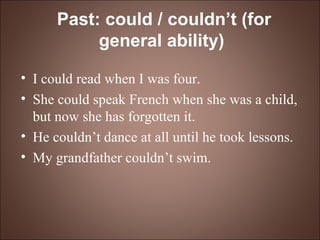
Past: could / couldn’t (for general ability)   I could read when I was four. She could speak French when she was a child, but now she has forgotten it. He couldn’t dance at all until he took lessons. My grandfather couldn’t swim.
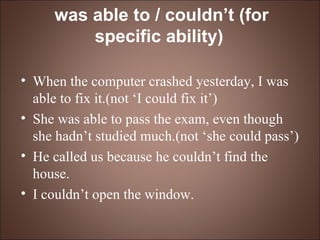
was able to / couldn’t (for specific ability)   When the computer crashed yesterday, I was able to fix it.(not ‘I could fix it’) She was able to pass the exam, even though she hadn’t studied much.(not ‘she could pass’) He called us because he couldn’t find the house. I couldn’t open the window.
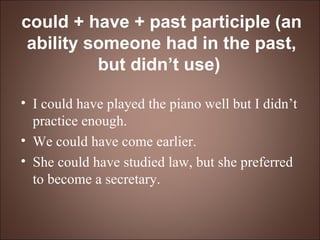
could + have + past participle (an ability someone had in the past, but didn’t use)   I could have played the piano well but I didn’t practice enough. We could have come earlier. She could have studied law, but she preferred to become a secretary.
Future: will / won’t be able to (general ability)   At the end of the course, you will be able to make your own website. He won’t be able to speak Japanese in a week!  It will take months.
can / can't (specific ability)   I can help you tomorrow I can't come to the party
Modal Verbs of Ability The modal verbs of  ability  show just that -- ability.  Ability can be expressed in the past, present, or future. It can be an ability that was used over and over again, or something that was done  just once , on a special, or rare, occasion.
The modal verbs of ability are  can ,  could , and  be able to .      Can  is used to talk about ability in  the present  or future.       He  can  read well.      Could  is used to talk about ability in the past.       He  could  read well when he was younger.      Be able to  is used to talk about a certain, or particular, ability.       He  was able to  read when he was 4 years old.  ** While  could  might be used in the last example,  be able to  emphasizes the early age at which he could read.     Could have,  followed by a past participle indicates an ability  NOT  used and often shows disapproval.       He  could have  called me! (He didn't)      Could not have  followed by a past participle indicates that an ability didn't exist in the past.
       I  couldn't have phoned  you yesterday, because I lost my phone last week.      Be able to  is used with other modals or when forming the 'ing' or 'to' infinitive forms.       You will have the satisfaction of  being able to  read my report.       Nobody will  be able to  read what you have written.     We use  can  or  could  with the senses verbs; see, hear, smell, etc., to say that someone is aware of something through their senses.       I  can  smell gas downstairs.       I  could  see a few  stars in the sky  last night.       I  couldn't  hear what she said because of the noise.
MODAL VERBS: POSSIBILITY The modals of possibility   (may, might, can, could)  mean something like: "The way I see/feel things in the present circumstances, it is possible that.   For may and might, we should add: (..if I have anything to do with it). Could and might  express remoteness of any kind (past time, unlikely occurrence, stiffness -due to shyness or respect-.
May and might  express a more personal involvement in the creation of the possibility (an extrictly personal opinion, or some kind of authority.
There are many kinds of possibility: Probability , chances:  This could be your lucky day  (It is likely, possible that..)   Theoretical possibility , options:  We can be friends, if you want to.   Ability :  He can dance on his nose  (He is able to..)   Assumptions  (logical possibility):  This may well be the purse you lost   Permission :  Can I go to the cinema? –No, you may not . (You’re not allowed to..)
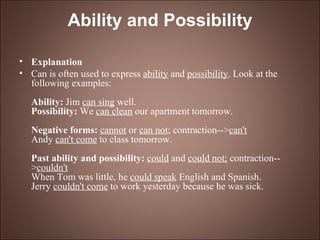
Ability and Possibility Explanation Can is often used to express  ability  and  possibility . Look at the following examples: Ability:  Jim  can sing  well. Possibility:  We  can clean  our apartment tomorrow. Negative forms:   cannot  or  can not ; contraction--> can't Andy  can't come  to class tomorrow. Past ability and possibility:   could  and  could not;  contraction--> couldn't When Tom was little, he  could speak  English and Spanish. Jerry  couldn't come  to work yesterday because he was sick.
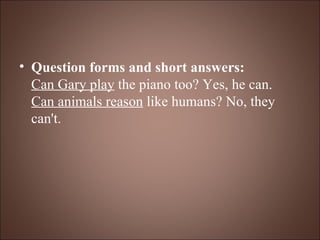
Question forms and short answers: Can Gary play  the piano too? Yes, he can. Can animals reason  like humans? No, they can't.

Possibility & ability

  • 1.
    CAN AND CAN´TAND OTHER MODALS USED TO EXPRESS POSSIBILITY AND ABILITY
  • 2.
    ABILITY When wetalk about ability, we mean two things. First, we mean general ability . This is something that once you have learned you can do any time you want, like being able to read or swim or speak a language, for example. The other kind of ability is specific ability . This mean something that you can or can't do in one particiular situation. For example, being able to lift something heavy, or find somewhere you are looking for.
  • 3.
    Present : can / can’t (for both general and specific ability) I can play the piano. She can speak English. He can’t drive – he’s too tired. We can’t come now. We use 'can' and 'could' to talk about a skill or ability.
  • 4.
    We use 'can'and 'could' to talk about a skill or ability. For example: She can speak six languages. My grandfather could play golf very well I can't drive
  • 5.
    Past: could /couldn’t (for general ability) I could read when I was four. She could speak French when she was a child, but now she has forgotten it. He couldn’t dance at all until he took lessons. My grandfather couldn’t swim.
  • 6.
    was able to/ couldn’t (for specific ability) When the computer crashed yesterday, I was able to fix it.(not ‘I could fix it’) She was able to pass the exam, even though she hadn’t studied much.(not ‘she could pass’) He called us because he couldn’t find the house. I couldn’t open the window.
  • 7.
    could + have+ past participle (an ability someone had in the past, but didn’t use) I could have played the piano well but I didn’t practice enough. We could have come earlier. She could have studied law, but she preferred to become a secretary.
  • 8.
    Future: will /won’t be able to (general ability) At the end of the course, you will be able to make your own website. He won’t be able to speak Japanese in a week! It will take months.
  • 9.
    can / can't(specific ability) I can help you tomorrow I can't come to the party
  • 10.
    Modal Verbs ofAbility The modal verbs of ability show just that -- ability. Ability can be expressed in the past, present, or future. It can be an ability that was used over and over again, or something that was done just once , on a special, or rare, occasion.
  • 11.
    The modal verbsof ability are can , could , and be able to .     Can is used to talk about ability in the present or future.       He can read well.     Could is used to talk about ability in the past.       He could read well when he was younger.     Be able to is used to talk about a certain, or particular, ability.       He was able to read when he was 4 years old. ** While could might be used in the last example, be able to emphasizes the early age at which he could read.     Could have, followed by a past participle indicates an ability NOT used and often shows disapproval.       He could have called me! (He didn't)     Could not have followed by a past participle indicates that an ability didn't exist in the past.
  • 12.
           I couldn't have phoned you yesterday, because I lost my phone last week.     Be able to is used with other modals or when forming the 'ing' or 'to' infinitive forms.       You will have the satisfaction of being able to read my report.       Nobody will be able to read what you have written.    We use can or could with the senses verbs; see, hear, smell, etc., to say that someone is aware of something through their senses.       I can smell gas downstairs.       I could see a few stars in the sky last night.       I couldn't hear what she said because of the noise.
  • 13.
    MODAL VERBS: POSSIBILITYThe modals of possibility (may, might, can, could) mean something like: "The way I see/feel things in the present circumstances, it is possible that. For may and might, we should add: (..if I have anything to do with it). Could and might express remoteness of any kind (past time, unlikely occurrence, stiffness -due to shyness or respect-.
  • 14.
    May and might express a more personal involvement in the creation of the possibility (an extrictly personal opinion, or some kind of authority.
  • 15.
    There are manykinds of possibility: Probability , chances: This could be your lucky day (It is likely, possible that..) Theoretical possibility , options: We can be friends, if you want to. Ability : He can dance on his nose (He is able to..) Assumptions (logical possibility): This may well be the purse you lost Permission : Can I go to the cinema? –No, you may not . (You’re not allowed to..)
  • 16.
    Ability and PossibilityExplanation Can is often used to express ability and possibility . Look at the following examples: Ability: Jim can sing well. Possibility: We can clean our apartment tomorrow. Negative forms: cannot or can not ; contraction--> can't Andy can't come to class tomorrow. Past ability and possibility: could and could not; contraction--> couldn't When Tom was little, he could speak English and Spanish. Jerry couldn't come to work yesterday because he was sick.
  • 17.
    Question forms andshort answers: Can Gary play the piano too? Yes, he can. Can animals reason like humans? No, they can't.