www. eltcamp .com
Future Time Prediction Will  is used to make predictions. It is often preceded by / think or by opinion words like perhaps. A time expression is also necessary . I think it ‘ ll rain  tomorrow. Perhaps she ' ll be  late. Tomorrow  will be  warm with some cloud in the afternoon. Who do you think  will win ? You’ ll  never  finish  that book.
Will- Shall I / we  will  and I / we  shall  are used with no difference of meaning in most situations in modern British English.  Will  is more common than  shall . In speech, both  will  and  shall  are contracted to  ‘ll.  Use of  shall  after  I  and  we  is more common in formal speech .
Will  is also used 2.  to give or ask for information about the future, in cases where there is no reason to use a present verb-form We  will need  the money on the 15 th. Will  all the family  be  at the wedding?  It  will be  spring soon. She  will be  here in a few minutes.
Going to If a predicted event is very near, and especially in impersonal statements,  going to  is also commonly used for predictions . Will  can also be used in these examples, with no change of meaning . You ' re going   to fall !  Liverpool  are going to win   the Cup.
2. Going to  can be used instead of  will  in predictions. For some speakers this seems more colloquial. I'm sure you ' re   going to enjoy  the film. I 'm sure you  ‘ll enjoy  the film.
Present Cause  We often make a prediction because we can see the cause of the event. Look out! There's a bus coming! It' s going to  hit us! I can see you' re going to have  a baby. When is it due? He is looking up! He  is going to fall  into the hole.
Going to  is also used b)  When we talk about plans, decisions and firm intentions, especially in an informal style. We ’re   going to get   a new car soon. When   are   you   gonig to get   your hair cut? I’ m   going to keep   asking her out until she says ‘Yes’.
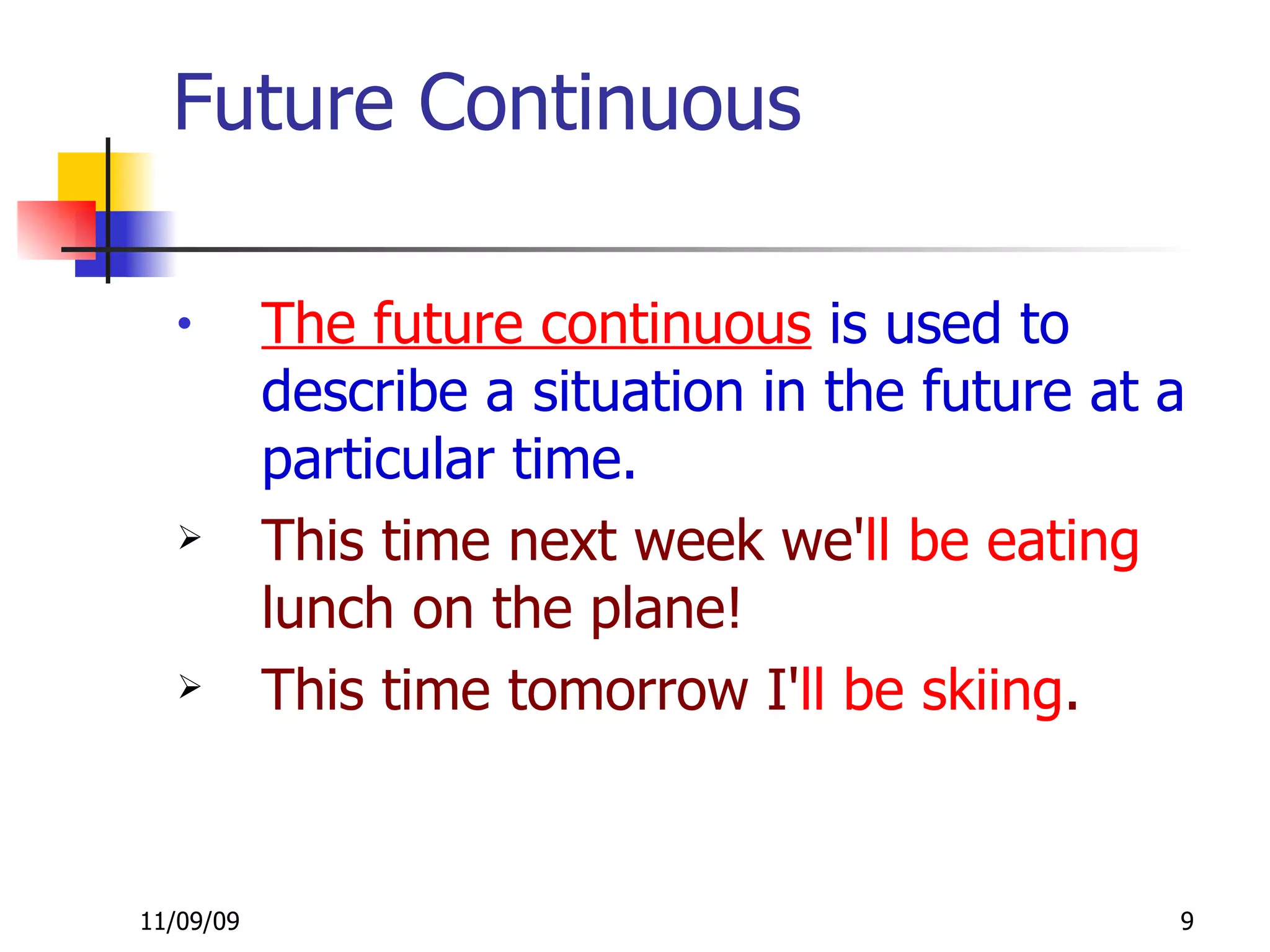
Future Continuous The future continuous  is used to describe a situation in the future at a particular time. This time next week we' ll   be eating  lunch on the plane!  This time tomorrow I' ll   be skiing .
Future Continuous 2.  It is also used to predict a future state or habit at a particular time in the future. In ten years time I expect I' ll   be living  in London. And I' ll   probably be cycling   to work. Professor Asher  will be giving  another lecture at the same time next week.  I’ ll   be seeing  you one of these days. I expect.
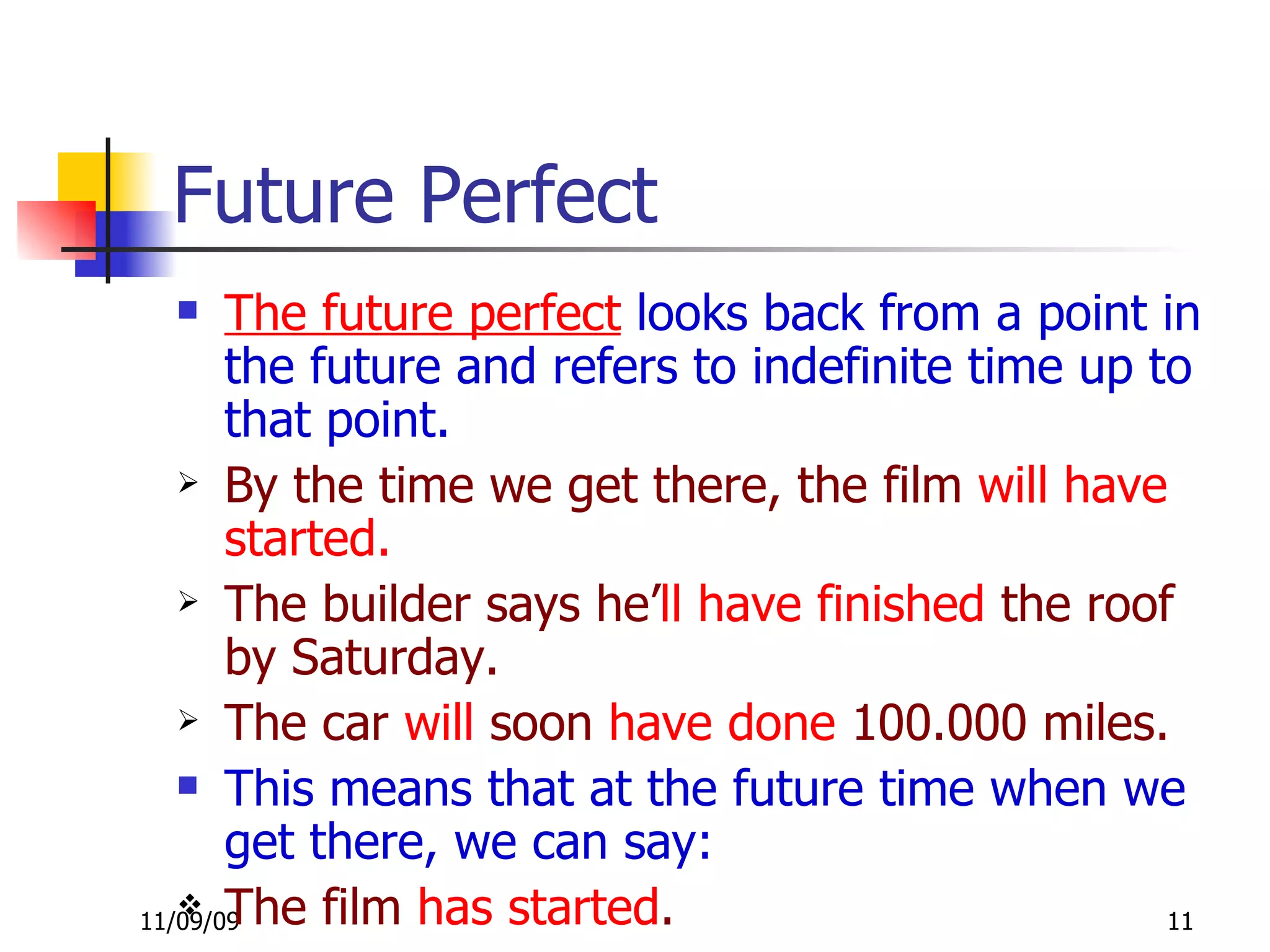
Future Perfect The future perfect  looks back from a point in the future and refers to indefinite time up to that point. By the time we get there, the film  will have   started.   The builder says he’ ll   have finished  the roof by Saturday. The car  will  soon  have done  100.000 miles. This means that at the future time when we get there, we can say: The film  has started .
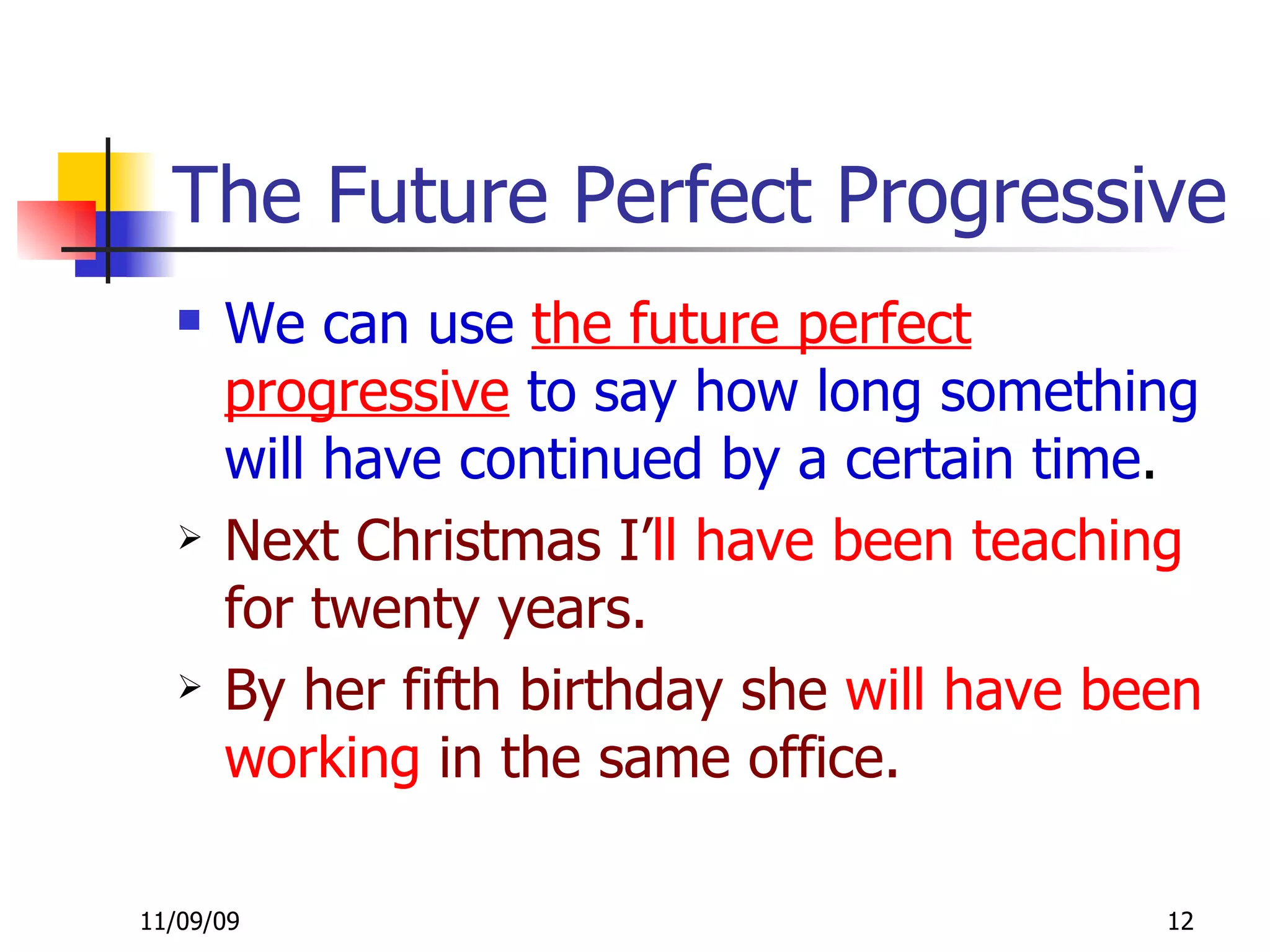
The Future Perfect Progressive  We can use  the future perfect progressive  to say how long something will have continued by a certain time . Next Christmas I’ ll   have been teaching  for twenty years. By her fifth birthday she  will have been   working  in the same office.
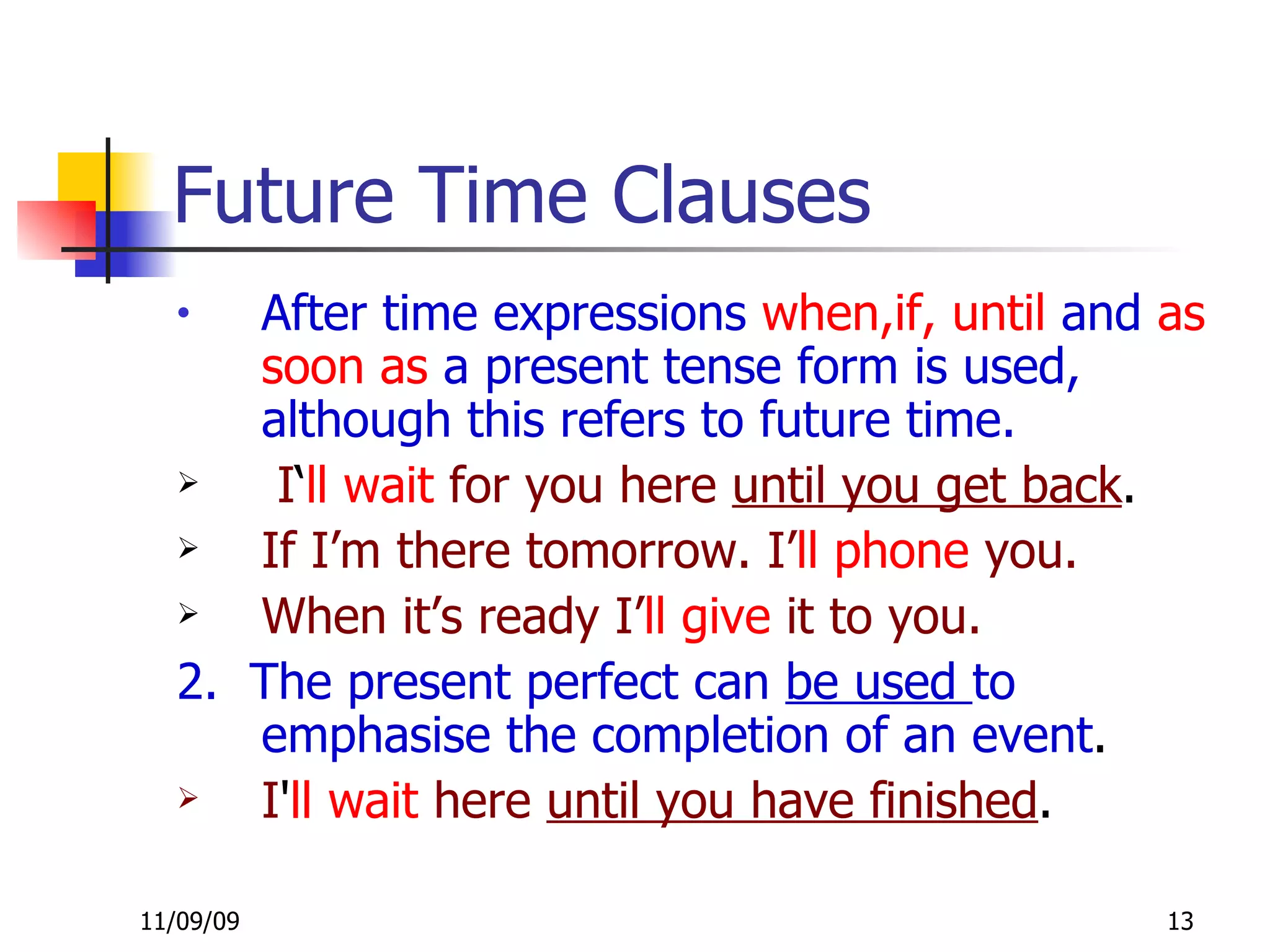
Future Time Clauses After time expressions  when,if, until  and  as soon as  a present tense form is used, although this refers to future time.  I ‘ ll wait   for you here  until you get back . If I’m there tomorrow. I’ ll   phone  you. When it’s ready I’ ll   give  it to you. 2.  The present perfect can  be used  to emphasise the completion of an event .  I ' ll wait   here  until you have finished .
Intention Going to  is used to describe a present intention.   I ' m   going to fix   the television tomorrow . 2 .   Will  is also used for decisions made at the time of speaking .  I know,   I ' ll   get   him a wallet for his birthday.
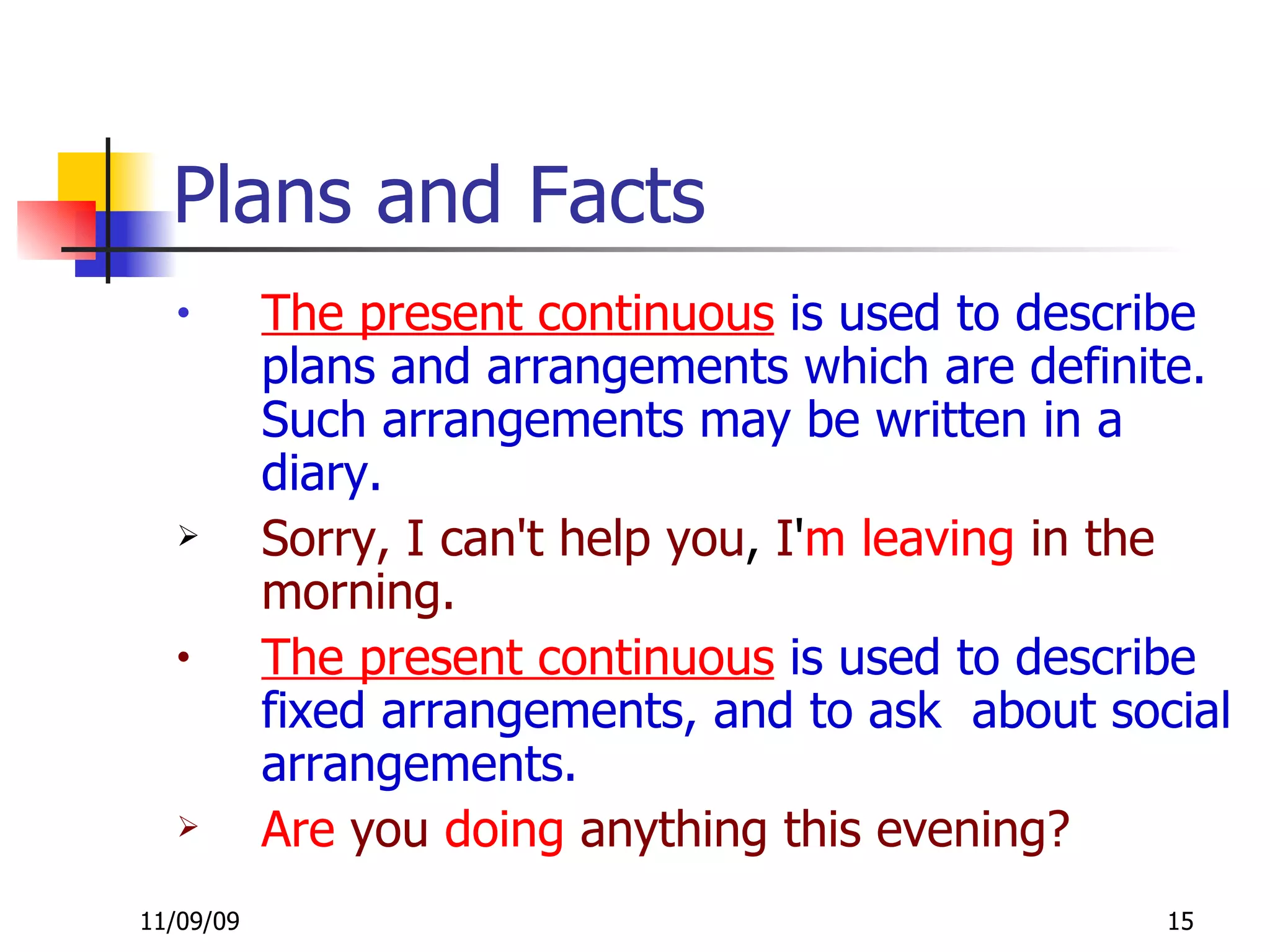
Plans and Facts The present continuous  is used to describe plans and arrangements which are definite. Such arrangements may be written in a diary.  Sorry, I can't help you ,  I ' m   leaving   in the morning. The present continuous  is used to describe fixed arrangements, and to ask  about social arrangements. Are  you  doing  anything this evening?
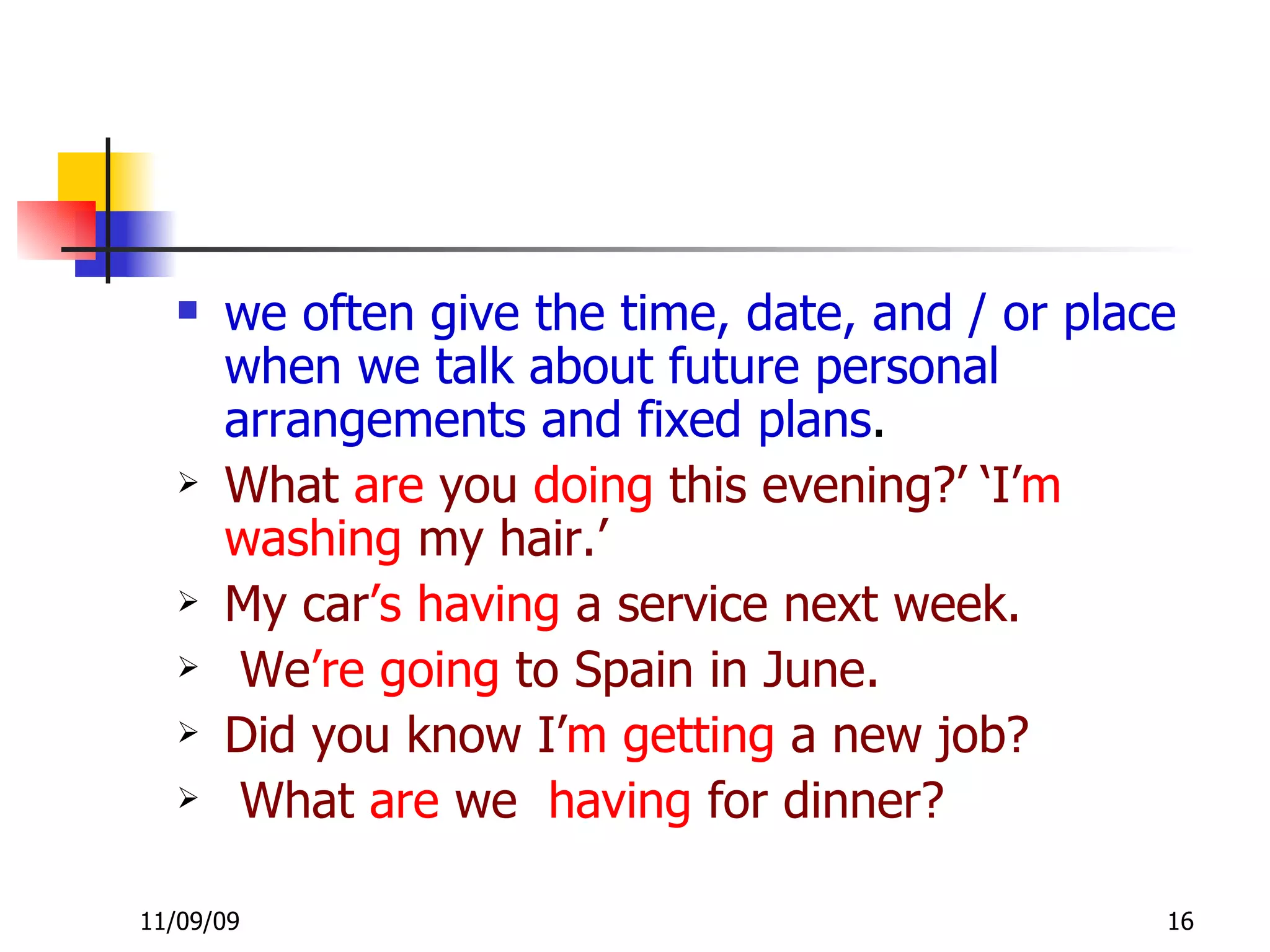
we often give the time, date, and / or place when we talk about future personal arrangements and fixed plans . What  are  you  doing  this evening?’ ‘I’ m   washing  my hair.’ My car ’s   having  a service next week.  We ’re   going  to Spain in June. Did you know I’ m   getting  a new job?  What  are  we  having  for dinner?
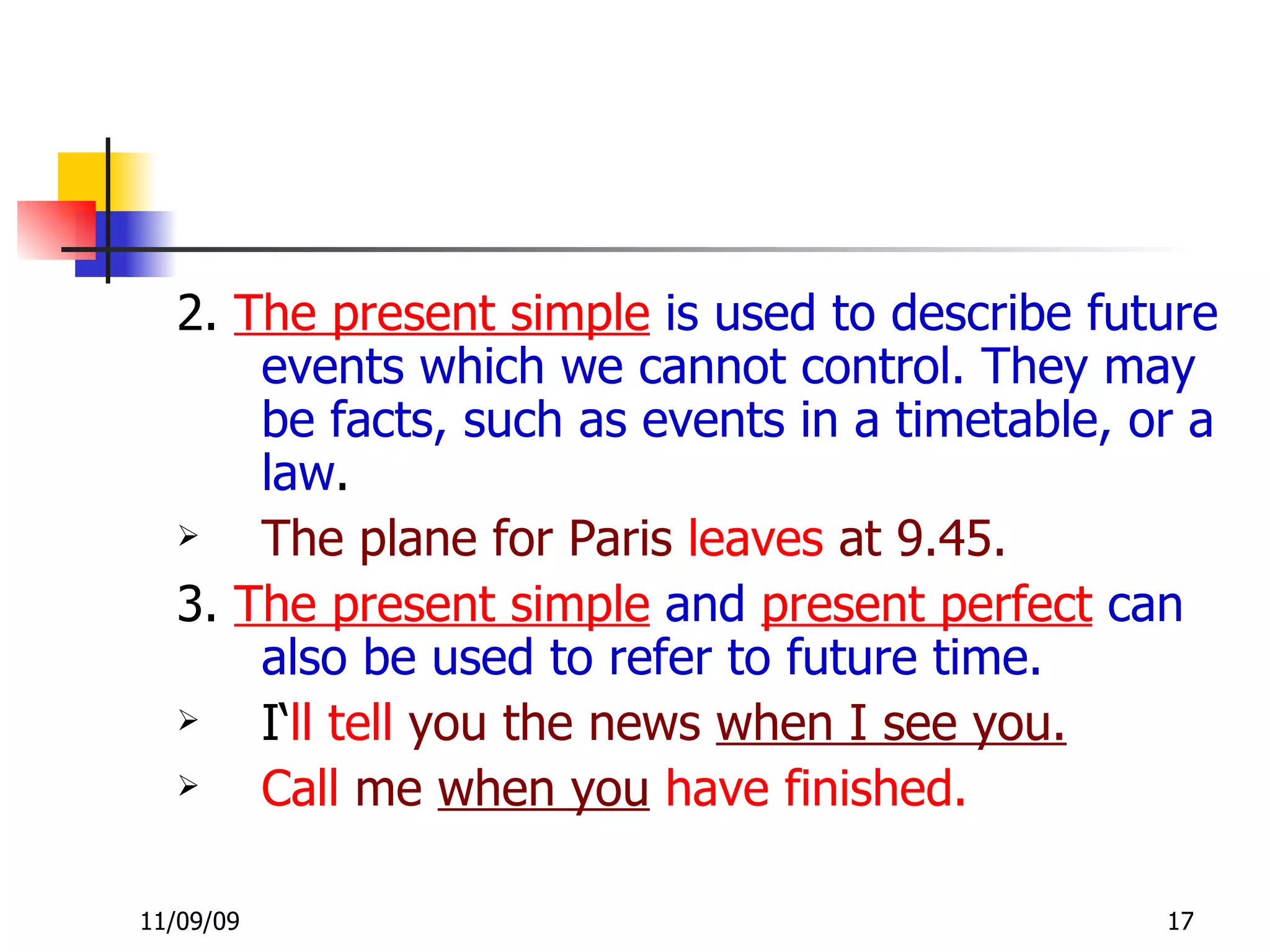
2.  The present simple  is used to describe future events which we cannot control. They may be   facts, such as events in a timetable, or a law . The plane for Paris   leaves   at 9.45. 3.  The present simple  and  present perfect  can also be used to refer to future time. I‘ ll tell   you the news  when I see you.   Call   me  when you   have finished.
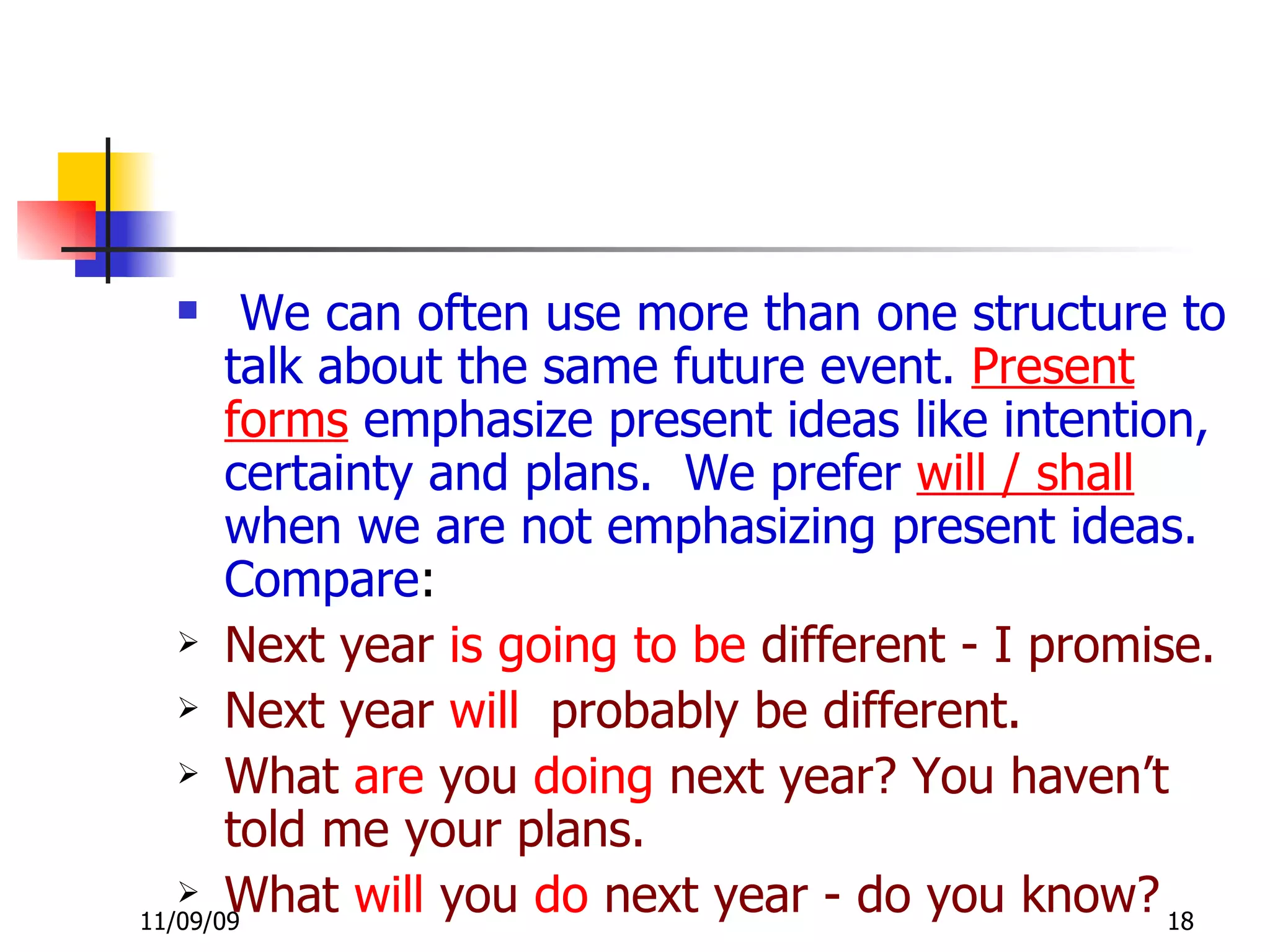
We can often use more than one structure to talk about the same future event.  Present forms  emphasize present ideas like intention, certainty and plans.  We prefer  will / shall   when we are not emphasizing present ideas. Compare : Next year  is going to be  different - I promise.   Next year  will  probably be different. What  are  you  doing  next year? You haven’t told me your plans. What  will  you  do  next year - do you know?
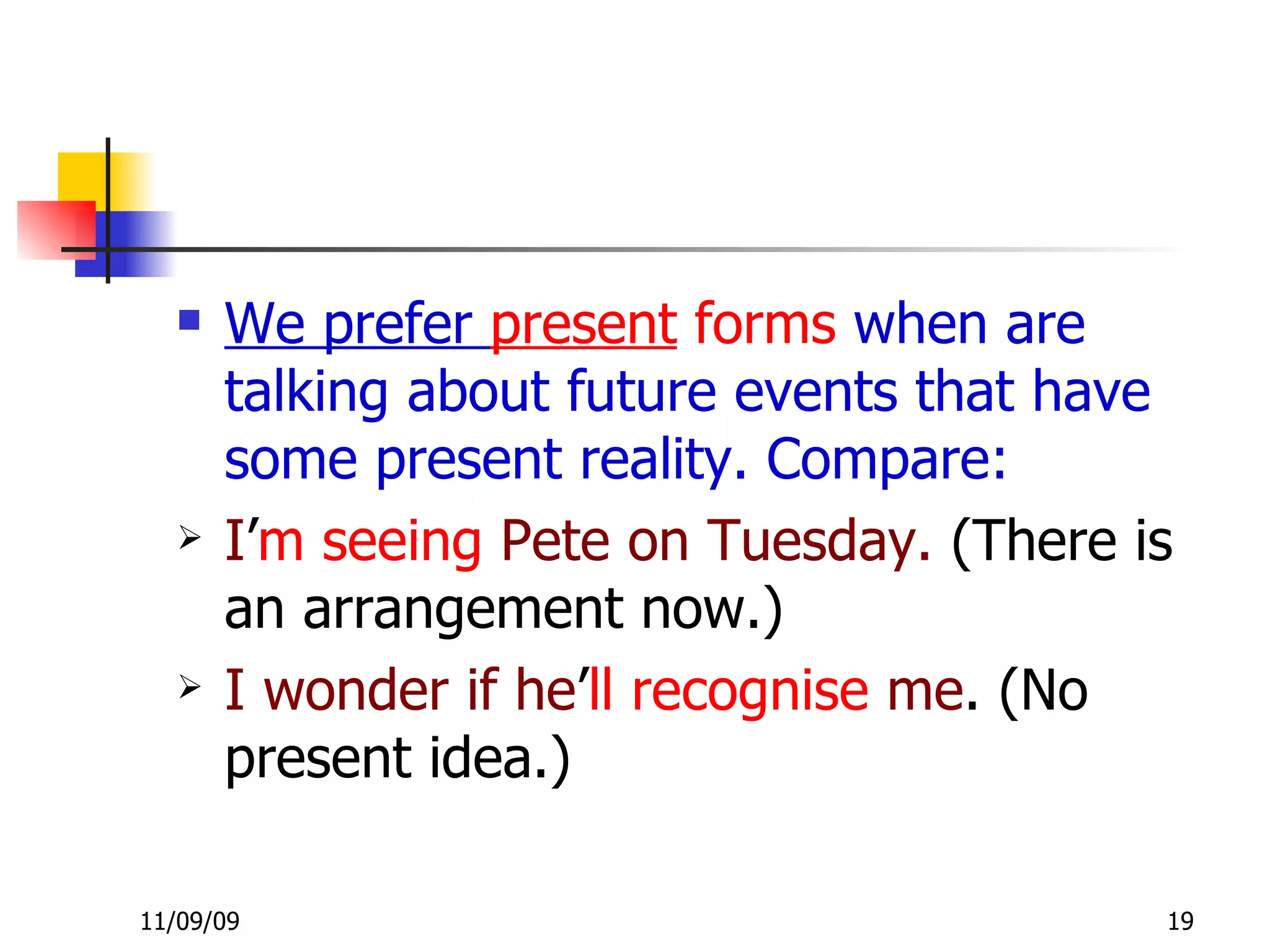
We prefer  present  forms  when are talking about future events that have some present reality. Compare: I ’ m   seeing   Pete on Tuesday.  (There is an arrangement now.) I wonder if   he ’ ll   recognise   me . (No present idea.)
In predictions, we prefer  present forms  when there is outside evidence for what  will happen  - when we can see something coming. Look out - we’ re   going to crash !  (I can see it coming.) We prefer  will  when we are talking more about what is inside our heads: our beliefs, guesses, knowledge etc. Don’t lend him your car - he’ ll crash  it.  (I know him.)
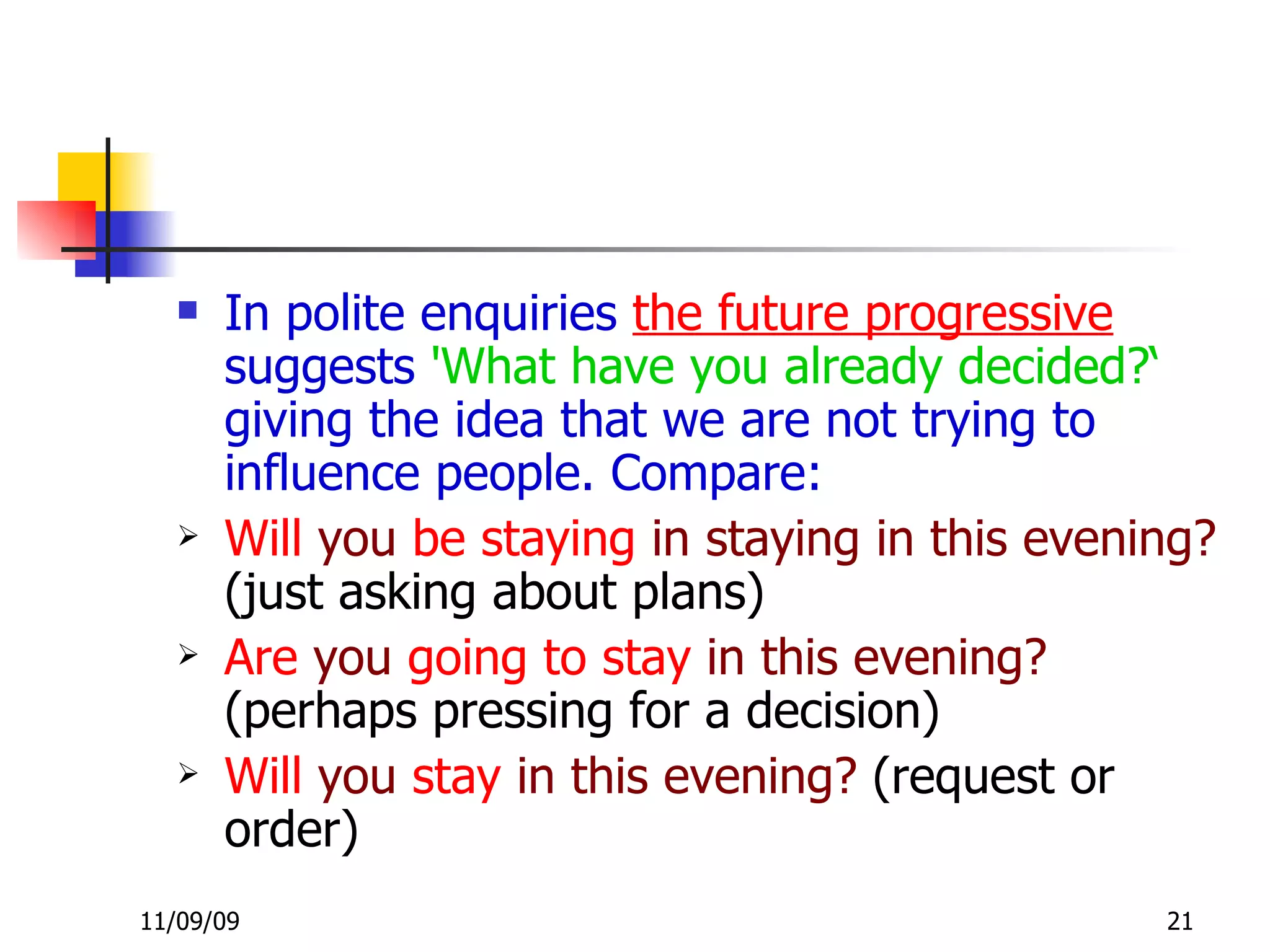
In polite enquiries  the future progressive  suggests  'What have you already decided?‘  giving the idea that we are not trying to influence people. Compare: Will  you  be staying  in staying in this evening?  (just asking about plans) Are  you  going to stay  in this evening?  (perhaps pressing for a decision) Will  you  stay  in this evening?  (request or order)
is to, are to, was to We can talk about the future by saying that something   is to   happen.We often use this structure to talk about official plans and fixed personal arrangements . The President  is to   visit  Scotland in September. We  are to get  a wage rise. I felt nervous because I  was  soon  to leave  home for the first time.
exercises Choose the most suitable answer. Why ……………. a new mountain bike? are  you  going to buy will  you  buy are you going to buy
Don't phone between 8.00 and 9.00. …………………..then. I 'll study I 'll be studying   I'll be studying
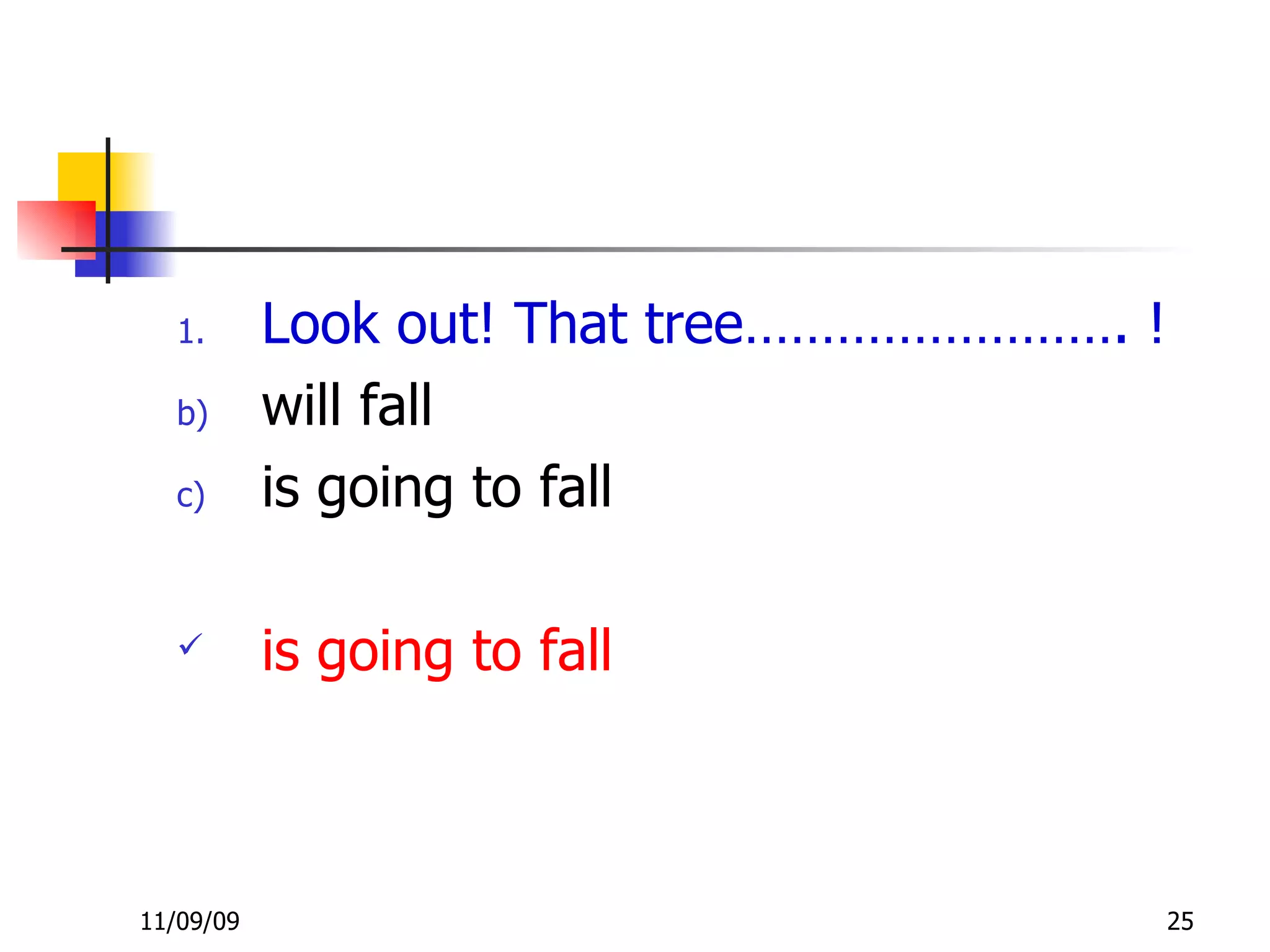
Look out! That tree……………………. ! will fall is going to fall is going to fall
Let me know as soon as Louise …….. Here will get gets gets
Great news! Jean and Chris …………to stay with us. will come are coming are coming
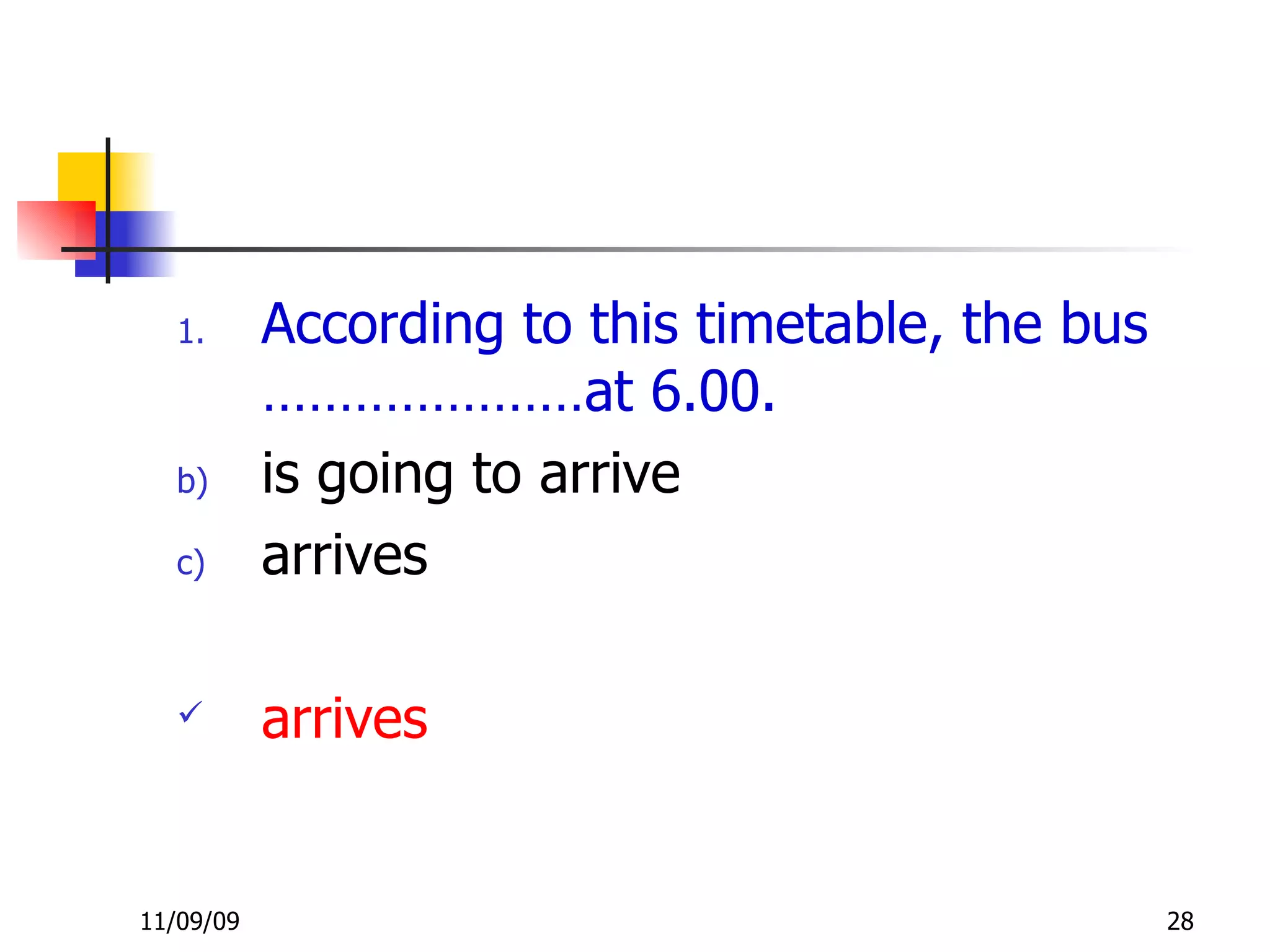
According to this timetable, the bus …………………at 6.00. is going to arrive arrives arrives
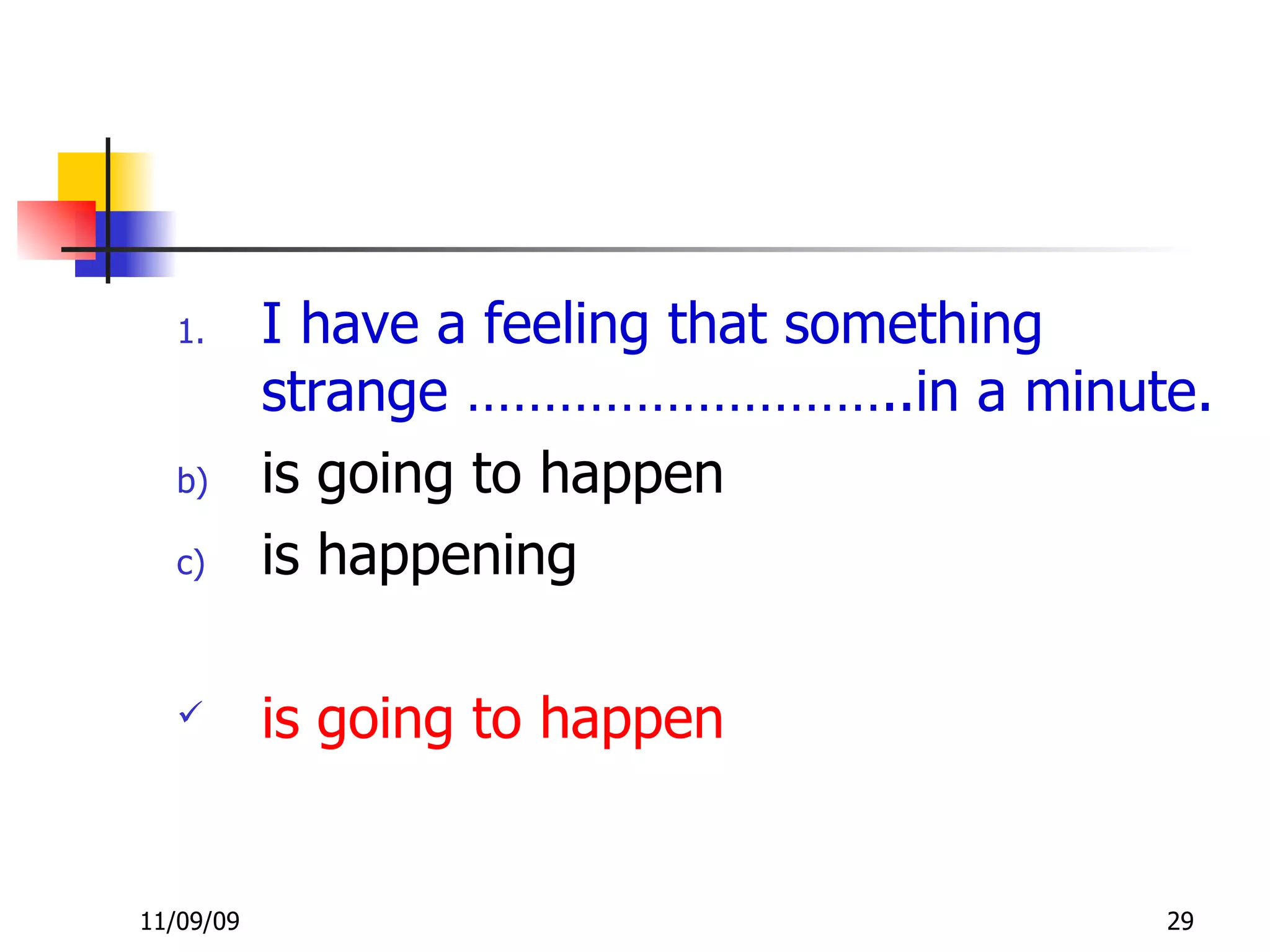
I have a feeling that something strange ………………………..in a minute. is going to happen is happening is going to happen
The doctor says I ………………..a baby!   will have am going to have am going to have Can you call me at 7.00, because ………………tomorrow. I 'll leave I 'm leaving I'm leaving
If you arrive late at the sale, the best things ………………. . will go will have gone will have gone
Ramazan Bey.................... back until six. Can I take a message? Won’t be Is not going to be Isn’t Wasn’t Won’t being Won’t be
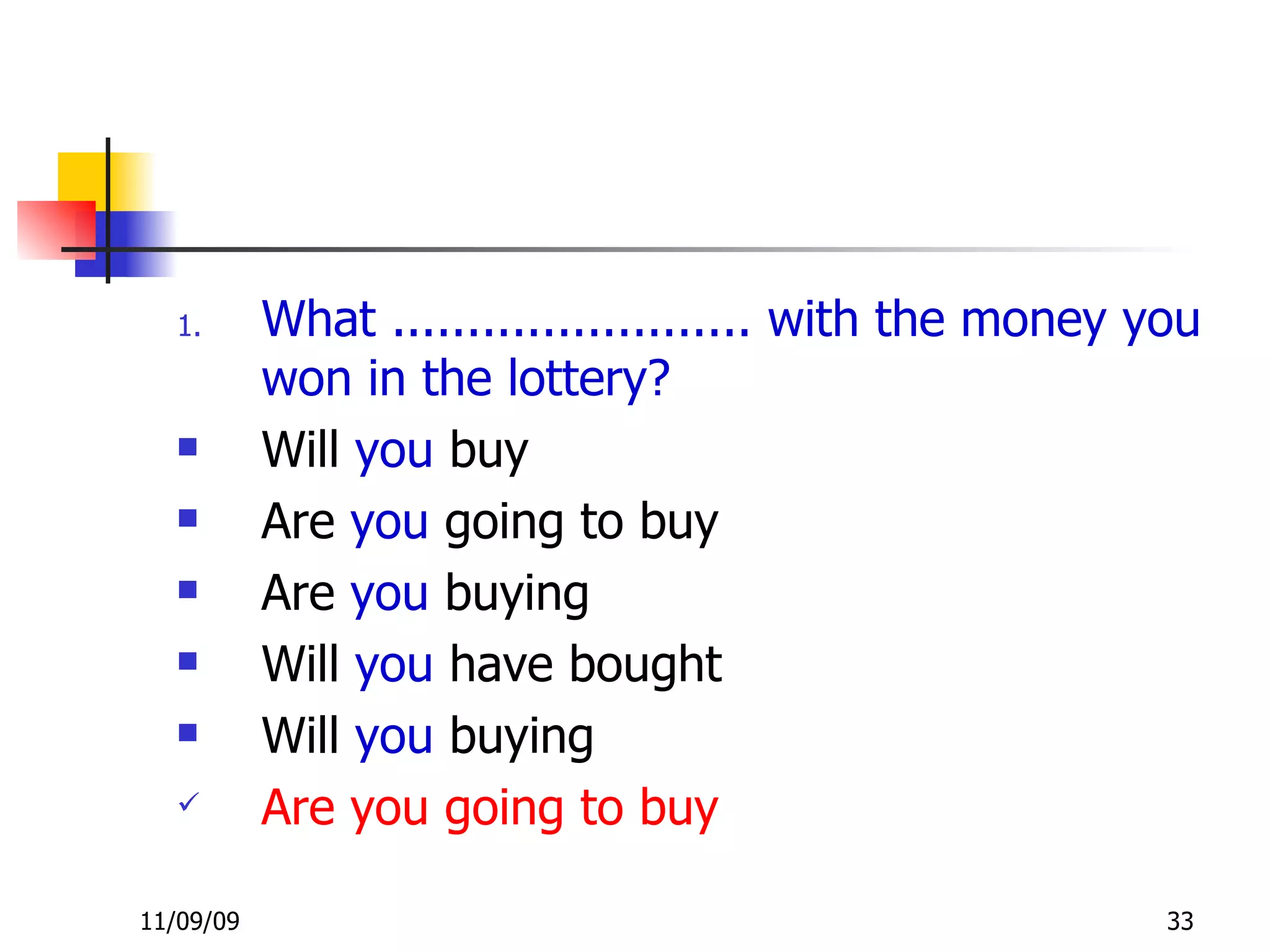
What ........................ with the money you won in the lottery? Will  you  buy Are  you  going to buy Are  you  buying Will  you  have bought Will  you  buying Are you going to buy
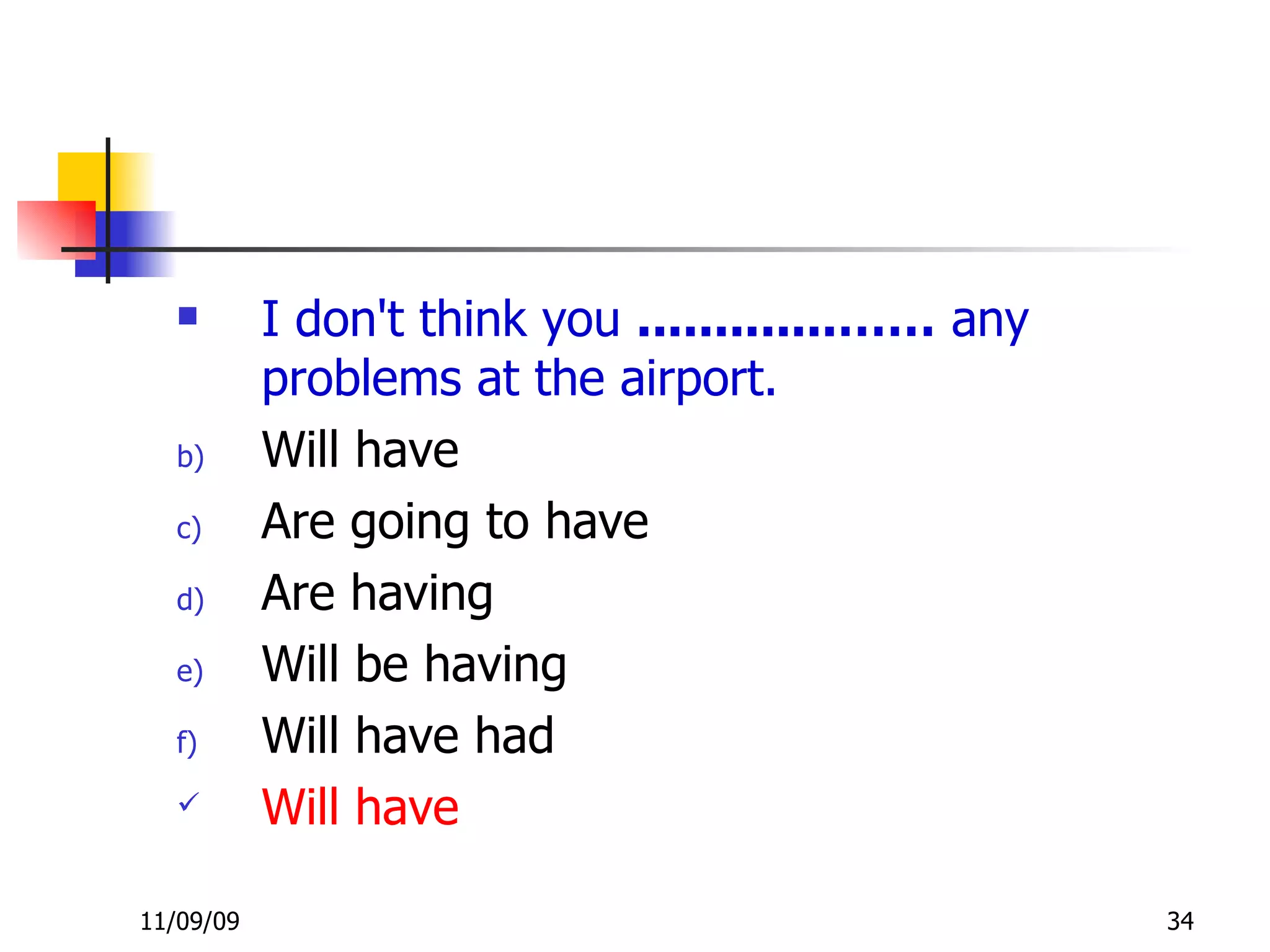
I don't think you  .............……  any problems at the airport. Will have Are going to have Are having Will be having Will have had Will have
......... your dog with you to Ankara ? Will  you  take Are  you  going to take Are  you  taking Will  you  be taking Will  have  taken Are you taking * are you going to take
Can you answer the phone for me? I .................... for a while. Will lie down Am going to lie down Will be lying down Will have lien down Am lying Am going to lie down
All the hotels are full. Where ............  the night? Will  we  spend Are  we  going to spend Are  we  spending Will  we  be spending Will  we  have spent Are we going to spend
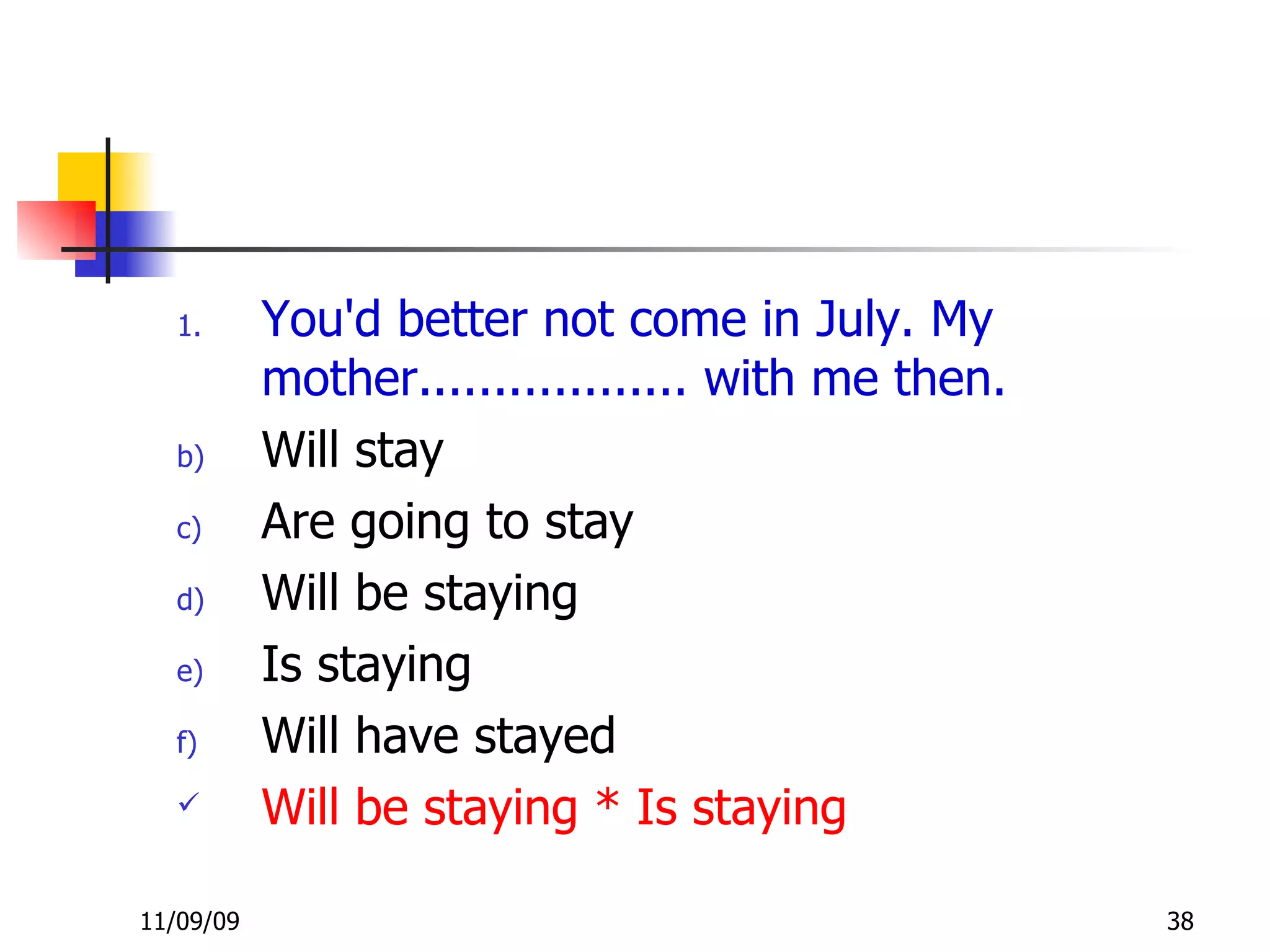
You'd better not come in July. My mother.................. with me then. Will stay Are going to stay Will be staying Is staying Will have stayed Will be staying * Is staying
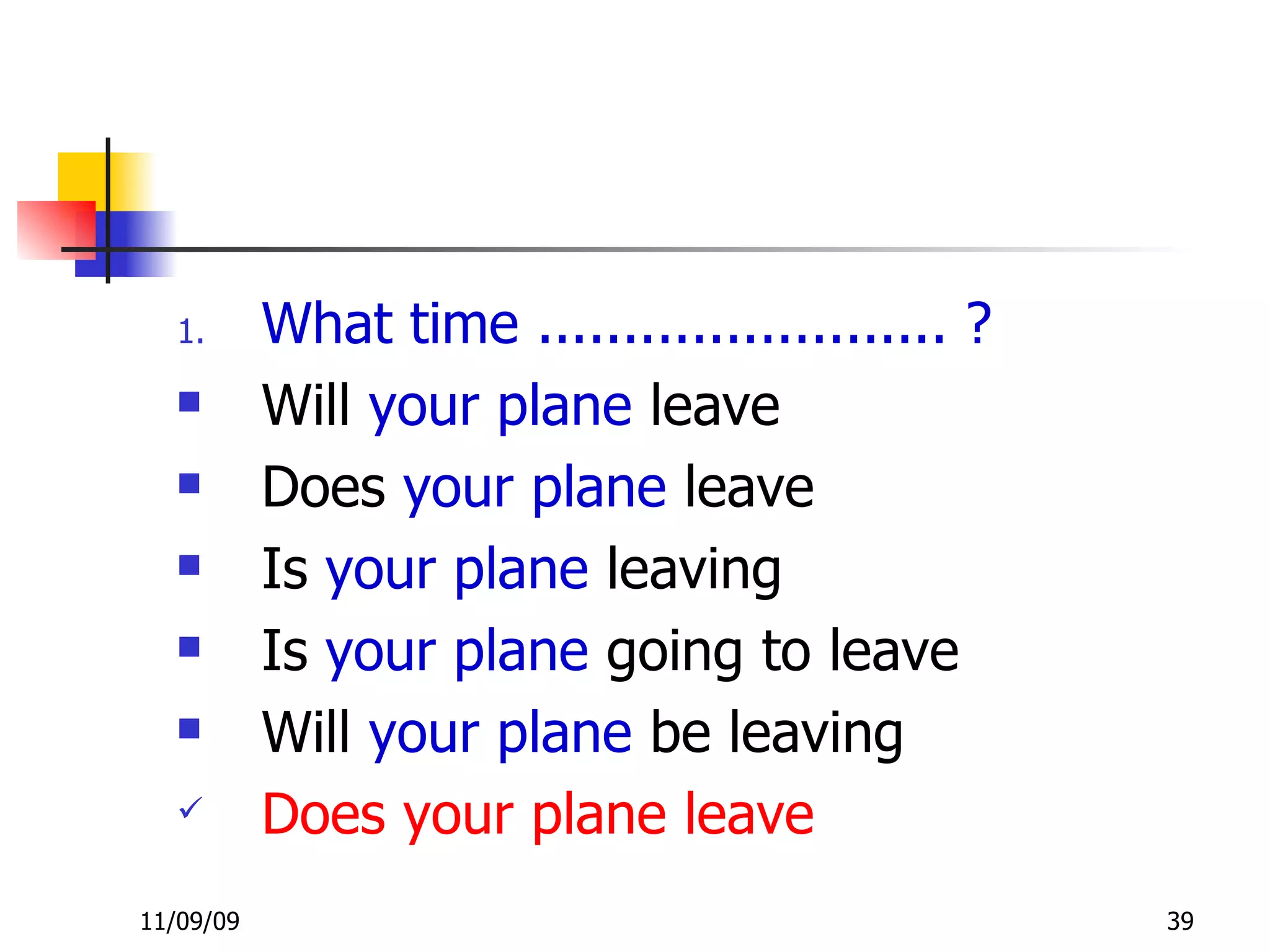
What time ........................ ? Will  your plane  leave Does  your plane  leave Is  your plane  leaving Is  your plane  going to leave Will  your plane  be leaving Does your plane leave
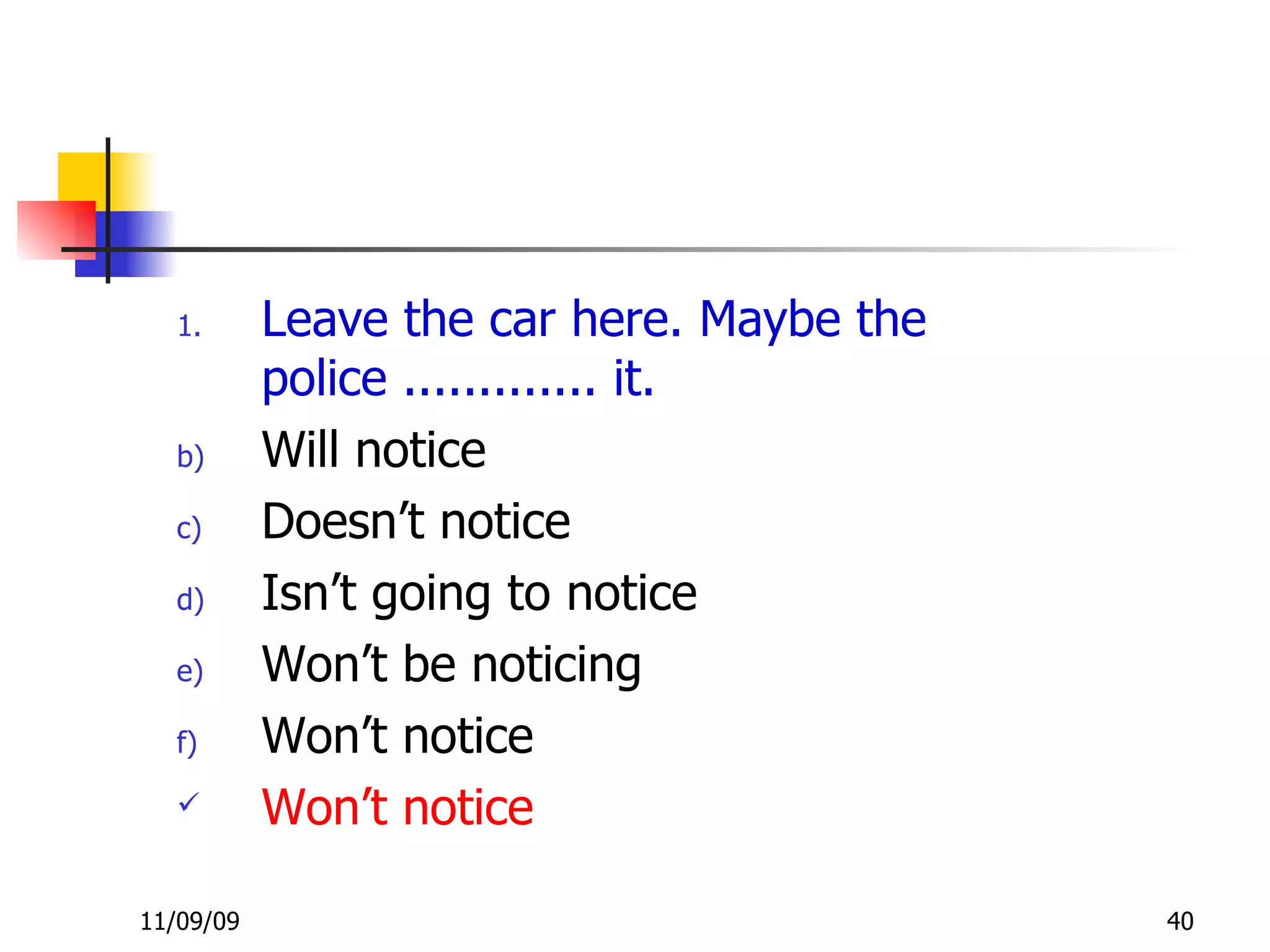
Leave the car here. Maybe the police ............. it. Will notice Doesn’t notice Isn’t going to notice Won’t be noticing Won’t notice Won’t notice
By the time we reach home, the rain …….. .   Will stop Is going to stop Will be stopping Will have stopped Is stopping Will have stopped
This time next week I ............. on the beach in Antalya. Will lie Is going to lie Is lying Will be lying Will have lean Will be lying
In ten years' time I ................ for a different company. Will work Is going to work Is working Will be working Will have worked Will be working
If we don't get there by 5, the teacher …… .   Will leave Is going to leave Is leaving Will be leaving Will have left Will have left
In July they ........... for twenty years. Will be married Is going to be married Is being married Will have been married Will be being married Will have been married
According to computer experts, computers ............. to make accurate predictions about the future.   Will soon be able  is soon going to be able Will soon being able Will have been able Will soon be able
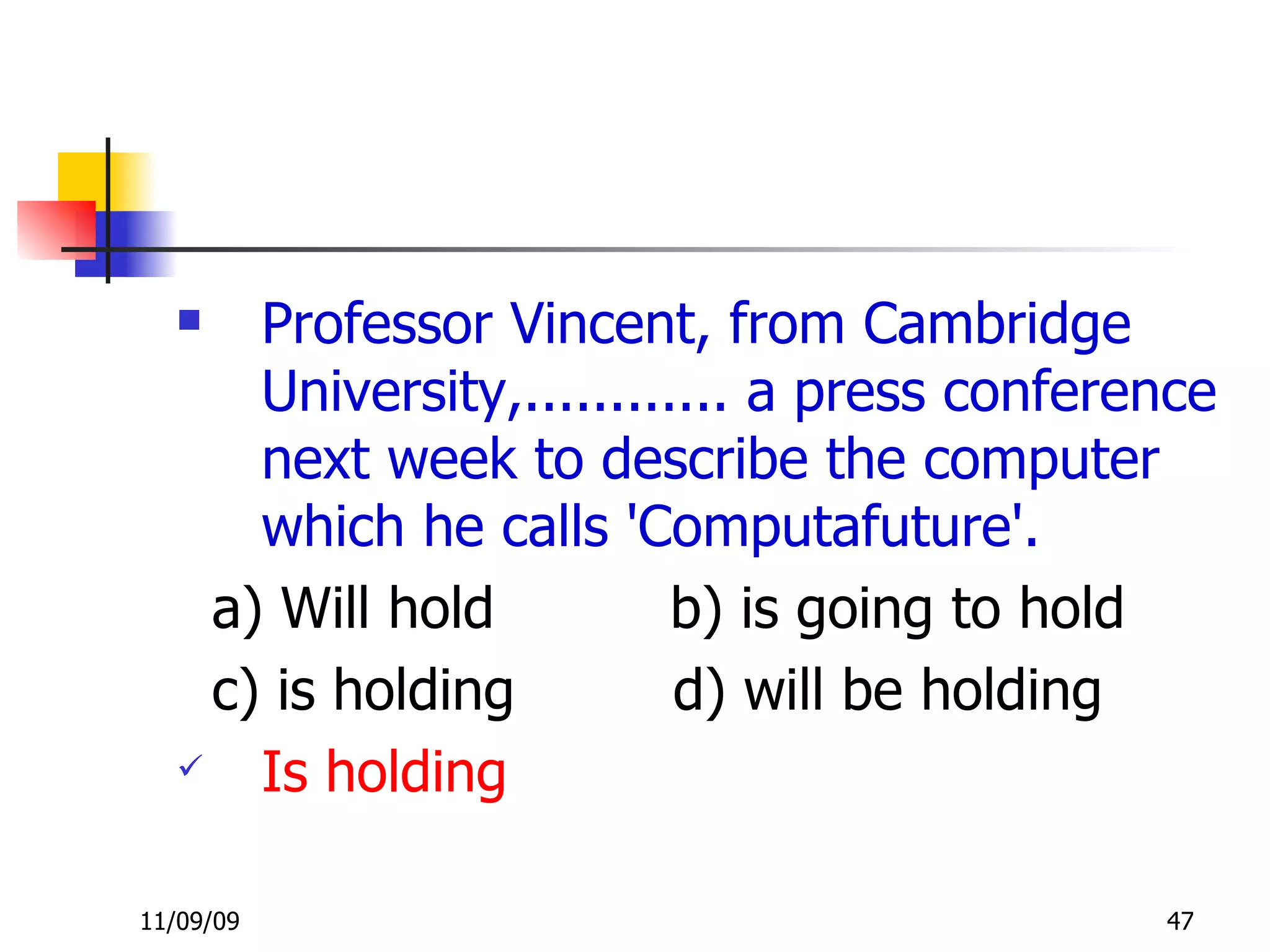
Professor Vincent, from Cambridge University,............ a press conference next week to describe the computer which he calls 'Computafuture'.   a) Will hold  b) is going to hold c) is holding  d) will be holding Is holding

F U T U R E T E N S E S

  • 1.
  • 2.
    Future Time PredictionWill is used to make predictions. It is often preceded by / think or by opinion words like perhaps. A time expression is also necessary . I think it ‘ ll rain tomorrow. Perhaps she ' ll be late. Tomorrow will be warm with some cloud in the afternoon. Who do you think will win ? You’ ll never finish that book.
  • 3.
    Will- Shall I/ we will and I / we shall are used with no difference of meaning in most situations in modern British English. Will is more common than shall . In speech, both will and shall are contracted to ‘ll. Use of shall after I and we is more common in formal speech .
  • 4.
    Will isalso used 2. to give or ask for information about the future, in cases where there is no reason to use a present verb-form We will need the money on the 15 th. Will all the family be at the wedding? It will be spring soon. She will be here in a few minutes.
  • 5.
    Going to Ifa predicted event is very near, and especially in impersonal statements, going to is also commonly used for predictions . Will can also be used in these examples, with no change of meaning . You ' re going to fall ! Liverpool are going to win the Cup.
  • 6.
    2. Going to can be used instead of will in predictions. For some speakers this seems more colloquial. I'm sure you ' re going to enjoy the film. I 'm sure you ‘ll enjoy the film.
  • 7.
    Present Cause We often make a prediction because we can see the cause of the event. Look out! There's a bus coming! It' s going to hit us! I can see you' re going to have a baby. When is it due? He is looking up! He is going to fall into the hole.
  • 8.
    Going to is also used b) When we talk about plans, decisions and firm intentions, especially in an informal style. We ’re going to get a new car soon. When are you gonig to get your hair cut? I’ m going to keep asking her out until she says ‘Yes’.
  • 9.
    Future Continuous Thefuture continuous is used to describe a situation in the future at a particular time. This time next week we' ll be eating lunch on the plane! This time tomorrow I' ll be skiing .
  • 10.
    Future Continuous 2. It is also used to predict a future state or habit at a particular time in the future. In ten years time I expect I' ll be living in London. And I' ll probably be cycling to work. Professor Asher will be giving another lecture at the same time next week. I’ ll be seeing you one of these days. I expect.
  • 11.
    Future Perfect Thefuture perfect looks back from a point in the future and refers to indefinite time up to that point. By the time we get there, the film will have started. The builder says he’ ll have finished the roof by Saturday. The car will soon have done 100.000 miles. This means that at the future time when we get there, we can say: The film has started .
  • 12.
    The Future PerfectProgressive We can use the future perfect progressive to say how long something will have continued by a certain time . Next Christmas I’ ll have been teaching for twenty years. By her fifth birthday she will have been working in the same office.
  • 13.
    Future Time ClausesAfter time expressions when,if, until and as soon as a present tense form is used, although this refers to future time. I ‘ ll wait for you here until you get back . If I’m there tomorrow. I’ ll phone you. When it’s ready I’ ll give it to you. 2. The present perfect can be used to emphasise the completion of an event . I ' ll wait here until you have finished .
  • 14.
    Intention Going to is used to describe a present intention. I ' m going to fix the television tomorrow . 2 . Will is also used for decisions made at the time of speaking . I know, I ' ll get him a wallet for his birthday.
  • 15.
    Plans and FactsThe present continuous is used to describe plans and arrangements which are definite. Such arrangements may be written in a diary. Sorry, I can't help you , I ' m leaving in the morning. The present continuous is used to describe fixed arrangements, and to ask about social arrangements. Are you doing anything this evening?
  • 16.
    we often givethe time, date, and / or place when we talk about future personal arrangements and fixed plans . What are you doing this evening?’ ‘I’ m washing my hair.’ My car ’s having a service next week. We ’re going to Spain in June. Did you know I’ m getting a new job? What are we having for dinner?
  • 17.
    2. Thepresent simple is used to describe future events which we cannot control. They may be facts, such as events in a timetable, or a law . The plane for Paris leaves at 9.45. 3. The present simple and present perfect can also be used to refer to future time. I‘ ll tell you the news when I see you. Call me when you have finished.
  • 18.
    We can oftenuse more than one structure to talk about the same future event. Present forms emphasize present ideas like intention, certainty and plans. We prefer will / shall when we are not emphasizing present ideas. Compare : Next year is going to be different - I promise. Next year will probably be different. What are you doing next year? You haven’t told me your plans. What will you do next year - do you know?
  • 19.
    We prefer present forms when are talking about future events that have some present reality. Compare: I ’ m seeing Pete on Tuesday. (There is an arrangement now.) I wonder if he ’ ll recognise me . (No present idea.)
  • 20.
    In predictions, weprefer present forms when there is outside evidence for what will happen - when we can see something coming. Look out - we’ re going to crash ! (I can see it coming.) We prefer will when we are talking more about what is inside our heads: our beliefs, guesses, knowledge etc. Don’t lend him your car - he’ ll crash it. (I know him.)
  • 21.
    In polite enquiries the future progressive suggests 'What have you already decided?‘ giving the idea that we are not trying to influence people. Compare: Will you be staying in staying in this evening? (just asking about plans) Are you going to stay in this evening? (perhaps pressing for a decision) Will you stay in this evening? (request or order)
  • 22.
    is to, areto, was to We can talk about the future by saying that something is to happen.We often use this structure to talk about official plans and fixed personal arrangements . The President is to visit Scotland in September. We are to get a wage rise. I felt nervous because I was soon to leave home for the first time.
  • 23.
    exercises Choose themost suitable answer. Why ……………. a new mountain bike? are you going to buy will you buy are you going to buy
  • 24.
    Don't phone between8.00 and 9.00. …………………..then. I 'll study I 'll be studying I'll be studying
  • 25.
    Look out! Thattree……………………. ! will fall is going to fall is going to fall
  • 26.
    Let me knowas soon as Louise …….. Here will get gets gets
  • 27.
    Great news! Jeanand Chris …………to stay with us. will come are coming are coming
  • 28.
    According to thistimetable, the bus …………………at 6.00. is going to arrive arrives arrives
  • 29.
    I have afeeling that something strange ………………………..in a minute. is going to happen is happening is going to happen
  • 30.
    The doctor saysI ………………..a baby! will have am going to have am going to have Can you call me at 7.00, because ………………tomorrow. I 'll leave I 'm leaving I'm leaving
  • 31.
    If you arrivelate at the sale, the best things ………………. . will go will have gone will have gone
  • 32.
    Ramazan Bey.................... backuntil six. Can I take a message? Won’t be Is not going to be Isn’t Wasn’t Won’t being Won’t be
  • 33.
    What ........................ withthe money you won in the lottery? Will you buy Are you going to buy Are you buying Will you have bought Will you buying Are you going to buy
  • 34.
    I don't thinkyou .............…… any problems at the airport. Will have Are going to have Are having Will be having Will have had Will have
  • 35.
    ......... your dogwith you to Ankara ? Will you take Are you going to take Are you taking Will you be taking Will have taken Are you taking * are you going to take
  • 36.
    Can you answerthe phone for me? I .................... for a while. Will lie down Am going to lie down Will be lying down Will have lien down Am lying Am going to lie down
  • 37.
    All the hotelsare full. Where ............ the night? Will we spend Are we going to spend Are we spending Will we be spending Will we have spent Are we going to spend
  • 38.
    You'd better notcome in July. My mother.................. with me then. Will stay Are going to stay Will be staying Is staying Will have stayed Will be staying * Is staying
  • 39.
    What time ........................? Will your plane leave Does your plane leave Is your plane leaving Is your plane going to leave Will your plane be leaving Does your plane leave
  • 40.
    Leave the carhere. Maybe the police ............. it. Will notice Doesn’t notice Isn’t going to notice Won’t be noticing Won’t notice Won’t notice
  • 41.
    By the timewe reach home, the rain …….. . Will stop Is going to stop Will be stopping Will have stopped Is stopping Will have stopped
  • 42.
    This time nextweek I ............. on the beach in Antalya. Will lie Is going to lie Is lying Will be lying Will have lean Will be lying
  • 43.
    In ten years'time I ................ for a different company. Will work Is going to work Is working Will be working Will have worked Will be working
  • 44.
    If we don'tget there by 5, the teacher …… . Will leave Is going to leave Is leaving Will be leaving Will have left Will have left
  • 45.
    In July they........... for twenty years. Will be married Is going to be married Is being married Will have been married Will be being married Will have been married
  • 46.
    According to computerexperts, computers ............. to make accurate predictions about the future. Will soon be able is soon going to be able Will soon being able Will have been able Will soon be able
  • 47.
    Professor Vincent, fromCambridge University,............ a press conference next week to describe the computer which he calls 'Computafuture'. a) Will hold b) is going to hold c) is holding d) will be holding Is holding