Fungal Characteristics
       1)Cell wall made of Chitin

    2)Heterotrophs and major Decomposers

    3)Body is made of Long filaments of

      hyphae which form a mycelium
An example of Fungi You know
Mushrooms – “Club Like” Fungi or Basidiomycete Fungi
Bracket Fungi – Basidiomycete Fungi
Bread Mold – a
Zygomycete Fungi
Cup Fungi – Ascomycete Fungi


   Note the cup shapes and
     orange peel colour
Kingdom Fungi – you must know 5 Major Phyla
1. Phylum Zygomycota = the Bread Molds
      Rhizopus – black bread mold


2. Oomycota = the Water Molds
      Water mold, potato blight, mildew


3. Phylum Ascomycota = the Sac Fungi
      Yeast, morels, truffles


4. Phylum Basidiomycota = the Club Fungi
      Mushrooms, puffballs, bracket fungi, rusts, smuts,
        toadstools
5. Phylum Deuteromycota = the Fungi Imperfecti
Zygomycota (Rhizopus) the
    Common Molds
-are primarily decomposers 
-asexual spores may be produced in sporangia 

-sexual reproduction occurs between + and – strains 
forming a 2n zygote; a zygospore develops and may 
lie dormant for a long period of time; meiosis occurs 
just before germination 

-only the zygote is diploid; all 
hyphae and asexual spores are 
haploid 
Zygomycota – common molds


The fungal mass of
hyphae, known as
the MYCELIUM
penetrates the
bread and
produces the
fruiting bodies on
top of the stalks  Mycelia = a mass of hyphae or 
                     filaments
Rhizoids = root-like hyphae 
The zhizoids meet underground and mating occurs between 
hyphae of different molds (SEXUAL REPRODUCTION)
Zygomycota (Rhizopus) 
Lifecycle of a Zygomycete Fungi – Asexual then Sexual
Ascomycota – Cup Fungi Life Cycle
Yeast is an Ascomycete Fungus
Morels are Ascomycete Fungi
Basidiomycete or Club Fungi
Life Cycle of Basidiomycete Fungi
Bracket Fungi


                       Puff Balls

Basidiomycete Fungi that all
   produce Basiospores
                          Jelly Fungi
 Mushrooms
Other Basidiomycetes Rusts and 
                   Smuts
   Rust
 infecting
               Rust infecting     Whitrot Smut
wheat leaves
                  a Leaf        digesting old wood
Deuteromycota (Imperfect Fungi)
-Regarded as imperfect because they exhibit no sexual 
stage has been observed in their life cycle 

-Members are not closely related and are not 
necessarily similar in structure or appearance; do not 
share a common ancestry, polyphyletic = coming from 
many ancestors – hmm weird 
Deuteromycota – the Fungi
                  Imperfecti
• Resemble Ascomycetes,
  but their reproductive
                                Penicillium fungi 
  cycle has never been
  observed

• Different from
  Ascomycetes because
  there is a definite lack of     Up Close
  sexual reproduction,
  which is why they are
  called Imperfect Fungi
Water Molds -- Oomycota
        The water molds are better known as the 
        MILDEWS.  Fish tank fuzz is an example.
        Protist-like mold because share common 
        characteristics with plant-like protists, such 
        as the cell wall
Life Cycle of Oomycota
Things to Know about Oomycete
             Fungi
1. Water molds or mildews
2. Cause diseases such as potato blight
3. Cell walls made of cellulose (like plant)
4. Hyphae have multiple nuclei!  Because 
   the cell walls do not fully close off.
5. Spore swims away like a flagellate, which 
   is why it is protist like (think of Euglena)
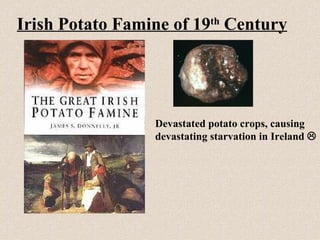
Irish Potato Famine of 19th Century


                 Devastated potato crops, causing
                 devastating starvation in Ireland 
Phylum         Ex’s    Characterist     Asexual        Sexual
                            ics
Oomycota     Mildew     Cellulose cell Flagellated   Gametes fuse
             Spud       walls, 2N      oospores      in
             blight     hyphae         from          gametangia
                                       sporangia     creating
                                                     oospores
Zygomycota   Rhizopus   Chitin cell    Unflagel.     Gametangia
             a dung     walls          spores drop   fuse to create
             fungus     Coenocytic =   from          zygospore
                        hyphae lack    sporangia
                        crosswalls
Ascomycota   Yeast,                    Conidia on   Hyphae + & -
             morels,                   conidophores fuse to create
             truffles                               ascospores in
                                                    ascus
Basidiomycota   Mushroo       Cross Asexual by way      Sexual when
                   ms        walls in of Conidophores    hyphae fuse
                Puffballs,   hyphae which produce       in BASIDIA
                 rusts,                conidiospores     to produce
                 smuts                                  basidiospores
Fungi           Penicilliu Similar      Asexual by      Sexual repro
Imperfecti         m,        To        conidia which     Not known
                Athlete’s Basidio        produce
Deuteromycota     Foot                 conidophores
                             and
                 fungus, Zygomy
                 Tomato
                  Blight
Cross Walls of Hyphae
             Coenocytic hyphae where the 
             nucleis of each cell is 
             embedded in the cytoplasm 
             without a cell wall
             Eg.  Zygomycota, Oomycota


           Hyphae with cross walls
           Eg. Basidiomycota, 
           Ascomycota
Lichens
Lichens are mutualistic symbiotic 
organisms. They have an 
____________ fungus and a 
_________ or cyanobacterial 
portion. There are three lichen 
growth forms which are 
predominant in nature: 
_____________________
_____________________________
Fruticose 


Crustose


           Foliose
Mycorrhizae 

 Mycorrhizae means “fungus-root”; 
 mutualistic relationship between 
 plant and fungi 

 The plant photosynthesizes while 
 the fungus more efficiently takes 
 up nutrients and water from the 
 rhizosphere than the roots would 
 alone. 
Plant benefits include:
    •Improved nutrient/water
    uptake 
    •Improved root growth 
    •Improved plant growth and
    yield 
    •Improved disease resistance 
    •Reduced transplant shock 
    •Reduced drought stress 
Soredia are the asexual reproductive part of lichens, 
containing both symbionts.  Rhizines may be present to 
anchor the lichen. Notice the distinctive algal layer
and the fungal layer present in the above illustration.

Fungiopt 100401121730-phpapp02