THE CLUB FUNGI
GROUP 3


are filamentous fungi composed
of hyphae (except for yeasts), and
reproducing sexually via the formation
of specialized club-shaped
end cellscalled basidia that normally
bear external meiospores (usually
four).
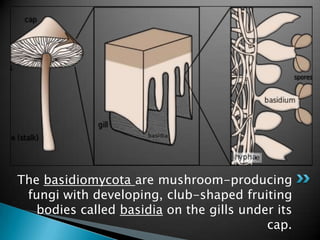
The basidiomycota are mushroom-producing
fungi with developing, club-shaped fruiting
bodies called basidia on the gills under its
cap.


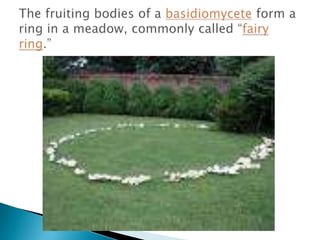
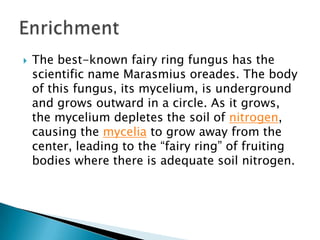
The best-known fairy ring fungus has the
scientific name Marasmius oreades. The body
of this fungus, its mycelium, is underground
and grows outward in a circle. As it grows,
the mycelium depletes the soil of nitrogen,
causing the mycelia to grow away from the
center, leading to the “fairy ring” of fruiting
bodies where there is adequate soil nitrogen.



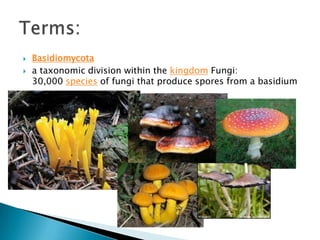
Basidiomycota
a taxonomic division within the kingdom Fungi:
30,000 species of fungi that produce spores from a basidium


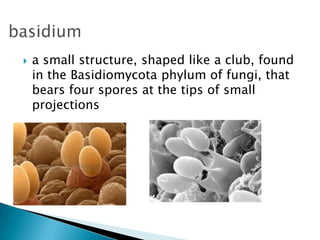
a small structure, shaped like a club, found
in the Basidiomycota phylum of fungi, that
bears four spores at the tips of small
projections


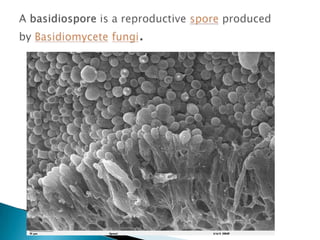
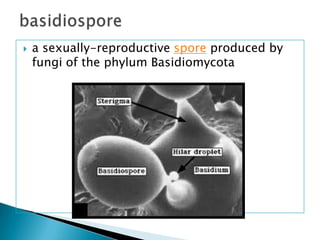
a sexually-reproductive spore produced by
fungi of the phylum Basidiomycota
a

fruiting body that protrudes
from the ground, known as
a mushroom, which has
a developing basidia on the
gills under its cap
a

fungus of the phylum
Basidiomycota, which
produces sexual spores on a
basidium







The majority of edible fungi belong to the
Phylum Basidiomycota.
The basidiomycota includes shelf
fungus, toadstools, and smuts and rusts.
Unlike most fungi, basidiomycota reproduce sexually
as opposed to asexually.
Two different mating strains are required for the
fusion of genetic material in the basidiumwhich is
followed by meiosis producing haploid basidiospores.
Mycelia of different mating strains combine to
produce a secondary mycelium that contains haploid
basidiospores in what is called the dikaryotic
stage, where the fungi remains until
abasidiocarp (mushroom) is generated with the
developing basidia on the gills under its cap.

Basidiomycetes

  • 1.
  • 2.
     are filamentous fungicomposed of hyphae (except for yeasts), and reproducing sexually via the formation of specialized club-shaped end cellscalled basidia that normally bear external meiospores (usually four).
  • 4.
    The basidiomycota aremushroom-producing fungi with developing, club-shaped fruiting bodies called basidia on the gills under its cap.
  • 6.
     The best-known fairyring fungus has the scientific name Marasmius oreades. The body of this fungus, its mycelium, is underground and grows outward in a circle. As it grows, the mycelium depletes the soil of nitrogen, causing the mycelia to grow away from the center, leading to the “fairy ring” of fruiting bodies where there is adequate soil nitrogen.
  • 7.
      Basidiomycota a taxonomic divisionwithin the kingdom Fungi: 30,000 species of fungi that produce spores from a basidium
  • 8.
     a small structure,shaped like a club, found in the Basidiomycota phylum of fungi, that bears four spores at the tips of small projections
  • 9.
     a sexually-reproductive sporeproduced by fungi of the phylum Basidiomycota
  • 10.
    a fruiting body thatprotrudes from the ground, known as a mushroom, which has a developing basidia on the gills under its cap
  • 11.
    a fungus of thephylum Basidiomycota, which produces sexual spores on a basidium
  • 13.
         The majority ofedible fungi belong to the Phylum Basidiomycota. The basidiomycota includes shelf fungus, toadstools, and smuts and rusts. Unlike most fungi, basidiomycota reproduce sexually as opposed to asexually. Two different mating strains are required for the fusion of genetic material in the basidiumwhich is followed by meiosis producing haploid basidiospores. Mycelia of different mating strains combine to produce a secondary mycelium that contains haploid basidiospores in what is called the dikaryotic stage, where the fungi remains until abasidiocarp (mushroom) is generated with the developing basidia on the gills under its cap.