INTRODUCTION TO FUNGI
AND THEIR SIGNIFICANCE TO
HUMANS
GUIDEDGUIDED BYBY
ProfProf.. H.KH.K KEHRIKEHRI
PRESENTED BYPRESENTED BY
BRIJESH PRATAP SINGHBRIJESH PRATAP SINGH
RAVINDRA CHAUHANRAVINDRA CHAUHAN
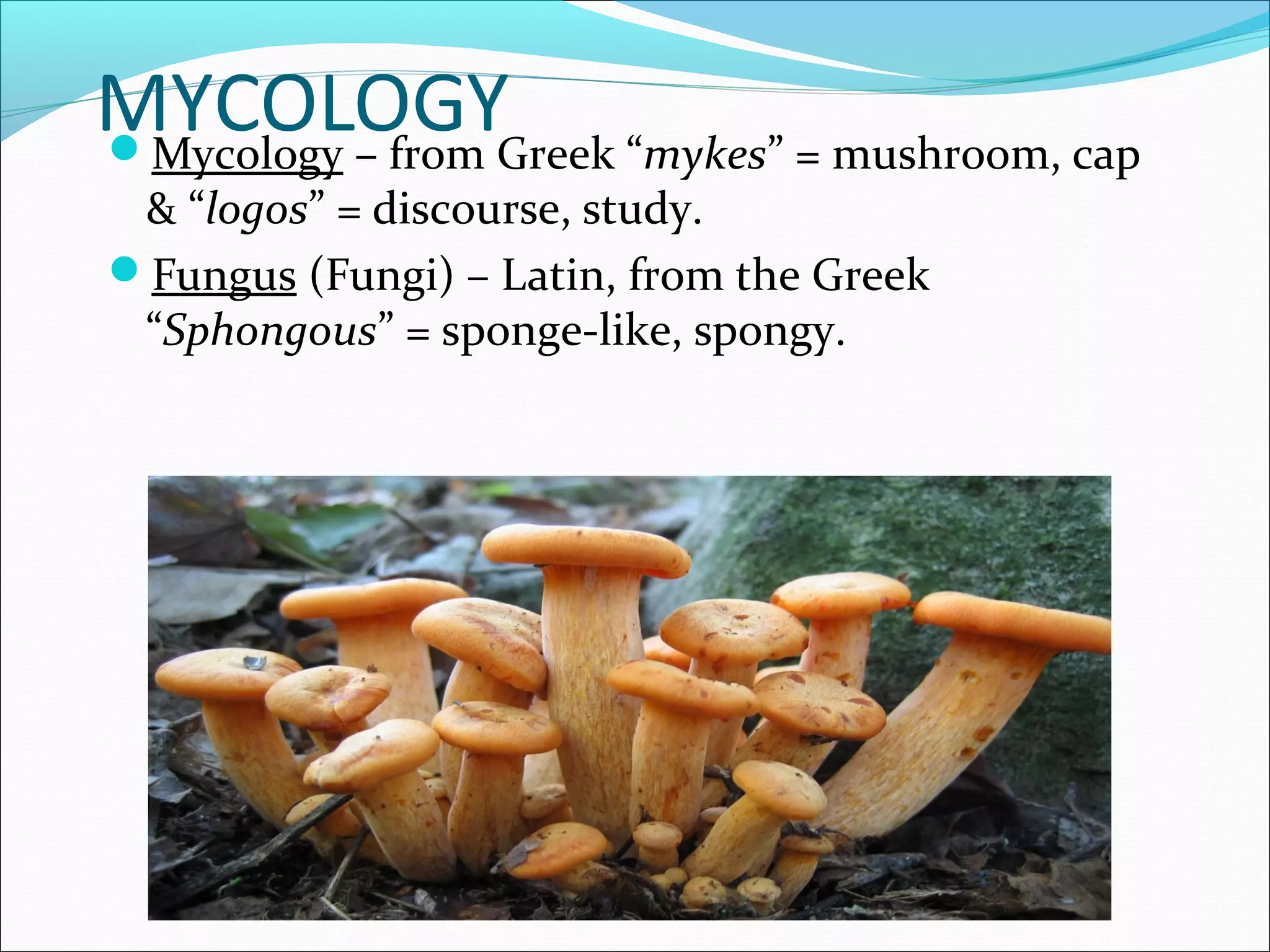
MYCOLOGYMycology – from Greek “mykes” = mushroom, cap
& “logos” = discourse, study.
Fungus (Fungi) – Latin, from the Greek
“Sphongous” = sponge-like, spongy.
Study – “Mycology”.
Term Fungus- Gaspard Bauhin.
P.A. Micheli- father and faunder of Mycology.
E.J. Butler- father of indian Mycology.
K.C. Mehta –famous for studying the Black rust
disease in wheat.
 According to Alexopoulos(1962),
The Fungi include nucleated spore bearing
achlorophyllous organism that generally reproduce
sexually and whose filamentous branched somatic
stuctures are typically -
Surrounded by cellwalls containg cellulose or chitin or
both.
A more technical definition of Fungi was later given
by Bessey(1968) which say that fungi are chlorophyll-
less, non-vascular plants whose reproductive or
vegetative structures do not permit them to be
assigned to position among recognised groups of
higher plants or algae.
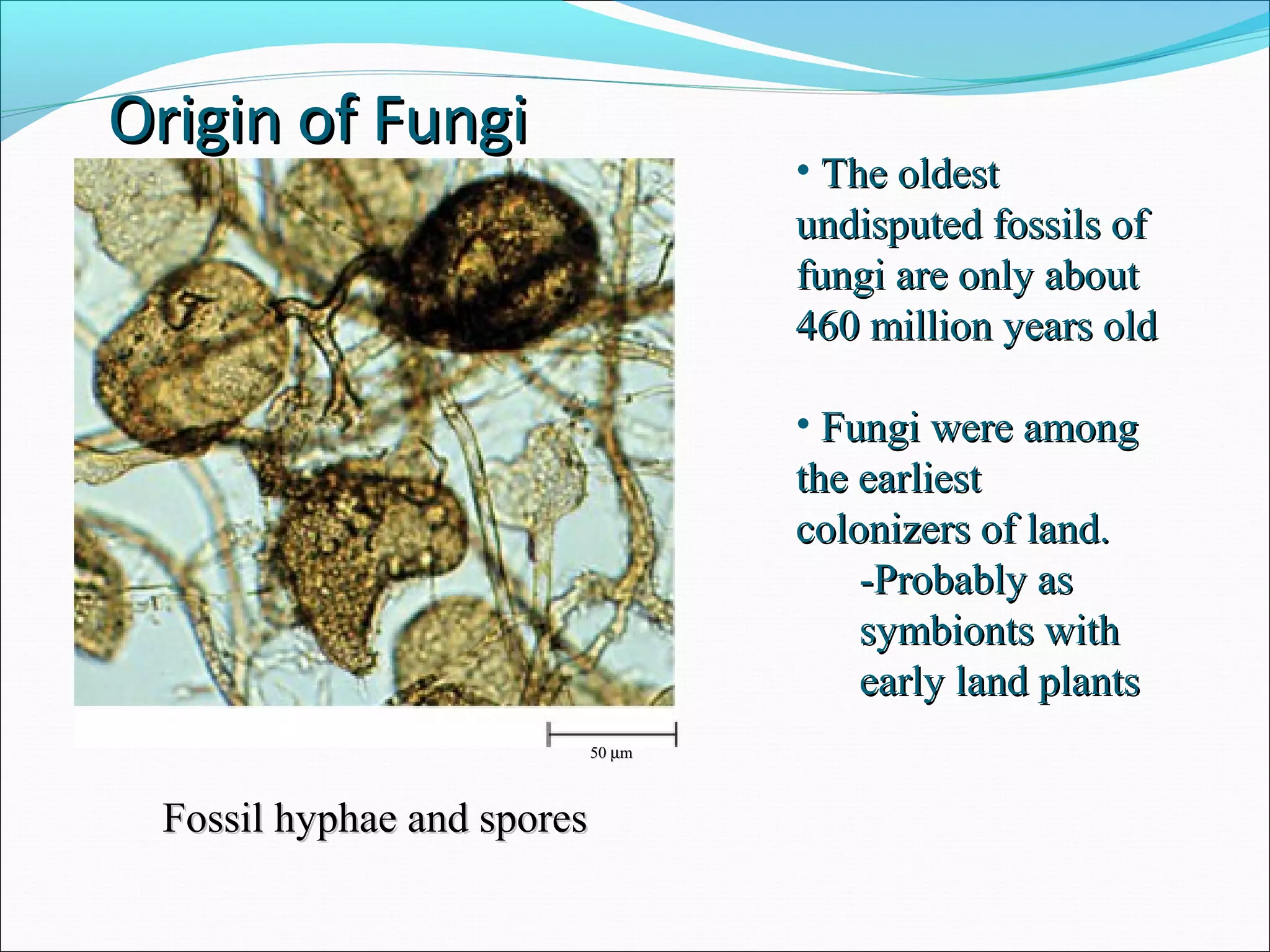
5050 µµmm
Fossil hyphae and sporesFossil hyphae and spores
• The oldestThe oldest
undisputed fossils ofundisputed fossils of
fungi are only aboutfungi are only about
460 million years old460 million years old
• Fungi were amongFungi were among
the earliestthe earliest
colonizers of land.colonizers of land.
-Probably as-Probably as
symbionts withsymbionts with
early land plantsearly land plants
Origin of FungiOrigin of Fungi
• Fungi descended from an aquatic, single-Fungi descended from an aquatic, single-
celled, flagellated protistcelled, flagellated protist
• Systematists now recognize Fungi andSystematists now recognize Fungi and
Animalia as sister kingdomsAnimalia as sister kingdoms
– Because fungi and animals are more closelyBecause fungi and animals are more closely
related to each other than they are to plantsrelated to each other than they are to plants
or other eukaryotesor other eukaryotes
• Molecular evidenceMolecular evidence
– Supports the hypothesis that fungi andSupports the hypothesis that fungi and
animals diverged from a common ancestoranimals diverged from a common ancestor
that was unicellular and bore flagellathat was unicellular and bore flagella
• Fungi probably evolvedFungi probably evolved
– Before the colonization of land byBefore the colonization of land by
multicellular organismsmulticellular organisms
Evolution/Origin of FungiEvolution/Origin of Fungi
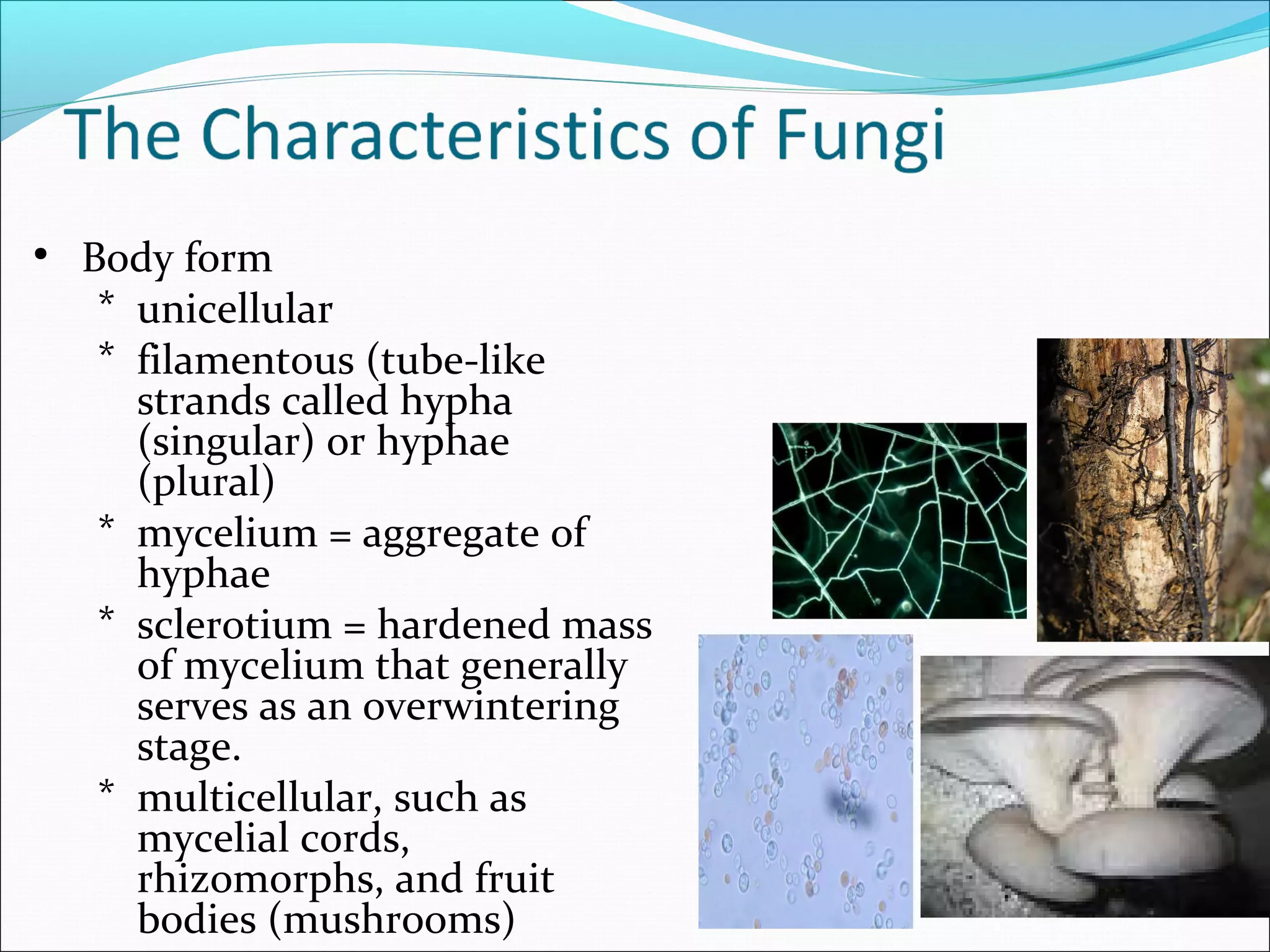
• Body form
* unicellular
* filamentous (tube-like
strands called hypha
(singular) or hyphae
(plural)
* mycelium = aggregate of
hyphae
* sclerotium = hardened mass
of mycelium that generally
serves as an overwintering
stage.
* multicellular, such as
mycelial cords,
rhizomorphs, and fruit
bodies (mushrooms)
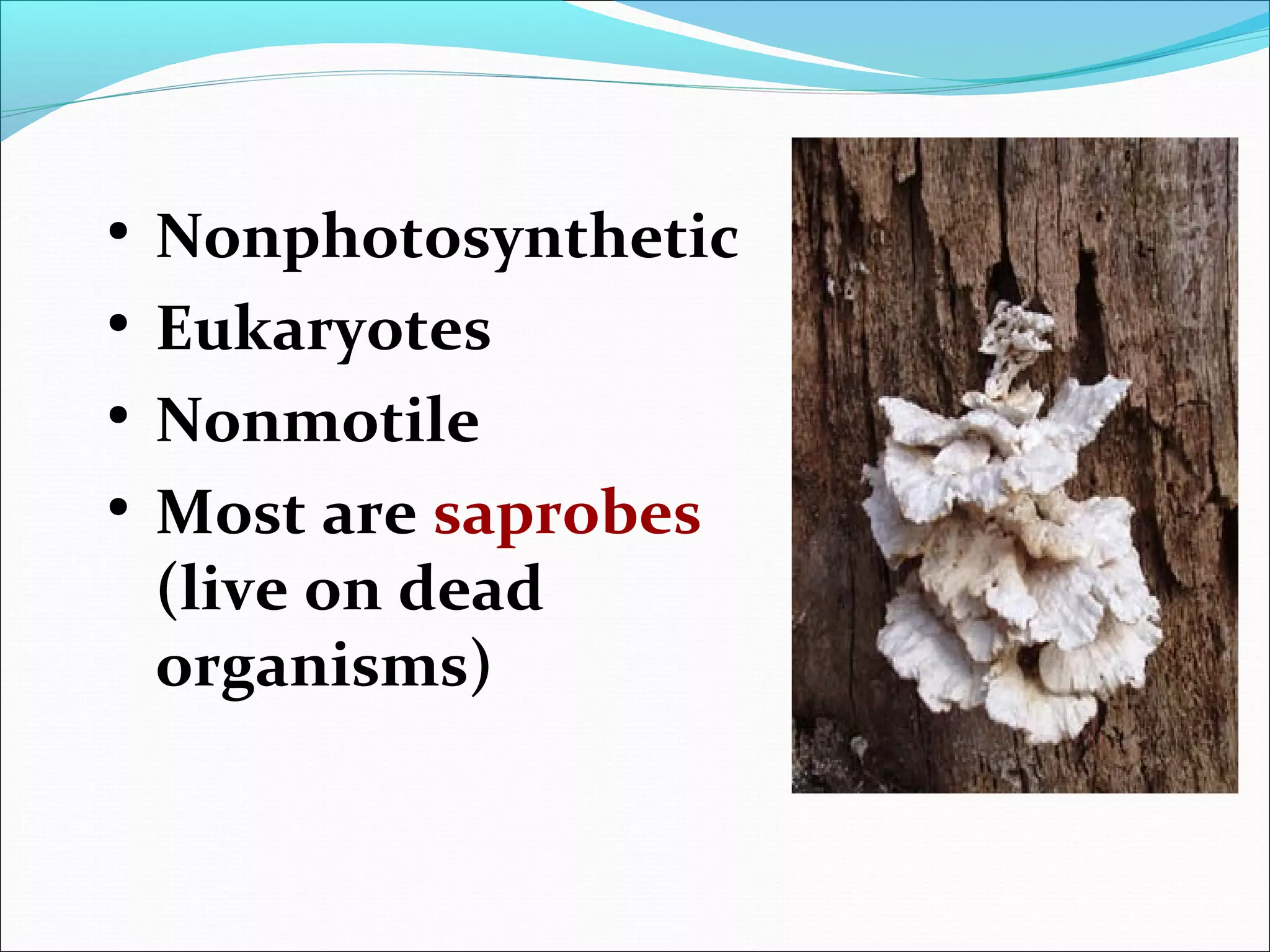
• Nonphotosynthetic
• Eukaryotes
• Nonmotile
• Most are saprobes
(live on dead
organisms)
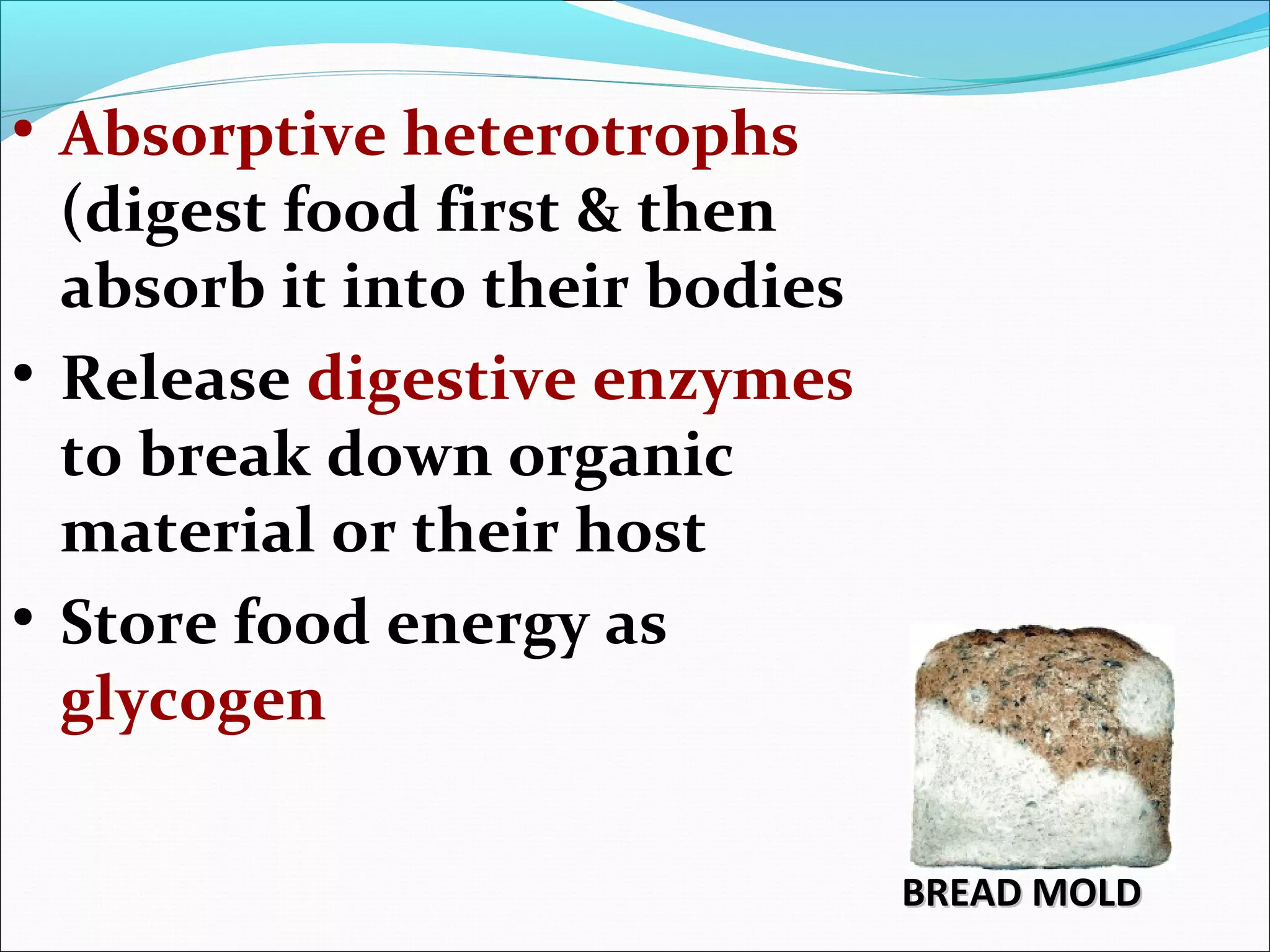
• Absorptive heterotrophs
(digest food first & then
absorb it into their bodies
• Release digestive enzymes
to break down organic
material or their host
• Store food energy as
glycogen
BREAD MOLDBREAD MOLD
• Important decomposers
& recyclers of nutrients
in the environment
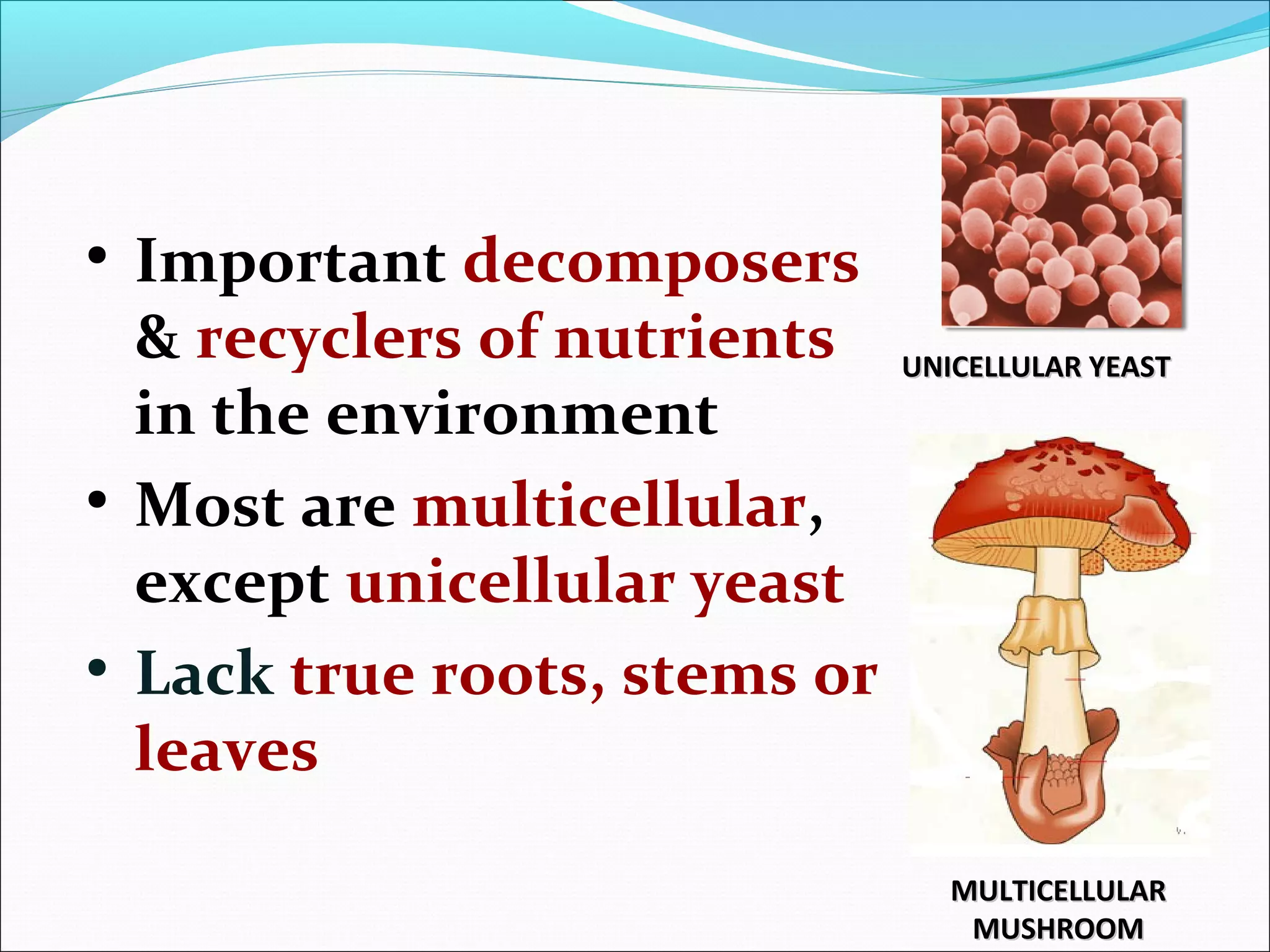
• Most are multicellular,
except unicellular yeast
• Lack true roots, stems or
leaves
UNICELLULAR YEASTUNICELLULAR YEAST
MULTICELLULARMULTICELLULAR
MUSHROOMMUSHROOM
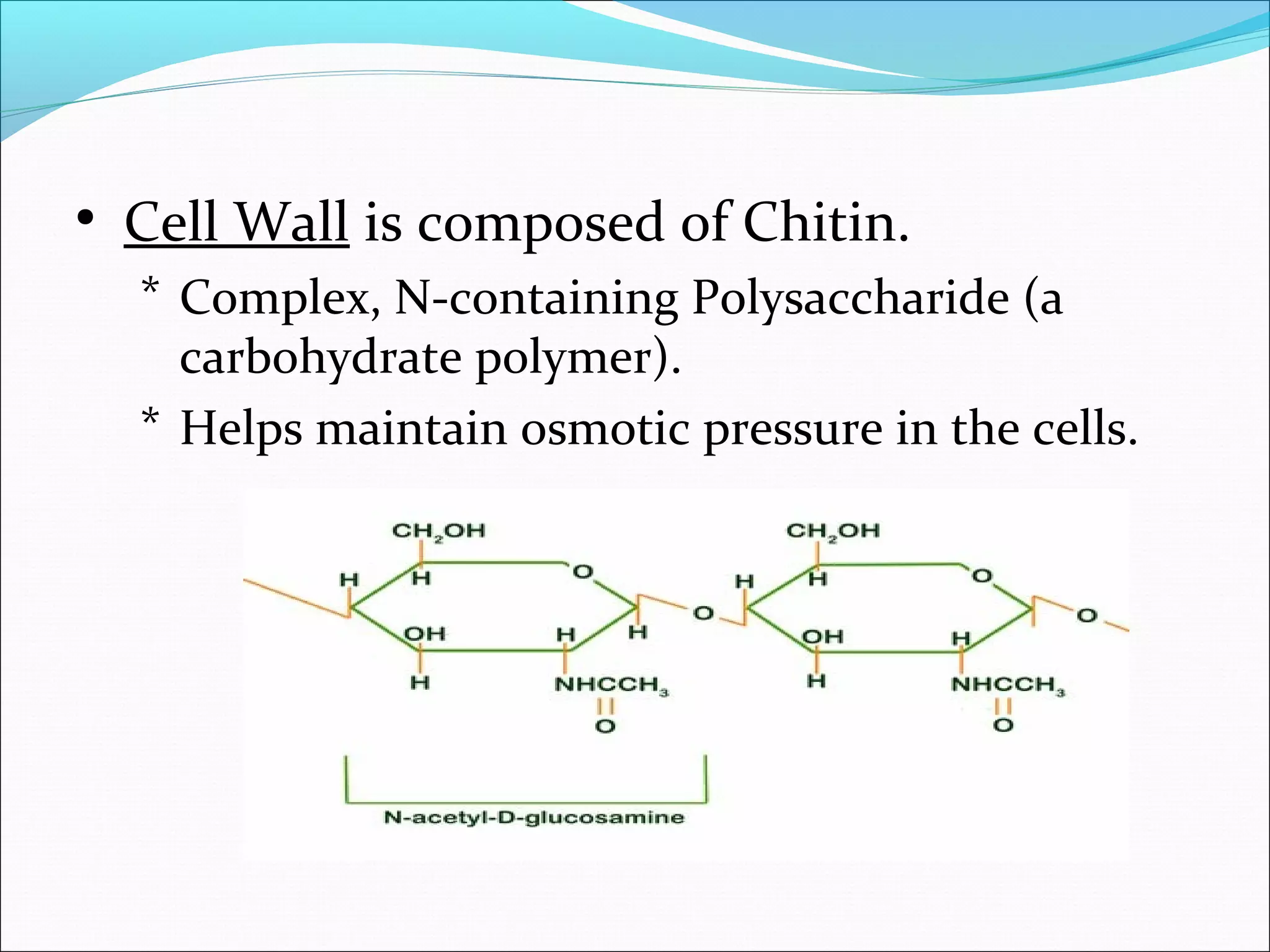
• Cell Wall is composed of Chitin.
* Complex, N-containing Polysaccharide (a
carbohydrate polymer).
* Helps maintain osmotic pressure in the cells.
Heterotrophy - 'other food'
Saprophytes or saprobes - feed on dead
tissues or organic waste (decomposers)
Symbionts - mutually beneficial
relationship between a fungus and
another organism
Parasites - feeding on living tissue of a
host.
Parasites that cause disease are called
pathogens.
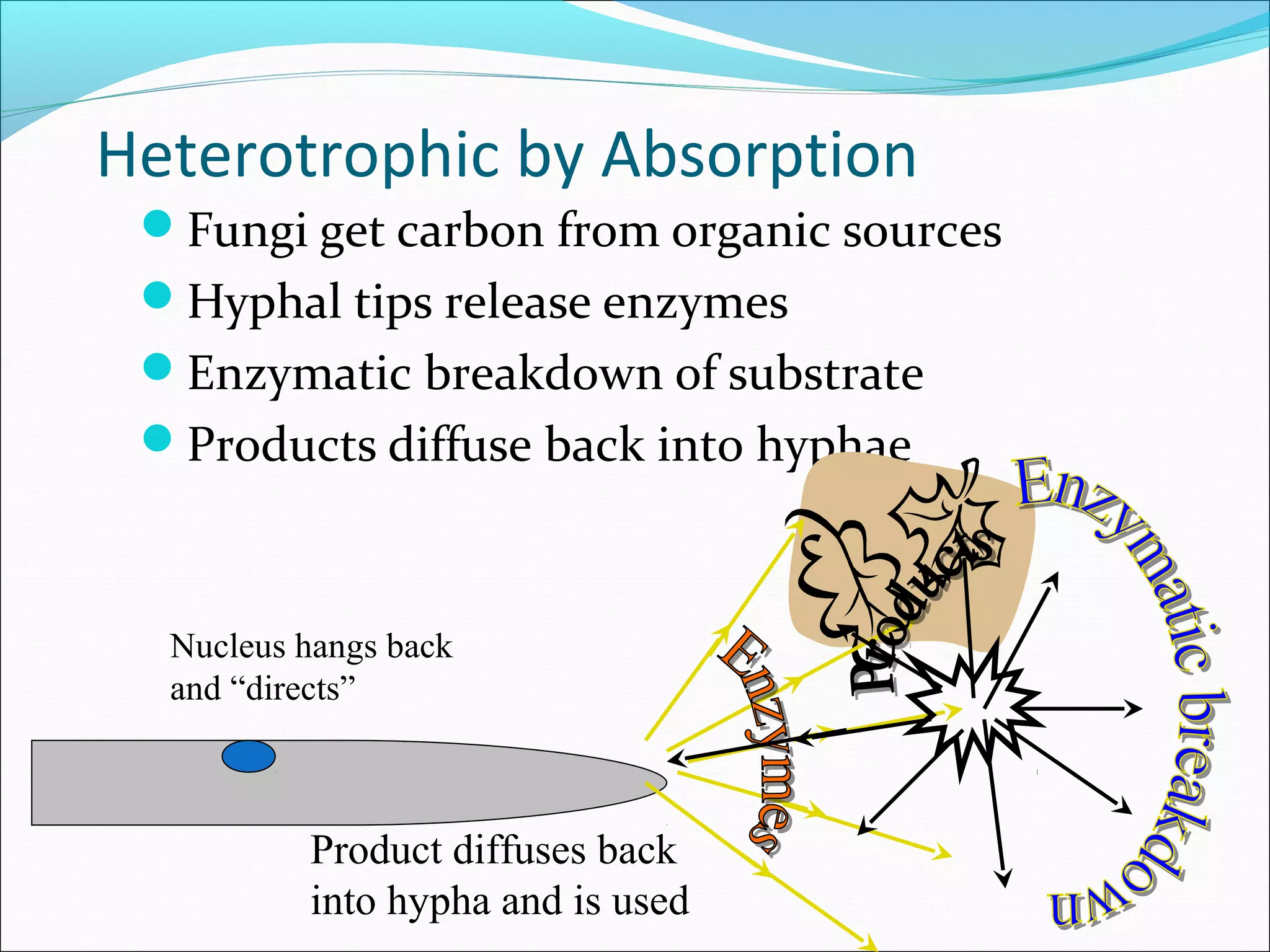
Heterotrophic by Absorption
Fungi get carbon from organic sources
Hyphal tips release enzymes
Enzymatic breakdown of substrate
Products diffuse back into hyphae
Product diffuses back
into hypha and is used
Nucleus hangs back
and “directs”
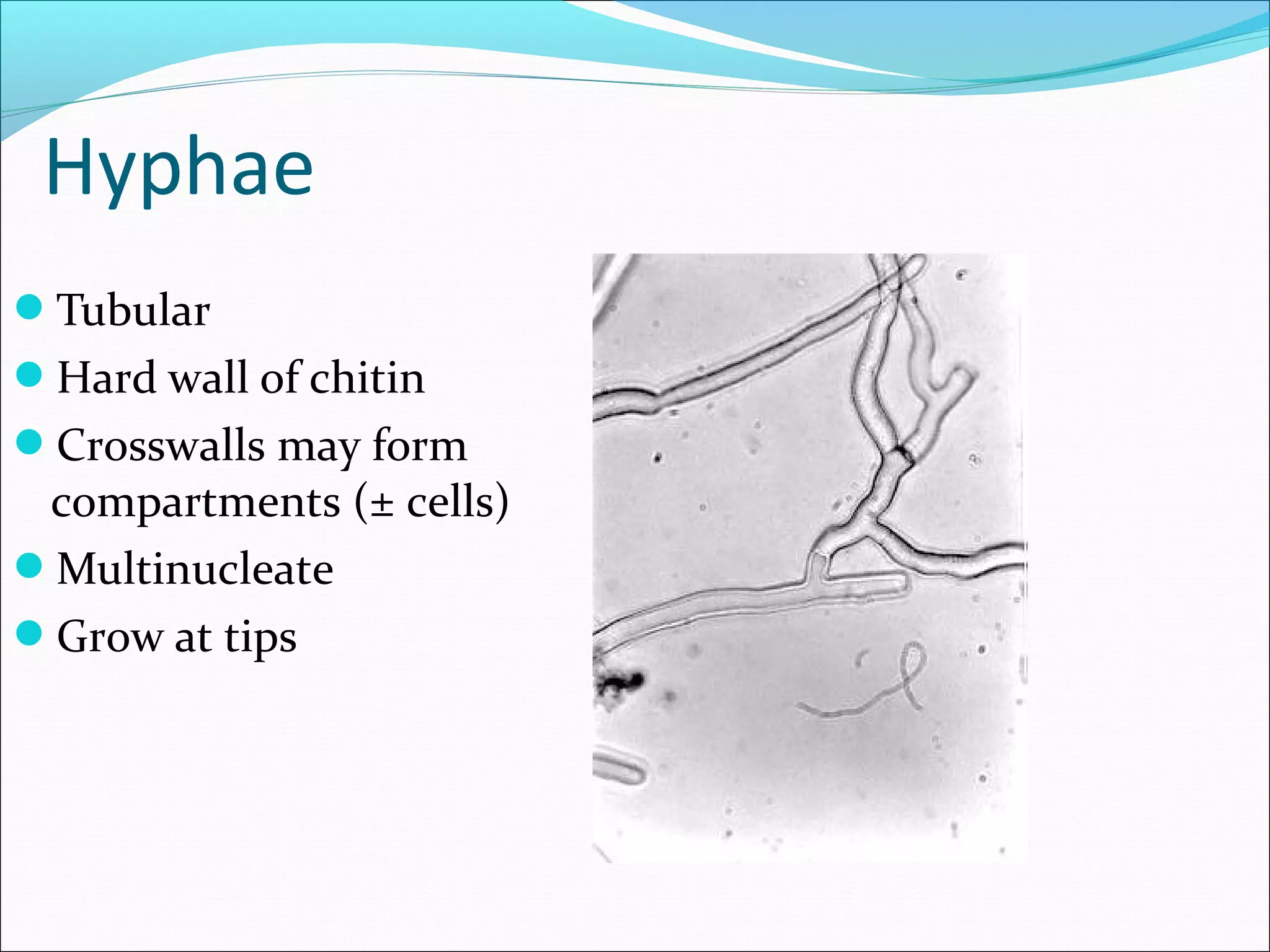
Hyphae
Tubular
Hard wall of chitin
Crosswalls may form
compartments (± cells)
Multinucleate
Grow at tips
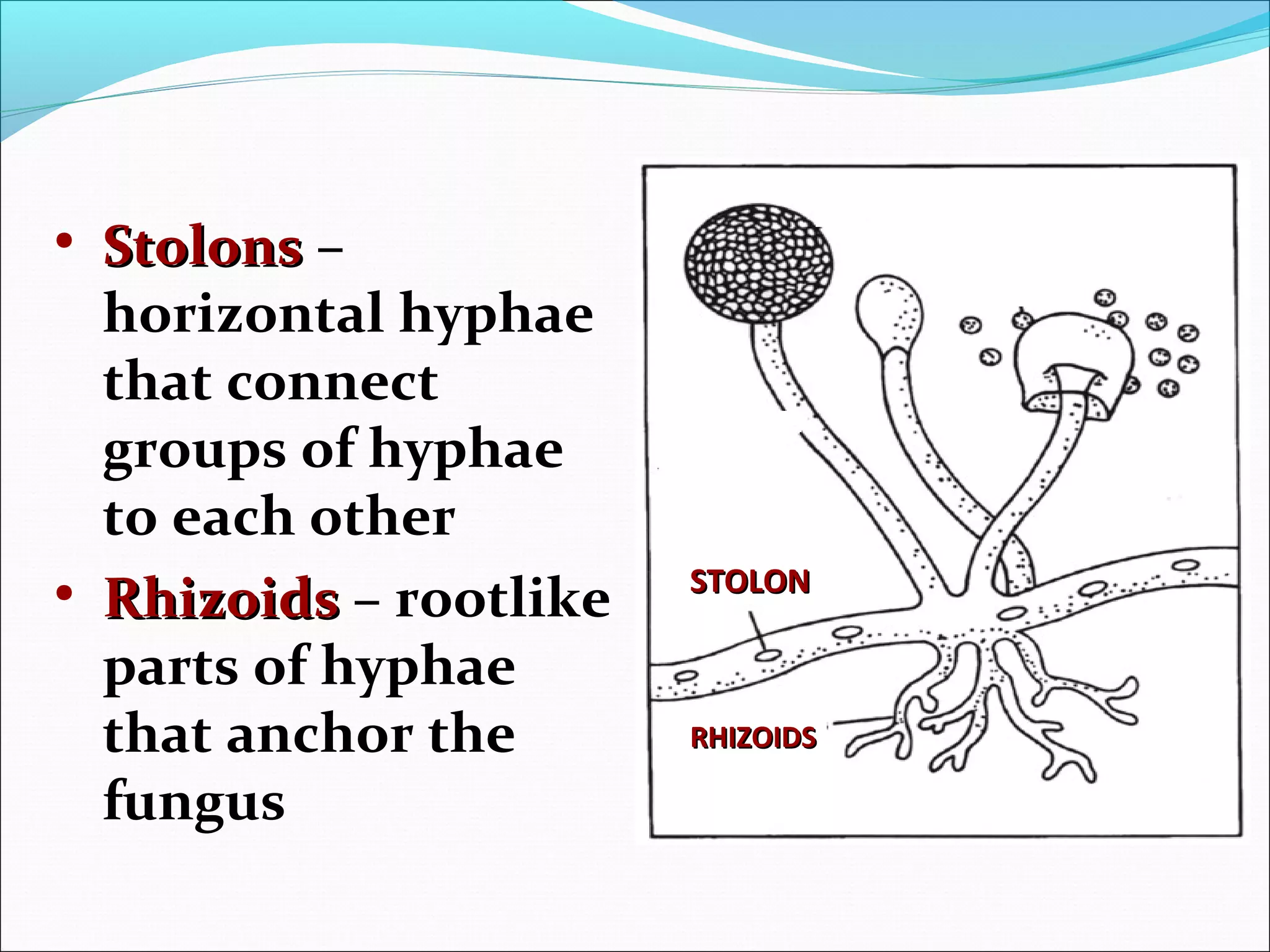
• StolonsStolons –
horizontal hyphae
that connect
groups of hyphae
to each other
• RhizoidsRhizoids – rootlike
parts of hyphae
that anchor the
fungus
STOLONSTOLON
RHIZOIDSRHIZOIDS
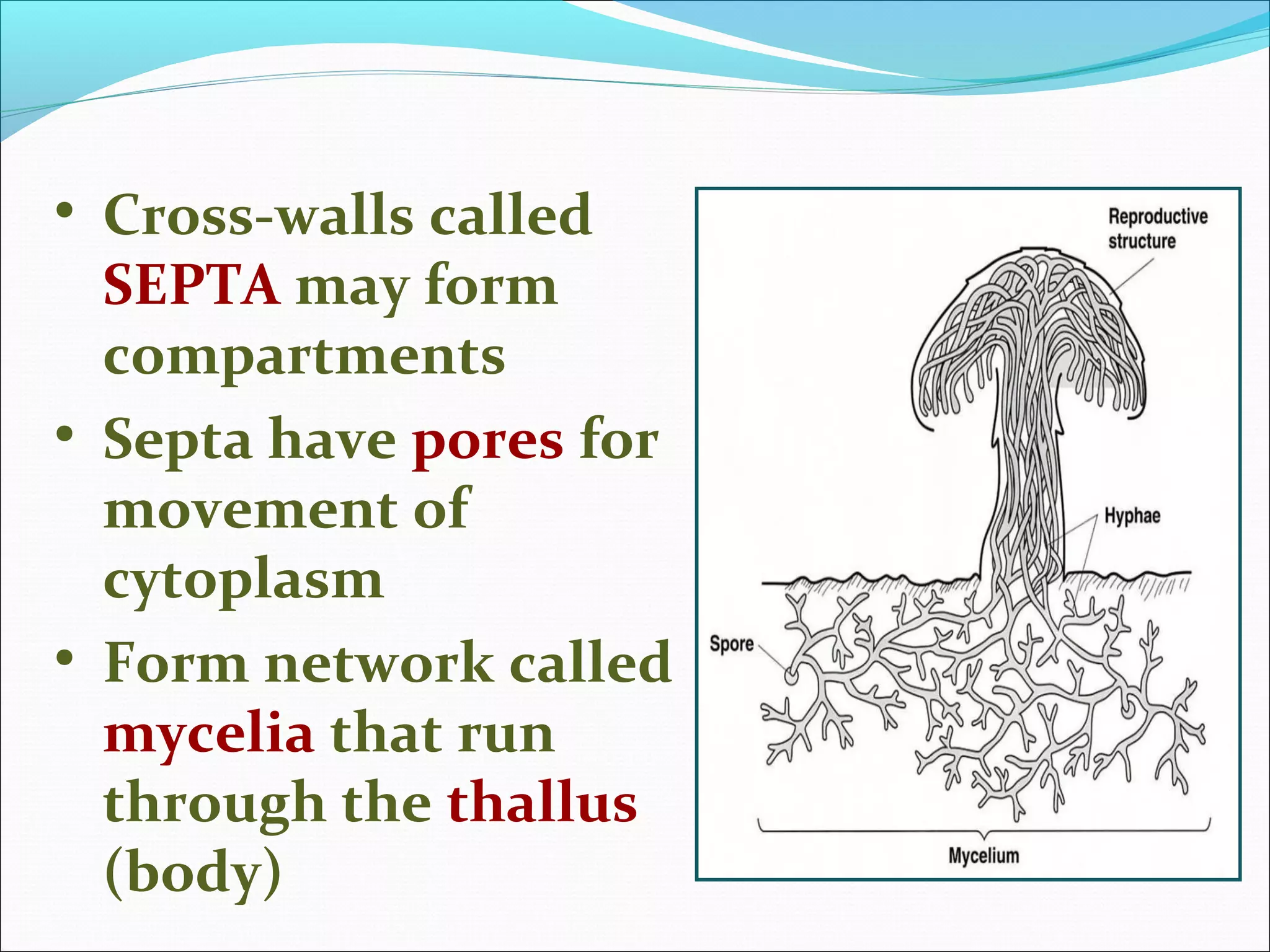
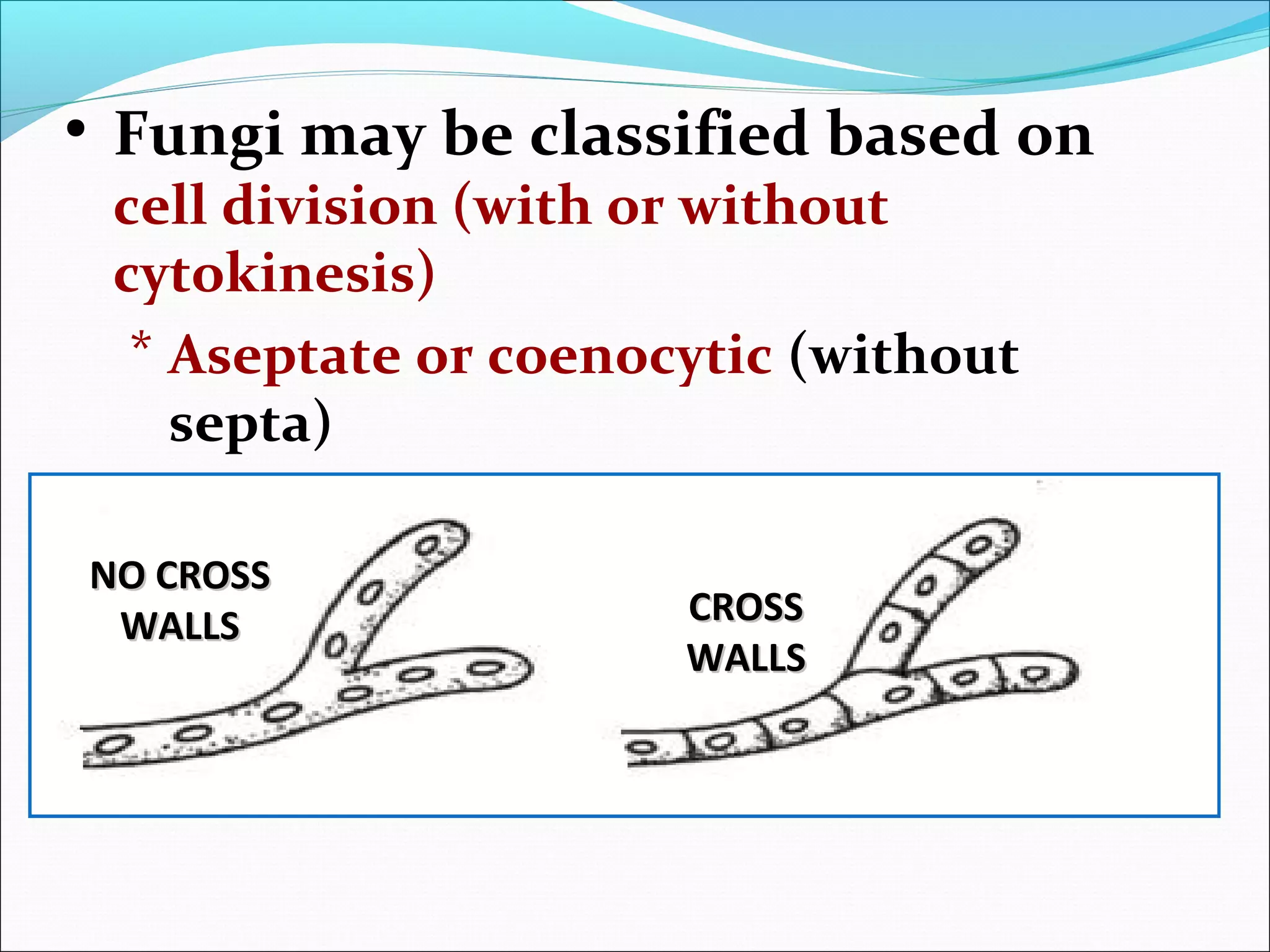
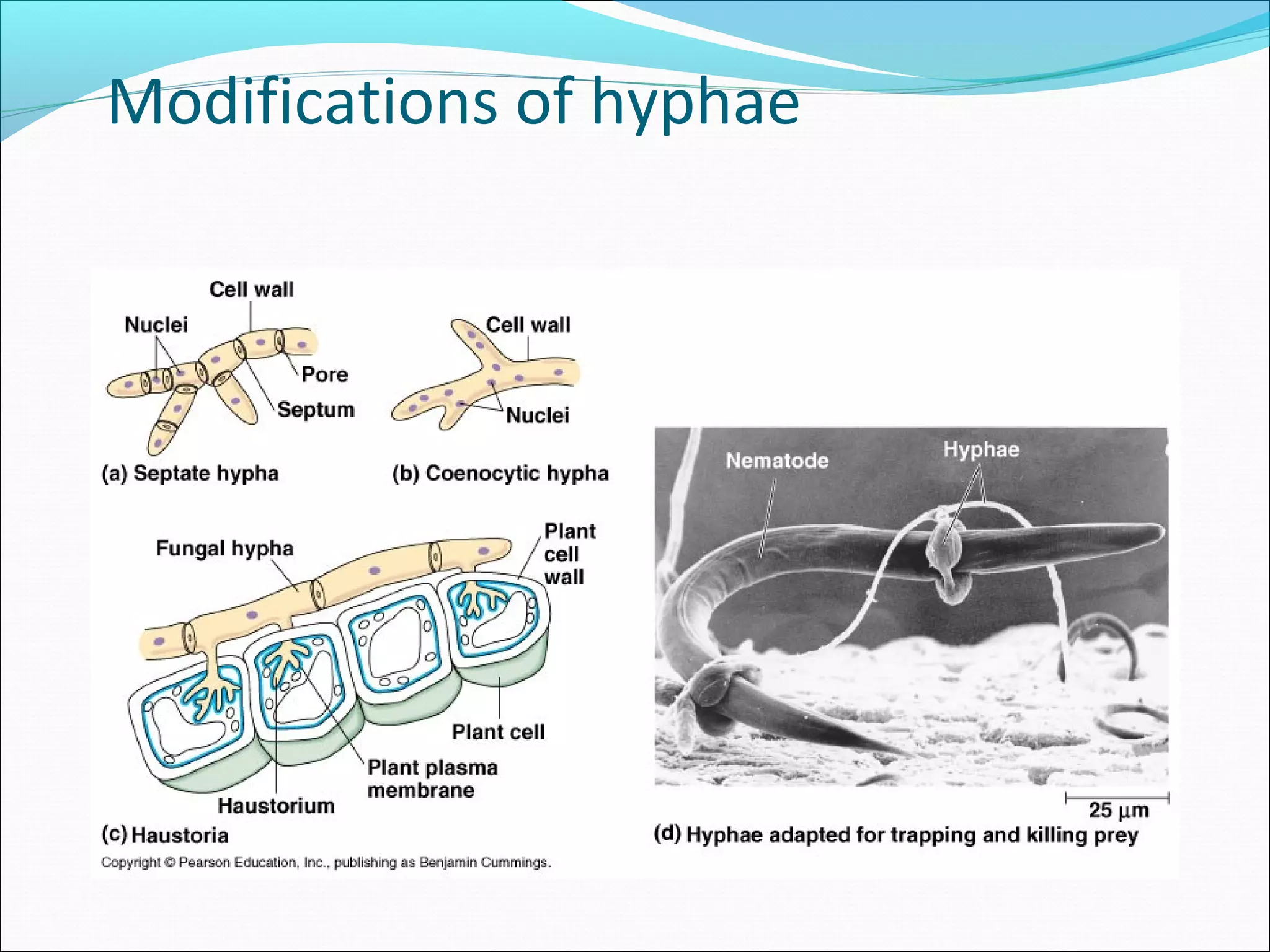
• Cross-walls called
SEPTA may form
compartments
• Septa have pores for
movement of
cytoplasm
• Form network called
mycelia that run
through the thallus
(body)
• Fungi may be classified based on
cell division (with or without
cytokinesis)
* Aseptate or coenocytic (without
septa)
* Septate (with septa)
NO CROSSNO CROSS
WALLSWALLS CROSSCROSS
WALLSWALLS
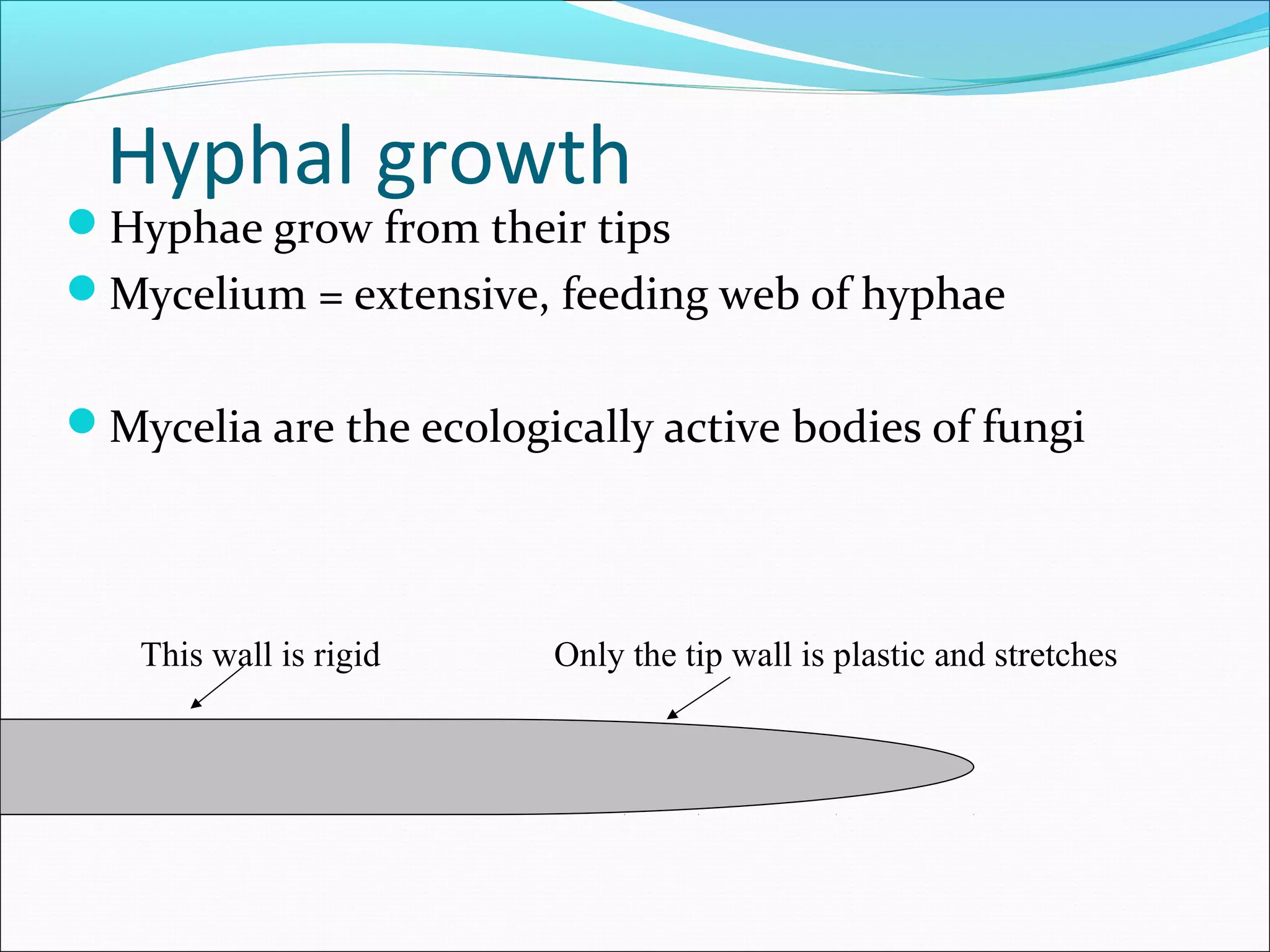
Hyphal growth
Hyphae grow from their tips
Mycelium = extensive, feeding web of hyphae
Mycelia are the ecologically active bodies of fungi
This wall is rigid Only the tip wall is plastic and stretches
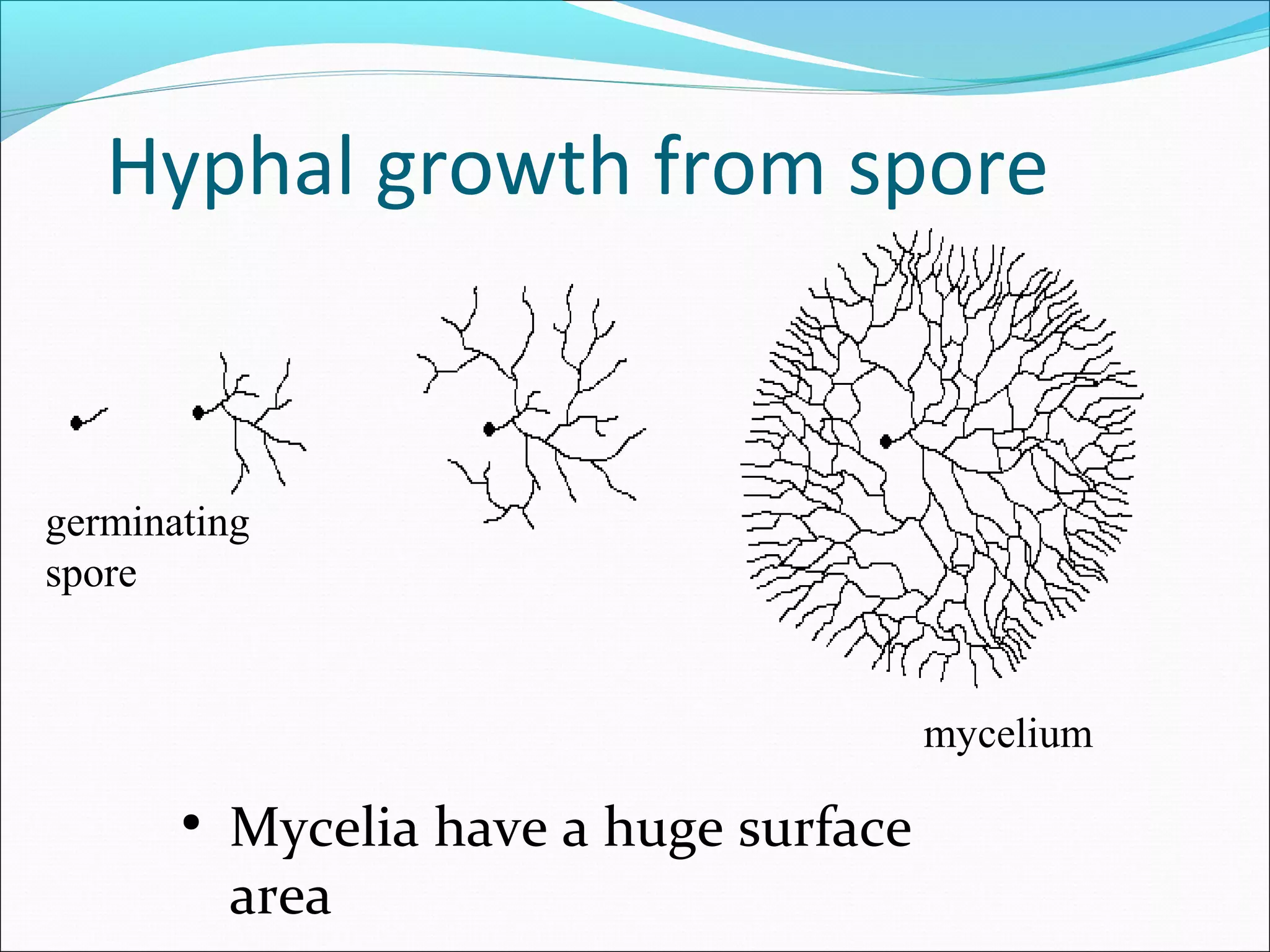
mycelium
germinating
spore
• Mycelia have a huge surface
area
Hyphal growth from spore
Modifications of hyphae
Reproduction in fungi
 Sexual - formation of zygospores, ascospores or
basidiospores
 Asexual reproduction – budding or fission
 Asexual spores are formed on or in specialized
structures.
 Vary in size, shape & colour but these
characteristics are constant for a particular
species.
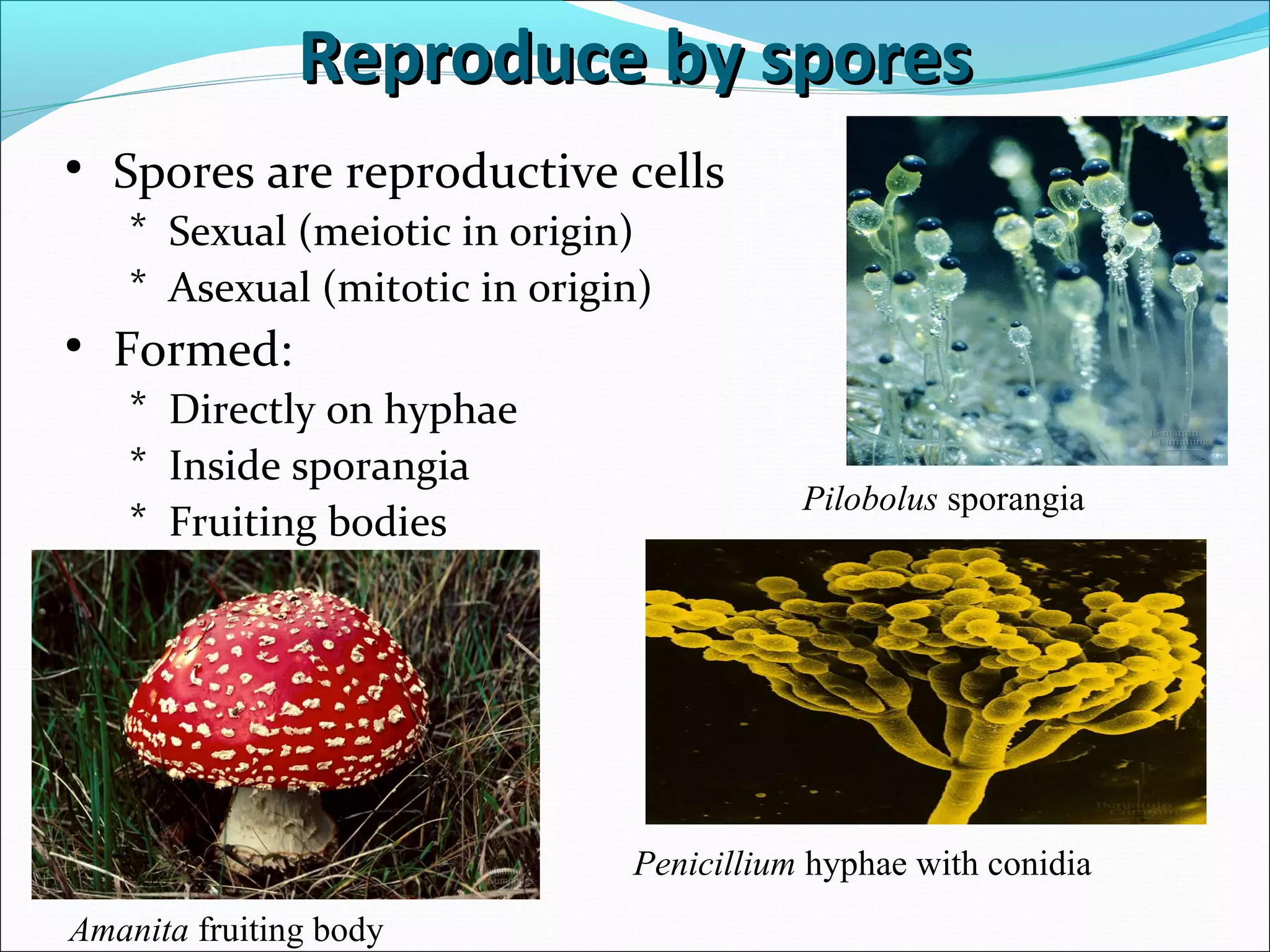
• Spores are reproductive cells
* Sexual (meiotic in origin)
* Asexual (mitotic in origin)
• Formed:
* Directly on hyphae
* Inside sporangia
* Fruiting bodies
Reproduce by sporesReproduce by spores
Amanita fruiting body
Pilobolus sporangia
Penicillium hyphae with conidia
Fungi are Spore-ific!!!Fungi are Spore-ific!!!
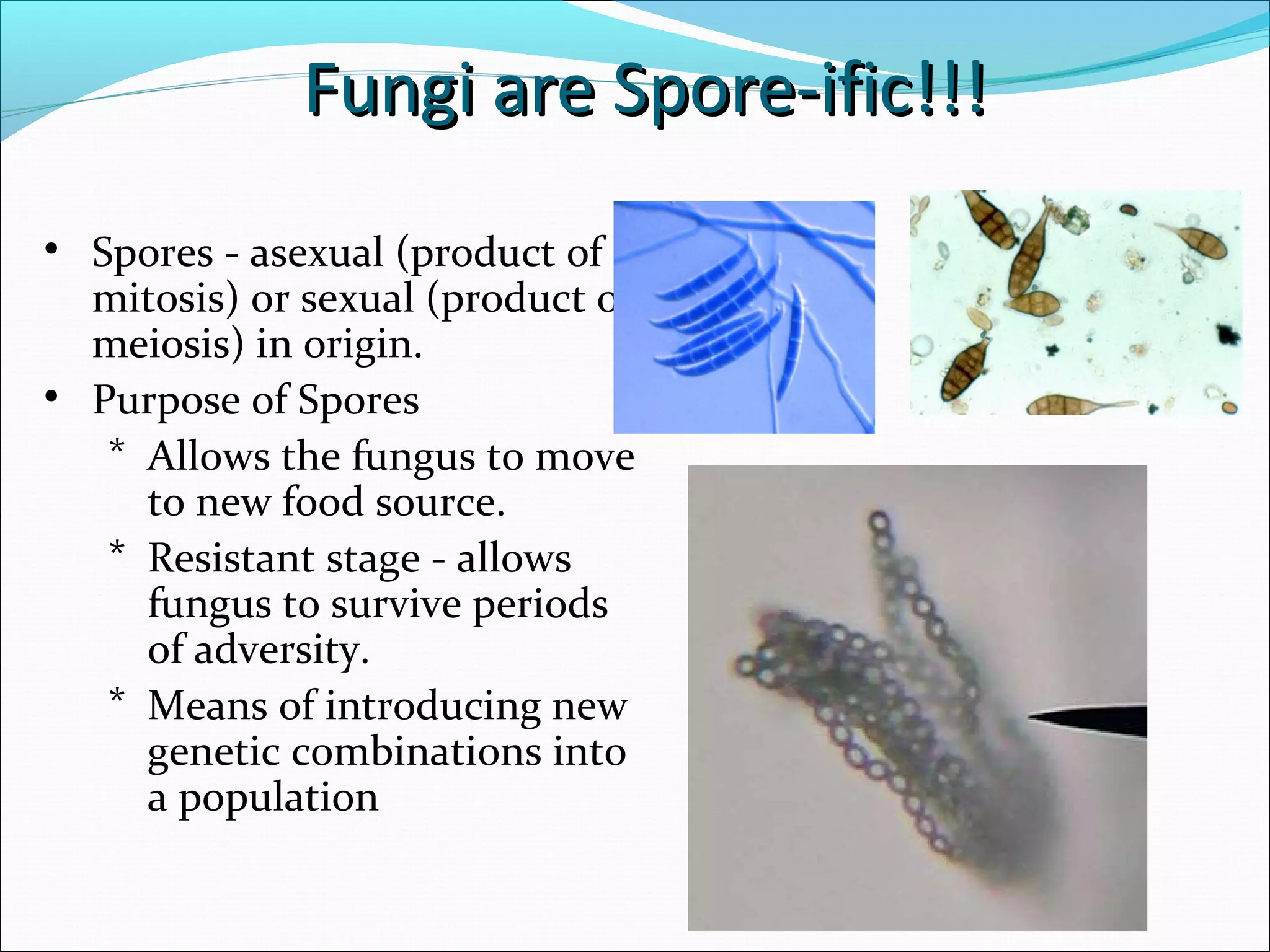
• Spores - asexual (product of
mitosis) or sexual (product of
meiosis) in origin.
• Purpose of Spores
* Allows the fungus to move
to new food source.
* Resistant stage - allows
fungus to survive periods
of adversity.
* Means of introducing new
genetic combinations into
a population
Asexual Reproduction
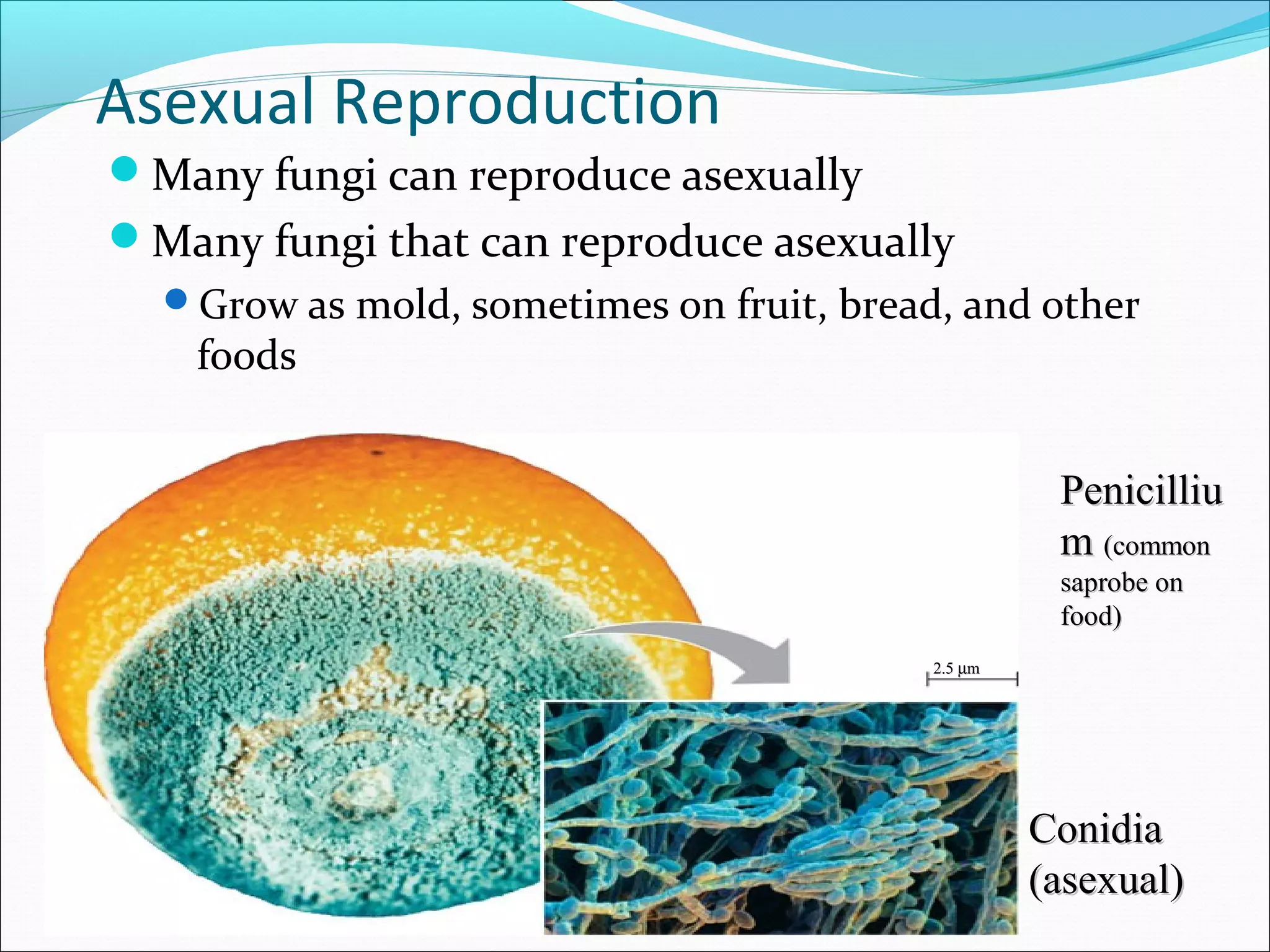
Many fungi can reproduce asexually
Many fungi that can reproduce asexually
Grow as mold, sometimes on fruit, bread, and other
foods
2.52.5 µµmm
ConidiaConidia
(asexual)(asexual)
PenicilliuPenicilliu
mm (common(common
saprobe onsaprobe on
food)food)
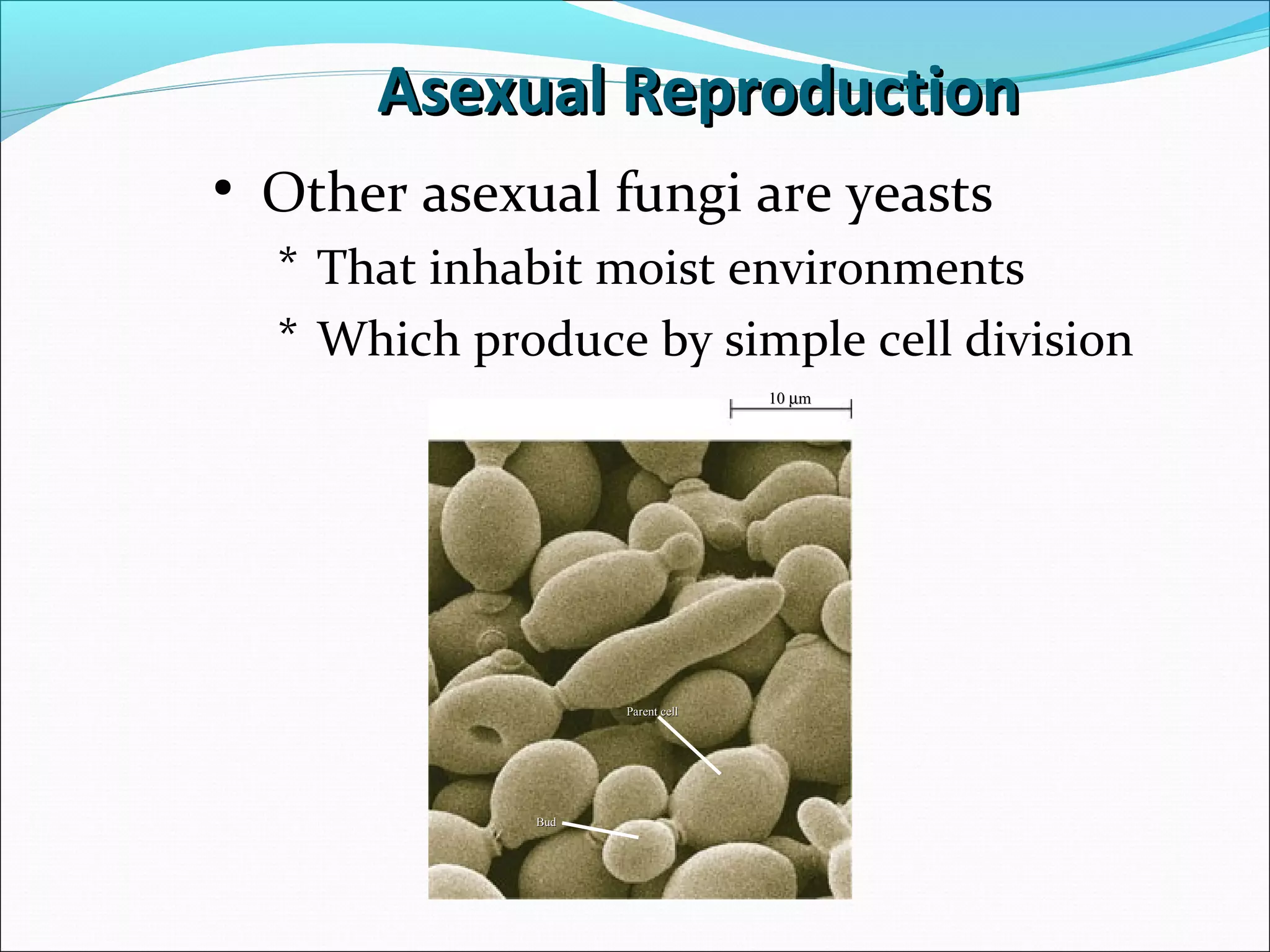
• Other asexual fungi are yeasts
* That inhabit moist environments
* Which produce by simple cell division
1010 µµmm
Parent cellParent cell
BudBud
Asexual ReproductionAsexual Reproduction
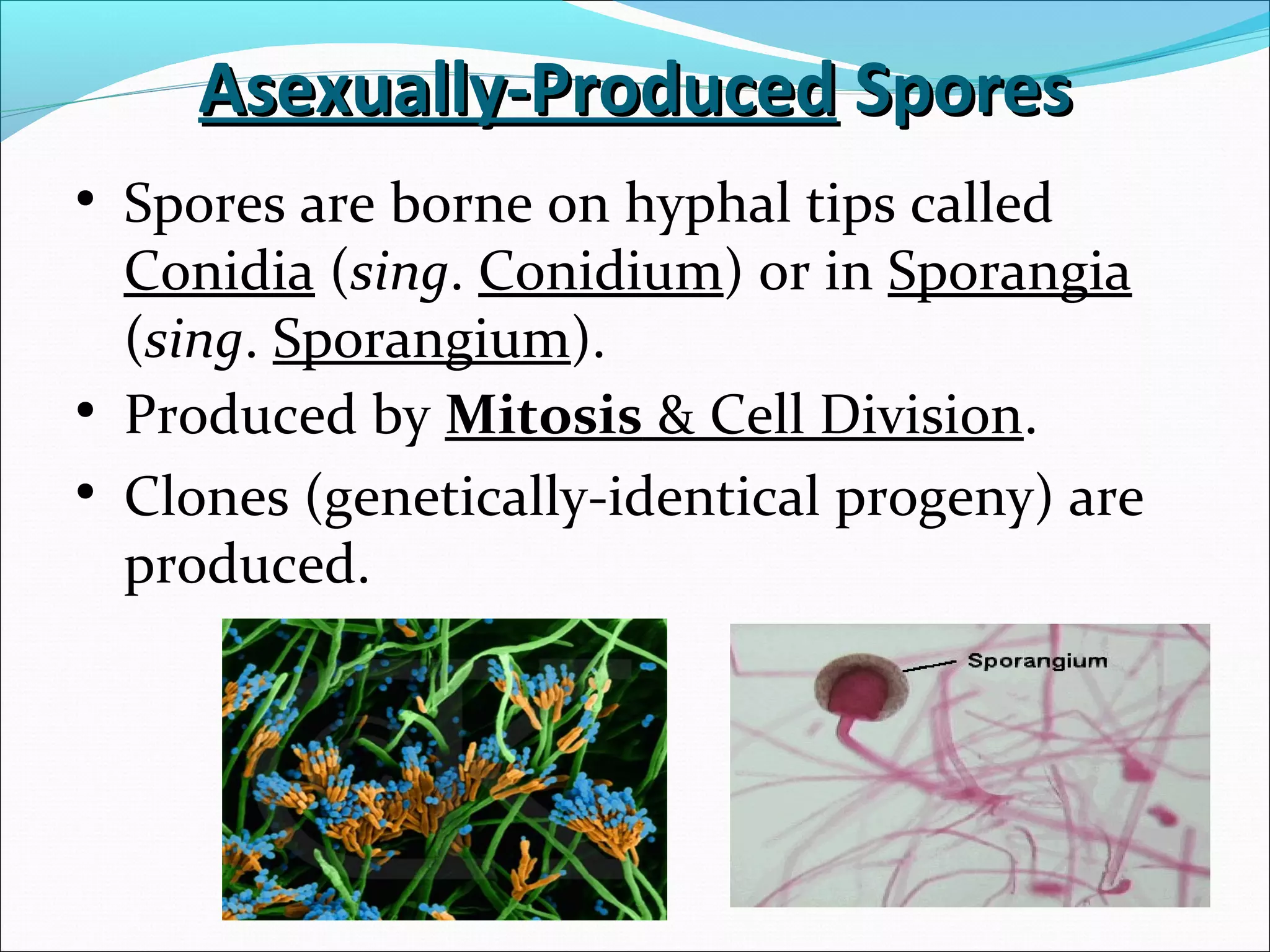
• Spores are borne on hyphal tips called
Conidia (sing. Conidium) or in Sporangia
(sing. Sporangium).
Asexually-ProducedAsexually-Produced SporesSpores
• Produced by Mitosis & Cell Division.
• Clones (genetically-identical progeny) are
produced.
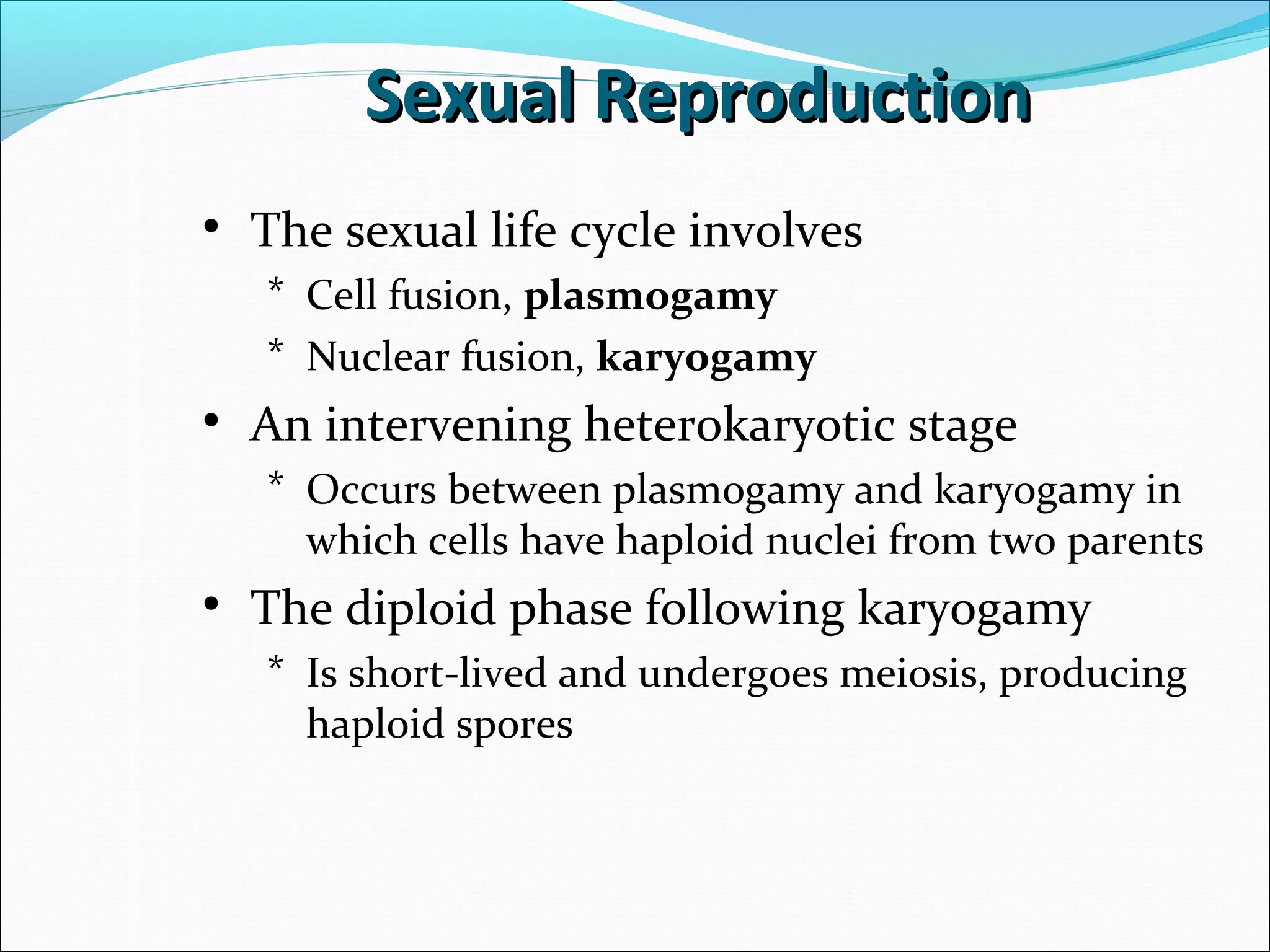
• The sexual life cycle involves
* Cell fusion, plasmogamy
* Nuclear fusion, karyogamy
• An intervening heterokaryotic stage
* Occurs between plasmogamy and karyogamy in
which cells have haploid nuclei from two parents
• The diploid phase following karyogamy
* Is short-lived and undergoes meiosis, producing
haploid spores
Sexual ReproductionSexual Reproduction
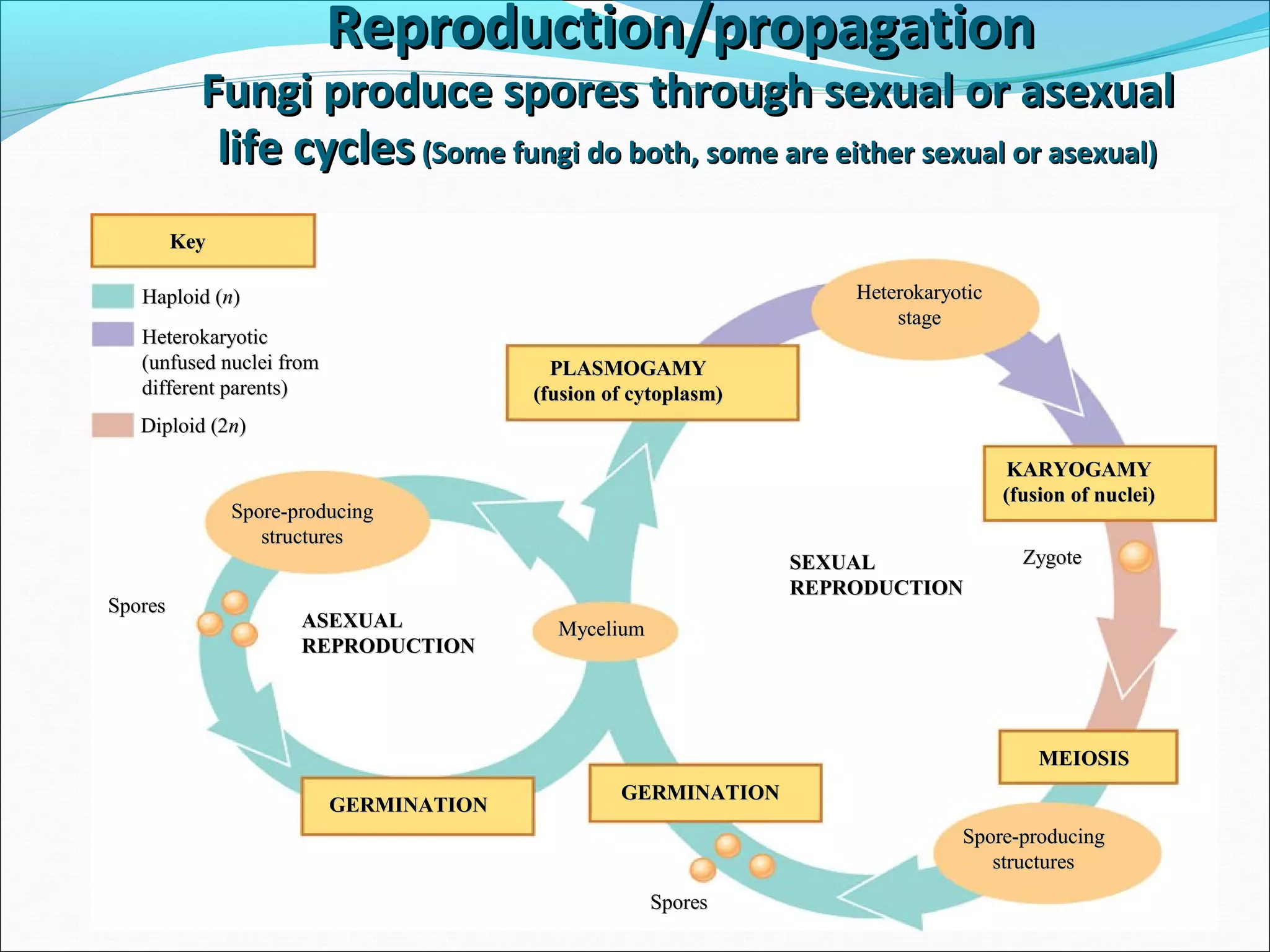
KeyKey
Haploid (Haploid (nn))
HeterokaryoticHeterokaryotic
(unfused nuclei from(unfused nuclei from
different parents)different parents)
Diploid (2Diploid (2nn))
PLASMOGAMYPLASMOGAMY
(fusion of cytoplasm)(fusion of cytoplasm)
HeterokaryoticHeterokaryotic
stagestage
KARYOGAMYKARYOGAMY
(fusion of nuclei)(fusion of nuclei)
SEXUALSEXUAL
REPRODUCTIONREPRODUCTION
Spore-producingSpore-producing
structuresstructures
SporesSpores
ASEXUALASEXUAL
REPRODUCTIONREPRODUCTION
ZygoteZygote
MyceliumMycelium
GERMINATIONGERMINATION
MEIOSISMEIOSIS
Spore-producingSpore-producing
structuresstructures
SporesSpores
Reproduction/propagationReproduction/propagation
Fungi produce spores through sexual or asexualFungi produce spores through sexual or asexual
life cycleslife cycles (Some fungi do both, some are either sexual or asexual)(Some fungi do both, some are either sexual or asexual)
Systematic classificationSystematic classification
FFungi comprise a monophyletic group broken into 4 lineagesungi comprise a monophyletic group broken into 4 lineages
(therefore also 4 Phyla):(therefore also 4 Phyla):
Phylum: ChytridiomycotaPhylum: Chytridiomycota
Phylum: ZygomycotaPhylum: Zygomycota
Phylum: AscomycotaPhylum: Ascomycota
Phylum: BasidiomycotaPhylum: Basidiomycota
““Phylum”: Deuteromycota is an artificial groupPhylum”: Deuteromycota is an artificial group
representing fungi that do not or have yet to exhibit arepresenting fungi that do not or have yet to exhibit a
sexual stage (meiosis & syngamy).sexual stage (meiosis & syngamy).
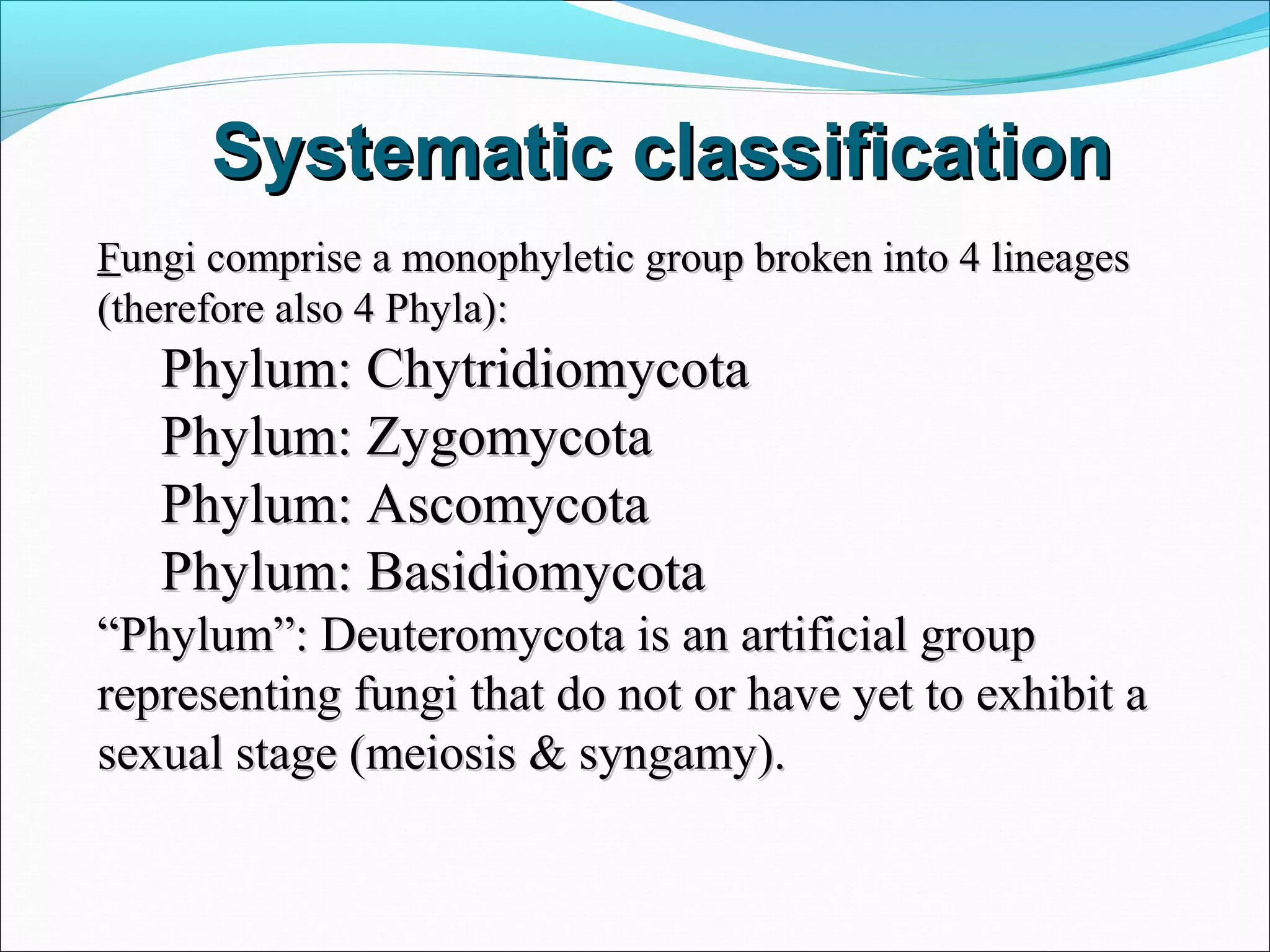
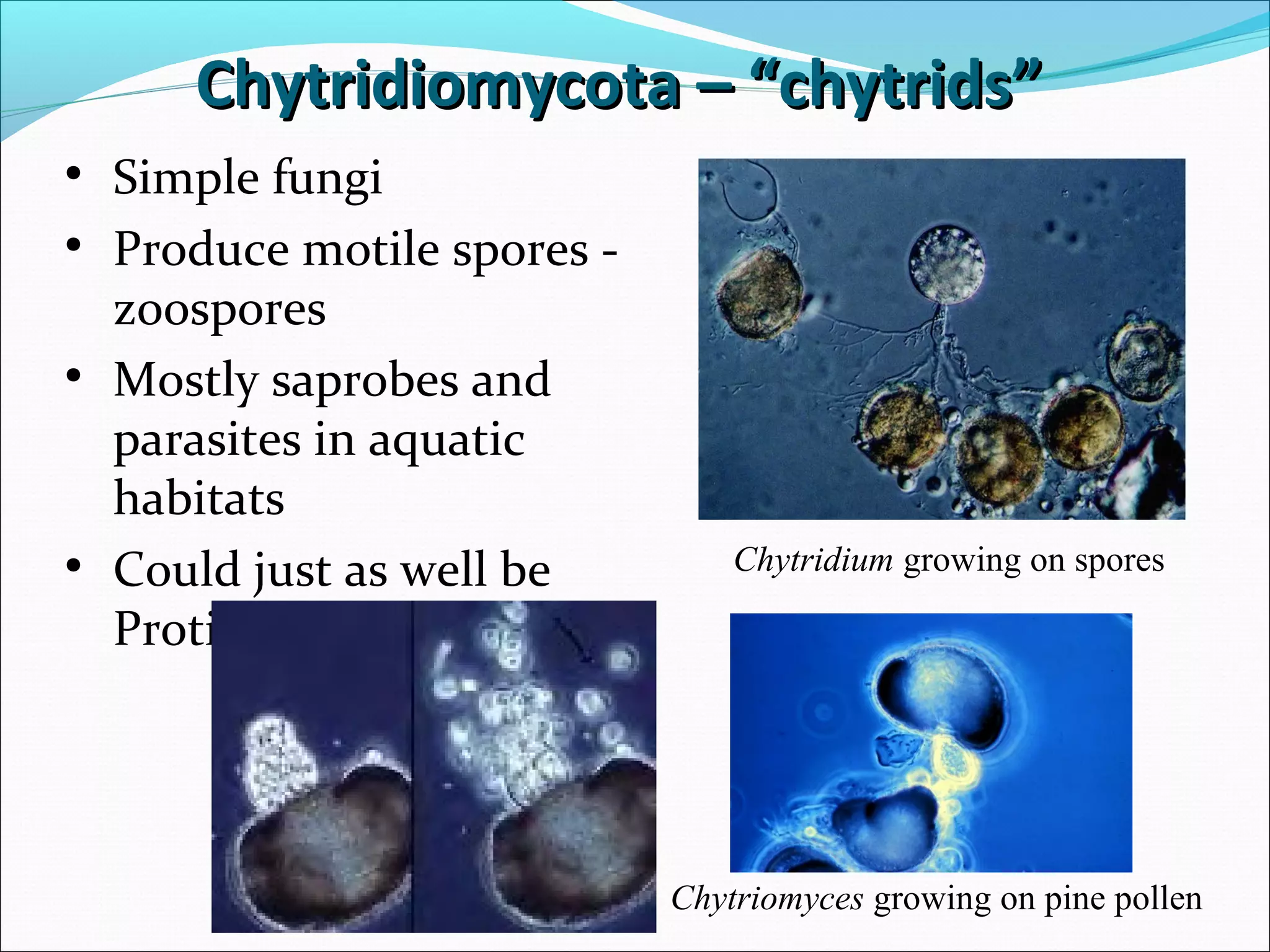
Chytridiomycota – “chytrids”Chytridiomycota – “chytrids”
• Simple fungi
• Produce motile spores -
zoospores
• Mostly saprobes and
parasites in aquatic
habitats
• Could just as well be
Protists
Chytridium growing on spores
Chytriomyces growing on pine pollen
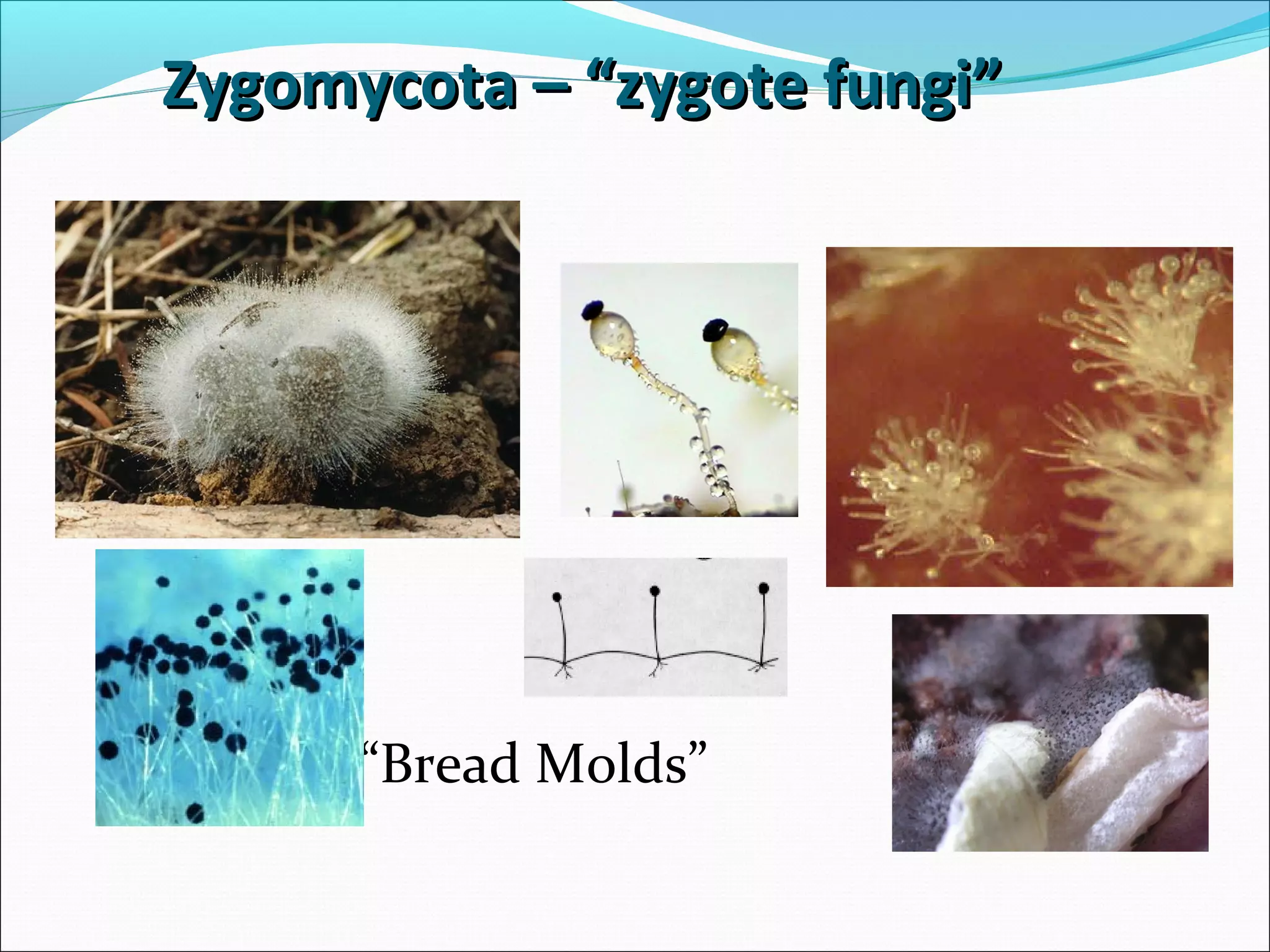
• The “Bread Molds”
Zygomycota – “zygote fungi”Zygomycota – “zygote fungi”
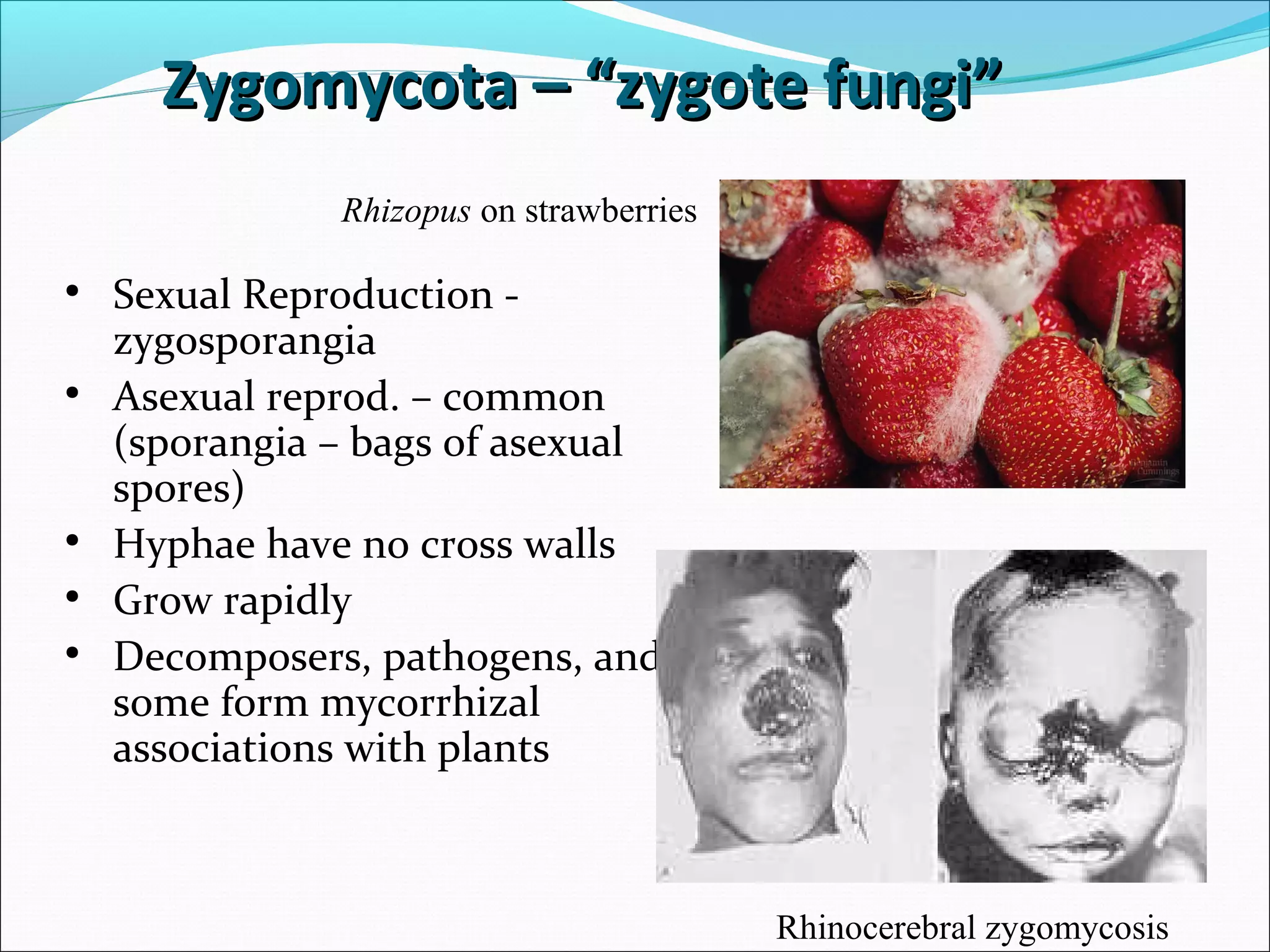
• Sexual Reproduction -
zygosporangia
• Asexual reprod. – common
(sporangia – bags of asexual
spores)
• Hyphae have no cross walls
• Grow rapidly
• Decomposers, pathogens, and
some form mycorrhizal
associations with plants
Rhizopus on strawberries
Rhinocerebral zygomycosis
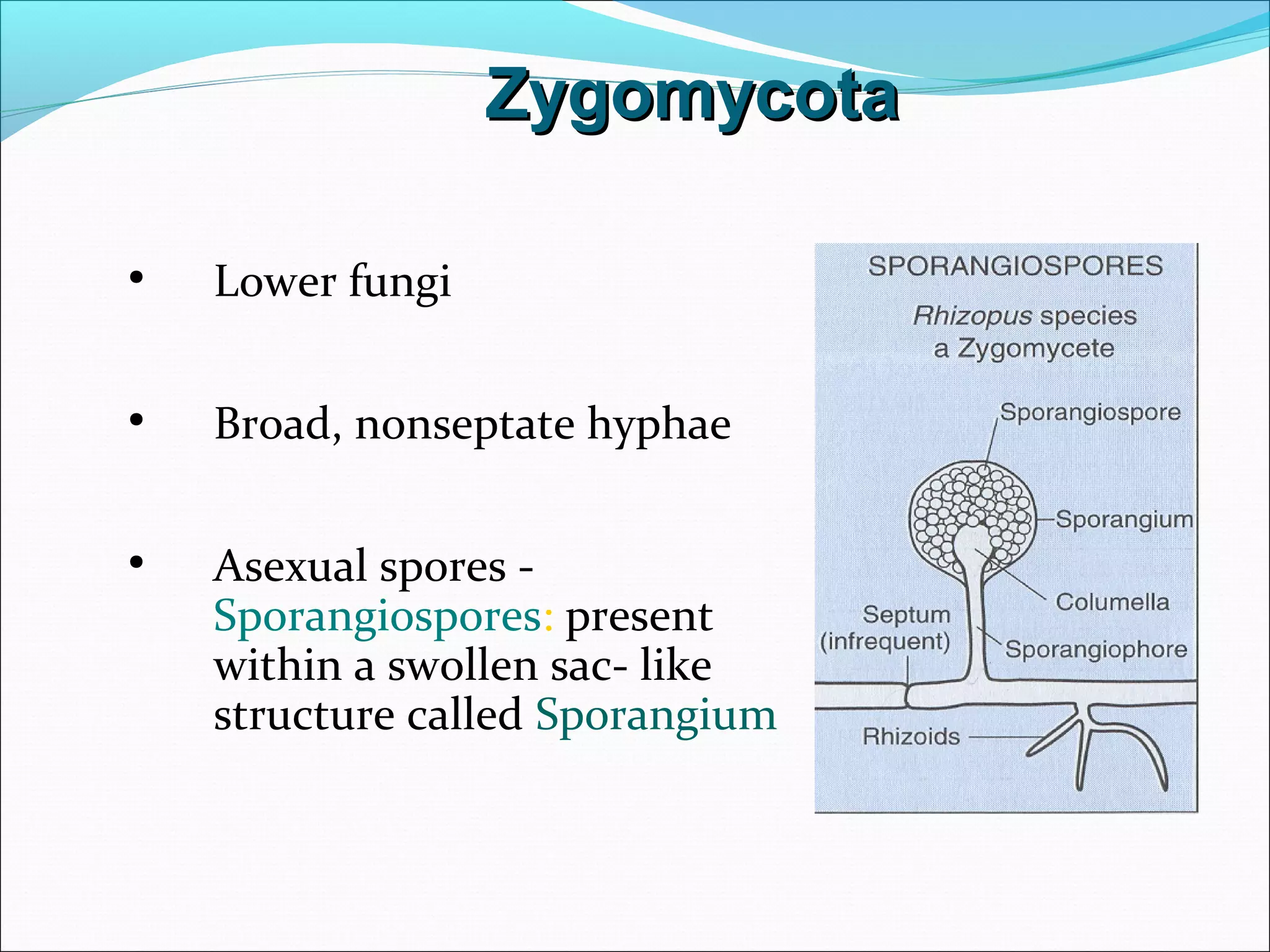
• Lower fungi
• Broad, nonseptate hyphae
• Asexual spores -
Sporangiospores: present
within a swollen sac- like
structure called Sporangium
ZygomycotaZygomycota
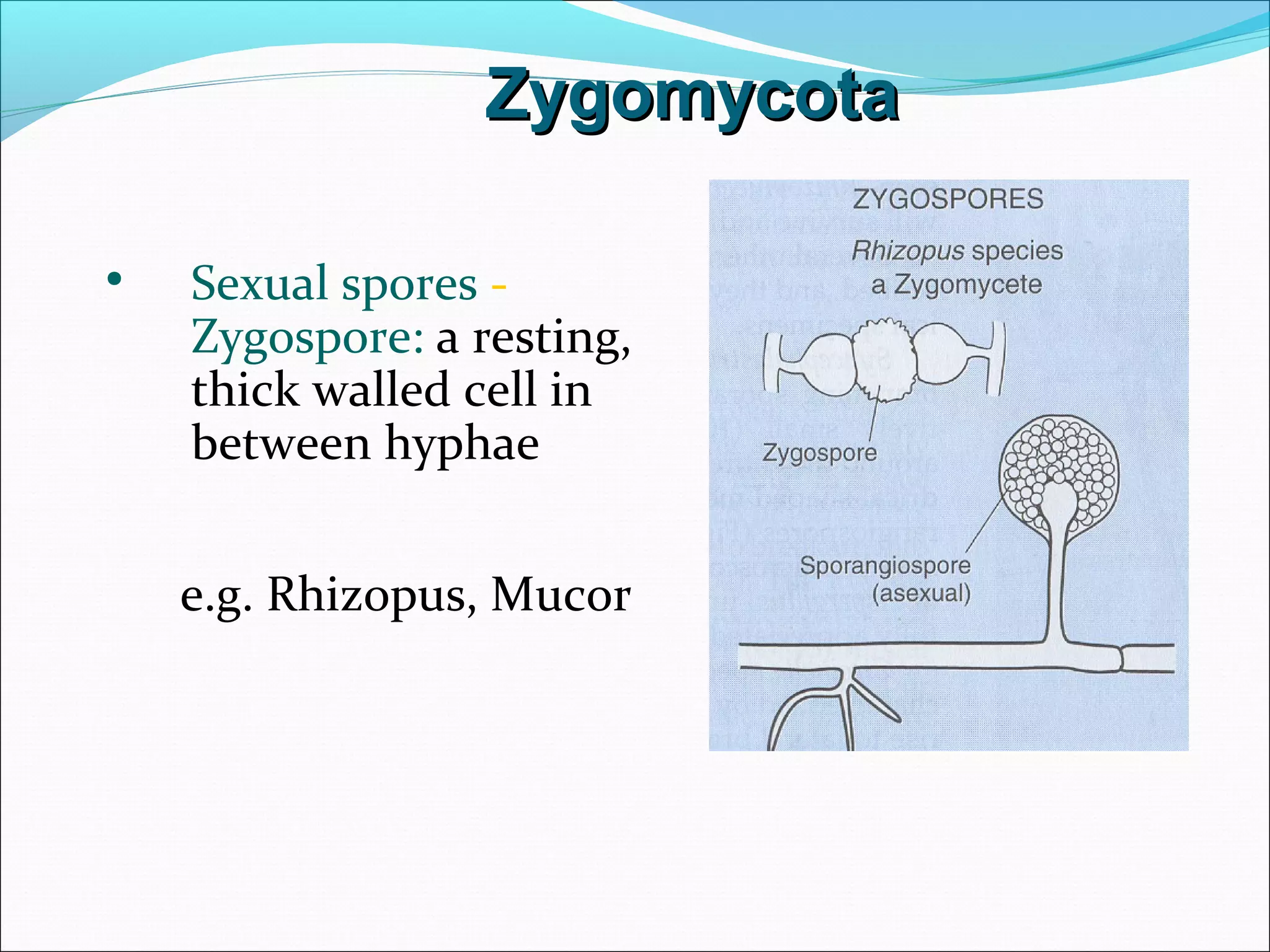
• Sexual spores -
Zygospore: a resting,
thick walled cell in
between hyphae
e.g. Rhizopus, Mucor
ZygomycotaZygomycota
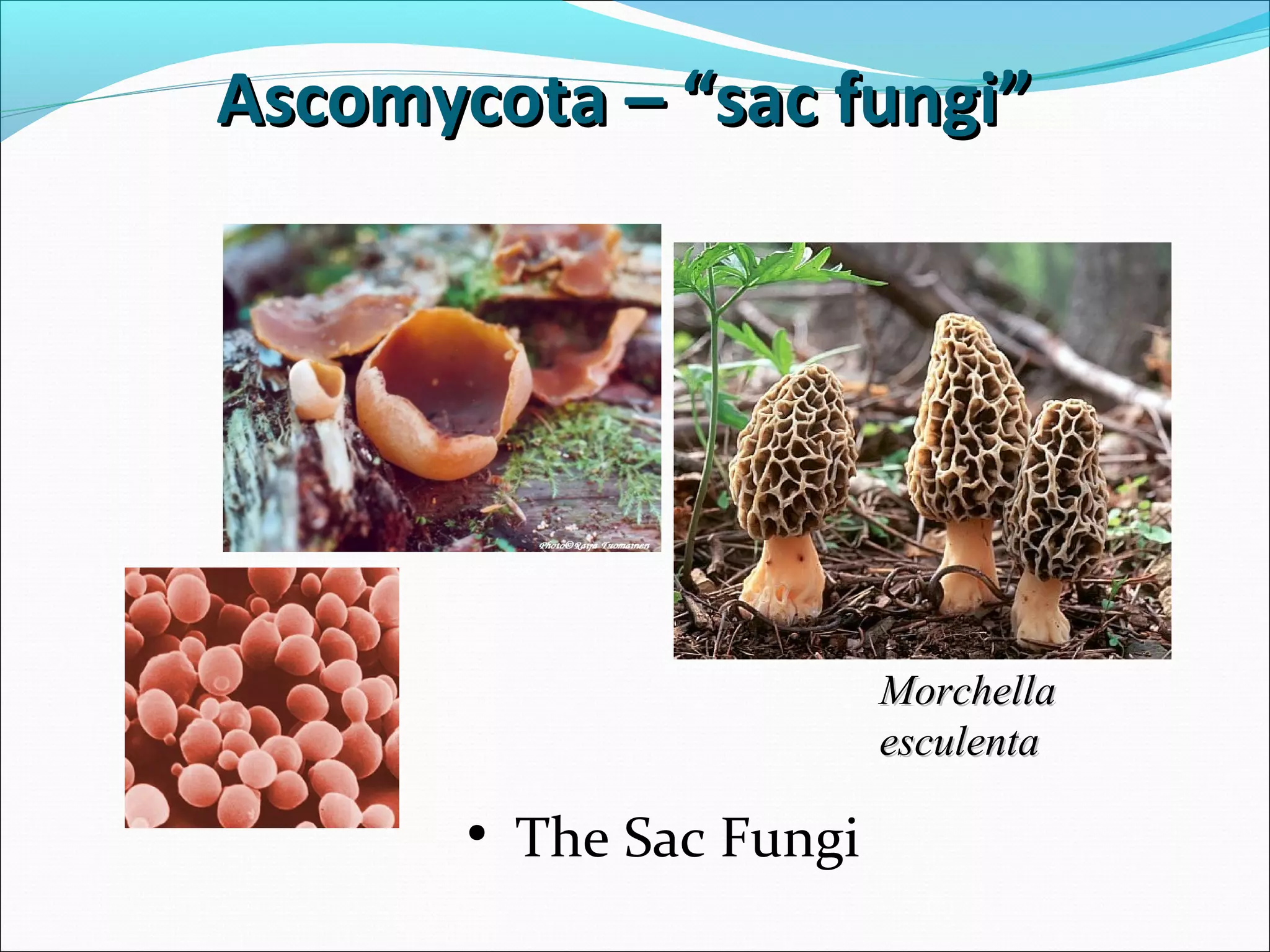
• The Sac Fungi
MorchellaMorchella
esculentaesculenta
Ascomycota – “sac fungi”Ascomycota – “sac fungi”
AscomycotaAscomycota
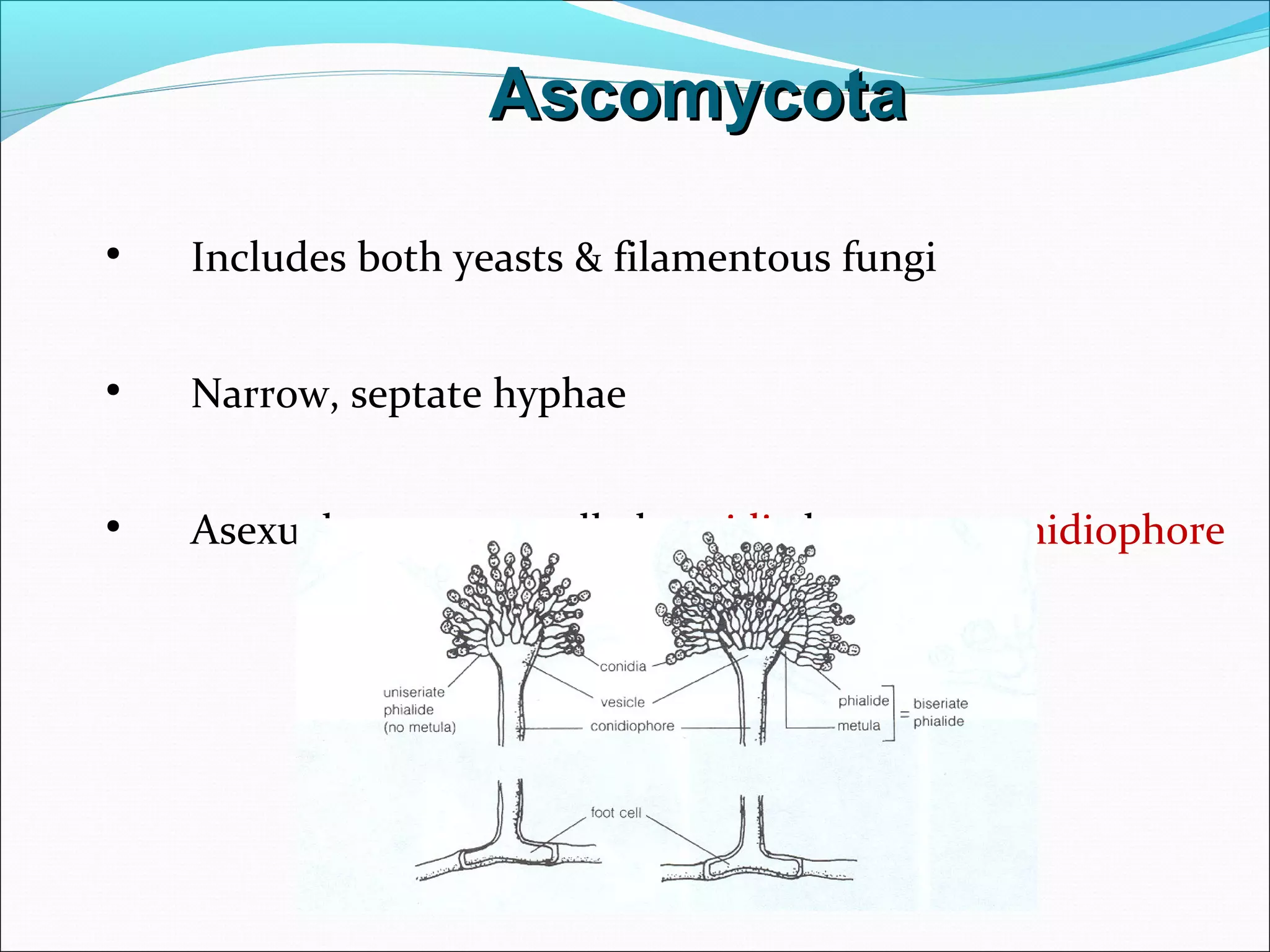
• Includes both yeasts & filamentous fungi
• Narrow, septate hyphae
• Asexual spores are called conidia borne on conidiophore
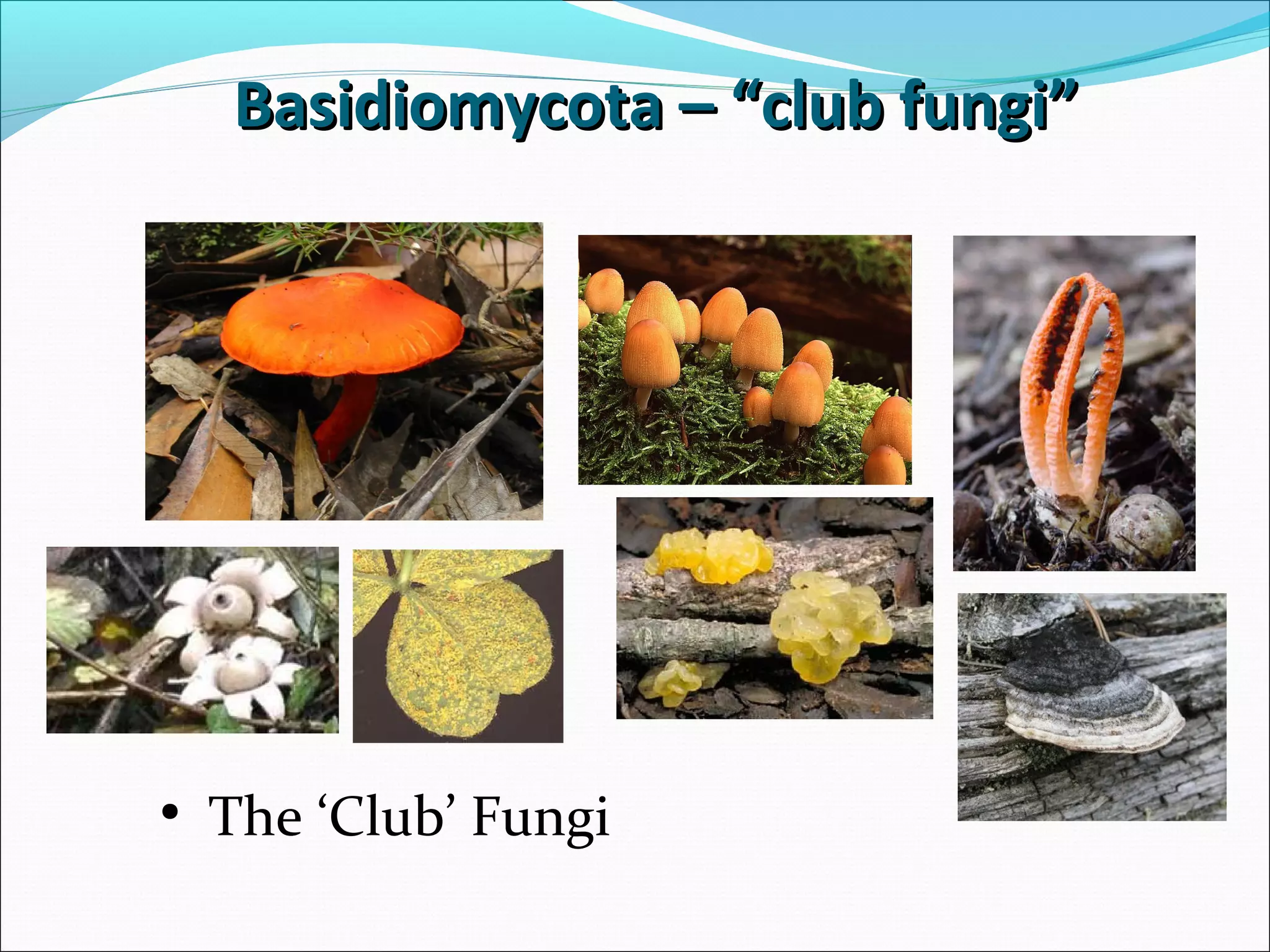
• Sexual spores called ascospores are
present within a sac like structure
called Ascus.
• Several asci may be seen within a
fruiting body as seen in Penicillium,
Aspergillus
• Each ascus has 4 to 8 ascospores.
AscomycotaAscomycota
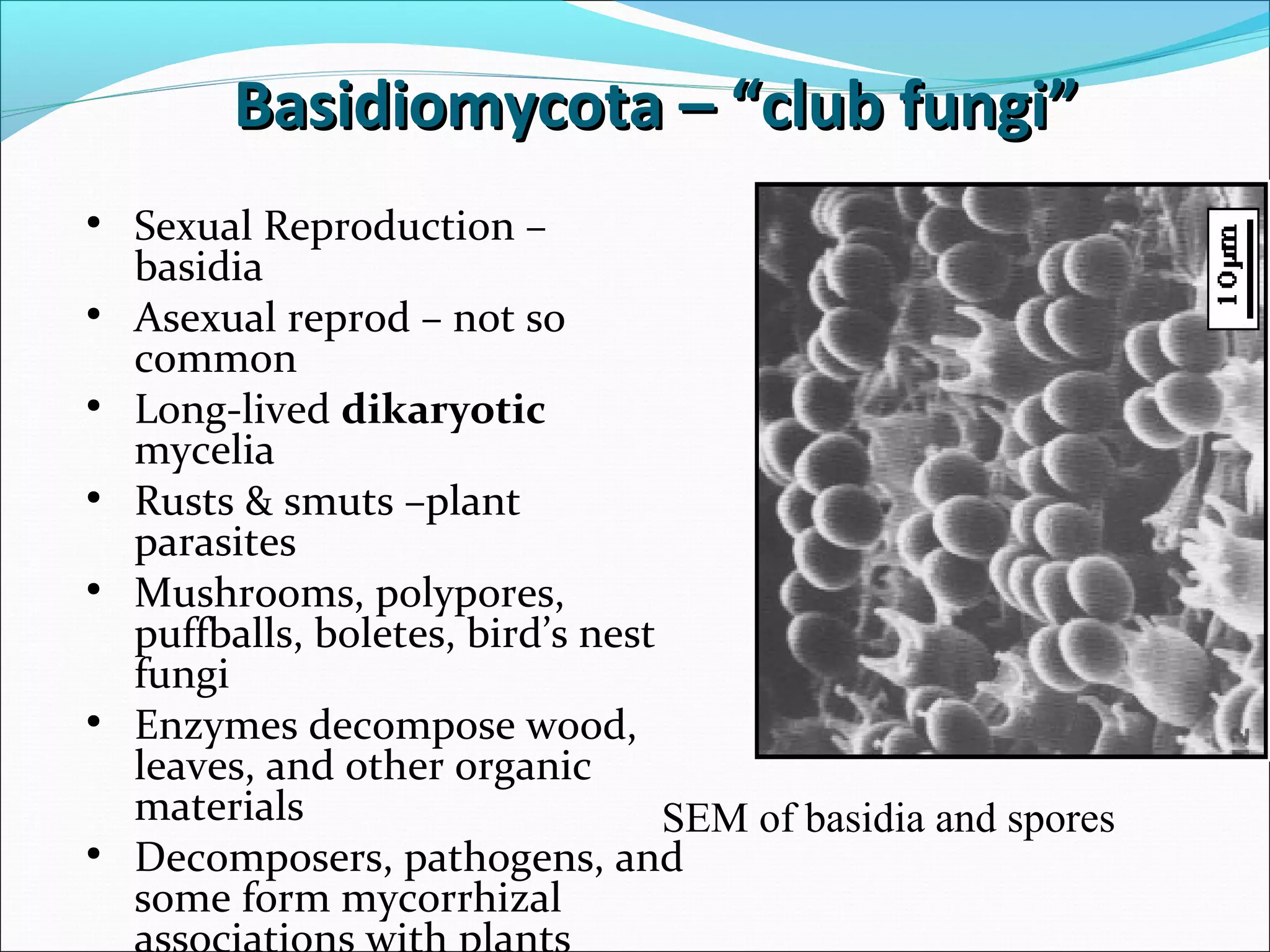
• The ‘Club’ Fungi
Basidiomycota – “club fungi”Basidiomycota – “club fungi”
• Sexual Reproduction –
basidia
• Asexual reprod – not so
common
• Long-lived dikaryotic
mycelia
• Rusts & smuts –plant
parasites
• Mushrooms, polypores,
puffballs, boletes, bird’s nest
fungi
• Enzymes decompose wood,
leaves, and other organic
materials
• Decomposers, pathogens, and
some form mycorrhizal
SEM of basidia and spores
BasidiomycotaBasidiomycota
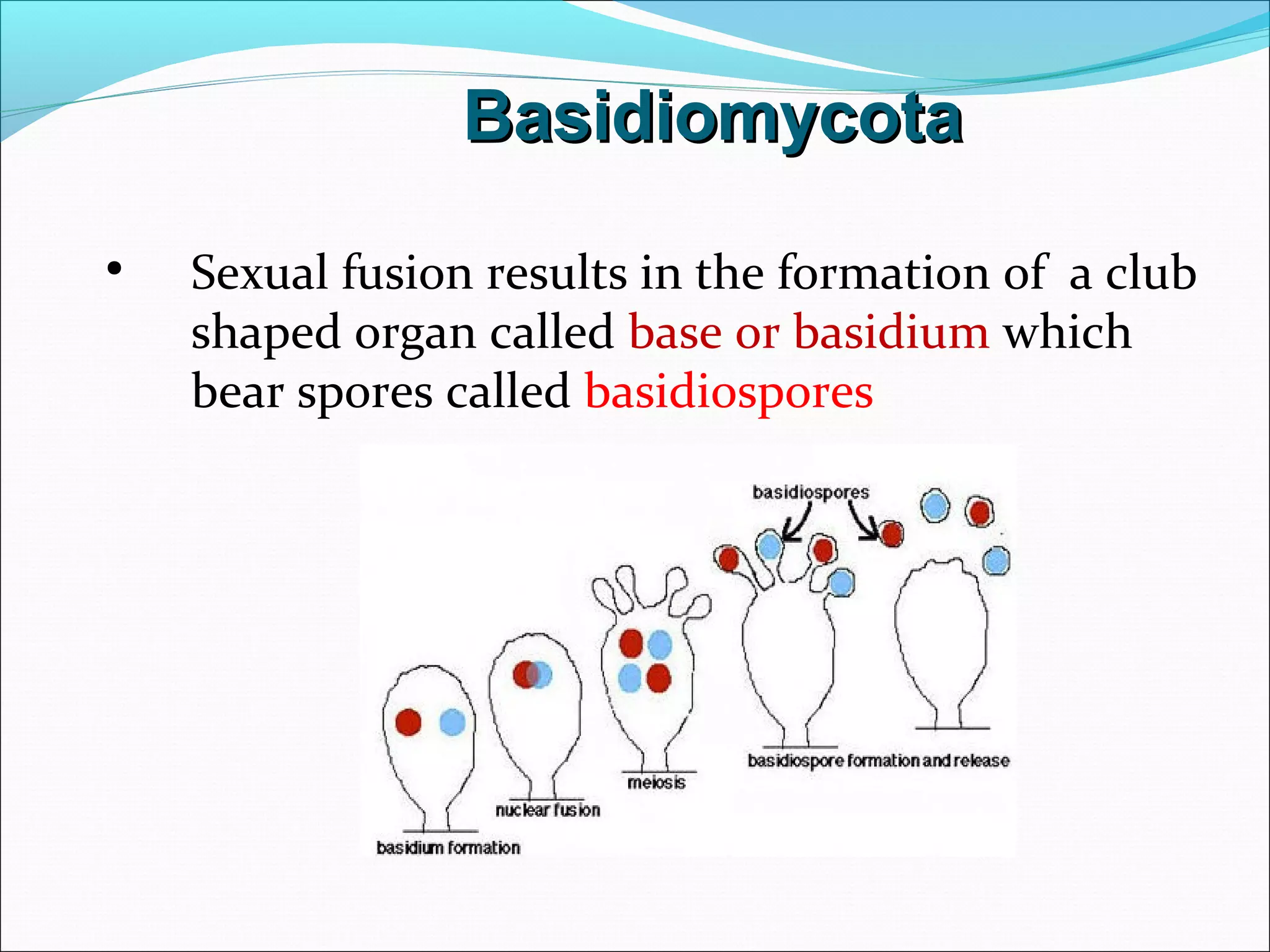
• Sexual fusion results in the formation of a club
shaped organ called base or basidium which
bear spores called basidiospores
BasidiomycotaBasidiomycota
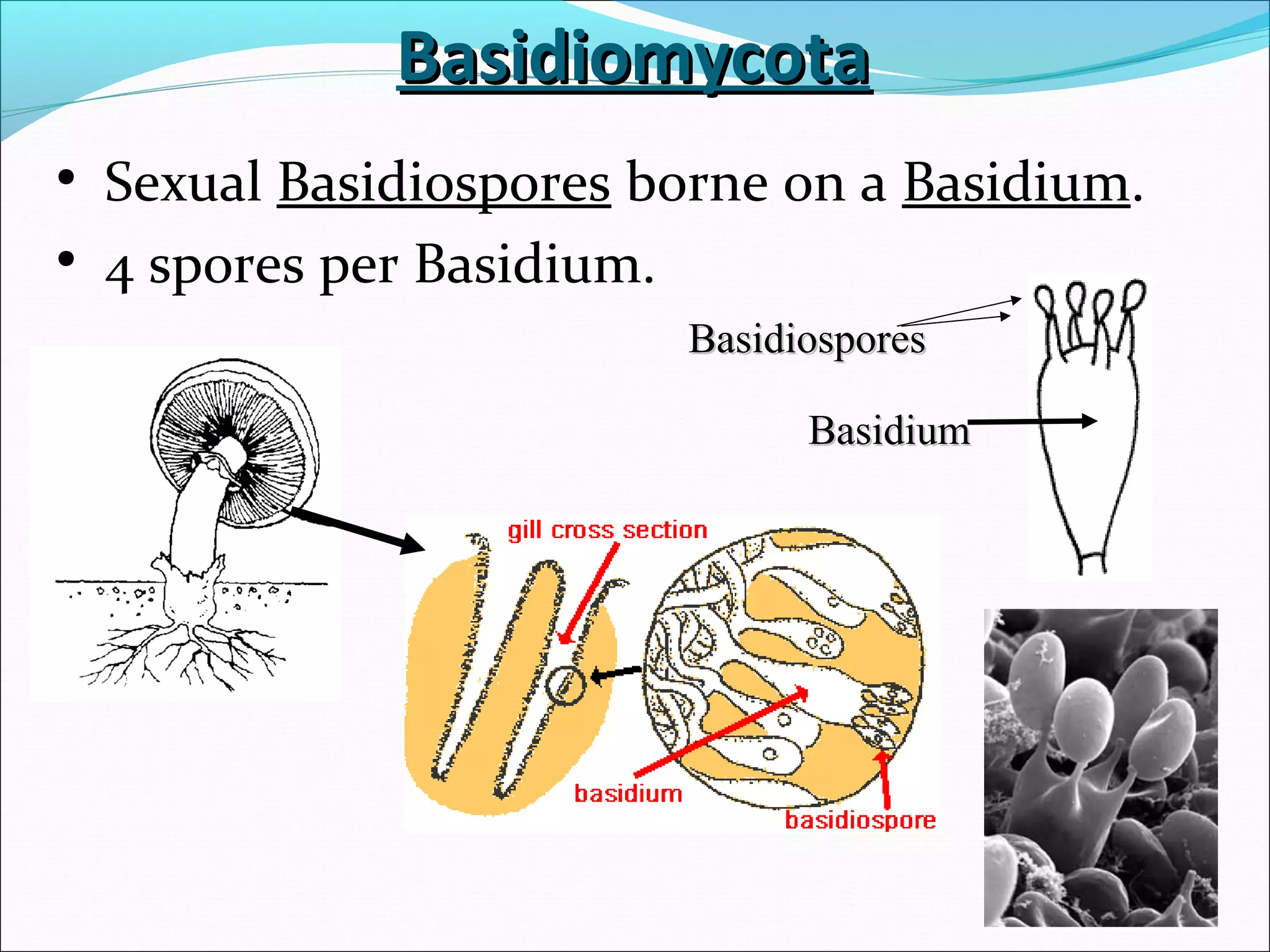
• Sexual Basidiospores borne on a Basidium.
• 4 spores per Basidium.
BasidiumBasidium
BasidiosporesBasidiospores
Deuteromycota – Form PhylumDeuteromycota – Form Phylum
“Imperfect Fungi”“Imperfect Fungi”
• Fungi that seldom or never reproduce
sexually.
• Asexual reproduction by vegetative
growth and production of asexual spores
common.
1.1. Sources of important chemicalsSources of important chemicals
– Medicines.Medicines.
• Antibiotics like Penicillin, Cephalosporin.Antibiotics like Penicillin, Cephalosporin.
• Eastern Medicine, herbal remedies, anti-tumor, etc.Eastern Medicine, herbal remedies, anti-tumor, etc.
– MetabolitesMetabolites
• Plant growth hormones, steroids.Plant growth hormones, steroids.
– Mycotoxins, biological control agents.Mycotoxins, biological control agents.
– Transformative enzymes.Transformative enzymes.
• Alcohol fermentation with COAlcohol fermentation with CO22 production byproduction by
Saccharomyces cerevisiaeSaccharomyces cerevisiae (yeast).(yeast).
• Cheese ripening, sausage production, misoCheese ripening, sausage production, miso
Significance & ImportanceSignificance & Importance
2. Food sources.
* Mushrooms
• Shiitake, Oyster, Porcini, Portobello, Morel, Truffle…
• Wild Mushrooms….Poisonings.
* Cheeses, Miso, Beer, Wine, Bread.
* Cultivation…by humans and other animals.
3. Spiritual ceremony & shamanism.
* Natives of Mexico & Central America – hallucinogenic
religious rites involving Psilocybe cubensis. (more
recently studied by Wasson, McKenna, & others).
* Mushroom effigies associated with many primitive (&
modern) cultures.
4. Ecosystem Contributions
* Decomposers of cellulose, lignin (wood).
(often found in human-manufactured items)
* Control of nutrient cycling.
* Soil retention.
* Mycorrhizal associations with plants.
5. Plant pathogens
* Potato blight (Oomycete)
* Chestnut blight (Cryphonectria parasitica)
* Dutch elm disease (Ophiostoma sp.)
* Ergot of Rye (Claviceps purpurea)
6. Animal Pathogens
* Insects (Oomycetes, Laboulbeniales, Septobasidium).
* Humans (‘mycoses’)
• Ringworm, histoplasmosis, yeast infections.
7. Scientific “lab rats”
* Especially Genetics
• Schizophyllum commune, Neurospora
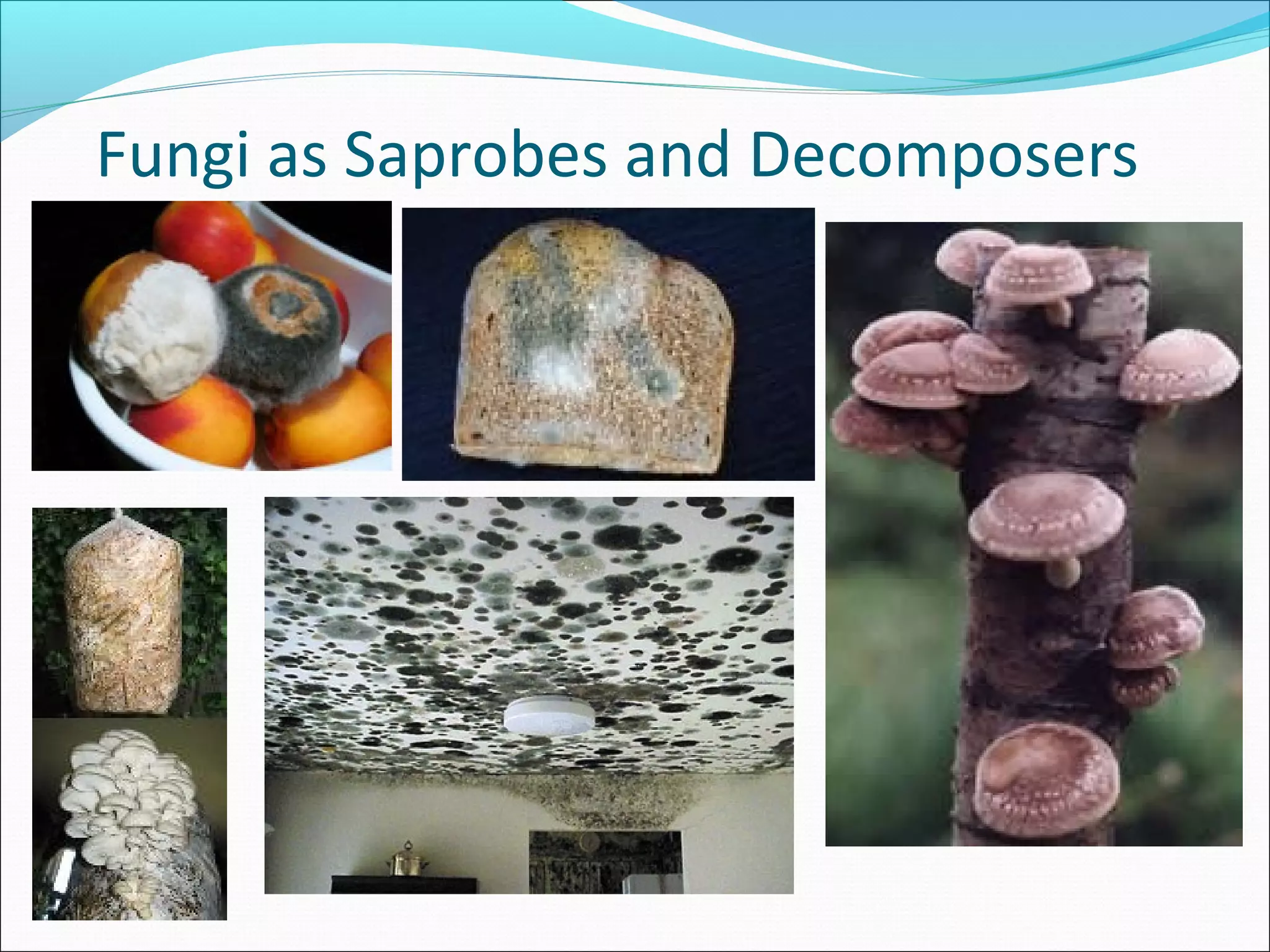
Fungi as Saprobes and Decomposers
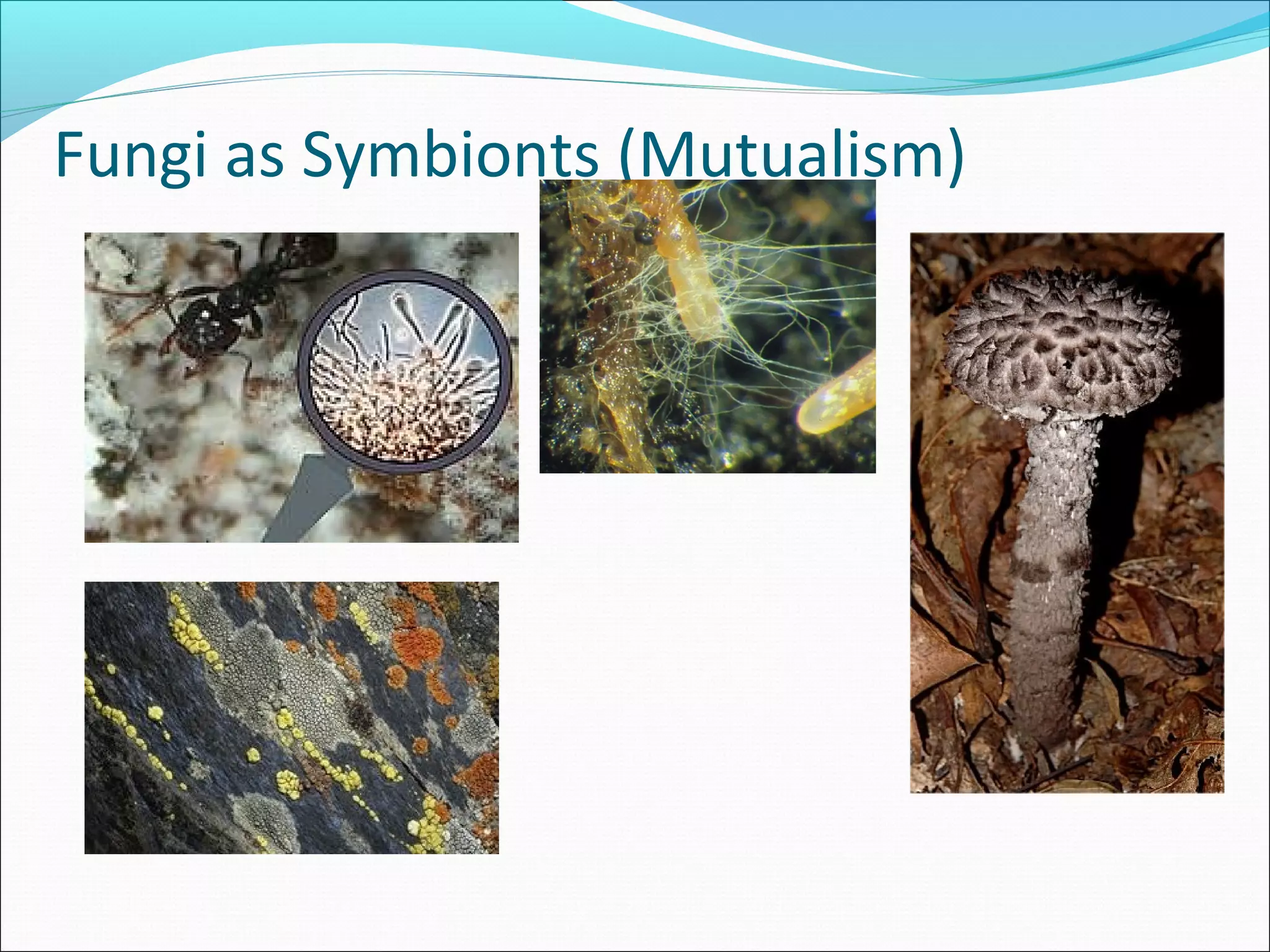
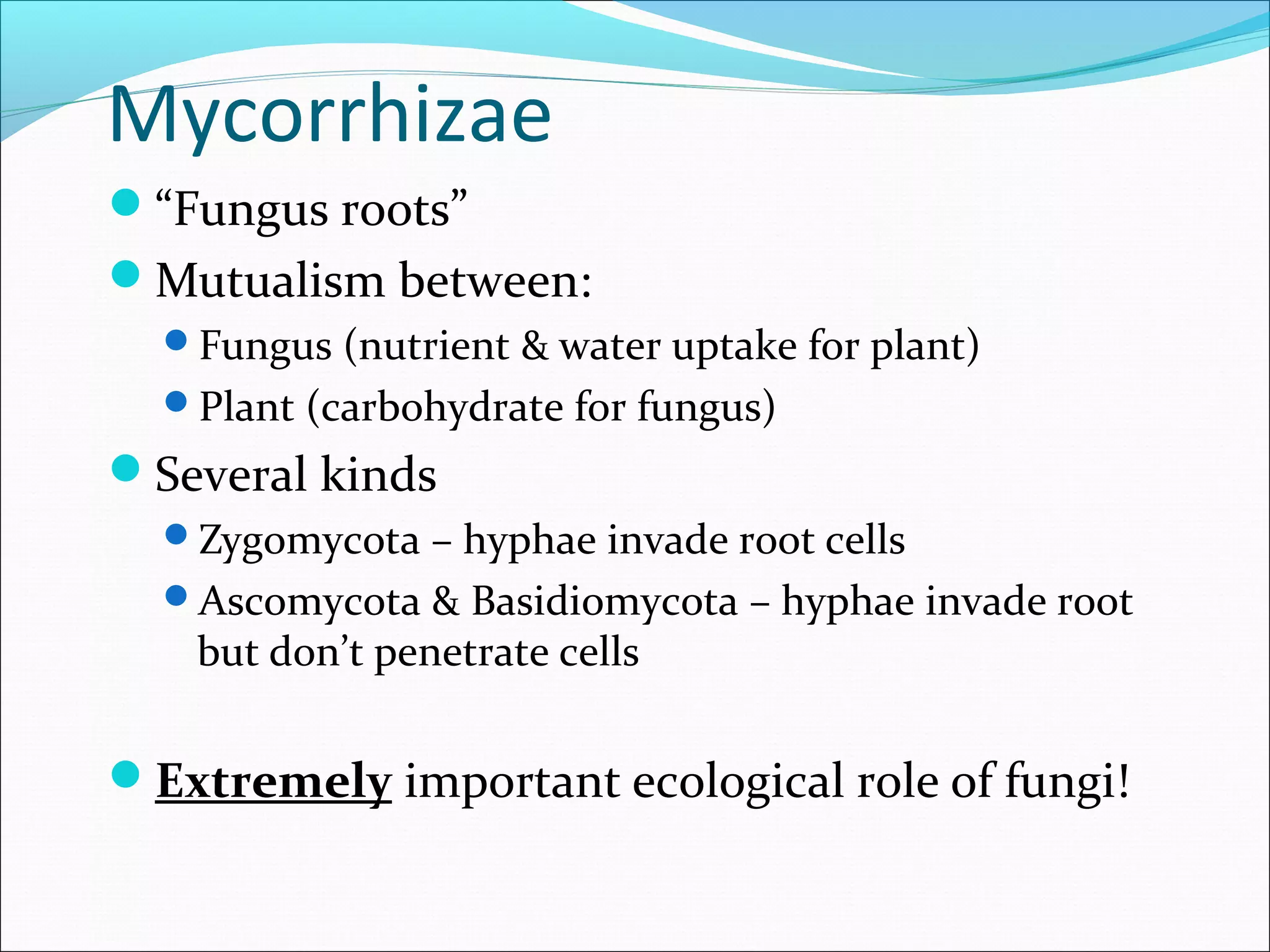
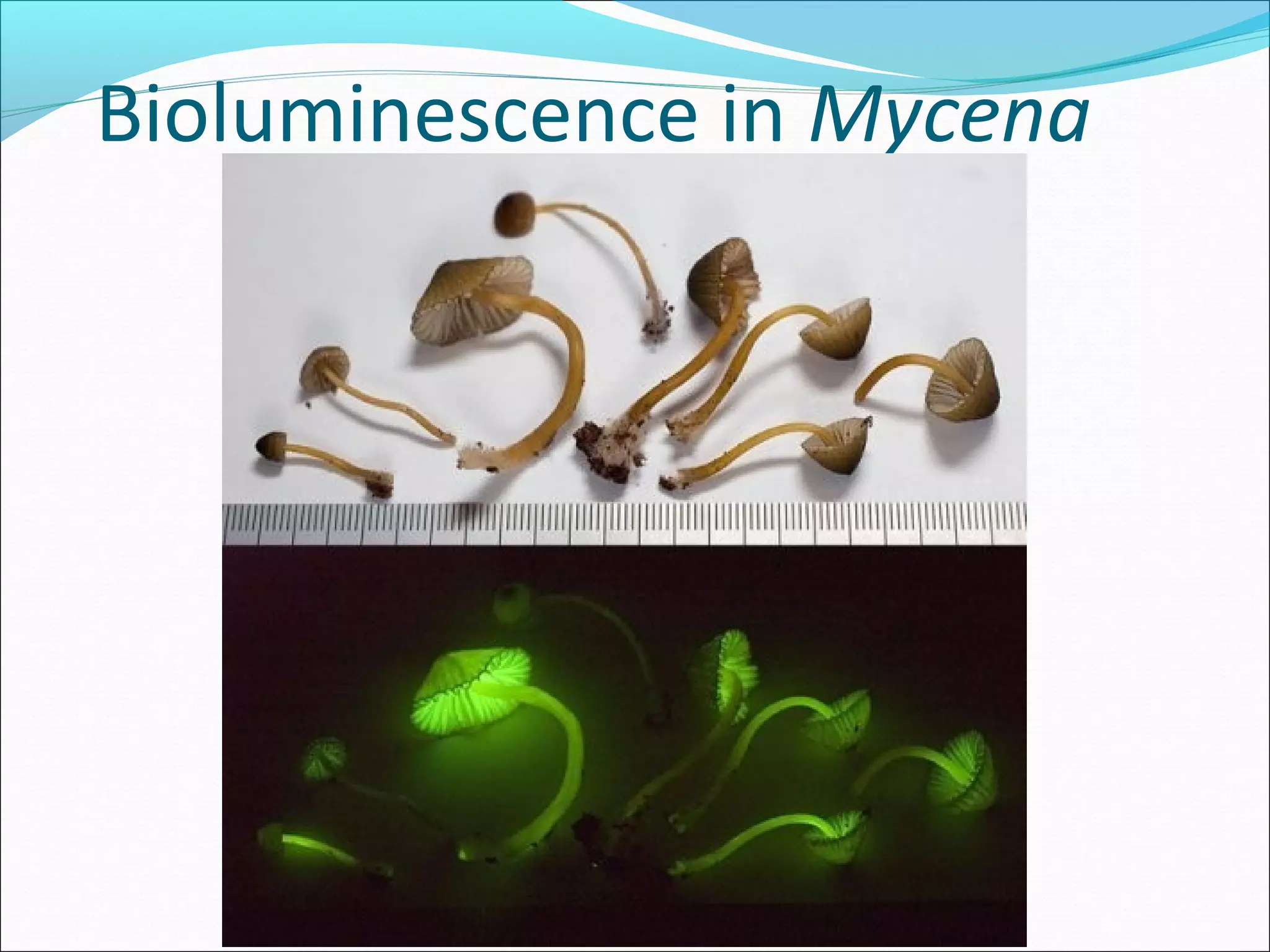
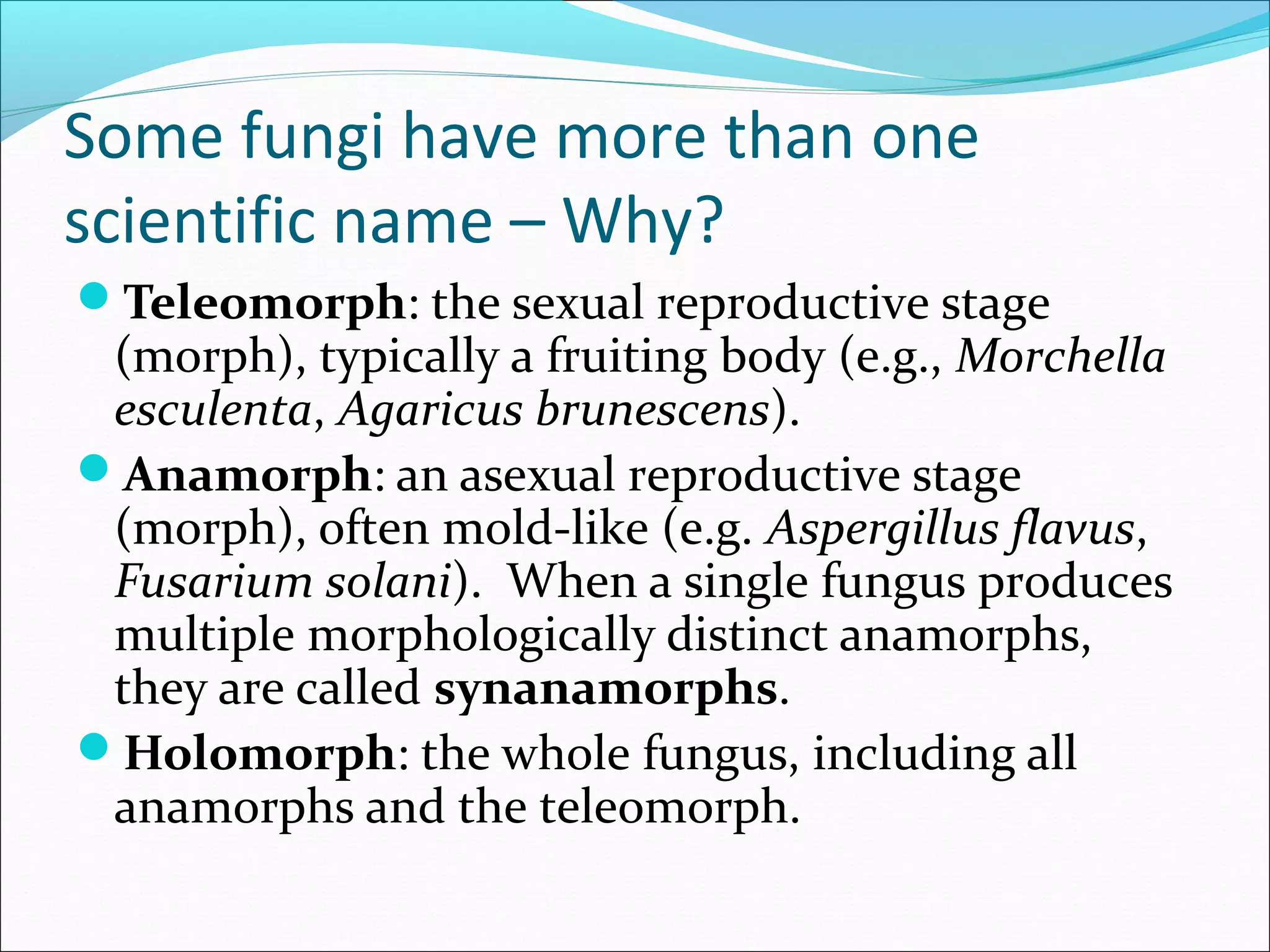
Fungi as Symbionts (Mutualism)
Mycorrhizae
“Fungus roots”
Mutualism between:
Fungus (nutrient & water uptake for plant)
Plant (carbohydrate for fungus)
Several kinds
Zygomycota – hyphae invade root cells
Ascomycota & Basidiomycota – hyphae invade root
but don’t penetrate cells
Extremely important ecological role of fungi!
Fungi as Parasites & Pathogens
Bioluminescence in Mycena
Some fungi have more than one
scientific name – Why?
Teleomorph: the sexual reproductive stage
(morph), typically a fruiting body (e.g., Morchella
esculenta, Agaricus brunescens).
Anamorph: an asexual reproductive stage
(morph), often mold-like (e.g. Aspergillus flavus,
Fusarium solani). When a single fungus produces
multiple morphologically distinct anamorphs,
they are called synanamorphs.
Holomorph: the whole fungus, including all
anamorphs and the teleomorph.
REFERENCE
Introductory Mycology –Alexopoulos,Mims andIntroductory Mycology –Alexopoulos,Mims and
BlackwellBlackwell
Introduction to fungi-WebsterIntroduction to fungi-Webster
Fungi-B.R. Vashshta,Dr.A.K.SinhaFungi-B.R. Vashshta,Dr.A.K.Sinha
Introdution of fungi by brijesh pratap singh and ravindra chauhan

Introdution of fungi by brijesh pratap singh and ravindra chauhan

  • 1.
    INTRODUCTION TO FUNGI ANDTHEIR SIGNIFICANCE TO HUMANS GUIDEDGUIDED BYBY ProfProf.. H.KH.K KEHRIKEHRI PRESENTED BYPRESENTED BY BRIJESH PRATAP SINGHBRIJESH PRATAP SINGH RAVINDRA CHAUHANRAVINDRA CHAUHAN
  • 2.
    MYCOLOGYMycology – fromGreek “mykes” = mushroom, cap & “logos” = discourse, study. Fungus (Fungi) – Latin, from the Greek “Sphongous” = sponge-like, spongy.
  • 3.
    Study – “Mycology”. TermFungus- Gaspard Bauhin. P.A. Micheli- father and faunder of Mycology. E.J. Butler- father of indian Mycology. K.C. Mehta –famous for studying the Black rust disease in wheat.  According to Alexopoulos(1962), The Fungi include nucleated spore bearing achlorophyllous organism that generally reproduce sexually and whose filamentous branched somatic stuctures are typically -
  • 4.
    Surrounded by cellwallscontaing cellulose or chitin or both. A more technical definition of Fungi was later given by Bessey(1968) which say that fungi are chlorophyll- less, non-vascular plants whose reproductive or vegetative structures do not permit them to be assigned to position among recognised groups of higher plants or algae.
  • 5.
    5050 µµmm Fossil hyphaeand sporesFossil hyphae and spores • The oldestThe oldest undisputed fossils ofundisputed fossils of fungi are only aboutfungi are only about 460 million years old460 million years old • Fungi were amongFungi were among the earliestthe earliest colonizers of land.colonizers of land. -Probably as-Probably as symbionts withsymbionts with early land plantsearly land plants Origin of FungiOrigin of Fungi
  • 6.
    • Fungi descendedfrom an aquatic, single-Fungi descended from an aquatic, single- celled, flagellated protistcelled, flagellated protist • Systematists now recognize Fungi andSystematists now recognize Fungi and Animalia as sister kingdomsAnimalia as sister kingdoms – Because fungi and animals are more closelyBecause fungi and animals are more closely related to each other than they are to plantsrelated to each other than they are to plants or other eukaryotesor other eukaryotes • Molecular evidenceMolecular evidence – Supports the hypothesis that fungi andSupports the hypothesis that fungi and animals diverged from a common ancestoranimals diverged from a common ancestor that was unicellular and bore flagellathat was unicellular and bore flagella • Fungi probably evolvedFungi probably evolved – Before the colonization of land byBefore the colonization of land by multicellular organismsmulticellular organisms Evolution/Origin of FungiEvolution/Origin of Fungi
  • 7.
    • Body form *unicellular * filamentous (tube-like strands called hypha (singular) or hyphae (plural) * mycelium = aggregate of hyphae * sclerotium = hardened mass of mycelium that generally serves as an overwintering stage. * multicellular, such as mycelial cords, rhizomorphs, and fruit bodies (mushrooms)
  • 8.
    • Nonphotosynthetic • Eukaryotes •Nonmotile • Most are saprobes (live on dead organisms)
  • 9.
    • Absorptive heterotrophs (digestfood first & then absorb it into their bodies • Release digestive enzymes to break down organic material or their host • Store food energy as glycogen BREAD MOLDBREAD MOLD
  • 10.
    • Important decomposers &recyclers of nutrients in the environment • Most are multicellular, except unicellular yeast • Lack true roots, stems or leaves UNICELLULAR YEASTUNICELLULAR YEAST MULTICELLULARMULTICELLULAR MUSHROOMMUSHROOM
  • 11.
    • Cell Wallis composed of Chitin. * Complex, N-containing Polysaccharide (a carbohydrate polymer). * Helps maintain osmotic pressure in the cells.
  • 12.
    Heterotrophy - 'otherfood' Saprophytes or saprobes - feed on dead tissues or organic waste (decomposers) Symbionts - mutually beneficial relationship between a fungus and another organism Parasites - feeding on living tissue of a host. Parasites that cause disease are called pathogens.
  • 13.
    Heterotrophic by Absorption Fungiget carbon from organic sources Hyphal tips release enzymes Enzymatic breakdown of substrate Products diffuse back into hyphae Product diffuses back into hypha and is used Nucleus hangs back and “directs”
  • 14.
    Hyphae Tubular Hard wall ofchitin Crosswalls may form compartments (± cells) Multinucleate Grow at tips
  • 15.
    • StolonsStolons – horizontalhyphae that connect groups of hyphae to each other • RhizoidsRhizoids – rootlike parts of hyphae that anchor the fungus STOLONSTOLON RHIZOIDSRHIZOIDS
  • 16.
    • Cross-walls called SEPTAmay form compartments • Septa have pores for movement of cytoplasm • Form network called mycelia that run through the thallus (body)
  • 17.
    • Fungi maybe classified based on cell division (with or without cytokinesis) * Aseptate or coenocytic (without septa) * Septate (with septa) NO CROSSNO CROSS WALLSWALLS CROSSCROSS WALLSWALLS
  • 18.
    Hyphal growth Hyphae growfrom their tips Mycelium = extensive, feeding web of hyphae Mycelia are the ecologically active bodies of fungi This wall is rigid Only the tip wall is plastic and stretches
  • 19.
    mycelium germinating spore • Mycelia havea huge surface area Hyphal growth from spore
  • 20.
  • 21.
    Reproduction in fungi Sexual - formation of zygospores, ascospores or basidiospores  Asexual reproduction – budding or fission  Asexual spores are formed on or in specialized structures.  Vary in size, shape & colour but these characteristics are constant for a particular species.
  • 22.
    • Spores arereproductive cells * Sexual (meiotic in origin) * Asexual (mitotic in origin) • Formed: * Directly on hyphae * Inside sporangia * Fruiting bodies Reproduce by sporesReproduce by spores Amanita fruiting body Pilobolus sporangia Penicillium hyphae with conidia
  • 23.
    Fungi are Spore-ific!!!Fungiare Spore-ific!!! • Spores - asexual (product of mitosis) or sexual (product of meiosis) in origin. • Purpose of Spores * Allows the fungus to move to new food source. * Resistant stage - allows fungus to survive periods of adversity. * Means of introducing new genetic combinations into a population
  • 24.
    Asexual Reproduction Many fungican reproduce asexually Many fungi that can reproduce asexually Grow as mold, sometimes on fruit, bread, and other foods 2.52.5 µµmm ConidiaConidia (asexual)(asexual) PenicilliuPenicilliu mm (common(common saprobe onsaprobe on food)food)
  • 25.
    • Other asexualfungi are yeasts * That inhabit moist environments * Which produce by simple cell division 1010 µµmm Parent cellParent cell BudBud Asexual ReproductionAsexual Reproduction
  • 26.
    • Spores areborne on hyphal tips called Conidia (sing. Conidium) or in Sporangia (sing. Sporangium). Asexually-ProducedAsexually-Produced SporesSpores • Produced by Mitosis & Cell Division. • Clones (genetically-identical progeny) are produced.
  • 27.
    • The sexuallife cycle involves * Cell fusion, plasmogamy * Nuclear fusion, karyogamy • An intervening heterokaryotic stage * Occurs between plasmogamy and karyogamy in which cells have haploid nuclei from two parents • The diploid phase following karyogamy * Is short-lived and undergoes meiosis, producing haploid spores Sexual ReproductionSexual Reproduction
  • 28.
    KeyKey Haploid (Haploid (nn)) HeterokaryoticHeterokaryotic (unfusednuclei from(unfused nuclei from different parents)different parents) Diploid (2Diploid (2nn)) PLASMOGAMYPLASMOGAMY (fusion of cytoplasm)(fusion of cytoplasm) HeterokaryoticHeterokaryotic stagestage KARYOGAMYKARYOGAMY (fusion of nuclei)(fusion of nuclei) SEXUALSEXUAL REPRODUCTIONREPRODUCTION Spore-producingSpore-producing structuresstructures SporesSpores ASEXUALASEXUAL REPRODUCTIONREPRODUCTION ZygoteZygote MyceliumMycelium GERMINATIONGERMINATION GERMINATIONGERMINATION MEIOSISMEIOSIS Spore-producingSpore-producing structuresstructures SporesSpores Reproduction/propagationReproduction/propagation Fungi produce spores through sexual or asexualFungi produce spores through sexual or asexual life cycleslife cycles (Some fungi do both, some are either sexual or asexual)(Some fungi do both, some are either sexual or asexual)
  • 29.
    Systematic classificationSystematic classification FFungicomprise a monophyletic group broken into 4 lineagesungi comprise a monophyletic group broken into 4 lineages (therefore also 4 Phyla):(therefore also 4 Phyla): Phylum: ChytridiomycotaPhylum: Chytridiomycota Phylum: ZygomycotaPhylum: Zygomycota Phylum: AscomycotaPhylum: Ascomycota Phylum: BasidiomycotaPhylum: Basidiomycota ““Phylum”: Deuteromycota is an artificial groupPhylum”: Deuteromycota is an artificial group representing fungi that do not or have yet to exhibit arepresenting fungi that do not or have yet to exhibit a sexual stage (meiosis & syngamy).sexual stage (meiosis & syngamy).
  • 30.
    Chytridiomycota – “chytrids”Chytridiomycota– “chytrids” • Simple fungi • Produce motile spores - zoospores • Mostly saprobes and parasites in aquatic habitats • Could just as well be Protists Chytridium growing on spores Chytriomyces growing on pine pollen
  • 31.
    • The “BreadMolds” Zygomycota – “zygote fungi”Zygomycota – “zygote fungi”
  • 32.
    Zygomycota – “zygotefungi”Zygomycota – “zygote fungi” • Sexual Reproduction - zygosporangia • Asexual reprod. – common (sporangia – bags of asexual spores) • Hyphae have no cross walls • Grow rapidly • Decomposers, pathogens, and some form mycorrhizal associations with plants Rhizopus on strawberries Rhinocerebral zygomycosis
  • 33.
    • Lower fungi •Broad, nonseptate hyphae • Asexual spores - Sporangiospores: present within a swollen sac- like structure called Sporangium ZygomycotaZygomycota
  • 34.
    • Sexual spores- Zygospore: a resting, thick walled cell in between hyphae e.g. Rhizopus, Mucor ZygomycotaZygomycota
  • 35.
    • The SacFungi MorchellaMorchella esculentaesculenta Ascomycota – “sac fungi”Ascomycota – “sac fungi”
  • 36.
    AscomycotaAscomycota • Includes bothyeasts & filamentous fungi • Narrow, septate hyphae • Asexual spores are called conidia borne on conidiophore
  • 37.
    • Sexual sporescalled ascospores are present within a sac like structure called Ascus. • Several asci may be seen within a fruiting body as seen in Penicillium, Aspergillus • Each ascus has 4 to 8 ascospores. AscomycotaAscomycota
  • 38.
    • The ‘Club’Fungi Basidiomycota – “club fungi”Basidiomycota – “club fungi”
  • 39.
    Basidiomycota – “clubfungi”Basidiomycota – “club fungi” • Sexual Reproduction – basidia • Asexual reprod – not so common • Long-lived dikaryotic mycelia • Rusts & smuts –plant parasites • Mushrooms, polypores, puffballs, boletes, bird’s nest fungi • Enzymes decompose wood, leaves, and other organic materials • Decomposers, pathogens, and some form mycorrhizal SEM of basidia and spores
  • 40.
    BasidiomycotaBasidiomycota • Sexual fusionresults in the formation of a club shaped organ called base or basidium which bear spores called basidiospores
  • 41.
    BasidiomycotaBasidiomycota • Sexual Basidiosporesborne on a Basidium. • 4 spores per Basidium. BasidiumBasidium BasidiosporesBasidiospores
  • 42.
    Deuteromycota – FormPhylumDeuteromycota – Form Phylum “Imperfect Fungi”“Imperfect Fungi” • Fungi that seldom or never reproduce sexually. • Asexual reproduction by vegetative growth and production of asexual spores common.
  • 43.
    1.1. Sources ofimportant chemicalsSources of important chemicals – Medicines.Medicines. • Antibiotics like Penicillin, Cephalosporin.Antibiotics like Penicillin, Cephalosporin. • Eastern Medicine, herbal remedies, anti-tumor, etc.Eastern Medicine, herbal remedies, anti-tumor, etc. – MetabolitesMetabolites • Plant growth hormones, steroids.Plant growth hormones, steroids. – Mycotoxins, biological control agents.Mycotoxins, biological control agents. – Transformative enzymes.Transformative enzymes. • Alcohol fermentation with COAlcohol fermentation with CO22 production byproduction by Saccharomyces cerevisiaeSaccharomyces cerevisiae (yeast).(yeast). • Cheese ripening, sausage production, misoCheese ripening, sausage production, miso Significance & ImportanceSignificance & Importance
  • 44.
    2. Food sources. *Mushrooms • Shiitake, Oyster, Porcini, Portobello, Morel, Truffle… • Wild Mushrooms….Poisonings. * Cheeses, Miso, Beer, Wine, Bread. * Cultivation…by humans and other animals. 3. Spiritual ceremony & shamanism. * Natives of Mexico & Central America – hallucinogenic religious rites involving Psilocybe cubensis. (more recently studied by Wasson, McKenna, & others). * Mushroom effigies associated with many primitive (& modern) cultures.
  • 45.
    4. Ecosystem Contributions *Decomposers of cellulose, lignin (wood). (often found in human-manufactured items) * Control of nutrient cycling. * Soil retention. * Mycorrhizal associations with plants. 5. Plant pathogens * Potato blight (Oomycete) * Chestnut blight (Cryphonectria parasitica) * Dutch elm disease (Ophiostoma sp.) * Ergot of Rye (Claviceps purpurea)
  • 46.
    6. Animal Pathogens *Insects (Oomycetes, Laboulbeniales, Septobasidium). * Humans (‘mycoses’) • Ringworm, histoplasmosis, yeast infections. 7. Scientific “lab rats” * Especially Genetics • Schizophyllum commune, Neurospora
  • 47.
    Fungi as Saprobesand Decomposers
  • 48.
    Fungi as Symbionts(Mutualism)
  • 49.
    Mycorrhizae “Fungus roots” Mutualism between: Fungus(nutrient & water uptake for plant) Plant (carbohydrate for fungus) Several kinds Zygomycota – hyphae invade root cells Ascomycota & Basidiomycota – hyphae invade root but don’t penetrate cells Extremely important ecological role of fungi!
  • 50.
    Fungi as Parasites& Pathogens
  • 51.
  • 52.
    Some fungi havemore than one scientific name – Why? Teleomorph: the sexual reproductive stage (morph), typically a fruiting body (e.g., Morchella esculenta, Agaricus brunescens). Anamorph: an asexual reproductive stage (morph), often mold-like (e.g. Aspergillus flavus, Fusarium solani). When a single fungus produces multiple morphologically distinct anamorphs, they are called synanamorphs. Holomorph: the whole fungus, including all anamorphs and the teleomorph.
  • 53.
    REFERENCE Introductory Mycology –Alexopoulos,MimsandIntroductory Mycology –Alexopoulos,Mims and BlackwellBlackwell Introduction to fungi-WebsterIntroduction to fungi-Webster Fungi-B.R. Vashshta,Dr.A.K.SinhaFungi-B.R. Vashshta,Dr.A.K.Sinha

Editor's Notes

  • #14 Most enzyme release (and absorption) at tips Proteins and other materials synthesized by the entire mycelium are channeled by cytoplasmic streaming to the tips of the extending hyphae.
  • #15 Chitin is the same material used by Arthropods (Insects, crabs, etc.) in their exoskeletonsa Nuclei of fungi are hard to see without stains
  • #50 Half of the mushroom-forming fungi (basidiomycota) form mycorrhizas with trees Some people think that the spongy tissue in roots evolved as a place where fungi could invade to form early links with plants that helped them survive the harsh life on early earth