Prescriptive Process models
• Waterfall Model.
• Incremental Process Model.
• Evolutionary Process Model.
• Concurrent model
1
Prescriptive Process models
Waterfall Model
• Oldest software lifecycle model & best understood by
upper management
• Used when requirements are well understood and risk
is low
• Work flow is in a linear fashion (i.e., sequential)
• Used often with well-defined adaptations or
enhancements to current software 2
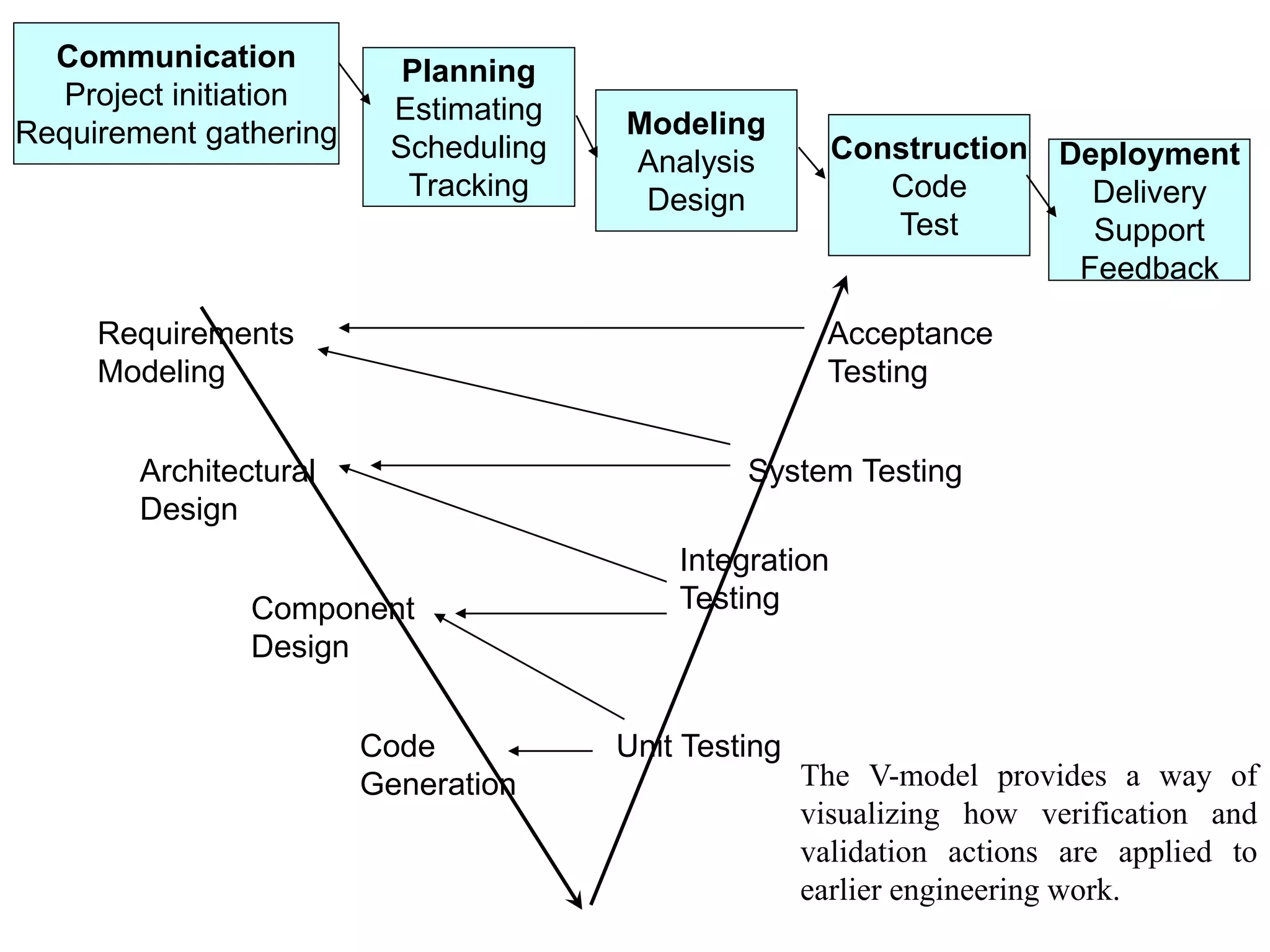
Communication
Project initiation
Requirement gathering
Planning
Estimating
Scheduling
Tracking
Modeling
Analysis
Design
Construction
Code
Test
Deployment
Delivery
Support
Feedback
Requirements
Modeling
Architectural
Design
Component
Design
Code
Generation
Unit Testing
Integration
Testing
System Testing
Acceptance
Testing
The V-model provides a way of
visualizing how verification and
validation actions are applied to
earlier engineering work.
Waterfall Model
Problems
• Real projects rarely follow sequential flow.
• Difficult for customers to state all requirements
explicitly and up front
• Requires customer patience because a working
version of the program doesn't occur until the final
phase
• Doesn't support iteration, so changes can cause
confusion and Leads to “blocking states”.
Useful
• Where requirements are fixed and is to proceed to
completion in a linear manner.
4
Prescriptive Process models
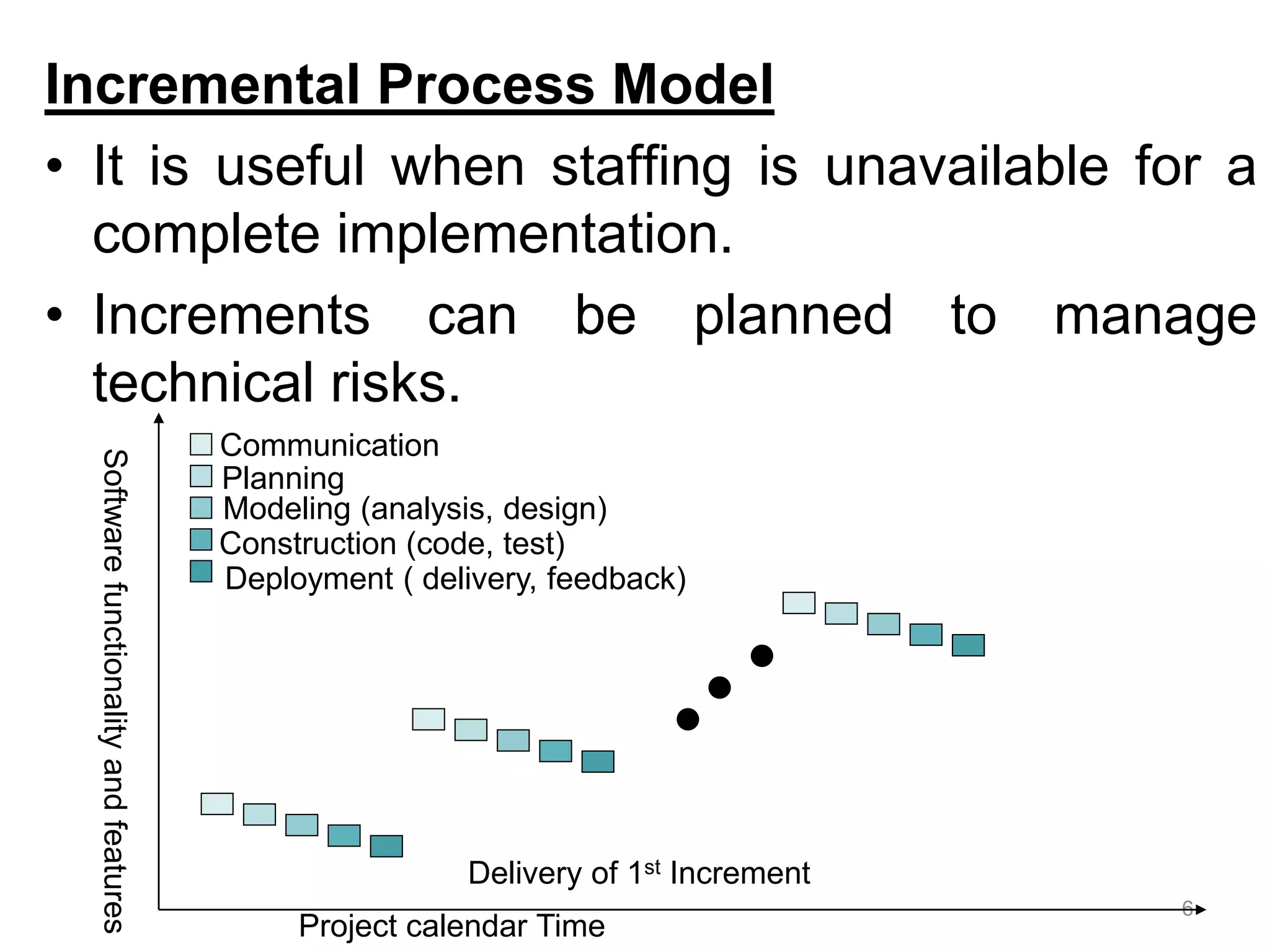
Incremental Process Model
• Combines elements of linear and parallel process
flows.
• It delivers a series of releases, called increments that
provide progressively more functionality for the
customer as each is delivered
• The first increment is often a core product.
• The plan addresses the modification of the core
product to better meet the needs of the customer and
the delivery of additional feature and functionality.
• It focuses on the delivery of an operational product
with each increment. 5
Incremental Process Model
• It is useful when staffing is unavailable for a
complete implementation.
• Increments can be planned to manage
technical risks.
6
Softwarefunctionalityandfeatures
Project calendar Time
Communication
Planning
Modeling (analysis, design)
Construction (code, test)
Deployment ( delivery, feedback)
Delivery of 1st Increment
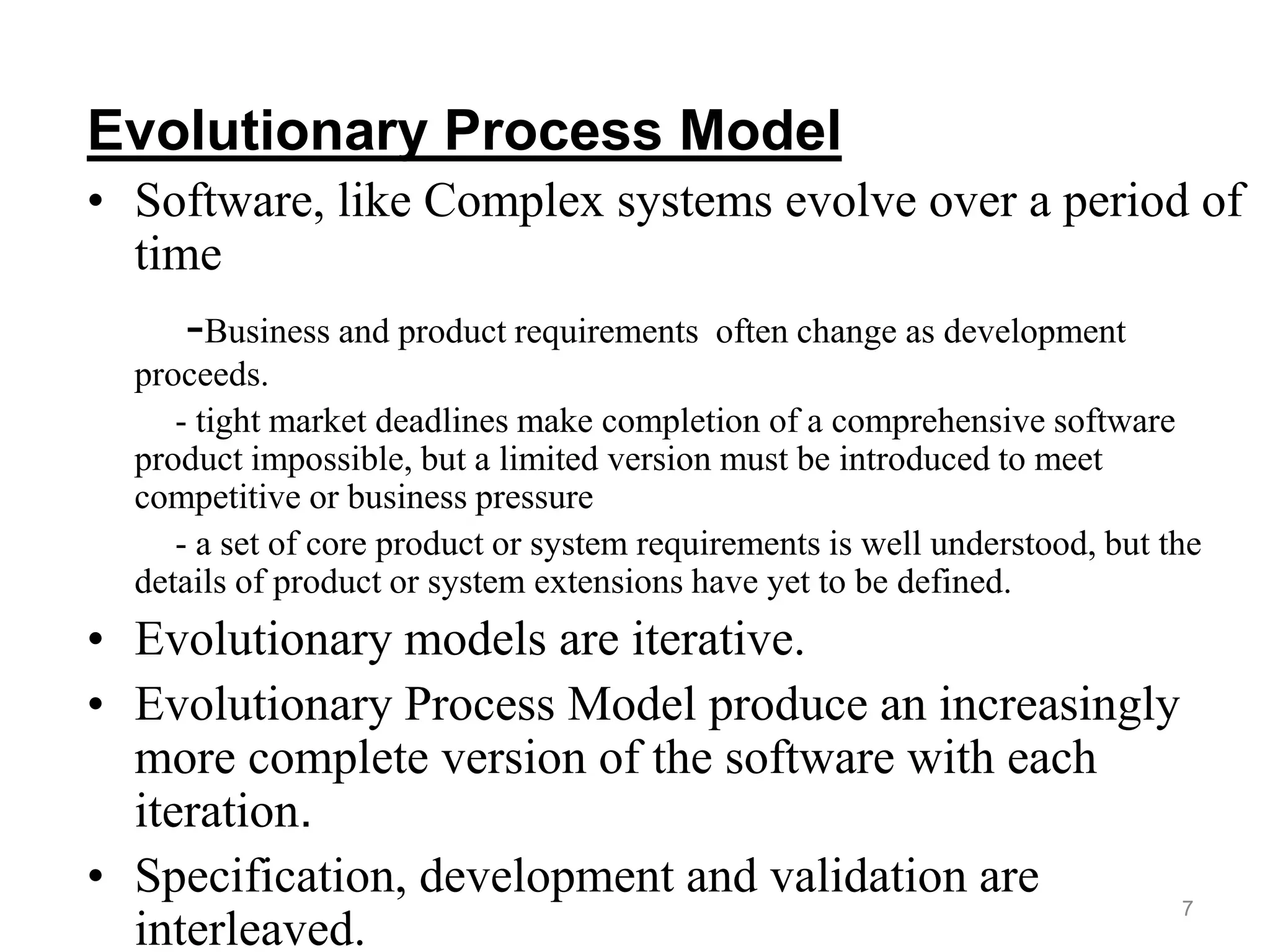
Evolutionary Process Model
• Software, like Complex systems evolve over a period of
time
-Business and product requirements often change as development
proceeds.
- tight market deadlines make completion of a comprehensive software
product impossible, but a limited version must be introduced to meet
competitive or business pressure
- a set of core product or system requirements is well understood, but the
details of product or system extensions have yet to be defined.
• Evolutionary models are iterative.
• Evolutionary Process Model produce an increasingly
more complete version of the software with each
iteration.
• Specification, development and validation are
interleaved.
7
Prescriptive Process models
Evolutionary Process Model
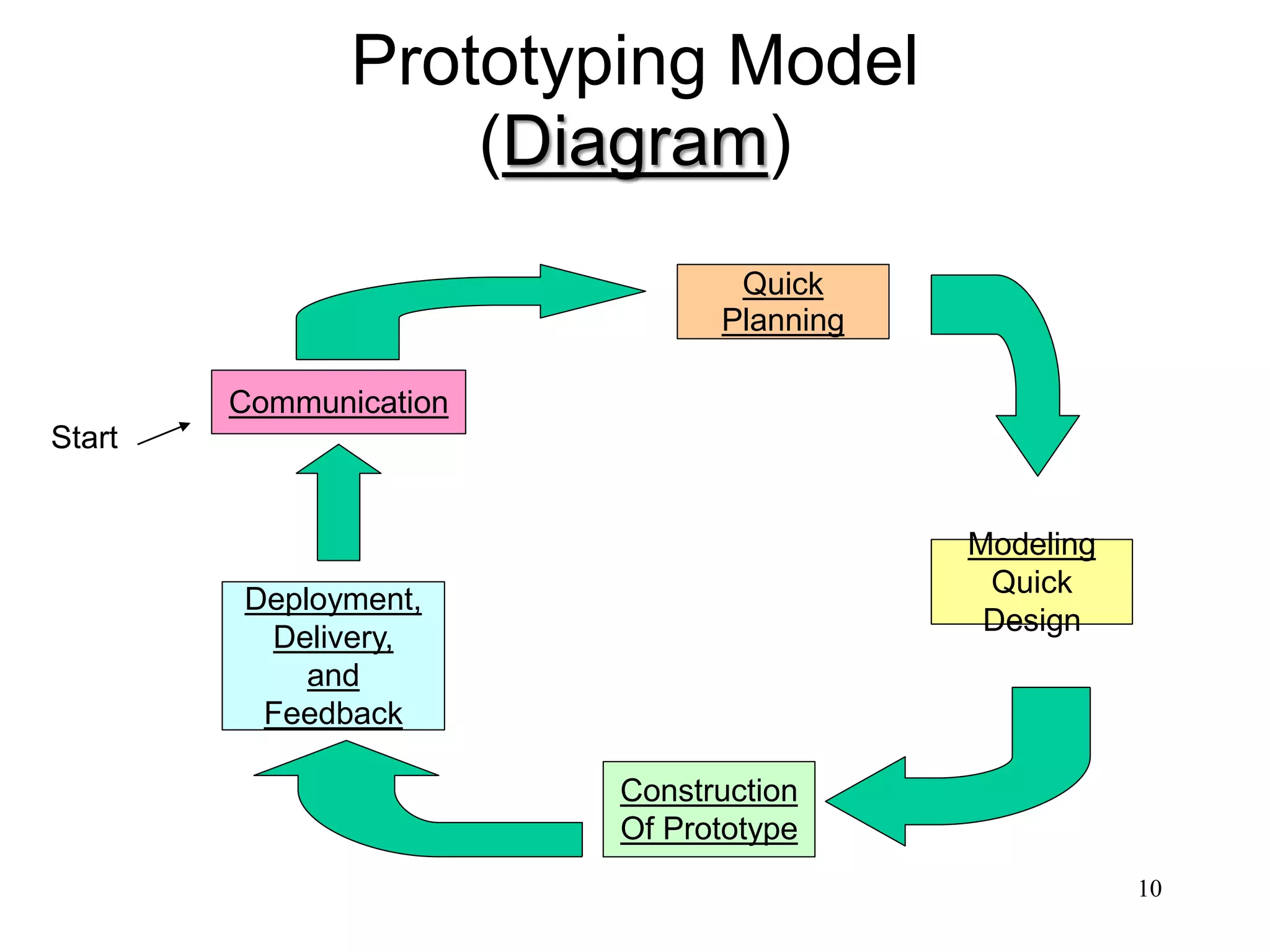
• Prototyping
• Spiral Model
8
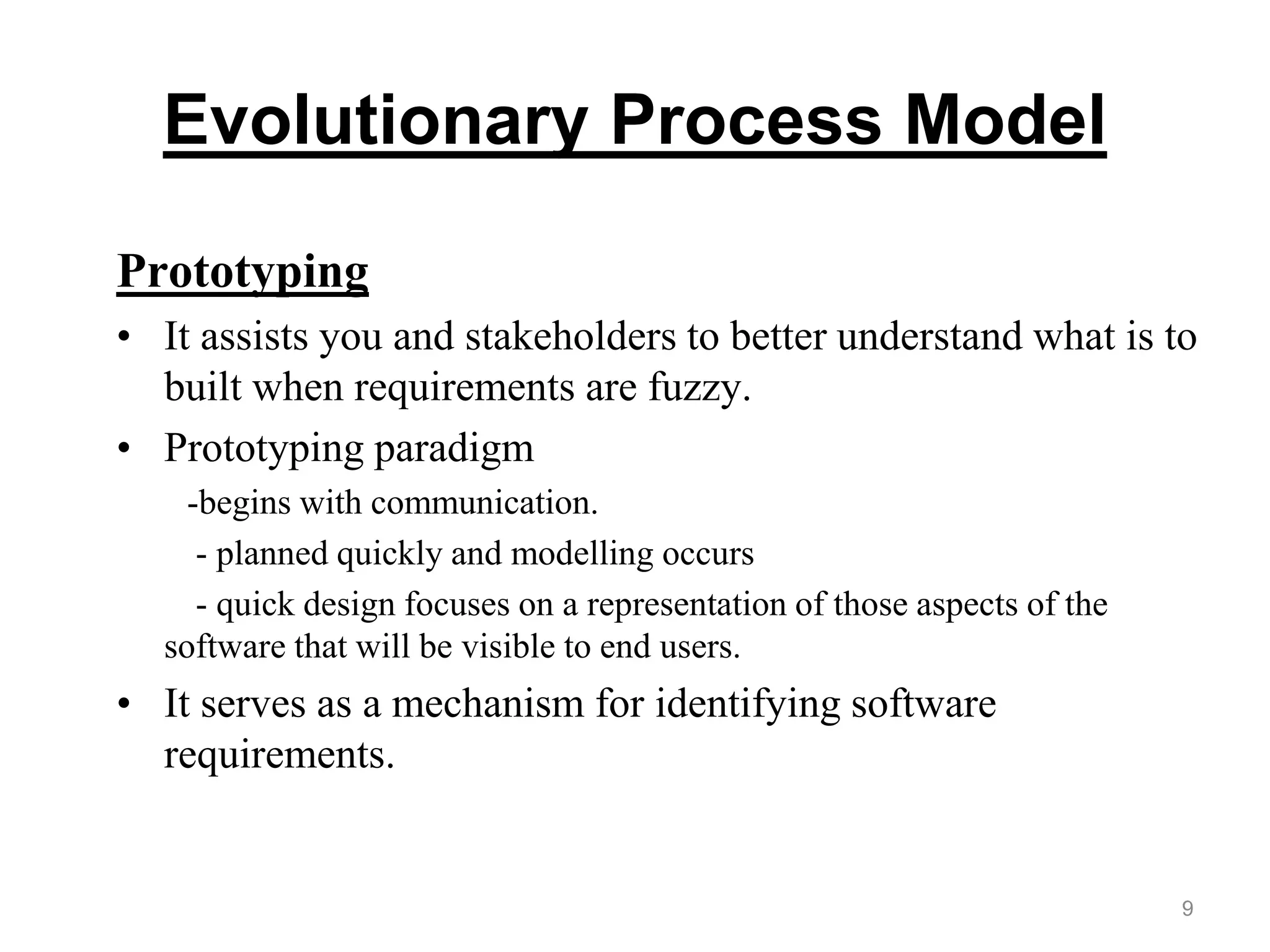
Evolutionary Process Model
Prototyping
• It assists you and stakeholders to better understand what is to
built when requirements are fuzzy.
• Prototyping paradigm
-begins with communication.
- planned quickly and modelling occurs
- quick design focuses on a representation of those aspects of the
software that will be visible to end users.
• It serves as a mechanism for identifying software
requirements.
9
10
Prototyping Model
(Diagram)
Communication
Quick
Planning
Modeling
Quick
Design
Construction
Of Prototype
Deployment,
Delivery,
and
Feedback
Start
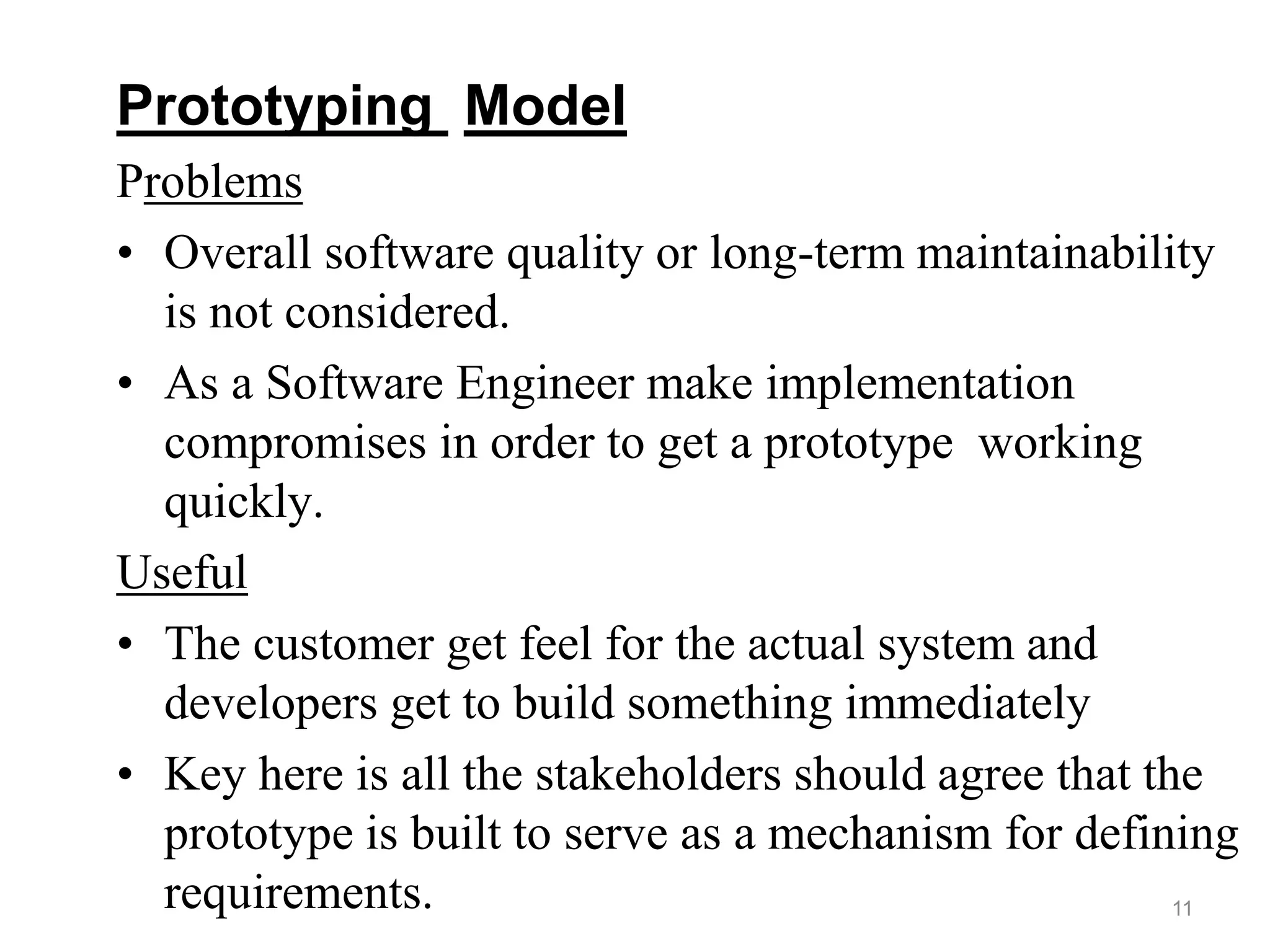
Prototyping Model
Problems
• Overall software quality or long-term maintainability
is not considered.
• As a Software Engineer make implementation
compromises in order to get a prototype working
quickly.
Useful
• The customer get feel for the actual system and
developers get to build something immediately
• Key here is all the stakeholders should agree that the
prototype is built to serve as a mechanism for defining
requirements. 11
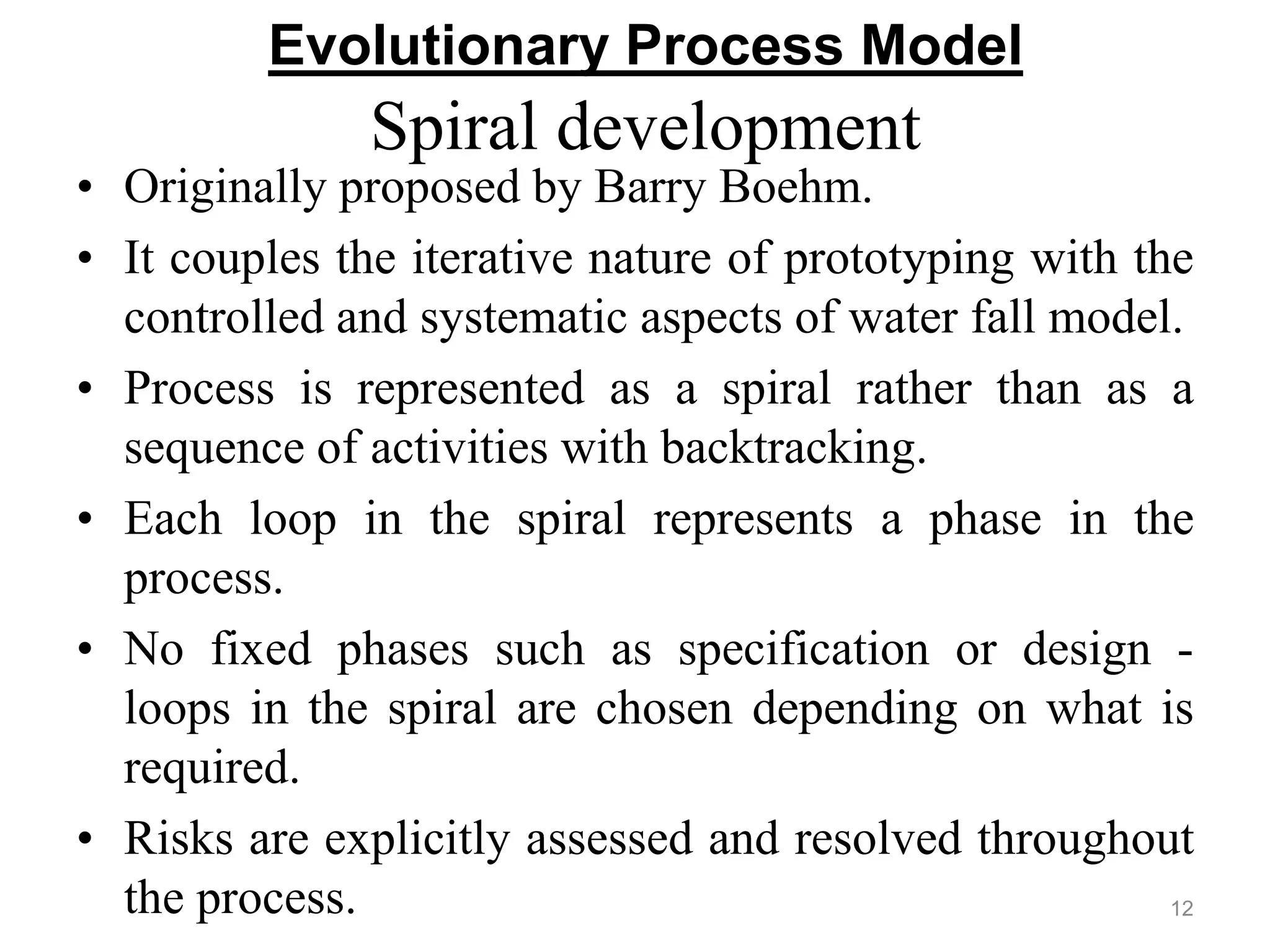
Evolutionary Process Model
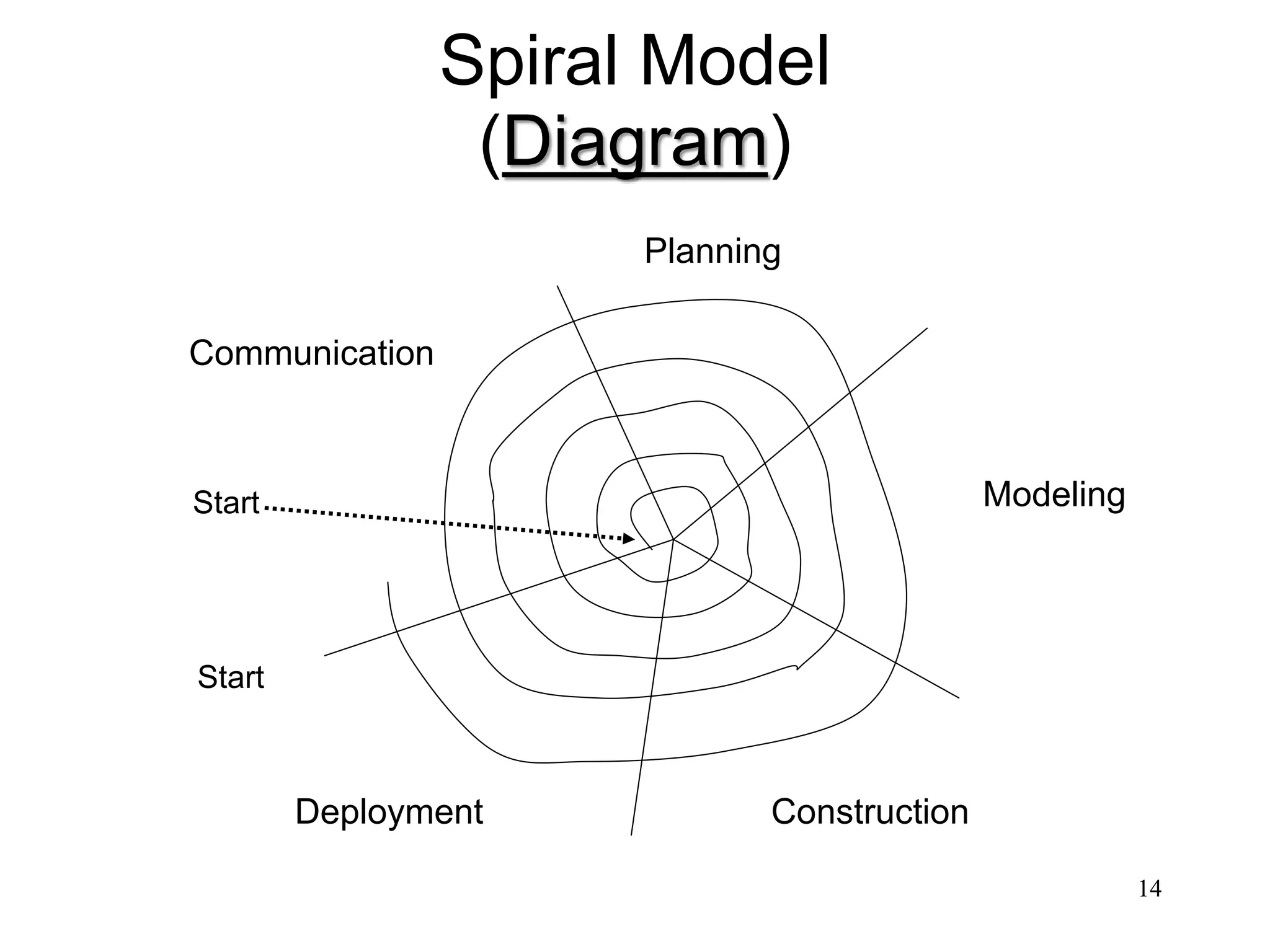
Spiral development
• Originally proposed by Barry Boehm.
• It couples the iterative nature of prototyping with the
controlled and systematic aspects of water fall model.
• Process is represented as a spiral rather than as a
sequence of activities with backtracking.
• Each loop in the spiral represents a phase in the
process.
• No fixed phases such as specification or design -
loops in the spiral are chosen depending on what is
required.
• Risks are explicitly assessed and resolved throughout
the process. 12
Spiral model
• It is a realistic approach to the development of
large-scale systems and software.
• The software evolves as the process progresses, the
developer and customer better understand and react
at each evolutionary level.
• It uses prototyping as a risk reduction mechanism.
• It demands considerable risk assessment expertise
and realise on this expertise for success.
13
14
Spiral Model
(Diagram)
Start
Start
Communication
Planning
Modeling
ConstructionDeployment
Evolutionary development
• Problems
– Do not establish the max. speed of the evolution.
– Systems are often poorly structured;
– Special skills (e.g. in languages for rapid prototyping)
may be required.
– Proj. mgmt. and estimation technique do not fit
completely
• Applicability
– For small or medium-size interactive systems;
– For parts of large systems (e.g. the user interface);
– For short-lifetime systems.
15
Concurrent Model
• The concurrent development model sometimes called
Concurrent Engineering.
• It allows team to represent iterative and concurrent
elements of any of the process models.
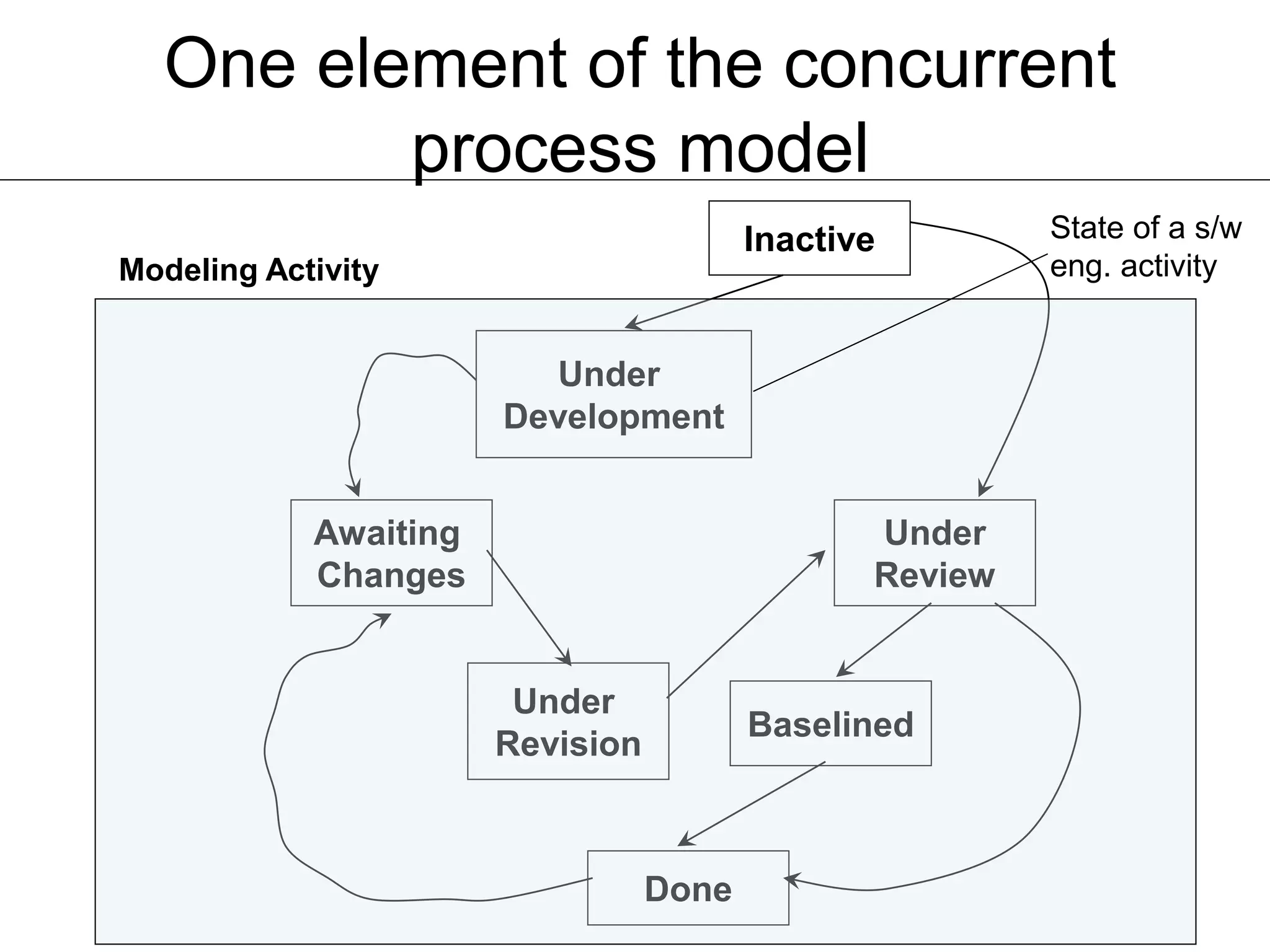
• All software engineering activities exist concurrently but
reside in different states.
• Concurrent modeling defines a series of events that will
trigger transitions from state to state for each of the
activities.
• Concurrent modeling is applicable to all types of
software development and provide an accurate picture of
the current state of a project. 16
One element of the concurrent
process model
Inactive
Under
Development
Awaiting
Changes
Under
Revision
Under
Review
Baselined
Done
Modeling Activity
State of a s/w
eng. activity

Fundamentals of Software Engineering

  • 1.
    Prescriptive Process models •Waterfall Model. • Incremental Process Model. • Evolutionary Process Model. • Concurrent model 1
  • 2.
    Prescriptive Process models WaterfallModel • Oldest software lifecycle model & best understood by upper management • Used when requirements are well understood and risk is low • Work flow is in a linear fashion (i.e., sequential) • Used often with well-defined adaptations or enhancements to current software 2
  • 3.
    Communication Project initiation Requirement gathering Planning Estimating Scheduling Tracking Modeling Analysis Design Construction Code Test Deployment Delivery Support Feedback Requirements Modeling Architectural Design Component Design Code Generation UnitTesting Integration Testing System Testing Acceptance Testing The V-model provides a way of visualizing how verification and validation actions are applied to earlier engineering work.
  • 4.
    Waterfall Model Problems • Realprojects rarely follow sequential flow. • Difficult for customers to state all requirements explicitly and up front • Requires customer patience because a working version of the program doesn't occur until the final phase • Doesn't support iteration, so changes can cause confusion and Leads to “blocking states”. Useful • Where requirements are fixed and is to proceed to completion in a linear manner. 4
  • 5.
    Prescriptive Process models IncrementalProcess Model • Combines elements of linear and parallel process flows. • It delivers a series of releases, called increments that provide progressively more functionality for the customer as each is delivered • The first increment is often a core product. • The plan addresses the modification of the core product to better meet the needs of the customer and the delivery of additional feature and functionality. • It focuses on the delivery of an operational product with each increment. 5
  • 6.
    Incremental Process Model •It is useful when staffing is unavailable for a complete implementation. • Increments can be planned to manage technical risks. 6 Softwarefunctionalityandfeatures Project calendar Time Communication Planning Modeling (analysis, design) Construction (code, test) Deployment ( delivery, feedback) Delivery of 1st Increment
  • 7.
    Evolutionary Process Model •Software, like Complex systems evolve over a period of time -Business and product requirements often change as development proceeds. - tight market deadlines make completion of a comprehensive software product impossible, but a limited version must be introduced to meet competitive or business pressure - a set of core product or system requirements is well understood, but the details of product or system extensions have yet to be defined. • Evolutionary models are iterative. • Evolutionary Process Model produce an increasingly more complete version of the software with each iteration. • Specification, development and validation are interleaved. 7
  • 8.
    Prescriptive Process models EvolutionaryProcess Model • Prototyping • Spiral Model 8
  • 9.
    Evolutionary Process Model Prototyping •It assists you and stakeholders to better understand what is to built when requirements are fuzzy. • Prototyping paradigm -begins with communication. - planned quickly and modelling occurs - quick design focuses on a representation of those aspects of the software that will be visible to end users. • It serves as a mechanism for identifying software requirements. 9
  • 10.
  • 11.
    Prototyping Model Problems • Overallsoftware quality or long-term maintainability is not considered. • As a Software Engineer make implementation compromises in order to get a prototype working quickly. Useful • The customer get feel for the actual system and developers get to build something immediately • Key here is all the stakeholders should agree that the prototype is built to serve as a mechanism for defining requirements. 11
  • 12.
    Evolutionary Process Model Spiraldevelopment • Originally proposed by Barry Boehm. • It couples the iterative nature of prototyping with the controlled and systematic aspects of water fall model. • Process is represented as a spiral rather than as a sequence of activities with backtracking. • Each loop in the spiral represents a phase in the process. • No fixed phases such as specification or design - loops in the spiral are chosen depending on what is required. • Risks are explicitly assessed and resolved throughout the process. 12
  • 13.
    Spiral model • Itis a realistic approach to the development of large-scale systems and software. • The software evolves as the process progresses, the developer and customer better understand and react at each evolutionary level. • It uses prototyping as a risk reduction mechanism. • It demands considerable risk assessment expertise and realise on this expertise for success. 13
  • 14.
  • 15.
    Evolutionary development • Problems –Do not establish the max. speed of the evolution. – Systems are often poorly structured; – Special skills (e.g. in languages for rapid prototyping) may be required. – Proj. mgmt. and estimation technique do not fit completely • Applicability – For small or medium-size interactive systems; – For parts of large systems (e.g. the user interface); – For short-lifetime systems. 15
  • 16.
    Concurrent Model • Theconcurrent development model sometimes called Concurrent Engineering. • It allows team to represent iterative and concurrent elements of any of the process models. • All software engineering activities exist concurrently but reside in different states. • Concurrent modeling defines a series of events that will trigger transitions from state to state for each of the activities. • Concurrent modeling is applicable to all types of software development and provide an accurate picture of the current state of a project. 16
  • 17.
    One element ofthe concurrent process model Inactive Under Development Awaiting Changes Under Revision Under Review Baselined Done Modeling Activity State of a s/w eng. activity