Software Engineering
(CSI 321)
Process Models
1
Process Model
• A software process model is a simplified
representation of a software process, presented
from a specific perspective.
• A software process model is an abstract
representation of a software process.
2
Process Model
• Attempt to organize the software life cycle by
– defining activities involved in software production
– order of activities and their relationships
• Every process model must be adapted so that it is
used effectively for a specific software project.
3
Prescriptive Process Models
• Prescriptive software process models have been applied for
many years in an effort to bring order and structure to
software development.
• Each of these conventional models suggests a somewhat
different process flow, but all perform the same set of generic
framework activities –
– Communication
– Planning
– Modeling
– Construction
– deployment
4
Prescriptive Process Models
• A prescriptive process model populates a process
framework with explicit task sets for software
engineering actions.
• Prescriptive process models advocate an orderly
approach to software engineering.
• Prescriptive Process Models are NOT static, they
should be adapted to the –
– People
– Problem
– Project
5
Prescriptive Process Models
 The Waterfall Model
 Incremental Process Models
 Evolutionary Process Models
6
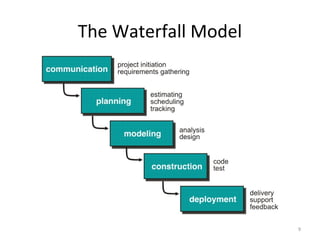
The Waterfall Model
• The oldest paradigm for software engineering.
• The Waterfall model, sometimes called the classic
life cycle, suggests a systematic, sequential approach
to software development.
• One phase begins when another completes.
• Useful process model in situations where
requirements are well-defined and stable, and work
is to be proceed to completion in a linear manner.
7
The Waterfall Model
8
The Waterfall Model
9
Advantages of the Waterfall model
• Identifies systems requirements long before
programming begins.
• Minimized changes to the requirements as the
project proceeds.
10
Problems of the Waterfall model
• The Waterfall model suggests a linear progression of framework
activities that is often inconsistent with modern realities( e.g.
continuous change, evolving systems, tight timelines). Real projects
rarely follow the sequential flow that the model proposes.
• The main drawback of the waterfall model is the difficulty of
accommodating change after the process is underway. One phase
has to be completed before moving onto the next phase.
• Inflexible partitioning of the project into distinct stages makes it
difficult to respond to changing customer requirements.
– It is often difficult for the customer to state all requirements
explicitly
– The customer must be patient
11
Incremental Process Models
• Rather than deliver the system as a single delivery, the
development and delivery is broken down into increments
with each increment delivering part of the required
functionality.
• User requirements are prioritized and the highest priority
requirements are included in early increments.
• Once the development of an increment is started, the
requirements are frozen though requirements for later
increments can continue to evolve.
 Incremental software process models produce software as a
series of increment releases.
– The Incremental Model
– The RAD model
12
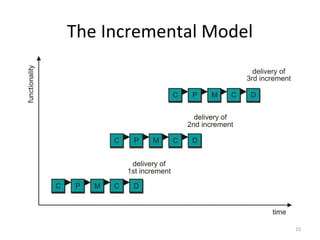
The Incremental Model
• The Incremental Model combines elements of the
Waterfall model applied in an iterative fashion.
• Delivers a series of releases , called increments, that
provide progressively more functionality for the
customer as each increment is delivered.
– Deliver the core product first
– Add on / refine features
– Provide a platform for evaluation by user
13
The Incremental Model
• The incremental process model, like prototyping and other
evolutionary approaches, is iterative in nature.
• Unlike prototyping, the incremental model focuses on the
delivery of an operational product with each increment. Early
increments are “stripped down” versions of the final product.
• Incremental development is particularly useful when staffing
is unavailable for a complete implementation by the business
deadline that has been established for the project.
– Early increments can be implemented with fewer people.
– If core product is well received, additional staff can be added to
implement the next increment.
– Increments can be planned to manage technical risks
14
The Incremental Model
15
Advantages of Incremental Model
• Customer value can be delivered with each increment so
system functionality is available earlier.
• Early increments act as a prototype to help elicit
requirements for later increments.
• Lower risk of overall project failure.
• The highest priority system services tend to receive the most
testing.
16
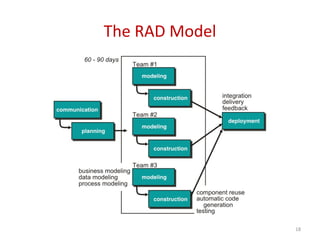
The RAD Model
• Rapid Application Development (RAD) model
• Incremental software process model that emphasizes a
short development cycle ( as little as 60-90 days)
• “High-speed” adaptation of the Waterfall model
• Rapid development is achieved by using a component-
based construction approach
• Each major function handled by separate RAD team, and
then integrated to form a whole
• RAD model is designed for larger projects that must be
delivered in tight time frames
17
The RAD Model
18
Drawbacks of the RAD model
• For large projects, RAD requires sufficient human
resources ( to create right number of RAD teams).
• RAD projects fails in the event if developers & customers
are not committed to rapid-fire activities within short
time frame
• If a system cannot be properly modularized, building the
components necessary for RAD will be problematic
• Not suitable when technical risks are high, or when high
performance needs to be achieved through tuning.
19
Evolutionary Process Models
• Evolutionary Process Models produce an increasingly more
complete version of the software with each iteration.
• Evolutionary models are iterative and are designed to
accommodate change.
• Produce incremental work products(or working version of the
software) quickly.
• Based on the idea of developing an initial implementation,
exposing this to user comment & refining it through many
versions until an adequate system has been developed.
20
Evolutionary Process Models
• These models can be adopted to apply across all
software engineering activities –from concept
development to long-term system maintenance.
– Prototyping
– Spiral development
21
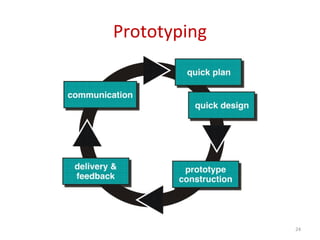
Prototyping
• Designing and building a scaled-down but functional version
of a desired system is known as prototyping.
• Prototyping is an iterative process of systems development in
which requirements are converted to a working system that is
continually revised through close collaboration between an
analyst and users.
– Requirements quickly converted to a working system
– System is continually revised
– Close collaboration between users and analysts
• Start with a "quick-and-dirty" prototype (that provides
minimal functionality), repeat process, refining the prototype
each time, stop when prototype is a working system.
22
Prototyping
• Objective is to understand the customer’s
requirements & hence develop a better requirements
definition for the system.
• Should start with poorly understood requirements to
clarify what is really needed.
• The prototype serves as a mechanism for identifying
software requirements
23
Prototyping
24
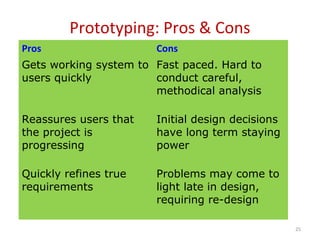
Prototyping: Pros & Cons
Pros Cons
Gets working system to
users quickly
Fast paced. Hard to
conduct careful,
methodical analysis
Reassures users that
the project is
progressing
Initial design decisions
have long term staying
power
Quickly refines true
requirements
Problems may come to
light late in design,
requiring re-design
25
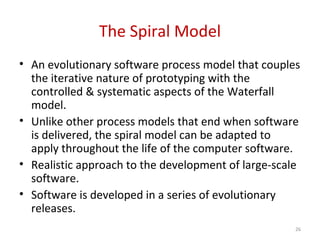
The Spiral Model
• An evolutionary software process model that couples
the iterative nature of prototyping with the
controlled & systematic aspects of the Waterfall
model.
• Unlike other process models that end when software
is delivered, the spiral model can be adapted to
apply throughout the life of the computer software.
• Realistic approach to the development of large-scale
software.
• Software is developed in a series of evolutionary
releases.
26
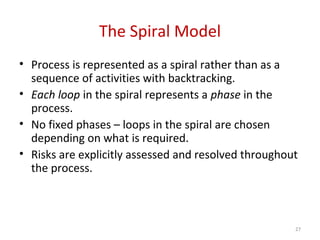
The Spiral Model
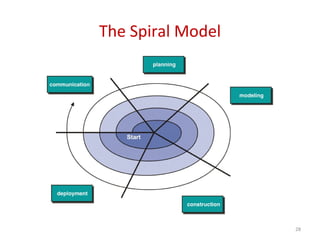
• Process is represented as a spiral rather than as a
sequence of activities with backtracking.
• Each loop in the spiral represents a phase in the
process.
• No fixed phases – loops in the spiral are chosen
depending on what is required.
• Risks are explicitly assessed and resolved throughout
the process.
27
The Spiral Model
28
The Spiral Model
29
Risk
analysis
Risk
analysis
Risk
analysis
Risk
analysis Proto-
type 1
Prototype 2
Prototype 3
Opera-
tional
protoype
Concept of
Operation
Simulations, models, benchmarks
S/W
requirements
Requirement
validation
Design
V&V
Product
design Detailed
design
Code
Unit test
Integration
testAcceptance
testService Develop, verify
next-level product
Evaluate alternatives
identify, resolve risks
Determine objectives
alternatives and
constraints
Plan next phase
Integration
and test plan
Development
plan
Requirements plan
Life-cycle plan
REVIEW
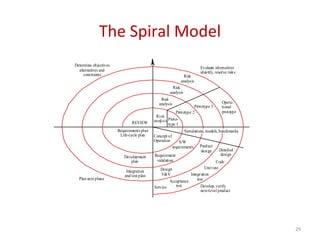
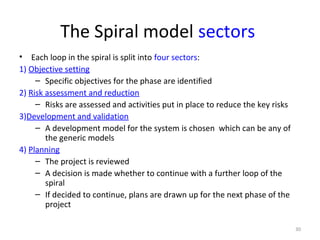
The Spiral model sectors
• Each loop in the spiral is split into four sectors:
1) Objective setting
– Specific objectives for the phase are identified
2) Risk assessment and reduction
– Risks are assessed and activities put in place to reduce the key risks
3)Development and validation
– A development model for the system is chosen which can be any of
the generic models
4) Planning
– The project is reviewed
– A decision is made whether to continue with a further loop of the
spiral
– If decided to continue, plans are drawn up for the next phase of the
project
30
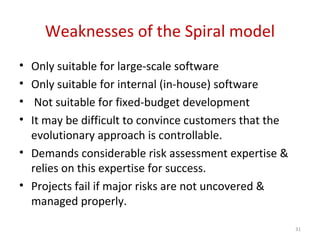
Weaknesses of the Spiral model
• Only suitable for large-scale software
• Only suitable for internal (in-house) software
• Not suitable for fixed-budget development
• It may be difficult to convince customers that the
evolutionary approach is controllable.
• Demands considerable risk assessment expertise &
relies on this expertise for success.
• Projects fail if major risks are not uncovered &
managed properly.
31
Specialized Process Model
• Component-Based Development Model
• Formal methods Model
• Aspect-Oriented Model
32
Specialized Process Model
 Component-Based Development Model
– Component-Based Model emphasizes component reuse
and assembly
– COTS software components can be used when software is
to be built. These components provide targeted
functionality with well-defined interfaces that enable the
component to be integrated into the software.
– Component-based development model incorporates many
of the characteristics of the spiral model. It is evolutionary
in nature, demanding an iterative approach to the creation
of software
– The model composes applications from prepackaged
software components
33
Specialized Process Model
 Component-based development model incorporates
the following steps –
1) Available component-based products are researched and
evaluated for the application domain
2) Component integration issues are considered
3) A software architecture is designed to accommodate the
components
4) Components are integrated into the architecture
5) Comprehensive testing is conducted to ensure proper
functionality
34
Specialized Process Model
 Formal Methods Model
– Encompasses a set of activities that leads to formal
mathematical specification of computer software
– Encourages a mathematically based approach to software
development & verification
– A variation on this approach, called clean-room software
engineering, is currently applied by some software
development organizations.
– Provide a mechanism for eliminating many of the
problems that are difficult to overcome using other SE
paradigms. Ambiguity, incompleteness, and inconsistency
can be discovered & corrected more easily through the
application of mathematical analysis.
35
Specialized Process Model
• Formal methods model offers the promise of defect-
free software. BUT, it is not widely used –
– Development of formal models is quite time-consuming &
expensive
– Because few developers have the necessary background to
apply formal methods, extensive training is required
– It is difficult to use the models as a communication
mechanism for technically unsophisticated customers.
36
Specialized Process Model
 Aspect-Oriented Model
– Accommodates cross-cutting concerns that spans
the entire system architecture
– AOSD defines “aspects” that express customer
concerns that cut across multiple system
functions, features, and information
37
Unified Process Model
• The Unified Process is a “use-case driven,
architecture-centric, iterative and incremental”
software process designed as a framework for UML
methods and tools.
• UP phases are similar in intent to the generic
framework activities .
• A modern process model that is organized into five
phases but that separates activities from these
phases.
38
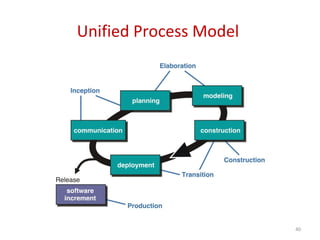
Five Phases of Unified Process Model
1) Inception
– Establish the business case for the system.
1) Elaboration
– Develop an understanding of the problem domain and the system
architecture.
1) Construction
– System design, programming and testing.
1) Transition
– Deploy the system in its operating environment.
1) Production
– On-going monitoring & support
39
Unified Process Model
40

Software Engineering (Process Models)

  • 1.
  • 2.
    Process Model • Asoftware process model is a simplified representation of a software process, presented from a specific perspective. • A software process model is an abstract representation of a software process. 2
  • 3.
    Process Model • Attemptto organize the software life cycle by – defining activities involved in software production – order of activities and their relationships • Every process model must be adapted so that it is used effectively for a specific software project. 3
  • 4.
    Prescriptive Process Models •Prescriptive software process models have been applied for many years in an effort to bring order and structure to software development. • Each of these conventional models suggests a somewhat different process flow, but all perform the same set of generic framework activities – – Communication – Planning – Modeling – Construction – deployment 4
  • 5.
    Prescriptive Process Models •A prescriptive process model populates a process framework with explicit task sets for software engineering actions. • Prescriptive process models advocate an orderly approach to software engineering. • Prescriptive Process Models are NOT static, they should be adapted to the – – People – Problem – Project 5
  • 6.
    Prescriptive Process Models The Waterfall Model  Incremental Process Models  Evolutionary Process Models 6
  • 7.
    The Waterfall Model •The oldest paradigm for software engineering. • The Waterfall model, sometimes called the classic life cycle, suggests a systematic, sequential approach to software development. • One phase begins when another completes. • Useful process model in situations where requirements are well-defined and stable, and work is to be proceed to completion in a linear manner. 7
  • 8.
  • 9.
  • 10.
    Advantages of theWaterfall model • Identifies systems requirements long before programming begins. • Minimized changes to the requirements as the project proceeds. 10
  • 11.
    Problems of theWaterfall model • The Waterfall model suggests a linear progression of framework activities that is often inconsistent with modern realities( e.g. continuous change, evolving systems, tight timelines). Real projects rarely follow the sequential flow that the model proposes. • The main drawback of the waterfall model is the difficulty of accommodating change after the process is underway. One phase has to be completed before moving onto the next phase. • Inflexible partitioning of the project into distinct stages makes it difficult to respond to changing customer requirements. – It is often difficult for the customer to state all requirements explicitly – The customer must be patient 11
  • 12.
    Incremental Process Models •Rather than deliver the system as a single delivery, the development and delivery is broken down into increments with each increment delivering part of the required functionality. • User requirements are prioritized and the highest priority requirements are included in early increments. • Once the development of an increment is started, the requirements are frozen though requirements for later increments can continue to evolve.  Incremental software process models produce software as a series of increment releases. – The Incremental Model – The RAD model 12
  • 13.
    The Incremental Model •The Incremental Model combines elements of the Waterfall model applied in an iterative fashion. • Delivers a series of releases , called increments, that provide progressively more functionality for the customer as each increment is delivered. – Deliver the core product first – Add on / refine features – Provide a platform for evaluation by user 13
  • 14.
    The Incremental Model •The incremental process model, like prototyping and other evolutionary approaches, is iterative in nature. • Unlike prototyping, the incremental model focuses on the delivery of an operational product with each increment. Early increments are “stripped down” versions of the final product. • Incremental development is particularly useful when staffing is unavailable for a complete implementation by the business deadline that has been established for the project. – Early increments can be implemented with fewer people. – If core product is well received, additional staff can be added to implement the next increment. – Increments can be planned to manage technical risks 14
  • 15.
  • 16.
    Advantages of IncrementalModel • Customer value can be delivered with each increment so system functionality is available earlier. • Early increments act as a prototype to help elicit requirements for later increments. • Lower risk of overall project failure. • The highest priority system services tend to receive the most testing. 16
  • 17.
    The RAD Model •Rapid Application Development (RAD) model • Incremental software process model that emphasizes a short development cycle ( as little as 60-90 days) • “High-speed” adaptation of the Waterfall model • Rapid development is achieved by using a component- based construction approach • Each major function handled by separate RAD team, and then integrated to form a whole • RAD model is designed for larger projects that must be delivered in tight time frames 17
  • 18.
  • 19.
    Drawbacks of theRAD model • For large projects, RAD requires sufficient human resources ( to create right number of RAD teams). • RAD projects fails in the event if developers & customers are not committed to rapid-fire activities within short time frame • If a system cannot be properly modularized, building the components necessary for RAD will be problematic • Not suitable when technical risks are high, or when high performance needs to be achieved through tuning. 19
  • 20.
    Evolutionary Process Models •Evolutionary Process Models produce an increasingly more complete version of the software with each iteration. • Evolutionary models are iterative and are designed to accommodate change. • Produce incremental work products(or working version of the software) quickly. • Based on the idea of developing an initial implementation, exposing this to user comment & refining it through many versions until an adequate system has been developed. 20
  • 21.
    Evolutionary Process Models •These models can be adopted to apply across all software engineering activities –from concept development to long-term system maintenance. – Prototyping – Spiral development 21
  • 22.
    Prototyping • Designing andbuilding a scaled-down but functional version of a desired system is known as prototyping. • Prototyping is an iterative process of systems development in which requirements are converted to a working system that is continually revised through close collaboration between an analyst and users. – Requirements quickly converted to a working system – System is continually revised – Close collaboration between users and analysts • Start with a "quick-and-dirty" prototype (that provides minimal functionality), repeat process, refining the prototype each time, stop when prototype is a working system. 22
  • 23.
    Prototyping • Objective isto understand the customer’s requirements & hence develop a better requirements definition for the system. • Should start with poorly understood requirements to clarify what is really needed. • The prototype serves as a mechanism for identifying software requirements 23
  • 24.
  • 25.
    Prototyping: Pros &Cons Pros Cons Gets working system to users quickly Fast paced. Hard to conduct careful, methodical analysis Reassures users that the project is progressing Initial design decisions have long term staying power Quickly refines true requirements Problems may come to light late in design, requiring re-design 25
  • 26.
    The Spiral Model •An evolutionary software process model that couples the iterative nature of prototyping with the controlled & systematic aspects of the Waterfall model. • Unlike other process models that end when software is delivered, the spiral model can be adapted to apply throughout the life of the computer software. • Realistic approach to the development of large-scale software. • Software is developed in a series of evolutionary releases. 26
  • 27.
    The Spiral Model •Process is represented as a spiral rather than as a sequence of activities with backtracking. • Each loop in the spiral represents a phase in the process. • No fixed phases – loops in the spiral are chosen depending on what is required. • Risks are explicitly assessed and resolved throughout the process. 27
  • 28.
  • 29.
    The Spiral Model 29 Risk analysis Risk analysis Risk analysis Risk analysisProto- type 1 Prototype 2 Prototype 3 Opera- tional protoype Concept of Operation Simulations, models, benchmarks S/W requirements Requirement validation Design V&V Product design Detailed design Code Unit test Integration testAcceptance testService Develop, verify next-level product Evaluate alternatives identify, resolve risks Determine objectives alternatives and constraints Plan next phase Integration and test plan Development plan Requirements plan Life-cycle plan REVIEW
  • 30.
    The Spiral modelsectors • Each loop in the spiral is split into four sectors: 1) Objective setting – Specific objectives for the phase are identified 2) Risk assessment and reduction – Risks are assessed and activities put in place to reduce the key risks 3)Development and validation – A development model for the system is chosen which can be any of the generic models 4) Planning – The project is reviewed – A decision is made whether to continue with a further loop of the spiral – If decided to continue, plans are drawn up for the next phase of the project 30
  • 31.
    Weaknesses of theSpiral model • Only suitable for large-scale software • Only suitable for internal (in-house) software • Not suitable for fixed-budget development • It may be difficult to convince customers that the evolutionary approach is controllable. • Demands considerable risk assessment expertise & relies on this expertise for success. • Projects fail if major risks are not uncovered & managed properly. 31
  • 32.
    Specialized Process Model •Component-Based Development Model • Formal methods Model • Aspect-Oriented Model 32
  • 33.
    Specialized Process Model Component-Based Development Model – Component-Based Model emphasizes component reuse and assembly – COTS software components can be used when software is to be built. These components provide targeted functionality with well-defined interfaces that enable the component to be integrated into the software. – Component-based development model incorporates many of the characteristics of the spiral model. It is evolutionary in nature, demanding an iterative approach to the creation of software – The model composes applications from prepackaged software components 33
  • 34.
    Specialized Process Model Component-based development model incorporates the following steps – 1) Available component-based products are researched and evaluated for the application domain 2) Component integration issues are considered 3) A software architecture is designed to accommodate the components 4) Components are integrated into the architecture 5) Comprehensive testing is conducted to ensure proper functionality 34
  • 35.
    Specialized Process Model Formal Methods Model – Encompasses a set of activities that leads to formal mathematical specification of computer software – Encourages a mathematically based approach to software development & verification – A variation on this approach, called clean-room software engineering, is currently applied by some software development organizations. – Provide a mechanism for eliminating many of the problems that are difficult to overcome using other SE paradigms. Ambiguity, incompleteness, and inconsistency can be discovered & corrected more easily through the application of mathematical analysis. 35
  • 36.
    Specialized Process Model •Formal methods model offers the promise of defect- free software. BUT, it is not widely used – – Development of formal models is quite time-consuming & expensive – Because few developers have the necessary background to apply formal methods, extensive training is required – It is difficult to use the models as a communication mechanism for technically unsophisticated customers. 36
  • 37.
    Specialized Process Model Aspect-Oriented Model – Accommodates cross-cutting concerns that spans the entire system architecture – AOSD defines “aspects” that express customer concerns that cut across multiple system functions, features, and information 37
  • 38.
    Unified Process Model •The Unified Process is a “use-case driven, architecture-centric, iterative and incremental” software process designed as a framework for UML methods and tools. • UP phases are similar in intent to the generic framework activities . • A modern process model that is organized into five phases but that separates activities from these phases. 38
  • 39.
    Five Phases ofUnified Process Model 1) Inception – Establish the business case for the system. 1) Elaboration – Develop an understanding of the problem domain and the system architecture. 1) Construction – System design, programming and testing. 1) Transition – Deploy the system in its operating environment. 1) Production – On-going monitoring & support 39
  • 40.