Agile Process Models
What is “Agility”?
2
 Effective (rapid and adaptive) response to change (team members, new
technology, requirements)
 Effective communication in structure and attitudes among all team
members, technological and business people, software engineers and
managers。
 Drawing the customer into the team. Eliminate “us and them” attitude.
Planning in an uncertain world has its limits and plan must be flexible.
Eliminate all but the most essential work products and keep them lean.
 Organizing a team so that it is in control of the work performed

 Emphasize an incremental delivery strategy as opposed to intermediate
products that gets working software to the customer as rapidly as feasible.
What is “Agility”?
3
Yielding …
 Rapid, incremental delivery of software
 The development guidelines stress delivery over
analysis and design although these activates are not
discouraged, and active and continuous
communication between developers and customers.
Why and What Steps are“Agility”
4
important?
 Why? The modern business environment is fast-
paced and ever-changing. It represents a reasonable
alternative to conventional software engineering for
certain classes of software projects. It has been
demonstrated to deliver successful systems quickly.
 What? May be termed as “software engineering lite”
The basic activities- communication, planning, modeling,
construction and deployment remain. But they morph into
a minimal task set that push the team toward construction
and delivery sooner.
 The only really important work product is an
operational
“software increment” that is delivered.
Agility and the Cost of Change
5
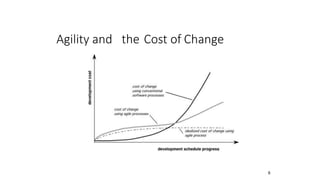
 Conventional wisdom is that the cost of change increases nonlinearly
as a project progresses. It is relatively easy to accommodate a change
when a team is gathering requirements early in a project. If there are
any changes, the costs of doing this work are minimal. But if the middle
of validation testing, a stakeholder is requesting a major functional
change. Then the change requires a modification to the architectural
design, construction of new components, changes to other existing
components, new testing and so on. Costs escalate quickly.
 A well-designed agile process may “flatten” the cost of change curve
by coupling incremental delivery with agile practices such as
continuous unit testing and pair programming. Thus team can
accommodate changes late in the software project without dramatic
cost and time impact.
Agility and the Cost of Change
6
An Agile Process
7
 Is driven by customer descriptions of what is required
(scenarios). Some assumptions:
 Recognizes that plans are short-lived (some requirements will persist, some will
change. Customer priorities will change)
 Develops software iteratively with a heavy emphasis on construction
activities (design and construction are interleaved, hard to say how much design is
necessary before construction. Design models are proven as they are created. )
 Analysis, design, construction and testing are not predictable.
 Thus has to Adapt as changes occur due to
unpredictability
 Delivers multiple ‘software increments’, deliver an
operational prototype or portion of an OS to collect customer
feedback for adaption.
Agility Principles - I
8
1. Our highest priority is to satisfy the customer through early and
continuous delivery of valuable software.
2. Welcome changing requirements, even late in development. Agile
processes harness change for the customer's competitive advantage.
3. Deliver working software frequently, from a couple of weeks to a
couple of months, with a preference to the shorter timescale.
4. Business people and developers must work together daily
throughout the project.
5. Build projects around motivated individuals. Give them the
environment and support they need, and trust them to get the job
done.
6. The most efficient and effective method of conveying information
to and within a development team is face–to–face conversation.
Agility Principles - II
9
7. Working software is the primary measure of progress.
8. Agile processes promote sustainable development. The
sponsors, developers, and users should be able to maintain a
constant pace indefinitely.
9. Continuous attention to technical excellence and good design
enhances agility.
10.Simplicity – the art of maximizing the amount of work not
done – is essential.
11.The best architectures, requirements, and designs emerge
from self–organizing teams.
12.At regular intervals, the team reflects on how to become
more effective, then tunes and adjusts its behavior
accordingly.
Human Factors
 the process molds to the needs of the people and team, not the
other way around
 key traits must exist among the people on an agile team and the
team itself:
 Competence. ( talent, skills, knowledge should be shared among agile team
members)
 Common focus. ( deliver a working software increment to customer within the
time promised)
 Collaboration. ( peers and stakeholders collaboration that provide business
values for the customer)
 Decision-making ability. ( Any software team is given freedom to control its
own destiny-decision making)
10
 Fuzzy problem-solving ability.(Agile team should deal with ambiguity and constant changes, today
problem may not be tomorrow’s problem)
 Mutual trust and respect. ( “so strongly knit that the whole is greater than the sum of the parts”)
 Self-organization. ( Agile team organizes: themselves for the work to be done, the process that best
accommodate for its local environment, the work schedule to best achieve delivery of the software
increment)
11

Fundamentals of Software Engineering

  • 1.
  • 2.
    What is “Agility”? 2 Effective (rapid and adaptive) response to change (team members, new technology, requirements)  Effective communication in structure and attitudes among all team members, technological and business people, software engineers and managers。  Drawing the customer into the team. Eliminate “us and them” attitude. Planning in an uncertain world has its limits and plan must be flexible. Eliminate all but the most essential work products and keep them lean.  Organizing a team so that it is in control of the work performed   Emphasize an incremental delivery strategy as opposed to intermediate products that gets working software to the customer as rapidly as feasible.
  • 3.
    What is “Agility”? 3 Yielding…  Rapid, incremental delivery of software  The development guidelines stress delivery over analysis and design although these activates are not discouraged, and active and continuous communication between developers and customers.
  • 4.
    Why and WhatSteps are“Agility” 4 important?  Why? The modern business environment is fast- paced and ever-changing. It represents a reasonable alternative to conventional software engineering for certain classes of software projects. It has been demonstrated to deliver successful systems quickly.  What? May be termed as “software engineering lite” The basic activities- communication, planning, modeling, construction and deployment remain. But they morph into a minimal task set that push the team toward construction and delivery sooner.  The only really important work product is an operational “software increment” that is delivered.
  • 5.
    Agility and theCost of Change 5  Conventional wisdom is that the cost of change increases nonlinearly as a project progresses. It is relatively easy to accommodate a change when a team is gathering requirements early in a project. If there are any changes, the costs of doing this work are minimal. But if the middle of validation testing, a stakeholder is requesting a major functional change. Then the change requires a modification to the architectural design, construction of new components, changes to other existing components, new testing and so on. Costs escalate quickly.  A well-designed agile process may “flatten” the cost of change curve by coupling incremental delivery with agile practices such as continuous unit testing and pair programming. Thus team can accommodate changes late in the software project without dramatic cost and time impact.
  • 6.
    Agility and theCost of Change 6
  • 7.
    An Agile Process 7 Is driven by customer descriptions of what is required (scenarios). Some assumptions:  Recognizes that plans are short-lived (some requirements will persist, some will change. Customer priorities will change)  Develops software iteratively with a heavy emphasis on construction activities (design and construction are interleaved, hard to say how much design is necessary before construction. Design models are proven as they are created. )  Analysis, design, construction and testing are not predictable.  Thus has to Adapt as changes occur due to unpredictability  Delivers multiple ‘software increments’, deliver an operational prototype or portion of an OS to collect customer feedback for adaption.
  • 8.
    Agility Principles -I 8 1. Our highest priority is to satisfy the customer through early and continuous delivery of valuable software. 2. Welcome changing requirements, even late in development. Agile processes harness change for the customer's competitive advantage. 3. Deliver working software frequently, from a couple of weeks to a couple of months, with a preference to the shorter timescale. 4. Business people and developers must work together daily throughout the project. 5. Build projects around motivated individuals. Give them the environment and support they need, and trust them to get the job done. 6. The most efficient and effective method of conveying information to and within a development team is face–to–face conversation.
  • 9.
    Agility Principles -II 9 7. Working software is the primary measure of progress. 8. Agile processes promote sustainable development. The sponsors, developers, and users should be able to maintain a constant pace indefinitely. 9. Continuous attention to technical excellence and good design enhances agility. 10.Simplicity – the art of maximizing the amount of work not done – is essential. 11.The best architectures, requirements, and designs emerge from self–organizing teams. 12.At regular intervals, the team reflects on how to become more effective, then tunes and adjusts its behavior accordingly.
  • 10.
    Human Factors  theprocess molds to the needs of the people and team, not the other way around  key traits must exist among the people on an agile team and the team itself:  Competence. ( talent, skills, knowledge should be shared among agile team members)  Common focus. ( deliver a working software increment to customer within the time promised)  Collaboration. ( peers and stakeholders collaboration that provide business values for the customer)  Decision-making ability. ( Any software team is given freedom to control its own destiny-decision making) 10
  • 11.
     Fuzzy problem-solvingability.(Agile team should deal with ambiguity and constant changes, today problem may not be tomorrow’s problem)  Mutual trust and respect. ( “so strongly knit that the whole is greater than the sum of the parts”)  Self-organization. ( Agile team organizes: themselves for the work to be done, the process that best accommodate for its local environment, the work schedule to best achieve delivery of the software increment) 11