System Development Life Cycle (SDLC)
Waterfall Model
Presented By: Manar Alfarsi
Outline
 Waterfall Model Definition.
 Phases of Waterfall Model.
 When to use Waterfall Mode?
 Waterfall Model Advantages.
 Waterfall Model Disadvantages.
 Waterfall model is the earliest SDLC approach that was used
for software development .
 It is also referred to as a linear-sequential life cycle model.
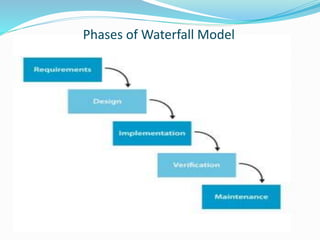
 Each phase must be completed before the next phase can
begin.
 The outcome of one phase acts as the input for the next phase
sequentially.
 There is no overlapping in the phases.
Waterfall Model Definition
Phases of Waterfall Model
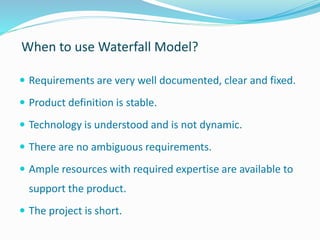
When to use Waterfall Model?
 Requirements are very well documented, clear and fixed.
 Product definition is stable.
 Technology is understood and is not dynamic.
 There are no ambiguous requirements.
 Ample resources with required expertise are available to
support the product.
 The project is short.
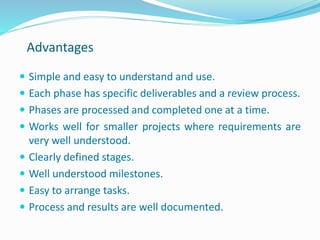
Advantages
 Simple and easy to understand and use.
 Each phase has specific deliverables and a review process.
 Phases are processed and completed one at a time.
 Works well for smaller projects where requirements are
very well understood.
 Clearly defined stages.
 Well understood milestones.
 Easy to arrange tasks.
 Process and results are well documented.
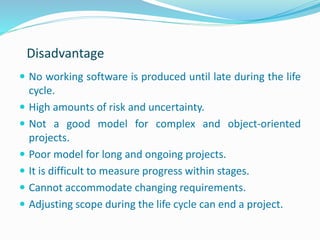
Disadvantage
 No working software is produced until late during the life
cycle.
 High amounts of risk and uncertainty.
 Not a good model for complex and object-oriented
projects.
 Poor model for long and ongoing projects.
 It is difficult to measure progress within stages.
 Cannot accommodate changing requirements.
 Adjusting scope during the life cycle can end a project.
References
 http://www.tutorialspoint.com/sdlc/sdlc_waterfall_m
odel.htm
 http://www.waterfall-model.com/

Sdlc

  • 1.
    System Development LifeCycle (SDLC) Waterfall Model Presented By: Manar Alfarsi
  • 2.
    Outline  Waterfall ModelDefinition.  Phases of Waterfall Model.  When to use Waterfall Mode?  Waterfall Model Advantages.  Waterfall Model Disadvantages.
  • 3.
     Waterfall modelis the earliest SDLC approach that was used for software development .  It is also referred to as a linear-sequential life cycle model.  Each phase must be completed before the next phase can begin.  The outcome of one phase acts as the input for the next phase sequentially.  There is no overlapping in the phases. Waterfall Model Definition
  • 4.
  • 5.
    When to useWaterfall Model?  Requirements are very well documented, clear and fixed.  Product definition is stable.  Technology is understood and is not dynamic.  There are no ambiguous requirements.  Ample resources with required expertise are available to support the product.  The project is short.
  • 6.
    Advantages  Simple andeasy to understand and use.  Each phase has specific deliverables and a review process.  Phases are processed and completed one at a time.  Works well for smaller projects where requirements are very well understood.  Clearly defined stages.  Well understood milestones.  Easy to arrange tasks.  Process and results are well documented.
  • 7.
    Disadvantage  No workingsoftware is produced until late during the life cycle.  High amounts of risk and uncertainty.  Not a good model for complex and object-oriented projects.  Poor model for long and ongoing projects.  It is difficult to measure progress within stages.  Cannot accommodate changing requirements.  Adjusting scope during the life cycle can end a project.
  • 8.