1
3.Software Testing Strategies
• A strategy for software testing integrates the design of software test
cases into a well-planned series of steps that result in successful
development of the software
• The strategy provides a road map that describes the steps to be taken,
when, and how much effort, time, and resources will be required
• The strategy incorporates test planning, test case design, test
execution, and test result collection and evaluation
• The strategy provides guidance for the practitioner and a set of
milestones for the manager
• Because of time pressures, progress must be measurable and problems
must surface as early as possible
2
General Characteristics of
Strategic Testing
• To perform effective testing, a software team should conduct effective
formal technical reviews
• Testing begins at the component level and work outward toward the
integration of the entire computer-based system
• Different testing techniques are appropriate at different points in time
• Testing is conducted by the developer of the software and (for large
projects) by an independent test group
• Testing and debugging are different activities, but debugging must be
accommodated in any testing strategy
3
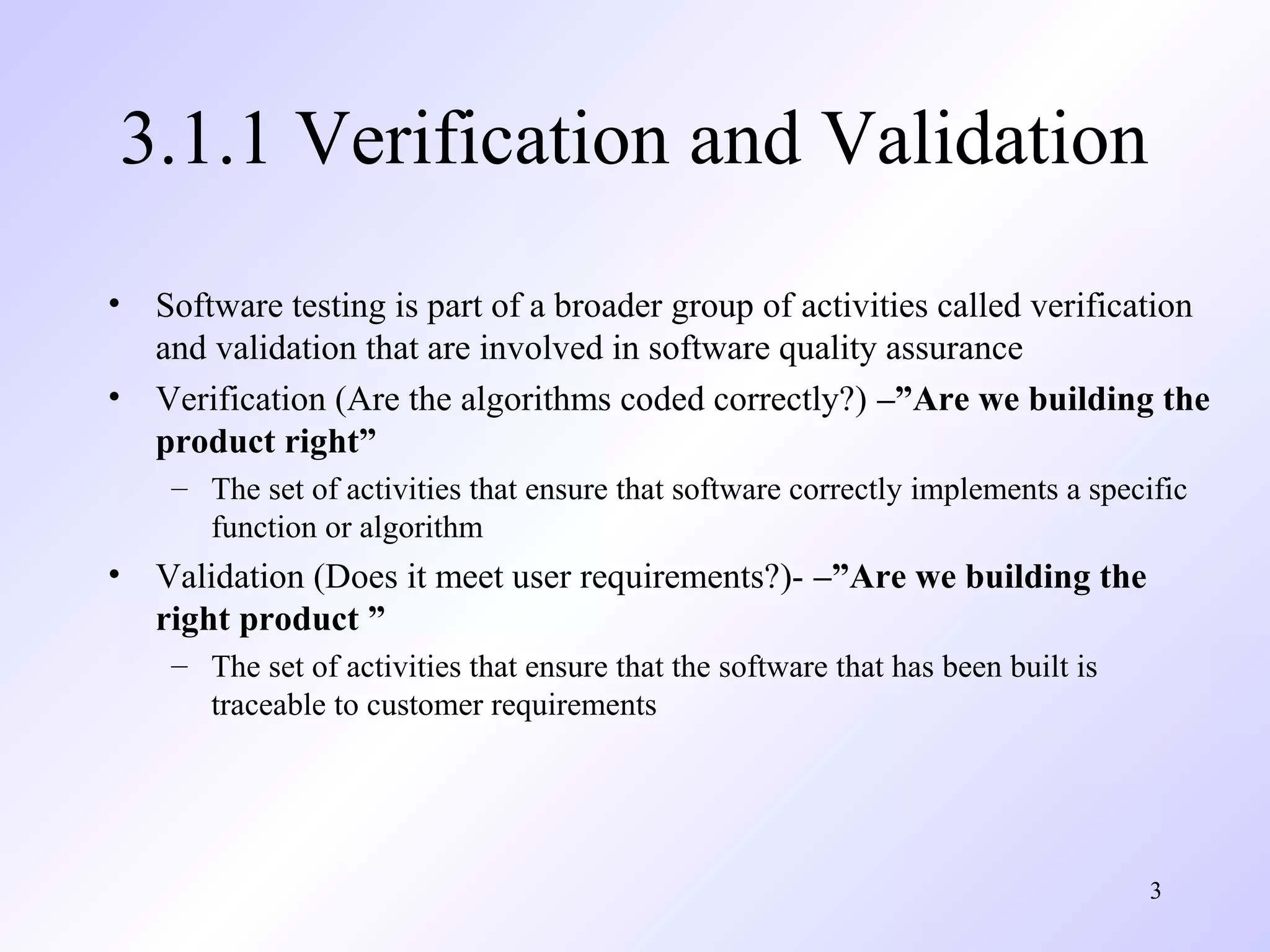
3.1.1 Verification and Validation
• Software testing is part of a broader group of activities called verification
and validation that are involved in software quality assurance
• Verification (Are the algorithms coded correctly?) –”Are we building the
product right”
– The set of activities that ensure that software correctly implements a specific
function or algorithm
• Validation (Does it meet user requirements?)- –”Are we building the
right product ”
– The set of activities that ensure that the software that has been built is
traceable to customer requirements
4
3.1.2 Organizing for Software
Testing
• Testing should aim at "breaking" the software
• Common misconceptions
– The developer of software should do no testing at all
– The software should be given to a secret team of testers who will test it
unmercifully
– The testers get involved with the project only when the testing steps are
about to begin
• Reality: Independent test group
– Removes the inherent problems associated with letting the builder test the
software that has been built
– Removes the conflict of interest that may otherwise be present
– Works closely with the software developer during analysis and design to
ensure that thorough testing occurs
5
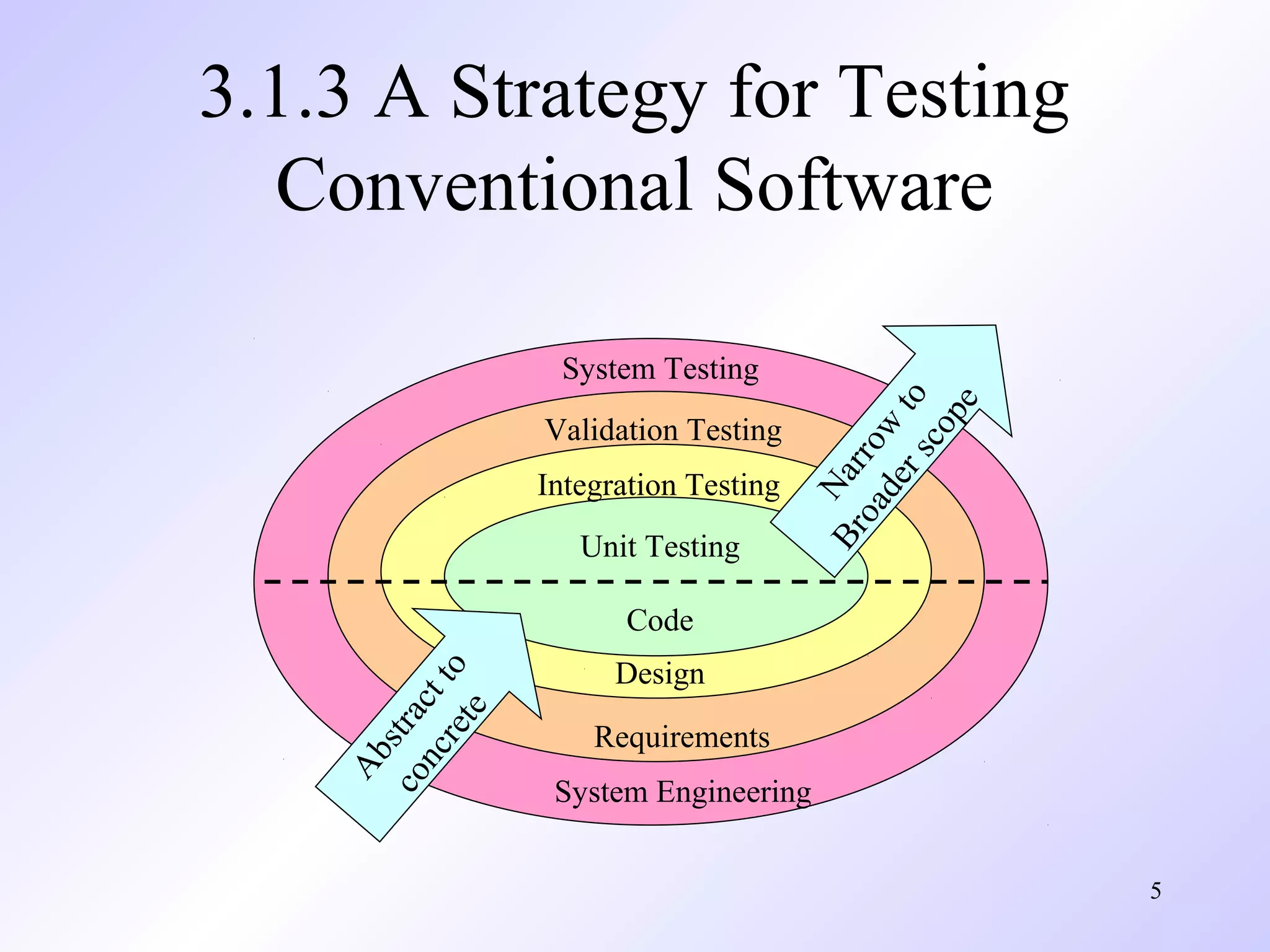
3.1.3 A Strategy for Testing
Conventional Software
Code
Design
Requirements
System Engineering
Unit Testing
Integration Testing
Validation Testing
System TestingAbstractto
concrete
Narrow
to
Broaderscope
6
Levels of Testing for
Conventional Software
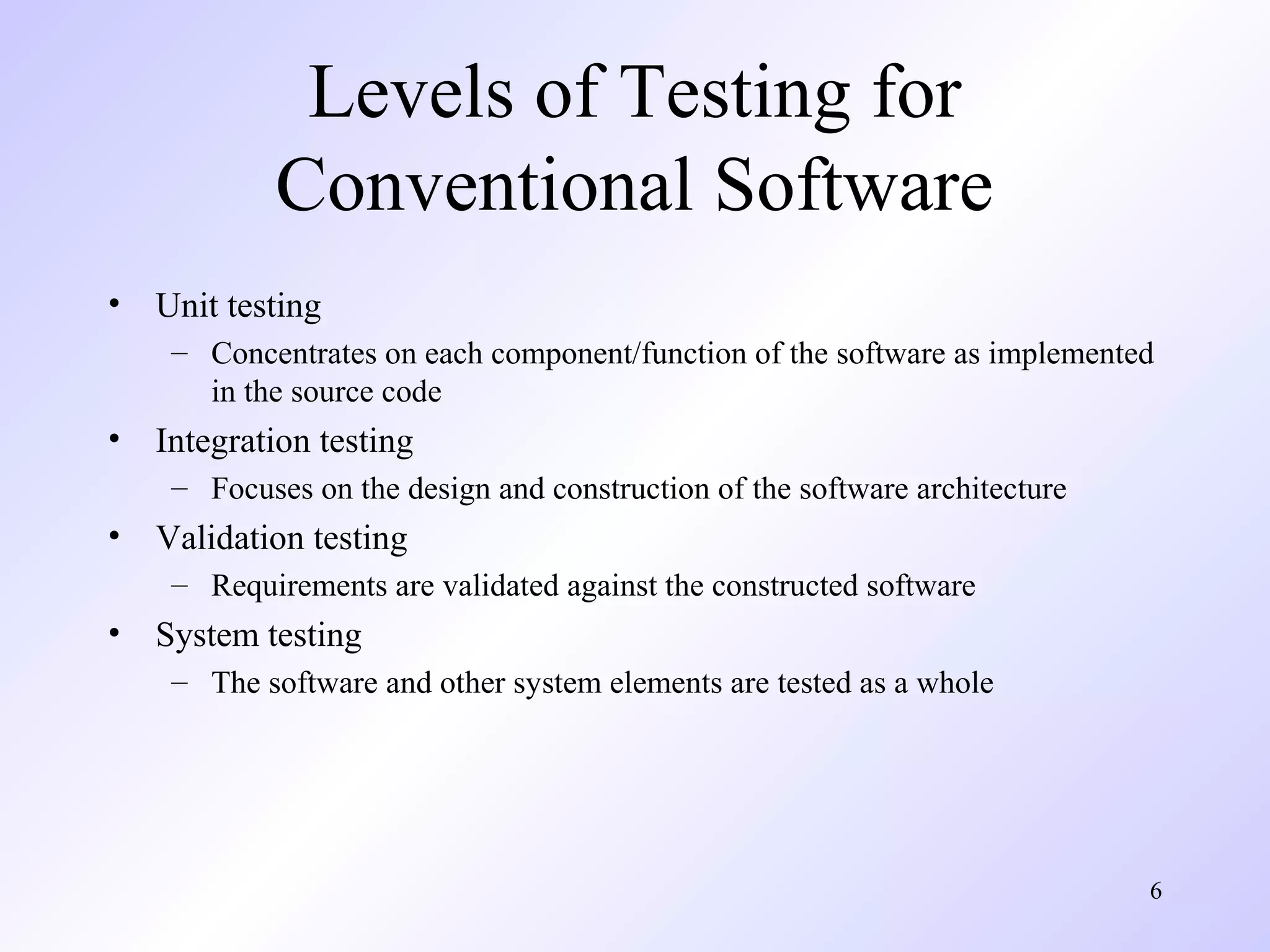
• Unit testing
– Concentrates on each component/function of the software as implemented
in the source code
• Integration testing
– Focuses on the design and construction of the software architecture
• Validation testing
– Requirements are validated against the constructed software
• System testing
– The software and other system elements are tested as a whole
7
Testing Strategy applied to
Conventional Software
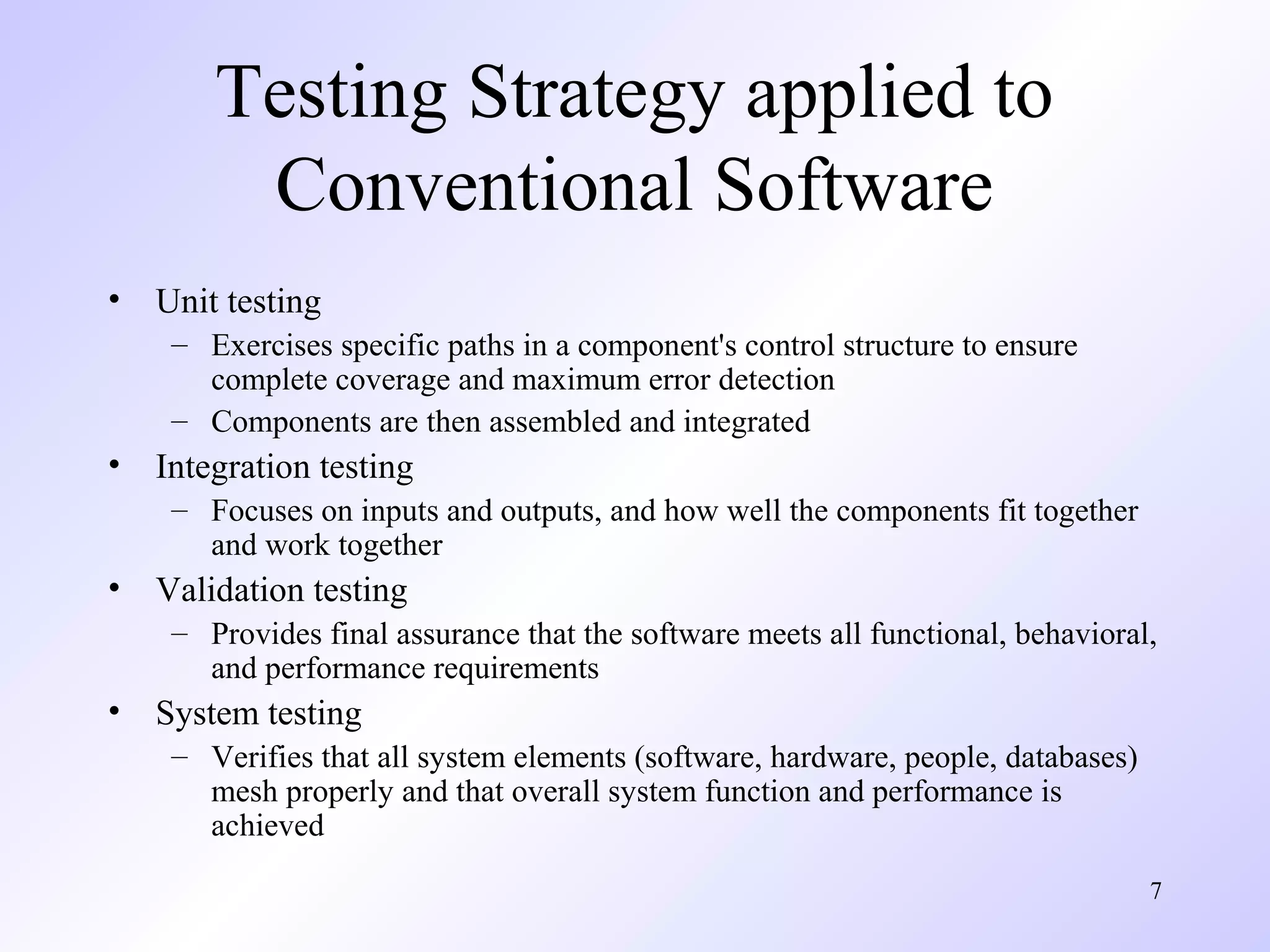
• Unit testing
– Exercises specific paths in a component's control structure to ensure
complete coverage and maximum error detection
– Components are then assembled and integrated
• Integration testing
– Focuses on inputs and outputs, and how well the components fit together
and work together
• Validation testing
– Provides final assurance that the software meets all functional, behavioral,
and performance requirements
• System testing
– Verifies that all system elements (software, hardware, people, databases)
mesh properly and that overall system function and performance is
achieved
8
3.1.4When is Testing Complete?
• There is no definitive answer to this question
• Every time a user executes the software, the program is being tested
• Sadly, testing usually stops when a project is running out of time,
money, or both
• One approach is to divide the test results into various severity levels
– Then consider testing to be complete when certain levels of errors no
longer occur or have been repaired or eliminated
9
3.2 Startegic Issues-Ensuring a
Successful Software Test
Strategy• Specify product requirements in a quantifiable manner long before
testing commences
• State testing objectives explicitly in measurable terms
• Understand the user of the software (through use cases) and develop a
profile for each user category
• Develop a testing plan that emphasizes rapid cycle testing to get quick
feedback to control quality levels and adjust the test strategy
• Build robust software that is designed to test itself and can diagnose
certain kinds of errors
• Use effective formal technical reviews as a filter prior to testing to
reduce the amount of testing required
• Conduct formal technical reviews to assess the test strategy and test
cases themselves
• Develop a continuous improvement approach for the testing process
through the gathering of metrics
9
3.2 Startegic Issues-Ensuring a
Successful Software Test
Strategy• Specify product requirements in a quantifiable manner long before
testing commences
• State testing objectives explicitly in measurable terms
• Understand the user of the software (through use cases) and develop a
profile for each user category
• Develop a testing plan that emphasizes rapid cycle testing to get quick
feedback to control quality levels and adjust the test strategy
• Build robust software that is designed to test itself and can diagnose
certain kinds of errors
• Use effective formal technical reviews as a filter prior to testing to
reduce the amount of testing required
• Conduct formal technical reviews to assess the test strategy and test
cases themselves
• Develop a continuous improvement approach for the testing process
through the gathering of metrics

Fundamentals of Software Engineering

  • 1.
    1 3.Software Testing Strategies •A strategy for software testing integrates the design of software test cases into a well-planned series of steps that result in successful development of the software • The strategy provides a road map that describes the steps to be taken, when, and how much effort, time, and resources will be required • The strategy incorporates test planning, test case design, test execution, and test result collection and evaluation • The strategy provides guidance for the practitioner and a set of milestones for the manager • Because of time pressures, progress must be measurable and problems must surface as early as possible
  • 2.
    2 General Characteristics of StrategicTesting • To perform effective testing, a software team should conduct effective formal technical reviews • Testing begins at the component level and work outward toward the integration of the entire computer-based system • Different testing techniques are appropriate at different points in time • Testing is conducted by the developer of the software and (for large projects) by an independent test group • Testing and debugging are different activities, but debugging must be accommodated in any testing strategy
  • 3.
    3 3.1.1 Verification andValidation • Software testing is part of a broader group of activities called verification and validation that are involved in software quality assurance • Verification (Are the algorithms coded correctly?) –”Are we building the product right” – The set of activities that ensure that software correctly implements a specific function or algorithm • Validation (Does it meet user requirements?)- –”Are we building the right product ” – The set of activities that ensure that the software that has been built is traceable to customer requirements
  • 4.
    4 3.1.2 Organizing forSoftware Testing • Testing should aim at "breaking" the software • Common misconceptions – The developer of software should do no testing at all – The software should be given to a secret team of testers who will test it unmercifully – The testers get involved with the project only when the testing steps are about to begin • Reality: Independent test group – Removes the inherent problems associated with letting the builder test the software that has been built – Removes the conflict of interest that may otherwise be present – Works closely with the software developer during analysis and design to ensure that thorough testing occurs
  • 5.
    5 3.1.3 A Strategyfor Testing Conventional Software Code Design Requirements System Engineering Unit Testing Integration Testing Validation Testing System TestingAbstractto concrete Narrow to Broaderscope
  • 6.
    6 Levels of Testingfor Conventional Software • Unit testing – Concentrates on each component/function of the software as implemented in the source code • Integration testing – Focuses on the design and construction of the software architecture • Validation testing – Requirements are validated against the constructed software • System testing – The software and other system elements are tested as a whole
  • 7.
    7 Testing Strategy appliedto Conventional Software • Unit testing – Exercises specific paths in a component's control structure to ensure complete coverage and maximum error detection – Components are then assembled and integrated • Integration testing – Focuses on inputs and outputs, and how well the components fit together and work together • Validation testing – Provides final assurance that the software meets all functional, behavioral, and performance requirements • System testing – Verifies that all system elements (software, hardware, people, databases) mesh properly and that overall system function and performance is achieved
  • 8.
    8 3.1.4When is TestingComplete? • There is no definitive answer to this question • Every time a user executes the software, the program is being tested • Sadly, testing usually stops when a project is running out of time, money, or both • One approach is to divide the test results into various severity levels – Then consider testing to be complete when certain levels of errors no longer occur or have been repaired or eliminated
  • 9.
    9 3.2 Startegic Issues-Ensuringa Successful Software Test Strategy• Specify product requirements in a quantifiable manner long before testing commences • State testing objectives explicitly in measurable terms • Understand the user of the software (through use cases) and develop a profile for each user category • Develop a testing plan that emphasizes rapid cycle testing to get quick feedback to control quality levels and adjust the test strategy • Build robust software that is designed to test itself and can diagnose certain kinds of errors • Use effective formal technical reviews as a filter prior to testing to reduce the amount of testing required • Conduct formal technical reviews to assess the test strategy and test cases themselves • Develop a continuous improvement approach for the testing process through the gathering of metrics
  • 10.
    9 3.2 Startegic Issues-Ensuringa Successful Software Test Strategy• Specify product requirements in a quantifiable manner long before testing commences • State testing objectives explicitly in measurable terms • Understand the user of the software (through use cases) and develop a profile for each user category • Develop a testing plan that emphasizes rapid cycle testing to get quick feedback to control quality levels and adjust the test strategy • Build robust software that is designed to test itself and can diagnose certain kinds of errors • Use effective formal technical reviews as a filter prior to testing to reduce the amount of testing required • Conduct formal technical reviews to assess the test strategy and test cases themselves • Develop a continuous improvement approach for the testing process through the gathering of metrics