The Unified Process
2
Background
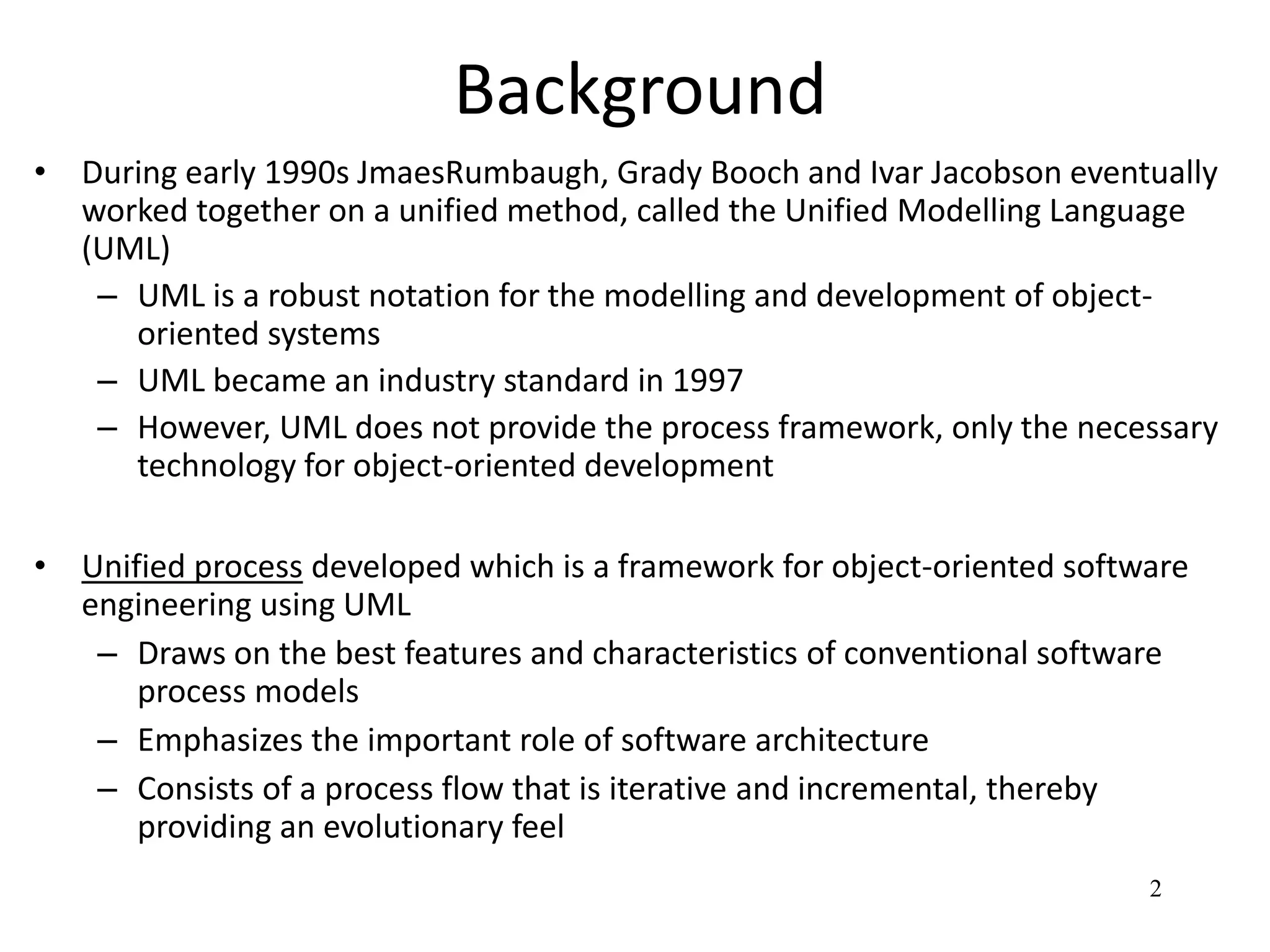
• During early 1990s JmaesRumbaugh, Grady Booch and Ivar Jacobson eventually
worked together on a unified method, called the Unified Modelling Language
(UML)
– UML is a robust notation for the modelling and development of object-
oriented systems
– UML became an industry standard in 1997
– However, UML does not provide the process framework, only the necessary
technology for object-oriented development
• Unified process developed which is a framework for object-oriented software
engineering using UML
– Draws on the best features and characteristics of conventional software
process models
– Emphasizes the important role of software architecture
– Consists of a process flow that is iterative and incremental, thereby
providing an evolutionary feel
3
Background (continued)
• Consists of 5 phases:
1. inception,
2. elaboration,
3. construction,
4. transition,
5. production
4
Phases of the Unified Process
communication
planning
modeling
construction
deployment
Inception Elaboration
Construction
TransitionProduction
5
(1) - Inception Phase
• Encompasses both customer communication and planning
activities of the generic process
• Business requirements for the software are identified
• A rough architecture for the system is proposed
• A plan is created for an incremental, iterative development
• Fundamental business requirements are described through
preliminary use cases
– A use case describes a sequence of actions that are performed by a user
6
(2) - Elaboration Phase
• Encompasses both the planning and modelling activities of the generic
process
• Refines and expands the preliminary use cases
• Expands the architectural representation to include five views
– Use-case model
– Analysis model
– Design model
– Implementation model
– Deployment model
• Often results in an executable architectural baseline that represents a
first cut executable system
• The baseline demonstrates the viability of the architecture but does not
provide all features and functions required to use the system
7
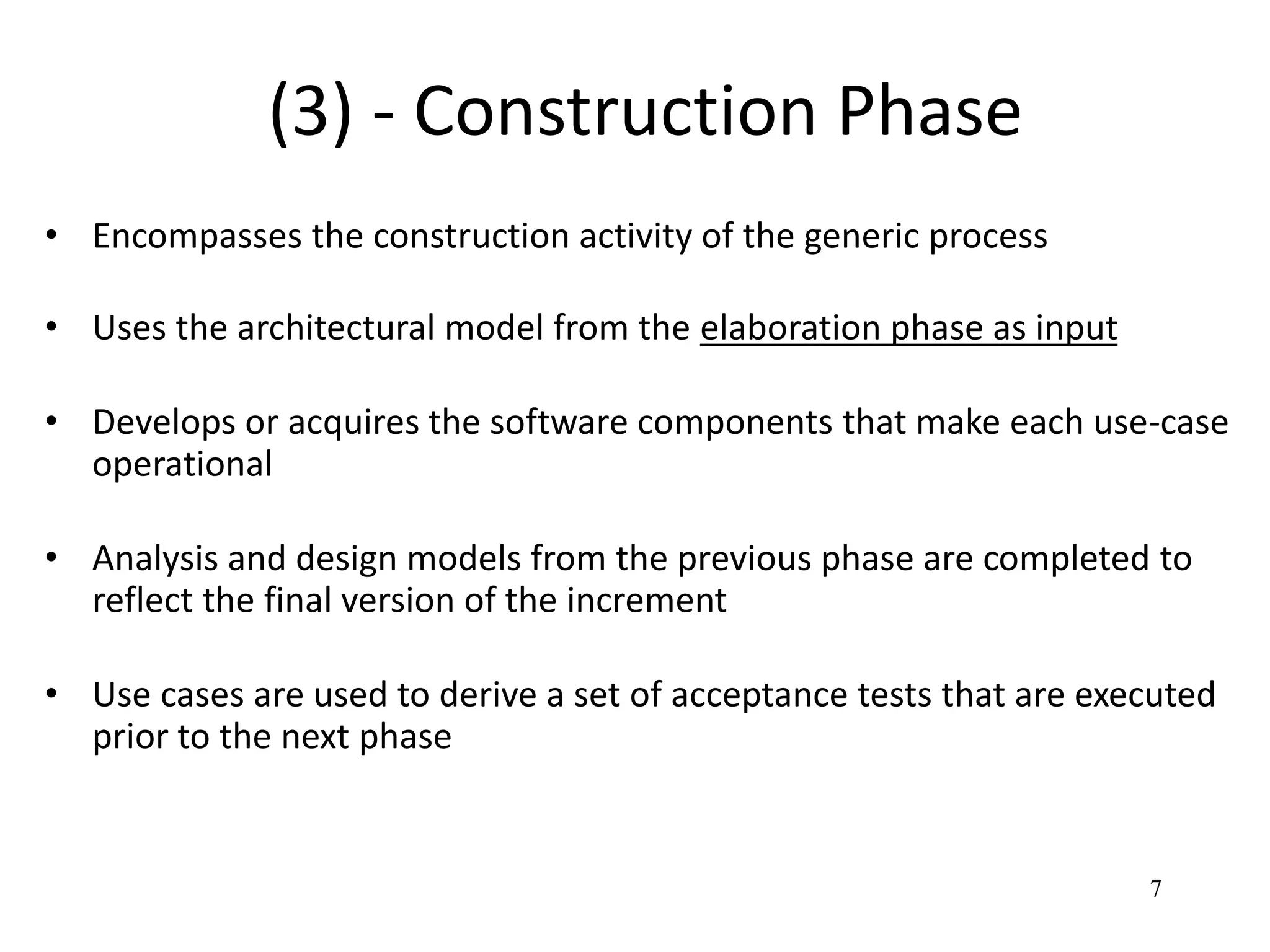
(3) - Construction Phase
• Encompasses the construction activity of the generic process
• Uses the architectural model from the elaboration phase as input
• Develops or acquires the software components that make each use-case
operational
• Analysis and design models from the previous phase are completed to
reflect the final version of the increment
• Use cases are used to derive a set of acceptance tests that are executed
prior to the next phase
8
(4) - Transition Phase
• Encompasses the last part of the construction activity and the first
part of the deployment activity of the generic process
• Software is given to end users for beta testing and user feedback
reports on defects and necessary changes
• The software teams create necessary support documentation
(user manuals, trouble-shooting guides, installation procedures)
• At the conclusion of this phase, the software increment becomes a
usable software release
9
(5) - Production Phase
• Encompasses the last part of the deployment activity of the
generic process
• On-going use of the software is monitored
• Support for the operating environment (infrastructure) is provided
• Defect reports and requests for changes are submitted and
evaluated
10
Unified Process Work Products
• Work products are produced in each of the first four phases of
the unified process
• In this course, we will concentrate on the analysis model and the
design model work products
• Analysis model includes
– Scenario-based model, class-based model, and behavioural
model
• Design model includes
– Component-level design, interface design, architectural
design, and data/class design


Fundamentals of Software Engineering

  • 1.
  • 2.
    2 Background • During early1990s JmaesRumbaugh, Grady Booch and Ivar Jacobson eventually worked together on a unified method, called the Unified Modelling Language (UML) – UML is a robust notation for the modelling and development of object- oriented systems – UML became an industry standard in 1997 – However, UML does not provide the process framework, only the necessary technology for object-oriented development • Unified process developed which is a framework for object-oriented software engineering using UML – Draws on the best features and characteristics of conventional software process models – Emphasizes the important role of software architecture – Consists of a process flow that is iterative and incremental, thereby providing an evolutionary feel
  • 3.
    3 Background (continued) • Consistsof 5 phases: 1. inception, 2. elaboration, 3. construction, 4. transition, 5. production
  • 4.
    4 Phases of theUnified Process communication planning modeling construction deployment Inception Elaboration Construction TransitionProduction
  • 5.
    5 (1) - InceptionPhase • Encompasses both customer communication and planning activities of the generic process • Business requirements for the software are identified • A rough architecture for the system is proposed • A plan is created for an incremental, iterative development • Fundamental business requirements are described through preliminary use cases – A use case describes a sequence of actions that are performed by a user
  • 6.
    6 (2) - ElaborationPhase • Encompasses both the planning and modelling activities of the generic process • Refines and expands the preliminary use cases • Expands the architectural representation to include five views – Use-case model – Analysis model – Design model – Implementation model – Deployment model • Often results in an executable architectural baseline that represents a first cut executable system • The baseline demonstrates the viability of the architecture but does not provide all features and functions required to use the system
  • 7.
    7 (3) - ConstructionPhase • Encompasses the construction activity of the generic process • Uses the architectural model from the elaboration phase as input • Develops or acquires the software components that make each use-case operational • Analysis and design models from the previous phase are completed to reflect the final version of the increment • Use cases are used to derive a set of acceptance tests that are executed prior to the next phase
  • 8.
    8 (4) - TransitionPhase • Encompasses the last part of the construction activity and the first part of the deployment activity of the generic process • Software is given to end users for beta testing and user feedback reports on defects and necessary changes • The software teams create necessary support documentation (user manuals, trouble-shooting guides, installation procedures) • At the conclusion of this phase, the software increment becomes a usable software release
  • 9.
    9 (5) - ProductionPhase • Encompasses the last part of the deployment activity of the generic process • On-going use of the software is monitored • Support for the operating environment (infrastructure) is provided • Defect reports and requests for changes are submitted and evaluated
  • 10.
    10 Unified Process WorkProducts • Work products are produced in each of the first four phases of the unified process • In this course, we will concentrate on the analysis model and the design model work products • Analysis model includes – Scenario-based model, class-based model, and behavioural model • Design model includes – Component-level design, interface design, architectural design, and data/class design 