Software Engineering: 4
Critical Analysis of Waterfall Model
Prof Neeraj Bhargava
Vaibhav Khanna
Department of Computer Science
School of Engineering and Systems Sciences
Maharshi Dayanand Saraswati University Ajmer
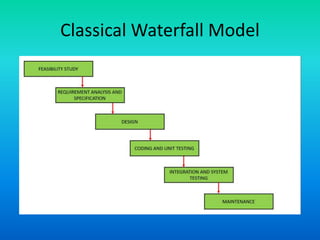
Classical Waterfall Model
Feasibility Study
• The main goal of this phase is to determine
whether it would be financially and technically
feasible to develop the software.
• The feasibility study involves understanding the
problem and then determine the various possible
strategies to solve the problem.
• These different identified solutions are analyzed
based on their benefits and drawbacks, The best
solution is chosen and all the other phases are
carried out as per this solution strategy.
Requirements analysis and
specification
• The aim is to understand the exact requirements
of the customer and document them properly.
This phase consists of two different activities.
– Requirement gathering and analysis:
– Requirement specification:
• These analyzed requirements are documented in
a software requirement specification (SRS)
document.
• SRS document serves as a contract between
development team and customers.
Design
• The aim of the design phase is to transform
the requirements specified in the SRS
document into a structure that is suitable for
implementation in some programming
language.
Coding and Unit testing
• In coding phase software design is translated
into source code using any suitable
programming language.
• Each designed module is coded and unit
testing is conducted.
• The aim of the unit testing phase is to check
whether each module is working properly or
not.
Integration
• Integration of different modules are undertaken
soon after they have been coded and unit tested.
• Integration of various modules is carried out
incrementally over a number of steps.
• During each integration step, previously planned
modules are added to the partially integrated
system and the resultant system is tested.
• Finally, after all the modules have been
successfully integrated and tested, the full
working system is obtained and system testing is
carried out on this
System testing
• Alpha testing: Alpha testing is the system
testing performed by the development team.
• Beta testing: Beta testing is the system testing
performed by a friendly set of customers.
• Acceptance testing: After the software has
been delivered, the customer performed the
acceptance testing to determine whether to
accept the delivered software or some
changes are needed.
Maintainence
• Corrective Maintenance: This type of maintenance is
carried out to correct errors that were not discovered
during the product development phase.
• Perfective Maintenance: This type of maintenance is
carried out to enhance the functionalities of the
system based on the customer’s request.
• Adaptive Maintenance: Adaptive maintenance is
usually required for porting the software to work in a
new environment such as work on a new computer
platform or with a new operating system.
Advantages of Classical Waterfall
Model
• This model is very simple and is easy to understand.
• Phases in this model are processed one at a time.
• Each stage in the model is clearly defined.
• This model has very clear and well understood
milestones.
• Process, actions and results are very well documented.
• Reinforces good habits: define-before- design,
design-before-code.
• This model works well for smaller projects and projects
where requirements are well
understood.
Drawbacks of Classical Waterfall
Model
• No feedback path: It assumes that no error is ever
committed by developers during any phases.
• Difficult to accommodate change requests: This model
assumes that all the customer requirements can be
completely and correctly defined at the beginning of
the project,
• No overlapping of phases: This model recommends
that new phase can start only after the completion of
the previous phase. But in real projects, this can’t be
maintained. To increase the efficiency and reduce the
cost, phases may overlap

Software engineering 4 critical analysis of waterfall model

  • 1.
    Software Engineering: 4 CriticalAnalysis of Waterfall Model Prof Neeraj Bhargava Vaibhav Khanna Department of Computer Science School of Engineering and Systems Sciences Maharshi Dayanand Saraswati University Ajmer
  • 2.
  • 3.
    Feasibility Study • Themain goal of this phase is to determine whether it would be financially and technically feasible to develop the software. • The feasibility study involves understanding the problem and then determine the various possible strategies to solve the problem. • These different identified solutions are analyzed based on their benefits and drawbacks, The best solution is chosen and all the other phases are carried out as per this solution strategy.
  • 4.
    Requirements analysis and specification •The aim is to understand the exact requirements of the customer and document them properly. This phase consists of two different activities. – Requirement gathering and analysis: – Requirement specification: • These analyzed requirements are documented in a software requirement specification (SRS) document. • SRS document serves as a contract between development team and customers.
  • 5.
    Design • The aimof the design phase is to transform the requirements specified in the SRS document into a structure that is suitable for implementation in some programming language.
  • 6.
    Coding and Unittesting • In coding phase software design is translated into source code using any suitable programming language. • Each designed module is coded and unit testing is conducted. • The aim of the unit testing phase is to check whether each module is working properly or not.
  • 7.
    Integration • Integration ofdifferent modules are undertaken soon after they have been coded and unit tested. • Integration of various modules is carried out incrementally over a number of steps. • During each integration step, previously planned modules are added to the partially integrated system and the resultant system is tested. • Finally, after all the modules have been successfully integrated and tested, the full working system is obtained and system testing is carried out on this
  • 8.
    System testing • Alphatesting: Alpha testing is the system testing performed by the development team. • Beta testing: Beta testing is the system testing performed by a friendly set of customers. • Acceptance testing: After the software has been delivered, the customer performed the acceptance testing to determine whether to accept the delivered software or some changes are needed.
  • 9.
    Maintainence • Corrective Maintenance:This type of maintenance is carried out to correct errors that were not discovered during the product development phase. • Perfective Maintenance: This type of maintenance is carried out to enhance the functionalities of the system based on the customer’s request. • Adaptive Maintenance: Adaptive maintenance is usually required for porting the software to work in a new environment such as work on a new computer platform or with a new operating system.
  • 10.
    Advantages of ClassicalWaterfall Model • This model is very simple and is easy to understand. • Phases in this model are processed one at a time. • Each stage in the model is clearly defined. • This model has very clear and well understood milestones. • Process, actions and results are very well documented. • Reinforces good habits: define-before- design, design-before-code. • This model works well for smaller projects and projects where requirements are well understood.
  • 11.
    Drawbacks of ClassicalWaterfall Model • No feedback path: It assumes that no error is ever committed by developers during any phases. • Difficult to accommodate change requests: This model assumes that all the customer requirements can be completely and correctly defined at the beginning of the project, • No overlapping of phases: This model recommends that new phase can start only after the completion of the previous phase. But in real projects, this can’t be maintained. To increase the efficiency and reduce the cost, phases may overlap