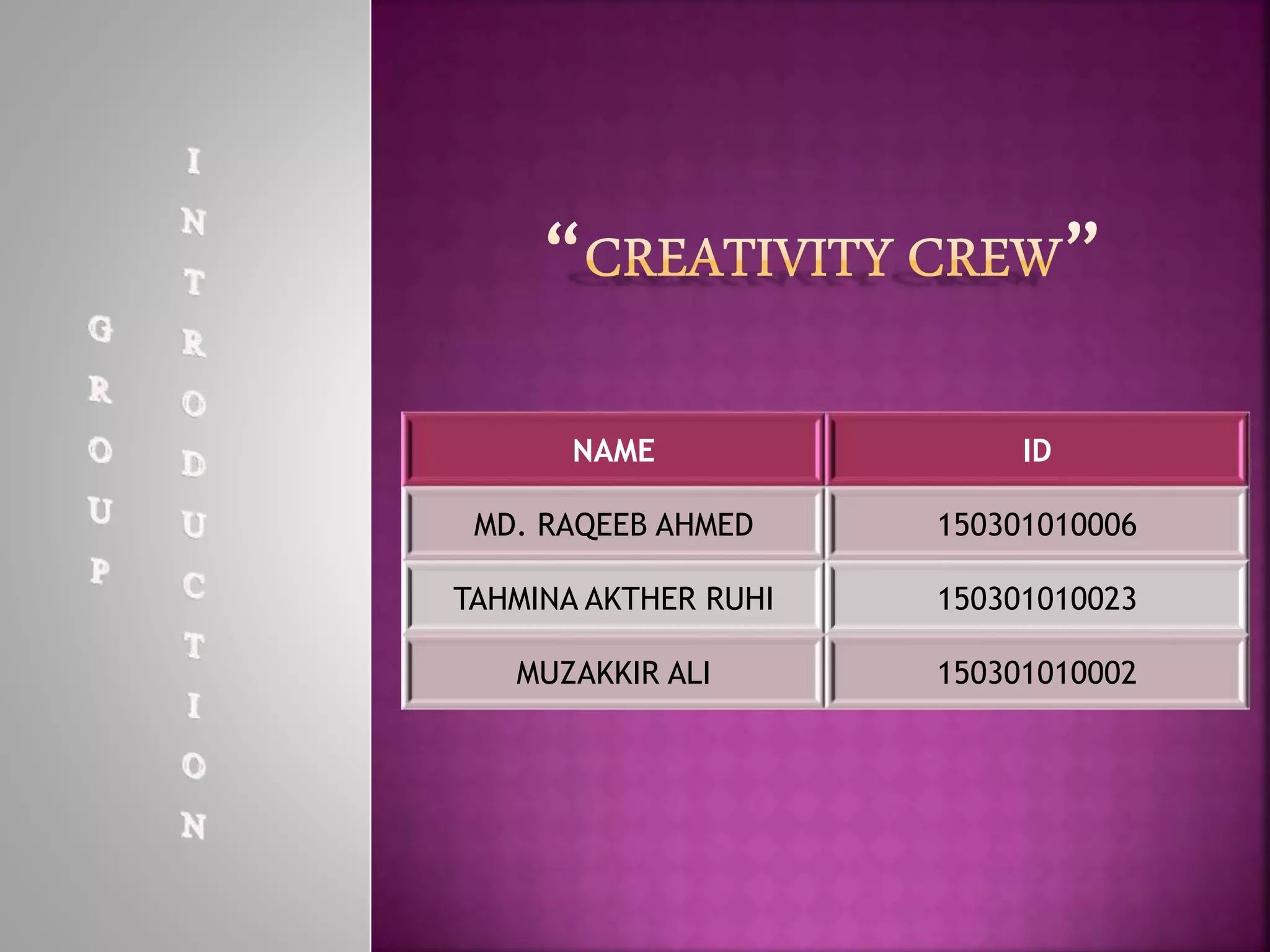
NAME ID
MD. RAQEEB AHMED 150301010006
TAHMINA AKTHER RUHI 150301010023
MUZAKKIR ALI 150301010002
 The South Asian Free Trade Area ( SAFTA) is an agreement
signed in 6 January 2004.
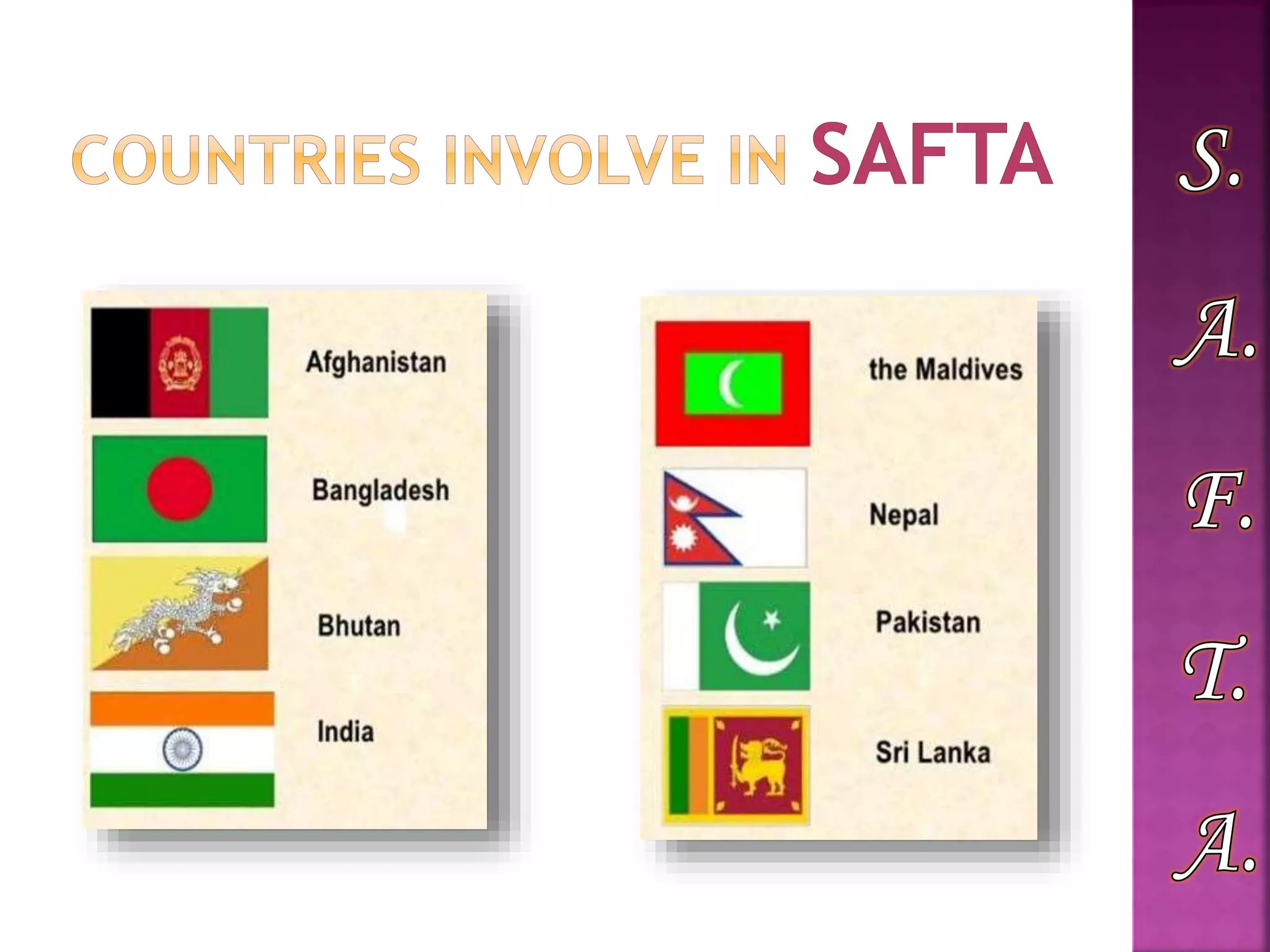
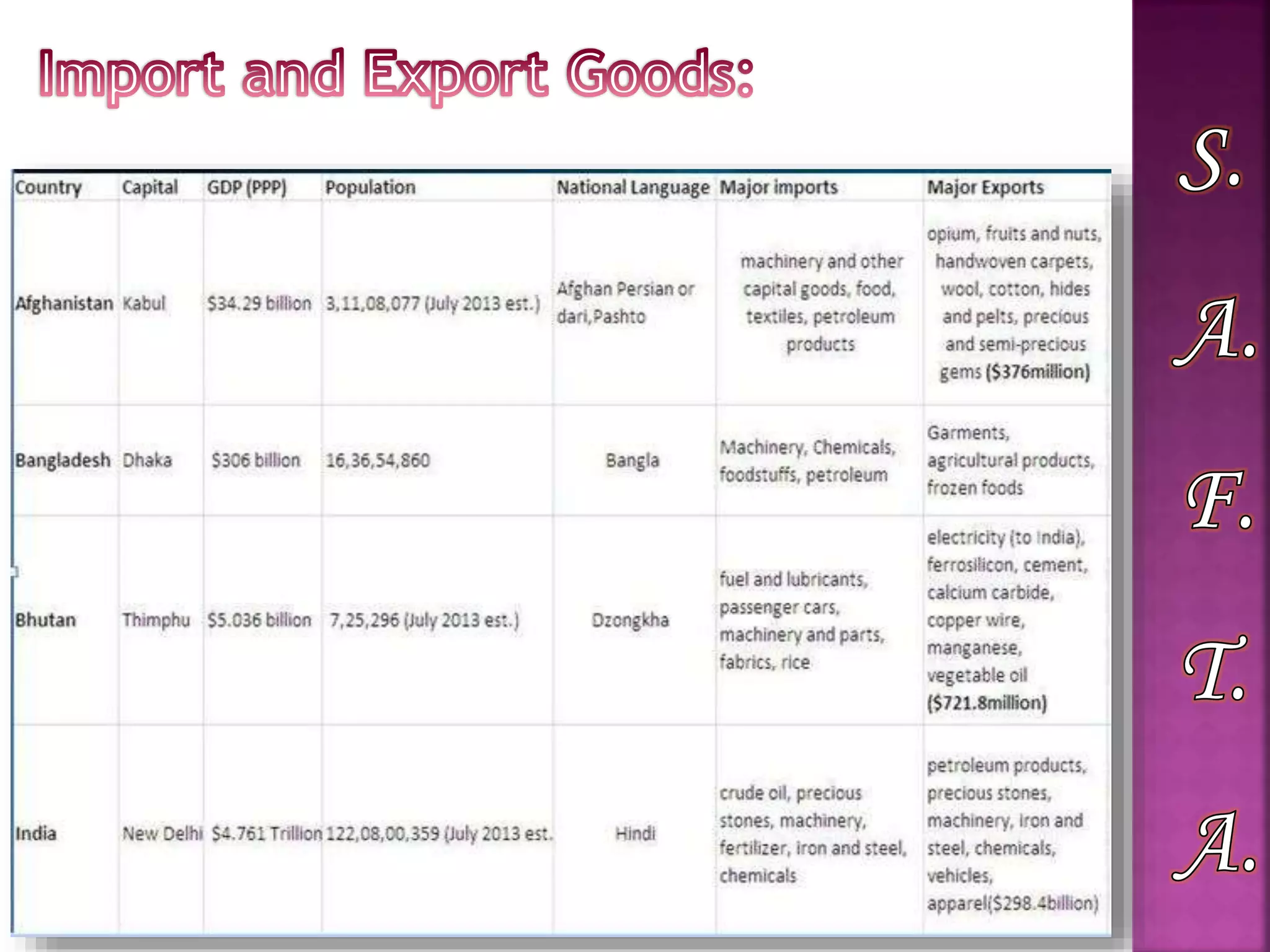
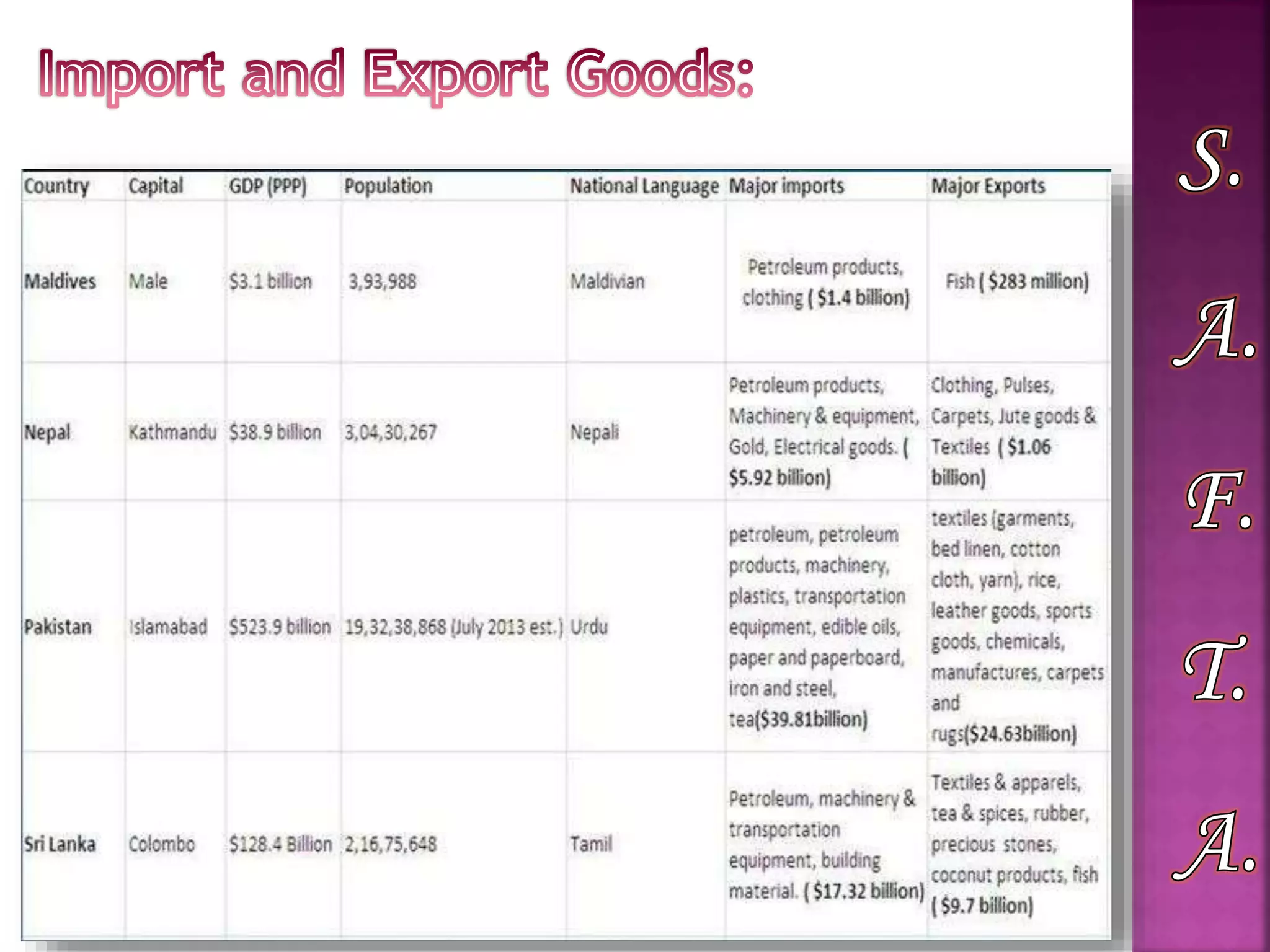
 Member countries of SAFTA are Bangladesh, Maldives,
Bhutan, Pakistan, Afghanistan, Nepal, India and Srilanka.
 After the establishment of SAARC in 1985 and SAPTA in
1995, the member countries recognized the need to
progress beyond a preferential trading arrangement and
move towards a higher level of trade and economic
cooperation in the region.
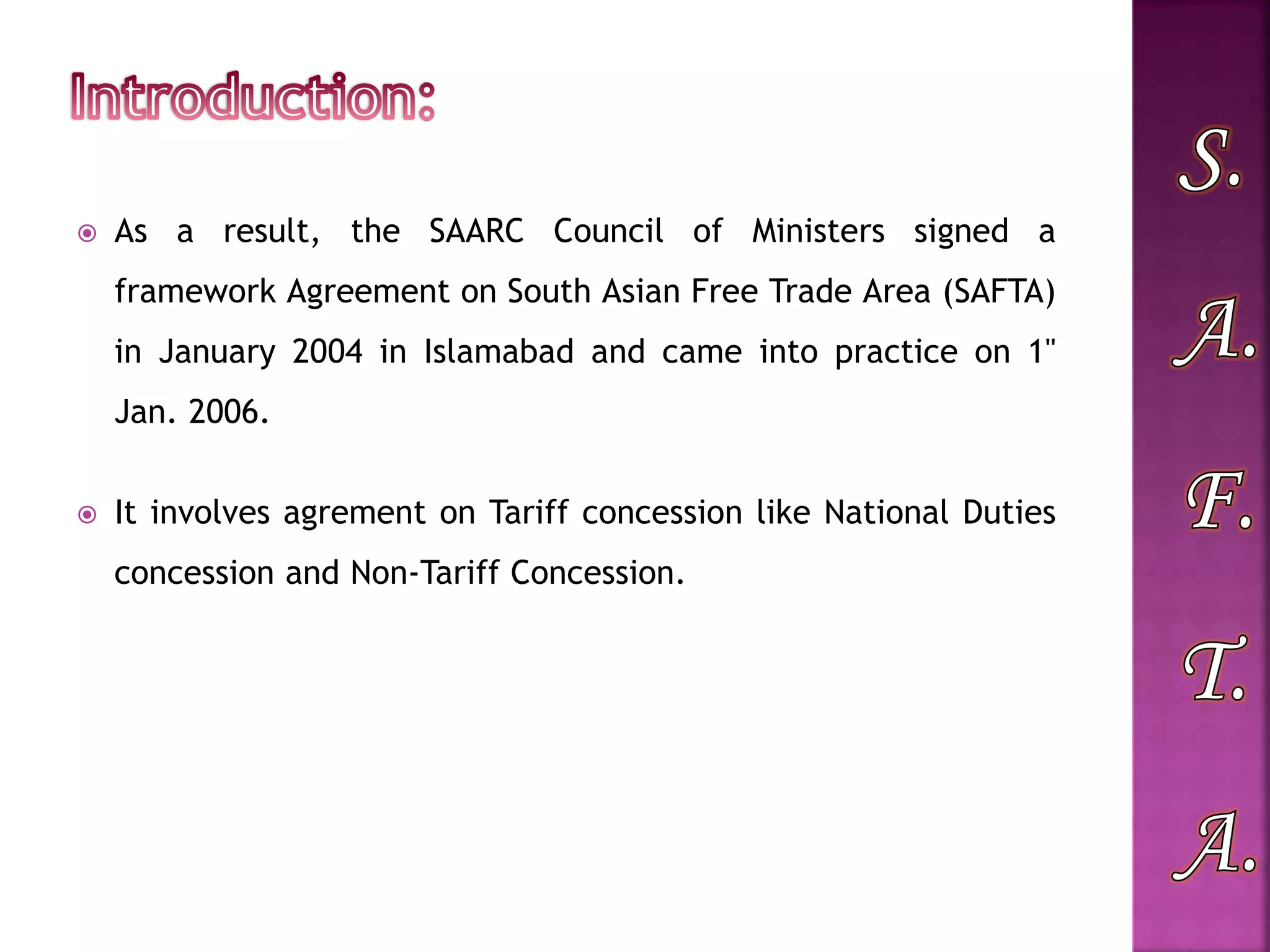
 As a result, the SAARC Council of Ministers signed a
framework Agreement on South Asian Free Trade Area (SAFTA)
in January 2004 in Islamabad and came into practice on 1"
Jan. 2006.
 It involves agrement on Tariff concession like National Duties
concession and Non-Tariff Concession.
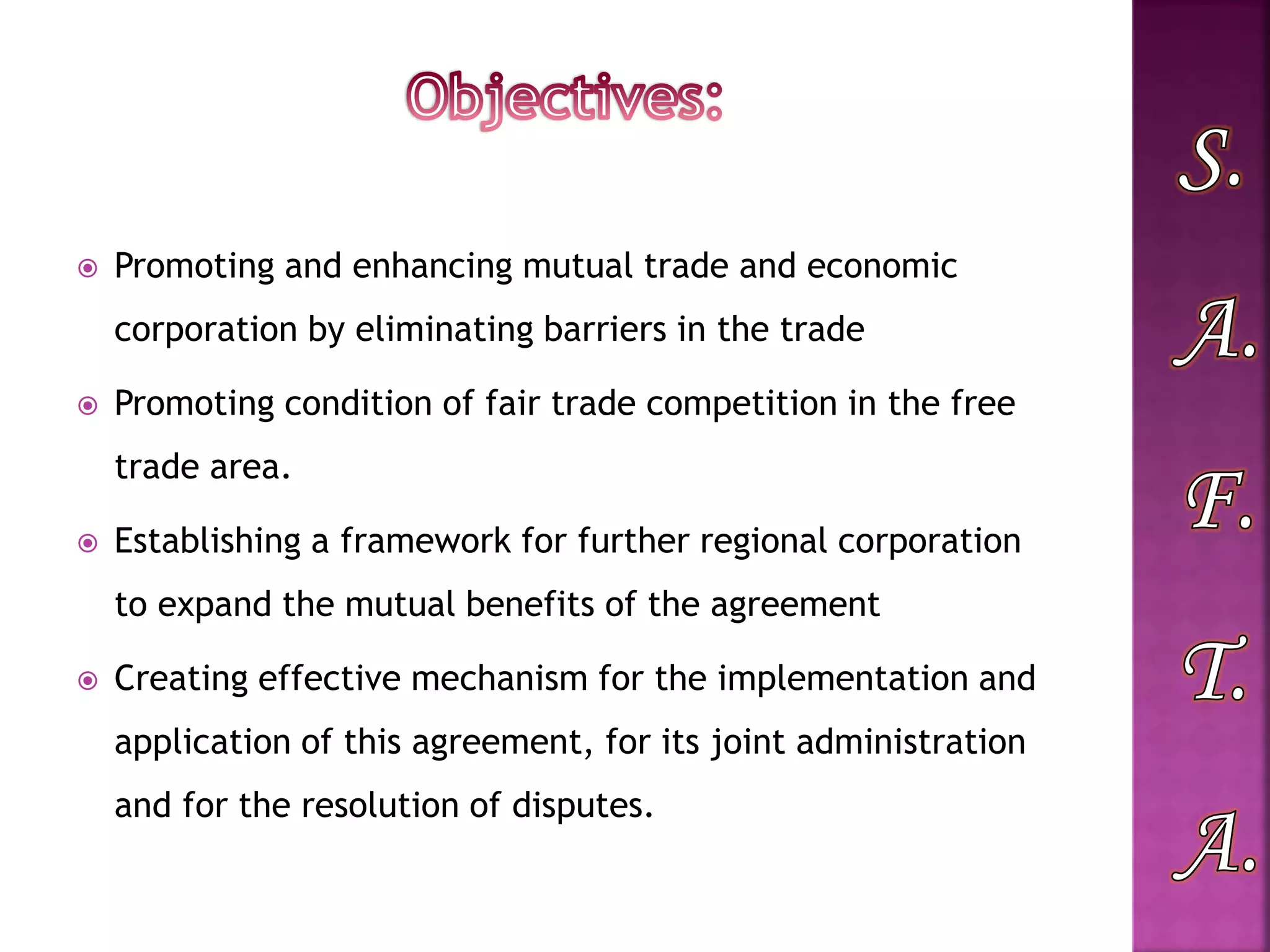
 Promoting and enhancing mutual trade and economic
corporation by eliminating barriers in the trade
 Promoting condition of fair trade competition in the free
trade area.
 Establishing a framework for further regional corporation
to expand the mutual benefits of the agreement
 Creating effective mechanism for the implementation and
application of this agreement, for its joint administration
and for the resolution of disputes.
 Governed by the law of agreement.
 Governed by the Existing rights and obligations.
 Overall Mutuality
 Free movement of goods.
 Adoption of Trade Facilitation and Other Measures
 Recognization of the need of Least Developed Countries.
The Major Instruments Outlined in Agrement:
 Trade Liberalization Programme
 Rules of Origin
 Institutional Arrangements
 Safeguard Measures
 Any other instrument that may be agreed
Upon by all members.
 Increased trade between member countries
 Increased competition for producers leading to
greater efficiency
 Greater specialization in production and trade
 Lower consumer prices
 Greater market access
 Political stability
Country Least Developed Country Non-Least Developed Country
Bangladesh 1233 1241
India 25 695
Bhutan 150 150
Nepal 1257 1295
The Maldives 681 681
Pakistan 1169 0
Sri Lanka 1042 0
Afganistan 1072 0
A sensitive list is a number of goods with every country which does not
include tariff concession.
Even after 13 years of establishment, SAFTA seems to be significantly
far from achieving the ultimate objective of closer integration among
member countries. Major hurdles in this way are lack of trust and
political tensions among member countries.
The South Asian Free Trade Area (SAFTA), vividly portraying their
inherent dissimilarities, also point toward a somewhat uncomfortable
scenario of unequal distribution of potential gains from the regional
cooperation scheme. Whilst all the SAFTA members are low-income
developing countries, four of them viz., Bhutan, Bangladesh, Maldives
and Nepal are amongst the least developed countries (LDCs) due to a
number of overriding problems that constrain their economic growth
and development.
 All the member country should work together towards
finding solution to their common problems.
 As the member countries are labor-abundant, there is a
huge potential to gain from the supply of labor.
 Each country should provides each other the preferential
treatment to reduce import tariffs on preferential items.
 SAFTA should enhance trade within the region by
progressive reduction of tariff rates and non-tariff and
putting in place trade and investment facilitation
measures.
At last We will say that if the agrement is maintain full by
the member countries, all the goods will start flowing
across the border without any tariff and extra cost and the
price of the product will decrease significantly.
The ultimate aim of the SAFTA is to create a 'South Asian
Economic Union'. At the moment it seems like a 'dream'
that can only be transformed into reality if all the member
countries are willing to live up to their commitments.
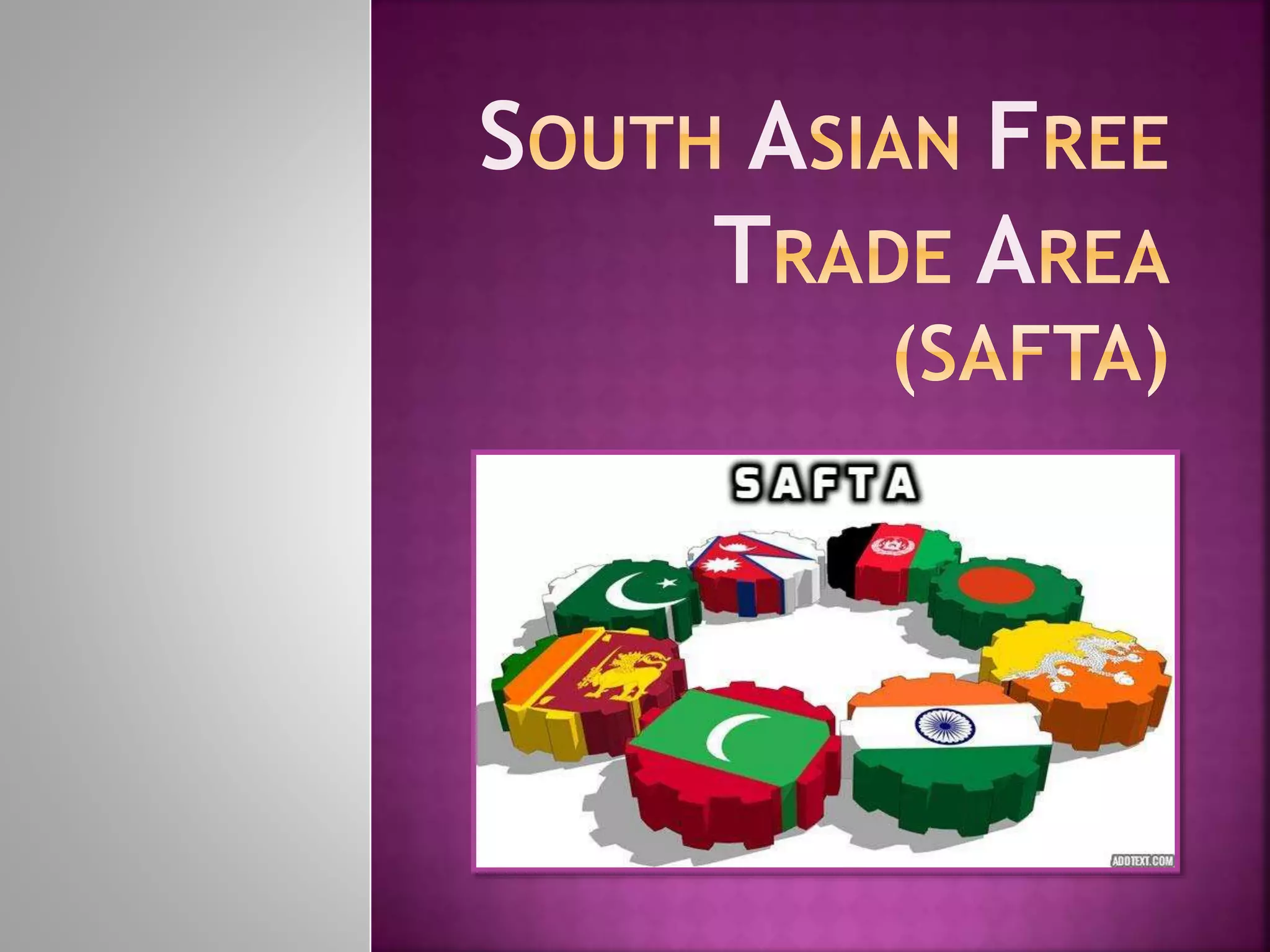
SAFTA - South Asian Free Trade Area

SAFTA - South Asian Free Trade Area

  • 2.
    NAME ID MD. RAQEEBAHMED 150301010006 TAHMINA AKTHER RUHI 150301010023 MUZAKKIR ALI 150301010002
  • 5.
     The SouthAsian Free Trade Area ( SAFTA) is an agreement signed in 6 January 2004.  Member countries of SAFTA are Bangladesh, Maldives, Bhutan, Pakistan, Afghanistan, Nepal, India and Srilanka.  After the establishment of SAARC in 1985 and SAPTA in 1995, the member countries recognized the need to progress beyond a preferential trading arrangement and move towards a higher level of trade and economic cooperation in the region.
  • 6.
     As aresult, the SAARC Council of Ministers signed a framework Agreement on South Asian Free Trade Area (SAFTA) in January 2004 in Islamabad and came into practice on 1" Jan. 2006.  It involves agrement on Tariff concession like National Duties concession and Non-Tariff Concession.
  • 7.
     Promoting andenhancing mutual trade and economic corporation by eliminating barriers in the trade  Promoting condition of fair trade competition in the free trade area.  Establishing a framework for further regional corporation to expand the mutual benefits of the agreement  Creating effective mechanism for the implementation and application of this agreement, for its joint administration and for the resolution of disputes.
  • 8.
     Governed bythe law of agreement.  Governed by the Existing rights and obligations.  Overall Mutuality  Free movement of goods.  Adoption of Trade Facilitation and Other Measures  Recognization of the need of Least Developed Countries.
  • 11.
    The Major InstrumentsOutlined in Agrement:  Trade Liberalization Programme  Rules of Origin  Institutional Arrangements  Safeguard Measures  Any other instrument that may be agreed Upon by all members.
  • 12.
     Increased tradebetween member countries  Increased competition for producers leading to greater efficiency  Greater specialization in production and trade  Lower consumer prices  Greater market access  Political stability
  • 13.
    Country Least DevelopedCountry Non-Least Developed Country Bangladesh 1233 1241 India 25 695 Bhutan 150 150 Nepal 1257 1295 The Maldives 681 681 Pakistan 1169 0 Sri Lanka 1042 0 Afganistan 1072 0 A sensitive list is a number of goods with every country which does not include tariff concession.
  • 14.
    Even after 13years of establishment, SAFTA seems to be significantly far from achieving the ultimate objective of closer integration among member countries. Major hurdles in this way are lack of trust and political tensions among member countries. The South Asian Free Trade Area (SAFTA), vividly portraying their inherent dissimilarities, also point toward a somewhat uncomfortable scenario of unequal distribution of potential gains from the regional cooperation scheme. Whilst all the SAFTA members are low-income developing countries, four of them viz., Bhutan, Bangladesh, Maldives and Nepal are amongst the least developed countries (LDCs) due to a number of overriding problems that constrain their economic growth and development.
  • 15.
     All themember country should work together towards finding solution to their common problems.  As the member countries are labor-abundant, there is a huge potential to gain from the supply of labor.  Each country should provides each other the preferential treatment to reduce import tariffs on preferential items.  SAFTA should enhance trade within the region by progressive reduction of tariff rates and non-tariff and putting in place trade and investment facilitation measures.
  • 16.
    At last Wewill say that if the agrement is maintain full by the member countries, all the goods will start flowing across the border without any tariff and extra cost and the price of the product will decrease significantly. The ultimate aim of the SAFTA is to create a 'South Asian Economic Union'. At the moment it seems like a 'dream' that can only be transformed into reality if all the member countries are willing to live up to their commitments.