A Brief History of GATT
and WTO
A Brief History of GATT
• United Nations conference of 1944 recommended
the establishment of
▫ IMF (International Monetary Fund)
▫ World Bank
▫ ITO (International Trade Organization)
• GATT (General Agreement on Tariffs and Trade)
came into existence in 1947.
▫ It was first discussed in United Nations conference
on the topic of Trade and Employment in 1947, in
Geneva.
• To boost the economic activity across the nations,
which was affected after World War II.
• Great depression period took over the world’s economy
1913.
• Reduced employment rate
• Inflation, etc .
• It was a treaty not an organization.
• Later it was transformed into WTO (World Trade
Organization ) in 1995.
General Agreement on Tariffs and
Trade
• It is a legal agreement between countries to
promote international trade by reducing or
eliminating trade barriers.
Objectives of GATT
• Raising living standards
• Ensuring full employment
• Developing full use of resources of the world
• Expansion of production and international
trade.
• Reducing trade barriers.
▫ Tariffs
▫ Non-Tariffs
▫ Quotas
Principles of GATT
• Non-Discrimination Principle
• Prohibition of Quantitative Restrictions
• Consultation
Non-Discrimination Principle
• This principle states that no member/ country
should discriminate between countries for
conducting international trade.
Prohibition of Quantitative
Restrictions
• GATT seeks to prohibit quantitative restrictions
as far as possible and limit restrictions on trade
to the less rigid tariffs.
• GATT also restricts the members to adopt
dumping and export subsidies.
Consultations
• By providing a forum to the countries involved
in international trade to resolve disagreement
through consultation.
Exceptions in GATT
• Certain exceptions are granted to countries,
confronted with balance of payment difficulties
and to the developing countries.
• Giving subsidies to farmers and promoting
agricultural trade and sector.
• Restriction on textile trade for developed
countries.
World Trade Organization (WTO)
• In 1986, United nations held a meeting Uruguay in
the context of international trade and discussed
scope of international trade including new areas.
▫ GATS (General Agreement on Trade in Services)
▫ TRIPS (Trade Related Aspects of Intellectual
Property Rights)
• GATT was then transformed into proper
organization WTO, in 1995.
▫ Under WTO, GATT still exists as an agreement.
Basic Structure and
Functions of WTO
The Basic Structure of WTO
• WTO is basically an intergovernmental
organization (IGO)
▫ that is concerned with the regulation of
international trade between countries.
▫ IGO is an organization which involves governments
of more than one countries
• Broadly WTO has two largest parts of trade
▫ Products
▫ Services
• The structure of WTO has 3 part:
1. Basic principles
2. Additional details
3. Market access commitments
• There are five basic principles:
1. GATT (General Agreement on Tariffs and Trade)
2. GATS (General Agreement on Trade in Services)
3. TRIPS (Trade-Related Aspects of Intellectual
Property Rights)
4. Dispute settlement
5. TPRM (Trade Policy Review Mechanism)
General agreement on Trade in
Services (GATS)
• A legal agreement between different countries
whose overall purpose is to promote services
across nations, by reducing trade barriers.
▫ Cross border movement of people
▫ Tourism
▫ Baking services
▫ Telecommunication
Trade- Related Aspects of Intellectual
Property Rights (TRIPS)
• Intellectual property is any information with
commercial value.
• TRIPS is an international legal agreement
between the nations of WTO, whose purpose is
to protect intellectual property of the nations.
▫ Patents
▫ Copyrights
▫ trademarks
• Trademark
▫ Logo, symbol, brand name, colors, etc.
• Copyright
▫ A legal right of any business to create anything
that expresses an idea.
• Patents
▫ A patent right protects the business for their
products/ services being sold, created or used by
another party without permission.
Dispute Settlement
• A system of WTO to tackle broken promises
between countries, businesses and government.
• WTO members have agreed that if they believe that
one nation of WTO has violated trade rules, they
will use multi-lateral system instead of taking
unilateral action.
Trade Policy Review Mechanism
(TPRM)
• An instrument for surveillance of members’
trade policy.
• Its purpose is to make the trade policies between
countries, transparent and smoother.
▫ Ensuring that all the rules and regulations of WTO
are accepted by all the members.
Additional Details
• It deals with the special requirements for
specific sectors and issues.
Market Access Commitments
• Lengthy and detailed commitments made by
individual member for giving access to the
foreign supplier to their domestic market.
Non-Discrimination (in detail)
• Two major components
1. Most-Favored Nation (MFN) Rule
2. National Treatment Principle
Most Favored Nation (MFN) Rule
• It states that product made in one country be
treated no less favorably than a similar product
originated in an other country.
• This rule also states that if any concessions or
privileges are given to one country
▫ Those privileges will be given to all the members
of WTO.
▫ Giving equal rights
• MFN is the pillar of WTO as it does not
discriminate between nations and does not allow
the importers/ exporters to discriminate
between consumers.
• MFN ensures smaller countries that larger
countries will not exploit the market.
• MFN reduces negotiation costs.
National Treatment Principle
• It states that if the nation provides special
treatment and privileges to its citizens
▫ Then it should also provide same privileges to foreign
citizens living in that nation.
• Same rule applies to foreign products imported in
that nation.
• It provides a sense of security to the foreign
suppliers.
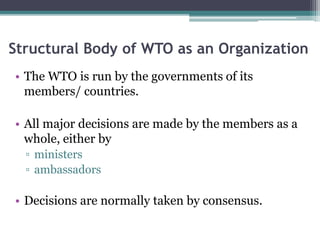
Structural Body of WTO as an Organization
• The WTO is run by the governments of its
members/ countries.
• All major decisions are made by the members as a
whole, either by
▫ ministers
▫ ambassadors
• Decisions are normally taken by consensus.
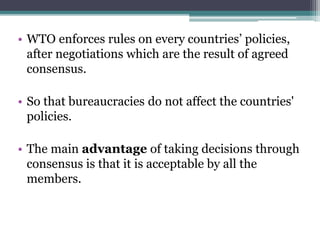
• WTO enforces rules on every countries’ policies,
after negotiations which are the result of agreed
consensus.
• So that bureaucracies do not affect the countries'
policies.
• The main advantage of taking decisions through
consensus is that it is acceptable by all the
members.
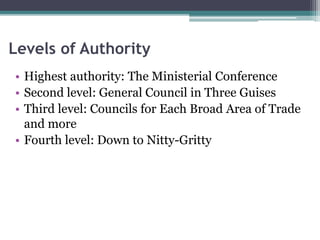
Levels of Authority
• Highest authority: The Ministerial Conference
• Second level: General Council in Three Guises
• Third level: Councils for Each Broad Area of Trade
and more
• Fourth level: Down to Nitty-Gritty
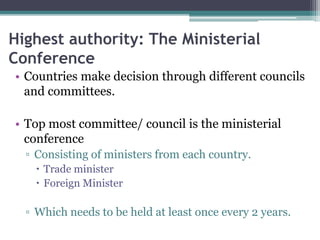
Highest authority: The Ministerial
Conference
• Countries make decision through different councils
and committees.
• Top most committee/ council is the ministerial
conference
▫ Consisting of ministers from each country.
 Trade minister
 Foreign Minister
▫ Which needs to be held at least once every 2 years.
Third level: Councils for Each Broad
Area of Trade and more
• Three councils for different broad areas of trade
report to The General Council
1. Goods Council
2. Services Council
3. TRIPS Council
Second level: General Council in Three
Guises
• Overlooks and coordinate day-to-day work between
ministerial conference by three bodies.
1. The General Council
2. The Dispute Settlement Body
3. The Trade Policy Review Body
Fourth level: Down to Nitty-Gritty
• Each higher level of councils have subsidiary
bodies.
• The goods council have further 11 committees
▫ Agriculture,
▫ Market access
▫ Anti-dumping
▫ Textile monitory policy
▫ Import licensing, etc.
• The services councils’ subsidiary bodies deals with
▫ Financial services
▫ Domestic regulations
▫ Transportation
HODs and BODs: the need for
informality
• Formal meetings are conducted by higher
authorities.
• Informality plays an important role.
▫ Before formal meetings, informal meetings are
conducted and important topics are filtered out.
▫ These informal meetings include HODs (Head of
Delegations)
• Informal meetings conducted in smaller groups
▫ 20-30 members
• It is necessary to keep the informal meetings held
with sensitivity and transparency.
• Green Room is a phrase used for conducting
meetings by HODs
▫ Proper reports are prepared for follow up.
• In order to increase the bargaining power countries
form coalition and alliance.
• To achieve the agreement on decisions through
consensus is an art to strike an appropriate balance.
Structural Body of WTO as an Organization
• The WTO is run by the governments of its
members/ countries.
• All major decisions are made by the members as a
whole, either by
▫ ministers
▫ ambassadors
• Decisions are normally taken by consensus.
• WTO enforces rules on every countries’ policies,
after negotiations which are the result of agreed
consensus.
▫ So that bureaucracies do not affect the countries'
policies.
• The main advantage of taking decisions through
consensus is that it is acceptable by all the
members.
Levels of Authority
• Highest authority: The Ministerial Conference
• Second level: General Council in Three Guises
• Third level: Councils for Each Broad Area of Trade
and more
• Fourth level: Down to Nitty-Gritty
Highest authority: The Ministerial
Conference
• Countries make decision through different councils
and committees.
• Top most committee/ council is the ministerial
conference
▫ Consisting of ministers from each country.
 Trade minister
 Foreign Minister
▫ Which needs to be held at least once every 2 years.
Second level: General Council in Three
Guises
• Overlooks and coordinate day-to-day work between
ministerial conference by three bodies.
1. The General Council
2. The Dispute Settlement Body
3. The Trade Policy Review Body
Third level: Councils for Each Broad
Area of Trade and more
• Three councils for different broad areas of trade
report to The General Council
1. Goods Council
2. Services Council
3. TRIPS Council
Fourth level: Down to Nitty-Gritty
• Each higher level of councils have subsidiary
bodies.
• The goods council have further 11 committees
▫ Agriculture,
▫ Market access
▫ Anti-dumping
▫ Textile monitory policy
▫ Import licensing, etc.
• The services councils’ subsidiary bodies deals with
▫ Financial services
▫ Domestic regulations
▫ Transportation
HODs and BODs: the need for
informality
• Formal meetings are conducted by higher
authorities.
• Informality plays an important role.
▫ Before formal meetings, informal meetings are
conducted and important topics are filtered out.
▫ These informal meetings include HODs (Head of
Delegations)
• Informal meetings conducted in smaller groups
▫ 20-30 members
• It is necessary to keep the informal meetings held
with sensitivity and transparency.
• Green Room is a phrase used for conducting
meetings by HODs
▫ Proper reports are prepared for follow up.
• In order to increase the bargaining power countries
form coalition and alliance.
• To achieve the agreement on decisions through
consensus is an art to strike an appropriate balance.

Basic Structure and Functions of WTO (1).pptx

  • 1.
    A Brief Historyof GATT and WTO
  • 2.
    A Brief Historyof GATT • United Nations conference of 1944 recommended the establishment of ▫ IMF (International Monetary Fund) ▫ World Bank ▫ ITO (International Trade Organization) • GATT (General Agreement on Tariffs and Trade) came into existence in 1947. ▫ It was first discussed in United Nations conference on the topic of Trade and Employment in 1947, in Geneva.
  • 3.
    • To boostthe economic activity across the nations, which was affected after World War II. • Great depression period took over the world’s economy 1913. • Reduced employment rate • Inflation, etc . • It was a treaty not an organization. • Later it was transformed into WTO (World Trade Organization ) in 1995.
  • 4.
    General Agreement onTariffs and Trade • It is a legal agreement between countries to promote international trade by reducing or eliminating trade barriers.
  • 5.
    Objectives of GATT •Raising living standards • Ensuring full employment • Developing full use of resources of the world • Expansion of production and international trade. • Reducing trade barriers. ▫ Tariffs ▫ Non-Tariffs ▫ Quotas
  • 6.
    Principles of GATT •Non-Discrimination Principle • Prohibition of Quantitative Restrictions • Consultation
  • 7.
    Non-Discrimination Principle • Thisprinciple states that no member/ country should discriminate between countries for conducting international trade.
  • 8.
    Prohibition of Quantitative Restrictions •GATT seeks to prohibit quantitative restrictions as far as possible and limit restrictions on trade to the less rigid tariffs. • GATT also restricts the members to adopt dumping and export subsidies.
  • 9.
    Consultations • By providinga forum to the countries involved in international trade to resolve disagreement through consultation.
  • 10.
    Exceptions in GATT •Certain exceptions are granted to countries, confronted with balance of payment difficulties and to the developing countries. • Giving subsidies to farmers and promoting agricultural trade and sector. • Restriction on textile trade for developed countries.
  • 11.
    World Trade Organization(WTO) • In 1986, United nations held a meeting Uruguay in the context of international trade and discussed scope of international trade including new areas. ▫ GATS (General Agreement on Trade in Services) ▫ TRIPS (Trade Related Aspects of Intellectual Property Rights) • GATT was then transformed into proper organization WTO, in 1995. ▫ Under WTO, GATT still exists as an agreement.
  • 12.
  • 13.
    The Basic Structureof WTO • WTO is basically an intergovernmental organization (IGO) ▫ that is concerned with the regulation of international trade between countries. ▫ IGO is an organization which involves governments of more than one countries • Broadly WTO has two largest parts of trade ▫ Products ▫ Services
  • 14.
    • The structureof WTO has 3 part: 1. Basic principles 2. Additional details 3. Market access commitments • There are five basic principles: 1. GATT (General Agreement on Tariffs and Trade) 2. GATS (General Agreement on Trade in Services) 3. TRIPS (Trade-Related Aspects of Intellectual Property Rights) 4. Dispute settlement 5. TPRM (Trade Policy Review Mechanism)
  • 15.
    General agreement onTrade in Services (GATS) • A legal agreement between different countries whose overall purpose is to promote services across nations, by reducing trade barriers. ▫ Cross border movement of people ▫ Tourism ▫ Baking services ▫ Telecommunication
  • 16.
    Trade- Related Aspectsof Intellectual Property Rights (TRIPS) • Intellectual property is any information with commercial value. • TRIPS is an international legal agreement between the nations of WTO, whose purpose is to protect intellectual property of the nations. ▫ Patents ▫ Copyrights ▫ trademarks
  • 17.
    • Trademark ▫ Logo,symbol, brand name, colors, etc. • Copyright ▫ A legal right of any business to create anything that expresses an idea. • Patents ▫ A patent right protects the business for their products/ services being sold, created or used by another party without permission.
  • 18.
    Dispute Settlement • Asystem of WTO to tackle broken promises between countries, businesses and government. • WTO members have agreed that if they believe that one nation of WTO has violated trade rules, they will use multi-lateral system instead of taking unilateral action.
  • 19.
    Trade Policy ReviewMechanism (TPRM) • An instrument for surveillance of members’ trade policy. • Its purpose is to make the trade policies between countries, transparent and smoother. ▫ Ensuring that all the rules and regulations of WTO are accepted by all the members.
  • 20.
    Additional Details • Itdeals with the special requirements for specific sectors and issues. Market Access Commitments • Lengthy and detailed commitments made by individual member for giving access to the foreign supplier to their domestic market.
  • 21.
    Non-Discrimination (in detail) •Two major components 1. Most-Favored Nation (MFN) Rule 2. National Treatment Principle
  • 22.
    Most Favored Nation(MFN) Rule • It states that product made in one country be treated no less favorably than a similar product originated in an other country. • This rule also states that if any concessions or privileges are given to one country ▫ Those privileges will be given to all the members of WTO. ▫ Giving equal rights
  • 23.
    • MFN isthe pillar of WTO as it does not discriminate between nations and does not allow the importers/ exporters to discriminate between consumers. • MFN ensures smaller countries that larger countries will not exploit the market. • MFN reduces negotiation costs.
  • 24.
    National Treatment Principle •It states that if the nation provides special treatment and privileges to its citizens ▫ Then it should also provide same privileges to foreign citizens living in that nation. • Same rule applies to foreign products imported in that nation. • It provides a sense of security to the foreign suppliers.
  • 25.
    Structural Body ofWTO as an Organization • The WTO is run by the governments of its members/ countries. • All major decisions are made by the members as a whole, either by ▫ ministers ▫ ambassadors • Decisions are normally taken by consensus.
  • 26.
    • WTO enforcesrules on every countries’ policies, after negotiations which are the result of agreed consensus. • So that bureaucracies do not affect the countries' policies. • The main advantage of taking decisions through consensus is that it is acceptable by all the members.
  • 27.
    Levels of Authority •Highest authority: The Ministerial Conference • Second level: General Council in Three Guises • Third level: Councils for Each Broad Area of Trade and more • Fourth level: Down to Nitty-Gritty
  • 28.
    Highest authority: TheMinisterial Conference • Countries make decision through different councils and committees. • Top most committee/ council is the ministerial conference ▫ Consisting of ministers from each country.  Trade minister  Foreign Minister ▫ Which needs to be held at least once every 2 years.
  • 29.
    Third level: Councilsfor Each Broad Area of Trade and more • Three councils for different broad areas of trade report to The General Council 1. Goods Council 2. Services Council 3. TRIPS Council
  • 30.
    Second level: GeneralCouncil in Three Guises • Overlooks and coordinate day-to-day work between ministerial conference by three bodies. 1. The General Council 2. The Dispute Settlement Body 3. The Trade Policy Review Body
  • 31.
    Fourth level: Downto Nitty-Gritty • Each higher level of councils have subsidiary bodies. • The goods council have further 11 committees ▫ Agriculture, ▫ Market access ▫ Anti-dumping ▫ Textile monitory policy ▫ Import licensing, etc. • The services councils’ subsidiary bodies deals with ▫ Financial services ▫ Domestic regulations ▫ Transportation
  • 32.
    HODs and BODs:the need for informality • Formal meetings are conducted by higher authorities. • Informality plays an important role. ▫ Before formal meetings, informal meetings are conducted and important topics are filtered out. ▫ These informal meetings include HODs (Head of Delegations)
  • 33.
    • Informal meetingsconducted in smaller groups ▫ 20-30 members • It is necessary to keep the informal meetings held with sensitivity and transparency. • Green Room is a phrase used for conducting meetings by HODs ▫ Proper reports are prepared for follow up.
  • 34.
    • In orderto increase the bargaining power countries form coalition and alliance. • To achieve the agreement on decisions through consensus is an art to strike an appropriate balance.
  • 35.
    Structural Body ofWTO as an Organization • The WTO is run by the governments of its members/ countries. • All major decisions are made by the members as a whole, either by ▫ ministers ▫ ambassadors • Decisions are normally taken by consensus.
  • 36.
    • WTO enforcesrules on every countries’ policies, after negotiations which are the result of agreed consensus. ▫ So that bureaucracies do not affect the countries' policies. • The main advantage of taking decisions through consensus is that it is acceptable by all the members.
  • 37.
    Levels of Authority •Highest authority: The Ministerial Conference • Second level: General Council in Three Guises • Third level: Councils for Each Broad Area of Trade and more • Fourth level: Down to Nitty-Gritty
  • 38.
    Highest authority: TheMinisterial Conference • Countries make decision through different councils and committees. • Top most committee/ council is the ministerial conference ▫ Consisting of ministers from each country.  Trade minister  Foreign Minister ▫ Which needs to be held at least once every 2 years.
  • 39.
    Second level: GeneralCouncil in Three Guises • Overlooks and coordinate day-to-day work between ministerial conference by three bodies. 1. The General Council 2. The Dispute Settlement Body 3. The Trade Policy Review Body
  • 40.
    Third level: Councilsfor Each Broad Area of Trade and more • Three councils for different broad areas of trade report to The General Council 1. Goods Council 2. Services Council 3. TRIPS Council
  • 41.
    Fourth level: Downto Nitty-Gritty • Each higher level of councils have subsidiary bodies. • The goods council have further 11 committees ▫ Agriculture, ▫ Market access ▫ Anti-dumping ▫ Textile monitory policy ▫ Import licensing, etc. • The services councils’ subsidiary bodies deals with ▫ Financial services ▫ Domestic regulations ▫ Transportation
  • 42.
    HODs and BODs:the need for informality • Formal meetings are conducted by higher authorities. • Informality plays an important role. ▫ Before formal meetings, informal meetings are conducted and important topics are filtered out. ▫ These informal meetings include HODs (Head of Delegations)
  • 43.
    • Informal meetingsconducted in smaller groups ▫ 20-30 members • It is necessary to keep the informal meetings held with sensitivity and transparency. • Green Room is a phrase used for conducting meetings by HODs ▫ Proper reports are prepared for follow up.
  • 44.
    • In orderto increase the bargaining power countries form coalition and alliance. • To achieve the agreement on decisions through consensus is an art to strike an appropriate balance.