A N I N T R O D U C T I O N T O I N T E R N AT I O N A L E C O N O M I C S :
N E W P E R S P E C T I V E S O N T H E W O R L D E C O N O M Y
WORLD TRADE
ORGANIZATION
The Young Indian Economists
THE GENERAL AGREEMENT ON
TARIFFS AND TRADE
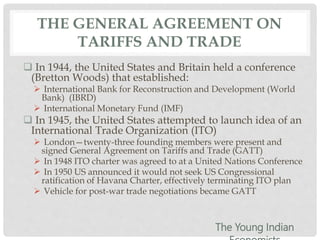
 In 1944, the United States and Britain held a conference
(Bretton Woods) that established:
 International Bank for Reconstruction and Development (World
Bank) (IBRD)
 International Monetary Fund (IMF)
 In 1945, the United States attempted to launch idea of an
International Trade Organization (ITO)
 London—twenty-three founding members were present and
signed General Agreement on Tariffs and Trade (GATT)
 In 1948 ITO charter was agreed to at a United Nations Conference
 In 1950 US announced it would not seek US Congressional
ratification of Havana Charter, effectively terminating ITO plan
 Vehicle for post-war trade negotiations became GATT
The Young Indian
THE GENERAL AGREEMENT ON
TARIFFS AND TRADE
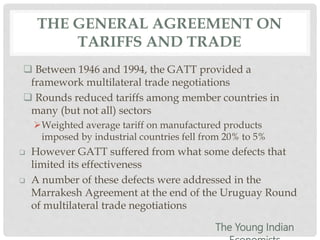
 Between 1946 and 1994, the GATT provided a
framework multilateral trade negotiations
 Rounds reduced tariffs among member countries in
many (but not all) sectors
Weighted average tariff on manufactured products
imposed by industrial countries fell from 20% to 5%
 However GATT suffered from what some defects that
limited its effectiveness
 A number of these defects were addressed in the
Marrakesh Agreement at the end of the Uruguay Round
of multilateral trade negotiations
The Young Indian
NON-DISCRIMINATION
PRINCIPLE
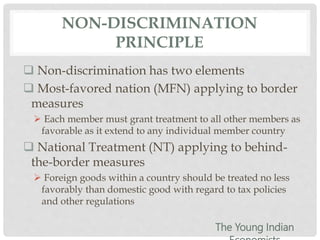
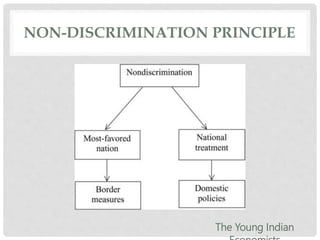
 Non-discrimination has two elements
 Most-favored nation (MFN) applying to border
measures
 Each member must grant treatment to all other members as
favorable as it extend to any individual member country
 National Treatment (NT) applying to behind-
the-border measures
 Foreign goods within a country should be treated no less
favorably than domestic good with regard to tax policies
and other regulations
The Young Indian
NON-DISCRIMINATION PRINCIPLE
The Young Indian
GENERAL PROHIBITION
OF QUOTAS
 A second important GATT principle
 General prohibition of quotas or quantitative restrictions on
trade
1. Reflects a longstanding view that price distortions (tariffs) are
preferred to quantity distortions in international markets
2. Quantitative restrictions were one of the most significant
impediments to trade prior to GATT
3. Exceptions are allowed
The Young Indian
Economists
TARIFF BINDINGS AND
FAIR TRADE
 Tariffs are bound at an agreed-upon level often above applied levels
 Levels may not be increased in the future
 Applied rates below bound rates may be increased
 GATT introduced stipulations with regard to subsidies,
countervailing duties, and antidumping duties
 Use of subsidies is not supposed to harm trading interests of other
members
• If subsidies cause “material injury” or “threat thereof” to a domestic industry of
another country, that country can apply countervailing duties or tariffs on its imports
of the product from the subsidizing country
 “Dumped goods are defined as exports sold below those charged by
the exporter in its domestic market
• It dumped goods cause “material injury” or “threat thereof” to a domestic industry
of another country, that country can apply anti-dumping duties or tariffs on its
imports of the product from the dumping country
The Young Indian
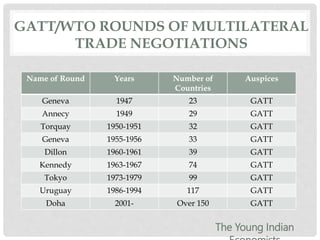
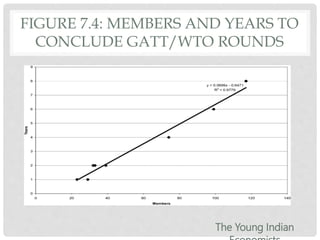
GATT/WTO ROUNDS OF MULTILATERAL
TRADE NEGOTIATIONS
Source: WTO
Name of Round Years Number of
Countries
Auspices
Geneva 1947 23 GATT
Annecy 1949 29 GATT
Torquay 1950-1951 32 GATT
Geneva 1955-1956 33 GATT
Dillon 1960-1961 39 GATT
Kennedy 1963-1967 74 GATT
Tokyo 1973-1979 99 GATT
Uruguay 1986-1994 117 GATT
Doha 2001- Over 150 GATT
The Young Indian
THE WORLD TRADE
ORGANIZATION
 The Marrakesh Agreement created the WTO and
included the WTO “tripod”
 General Agreement on Tariffs and Trade (GATT 94) on trade in
goods
 General Agreement on Trade in Services (GATS)
 Agreement on Trade-Related Aspects of Intellectual Property
Rights (TRIPS)
 Included a WTO charter
 Established WTO as a legal international organization
 Stipulated that “WTO shall provide the common institutional
framework for the conduct of trade relations among its members”
 Defined the functions of WTO
The Young Indian
ADMINISTRATIVE STRUCTURE
OF THE WTO
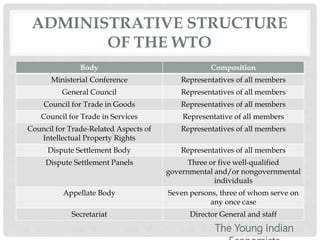
Body Composition
Ministerial Conference Representatives of all members
General Council Representatives of all members
Council for Trade in Goods Representatives of all members
Council for Trade in Services Representative of all members
Council for Trade-Related Aspects of
Intellectual Property Rights
Representatives of all members
Dispute Settlement Body Representatives of all members
Dispute Settlement Panels Three or five well-qualified
governmental and/or nongovernmental
individuals
Appellate Body Seven persons, three of whom serve on
any once case
Secretariat Director General and staff
The Young Indian
GATT: AGREEMENT ON
AGRICULTURE
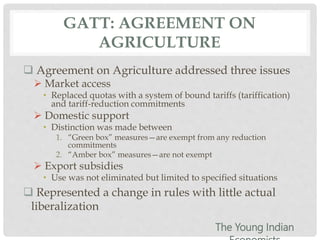
 Agreement on Agriculture addressed three issues
 Market access
• Replaced quotas with a system of bound tariffs (tariffication)
and tariff-reduction commitments
 Domestic support
• Distinction was made between
1. “Green box” measures—are exempt from any reduction
commitments
2. “Amber box” measures—are not exempt
 Export subsidies
• Use was not eliminated but limited to specified situations
 Represented a change in rules with little actual
liberalization
The Young Indian
TRADE IN SERVICES
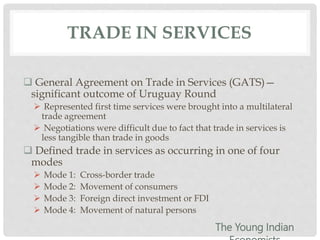
 General Agreement on Trade in Services (GATS)—
significant outcome of Uruguay Round
 Represented first time services were brought into a multilateral
trade agreement
 Negotiations were difficult due to fact that trade in services is
less tangible than trade in goods
 Defined trade in services as occurring in one of four
modes
 Mode 1: Cross-border trade
 Mode 2: Movement of consumers
 Mode 3: Foreign direct investment or FDI
 Mode 4: Movement of natural persons
The Young Indian
TRADE IN SERVICES
 Cross-border trade
 Mode of supply that does not require physical movement of
producers or consumers
• For example, Indian firms provide medical transcription services to US
hospitals via satellite technology
 Movement of consumers
 Consumer travels to the country of producer
• For example, tourism services
 Foreign direct investment
 Services that require a commercial presence by producers in
country of the consumers
• For example, financial services
 Temporary movement of natural persons
 Non-commercial presence by producers
• For example, consulting, construction, and instructional services
The Young Indian
GATS PROTOCOLS
 Second GATS Protocol: Revised Schedules of
Commitments on Financial Services, 1995
 Third GATS Protocol: Schedules of Specific
Commitments Relating to Movement of Natural
Persons, 1995
 Fourth GATS Protocol: Schedules of Specific
Commitments Concerning Basic
Telecommunications, 1997
 Fifth GATS Protocol: Schedules of Specific
Commitments and Lists of Exemptions from Article II
Concerning Financial Services, 1998
The Young Indian
INTELLECTUAL PROPERTY
 An asset in the form of rights conferred upon a product of
invention or creation by a country’s legal system
 Agreement on Trade-Related Aspects of Intellectual Property
Rights
 Most contentious aspect of Marrakesh Agreement
 Defined intellectual property as belonging to one of six categories
• Copyrights
• Trademarks
• Geographical indications
• Industrial designs
• Patents
• Layout designs of integrated circuits
 Applied the principle of nondiscrimination to intellectual property
The Young Indian
TRIPS AGREEMENT
 Sets out obligations for members
1. Copyrights
• Members must comply with 1971 Berne Convention on copyrights
2. Trademarks
• Goods and services are to be protected for a term of no less than seven years
• Provisions for the registration of trademarks must be made and are renewable
indefinitely
3. Geographical indications
• Members must provide legal means to prevent false use of geographical
indications
4. Industrial designs
• Members must protect “independently created industrial designs that are new or
original”
5. Patents
• Exceptions exist and include protection of public order, human, animal, and plant
life
6. Layout designs of integrated circuits
• Distribution of protected layout designs is forbidden
The Young Indian
TRIPS AGREEMENT
 Citizens and firms in developed countries own most of
the world’s IP
 Developing countries currently often have less IP
protection than developed countries
• Especially in the case of patents
 Raises cost of many goods and services to developing
countries
• Represents a transfer from developing country consumers to developed
country producers
 Issues have also been raised about the impact of new
pharmaceutical patents on access to medicines
The Young Indian
DISPUTE SETTLEMENT
 Marrakesh Agreement included an Understanding on
Rules and Procedures Governing the Settlement of
Disputes
 Original GATT was unclear about resolution of
disputes—Marrakesh Agreement attempted to clarify
dispute settlement procedures
 WTO includes councils on trade in goods and services
as well as a council on TRIPs
• Should help minimize occurrence of disputes
The Young Indian
DISPUTE SETTLEMENT
The Young Indian
DISPUTE SETTLEMENT
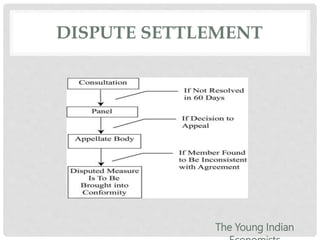
 If the consultation process fails to settle a dispute
within 60 days, the complaining member may
request the establishment of a panel
 Composed of three or five “well-qualified governmental or
non-governmental individuals”
 Function is to assist DSB in dispute settlement process
• Consults the parties involved and provides DSB with a written
report of its findings
• DSB has 60 days to adopt report by consensus unless a party to
dispute decides to appeal
 The appeal of a panel report is referred to an appellate
body
• Reviews the appeal and submits its report to the DSB
• Any DSB member can effectively insist on the adoption of the
appellate body report
The Young Indian
DISPUTE SETTLEMENT
 Dispute settlement procedure applies to all aspects
of the Marrakesh Agreement
 Improves procedures of old GATT
 Effectiveness of procedures depends on members’
commitment to it
• A country has option of ignoring outcome of the
dispute settlement process
• Complaining member has right to impose retaliatory tariffs on
a volume of imports from the other country determined by the
DSB
The Young Indian
THE ENVIRONMENT
 In 1991, the GATT reactivated a long-dormant Working
Group on Environmental Measures and International
Trade (EMIT)
 GATT dispute resolution panel issued its controversial
opinion in the now-famous tuna-dolphin case
 Ruled against US law banning imports of Mexican tuna that
involved dolphin-unsafe fishing practices
Argued import ban violated general prohibition against quotas
and United States had not attempted to negotiate cooperative
agreements on dolphin-safe tuna fishing
• US environmental community reacted strongly against the GATT
panel ruling, casting the GATT as anti-environment
The Young Indian
COMMITTEE ON TRADE AND THE
ENVIRONMENT
 EMIT was replaced by Committee on Trade and the
Environment
 Most developing country members of WTO have taken
a dim view of the work of CTE
 Fear the possibility of further protection against their exports in
the form of “green protection”
 Often view environmental matters having no place in the WTO
 Many trade economists support the developing-country
view that environmental issues represent an “intrusion”
into WTO trade agenda
 They do, however, support the use of multilateral environmental
agreements and perhaps even an World Environmental
Organization
The Young Indian
COMMITTEE ON TRADE AND THE
ENVIRONMENT
 In 1999, WTO formally took up trade and
environment issue
 Report argued increased trade can have both positive
and negative impacts on the environment
 Emphasized trade-driven growth cannot always be
counted upon to deliver improvements in
environmental quality through increased incomes
• Consequently, these higher incomes must be “translated into
higher environmental quality” through mechanism of
international cooperation
• Also emphasized that government subsidies to polluting and
resource-depleting sectors can exacerbate the environmental
consequences of trade
The Young Indian
THE DOHA ROUND
 Launched in Doha, Qatar in 2001
 Progress has been very uneven, with a noted failure
at the 2003 Cancun Ministerial Meeting
 July 2004, October 2005 and July 2008 negotiations
made some progress on contentious agricultural
issues
 A “final countdown” to conclude the Round by the
end of 2011 was missed
 Significant issues remain in agriculture and in “non-
agricultural market access” (NAMA)
The Young Indian
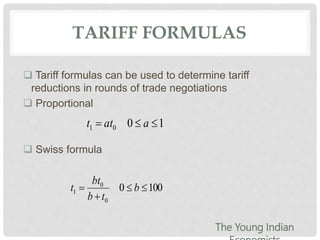
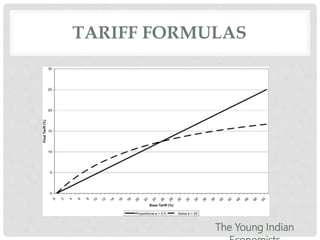
TARIFF FORMULAS
 Tariff formulas can be used to determine tariff
reductions in rounds of trade negotiations
 Proportional
 Swiss formula
1001  aatt
1000
0
0
1 

 b
tb
bt
t
The Young Indian
TARIFF FORMULAS
The Young Indian
FIGURE 7.4: MEMBERS AND YEARS TO
CONCLUDE GATT/WTO ROUNDS
The Young Indian
THANK YOU
The Young
Indian
Economists

WORLD TRADE ORGANISATION (WTO)

  • 1.
    A N IN T R O D U C T I O N T O I N T E R N AT I O N A L E C O N O M I C S : N E W P E R S P E C T I V E S O N T H E W O R L D E C O N O M Y WORLD TRADE ORGANIZATION The Young Indian Economists
  • 2.
    THE GENERAL AGREEMENTON TARIFFS AND TRADE  In 1944, the United States and Britain held a conference (Bretton Woods) that established:  International Bank for Reconstruction and Development (World Bank) (IBRD)  International Monetary Fund (IMF)  In 1945, the United States attempted to launch idea of an International Trade Organization (ITO)  London—twenty-three founding members were present and signed General Agreement on Tariffs and Trade (GATT)  In 1948 ITO charter was agreed to at a United Nations Conference  In 1950 US announced it would not seek US Congressional ratification of Havana Charter, effectively terminating ITO plan  Vehicle for post-war trade negotiations became GATT The Young Indian
  • 3.
    THE GENERAL AGREEMENTON TARIFFS AND TRADE  Between 1946 and 1994, the GATT provided a framework multilateral trade negotiations  Rounds reduced tariffs among member countries in many (but not all) sectors Weighted average tariff on manufactured products imposed by industrial countries fell from 20% to 5%  However GATT suffered from what some defects that limited its effectiveness  A number of these defects were addressed in the Marrakesh Agreement at the end of the Uruguay Round of multilateral trade negotiations The Young Indian
  • 4.
    NON-DISCRIMINATION PRINCIPLE  Non-discrimination hastwo elements  Most-favored nation (MFN) applying to border measures  Each member must grant treatment to all other members as favorable as it extend to any individual member country  National Treatment (NT) applying to behind- the-border measures  Foreign goods within a country should be treated no less favorably than domestic good with regard to tax policies and other regulations The Young Indian
  • 5.
  • 6.
    GENERAL PROHIBITION OF QUOTAS A second important GATT principle  General prohibition of quotas or quantitative restrictions on trade 1. Reflects a longstanding view that price distortions (tariffs) are preferred to quantity distortions in international markets 2. Quantitative restrictions were one of the most significant impediments to trade prior to GATT 3. Exceptions are allowed The Young Indian Economists
  • 7.
    TARIFF BINDINGS AND FAIRTRADE  Tariffs are bound at an agreed-upon level often above applied levels  Levels may not be increased in the future  Applied rates below bound rates may be increased  GATT introduced stipulations with regard to subsidies, countervailing duties, and antidumping duties  Use of subsidies is not supposed to harm trading interests of other members • If subsidies cause “material injury” or “threat thereof” to a domestic industry of another country, that country can apply countervailing duties or tariffs on its imports of the product from the subsidizing country  “Dumped goods are defined as exports sold below those charged by the exporter in its domestic market • It dumped goods cause “material injury” or “threat thereof” to a domestic industry of another country, that country can apply anti-dumping duties or tariffs on its imports of the product from the dumping country The Young Indian
  • 8.
    GATT/WTO ROUNDS OFMULTILATERAL TRADE NEGOTIATIONS Source: WTO Name of Round Years Number of Countries Auspices Geneva 1947 23 GATT Annecy 1949 29 GATT Torquay 1950-1951 32 GATT Geneva 1955-1956 33 GATT Dillon 1960-1961 39 GATT Kennedy 1963-1967 74 GATT Tokyo 1973-1979 99 GATT Uruguay 1986-1994 117 GATT Doha 2001- Over 150 GATT The Young Indian
  • 9.
    THE WORLD TRADE ORGANIZATION The Marrakesh Agreement created the WTO and included the WTO “tripod”  General Agreement on Tariffs and Trade (GATT 94) on trade in goods  General Agreement on Trade in Services (GATS)  Agreement on Trade-Related Aspects of Intellectual Property Rights (TRIPS)  Included a WTO charter  Established WTO as a legal international organization  Stipulated that “WTO shall provide the common institutional framework for the conduct of trade relations among its members”  Defined the functions of WTO The Young Indian
  • 10.
    ADMINISTRATIVE STRUCTURE OF THEWTO Body Composition Ministerial Conference Representatives of all members General Council Representatives of all members Council for Trade in Goods Representatives of all members Council for Trade in Services Representative of all members Council for Trade-Related Aspects of Intellectual Property Rights Representatives of all members Dispute Settlement Body Representatives of all members Dispute Settlement Panels Three or five well-qualified governmental and/or nongovernmental individuals Appellate Body Seven persons, three of whom serve on any once case Secretariat Director General and staff The Young Indian
  • 11.
    GATT: AGREEMENT ON AGRICULTURE Agreement on Agriculture addressed three issues  Market access • Replaced quotas with a system of bound tariffs (tariffication) and tariff-reduction commitments  Domestic support • Distinction was made between 1. “Green box” measures—are exempt from any reduction commitments 2. “Amber box” measures—are not exempt  Export subsidies • Use was not eliminated but limited to specified situations  Represented a change in rules with little actual liberalization The Young Indian
  • 12.
    TRADE IN SERVICES General Agreement on Trade in Services (GATS)— significant outcome of Uruguay Round  Represented first time services were brought into a multilateral trade agreement  Negotiations were difficult due to fact that trade in services is less tangible than trade in goods  Defined trade in services as occurring in one of four modes  Mode 1: Cross-border trade  Mode 2: Movement of consumers  Mode 3: Foreign direct investment or FDI  Mode 4: Movement of natural persons The Young Indian
  • 13.
    TRADE IN SERVICES Cross-border trade  Mode of supply that does not require physical movement of producers or consumers • For example, Indian firms provide medical transcription services to US hospitals via satellite technology  Movement of consumers  Consumer travels to the country of producer • For example, tourism services  Foreign direct investment  Services that require a commercial presence by producers in country of the consumers • For example, financial services  Temporary movement of natural persons  Non-commercial presence by producers • For example, consulting, construction, and instructional services The Young Indian
  • 14.
    GATS PROTOCOLS  SecondGATS Protocol: Revised Schedules of Commitments on Financial Services, 1995  Third GATS Protocol: Schedules of Specific Commitments Relating to Movement of Natural Persons, 1995  Fourth GATS Protocol: Schedules of Specific Commitments Concerning Basic Telecommunications, 1997  Fifth GATS Protocol: Schedules of Specific Commitments and Lists of Exemptions from Article II Concerning Financial Services, 1998 The Young Indian
  • 15.
    INTELLECTUAL PROPERTY  Anasset in the form of rights conferred upon a product of invention or creation by a country’s legal system  Agreement on Trade-Related Aspects of Intellectual Property Rights  Most contentious aspect of Marrakesh Agreement  Defined intellectual property as belonging to one of six categories • Copyrights • Trademarks • Geographical indications • Industrial designs • Patents • Layout designs of integrated circuits  Applied the principle of nondiscrimination to intellectual property The Young Indian
  • 16.
    TRIPS AGREEMENT  Setsout obligations for members 1. Copyrights • Members must comply with 1971 Berne Convention on copyrights 2. Trademarks • Goods and services are to be protected for a term of no less than seven years • Provisions for the registration of trademarks must be made and are renewable indefinitely 3. Geographical indications • Members must provide legal means to prevent false use of geographical indications 4. Industrial designs • Members must protect “independently created industrial designs that are new or original” 5. Patents • Exceptions exist and include protection of public order, human, animal, and plant life 6. Layout designs of integrated circuits • Distribution of protected layout designs is forbidden The Young Indian
  • 17.
    TRIPS AGREEMENT  Citizensand firms in developed countries own most of the world’s IP  Developing countries currently often have less IP protection than developed countries • Especially in the case of patents  Raises cost of many goods and services to developing countries • Represents a transfer from developing country consumers to developed country producers  Issues have also been raised about the impact of new pharmaceutical patents on access to medicines The Young Indian
  • 18.
    DISPUTE SETTLEMENT  MarrakeshAgreement included an Understanding on Rules and Procedures Governing the Settlement of Disputes  Original GATT was unclear about resolution of disputes—Marrakesh Agreement attempted to clarify dispute settlement procedures  WTO includes councils on trade in goods and services as well as a council on TRIPs • Should help minimize occurrence of disputes The Young Indian
  • 19.
  • 20.
    DISPUTE SETTLEMENT  Ifthe consultation process fails to settle a dispute within 60 days, the complaining member may request the establishment of a panel  Composed of three or five “well-qualified governmental or non-governmental individuals”  Function is to assist DSB in dispute settlement process • Consults the parties involved and provides DSB with a written report of its findings • DSB has 60 days to adopt report by consensus unless a party to dispute decides to appeal  The appeal of a panel report is referred to an appellate body • Reviews the appeal and submits its report to the DSB • Any DSB member can effectively insist on the adoption of the appellate body report The Young Indian
  • 21.
    DISPUTE SETTLEMENT  Disputesettlement procedure applies to all aspects of the Marrakesh Agreement  Improves procedures of old GATT  Effectiveness of procedures depends on members’ commitment to it • A country has option of ignoring outcome of the dispute settlement process • Complaining member has right to impose retaliatory tariffs on a volume of imports from the other country determined by the DSB The Young Indian
  • 22.
    THE ENVIRONMENT  In1991, the GATT reactivated a long-dormant Working Group on Environmental Measures and International Trade (EMIT)  GATT dispute resolution panel issued its controversial opinion in the now-famous tuna-dolphin case  Ruled against US law banning imports of Mexican tuna that involved dolphin-unsafe fishing practices Argued import ban violated general prohibition against quotas and United States had not attempted to negotiate cooperative agreements on dolphin-safe tuna fishing • US environmental community reacted strongly against the GATT panel ruling, casting the GATT as anti-environment The Young Indian
  • 23.
    COMMITTEE ON TRADEAND THE ENVIRONMENT  EMIT was replaced by Committee on Trade and the Environment  Most developing country members of WTO have taken a dim view of the work of CTE  Fear the possibility of further protection against their exports in the form of “green protection”  Often view environmental matters having no place in the WTO  Many trade economists support the developing-country view that environmental issues represent an “intrusion” into WTO trade agenda  They do, however, support the use of multilateral environmental agreements and perhaps even an World Environmental Organization The Young Indian
  • 24.
    COMMITTEE ON TRADEAND THE ENVIRONMENT  In 1999, WTO formally took up trade and environment issue  Report argued increased trade can have both positive and negative impacts on the environment  Emphasized trade-driven growth cannot always be counted upon to deliver improvements in environmental quality through increased incomes • Consequently, these higher incomes must be “translated into higher environmental quality” through mechanism of international cooperation • Also emphasized that government subsidies to polluting and resource-depleting sectors can exacerbate the environmental consequences of trade The Young Indian
  • 25.
    THE DOHA ROUND Launched in Doha, Qatar in 2001  Progress has been very uneven, with a noted failure at the 2003 Cancun Ministerial Meeting  July 2004, October 2005 and July 2008 negotiations made some progress on contentious agricultural issues  A “final countdown” to conclude the Round by the end of 2011 was missed  Significant issues remain in agriculture and in “non- agricultural market access” (NAMA) The Young Indian
  • 26.
    TARIFF FORMULAS  Tariffformulas can be used to determine tariff reductions in rounds of trade negotiations  Proportional  Swiss formula 1001  aatt 1000 0 0 1    b tb bt t The Young Indian
  • 27.
  • 28.
    FIGURE 7.4: MEMBERSAND YEARS TO CONCLUDE GATT/WTO ROUNDS The Young Indian
  • 29.