Presentation by
Abdulkarim khanapuri MB161001
WHAT IS WTO
• The World Trade Organization (WTO) is the only global
International organization dealing with the rules of trade
between nations to ensure trade that flows as smoothly,
predictably and freely as possible.
• The WTO began life on 1 January 1995 under the Marrakesh
Agreement, signed by 123 nations on 15 April 1994, but its
trading system is half a century older. Since 1948, the General
Agreement on Tariffs and Trade (GATT)
• The membership of the WTO were 77 in 1995 to 164 in the year
2017.
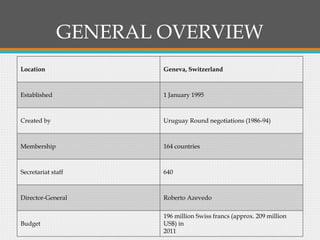
GENERAL OVERVIEW
Location Geneva, Switzerland
Established 1 January 1995
Created by Uruguay Round negotiations (1986-94)
Membership 164 countries
Secretariat staff 640
Director-General Roberto Azevedo
Budget
196 million Swiss francs (approx. 209 million
US$) in
2011
OBJECTIVES OF WTO
• Set and enforce rules for international trade
• Forum for trade negotiations
• Handling trade disputes
• Monitoring national trade policies
• Technical assistance and training for developing
countries
• Cooperation with other international organizations
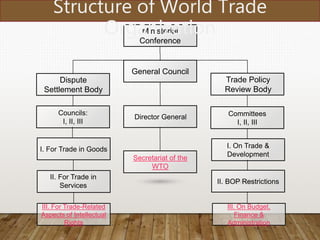
Ministerial
Conference
Dispute
Settlement Body
General Council
Trade Policy
Review Body
Councils:
I, II, III
Director General Committees
I, II, III
I. For Trade in Goods I. On Trade &
Development
Secretariat of the
WTO
III. On Budget,
Finance &
Administration
II. BOP Restrictions
II. For Trade in
Services
III. For Trade-Related
Aspects of Intellectual
Rights
Structure of World Trade
Organization
Dispute Settlement Body
 The General Council convenes as the Dispute Settlement Body
to deal with disputes between WTO members
 The DSB has authority to establish dispute settlement panels, refer
matters to arbitration, adopt panel, Appellate Body and arbitration
reports, maintain surveillance over the implementation of
recommendations and rulings contained in such reports, and
authorize suspension of concessions in the event of non-
compliance with those recommendations and rulings.
Appellate Body
 The Appellate Body was established in 1995 under Article 17 of the
Understanding on Rules and Procedures Governing the Settlement
of Disputes (DSU). It is a standing body of seven persons that
appeals from reports issued by panels in disputes brought by WTO
Members. The Appellate Body can uphold, modify or reverse the
legal findings and conclusions of a panel, and Appellate Body
Reports, once adopted by the Dispute Settlement Body (DSB),
be accepted by the parties to the dispute.
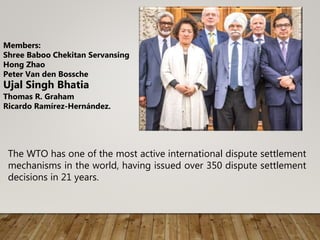
The WTO has one of the most active international dispute settlement
mechanisms in the world, having issued over 350 dispute settlement
decisions in 21 years.
Members:
Shree Baboo Chekitan Servansing
Hong Zhao
Peter Van den Bossche
Ujal Singh Bhatia
Thomas R. Graham
Ricardo Ramírez-Hernández.
• WTO General Council
• The General Council is the WTO’s highest-level decision-
making body in Geneva, meeting regularly to carry out the
functions of the WTO.
• It has representatives (usually ambassadors or equivalent) from
all member governments and has the authority to act on behalf
of the ministerial conference which only meets about every two
years.
• The current chair is Ambassador Xavier CARIM (South Africa).
• The General Council also meets, under different rules, as the
Dispute Settlement Body and as the Trade Policy Review Body.
Trade Policy Review Body
o The WTO general council met as a to undertake TPRM
o The trade policy review mechanism was an early result of the Uruguay round
being provisionally established the round in 1988.
o The current chair is ambassador is JUAN CARLOS GONZALEZ (Columbia)
Cambodia 21 to 23 November 2017
Iceland 4 to 6 October 2017
Paraguay 20 to 22 September 2017
Jamaica 13 to 15 September 2017
Brazil 17 and 19 July 2017
European Union 5 and 7 July 2017
Chronological list of TPRS
Sources: Google, Wikipedia, WTO official website
World trade organization

World trade organization

  • 1.
  • 2.
    WHAT IS WTO •The World Trade Organization (WTO) is the only global International organization dealing with the rules of trade between nations to ensure trade that flows as smoothly, predictably and freely as possible. • The WTO began life on 1 January 1995 under the Marrakesh Agreement, signed by 123 nations on 15 April 1994, but its trading system is half a century older. Since 1948, the General Agreement on Tariffs and Trade (GATT) • The membership of the WTO were 77 in 1995 to 164 in the year 2017.
  • 3.
    GENERAL OVERVIEW Location Geneva,Switzerland Established 1 January 1995 Created by Uruguay Round negotiations (1986-94) Membership 164 countries Secretariat staff 640 Director-General Roberto Azevedo Budget 196 million Swiss francs (approx. 209 million US$) in 2011
  • 4.
    OBJECTIVES OF WTO •Set and enforce rules for international trade • Forum for trade negotiations • Handling trade disputes • Monitoring national trade policies • Technical assistance and training for developing countries • Cooperation with other international organizations
  • 5.
    Ministerial Conference Dispute Settlement Body General Council TradePolicy Review Body Councils: I, II, III Director General Committees I, II, III I. For Trade in Goods I. On Trade & Development Secretariat of the WTO III. On Budget, Finance & Administration II. BOP Restrictions II. For Trade in Services III. For Trade-Related Aspects of Intellectual Rights Structure of World Trade Organization
  • 6.
    Dispute Settlement Body The General Council convenes as the Dispute Settlement Body to deal with disputes between WTO members  The DSB has authority to establish dispute settlement panels, refer matters to arbitration, adopt panel, Appellate Body and arbitration reports, maintain surveillance over the implementation of recommendations and rulings contained in such reports, and authorize suspension of concessions in the event of non- compliance with those recommendations and rulings. Appellate Body  The Appellate Body was established in 1995 under Article 17 of the Understanding on Rules and Procedures Governing the Settlement of Disputes (DSU). It is a standing body of seven persons that appeals from reports issued by panels in disputes brought by WTO Members. The Appellate Body can uphold, modify or reverse the legal findings and conclusions of a panel, and Appellate Body Reports, once adopted by the Dispute Settlement Body (DSB), be accepted by the parties to the dispute.
  • 7.
    The WTO hasone of the most active international dispute settlement mechanisms in the world, having issued over 350 dispute settlement decisions in 21 years. Members: Shree Baboo Chekitan Servansing Hong Zhao Peter Van den Bossche Ujal Singh Bhatia Thomas R. Graham Ricardo Ramírez-Hernández.
  • 8.
    • WTO GeneralCouncil • The General Council is the WTO’s highest-level decision- making body in Geneva, meeting regularly to carry out the functions of the WTO. • It has representatives (usually ambassadors or equivalent) from all member governments and has the authority to act on behalf of the ministerial conference which only meets about every two years. • The current chair is Ambassador Xavier CARIM (South Africa). • The General Council also meets, under different rules, as the Dispute Settlement Body and as the Trade Policy Review Body.
  • 9.
    Trade Policy ReviewBody o The WTO general council met as a to undertake TPRM o The trade policy review mechanism was an early result of the Uruguay round being provisionally established the round in 1988. o The current chair is ambassador is JUAN CARLOS GONZALEZ (Columbia) Cambodia 21 to 23 November 2017 Iceland 4 to 6 October 2017 Paraguay 20 to 22 September 2017 Jamaica 13 to 15 September 2017 Brazil 17 and 19 July 2017 European Union 5 and 7 July 2017 Chronological list of TPRS Sources: Google, Wikipedia, WTO official website

Editor's Notes

  • #2 To change the image on this slide, select the picture and delete it. Then click the Pictures icon in the placeholder to insert your own image.