Topics for today’s class:
3D shapes
Surface Area
Volume
Nets
Dimensions
2D shapes have 2 dimensions – e.g. length and width.
3D shapes have 3 dimensions – e.g. length, width and height.
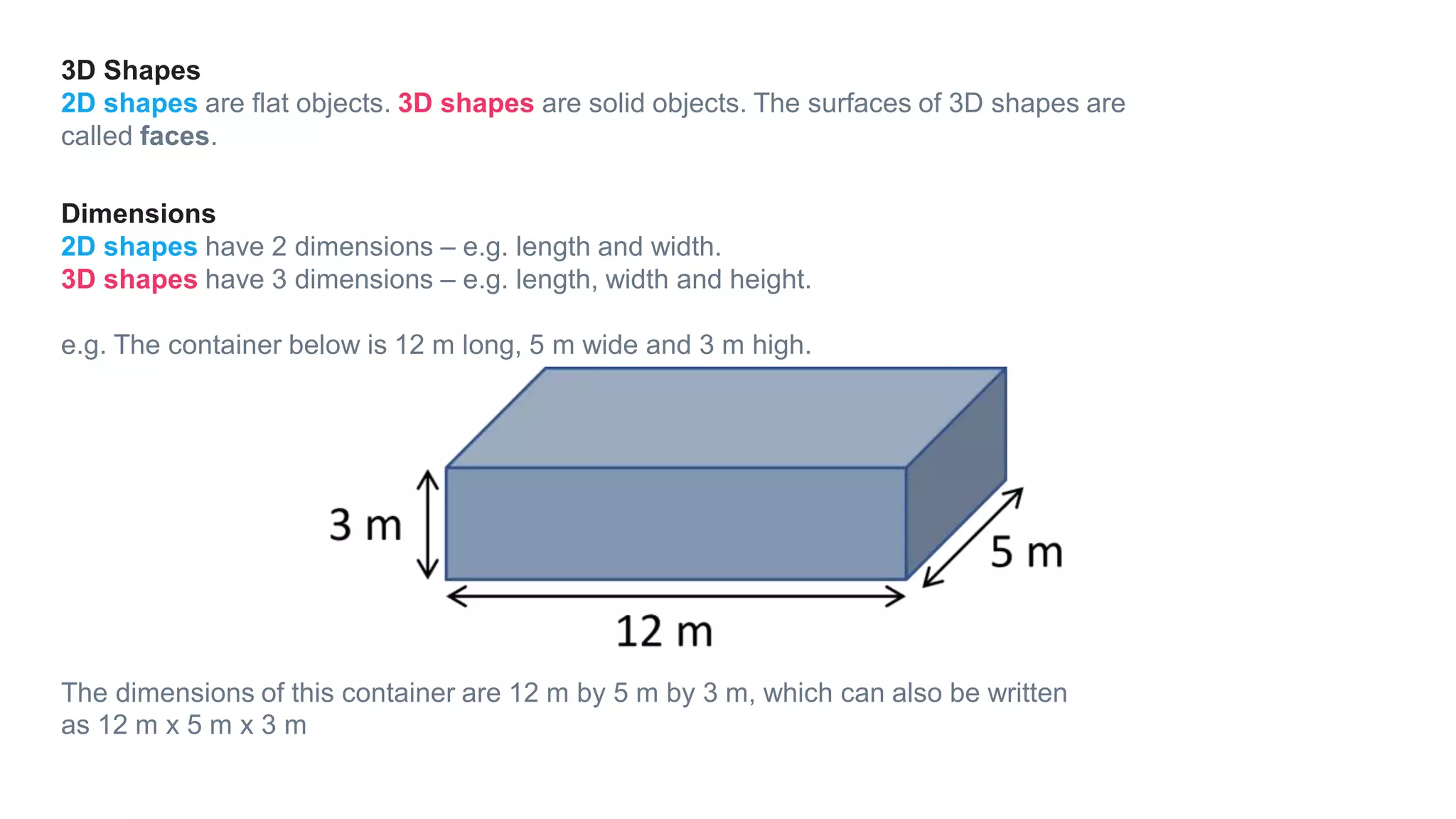
e.g. The container below is 12 m long, 5 m wide and 3 m high.
The dimensions of this container are 12 m by 5 m by 3 m, which can also be written
as 12 m x 5 m x 3 m
3D Shapes
2D shapes are flat objects. 3D shapes are solid objects. The surfaces of 3D shapes are
called faces.
Working with Dimensions
Example: Working with Dimensions
Leonardo is designing a box to hold 5 DVD cases.
Each DVD case is 14 cm long, 1.4 cm wide and 19 cm high.
Sketch a box that could hold the DVD cases. Give the dimensions.
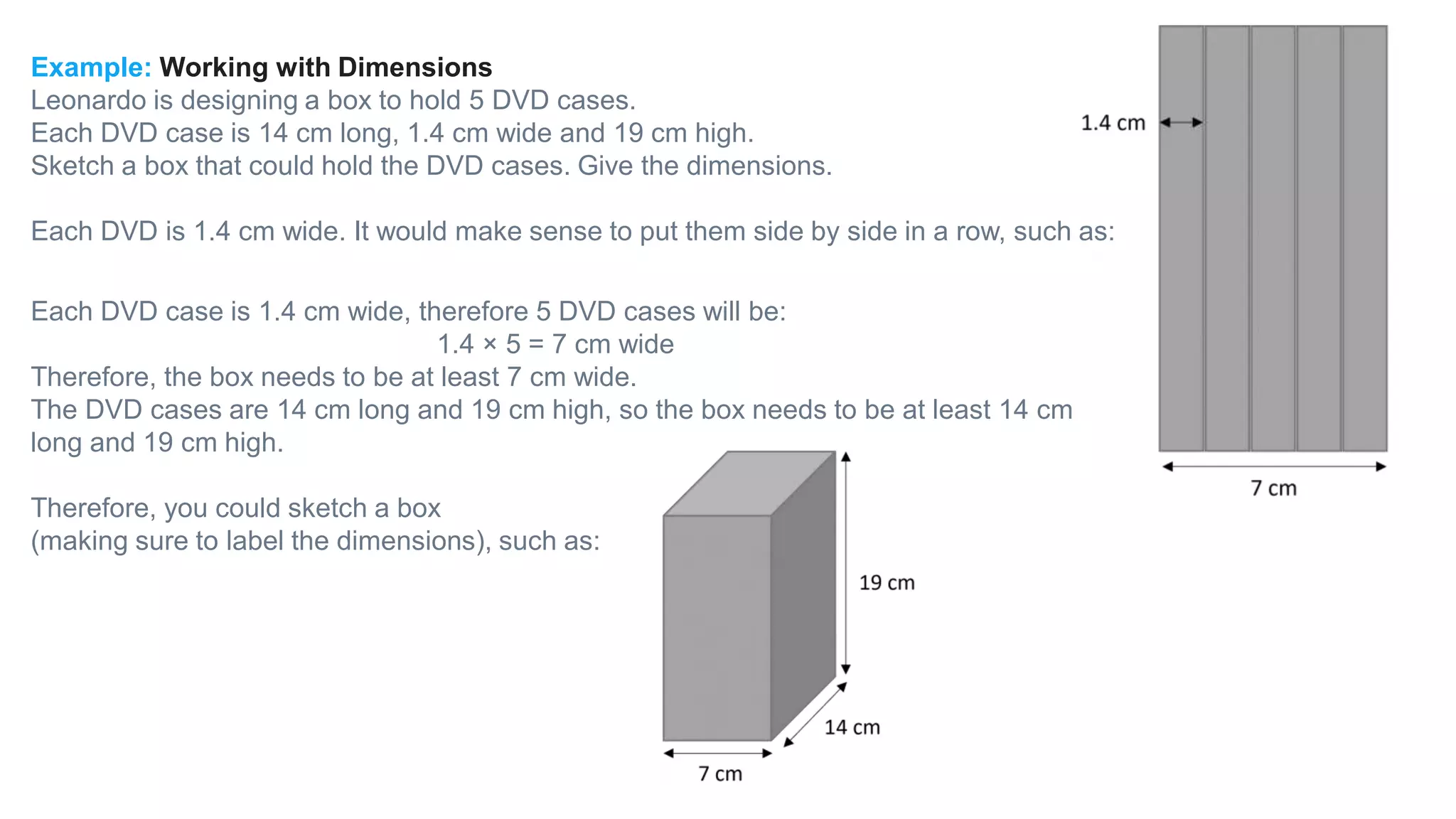
Each DVD is 1.4 cm wide. It would make sense to put them side by side in a row, such as:
Each DVD case is 1.4 cm wide, therefore 5 DVD cases will be:
1.4 × 5 = 7 cm wide
Therefore, the box needs to be at least 7 cm wide.
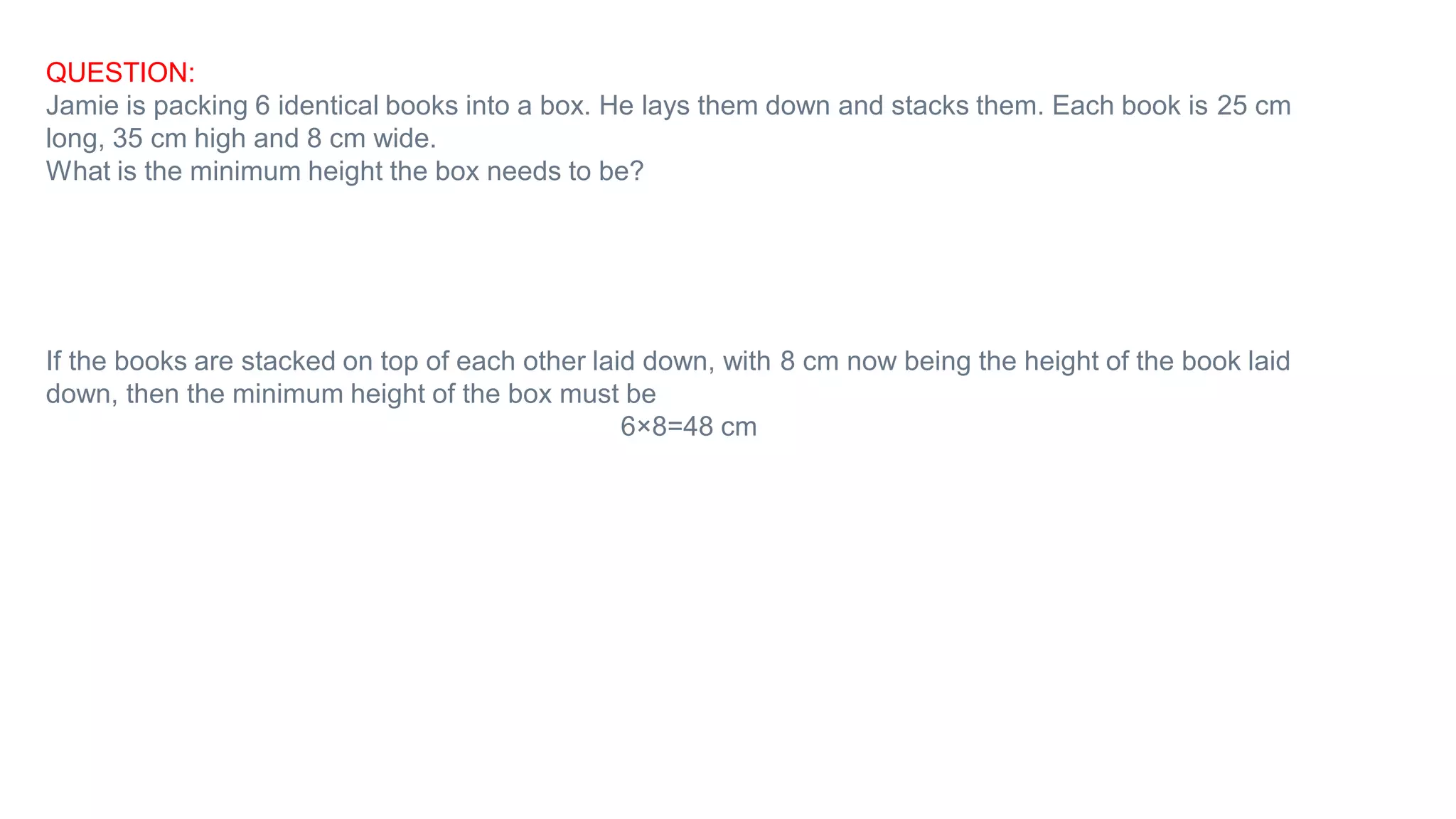
The DVD cases are 14 cm long and 19 cm high, so the box needs to be at least 14 cm
long and 19 cm high.
Therefore, you could sketch a box
(making sure to label the dimensions), such as:
QUESTION:
Jamie is packing 6 identical books into a box. He lays them down and stacks them. Each book is 25 cm
long, 35 cm high and 8 cm wide.
What is the minimum height the box needs to be?
If the books are stacked on top of each other laid down, with 8 cm now being the height of the book laid
down, then the minimum height of the box must be
6×8=48 cm
Nets
A net is a 3D shape that has been unfolded. You need to be able to recognize and draw
nets.
Understanding Nets
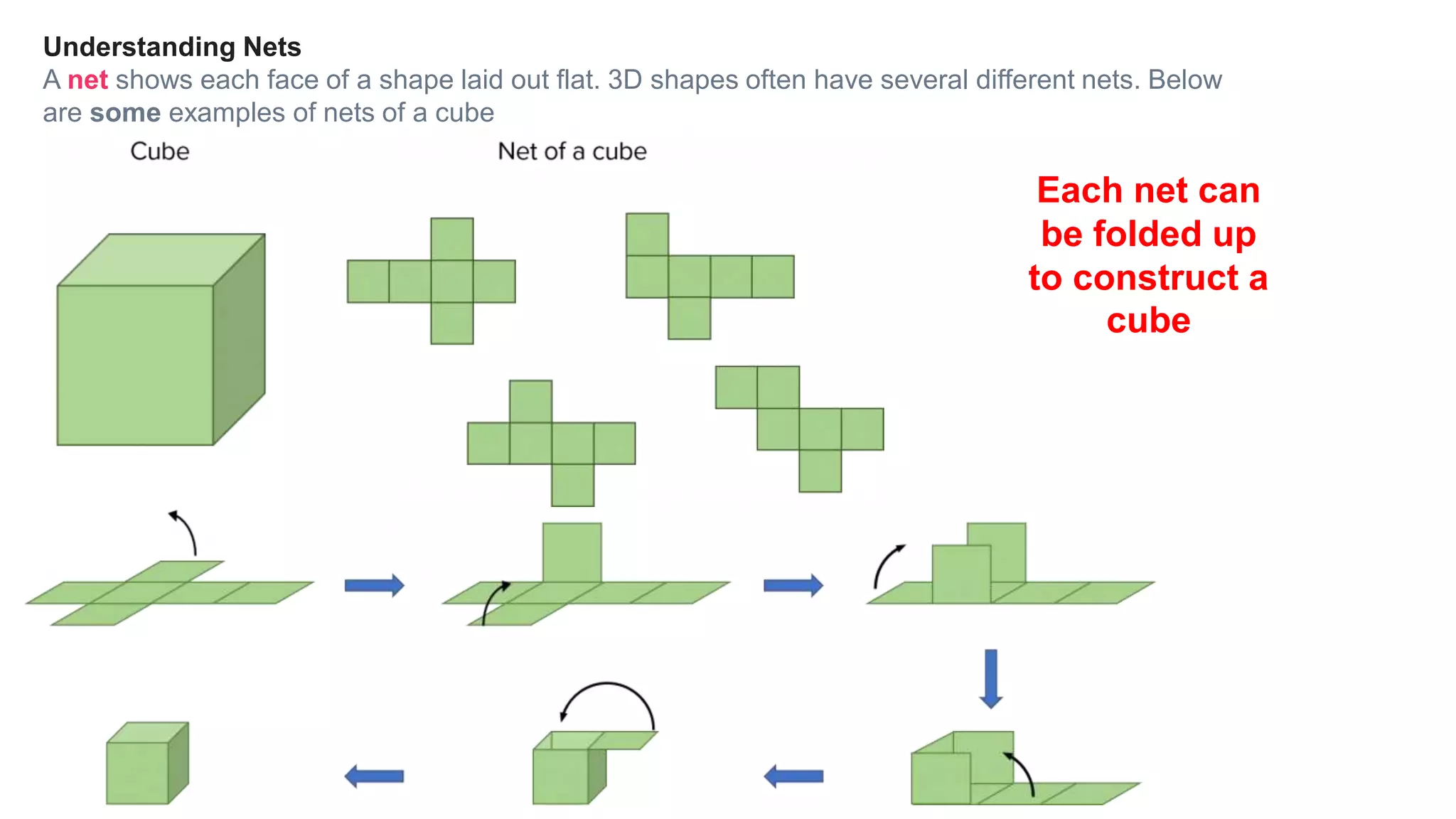
A net shows each face of a shape laid out flat. 3D shapes often have several different nets. Below
are some examples of nets of a cube
Each net can
be folded up
to construct a
cube
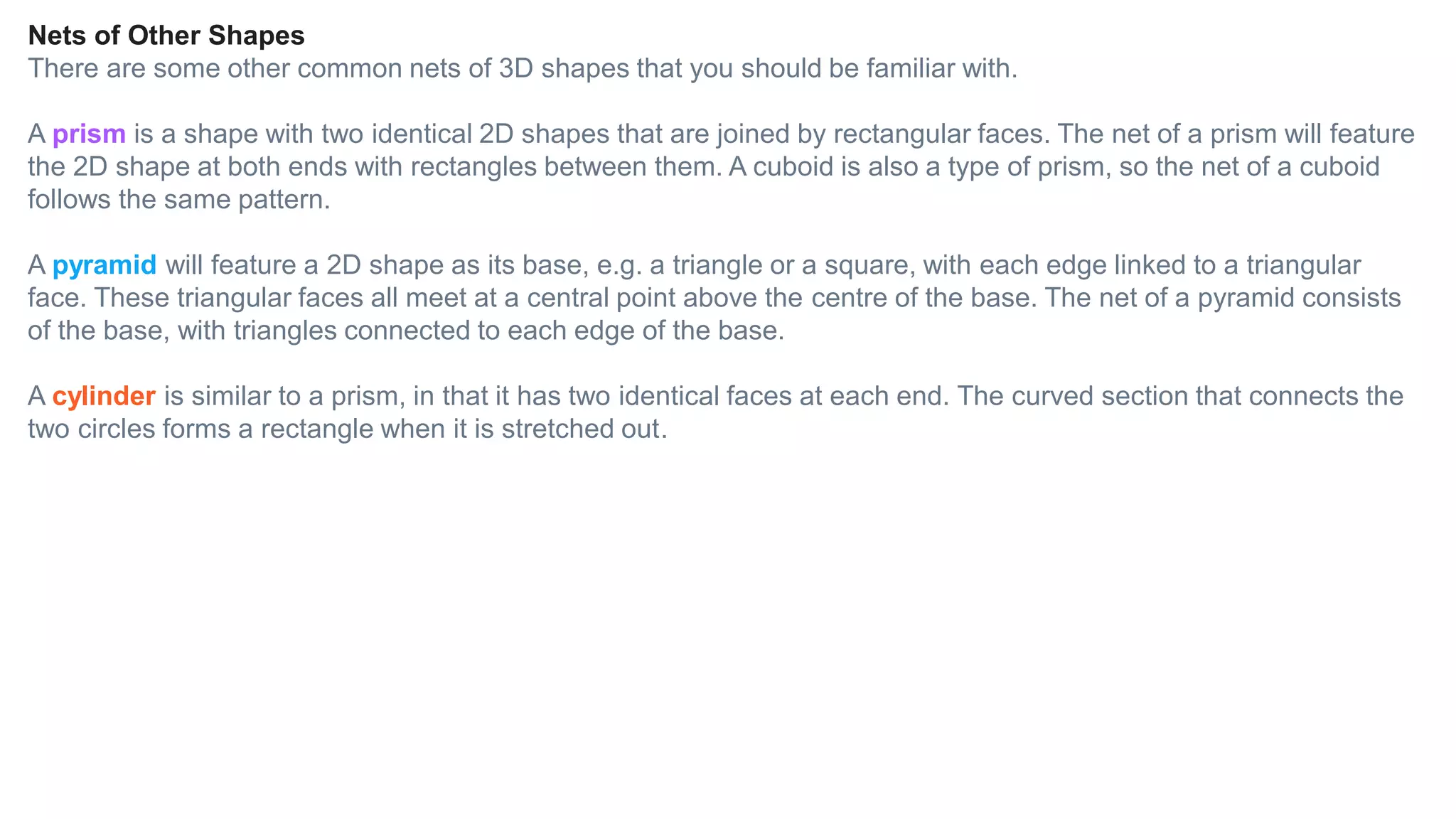
Nets of Other Shapes
There are some other common nets of 3D shapes that you should be familiar with.
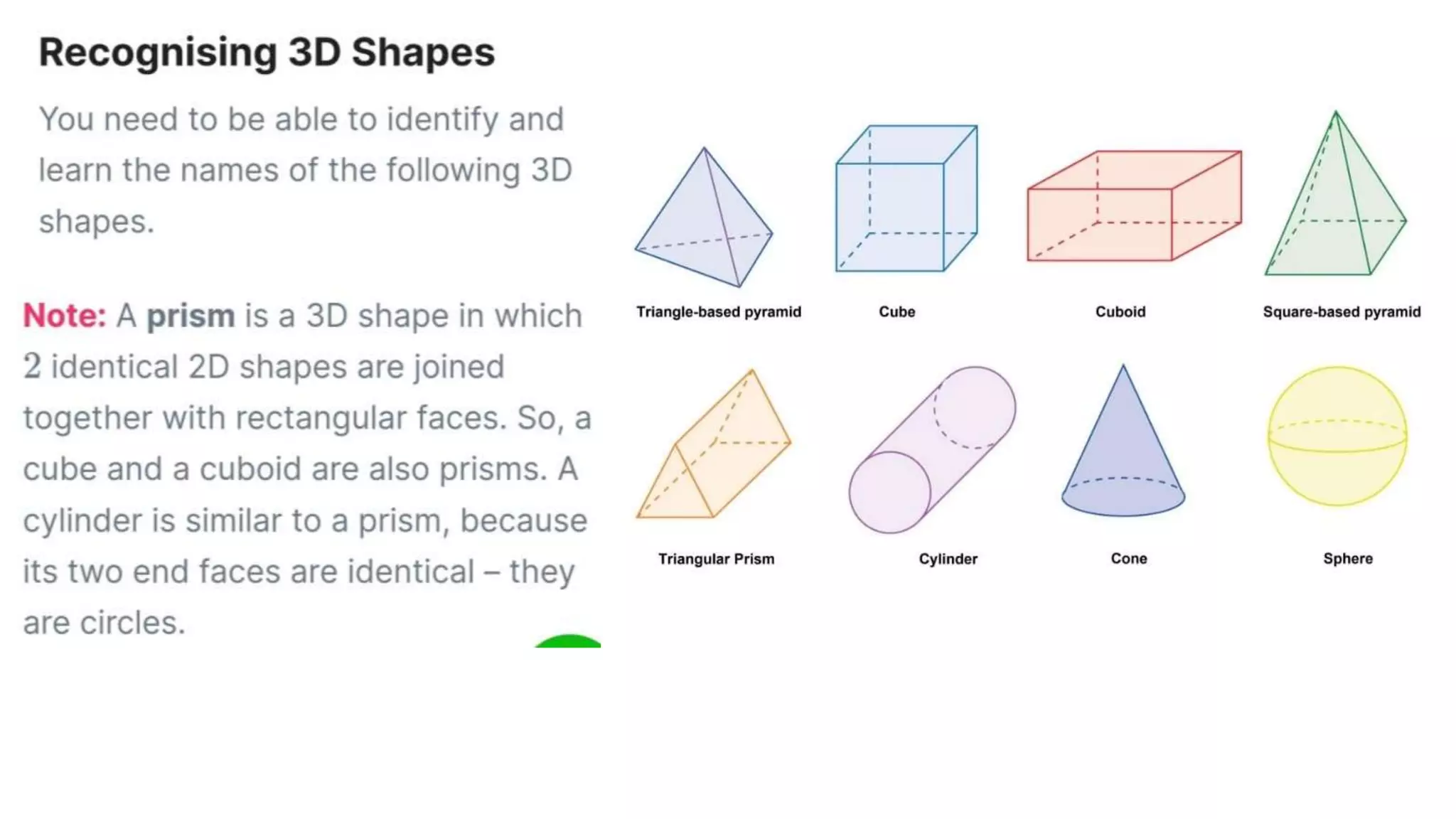
A prism is a shape with two identical 2D shapes that are joined by rectangular faces. The net of a prism will feature
the 2D shape at both ends with rectangles between them. A cuboid is also a type of prism, so the net of a cuboid
follows the same pattern.
A pyramid will feature a 2D shape as its base, e.g. a triangle or a square, with each edge linked to a triangular
face. These triangular faces all meet at a central point above the centre of the base. The net of a pyramid consists
of the base, with triangles connected to each edge of the base.
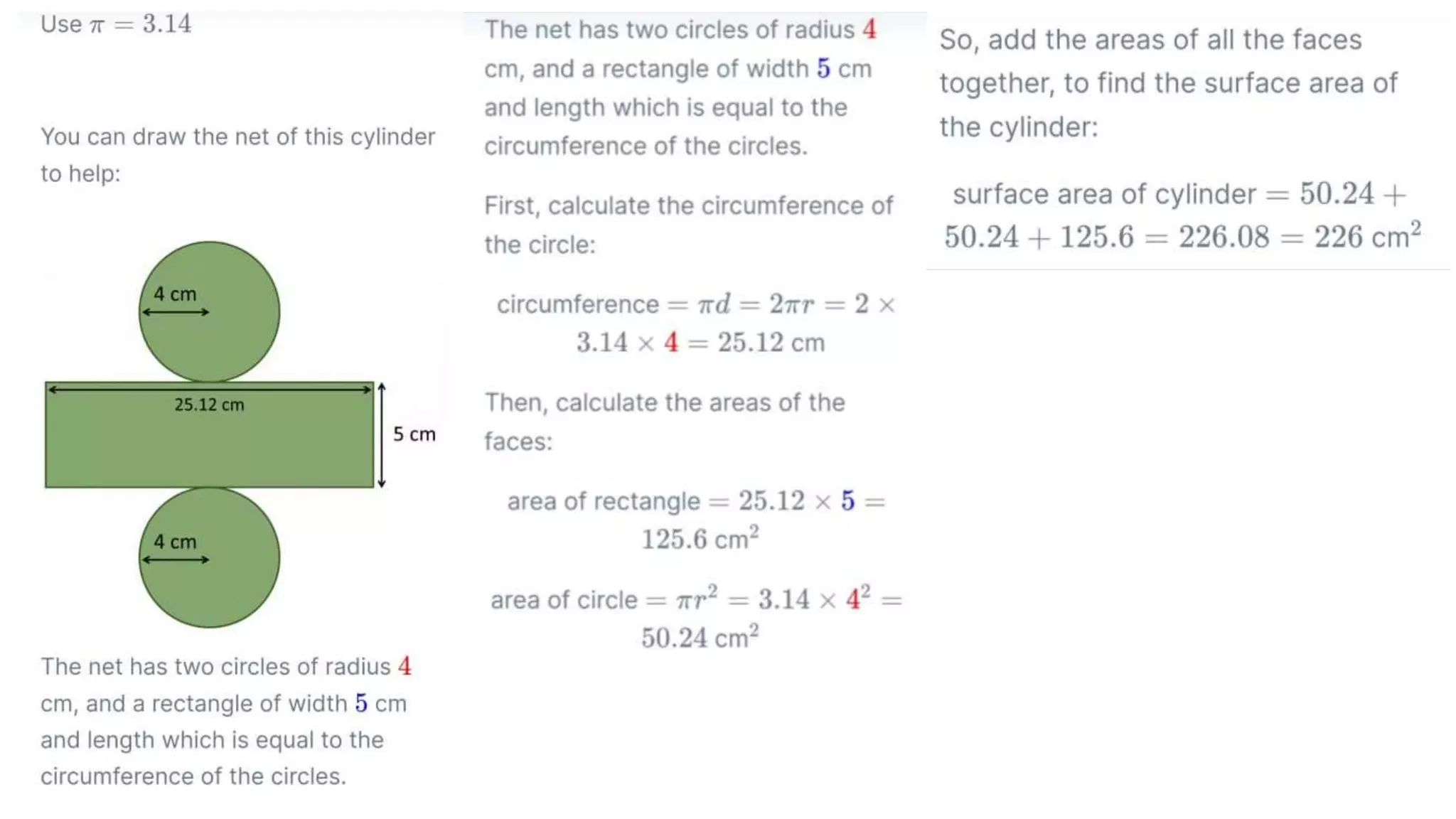
A cylinder is similar to a prism, in that it has two identical faces at each end. The curved section that connects the
two circles forms a rectangle when it is stretched out.
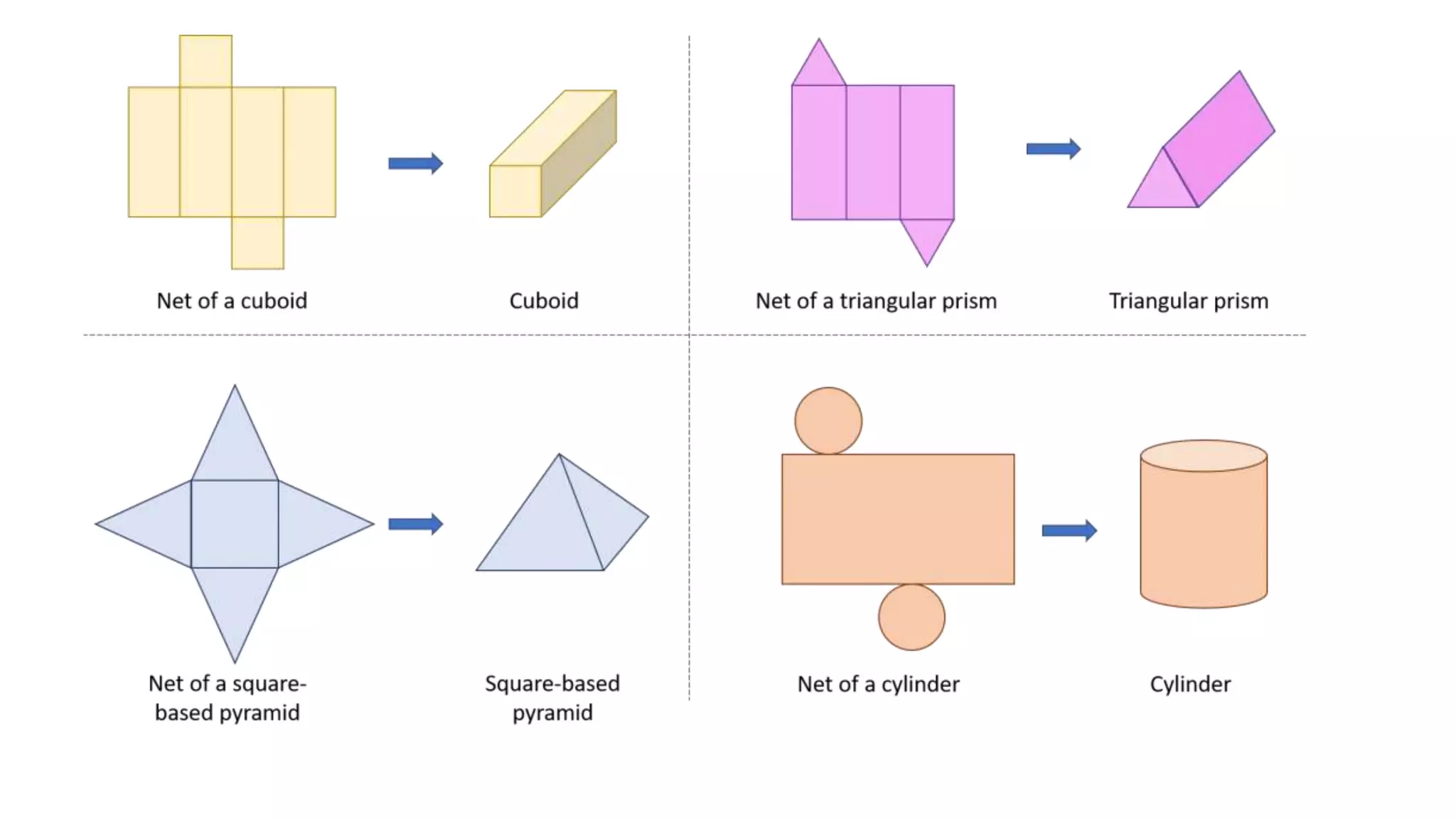
Question 1: Which of the following nets can be used to form a cube?
A and C will form a cube.
The faces on B will overlap when folded over and D has
too many faces.
So, A and C are the only nets that can form a cube.
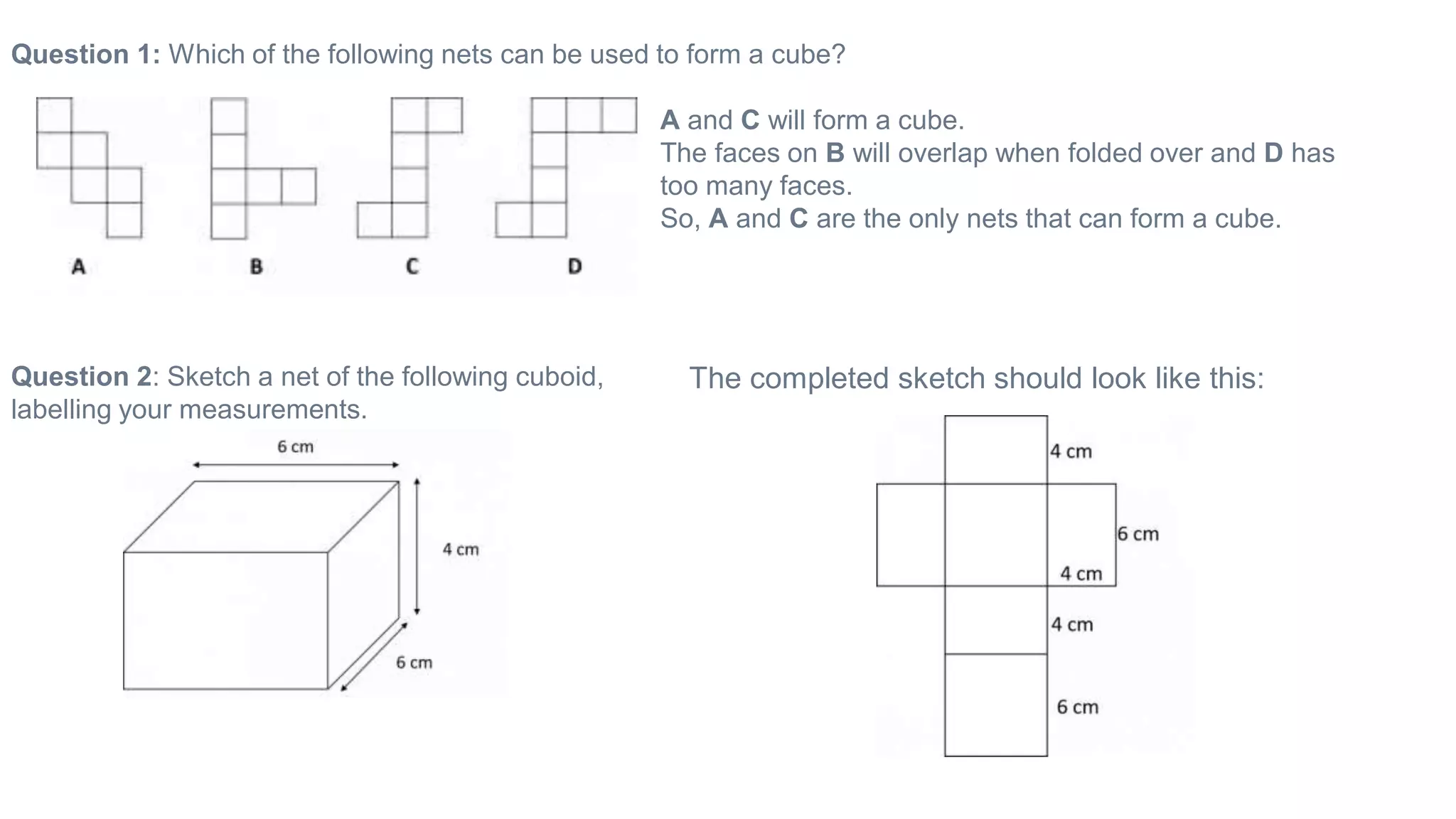
Question 2: Sketch a net of the following cuboid,
labelling your measurements.
The completed sketch should look like this:
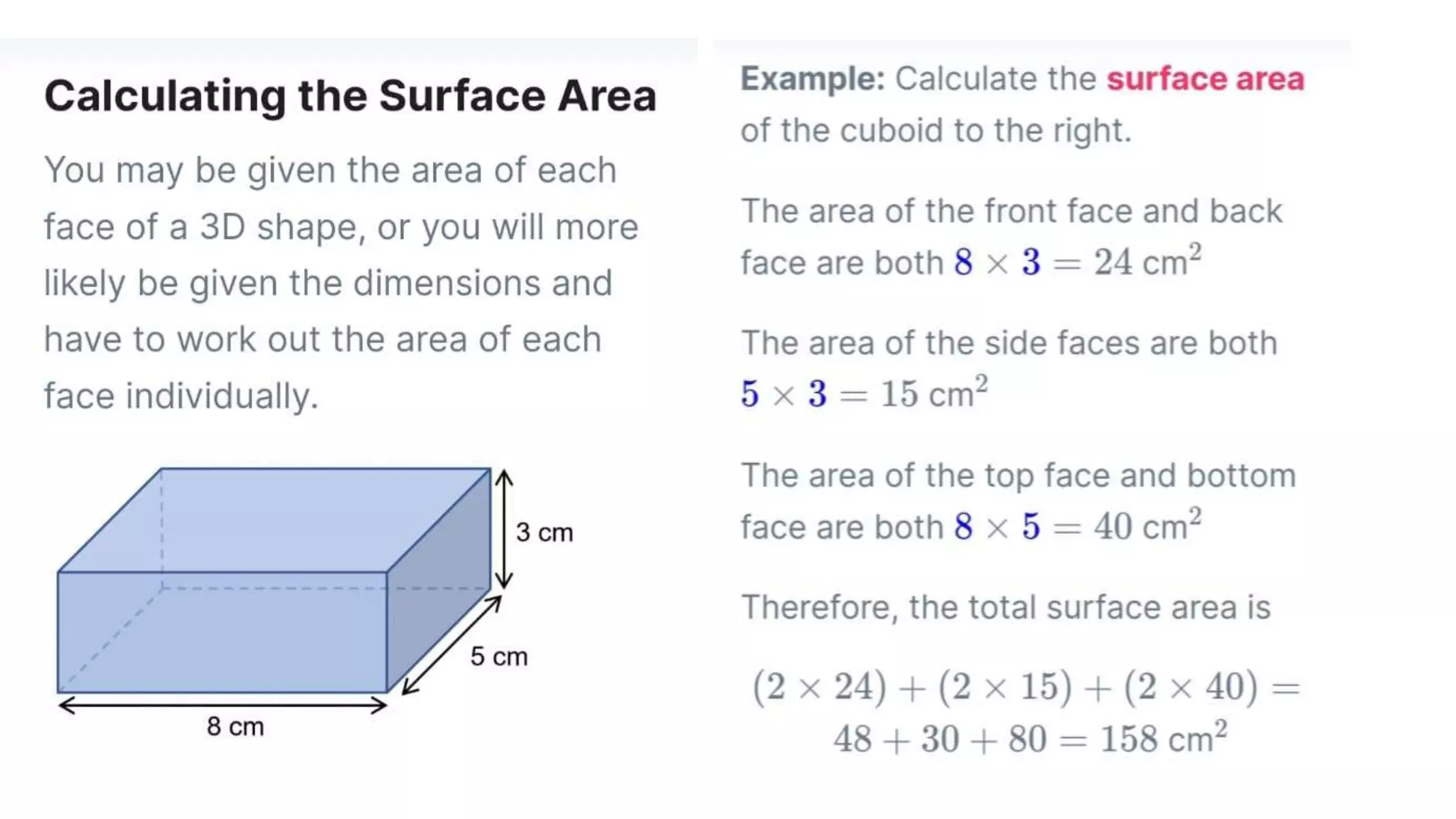
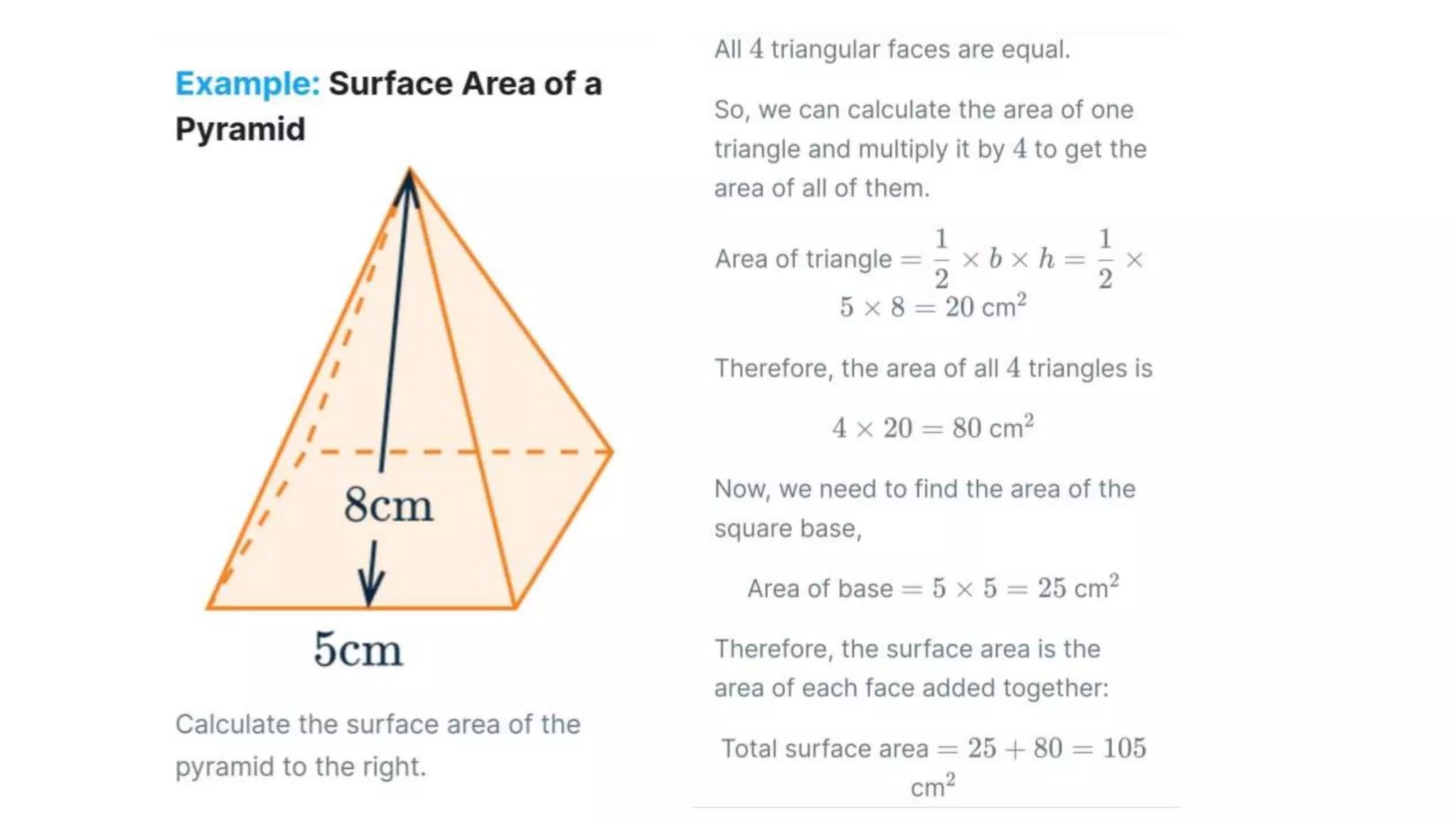
Surface Area
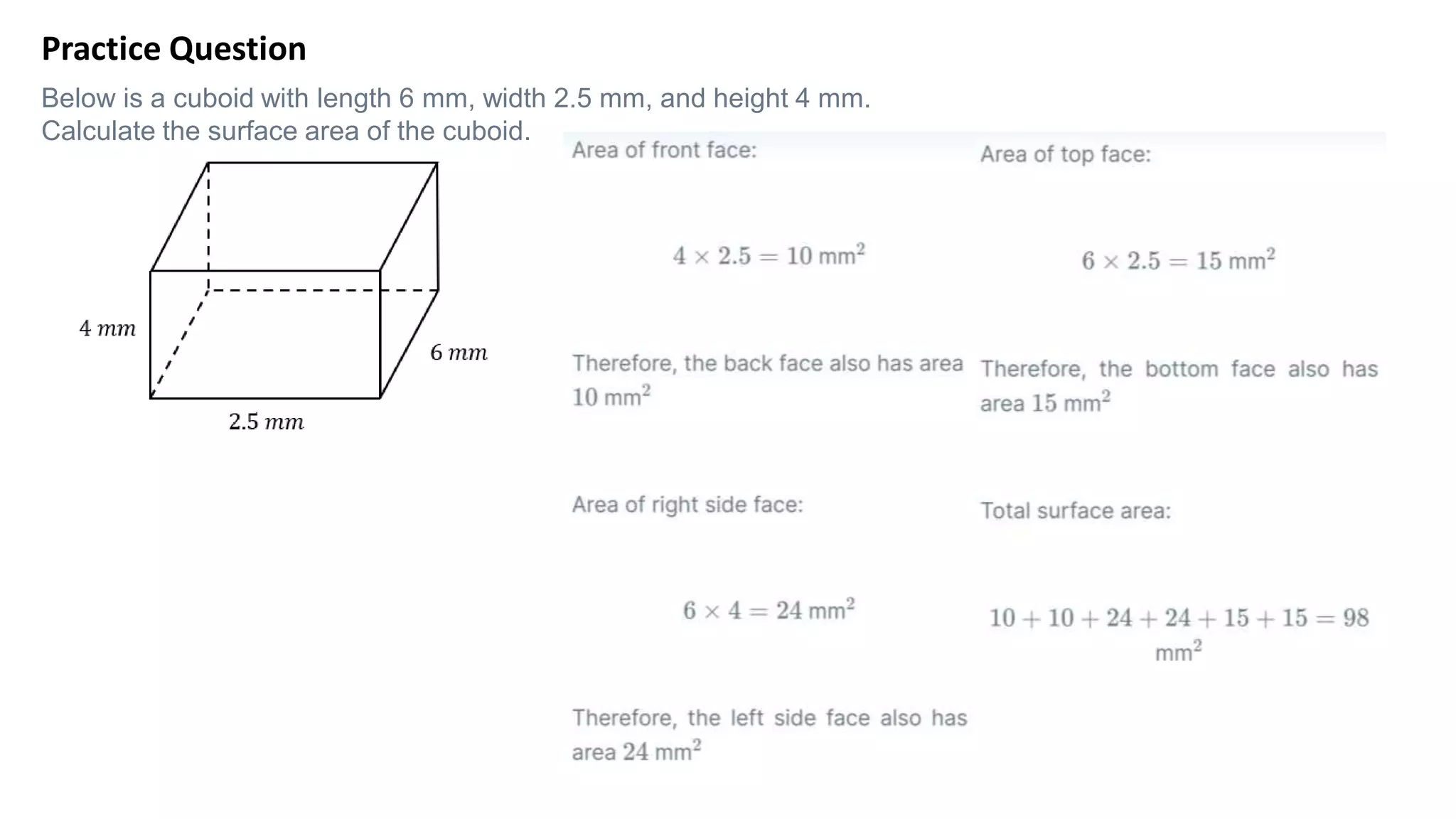
Practice Question
Below is a cuboid with length 6 mm, width 2.5 mm, and height 4 mm.
Calculate the surface area of the cuboid.
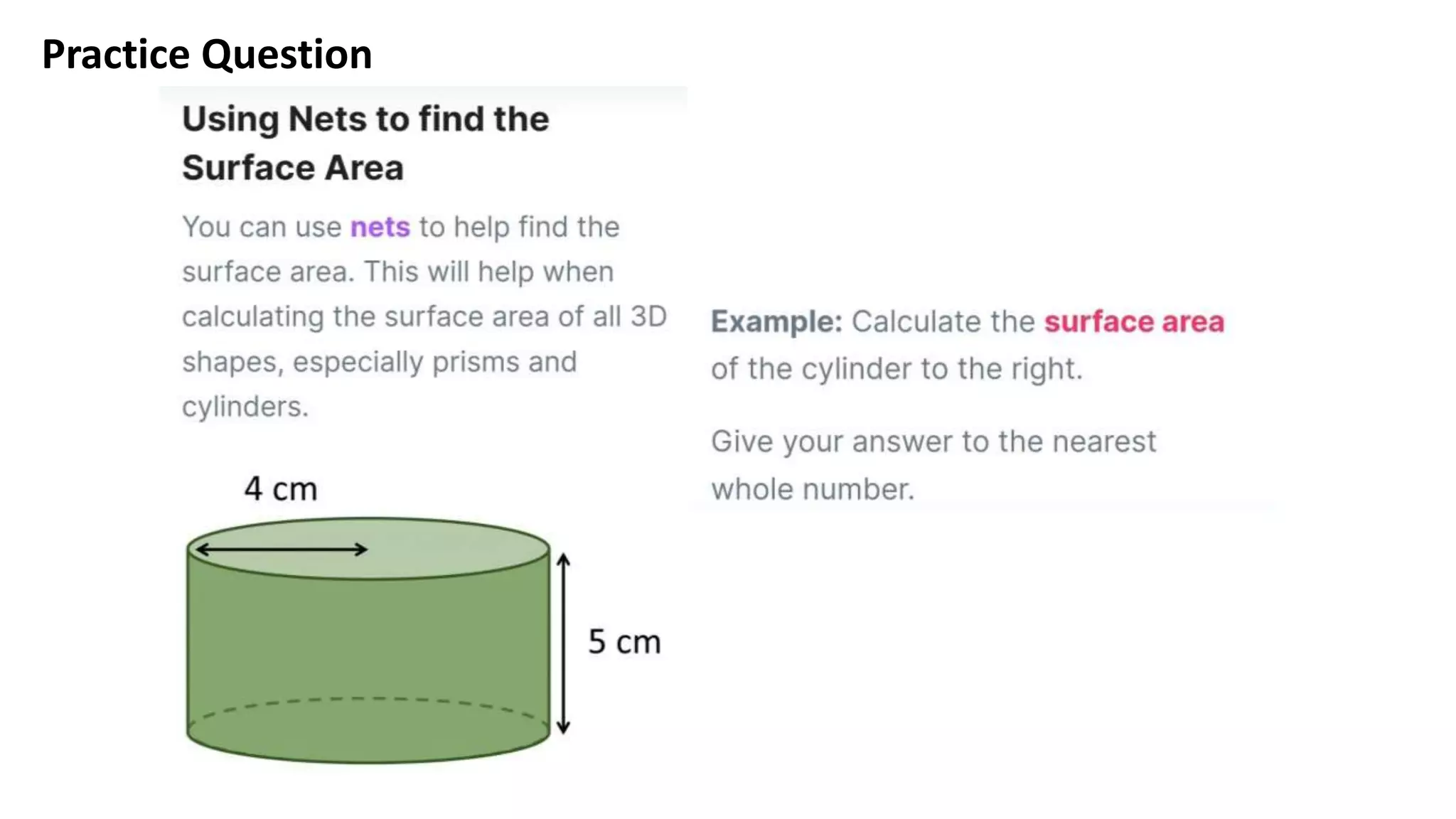
Practice Question
Volume
QUESTION:
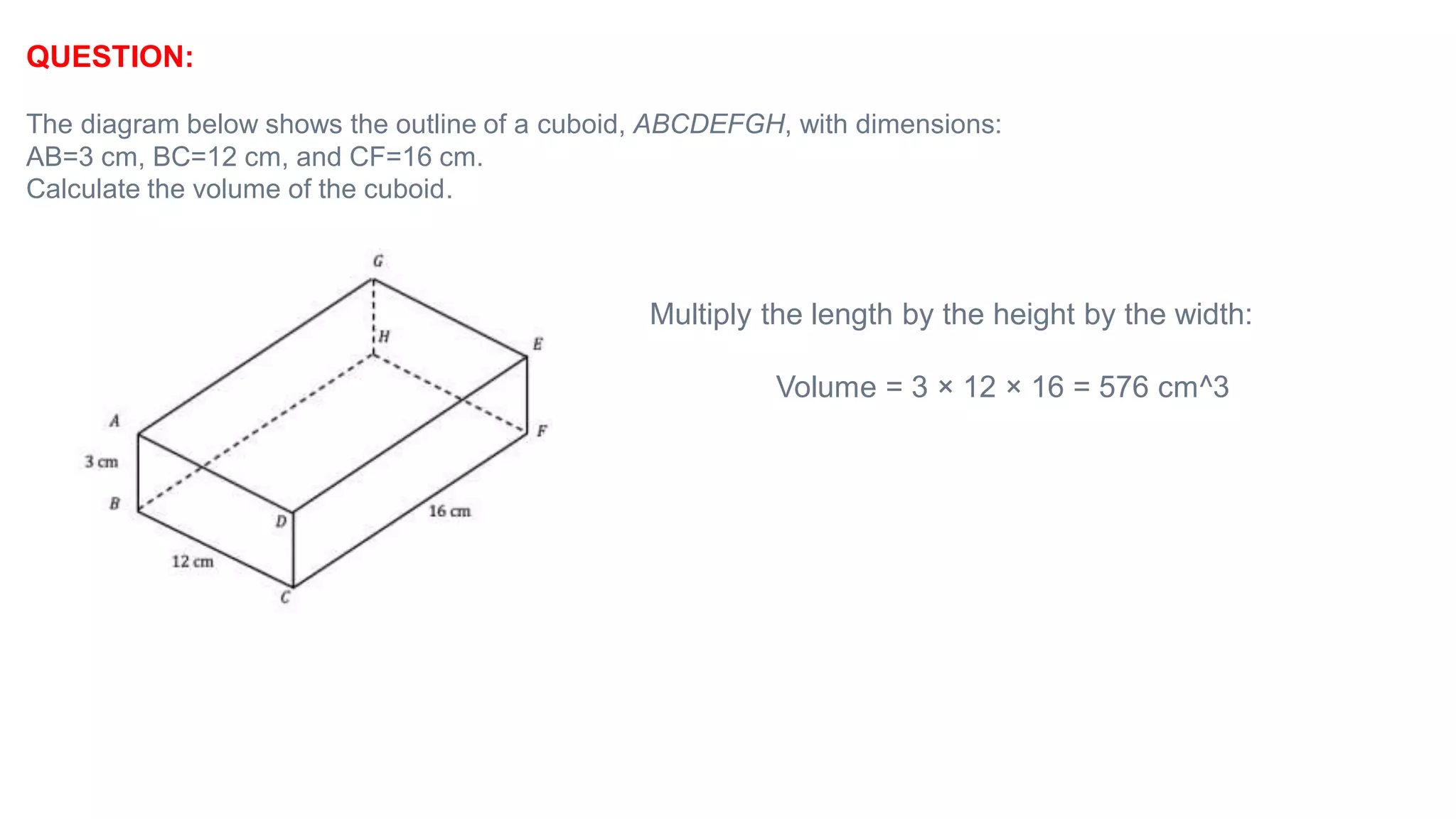
The diagram below shows the outline of a cuboid, ABCDEFGH, with dimensions:
AB=3 cm, BC=12 cm, and CF=16 cm.
Calculate the volume of the cuboid.
Multiply the length by the height by the width:
Volume = 3 × 12 × 16 = 576 cm^3

FS Maths Level 2 - April 22, 2023 (Nets, 3D shapes surface area and volume 1).

  • 1.
    Topics for today’sclass: 3D shapes Surface Area Volume Nets
  • 2.
    Dimensions 2D shapes have2 dimensions – e.g. length and width. 3D shapes have 3 dimensions – e.g. length, width and height. e.g. The container below is 12 m long, 5 m wide and 3 m high. The dimensions of this container are 12 m by 5 m by 3 m, which can also be written as 12 m x 5 m x 3 m 3D Shapes 2D shapes are flat objects. 3D shapes are solid objects. The surfaces of 3D shapes are called faces.
  • 4.
  • 5.
    Example: Working withDimensions Leonardo is designing a box to hold 5 DVD cases. Each DVD case is 14 cm long, 1.4 cm wide and 19 cm high. Sketch a box that could hold the DVD cases. Give the dimensions. Each DVD is 1.4 cm wide. It would make sense to put them side by side in a row, such as: Each DVD case is 1.4 cm wide, therefore 5 DVD cases will be: 1.4 × 5 = 7 cm wide Therefore, the box needs to be at least 7 cm wide. The DVD cases are 14 cm long and 19 cm high, so the box needs to be at least 14 cm long and 19 cm high. Therefore, you could sketch a box (making sure to label the dimensions), such as:
  • 6.
    QUESTION: Jamie is packing6 identical books into a box. He lays them down and stacks them. Each book is 25 cm long, 35 cm high and 8 cm wide. What is the minimum height the box needs to be? If the books are stacked on top of each other laid down, with 8 cm now being the height of the book laid down, then the minimum height of the box must be 6×8=48 cm
  • 7.
    Nets A net isa 3D shape that has been unfolded. You need to be able to recognize and draw nets.
  • 8.
    Understanding Nets A netshows each face of a shape laid out flat. 3D shapes often have several different nets. Below are some examples of nets of a cube Each net can be folded up to construct a cube
  • 9.
    Nets of OtherShapes There are some other common nets of 3D shapes that you should be familiar with. A prism is a shape with two identical 2D shapes that are joined by rectangular faces. The net of a prism will feature the 2D shape at both ends with rectangles between them. A cuboid is also a type of prism, so the net of a cuboid follows the same pattern. A pyramid will feature a 2D shape as its base, e.g. a triangle or a square, with each edge linked to a triangular face. These triangular faces all meet at a central point above the centre of the base. The net of a pyramid consists of the base, with triangles connected to each edge of the base. A cylinder is similar to a prism, in that it has two identical faces at each end. The curved section that connects the two circles forms a rectangle when it is stretched out.
  • 11.
    Question 1: Whichof the following nets can be used to form a cube? A and C will form a cube. The faces on B will overlap when folded over and D has too many faces. So, A and C are the only nets that can form a cube. Question 2: Sketch a net of the following cuboid, labelling your measurements. The completed sketch should look like this:
  • 12.
  • 15.
    Practice Question Below isa cuboid with length 6 mm, width 2.5 mm, and height 4 mm. Calculate the surface area of the cuboid.
  • 16.
  • 18.
  • 20.
    QUESTION: The diagram belowshows the outline of a cuboid, ABCDEFGH, with dimensions: AB=3 cm, BC=12 cm, and CF=16 cm. Calculate the volume of the cuboid. Multiply the length by the height by the width: Volume = 3 × 12 × 16 = 576 cm^3