Circle
  Prepared by:

 Joshua Cabarle
Maureen Villamora
 Geraldine Reyes
 Bea Nelene Que
PARTS AND
HISTORY OF A
   CIRCLE
Prepared by : Geraldine D.
     Reyes BSEd I-C
History
EUCLID (Circa 300 BC)
• Euclid was born in Alexandria, Greece. He
  founded the first school of Mathematics in
  Alexandria. He has been called the “Father of
  High School Geometry”. Euclid wrote the book
  titled “The Elements” which consists of plane and
  solid Geometry. He defined a point as ” that
  which has no parts,” ”a line has length without
  breadth”. In modern Geometry, these terms are
  left as undefined because it is impossible to state
  precise definitions for all these terms.
Also, some of Euclid’s Theorems are now taken
  as postulates because the proofs that he had
  offered had Logical shortcomings.
  Nevertheless, most of the theorems and much
  of the development contained in a typical
  High School Geometry subject today are taken
  from Euclid’s Elements.
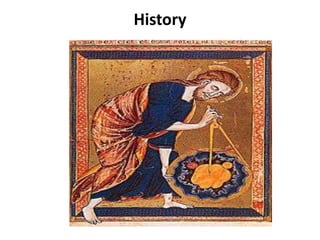
• The compass in this 13th century manuscript is a symbol of God's
  act of Creation. Notice also the circular shape of the halo
• The etymology of the word circle is from the Greek, kirkos "a
  circle," from the base ker- which means to turn or bend. The
  origin of the word "circus" is closely related as well.
• The circle has been known since before the beginning of recorded
  history. Natural circles would have been observed, such as the
  Moon, Sun, and a short plant stalk blowing in the wind on
  sand, which forms a circle shape in the sand. The circle is the basis
  for the wheel, which, with related inventions such as gears, makes
  much of modern civilization possible. In mathematics, the study of
  the circle has helped inspire the development of
  geometry, astronomy, and calculus.
• Early science, particularly geometry and astrology and
  astronomy, was connected to the divine for most medieval
  scholars, and many believed that there was something intrinsically
  "divine" or "perfect" that could be found in circles.[citation needed]
• Some highlights in the history of the circle are:
• 1700 BC – The Rhind papyrus gives a method to find
  the area of a circular field. The result corresponds to
  256/81 (3.16049...) as an approximate value of π.
• 300 BC – Book 3 of Euclid's Elements deals with the
  properties of circles.
• In Plato's Seventh Letter there is a detailed definition
  and explanation of the circle. Plato explains the
  perfect circle, and how it is different from any
  drawing, words, definition or explanation.
• 1880 – Lindemann proves that π is
  transcendental, effectively settling the millennia-old
  problem of squaring the circle.
Analytic results
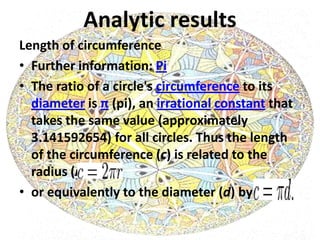
Length of circumference
• Further information: Pi
• The ratio of a circle's circumference to its
  diameter is π (pi), an irrational constant that
  takes the same value (approximately
  3.141592654) for all circles. Thus the length
  of the circumference (c) is related to the
  radius (r) by
• or equivalently to the diameter (d) by
Circle
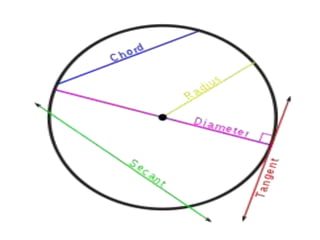
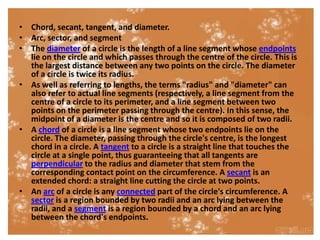
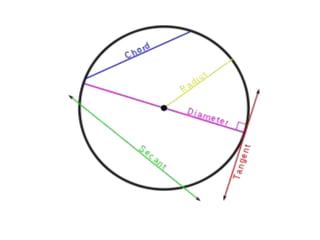
• Chord, secant, tangent, and diameter.
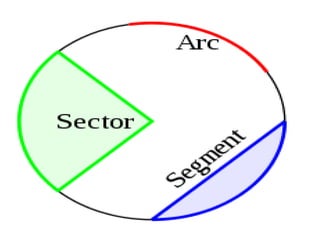
• Arc, sector, and segment
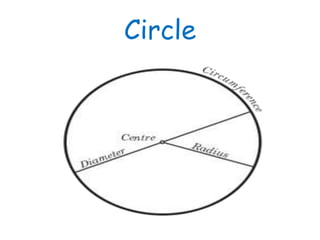
• The diameter of a circle is the length of a line segment whose endpoints
  lie on the circle and which passes through the centre of the circle. This is
  the largest distance between any two points on the circle. The diameter
  of a circle is twice its radius.
• As well as referring to lengths, the terms "radius" and "diameter" can
  also refer to actual line segments (respectively, a line segment from the
  centre of a circle to its perimeter, and a line segment between two
  points on the perimeter passing through the centre). In this sense, the
  midpoint of a diameter is the centre and so it is composed of two radii.
• A chord of a circle is a line segment whose two endpoints lie on the
  circle. The diameter, passing through the circle's centre, is the longest
  chord in a circle. A tangent to a circle is a straight line that touches the
  circle at a single point, thus guaranteeing that all tangents are
  perpendicular to the radius and diameter that stem from the
  corresponding contact point on the circumference. A secant is an
  extended chord: a straight line cutting the circle at two points.
• An arc of a circle is any connected part of the circle's circumference. A
  sector is a region bounded by two radii and an arc lying between the
  radii, and a segment is a region bounded by a chord and an arc lying
  between the chord's endpoints.
• A circle is a simple shape of Euclidean geometry consisting
  of those points in a plane which are equidistant from a
  given point called the centre (British English) or center
  (American English). The common distance of the points of a
  circle from its centre is called its radius.
• Circles are simple closed curves which divide the plane into
  two regions, an interior and an exterior. In everyday
  use, the term "circle" may be used interchangeably to refer
  to either the boundary of the figure (also known as the
  perimeter) or to the whole figure including its interior.
  However, in strict technical usage, "circle" refers to the
  perimeter while the interior of the circle is called a disk.
  The perimeter of a circle is also known as the
  circumference, especially when referring to its length.
• A circle is a special ellipse in which the two foci are
  coincident. Circles are conic sections attained when a right
  circular cone is intersected with a plane perpendicular to
  the axis of the cone.
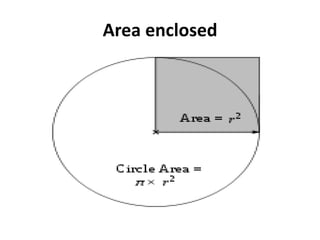
Area enclosed
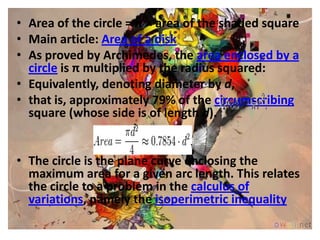
• Area of the circle = π × area of the shaded square
• Main article: Area of a disk
• As proved by Archimedes, the area enclosed by a
  circle is π multiplied by the radius squared:
• Equivalently, denoting diameter by d,
• that is, approximately 79% of the circumscribing
  square (whose side is of length d).


• The circle is the plane curve enclosing the
  maximum area for a given arc length. This relates
  the circle to a problem in the calculus of
  variations, namely the isoperimetric inequality
Calculating the area of a circle

A. By approximation
• We can demonstrate that the polygons shown
  below in figure 1 have areas given by the
  following formulas:
  the square has an area equal to 2r2;
  the hexagon has an area equal to approximately
  2.6r2;
  the octagon has an area equal to approximately
  2.8r2;
  the dodecagon has an area equal to 3r2.
B. Using the exact formula
• Area A of a circle with radius r is equal to r2.
  Remember that the value of is approximately
  3.14.
• So, A = × r2 = × r × r.
• To apply this formula, A and r must be
  expressed in corresponding units; for
  example if r is in cm, then A is in cm2.
II. Examples
• A. First example
• Calculating the area A of a circle with a radius of
   10 cm.
• × 10 cm × 10 cm = 100 cm² 314 cm², therefore
   A = 314 cm².
• B. Second example
• Calculating the area A of a circle with a diameter
   of 25 m.
• The radius equals 12.5 m (half of 25 m).
• × 12.5 m × 12.5 m = 156.25 m2 491
   m2, therefore A = 491 m2.
CIRCLE
Bea Nelene A. Que
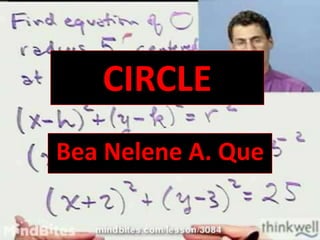
Center-radius form
• A circle is the set S of all points in R2 that are
  at a fixed distance r from a fixed point C.
• A circle is a locus(set) of points in a plain
  equidistant from a fixed point.
• The fixed point C is called the center of the circle
  and the fixed distance r is called the radius. Note
  that r is the undirected distance from the center
  C to any point P on the circle. Hence, the value of
  r is a nonnegative real number or r>0. it thus
  becomes clear that a circle with center C and
  radius r is the graph of the relation.
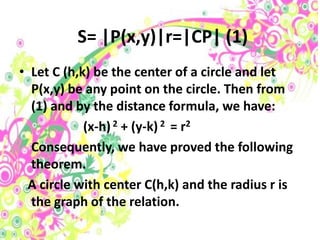
S= |P(x,y)|r=|CP| (1)
• Let C (h,k) be the center of a circle and let
  P(x,y) be any point on the circle. Then from
  (1) and by the distance formula, we have:
            (x-h) 2 + (y-k) 2 = r2
  Consequently, we have proved the following
  theorem.
  A circle with center C(h,k) and the radius r is
  the graph of the relation.
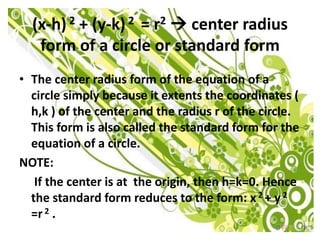
(x-h) 2 + (y-k) 2 = r2  center radius
   form of a circle or standard form
• The center radius form of the equation of a
  circle simply because it extents the coordinates (
  h,k ) of the center and the radius r of the circle.
  This form is also called the standard form for the
  equation of a circle.
NOTE:
   If the center is at the origin, then h=k=0. Hence
  the standard form reduces to the form: x 2 + y 2
  =r 2 .
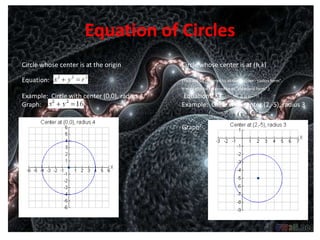
Equation of Circles
Circle whose center is at the origin          Circle whose center is at (h,k)

Equation:                                     (This will be referred to as the "center- radius form".
                                              It may also be referred to as "standard form".)
Example: Circle with center (0,0), radius 4    Equation:
Graph:                                        Example: Circle with center (2,-5), radius 3


                                              Graph:
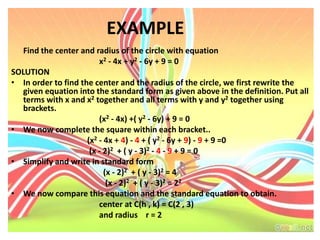
EXAMPLE
  Find the center and radius of the circle with equation
                         x2 - 4x + y2 - 6y + 9 = 0
SOLUTION
• In order to find the center and the radius of the circle, we first rewrite the
  given equation into the standard form as given above in the definition. Put all
  terms with x and x2 together and all terms with y and y2 together using
  brackets.
                         (x2 - 4x) +( y2 - 6y) + 9 = 0
• We now complete the square within each bracket..
                     (x2 - 4x + 4) - 4 + ( y2 - 6y + 9) - 9 + 9 =0
                      (x - 2)2 + ( y - 3)2 - 4 - 9 + 9 = 0
• Simplify and write in standard form
                           (x - 2)2 + ( y - 3)2 = 4
                            (x - 2)2 + ( y - 3)2 = 22
• We now compare this equation and the standard equation to obtain.
                         center at C(h , k) = C(2 , 3)
                         and radius r = 2
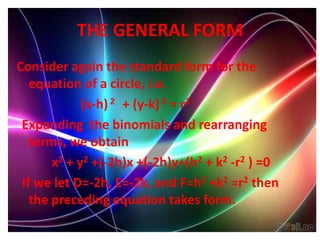
THE GENERAL FORM
Consider again the standard form for the
   equation of a circle, i.e.
             (x-h) 2 + (y-k) 2 = r2
 Expanding the binomials and rearranging
   terms, we obtain
       x2 + y2 +(-2h)x +(-2h)y+(h2 + k2 -r2 ) =0
 If we let D=-2h, E=-2k, and F=h2 +k2 =r2 then
   the preceding equation takes form.
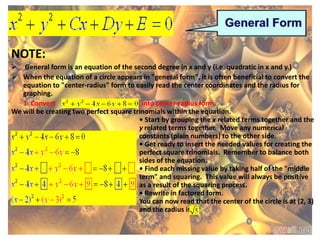
NOTE:
 General form is an equation of the second degree in x and y (i.e. quadratic in x and y.)
 When the equation of a circle appears in "general form", it is often beneficial to convert the
   equation to "center-radius" form to easily read the center coordinates and the radius for
   graphing.
   1. Convert                             into center-radius form.
We will be creating two perfect square trinomials within the equation.
                                         • Start by grouping the x related terms together and the
                                         y related terms together. Move any numerical
                                         constants (plain numbers) to the other side.
                                         • Get ready to insert the needed values for creating the
                                         perfect square trinomials. Remember to balance both
                                         sides of the equation.
                                         • Find each missing value by taking half of the "middle
                                         term" and squaring. This value will always be positive
                                         as a result of the squaring process.
                                         • Rewrite in factored form.
                                         You can now read that the center of the circle is at (2, 3)
                                         and the radius is
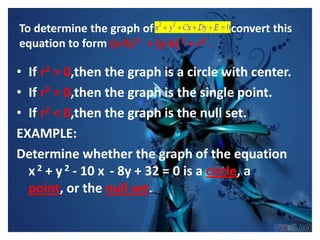
To determine the graph of                   convert this
equation to form (x-h) 2 + (y-k) 2 = r2 .

• If r2 > 0,then the graph is a circle with center.
• If r2 = 0,then the graph is the single point.
• If r2 < 0,then the graph is the null set.
EXAMPLE:
Determine whether the graph of the equation
  x 2 + y 2 - 10 x - 8y + 32 = 0 is a circle, a
  point, or the null set.
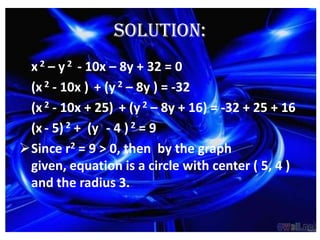
SOLUTION:
 x 2 – y 2 - 10x – 8y + 32 = 0
 (x 2 - 10x ) + (y 2 – 8y ) = -32
 (x 2 - 10x + 25) + (y 2 – 8y + 16) = -32 + 25 + 16
 (x - 5) 2 + (y - 4 ) 2 = 9
Since r2 = 9 > 0, then by the graph
 given, equation is a circle with center ( 5, 4 )
 and the radius 3.
Tangent to a
    circle
Maureen D. Villamora
     BSED IC
Tangent to a circle
Definition:
The word “tangent” comes from Latin
  tangere, meaning to touch.
• Touching a curve at a single point or along
  one line.
• In geometry, tangent circles ( also known as
  kissing circles) are circles that intersect in a
  single point. There are two types of tangency:
  internal or external.
• In geometry, the tangent line (or simply the
  tangent)to a curve at a given point is the
  straight line that “just touches” the curve at
  that point. As it passes through the point
  where the tangent line and the curve
  meet, or the point of tangency, the tangent
  line is “going in the same direction” as the
  curve, and id the sense it is the best straight-
  line approximation to the curve at that point
• A line, a segment, or a ray that intersects a circle at
  exactly one point.
• The line perpendicular drawn to a radius through the
  end point of the radius is a tangent to the circle.
• A line drawn perpendicular to a tangent through the
  point of contact with a circle passes through the
  centre of the circle.


POINT OF TANGENCY:
      The point of intersection of a circle and a tangent
  to the circle.
CIRCLES IN THE COORDINATE
           PLANE
Reported by: Joshua H. Cabarle
          BSED I-C
THE EQUATION OF A CIRCLE

• The distance formula is used in developing an
  equation for the graph of a circle
• REMEMBER:
• Every circle whose center is at the origin has
  an equation of the form X 2 + Y 2=r2
• If the circle with equation X 2 + Y 2=r2 is
  translated in the coordinate plane by moving
  every point of the circle, h units horizontally
  and k units vertically, the circle with radius r
  and center ( h, k ) has the equation
  (x - h)2 + (y - k)2 = r2
  REMEMBER:
• The equation of a circle whose center is at (
  h, k ) and with radius r is (x - h)2 + (y - k)2 = r2
IDENTIFYING THE CENTER AND
      RADIUS OF A CIRCLE
• There are times when the equation of the circle
  is given in the form
• x 2 + y 2=r2 + ax + by + c = 0
• This is the general equation of the circle. It can
  also transformed into the standard form
  (x - h)2 + (y - k)2 = r2
  by completing squares. This form also gives us
  information about the graph of the circle, the
  location of its center, and the length of its
  radius.
WRITING THE EQUATION OF A
            CIRCLE
If the center and the radius of the circle can be
  identified using the equation
  (x - h)2 + (y - k)2 = r2
  , the equation of the circle can be determined
  if its center and the radius are given.
USING THE EQUATION OF A
             CIRCLE


A line may intersect a circle at two points, at one
  point or at no point at all.
Circle

Circle

  • 1.
    Circle Preparedby: Joshua Cabarle Maureen Villamora Geraldine Reyes Bea Nelene Que
  • 2.
    PARTS AND HISTORY OFA CIRCLE Prepared by : Geraldine D. Reyes BSEd I-C
  • 3.
  • 4.
    EUCLID (Circa 300BC) • Euclid was born in Alexandria, Greece. He founded the first school of Mathematics in Alexandria. He has been called the “Father of High School Geometry”. Euclid wrote the book titled “The Elements” which consists of plane and solid Geometry. He defined a point as ” that which has no parts,” ”a line has length without breadth”. In modern Geometry, these terms are left as undefined because it is impossible to state precise definitions for all these terms.
  • 5.
    Also, some ofEuclid’s Theorems are now taken as postulates because the proofs that he had offered had Logical shortcomings. Nevertheless, most of the theorems and much of the development contained in a typical High School Geometry subject today are taken from Euclid’s Elements.
  • 6.
    • The compassin this 13th century manuscript is a symbol of God's act of Creation. Notice also the circular shape of the halo • The etymology of the word circle is from the Greek, kirkos "a circle," from the base ker- which means to turn or bend. The origin of the word "circus" is closely related as well. • The circle has been known since before the beginning of recorded history. Natural circles would have been observed, such as the Moon, Sun, and a short plant stalk blowing in the wind on sand, which forms a circle shape in the sand. The circle is the basis for the wheel, which, with related inventions such as gears, makes much of modern civilization possible. In mathematics, the study of the circle has helped inspire the development of geometry, astronomy, and calculus. • Early science, particularly geometry and astrology and astronomy, was connected to the divine for most medieval scholars, and many believed that there was something intrinsically "divine" or "perfect" that could be found in circles.[citation needed]
  • 7.
    • Some highlightsin the history of the circle are: • 1700 BC – The Rhind papyrus gives a method to find the area of a circular field. The result corresponds to 256/81 (3.16049...) as an approximate value of π. • 300 BC – Book 3 of Euclid's Elements deals with the properties of circles. • In Plato's Seventh Letter there is a detailed definition and explanation of the circle. Plato explains the perfect circle, and how it is different from any drawing, words, definition or explanation. • 1880 – Lindemann proves that π is transcendental, effectively settling the millennia-old problem of squaring the circle.
  • 8.
    Analytic results Length ofcircumference • Further information: Pi • The ratio of a circle's circumference to its diameter is π (pi), an irrational constant that takes the same value (approximately 3.141592654) for all circles. Thus the length of the circumference (c) is related to the radius (r) by • or equivalently to the diameter (d) by
  • 9.
  • 12.
    • Chord, secant,tangent, and diameter. • Arc, sector, and segment • The diameter of a circle is the length of a line segment whose endpoints lie on the circle and which passes through the centre of the circle. This is the largest distance between any two points on the circle. The diameter of a circle is twice its radius. • As well as referring to lengths, the terms "radius" and "diameter" can also refer to actual line segments (respectively, a line segment from the centre of a circle to its perimeter, and a line segment between two points on the perimeter passing through the centre). In this sense, the midpoint of a diameter is the centre and so it is composed of two radii. • A chord of a circle is a line segment whose two endpoints lie on the circle. The diameter, passing through the circle's centre, is the longest chord in a circle. A tangent to a circle is a straight line that touches the circle at a single point, thus guaranteeing that all tangents are perpendicular to the radius and diameter that stem from the corresponding contact point on the circumference. A secant is an extended chord: a straight line cutting the circle at two points. • An arc of a circle is any connected part of the circle's circumference. A sector is a region bounded by two radii and an arc lying between the radii, and a segment is a region bounded by a chord and an arc lying between the chord's endpoints.
  • 13.
    • A circleis a simple shape of Euclidean geometry consisting of those points in a plane which are equidistant from a given point called the centre (British English) or center (American English). The common distance of the points of a circle from its centre is called its radius. • Circles are simple closed curves which divide the plane into two regions, an interior and an exterior. In everyday use, the term "circle" may be used interchangeably to refer to either the boundary of the figure (also known as the perimeter) or to the whole figure including its interior. However, in strict technical usage, "circle" refers to the perimeter while the interior of the circle is called a disk. The perimeter of a circle is also known as the circumference, especially when referring to its length. • A circle is a special ellipse in which the two foci are coincident. Circles are conic sections attained when a right circular cone is intersected with a plane perpendicular to the axis of the cone.
  • 14.
  • 15.
    • Area ofthe circle = π × area of the shaded square • Main article: Area of a disk • As proved by Archimedes, the area enclosed by a circle is π multiplied by the radius squared: • Equivalently, denoting diameter by d, • that is, approximately 79% of the circumscribing square (whose side is of length d). • The circle is the plane curve enclosing the maximum area for a given arc length. This relates the circle to a problem in the calculus of variations, namely the isoperimetric inequality
  • 16.
    Calculating the areaof a circle A. By approximation • We can demonstrate that the polygons shown below in figure 1 have areas given by the following formulas: the square has an area equal to 2r2; the hexagon has an area equal to approximately 2.6r2; the octagon has an area equal to approximately 2.8r2; the dodecagon has an area equal to 3r2.
  • 17.
    B. Using theexact formula • Area A of a circle with radius r is equal to r2. Remember that the value of is approximately 3.14. • So, A = × r2 = × r × r. • To apply this formula, A and r must be expressed in corresponding units; for example if r is in cm, then A is in cm2.
  • 18.
    II. Examples • A.First example • Calculating the area A of a circle with a radius of 10 cm. • × 10 cm × 10 cm = 100 cm² 314 cm², therefore A = 314 cm². • B. Second example • Calculating the area A of a circle with a diameter of 25 m. • The radius equals 12.5 m (half of 25 m). • × 12.5 m × 12.5 m = 156.25 m2 491 m2, therefore A = 491 m2.
  • 19.
  • 20.
    Center-radius form • Acircle is the set S of all points in R2 that are at a fixed distance r from a fixed point C. • A circle is a locus(set) of points in a plain equidistant from a fixed point. • The fixed point C is called the center of the circle and the fixed distance r is called the radius. Note that r is the undirected distance from the center C to any point P on the circle. Hence, the value of r is a nonnegative real number or r>0. it thus becomes clear that a circle with center C and radius r is the graph of the relation.
  • 21.
    S= |P(x,y)|r=|CP| (1) •Let C (h,k) be the center of a circle and let P(x,y) be any point on the circle. Then from (1) and by the distance formula, we have: (x-h) 2 + (y-k) 2 = r2 Consequently, we have proved the following theorem. A circle with center C(h,k) and the radius r is the graph of the relation.
  • 22.
    (x-h) 2 +(y-k) 2 = r2  center radius form of a circle or standard form • The center radius form of the equation of a circle simply because it extents the coordinates ( h,k ) of the center and the radius r of the circle. This form is also called the standard form for the equation of a circle. NOTE: If the center is at the origin, then h=k=0. Hence the standard form reduces to the form: x 2 + y 2 =r 2 .
  • 23.
    Equation of Circles Circlewhose center is at the origin Circle whose center is at (h,k) Equation: (This will be referred to as the "center- radius form". It may also be referred to as "standard form".) Example: Circle with center (0,0), radius 4 Equation: Graph: Example: Circle with center (2,-5), radius 3 Graph:
  • 24.
    EXAMPLE Findthe center and radius of the circle with equation x2 - 4x + y2 - 6y + 9 = 0 SOLUTION • In order to find the center and the radius of the circle, we first rewrite the given equation into the standard form as given above in the definition. Put all terms with x and x2 together and all terms with y and y2 together using brackets. (x2 - 4x) +( y2 - 6y) + 9 = 0 • We now complete the square within each bracket.. (x2 - 4x + 4) - 4 + ( y2 - 6y + 9) - 9 + 9 =0 (x - 2)2 + ( y - 3)2 - 4 - 9 + 9 = 0 • Simplify and write in standard form (x - 2)2 + ( y - 3)2 = 4 (x - 2)2 + ( y - 3)2 = 22 • We now compare this equation and the standard equation to obtain. center at C(h , k) = C(2 , 3) and radius r = 2
  • 25.
    THE GENERAL FORM Consideragain the standard form for the equation of a circle, i.e. (x-h) 2 + (y-k) 2 = r2 Expanding the binomials and rearranging terms, we obtain x2 + y2 +(-2h)x +(-2h)y+(h2 + k2 -r2 ) =0 If we let D=-2h, E=-2k, and F=h2 +k2 =r2 then the preceding equation takes form.
  • 26.
    NOTE:  General formis an equation of the second degree in x and y (i.e. quadratic in x and y.)  When the equation of a circle appears in "general form", it is often beneficial to convert the equation to "center-radius" form to easily read the center coordinates and the radius for graphing. 1. Convert into center-radius form. We will be creating two perfect square trinomials within the equation. • Start by grouping the x related terms together and the y related terms together. Move any numerical constants (plain numbers) to the other side. • Get ready to insert the needed values for creating the perfect square trinomials. Remember to balance both sides of the equation. • Find each missing value by taking half of the "middle term" and squaring. This value will always be positive as a result of the squaring process. • Rewrite in factored form. You can now read that the center of the circle is at (2, 3) and the radius is
  • 27.
    To determine thegraph of convert this equation to form (x-h) 2 + (y-k) 2 = r2 . • If r2 > 0,then the graph is a circle with center. • If r2 = 0,then the graph is the single point. • If r2 < 0,then the graph is the null set. EXAMPLE: Determine whether the graph of the equation x 2 + y 2 - 10 x - 8y + 32 = 0 is a circle, a point, or the null set.
  • 28.
    SOLUTION: x 2– y 2 - 10x – 8y + 32 = 0 (x 2 - 10x ) + (y 2 – 8y ) = -32 (x 2 - 10x + 25) + (y 2 – 8y + 16) = -32 + 25 + 16 (x - 5) 2 + (y - 4 ) 2 = 9 Since r2 = 9 > 0, then by the graph given, equation is a circle with center ( 5, 4 ) and the radius 3.
  • 29.
    Tangent to a circle Maureen D. Villamora BSED IC
  • 30.
    Tangent to acircle Definition: The word “tangent” comes from Latin tangere, meaning to touch. • Touching a curve at a single point or along one line. • In geometry, tangent circles ( also known as kissing circles) are circles that intersect in a single point. There are two types of tangency: internal or external.
  • 31.
    • In geometry,the tangent line (or simply the tangent)to a curve at a given point is the straight line that “just touches” the curve at that point. As it passes through the point where the tangent line and the curve meet, or the point of tangency, the tangent line is “going in the same direction” as the curve, and id the sense it is the best straight- line approximation to the curve at that point
  • 32.
    • A line,a segment, or a ray that intersects a circle at exactly one point. • The line perpendicular drawn to a radius through the end point of the radius is a tangent to the circle. • A line drawn perpendicular to a tangent through the point of contact with a circle passes through the centre of the circle. POINT OF TANGENCY: The point of intersection of a circle and a tangent to the circle.
  • 34.
    CIRCLES IN THECOORDINATE PLANE Reported by: Joshua H. Cabarle BSED I-C
  • 35.
    THE EQUATION OFA CIRCLE • The distance formula is used in developing an equation for the graph of a circle • REMEMBER: • Every circle whose center is at the origin has an equation of the form X 2 + Y 2=r2
  • 36.
    • If thecircle with equation X 2 + Y 2=r2 is translated in the coordinate plane by moving every point of the circle, h units horizontally and k units vertically, the circle with radius r and center ( h, k ) has the equation (x - h)2 + (y - k)2 = r2 REMEMBER: • The equation of a circle whose center is at ( h, k ) and with radius r is (x - h)2 + (y - k)2 = r2
  • 37.
    IDENTIFYING THE CENTERAND RADIUS OF A CIRCLE • There are times when the equation of the circle is given in the form • x 2 + y 2=r2 + ax + by + c = 0 • This is the general equation of the circle. It can also transformed into the standard form (x - h)2 + (y - k)2 = r2 by completing squares. This form also gives us information about the graph of the circle, the location of its center, and the length of its radius.
  • 38.
    WRITING THE EQUATIONOF A CIRCLE If the center and the radius of the circle can be identified using the equation (x - h)2 + (y - k)2 = r2 , the equation of the circle can be determined if its center and the radius are given.
  • 39.
    USING THE EQUATIONOF A CIRCLE A line may intersect a circle at two points, at one point or at no point at all.