ON


Visualising solid shapes
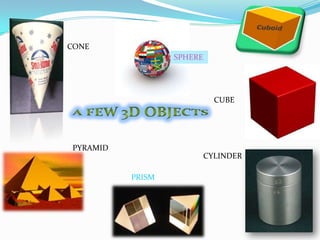
CONE
                  SPHERE


                             CUBE


PYRAMID
                           CYLINDER

          PRISM
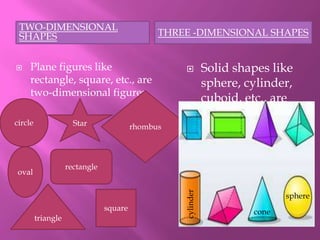
TWO-DIMENSIONAL
 SHAPES                                        THREE -DIMENSIONAL SHAPES


    Plane figures like                                      Solid shapes like
     rectangle, square, etc., are                             sphere, cylinder,
     two-dimensional figures.
                                                              cuboid, etc., are
                                                              three-dimensional
circle                Star               rhombus              figures.


                    rectangle
 oval

                                                   cylinder
                                                                             sphere
                                square                                cone
         triangle
Dimension - Dimension is a property of a shape, and tells us if
the shape has depth. A school playground is 3-D, but a drawing
you make on a flat piece of paper is 2-D.
Length - The edges of a shape have a certain length. The
length of the edges of a shape is what gives it a certain size,
and can be measured. The faces of both 2-D and 3-D shapes
have edges of certain length. You experience this property
when you measure the edge of something with a ruler.
Area - The amount of space the surface of one face takes up
is called the area. If you put a shape on a piece of graph
paper, the number of squares the face covers is the area. The
area of a shape can be measured in square centimeters (cm2)
and is a property of both 2-D and 3-D shapes. You have
experience with this property when you notice that your
friend got a bigger slice of pizza than you did.
Surface Area - If you add together all of the areas from the
faces of a 3-D shape, then the total is the surface area. It is
the total amount of space needed to cover the outer surface
of the shape. This is a property of 3-D shapes, and you might
have noticed it when you've tried to figure out how much
wrapping paper to use to wrap a present.
Volume - The amount of space that a 3-D shape takes up is
called volume. Volume can either be filled with a solid (like the
chocolate in a chocolate bar), a liquid (like the amount of milk
in a glass), or a gas (like the amount of air in an empty box).
Volume is a property of 3-D, but not 2-D, objects and can be
measured in cubic centimeters (cm3) or in milliliters (mL). In
fact, one cubic centimeter of water is also 1 milliliter of water!
You experience volume when you help make cookies and
measure out the ingredients with measuring cups
1. The circle, the square, the rectangle, the quadrilateral and
   the triangle are examples of plane figures; the cube, the
   cuboid, the sphere, the cylinder, the cone and the pyramid are
   examples of solid shapes.
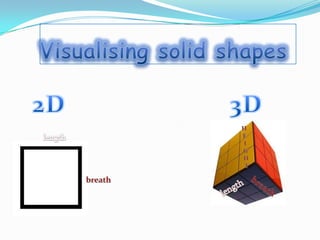
2. Plane figures are of two-dimensions (2-D) and the solid
   shapes are of three-dimensions (3-D).
3. The corners of a solid shape are called its vertices; the line
   segments of its skeleton are its edges; and its flat surfaces are
   its faces.
4. A net is a skeleton-outline of a solid that can be folded to
   make it. The same solid can have several types of nets.
5. Solid shapes can be drawn on a flat surface (like paper)
   realistically. We call this
2-D representation of a 3-D solid.
Visualising solid shapes

Visualising solid shapes

  • 1.
  • 4.
    CONE SPHERE CUBE PYRAMID CYLINDER PRISM
  • 5.
    TWO-DIMENSIONAL SHAPES THREE -DIMENSIONAL SHAPES  Plane figures like  Solid shapes like rectangle, square, etc., are sphere, cylinder, two-dimensional figures. cuboid, etc., are three-dimensional circle Star rhombus figures. rectangle oval cylinder sphere square cone triangle
  • 6.
    Dimension - Dimensionis a property of a shape, and tells us if the shape has depth. A school playground is 3-D, but a drawing you make on a flat piece of paper is 2-D. Length - The edges of a shape have a certain length. The length of the edges of a shape is what gives it a certain size, and can be measured. The faces of both 2-D and 3-D shapes have edges of certain length. You experience this property when you measure the edge of something with a ruler. Area - The amount of space the surface of one face takes up is called the area. If you put a shape on a piece of graph paper, the number of squares the face covers is the area. The area of a shape can be measured in square centimeters (cm2) and is a property of both 2-D and 3-D shapes. You have experience with this property when you notice that your friend got a bigger slice of pizza than you did.
  • 7.
    Surface Area -If you add together all of the areas from the faces of a 3-D shape, then the total is the surface area. It is the total amount of space needed to cover the outer surface of the shape. This is a property of 3-D shapes, and you might have noticed it when you've tried to figure out how much wrapping paper to use to wrap a present. Volume - The amount of space that a 3-D shape takes up is called volume. Volume can either be filled with a solid (like the chocolate in a chocolate bar), a liquid (like the amount of milk in a glass), or a gas (like the amount of air in an empty box). Volume is a property of 3-D, but not 2-D, objects and can be measured in cubic centimeters (cm3) or in milliliters (mL). In fact, one cubic centimeter of water is also 1 milliliter of water! You experience volume when you help make cookies and measure out the ingredients with measuring cups
  • 8.
    1. The circle,the square, the rectangle, the quadrilateral and the triangle are examples of plane figures; the cube, the cuboid, the sphere, the cylinder, the cone and the pyramid are examples of solid shapes. 2. Plane figures are of two-dimensions (2-D) and the solid shapes are of three-dimensions (3-D). 3. The corners of a solid shape are called its vertices; the line segments of its skeleton are its edges; and its flat surfaces are its faces. 4. A net is a skeleton-outline of a solid that can be folded to make it. The same solid can have several types of nets. 5. Solid shapes can be drawn on a flat surface (like paper) realistically. We call this 2-D representation of a 3-D solid.