Mr. Ledesma’s Math
Extravaganza
Geometry
Fourth Grade
• Standard 3.6: Visualize, describe, and
make models of geometric solids (e.g.,
prisms, pyramids) in terms of the number
and shape of faces, edges, and vertices;
interpret two-dimensional representations
of three-dimensional objects; and draw
patterns (of faces) for a solid that, when
cut and folded, will make a model of the
solid.
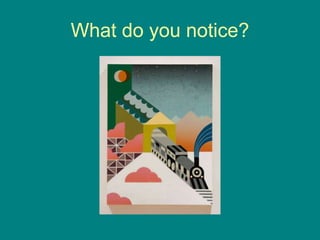
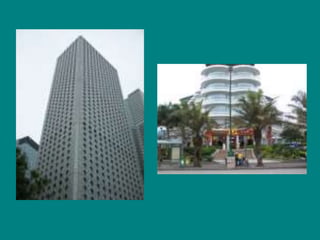
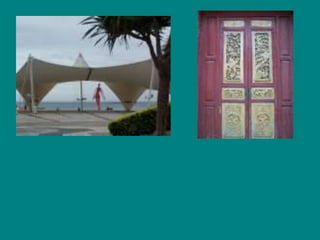
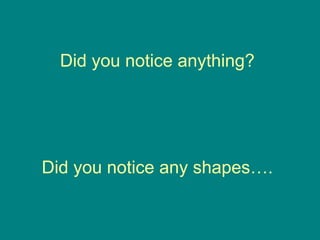
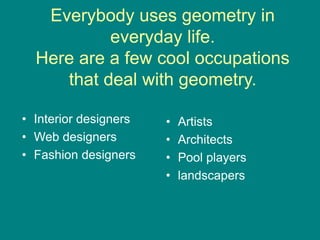
What do you notice?
Did you notice anything?
Did you notice any shapes….
Everybody uses geometry in
everyday life.
Here are a few cool occupations
that deal with geometry.
• Interior designers
• Web designers
• Fashion designers
• Artists
• Architects
• Pool players
• landscapers
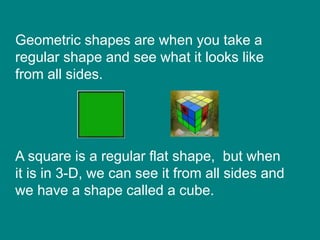
Geometric shapes are when you take a
regular shape and see what it looks like
from all sides.
A square is a regular flat shape, but when
it is in 3-D, we can see it from all sides and
we have a shape called a cube.
• Part of being a good problem solver is
being able to visualize. It is very important
that you can take a flat outline of a shape
and visualize what it will be when it is put
together. These flat pictures of the 3-D
shape are called nets.
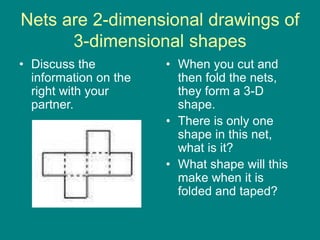
Nets are 2-dimensional drawings of
3-dimensional shapes
• Discuss the
information on the
right with your
partner.
• When you cut and
then fold the nets,
they form a 3-D
shape.
• There is only one
shape in this net,
what is it?
• What shape will this
make when it is
folded and taped?
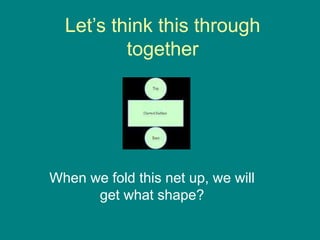
Let’s think this through
together
When we fold this net up, we will
get what shape?
3 important characteristics
• There are very specific characteristics that
geometric shapes have. They are:
• Faces
• Edges
• Vertices
FACES
• Faces are the flat sides that make up the
whole geometric shape.
EDGES
• Edges are when two faces come together
and meet. They will form a line. You will
be able to run your finger over the edge of
the geometric shape when it is put
together.
• Can you rub the edge of your desk?
VERTICES
• Vertices are the corners or points on a
geometric shape. They form when 3 faces
come together at a certain point. When
you have more than one vertex, the plural
form is vertices.
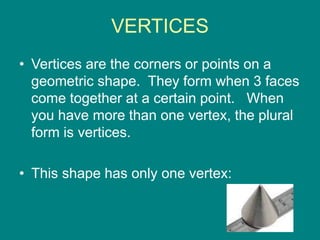
• This shape has only one vertex:
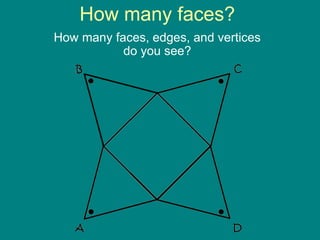
How many faces?
How many faces, edges, and vertices
do you see?
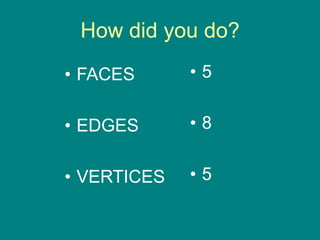
How did you do?
• FACES
• EDGES
• VERTICES
• 5
• 8
• 5
Let’s try it out and see!
• 1. Check your materials to make sure that you
have a net, scissors, and tape.
• 2. Examine your net carefully and try to
visualize what geometric shape your flat net will
turn into when you fold it and tape it.
• 3. Cut, fold, and tape your net to form your
shape.
• 4. After you have constructed your shape, write
down the number of faces, edges, and vertices
your shape has.

Final Copy

  • 1.
  • 2.
    Fourth Grade • Standard3.6: Visualize, describe, and make models of geometric solids (e.g., prisms, pyramids) in terms of the number and shape of faces, edges, and vertices; interpret two-dimensional representations of three-dimensional objects; and draw patterns (of faces) for a solid that, when cut and folded, will make a model of the solid.
  • 3.
    What do younotice?
  • 6.
    Did you noticeanything? Did you notice any shapes….
  • 7.
    Everybody uses geometryin everyday life. Here are a few cool occupations that deal with geometry. • Interior designers • Web designers • Fashion designers • Artists • Architects • Pool players • landscapers
  • 8.
    Geometric shapes arewhen you take a regular shape and see what it looks like from all sides. A square is a regular flat shape, but when it is in 3-D, we can see it from all sides and we have a shape called a cube.
  • 9.
    • Part ofbeing a good problem solver is being able to visualize. It is very important that you can take a flat outline of a shape and visualize what it will be when it is put together. These flat pictures of the 3-D shape are called nets.
  • 10.
    Nets are 2-dimensionaldrawings of 3-dimensional shapes • Discuss the information on the right with your partner. • When you cut and then fold the nets, they form a 3-D shape. • There is only one shape in this net, what is it? • What shape will this make when it is folded and taped?
  • 11.
    Let’s think thisthrough together When we fold this net up, we will get what shape?
  • 12.
    3 important characteristics •There are very specific characteristics that geometric shapes have. They are: • Faces • Edges • Vertices
  • 13.
    FACES • Faces arethe flat sides that make up the whole geometric shape.
  • 14.
    EDGES • Edges arewhen two faces come together and meet. They will form a line. You will be able to run your finger over the edge of the geometric shape when it is put together. • Can you rub the edge of your desk?
  • 15.
    VERTICES • Vertices arethe corners or points on a geometric shape. They form when 3 faces come together at a certain point. When you have more than one vertex, the plural form is vertices. • This shape has only one vertex:
  • 16.
    How many faces? Howmany faces, edges, and vertices do you see?
  • 17.
    How did youdo? • FACES • EDGES • VERTICES • 5 • 8 • 5
  • 18.
    Let’s try itout and see! • 1. Check your materials to make sure that you have a net, scissors, and tape. • 2. Examine your net carefully and try to visualize what geometric shape your flat net will turn into when you fold it and tape it. • 3. Cut, fold, and tape your net to form your shape. • 4. After you have constructed your shape, write down the number of faces, edges, and vertices your shape has.