By: Joanne P. Golocino BSEd-III
Friday(1:00-4:00 PM)
Objectives:
With the aid of power point presentation, the grade 7
students will be able to:
 define what is an Area,
 enumerate the formula of Area in every
figures, and;
 solve word problems related to Area
with 85% accuracy within 60 minutes.
What is an
Area?
Area?
Area?
Area?
Area?
Area? Area?
Area?
Area
 is the quantity that expresses the
extent of a two-dimensional figure
or shape in the plane.
Area
 It can be understood as the amount
of material with a given thickness that
would be necessary to fashion a model
of the shape, or the amount
of paint necessary to cover the surface
with a single coat.
When you measure the amount
of carpet to cover the floor of a
room, you measure it in square
units.
Would the area of your
bedroom or the area of
your house be greater?
The area of your house is
greater than the area of your
bedroom.
Lets find the area of this surface if each square is equal to one foot.
Count the number of squares.
Area = 15 square feet
To find out how much shape is inside we can
count the squares. Each square measures 1 cm.
The area of the shape is 18cm
2
.
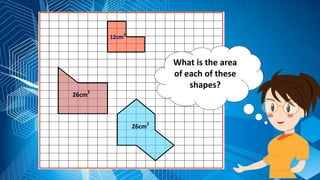
What is the area
of each of these
shapes?
12cm
2
26cm2
26cm2
Now how about finding
the Area without the grid?
Area:
• Square
• Rectangle
• Parallelogram
• Triangle
• Trapezoid
• Circle
Problem Solving
Area of a Square
Square
Is a plane figure
with four equal
straight sides and
four right angles.
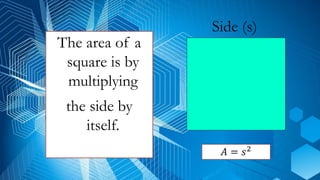
The area of a
square is by
multiplying
the side by
itself.
Side (s)
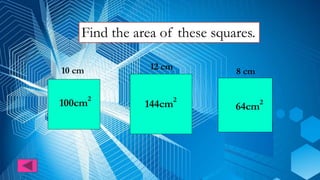
Find the area of these squares.
8 cm
12 cm10 cm
144cm2
100cm2
64cm2
Area of a Rectangle
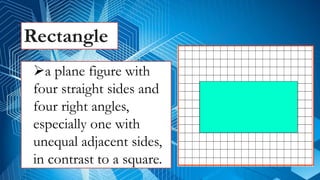
Rectangle
a plane figure with
four straight sides and
four right angles,
especially one with
unequal adjacent sides,
in contrast to a square.
We can work out
the area of a
rectangle
without the grid.
length
width
Watch this Video as a recap
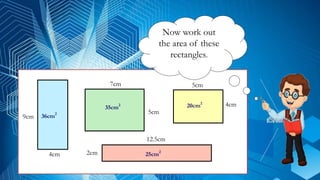
Now work out
the area of these
rectangles.
4cm
9cm
7cm
5cm
5cm
4cm
2cm
12.5cm
36cm
2
35cm
2 20cm2
25cm
2
10cm
8cm
8cm
4cm
Area =
4 x 10
40cm2
Area =
4 x 8
32cm2
2cm
It is a
composite
shape.
To find the area of
this shape we have to
split it up into two
rectangles.
Total area = 40 + 32 = 72 cm2
back
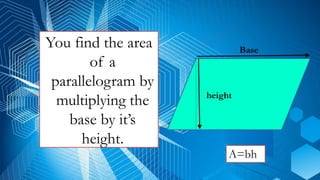
Area of a Parallelogram
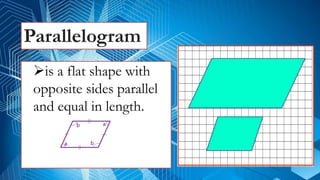
Parallelogram
is a flat shape with
opposite sides parallel
and equal in length.
You find the area
of a
parallelogram by
multiplying the
base by it’s
height.
A=bh
Base
height
Now work out
the area of these
parallelograms.
12 cm
3 cm 36cm
2
4cm
3 cm 12cm
2 24cm
2
6 cm
4 cm
back
Area of a Triangle
Finding the area of a triangle is different.
Area of a triangle = ½ (base x height)
***(Base x height) is the same as (length x width).***
A triangle is half of a
rectangle or square. This is
because the base (4) x the
height (3) would be the
same as the length x the
width of a rectangle.
4
3
Find the area of these triangles.
5 cm
7 cm
3 cm
4 cm
2cm
3 cm
6 cm
8cm
35cm2
5cm2
12cm2
48cm2
back
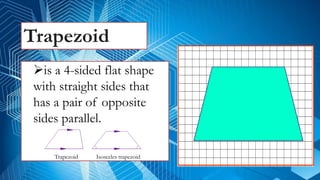
Area of a Trapezoid
Trapezoid
is a 4-sided flat shape
with straight sides that
has a pair of opposite
sides parallel.
Trapezoid Isosceles trapezoid
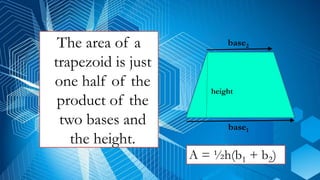
The area of a
trapezoid is just
one half of the
product of the
two bases and
the height.
A = ½h(b1 + b2)
base1
base2
height
Now work out
the area of these
trapezoid.
4cm
6cm
3cm 15cm2
4cm
7cm 3cm25cm2
6cm
4 cm
8 cm
28cm2
back
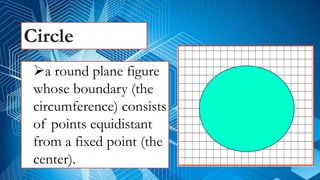
Area of a Circle
Circle
a round plane figure
whose boundary (the
circumference) consists
of points equidistant
from a fixed point (the
center).
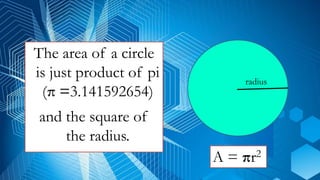
The area of a circle
is just product of pi
(π =3.141592654)
and the square of
the radius.
A = πr2
radius
Now work out
the area of these
circle.
5cm
3cm
A=78.54cm2
A=28.27cm2
Triangle
Area = ½ (bh)
b = base
h = vertical height
Square
Area = a2
a = length of side
Rectangle
Area = w × h
w = width
h = height
Parallelogram
Area = bh
b = base
h = vertical height
Trapezoid
Area = ½(a+b) × h
h = vertical height
Circle
Area = πr2
r = radius
Summary of the formula:
back
Problem
Solving
A small square is located inside
a bigger square. The length of
one side of the small square is
3 inches and the length of one
side of the big square is 7
inches
What is the area of the region
located outside the small
square, but inside the big
square?
The area that you are looking for is
everything is red. So you need to remove
the area of the small square from the
area of the big square. Use the formula.
Area of big square = s2 = 72 = 49 in2
Area of small square = s2 = 32 = 92
Area of the region in red =49 in2-9 in2 =
40 in2
7
3
A room whose area
is 24 ft2 has a length
that is 2 feet longer
than the width.
What are the
dimensions of the
room?
Let width = x,
so length = x + 2
Area = length × width
24 = x ( x + 2)
24 = x2 + 2x
x2 + 2x = 24
x2 + 2x - 24 = 0
( x + 6) × ( x - 4 ) = 0
x = -6 and x = 4
So width = 4 feet and length = 4 + 2 = 6 feet
Another problem:
The length of a page in a book is 2 cm greater
than the width of the page. A book designer finds
that if the length is increased by 2 cm and the
width is by 1 cm, the area of the page is increased
by 19 cm2. What are the dimensions of the
original page?
Answer:
Let width = x,
So length = x + 2 cm
Aoriginal = (x+2)(x)
Aoriginal = x2 + 2x
Increase:
width = x+1cm
length = (x + 2) +2 cm = x+4cm
Anew = length × width
Aoriginal + 19 cm2 =(x +4)( x + 1)
Aoriginal + 19 cm2 = x2 + 5x + 4
Aoriginal = x2 + 5x + 4 – 19
Aoriginal = x2 + 5x – 15
Aoriginal = Aoriginal
x2 + 2x = x2 + 5x – 15
x2 + 5x – 15 – x2 – 2x = 0
3x – 15 = 0
3x = 15 (divide both side by 3)
x = 5
Length = x + 2cm
= 5cm + 2cm
Length= 7 cm
Width = 5 cm
The dimensions of the original page is 7 cm by 5 cm.
Now try this problems
1.A classroom has a length of 20 feet and a width of 30
feet. The headmaster decided that tiles will look good in
that class. If each tile has a length of 24 inches and a
width of 36 inches, how many tiles are needed to fill the
classroom?
2. A square garden with a side length of 150 m has a
square swimming pool in the very centre with a side
length of 25 m . Calculate the area of the garden.
3. A rectangular garden has dimensions of 30 m by 20 m
and is divided in to 4 parts by two pathways that run
perpendicular from its sides. One pathway has a width of
8 dm and the other, 7 dm. Calculate the total usable area
of the garden.
4. Calculate the area of the quadrilateral that results from
drawing lines between the midpoints of the sides of a
rectangle whose base and height are 8 and 6 cm
respectively.
A line connects the midpoint of BC (Point E), with Point
D in the square ABCD shown below. Calculate the area
of the acquired trapezoid shape if the square has a side
of 4 m.
ASSIGNMENT
END
Area

Area

  • 1.
    By: Joanne P.Golocino BSEd-III Friday(1:00-4:00 PM)
  • 2.
    Objectives: With the aidof power point presentation, the grade 7 students will be able to:  define what is an Area,  enumerate the formula of Area in every figures, and;  solve word problems related to Area with 85% accuracy within 60 minutes.
  • 3.
  • 4.
    Area  is thequantity that expresses the extent of a two-dimensional figure or shape in the plane.
  • 5.
    Area  It canbe understood as the amount of material with a given thickness that would be necessary to fashion a model of the shape, or the amount of paint necessary to cover the surface with a single coat.
  • 6.
    When you measurethe amount of carpet to cover the floor of a room, you measure it in square units. Would the area of your bedroom or the area of your house be greater?
  • 7.
    The area ofyour house is greater than the area of your bedroom.
  • 8.
    Lets find thearea of this surface if each square is equal to one foot. Count the number of squares. Area = 15 square feet
  • 9.
    To find outhow much shape is inside we can count the squares. Each square measures 1 cm. The area of the shape is 18cm 2 .
  • 10.
    What is thearea of each of these shapes? 12cm 2 26cm2 26cm2
  • 11.
    Now how aboutfinding the Area without the grid?
  • 12.
    Area: • Square • Rectangle •Parallelogram • Triangle • Trapezoid • Circle Problem Solving
  • 13.
    Area of aSquare
  • 14.
    Square Is a planefigure with four equal straight sides and four right angles.
  • 15.
    The area ofa square is by multiplying the side by itself. Side (s)
  • 16.
    Find the areaof these squares. 8 cm 12 cm10 cm 144cm2 100cm2 64cm2
  • 17.
    Area of aRectangle
  • 18.
    Rectangle a plane figurewith four straight sides and four right angles, especially one with unequal adjacent sides, in contrast to a square.
  • 19.
    We can workout the area of a rectangle without the grid. length width
  • 20.
    Watch this Videoas a recap
  • 21.
    Now work out thearea of these rectangles. 4cm 9cm 7cm 5cm 5cm 4cm 2cm 12.5cm 36cm 2 35cm 2 20cm2 25cm 2
  • 22.
    10cm 8cm 8cm 4cm Area = 4 x10 40cm2 Area = 4 x 8 32cm2 2cm It is a composite shape. To find the area of this shape we have to split it up into two rectangles. Total area = 40 + 32 = 72 cm2 back
  • 23.
    Area of aParallelogram
  • 24.
    Parallelogram is a flatshape with opposite sides parallel and equal in length.
  • 25.
    You find thearea of a parallelogram by multiplying the base by it’s height. A=bh Base height
  • 26.
    Now work out thearea of these parallelograms. 12 cm 3 cm 36cm 2 4cm 3 cm 12cm 2 24cm 2 6 cm 4 cm back
  • 27.
    Area of aTriangle
  • 28.
    Finding the areaof a triangle is different. Area of a triangle = ½ (base x height) ***(Base x height) is the same as (length x width).*** A triangle is half of a rectangle or square. This is because the base (4) x the height (3) would be the same as the length x the width of a rectangle. 4 3
  • 29.
    Find the areaof these triangles. 5 cm 7 cm 3 cm 4 cm 2cm 3 cm 6 cm 8cm 35cm2 5cm2 12cm2 48cm2 back
  • 30.
    Area of aTrapezoid
  • 31.
    Trapezoid is a 4-sidedflat shape with straight sides that has a pair of opposite sides parallel. Trapezoid Isosceles trapezoid
  • 32.
    The area ofa trapezoid is just one half of the product of the two bases and the height. A = ½h(b1 + b2) base1 base2 height
  • 33.
    Now work out thearea of these trapezoid. 4cm 6cm 3cm 15cm2 4cm 7cm 3cm25cm2 6cm 4 cm 8 cm 28cm2 back
  • 34.
    Area of aCircle
  • 35.
    Circle a round planefigure whose boundary (the circumference) consists of points equidistant from a fixed point (the center).
  • 36.
    The area ofa circle is just product of pi (π =3.141592654) and the square of the radius. A = πr2 radius
  • 37.
    Now work out thearea of these circle. 5cm 3cm A=78.54cm2 A=28.27cm2
  • 38.
    Triangle Area = ½(bh) b = base h = vertical height Square Area = a2 a = length of side Rectangle Area = w × h w = width h = height Parallelogram Area = bh b = base h = vertical height Trapezoid Area = ½(a+b) × h h = vertical height Circle Area = πr2 r = radius Summary of the formula: back
  • 39.
  • 40.
    A small squareis located inside a bigger square. The length of one side of the small square is 3 inches and the length of one side of the big square is 7 inches What is the area of the region located outside the small square, but inside the big square? The area that you are looking for is everything is red. So you need to remove the area of the small square from the area of the big square. Use the formula. Area of big square = s2 = 72 = 49 in2 Area of small square = s2 = 32 = 92 Area of the region in red =49 in2-9 in2 = 40 in2 7 3
  • 41.
    A room whosearea is 24 ft2 has a length that is 2 feet longer than the width. What are the dimensions of the room? Let width = x, so length = x + 2 Area = length × width 24 = x ( x + 2) 24 = x2 + 2x x2 + 2x = 24 x2 + 2x - 24 = 0 ( x + 6) × ( x - 4 ) = 0 x = -6 and x = 4 So width = 4 feet and length = 4 + 2 = 6 feet
  • 42.
    Another problem: The lengthof a page in a book is 2 cm greater than the width of the page. A book designer finds that if the length is increased by 2 cm and the width is by 1 cm, the area of the page is increased by 19 cm2. What are the dimensions of the original page?
  • 43.
    Answer: Let width =x, So length = x + 2 cm Aoriginal = (x+2)(x) Aoriginal = x2 + 2x Increase: width = x+1cm length = (x + 2) +2 cm = x+4cm Anew = length × width Aoriginal + 19 cm2 =(x +4)( x + 1) Aoriginal + 19 cm2 = x2 + 5x + 4 Aoriginal = x2 + 5x + 4 – 19 Aoriginal = x2 + 5x – 15 Aoriginal = Aoriginal x2 + 2x = x2 + 5x – 15 x2 + 5x – 15 – x2 – 2x = 0 3x – 15 = 0 3x = 15 (divide both side by 3) x = 5 Length = x + 2cm = 5cm + 2cm Length= 7 cm Width = 5 cm The dimensions of the original page is 7 cm by 5 cm.
  • 44.
    Now try thisproblems 1.A classroom has a length of 20 feet and a width of 30 feet. The headmaster decided that tiles will look good in that class. If each tile has a length of 24 inches and a width of 36 inches, how many tiles are needed to fill the classroom? 2. A square garden with a side length of 150 m has a square swimming pool in the very centre with a side length of 25 m . Calculate the area of the garden.
  • 45.
    3. A rectangulargarden has dimensions of 30 m by 20 m and is divided in to 4 parts by two pathways that run perpendicular from its sides. One pathway has a width of 8 dm and the other, 7 dm. Calculate the total usable area of the garden. 4. Calculate the area of the quadrilateral that results from drawing lines between the midpoints of the sides of a rectangle whose base and height are 8 and 6 cm respectively.
  • 46.
    A line connectsthe midpoint of BC (Point E), with Point D in the square ABCD shown below. Calculate the area of the acquired trapezoid shape if the square has a side of 4 m. ASSIGNMENT
  • 47.