Mathematics
Exploring Regular & Irregular
SHAPES
Standard 3
Objectives
Geometric Shapes
If you like playing with objects, or like drawing,
then geometry is for you!
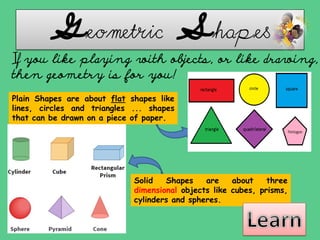
Plain Shapes are about flat shapes like
lines, circles and triangles ... shapes
that can be drawn on a piece of paper.
Solid Shapes are about three
dimensional objects like cubes, prisms,
cylinders and spheres.
Dimensions
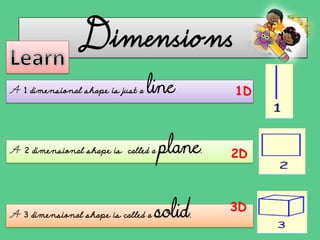
A 1 dimensional shape is just a line
A 2 dimensional shape is called a plane.
A 3 dimensional shape is called a solid.
1D
2D
3D
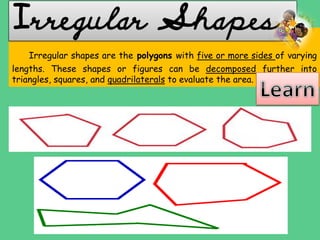
Irregular shapes are the polygons with five or more sides of varying
lengths. These shapes or figures can be decomposed further into
triangles, squares, and quadrilaterals to evaluate the area.
Irregular Shapes
Calculating the area of irregular shapes:
The approaches to estimating the area of an irregular shape
are:
Irregular Shapes
Do you see any irregular shapes around you?
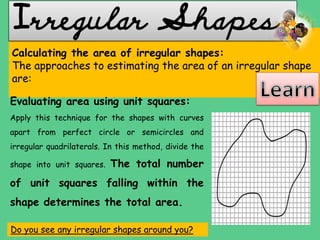
Evaluating area using unit squares:
Apply this technique for the shapes with curves
apart from perfect circle or semicircles and
irregular quadrilaterals. In this method, divide the
shape into unit squares. The total number
of unit squares falling within the
shape determines the total area.
Calculating the area of irregular shapes:
The approaches to estimating the area of an irregular shape
are:
Irregular Shapes
Do you see any irregular shapes around you?
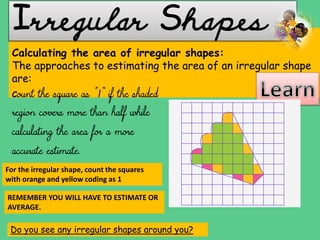
Count the square as “1” if the shaded
region covers more than half while
calculating the area for a more
accurate estimate.
For the irregular shape, count the squares
with orange and yellow coding as 1
REMEMBER YOU WILL HAVE TO ESTIMATE OR
AVERAGE.
Irregular Shapes
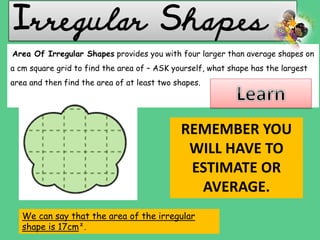
We can say that the area of the irregular
shape is 17cm².
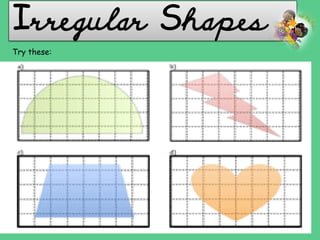
Area Of Irregular Shapes provides you with four larger than average shapes on
a cm square grid to find the area of – ASK yourself, what shape has the largest
area and then find the area of at least two shapes.
REMEMBER YOU
WILL HAVE TO
ESTIMATE OR
AVERAGE.
Irregular Shapes
Do you see any irregular shapes around you?
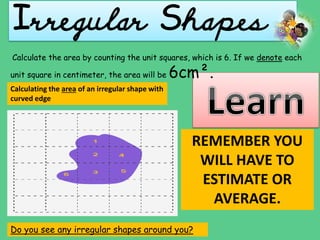
Calculate the area by counting the unit squares, which is 6. If we denote each
unit square in centimeter, the area will be 6cm².
Calculating the area of an irregular shape with
curved edge
REMEMBER YOU
WILL HAVE TO
ESTIMATE OR
AVERAGE.
Write out your notes in your note book.
Draw your pictures or print and stick in books
properly.
Cut out the nets and build the following solids.
Irregular Shapes
Try these:
Regular Shapes
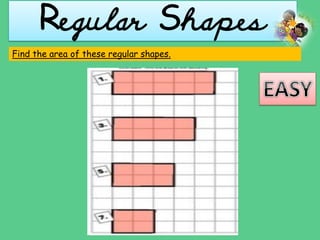
Find the area of these regular shapes.
Mathematics: Regular and Irregular Shapes

Mathematics: Regular and Irregular Shapes

  • 1.
    Mathematics Exploring Regular &Irregular SHAPES Standard 3 Objectives
  • 2.
    Geometric Shapes If youlike playing with objects, or like drawing, then geometry is for you! Plain Shapes are about flat shapes like lines, circles and triangles ... shapes that can be drawn on a piece of paper. Solid Shapes are about three dimensional objects like cubes, prisms, cylinders and spheres.
  • 3.
    Dimensions A 1 dimensionalshape is just a line A 2 dimensional shape is called a plane. A 3 dimensional shape is called a solid. 1D 2D 3D
  • 4.
    Irregular shapes arethe polygons with five or more sides of varying lengths. These shapes or figures can be decomposed further into triangles, squares, and quadrilaterals to evaluate the area. Irregular Shapes
  • 5.
    Calculating the areaof irregular shapes: The approaches to estimating the area of an irregular shape are: Irregular Shapes Do you see any irregular shapes around you? Evaluating area using unit squares: Apply this technique for the shapes with curves apart from perfect circle or semicircles and irregular quadrilaterals. In this method, divide the shape into unit squares. The total number of unit squares falling within the shape determines the total area.
  • 6.
    Calculating the areaof irregular shapes: The approaches to estimating the area of an irregular shape are: Irregular Shapes Do you see any irregular shapes around you? Count the square as “1” if the shaded region covers more than half while calculating the area for a more accurate estimate. For the irregular shape, count the squares with orange and yellow coding as 1 REMEMBER YOU WILL HAVE TO ESTIMATE OR AVERAGE.
  • 7.
    Irregular Shapes We cansay that the area of the irregular shape is 17cm². Area Of Irregular Shapes provides you with four larger than average shapes on a cm square grid to find the area of – ASK yourself, what shape has the largest area and then find the area of at least two shapes. REMEMBER YOU WILL HAVE TO ESTIMATE OR AVERAGE.
  • 8.
    Irregular Shapes Do yousee any irregular shapes around you? Calculate the area by counting the unit squares, which is 6. If we denote each unit square in centimeter, the area will be 6cm². Calculating the area of an irregular shape with curved edge REMEMBER YOU WILL HAVE TO ESTIMATE OR AVERAGE.
  • 9.
    Write out yournotes in your note book. Draw your pictures or print and stick in books properly. Cut out the nets and build the following solids.
  • 10.
  • 11.
    Regular Shapes Find thearea of these regular shapes.