CONTENTS
Perimeter ofplane shapes introduction
Perimeter of cycle
Perimeter of Triangle
Perimeter of Rectangle
Perimeter of Square
Perimeter of Parallelogram
Perimeter Rhombus
Perimeter of Kite
Perimeter of Trapezium
4.
Three dimensiona shapes
Ingeometry, 3D Shapes, also
known as three-dimensional
solids, have three key dimensions:
length, breadth, and height.
Unlike 2D shapes with only length
and width, 3D shapes possess
depth, giving them volume and
making them more realistic and
3-D Shapes edges,vertices and faces
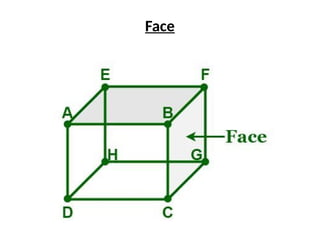
Faces
Definition: The flat or curved surfaces of a 3D
shape.
Example: A cube has 6 faces — all of them are
squares.
Edges
Definition: The straight lines where two faces meet.
Example: A cube has 12 edges — each edge
connects two square faces.
Vertices (Singular: Vertex)
Definition: The corners or points where edges meet.
3D Shapes Names:Geometry and
Property,
Cube
A Cube is a solid shape or three-dimensional shape that
has 6 square faces, 12 edges, and 8 Vertices.
Properties of the cube:
• All edges are equal.
• Each face is a square.
• It has a right angle at each
corner.
11.
Cuboid
Cuboid also knownas a rectangular prism, where the
faces are rectangular. All the angle measures 90
degrees.
Properties of Cuboid:
• All opposite edges are
equal.
• Each face is a
rectangle.
• It has a right angle at
each angle.
12.
Cone
A Cone isa three-dimensional object or a solid that has
a circular base that tapers easily to a single point and
has a single vertex.
Properties of Cone:
• It has a circular base.
• It has one curved
surface and one flat
surface.
• It does not have a
right angle.
13.
Cylinder
The Cylinder isa three-dimensional shape that has
two circular bases connected by a curved surface.
Properties of Cylinder:
• It has two equal
circular bases.
• It has one curved
surface.
• It does not have a right
angle.
14.
Sphere
The Sphere isa three-dimensional shape where every
point on its surface is equidistant from its center. It has
no edges, vertices, or flat shapes.
Properties of Sphere:
• It has no edges
• It has no faces
• It has no right angle.
15.
Hemisphere
A Hemisphere isa 3D Shape that represents half
of a sphere.
Properties of
Hemisphere:
• It has one curved
surface and one flat
circular face.
• It has no edges, only a
boundary.
• It has no right angle.
16.
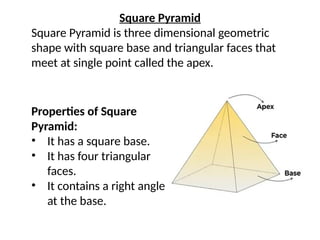
Square Pyramid
Square Pyramidis three dimensional geometric
shape with square base and triangular faces that
meet at single point called the apex.
Properties of Square
Pyramid:
• It has a square base.
• It has four triangular
faces.
• It contains a right angle
at the base.
17.
Hexagonal Pyramid
Hexagonal Pyramidis a three-dimensional geometric
shape with a hexagonal base and has 6 triangular
faces.
Properties of Hexagonal
Pyramid :
• It has a hexagonal
base.
• It has six triangular
faces.
• It does not have all
right angles.
18.
Triangular Prism
A TriangularPrism is a three-dimensional
geometric shape with two identical triangular
bases connected by three rectangular faces.
Properties of a triangular
prism
• It has two bases and
both are triangular.
• It has two rectangular
faces.
• It has a right angle only
in the rectangular face.
19.
Hexagonal Prism
Hexagonal Prismis a three-dimensional
geometric shape with two hexagonal bases
connected by six rectangular faces.
Properties of Hexagonal
Prism
• It has two hexagonal
bases
• It has six rectangular
faces.
• It has no right angle in
the hexagonal face.
20.
Basic Properties of3D
Shapes
Three-dimensional shapes possess unique properties
that set them apart from two-dimensional shapes.
These properties include:
Surface area— Unlike 2D Shapes, which have only
area, 3D shapes have their surface area. It is the total
area covered by all the outer surfaces of a 3D Shape.
Volume- A three-dimensional shape's volume is the
area occupied by a 3D shape or object. It is measured
in cubic units and provides insight into the capacity of
shapes.
Vertices, Edges, and Faces -These terms describe the
structure components of three three-dimensional
21.
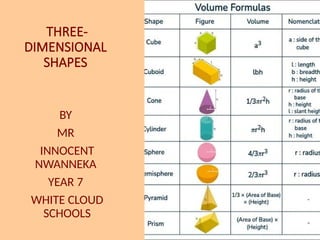
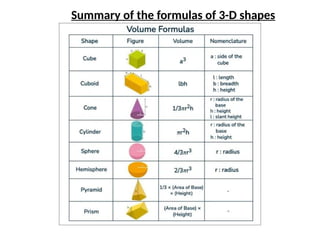
Volume Formulas for3D
Shapes
Volume refers to the amount of space
occupied by a three-dimensional object. In
geometry, calculating the volume is
essential for understanding the capacity of
a shape. It is used in various fields like
engineering, architecture, and
manufacturing to determine the amount
of material or space an object can hold.
22.
Capacity
When a hollowobject is filled with liquid or air and it
takes the shape of that object or container. The total
volume of the water and air which is filled inside the
container is called the capacity of the container.
Note: Capacity is calculated only for hollow object.
Note: The unit of capacity is litres(l) and
millilitres(ml).
23.
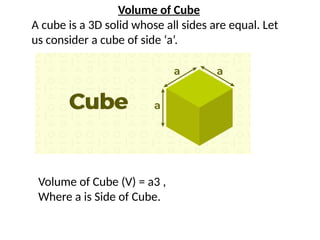
Volume of Cube
Acube is a 3D solid whose all sides are equal. Let
us consider a cube of side ‘a’.
Volume of Cube (V) = a3 ,
Where a is Side of Cube.
24.
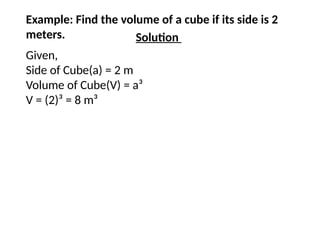
Example: Find thevolume of a cube if its side is 2
meters. Solution
Given,
Side of Cube(a) = 2 m
Volume of Cube(V) = a³
V = (2)³ = 8 m³
25.
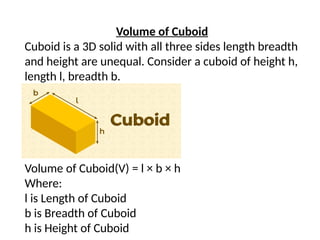
Volume of Cuboid
Cuboidis a 3D solid with all three sides length breadth
and height are unequal. Consider a cuboid of height h,
length l, breadth b.
Volume of Cuboid(V) = l × b × h
Where:
l is Length of Cuboid
b is Breadth of Cuboid
h is Height of Cuboid
26.
Example: Find thevolume of a cuboid of length 10
m height 10 m breadth 20 m.
Solution
Given,
Length of Cubiod(l) = 10 m
Breadth of Cubiod(b) = 10 m
Height of Cubiod(h) = 20 m
Volume of Cubiod(V) = l.b.h
V = (10)(10)(20)
V = 2,000 m³
27.
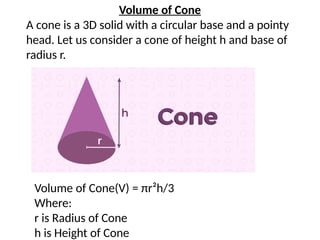
Volume of Cone
Acone is a 3D solid with a circular base and a pointy
head. Let us consider a cone of height h and base of
radius r.
Volume of Cone(V) = πr²h/3
Where:
r is Radius of Cone
h is Height of Cone
28.
Example: A conewith a radius of 30m and a height of
50 m is filled with water. What amount of water is
stored in it?
Solution
Given,
Radius of cone (r) = 30m
Height of the cone (h) = 50m
Volume is (V) = πr²h/3
V = (3.14 × 30 × 30 × 50)/3
V = 47,100 m³
29.
Volume of Cylinder
Acylinder is a 3D solid with 2 faces as circles and
some height. Let us consider a cylinder of base
radius r and height h.
Volume of Cylinder(V) = πr²h
Where:
r is Radius of Cylinder
h is Height of Cylinder
30.
Example: A cylindricalwater tank is of a height of 20
meters and has a diameter of 10 meters how much
water can we hold in this tank?
Solution
Given,
Height of Water Tank (h) = 20 m
Diameter of Water Tank (d) = 10 m
Radius of Water Tank (r) = d/2 = 10/2 = 5 m
Amount of water it holds is equal to the volume of
water tank
Volume of Water Tank(V) = πr²h
V = 3.14 × (5)² × (20)
V = 1570 m³
31.
Volume of Sphere
Asphere is a 3D version of a circle and only has a
radius. Let usthe consider a sphere of radius r.
Volume of Sphere = 4/3πr³
Where, r is the Radius of Sphere.
32.
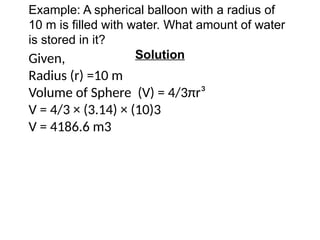
Example: A sphericalballoon with a radius of
10 m is filled with water. What amount of water
is stored in it?
Solution
Given,
Radius (r) =10 m
Volume of Sphere (V) = 4/3πr³
V = 4/3 × (3.14) × (10)3
V = 4186.6 m3
33.
Volume of Hemisphere
Ahemisphere is a 3D figure and is half of the sphere it
has a radius for its dimension.
Volume of a Hemisphere = 2/3πr³
Where, r is the Radius of Hemiphere
34.
Example: A hemisphericalbowl with a radius of 10 m
is filled with water. What amount of water is stored in
it?
Solution
Given,
Radius (r) =10 m
Volume of Hemiphere (V) = 2/3πr³
V = 2/3 × (3.14) × (10)³
V = 2093.3 m³
35.
Volume of Prism
Aprism is a 3-D figure in which the base is a
quadrilateral and its faces are triangular and
rectangular.
Volume of Prism (V) =
(Area of Base) × (Height of
Prism)
36.
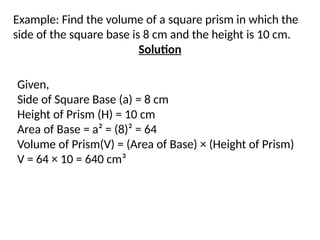
Example: Find thevolume of a square prism in which the
side of the square base is 8 cm and the height is 10 cm.
Solution
Given,
Side of Square Base (a) = 8 cm
Height of Prism (H) = 10 cm
Area of Base = a² = (8)² = 64
Volume of Prism(V) = (Area of Base) × (Height of Prism)
V = 64 × 10 = 640 cm³
37.
Volume of Pyramid
Apyramid is a 3-D figure in which the base is
triangular or square and the faces are also triangle.
Volume of Pyramid (V) =
1/3× (Area of Base) ×
(Height of Pyramid)
38.
Example: Find thevolume of the square pyramid in
which the side of the square base is 9 cm and the
height is 10 cm.
Solution
Given,
Side of Square Base (a) = 9 cm
Height of Pyramid (H) = 10 cm
Area of Base = a²= (9)² = 81
Volume of Pyramid(V) = 1/3 (Area of Base) × (Height of
Prism)
V = 27 × 10 = 270 cm³



















![Volume.ppt [recovered]](https://cdn.slidesharecdn.com/ss_thumbnails/volume-pptrecovered-120714054032-phpapp01-thumbnail.jpg?width=640&height=640&fit=bounds)


