PROGRESSIVE
SUPRANUCLEAR PALSY
& MULTIPLE SYSTEM
ATROPHY
Dr Sooraj Patil
Moderator-
Dr Abhishek Pathak
Learning Objectives
Definition NDD,
brief
classification
PSP & MSA
pathophysiology
and brief
classification of
subtypes
Recent
diagnostic
criteria's
Diagnostic
developments
and treatment
approach's
Database search and
reference articles
• MEDLINE/PUBMED, Google search for review articles, recent updates, diagnostic
criteria
• Progressive Supranuclear Palsy -Dr D Paviour and Professor D Burn 2013
• Progressive supranuclear palsy New concepts, Arq Neuropsiquiatr
2010;68(6):938-946
• Current Neurology and Neuroscience Reports (2018) Progressive
Supranuclear Palsy: an Update
• Update on the Diagnosis and Management of Progressive Supranuclear Palsy,
Curr Geri Rep 2016
• Clinical diagnosis of progressive supranuclear palsy: The movement disorder
society criteria Article in Movement Disorders · May 2017
• Clinical Approach to Progressive Supranuclear Palsy, Journal of mov disorders
2016
• Advances in progressive supranuclear palsy: new diagnostic criteria,
biomarkers, and therapeutic approaches, Lancet Neuro 2017
• Diagnosis of multiple system atrophy, Auton Neurosci. 2018 May ; 211:
15–25.
• Multiple-System Atrophy, NEJM 2015
• The diagnosis of progressive supranuclear palsy: current opinions and
challenges, EXPERT REVIEW OF NEUROTHERAPEUTICS 2018
• Oxford Textbook of Movement Disorders, David J. Burn
• Textbook of Principles and practice of movement disorders , Stanley Fahn,
Joseph Jankovic
• Diagnostic Approach to Atypical Parkinsonian Syndromes Nikolaus R.
McFarland, MD, PhD, Continuum review article 2016
DEFINITION
OF
NEURODEGENE
RATIVE
DISEASES
• Neurodegenerative diseases (NDDs) are characterized
by selective dysfunction and loss of neurons
associated with pathologically altered proteins
that deposit in the brain but also in peripheral organs
Progressive
Supranuclear
Palsy
• First described by Steele, Richardson, and
Olszewski in 1964
• Progressive supranuclear palsy (PSP) is
2nd M C form of neurodegenerative to IPD
• PSP comprises 5% to 6% of pts with
parkinsonism
Progressive Supranuclear Palsy
• Community-based prevalence is between 3.2 and
6.5 per 100 000
• Median age of onset for PSP is 65
• Median disease duration from disease onset to
death ranges between 5 and 8 years
Historical Perspective
Pathology
Characteristic lesions are of tau
isoform harboring 4 microtubule-
binding repeat motifs (4R tau) forming
straight filaments as opposed to paired
helical filaments in AD
Atrophy of the frontal convexity,
subthalamic nucleus, and midbrain as
well as depigmentation of substantia
nigra and other brainstem nuclei
Severity of astrogliosis and neuronal
loss appears to correlate with burden
of neurofibrillary tangles
Clinical Features
Early
postural
instability
Unexplained
falls
Vertical
supranuclear
palsy
Progressive
dementia
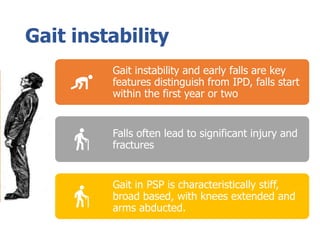
Gait instability
Gait instability and early falls are key
features distinguish from IPD, falls start
within the first year or two
Falls often lead to significant injury and
fractures
Gait in PSP is characteristically stiff,
broad based, with knees extended and
arms abducted.
Gait
instability
It is often described as clumsy
like a ‘‘drunken sailor’’ or
‘‘dancing bear,’’
Includes large lateral
deviations and step
asymmetry
When turning, persons with
PSP tend to pivot rather than
turn en bloc as is more typical
in PD
Vertical supranuclear palsy
• The patient has a fixed “Mona Lisa” stare, with a
markedly reduced blink frequency.
• First sign is failure to convergence & then
limitation of downgaze is most sensitive and
progresses to up gaze and lateral gaze palsies
• Slowed saccades and reduced optokinetic
nystagmus vertical more affected than horizontal
Progressive Supranuclear Palsy Dr D Paviour and Professor D Burn
Vertical supranuclear
palsy
Complete vertical gaze restriction first and fixed eye balls seen in advanced
PSP
Leading to eyebrow furrowing (procerus contraction),and vertical wrinkling
of the forehead, referred to as procerus sign.
Eye lid sudden closure or Apraxia of eyelid opening
Diplopia can occur -PSP mostly due to convergence insufficiency
Causes of
vertical
supranuclear
gaze palsy
• Progressive supranuclear palsy
• Corticobasal degeneration
• Fronto-temporal dementia with
• Parkinsonism linked to chromosome 17
• Prion diseases (Creutzfeld-Jakob disease,
progressive subcortical gliosis)
• Autosomal dominant cerebellar ataxias
(particularly SCA-2 and SCA-7)
• Whipple’s disease, Niemann-Pick disease
type C
• Vascular pseudo-parkinsonism
• Compressive midbrain syndromes (Parinaud
syndrome), eg, pinealoma, glioma
• Neurosyphilis
Other features of PSP
• Head is retracted and the voice is reduced to a
distinctive slurred growl.
• Hypertonic facial muscles produce facial folds
and a worried, astonished expression
• Progressive dysarthria that is often spastic or
hypernasal,hypokinetic, and monotonous
Other features of PSP
• Most concerning, however, is progressive
dysphagia that can lead to aspiration,
pneumonia, and early death.
• Emotional lability (also called emotional
incontinence), referred to as pseudobulbar
affect, also can occur and cause significant
distress
• A frontal subcortical dementia is typical, with
slowed processing, or bradyphrenia, reduced
verbal fluency, and executive dysfunction
Progressive Supranuclear Palsy
• Motor recklessness is often an early feature, leading
to the highly distinctive “rocket sign” on rising from
a chair.
• Clothes are soiled with spilled food, due an inability to
look down at the plate and difficulties swallowing (the
“messy-tie” sign).
• The time taken to respond to a question is prolonged,
because of slow cognitive processing
(bradyphrenia)
• There is sometimes palilalia or echolalia
Progressive Supranuclear Palsy Dr D Paviour and Professor D Burn
PSP Subtypes
Classical variant-
• PSP-RS
Brain stem
variants-
• PSP Parkinsons
• PSP-PAGF (Pure akinesia
with Gait Freezing)
Cortical variants-
• PSP CBS
• PSP-BvFTD
• PSP- PNFA (Progressive
non fluent aphasia)
PSP Subtypes
PSP-RS
• Usually present in 50’s or 60’s
• Non specific unsteadiness, falls, apathy
• Predominant cognitive decline in 1/5th
pts
• Diagnosis is usually delayed for 3-4
years
• Characteristic features- postural
instability with unprovoked falls, mostly
backwards, become disabling which
render the patients wheelchair-bound in
3 years
• PSP-RS also has a higher ratio of 4R to
3R tau as compared to PSP-P
PSP-RS
• Wide based gait (misdiagnosed as ataxia)
• PAGF can also be seen
• Procerus sign, retrocollis are marked
• Urinary urgency/retention, constipation &
sexual dysfunction can be seen without
orthostatic drop of BP
• Round house sign, vertical gauze palsy
• Pretarsal Blepharospasm, ocular apraxia
• Visual grasping (misdiagnosed as
cervical dystonia)
PSP-RS
• Frontal lobe dysfunction is most dominant
feature
• Behavioural changes, apathy with
pseudobulbar features
• FAB <12, Luria tests & applause sign
abnormality
• 1/3rd of PSP pts have memory impairment
including poor episodic memory and
visuospatial functions
• In the late stages, swallowing difficulties,
severe dysphonia and dysarthria, emotional
lability, inspiratory sighs, stereotyped
moaning or groaning occur.
• Pneumonia, respiratory failure, pulmonary
embolism and urinary tract infection are
common causes of death
Diagnostic criteria PSP RS
PSP-P
This subgroup is frequently misdiagnosed
clinically as Parkinson’s disease
Asymmetric limb bradykinesia, rigidity
and do not have supranuclear vertical
gaze palsy in the early stage
Half of the patients have moderate
levodopa response but the benefit rarely
sustains for more than a few years
As the disease advances, the clinical
picture usually becomes more like RS
Falls and cognitive decline occur late with
average survival of 9 years
Diagnostic criteria PSP-P
PSP-
PAGF
Pronounced gait ignition failure & start
hesitation - isolated clinical picture for
several years
As the condition progresses, freezing of
gait, stuttering or stammering speech
gradually develop with axial rigidity
The median disease duration of PSP-
PAGF is 11 years making this the most
benign PSP subtype
PAGF- Binswanger leukoaraiosis, NPH,
Parkinson’s disease and DLB to be ruled
out
Diagnostic
criteria
PSP-PAGF
PSP-
CBS
PSP-CBS rare presentation, only 4% of PSP
cases
Limb apraxia, parietal sensory impairment,
dystonia, myoclonus, levodopa-unresponsive
rigidity and bradykinesia & occasionally alien
limb phenomenon
Babinski’s signs are observed in half of PSP-
CBS cases
Median disease duration of PSP-CBS is 7.3
years, the same as PSP-RS.
Diagnostic
criteria PSP-
CBS
PSP-
PNFA
Characterised by non-fluent speech
with hesitancy, agrammatism and
phonemic errors
accompanied by AOS which is a
motor speech disorder featuring slow,
segmented and groping speech with
errors in timing and abnormal
prosody
PSP AOS is seen 50 % of time in
FTLD, others are CBD, Picks and AD,
LBD
Diagnostic criteria PSP-PNFA
PSP-
bvFTD
• Only less than 4% of bvFTD cases
have PSP pathology
• Frontal lobar signs with RS signs
which may appear later in the
disease process
PSP PI
• Prominent postural instability is a
core clinical feature in the MDS-PSP
criteria.
• It is stratified in descending order of
diagnostic certainty from
unprovoked falls, tendency to fall on
pull test, and more than two steps
backwards on pull test within 3
years
• Isolated postural instability can be
an early manifestation of PSP
Farwa Ali & Keith Josephs (2018): The diagnosis of progressive
supranuclear palsy: current opinions and challenges, Expert Review of Neurotherapeutics,
PSP-OM
• Extra ocular motor abnormalities may
be the predominant finding, usually
co-occurring with PSP-RS-like
symptoms.
• Impairment in vertical saccade velocity
and amplitude is the most important
marker of PSP
Farwa Ali & Keith Josephs (2018): The diagnosis of progressive
supranuclear palsy: current opinions and challenges, Expert Review of Neurotherapeutics,
PSP-C
• Cerebellar ataxia as the predominant early
presenting feature
• Mostly reported from Japan
• Associated with severe neuronal loss with gliosis
and higher densities of coiled bodies in the
cerebellar dentate nucleus
• Vertical supranuclear gaze palsy without
dysautonomia were predictive of PSP-C
PSP-PLS
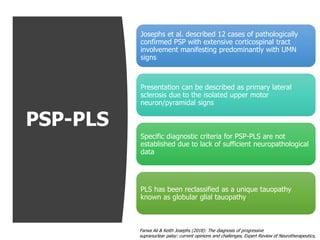
Josephs et al. described 12 cases of pathologically
confirmed PSP with extensive corticospinal tract
involvement manifesting predominantly with UMN
signs
Presentation can be described as primary lateral
sclerosis due to the isolated upper motor
neuron/pyramidal signs
Specific diagnostic criteria for PSP-PLS are not
established due to lack of sufficient neuropathological
data
PLS has been reclassified as a unique tauopathy
known as globular glial tauopathy
Farwa Ali & Keith Josephs (2018): The diagnosis of progressive
supranuclear palsy: current opinions and challenges, Expert Review of Neurotherapeutics,
NINDS SPSP Diagnostic
criteria 1996
NINDS SPSP Diagnostic
criteria 1996
Diagnostic
Criteria
One area where the NINDS-
SPSP criteria would be predicted
to have lower sensitivity is when
the development of “core”
diagnostic features is delayed
MDS updated diagnostic criteria
• Maintaining a high diagnostic sensitivity
for typical PSP (Richardson’s Syndrome)
• Improving sensitivity for early and
variant PSP presentations
• Ability to exclude alternate diagnoses
Core Clinical Features of PSP –
MDS Clinical Diagnostic Criteria
for PSP
The movement disorder society criteria. Mov Disord 2017;32:853-64
MDS Clinical Diagnostic
Criteria for PSP
Supportive features
Clinical rating scale PSP
A PSP Rating Scale (PSPRS)
produces a score of 0 to 100,
with 0 representing “normal”
28 items are sub-divided into
six categories
Daily activities
Behavioural symptoms
Bulbar symptoms
Oculomotor deficits
Limb motor deficits
Gait
Midline deficits
In addition to the PSPRS, a
disease-specific quality of life
scale, the PSPQoL which
contains 45 self-completed
questionnaire
PSP rating scale
• PSP MSA SEMINARpsp_rs.doc
Investigations
• The diagnosis of PSP still rests on the clinical
history and examination
• Rule out treatable conditions (MRI brain)
• HIV serology, VDRL, EEG
• CSF and protein biomarkers, structural
and functional imaging,
Neurophysiological tests
CSF analysis
Significantly higher tau
protein levels in CSF in
CBD, compared with PSP,
yielding sensitivities and
specificities of 100% and
87.5%
CSF neurofilament protein
(NFL) and glial fibrillary
acidic protein (GFAP)- no
difference was found
between PD, MSA and PSP
The concomitant use of a
levodopa test in
combination with CSF NFL
assay may improve
diagnostic accuracy for
atypical parkinsonism to
90%
Magnetic Resonance
Imaging (MRI)
• Diagnostic criteria-
• Midbrain diameter on axial scans of less than
17 mm
• Signal increase in the midbrain
• Atrophy or signal increase of the red nucleus
• Signal increase in the globus pallidus
• Midbrain to pons area ratio (figure ): reduced
area ratio on the midline sagittal plane to
approximately 0.12 (normal ~ 0.24)
• MRI may differentiate PSP from PD and MSA-P,
but features overlap with MSA-P and do not
clearly correlate with disease duration or
severity
Hummingbird
sign or
Penguin sign :
in PSP
Flattening or concave outline to the superior
aspect of the midbrain which should be upwardly
convex
mickey
mouse
appearance
Reduction of anteroposterior midline midbrain
diameter, at the level of the superior colliculi
Morning Glory sign
Magnetic
Resonance
Imaging
(MRI)
Atrophy or abnormal signal of the superior
cerebellar peduncle on proton-density-
weighted MRI helps PSP vs IPD
DTI imaging shown WM tract degeneration in
Superior cerebellar peduncle
Magnetic Resonance Parkinsonism
Index
MRPI is calculated by multiplying the pons
area-midbrain area ratio by middle cerebellar
peduncle width–superior cerebellar peduncle
width ratio
Magnetic Resonance Imaging
(MRI)
• MRPI had a higher accuracy in predicting PSP (92.9%) than clinical
features such as vertical ocular slowness or first-year falls (61.9% and
73.8%, respectively)
• MRI-based volumetry by examining atrophy of the caudate nucleus,
putamen, brainstem and cerebellum
• ADC-DWI may discriminate PSP from PD with a sensitivity of 90% and a
positive predictive value of 100%
• Significant increases in regional apparent diffusion coefficients being
noted in striatum and globus pallidus in PSP cases
ADC values in MCP and pons are significantly increased
in MSA-P compared to PSP, PD
Functional Imaging
• Positron emission tomography (PET) studies in PSP subjects have
demonstrated relative frontal lobe hypometabolism, although bi-
frontal hypoperfusion
• Cardiac MIBG uptake in PSP is significantly higher than in PD
• FDG-PET shown PIMPLE SIGN s/o midbrain atrophy 100%
specificity but only a 29% sensitivity
• Da T scan reduced tracer uptake in the striatum
• Tau-PET scan -PSP patients show 18F-AV-1451 uptake in
midbrain, basal ganglia, and dentate
DaT scan
Marked decreased uptake (B) of the radioligand in both
caudate and putamen (arrows) as compared to the control (A)
Tau PET Scan
Neurophysiological
Techniques
• Electro-oculography-PSP patients display
decreased saccadic velocity throughout their
disease course
• Sphincter EMG may differentiate atypical
akinetic-rigid syndromes from Parkinson’s
disease, but fails to reliably discriminate
between PSP and multiple system atrophy
• Computerized posturography testing may
differentiate early PSP from early PD and age-
matched controls.
Treatment
• 40 % pts show response to Levodopa, PSP-P show
better response compared to PSP-RS
• Gait, rigidity, and swallowing respond better with no
effect on dysarthria
• Amantidine has some benefit, but some times gait
freezing, apraxia, speech, or swallowing show
marked response
Treatment
Trials of levodopa and
amantadine should be given
to all pts
Zolpidem, a GABA agonist,
may improve motor function,
dysarthria and ocular
abnormalities
Memantine may provide
symptomatic benefit in
patients with PNFA
Botulinum toxin injection to
the pretarsal muscles is
effective for eyelid apraxia
Gastrostomy feeding
introduced in an appropriate
disease stage is helpful to
maintain nutrition, hydration
and prevent aspiration
MULTIPLE
SYSTEM ATROPHY
Introduction
• It was first described in the 1960s as Shy-Drager syndrome,
olivopontocerebellar atrophy or striatonigral degeneration
• Multiple system atrophy (MSA) is an adult-onset atypical
parkinsonian disorder (APD) characterized by either
• Rapidly progressive ds
• Levodopa-unresponsive parkinsonism or a cerebellar syndrome
• Associated with early autonomic failure
MSA
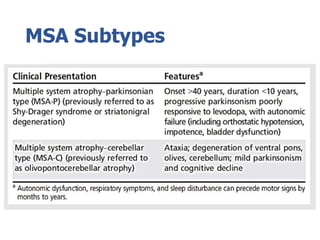
Two main clinical phenotypes
• MSA parkinsonian type
[MSA-P]
• MSA cerebellar type [MSA-C]
• MSA pure autonomic [MSA-
A]
Median age of onset for MSA is 58 years of
age, which is younger than that of PSP and
CBD
Median survival is 9 years with incidence of
0.6 cases 1.00.000 population
MSA Subtypes
Pathology
• Oligodendroglial cytoplasmic inclusion – sickle shaped, or oval alpha-
synuclein (Papp–Lantos bodies)
• Alpha synuclein deposition correlate with the severity of neuronal loss
and disease duration
• Neuronal loss and gliosis involving
• putamen, substantia nigra, pons, inferior olivary nucleus,
cerebellum, and intermediolateral cell column of the thoracic
and sacral spinal cord
• Autonomic features- dorsal motor nucleus of the vagus, locus
coeruleus, and ventrolateral medulla
Pathology
Clinical features MSA
• Western hemisphere, MSA-P is more common (70%) than MSA-C
(M C in Japan)
• Premotor phase-disorder months to years before the first motor
symptoms appear
• Sexual dysfunction, urinary urge incontinence or retention
• Orthostatic hypotension
• Inspiratory stridor
• Rapid-eye-movement sleep behaviour
• Bradykinesia , rigidity, and tremor -symmetric appearance than in
PD (presenting feature akinetic rigid in 58%)
• Pill-rolling type of tremor is uncommon in patients with MSA
• Tremor is of higher frequency, lower amplitude, and sometimes has
a jerky, stimulus-sensitive, myoclonic component
Natural history
Motor phase-MSA-P
• Bradykinesia , rigidity, and tremor -symmetric
appearance than in PD (presenting feature akinetic
rigid in 58% which is LD resistant)
• Pill-rolling type of tremor is uncommon in patients
with MSA
• Tremor is of higher frequency, lower amplitude, and
sometimes has a jerky, stimulus-sensitive,
myoclonic component in 50%
MSA-P
• Postural instability is a later feature in
MSA-P compared to that in PSP
• Speech is mixed spastic, hypokinetic
dysarthria or dysphonia
• Hyperreflexia, Babinski signs in 50%
• Dystonia in 16 to 42 %, anterocollis,
and early striatal deformities
• Non responsive to Levodopa, worsening
of OH after LD (28 % transient
response to LD)
• Early LD induced dyskinesia, orofacial
dystonia is a red flag for MSA-P
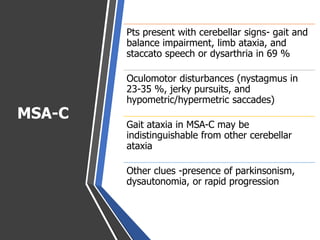
MSA-C
Pts present with cerebellar signs- gait and
balance impairment, limb ataxia, and
staccato speech or dysarthria in 69 %
Oculomotor disturbances (nystagmus in
23-35 %, jerky pursuits, and
hypometric/hypermetric saccades)
Gait ataxia in MSA-C may be
indistinguishable from other cerebellar
ataxia
Other clues -presence of parkinsonism,
dysautonomia, or rapid progression
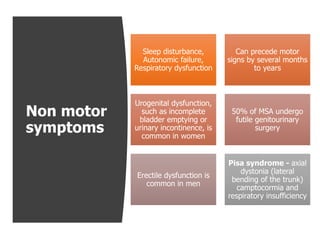
Non motor
symptoms
Sleep disturbance,
Autonomic failure,
Respiratory dysfunction
Can precede motor
signs by several months
to years
Urogenital dysfunction,
such as incomplete
bladder emptying or
urinary incontinence, is
common in women
50% of MSA undergo
futile genitourinary
surgery
Erectile dysfunction is
common in men
Pisa syndrome - axial
dystonia (lateral
bending of the trunk)
camptocormia and
respiratory insufficiency
Non motor symptoms
Diurnal or nocturnal
inspiratory stridor
develops in as many as
50% of patients
1
“coat-hanger pain”
(pain in the neck and
shoulder region) on
standing
2
Cognitive decline is
not prominent but
frontal lobe
dysfunction, emotional
incontinence is seen in
1/3rd of pts
3
PD vs MSA-P
28 % MSA shown initial
transient response to LD
Response usually last for 3
years
Postural instability is
common in early stages of
the disease course,
recurrent falls at disease
onset are unusual
Symmetric atremulous
picture might distinguish
MSA-P from PD
Characteristic clinical
picture of MSA-P usually
evolves within 5 years
Diagnostic
criteria for
Definite
MSA
Neuropathological findings during
post mortem examination must
include the following:
Widespread and abundant
cerebral alpha-synuclein–positive
GCIs
Neurodegenerative changes in
striatonigral or
olivopontocerebellar region
Gilman S, Wenning GK, Low PA, et al. Second consensus
statement on the diagnosis of multiple system atrophy.
Neurology 2008; 71: 670-6
Diagnostic
criteria for
Probable
MSA
• A sporadic, progressive, adult (>30 y)–onset
disease characterized by:
• Autonomic failure involving urinary incontinence
(inability to control the release of urine from the
bladder, with erectile dysfunction in males) or
an orthostatic decrease of blood pressure within
3 min of standing by at least 30 mmHg systolic
or 15 mmHg diastolic
AND
• Poorly levodopa-responsive parkinsonism
(bradykinesia with rigidity, tremor, or postural
instability)
OR
• A cerebellar syndrome (gait ataxia with
cerebellar dysarthria, limb ataxia, or cerebellar
oculomotor dysfunction)
Gilman S, Wenning GK, Low PA, et al. Second consensus
statement on the diagnosis of multiple system atrophy.
Neurology 2008; 71: 670-6
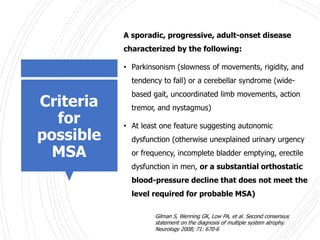
Criteria
for
possible
MSA
A sporadic, progressive, adult-onset disease
characterized by the following:
• Parkinsonism (slowness of movements, rigidity, and
tendency to fall) or a cerebellar syndrome (wide-
based gait, uncoordinated limb movements, action
tremor, and nystagmus)
• At least one feature suggesting autonomic
dysfunction (otherwise unexplained urinary urgency
or frequency, incomplete bladder emptying, erectile
dysfunction in men, or a substantial orthostatic
blood-pressure decline that does not meet the
level required for probable MSA)
Gilman S, Wenning GK, Low PA, et al. Second consensus
statement on the diagnosis of multiple system atrophy.
Neurology 2008; 71: 670-6
Criteria
for
possible
MSA
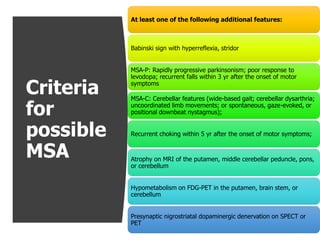
At least one of the following additional features:
Babinski sign with hyperreflexia, stridor
MSA-P: Rapidly progressive parkinsonism; poor response to
levodopa; recurrent falls within 3 yr after the onset of motor
symptoms
MSA-C: Cerebellar features (wide-based gait; cerebellar dysarthria;
uncoordinated limb movements; or spontaneous, gaze-evoked, or
positional downbeat nystagmus);
Recurrent choking within 5 yr after the onset of motor symptoms;
Atrophy on MRI of the putamen, middle cerebellar peduncle, pons,
or cerebellum
Hypometabolism on FDG-PET in the putamen, brain stem, or
cerebellum
Presynaptic nigrostriatal dopaminergic denervation on SPECT or
PET
Features supporting (red flags) and
not supporting a diagnosis of MSA
Gilman S, Wenning GK, Low PA, et al. Second consensus
statement on the diagnosis of multiple system atrophy.
Neurology 2008; 71: 670-6
Diagnosis
• Diagnosis of MSA is primarily based on clinical criteria
• MRI findings- bilateral T2 hypointensity in the posterolateral putamen,
representing iron deposition, and slit hyperintensity in the lateral margin
of the putamen
• Olivopontocerebellar atrophy is consistent With MSA-C
• Pontine atrophy and gliosis may be apparent on T2-weighted images in a
hot cross bun like pattern.
Hot Cross
bun sign
Putaminal Rim Sign
Investigations
Investigations
Autonomic Function
Testing
• Tilt-table testing, 24-hour ambulatory blood
pressure and heart rate monitoring
• Supine blood pressure with heart rate, then
standing blood pressure and heart rate after 3
minutes
• Sweat testing (eg, quantitative sudomotor
axon reflex test [QSART]) and gastric emptying
study (for gastroparesis)
Therapeutic Strategies
Treatment in MSA focuses mainly on supportive therapy
30% to 60% of patients with MSA initially respond to
dopaminergic therapy
Autonomic symptoms-oral hydration, increased salt intake,
and compression stockings or abdominal binder
If still symptomatic, pharmacologic therapy with
fludrocortisone or desmopressin, which increase blood volume
MSA Treatment
Neuroprotective agents
- Unfortunately, every
multicentre randomized
controlled trial so far has
failed to confirm disease
modification
r-HGH in revealed a trend
towards reduction in
progression of motor
symptoms that failed to
reach significance
Autonomic failure
• Non-pharmacological-fluid intake, high-salt diet, more
frequent, but smaller, meals (spreading of total daily
carbohydrate intake) to reduce postprandial hypotension
• Custom-made elastic body garments
• Head-up tilt during the night increases intravascular volume
by up to 1 litre within a week, which is particularly helpful
for improving early morning hypotension
• Fludrocortisone supports by sodium retention
Autonomic failure
• Directly acting α-agonist midodrine can be
used, can cause supine HTN
• Octreotide, which is a somatostatin analogue,
might alleviate postprandial hypotension
• Neurogenic bladder- Oxybutonin, CIC,
permanent transcutaneous suprapubic
catheterization
Therapeutic Strategies
DROXIDOPA- FDA
approved recently
for Neurogenic
hypotension
For neurogenic
bladder,
antispasmodics or
botulinum toxin
injections are helpful
Prognosis &
disease
progression
Relentless worsening of motor and
nonmotor symptoms during an
average time frame of 10 years
Approximately 50% require walking
aids within 3 years after the onset of
motor symptoms
60% require a wheelchair after 5 years
and the median time before the
patient is bedridden is 6 to 8 years
Causes of death include
bronchopneumonia, urosepsis, or
sudden death
Prognosis
Sudden Death Often Occurs
At Night As A Result Of
Either Acute Bilateral Vocal-
cord Paralysis Or Acute
Disruption Of The Brain-
stem Cardiorespiratory
Drive
Older Age At Onset,
Parkinsonian Phenotype,
early Development Of
Severe Autonomic Failure
Are Negative Prognostic
Factors
Cerebellar Phenotype And
Later Onset Of Autonomic
Symptoms Predict Slower
Disease Progression
THANK YOU

Progressive supranuclear palsy and multiple system atrophy

  • 1.
    PROGRESSIVE SUPRANUCLEAR PALSY & MULTIPLESYSTEM ATROPHY Dr Sooraj Patil Moderator- Dr Abhishek Pathak
  • 2.
    Learning Objectives Definition NDD, brief classification PSP& MSA pathophysiology and brief classification of subtypes Recent diagnostic criteria's Diagnostic developments and treatment approach's
  • 3.
    Database search and referencearticles • MEDLINE/PUBMED, Google search for review articles, recent updates, diagnostic criteria • Progressive Supranuclear Palsy -Dr D Paviour and Professor D Burn 2013 • Progressive supranuclear palsy New concepts, Arq Neuropsiquiatr 2010;68(6):938-946 • Current Neurology and Neuroscience Reports (2018) Progressive Supranuclear Palsy: an Update • Update on the Diagnosis and Management of Progressive Supranuclear Palsy, Curr Geri Rep 2016 • Clinical diagnosis of progressive supranuclear palsy: The movement disorder society criteria Article in Movement Disorders · May 2017 • Clinical Approach to Progressive Supranuclear Palsy, Journal of mov disorders 2016 • Advances in progressive supranuclear palsy: new diagnostic criteria, biomarkers, and therapeutic approaches, Lancet Neuro 2017 • Diagnosis of multiple system atrophy, Auton Neurosci. 2018 May ; 211: 15–25. • Multiple-System Atrophy, NEJM 2015 • The diagnosis of progressive supranuclear palsy: current opinions and challenges, EXPERT REVIEW OF NEUROTHERAPEUTICS 2018 • Oxford Textbook of Movement Disorders, David J. Burn • Textbook of Principles and practice of movement disorders , Stanley Fahn, Joseph Jankovic • Diagnostic Approach to Atypical Parkinsonian Syndromes Nikolaus R. McFarland, MD, PhD, Continuum review article 2016
  • 4.
    DEFINITION OF NEURODEGENE RATIVE DISEASES • Neurodegenerative diseases(NDDs) are characterized by selective dysfunction and loss of neurons associated with pathologically altered proteins that deposit in the brain but also in peripheral organs
  • 7.
    Progressive Supranuclear Palsy • First describedby Steele, Richardson, and Olszewski in 1964 • Progressive supranuclear palsy (PSP) is 2nd M C form of neurodegenerative to IPD • PSP comprises 5% to 6% of pts with parkinsonism
  • 8.
    Progressive Supranuclear Palsy •Community-based prevalence is between 3.2 and 6.5 per 100 000 • Median age of onset for PSP is 65 • Median disease duration from disease onset to death ranges between 5 and 8 years
  • 9.
  • 10.
    Pathology Characteristic lesions areof tau isoform harboring 4 microtubule- binding repeat motifs (4R tau) forming straight filaments as opposed to paired helical filaments in AD Atrophy of the frontal convexity, subthalamic nucleus, and midbrain as well as depigmentation of substantia nigra and other brainstem nuclei Severity of astrogliosis and neuronal loss appears to correlate with burden of neurofibrillary tangles
  • 11.
  • 12.
    Gait instability Gait instabilityand early falls are key features distinguish from IPD, falls start within the first year or two Falls often lead to significant injury and fractures Gait in PSP is characteristically stiff, broad based, with knees extended and arms abducted.
  • 13.
    Gait instability It is oftendescribed as clumsy like a ‘‘drunken sailor’’ or ‘‘dancing bear,’’ Includes large lateral deviations and step asymmetry When turning, persons with PSP tend to pivot rather than turn en bloc as is more typical in PD
  • 14.
    Vertical supranuclear palsy •The patient has a fixed “Mona Lisa” stare, with a markedly reduced blink frequency. • First sign is failure to convergence & then limitation of downgaze is most sensitive and progresses to up gaze and lateral gaze palsies • Slowed saccades and reduced optokinetic nystagmus vertical more affected than horizontal Progressive Supranuclear Palsy Dr D Paviour and Professor D Burn
  • 15.
    Vertical supranuclear palsy Complete verticalgaze restriction first and fixed eye balls seen in advanced PSP Leading to eyebrow furrowing (procerus contraction),and vertical wrinkling of the forehead, referred to as procerus sign. Eye lid sudden closure or Apraxia of eyelid opening Diplopia can occur -PSP mostly due to convergence insufficiency
  • 16.
    Causes of vertical supranuclear gaze palsy •Progressive supranuclear palsy • Corticobasal degeneration • Fronto-temporal dementia with • Parkinsonism linked to chromosome 17 • Prion diseases (Creutzfeld-Jakob disease, progressive subcortical gliosis) • Autosomal dominant cerebellar ataxias (particularly SCA-2 and SCA-7) • Whipple’s disease, Niemann-Pick disease type C • Vascular pseudo-parkinsonism • Compressive midbrain syndromes (Parinaud syndrome), eg, pinealoma, glioma • Neurosyphilis
  • 17.
    Other features ofPSP • Head is retracted and the voice is reduced to a distinctive slurred growl. • Hypertonic facial muscles produce facial folds and a worried, astonished expression • Progressive dysarthria that is often spastic or hypernasal,hypokinetic, and monotonous
  • 18.
    Other features ofPSP • Most concerning, however, is progressive dysphagia that can lead to aspiration, pneumonia, and early death. • Emotional lability (also called emotional incontinence), referred to as pseudobulbar affect, also can occur and cause significant distress • A frontal subcortical dementia is typical, with slowed processing, or bradyphrenia, reduced verbal fluency, and executive dysfunction
  • 19.
    Progressive Supranuclear Palsy •Motor recklessness is often an early feature, leading to the highly distinctive “rocket sign” on rising from a chair. • Clothes are soiled with spilled food, due an inability to look down at the plate and difficulties swallowing (the “messy-tie” sign). • The time taken to respond to a question is prolonged, because of slow cognitive processing (bradyphrenia) • There is sometimes palilalia or echolalia Progressive Supranuclear Palsy Dr D Paviour and Professor D Burn
  • 20.
    PSP Subtypes Classical variant- •PSP-RS Brain stem variants- • PSP Parkinsons • PSP-PAGF (Pure akinesia with Gait Freezing) Cortical variants- • PSP CBS • PSP-BvFTD • PSP- PNFA (Progressive non fluent aphasia)
  • 21.
  • 22.
    PSP-RS • Usually presentin 50’s or 60’s • Non specific unsteadiness, falls, apathy • Predominant cognitive decline in 1/5th pts • Diagnosis is usually delayed for 3-4 years • Characteristic features- postural instability with unprovoked falls, mostly backwards, become disabling which render the patients wheelchair-bound in 3 years • PSP-RS also has a higher ratio of 4R to 3R tau as compared to PSP-P
  • 23.
    PSP-RS • Wide basedgait (misdiagnosed as ataxia) • PAGF can also be seen • Procerus sign, retrocollis are marked • Urinary urgency/retention, constipation & sexual dysfunction can be seen without orthostatic drop of BP • Round house sign, vertical gauze palsy • Pretarsal Blepharospasm, ocular apraxia • Visual grasping (misdiagnosed as cervical dystonia)
  • 24.
    PSP-RS • Frontal lobedysfunction is most dominant feature • Behavioural changes, apathy with pseudobulbar features • FAB <12, Luria tests & applause sign abnormality • 1/3rd of PSP pts have memory impairment including poor episodic memory and visuospatial functions • In the late stages, swallowing difficulties, severe dysphonia and dysarthria, emotional lability, inspiratory sighs, stereotyped moaning or groaning occur. • Pneumonia, respiratory failure, pulmonary embolism and urinary tract infection are common causes of death
  • 25.
  • 26.
    PSP-P This subgroup isfrequently misdiagnosed clinically as Parkinson’s disease Asymmetric limb bradykinesia, rigidity and do not have supranuclear vertical gaze palsy in the early stage Half of the patients have moderate levodopa response but the benefit rarely sustains for more than a few years As the disease advances, the clinical picture usually becomes more like RS Falls and cognitive decline occur late with average survival of 9 years
  • 27.
  • 28.
    PSP- PAGF Pronounced gait ignitionfailure & start hesitation - isolated clinical picture for several years As the condition progresses, freezing of gait, stuttering or stammering speech gradually develop with axial rigidity The median disease duration of PSP- PAGF is 11 years making this the most benign PSP subtype PAGF- Binswanger leukoaraiosis, NPH, Parkinson’s disease and DLB to be ruled out
  • 29.
  • 30.
    PSP- CBS PSP-CBS rare presentation,only 4% of PSP cases Limb apraxia, parietal sensory impairment, dystonia, myoclonus, levodopa-unresponsive rigidity and bradykinesia & occasionally alien limb phenomenon Babinski’s signs are observed in half of PSP- CBS cases Median disease duration of PSP-CBS is 7.3 years, the same as PSP-RS.
  • 31.
  • 32.
    PSP- PNFA Characterised by non-fluentspeech with hesitancy, agrammatism and phonemic errors accompanied by AOS which is a motor speech disorder featuring slow, segmented and groping speech with errors in timing and abnormal prosody PSP AOS is seen 50 % of time in FTLD, others are CBD, Picks and AD, LBD
  • 33.
  • 34.
    PSP- bvFTD • Only lessthan 4% of bvFTD cases have PSP pathology • Frontal lobar signs with RS signs which may appear later in the disease process
  • 35.
    PSP PI • Prominentpostural instability is a core clinical feature in the MDS-PSP criteria. • It is stratified in descending order of diagnostic certainty from unprovoked falls, tendency to fall on pull test, and more than two steps backwards on pull test within 3 years • Isolated postural instability can be an early manifestation of PSP Farwa Ali & Keith Josephs (2018): The diagnosis of progressive supranuclear palsy: current opinions and challenges, Expert Review of Neurotherapeutics,
  • 36.
    PSP-OM • Extra ocularmotor abnormalities may be the predominant finding, usually co-occurring with PSP-RS-like symptoms. • Impairment in vertical saccade velocity and amplitude is the most important marker of PSP Farwa Ali & Keith Josephs (2018): The diagnosis of progressive supranuclear palsy: current opinions and challenges, Expert Review of Neurotherapeutics,
  • 37.
    PSP-C • Cerebellar ataxiaas the predominant early presenting feature • Mostly reported from Japan • Associated with severe neuronal loss with gliosis and higher densities of coiled bodies in the cerebellar dentate nucleus • Vertical supranuclear gaze palsy without dysautonomia were predictive of PSP-C
  • 38.
    PSP-PLS Josephs et al.described 12 cases of pathologically confirmed PSP with extensive corticospinal tract involvement manifesting predominantly with UMN signs Presentation can be described as primary lateral sclerosis due to the isolated upper motor neuron/pyramidal signs Specific diagnostic criteria for PSP-PLS are not established due to lack of sufficient neuropathological data PLS has been reclassified as a unique tauopathy known as globular glial tauopathy Farwa Ali & Keith Josephs (2018): The diagnosis of progressive supranuclear palsy: current opinions and challenges, Expert Review of Neurotherapeutics,
  • 39.
  • 40.
  • 41.
    Diagnostic Criteria One area wherethe NINDS- SPSP criteria would be predicted to have lower sensitivity is when the development of “core” diagnostic features is delayed MDS updated diagnostic criteria • Maintaining a high diagnostic sensitivity for typical PSP (Richardson’s Syndrome) • Improving sensitivity for early and variant PSP presentations • Ability to exclude alternate diagnoses
  • 42.
    Core Clinical Featuresof PSP – MDS Clinical Diagnostic Criteria for PSP The movement disorder society criteria. Mov Disord 2017;32:853-64
  • 43.
  • 44.
  • 45.
    Clinical rating scalePSP A PSP Rating Scale (PSPRS) produces a score of 0 to 100, with 0 representing “normal” 28 items are sub-divided into six categories Daily activities Behavioural symptoms Bulbar symptoms Oculomotor deficits Limb motor deficits Gait Midline deficits In addition to the PSPRS, a disease-specific quality of life scale, the PSPQoL which contains 45 self-completed questionnaire
  • 46.
    PSP rating scale •PSP MSA SEMINARpsp_rs.doc
  • 47.
    Investigations • The diagnosisof PSP still rests on the clinical history and examination • Rule out treatable conditions (MRI brain) • HIV serology, VDRL, EEG • CSF and protein biomarkers, structural and functional imaging, Neurophysiological tests
  • 48.
    CSF analysis Significantly highertau protein levels in CSF in CBD, compared with PSP, yielding sensitivities and specificities of 100% and 87.5% CSF neurofilament protein (NFL) and glial fibrillary acidic protein (GFAP)- no difference was found between PD, MSA and PSP The concomitant use of a levodopa test in combination with CSF NFL assay may improve diagnostic accuracy for atypical parkinsonism to 90%
  • 49.
    Magnetic Resonance Imaging (MRI) •Diagnostic criteria- • Midbrain diameter on axial scans of less than 17 mm • Signal increase in the midbrain • Atrophy or signal increase of the red nucleus • Signal increase in the globus pallidus • Midbrain to pons area ratio (figure ): reduced area ratio on the midline sagittal plane to approximately 0.12 (normal ~ 0.24) • MRI may differentiate PSP from PD and MSA-P, but features overlap with MSA-P and do not clearly correlate with disease duration or severity
  • 50.
    Hummingbird sign or Penguin sign: in PSP Flattening or concave outline to the superior aspect of the midbrain which should be upwardly convex
  • 51.
    mickey mouse appearance Reduction of anteroposteriormidline midbrain diameter, at the level of the superior colliculi
  • 52.
  • 53.
    Magnetic Resonance Imaging (MRI) Atrophy or abnormalsignal of the superior cerebellar peduncle on proton-density- weighted MRI helps PSP vs IPD DTI imaging shown WM tract degeneration in Superior cerebellar peduncle Magnetic Resonance Parkinsonism Index MRPI is calculated by multiplying the pons area-midbrain area ratio by middle cerebellar peduncle width–superior cerebellar peduncle width ratio
  • 54.
    Magnetic Resonance Imaging (MRI) •MRPI had a higher accuracy in predicting PSP (92.9%) than clinical features such as vertical ocular slowness or first-year falls (61.9% and 73.8%, respectively) • MRI-based volumetry by examining atrophy of the caudate nucleus, putamen, brainstem and cerebellum • ADC-DWI may discriminate PSP from PD with a sensitivity of 90% and a positive predictive value of 100% • Significant increases in regional apparent diffusion coefficients being noted in striatum and globus pallidus in PSP cases
  • 55.
    ADC values inMCP and pons are significantly increased in MSA-P compared to PSP, PD
  • 56.
    Functional Imaging • Positronemission tomography (PET) studies in PSP subjects have demonstrated relative frontal lobe hypometabolism, although bi- frontal hypoperfusion • Cardiac MIBG uptake in PSP is significantly higher than in PD • FDG-PET shown PIMPLE SIGN s/o midbrain atrophy 100% specificity but only a 29% sensitivity • Da T scan reduced tracer uptake in the striatum • Tau-PET scan -PSP patients show 18F-AV-1451 uptake in midbrain, basal ganglia, and dentate
  • 57.
    DaT scan Marked decreaseduptake (B) of the radioligand in both caudate and putamen (arrows) as compared to the control (A)
  • 58.
  • 59.
    Neurophysiological Techniques • Electro-oculography-PSP patientsdisplay decreased saccadic velocity throughout their disease course • Sphincter EMG may differentiate atypical akinetic-rigid syndromes from Parkinson’s disease, but fails to reliably discriminate between PSP and multiple system atrophy • Computerized posturography testing may differentiate early PSP from early PD and age- matched controls.
  • 60.
    Treatment • 40 %pts show response to Levodopa, PSP-P show better response compared to PSP-RS • Gait, rigidity, and swallowing respond better with no effect on dysarthria • Amantidine has some benefit, but some times gait freezing, apraxia, speech, or swallowing show marked response
  • 61.
    Treatment Trials of levodopaand amantadine should be given to all pts Zolpidem, a GABA agonist, may improve motor function, dysarthria and ocular abnormalities Memantine may provide symptomatic benefit in patients with PNFA Botulinum toxin injection to the pretarsal muscles is effective for eyelid apraxia Gastrostomy feeding introduced in an appropriate disease stage is helpful to maintain nutrition, hydration and prevent aspiration
  • 62.
  • 63.
    Introduction • It wasfirst described in the 1960s as Shy-Drager syndrome, olivopontocerebellar atrophy or striatonigral degeneration • Multiple system atrophy (MSA) is an adult-onset atypical parkinsonian disorder (APD) characterized by either • Rapidly progressive ds • Levodopa-unresponsive parkinsonism or a cerebellar syndrome • Associated with early autonomic failure
  • 64.
    MSA Two main clinicalphenotypes • MSA parkinsonian type [MSA-P] • MSA cerebellar type [MSA-C] • MSA pure autonomic [MSA- A] Median age of onset for MSA is 58 years of age, which is younger than that of PSP and CBD Median survival is 9 years with incidence of 0.6 cases 1.00.000 population
  • 65.
  • 66.
    Pathology • Oligodendroglial cytoplasmicinclusion – sickle shaped, or oval alpha- synuclein (Papp–Lantos bodies) • Alpha synuclein deposition correlate with the severity of neuronal loss and disease duration • Neuronal loss and gliosis involving • putamen, substantia nigra, pons, inferior olivary nucleus, cerebellum, and intermediolateral cell column of the thoracic and sacral spinal cord • Autonomic features- dorsal motor nucleus of the vagus, locus coeruleus, and ventrolateral medulla
  • 68.
  • 69.
    Clinical features MSA •Western hemisphere, MSA-P is more common (70%) than MSA-C (M C in Japan) • Premotor phase-disorder months to years before the first motor symptoms appear • Sexual dysfunction, urinary urge incontinence or retention • Orthostatic hypotension • Inspiratory stridor • Rapid-eye-movement sleep behaviour • Bradykinesia , rigidity, and tremor -symmetric appearance than in PD (presenting feature akinetic rigid in 58%) • Pill-rolling type of tremor is uncommon in patients with MSA • Tremor is of higher frequency, lower amplitude, and sometimes has a jerky, stimulus-sensitive, myoclonic component
  • 70.
  • 71.
    Motor phase-MSA-P • Bradykinesia, rigidity, and tremor -symmetric appearance than in PD (presenting feature akinetic rigid in 58% which is LD resistant) • Pill-rolling type of tremor is uncommon in patients with MSA • Tremor is of higher frequency, lower amplitude, and sometimes has a jerky, stimulus-sensitive, myoclonic component in 50%
  • 72.
    MSA-P • Postural instabilityis a later feature in MSA-P compared to that in PSP • Speech is mixed spastic, hypokinetic dysarthria or dysphonia • Hyperreflexia, Babinski signs in 50% • Dystonia in 16 to 42 %, anterocollis, and early striatal deformities • Non responsive to Levodopa, worsening of OH after LD (28 % transient response to LD) • Early LD induced dyskinesia, orofacial dystonia is a red flag for MSA-P
  • 73.
    MSA-C Pts present withcerebellar signs- gait and balance impairment, limb ataxia, and staccato speech or dysarthria in 69 % Oculomotor disturbances (nystagmus in 23-35 %, jerky pursuits, and hypometric/hypermetric saccades) Gait ataxia in MSA-C may be indistinguishable from other cerebellar ataxia Other clues -presence of parkinsonism, dysautonomia, or rapid progression
  • 74.
    Non motor symptoms Sleep disturbance, Autonomicfailure, Respiratory dysfunction Can precede motor signs by several months to years Urogenital dysfunction, such as incomplete bladder emptying or urinary incontinence, is common in women 50% of MSA undergo futile genitourinary surgery Erectile dysfunction is common in men Pisa syndrome - axial dystonia (lateral bending of the trunk) camptocormia and respiratory insufficiency
  • 75.
    Non motor symptoms Diurnalor nocturnal inspiratory stridor develops in as many as 50% of patients 1 “coat-hanger pain” (pain in the neck and shoulder region) on standing 2 Cognitive decline is not prominent but frontal lobe dysfunction, emotional incontinence is seen in 1/3rd of pts 3
  • 76.
    PD vs MSA-P 28% MSA shown initial transient response to LD Response usually last for 3 years Postural instability is common in early stages of the disease course, recurrent falls at disease onset are unusual Symmetric atremulous picture might distinguish MSA-P from PD Characteristic clinical picture of MSA-P usually evolves within 5 years
  • 77.
    Diagnostic criteria for Definite MSA Neuropathological findingsduring post mortem examination must include the following: Widespread and abundant cerebral alpha-synuclein–positive GCIs Neurodegenerative changes in striatonigral or olivopontocerebellar region Gilman S, Wenning GK, Low PA, et al. Second consensus statement on the diagnosis of multiple system atrophy. Neurology 2008; 71: 670-6
  • 78.
    Diagnostic criteria for Probable MSA • Asporadic, progressive, adult (>30 y)–onset disease characterized by: • Autonomic failure involving urinary incontinence (inability to control the release of urine from the bladder, with erectile dysfunction in males) or an orthostatic decrease of blood pressure within 3 min of standing by at least 30 mmHg systolic or 15 mmHg diastolic AND • Poorly levodopa-responsive parkinsonism (bradykinesia with rigidity, tremor, or postural instability) OR • A cerebellar syndrome (gait ataxia with cerebellar dysarthria, limb ataxia, or cerebellar oculomotor dysfunction) Gilman S, Wenning GK, Low PA, et al. Second consensus statement on the diagnosis of multiple system atrophy. Neurology 2008; 71: 670-6
  • 79.
    Criteria for possible MSA A sporadic, progressive,adult-onset disease characterized by the following: • Parkinsonism (slowness of movements, rigidity, and tendency to fall) or a cerebellar syndrome (wide- based gait, uncoordinated limb movements, action tremor, and nystagmus) • At least one feature suggesting autonomic dysfunction (otherwise unexplained urinary urgency or frequency, incomplete bladder emptying, erectile dysfunction in men, or a substantial orthostatic blood-pressure decline that does not meet the level required for probable MSA) Gilman S, Wenning GK, Low PA, et al. Second consensus statement on the diagnosis of multiple system atrophy. Neurology 2008; 71: 670-6
  • 80.
    Criteria for possible MSA At least oneof the following additional features: Babinski sign with hyperreflexia, stridor MSA-P: Rapidly progressive parkinsonism; poor response to levodopa; recurrent falls within 3 yr after the onset of motor symptoms MSA-C: Cerebellar features (wide-based gait; cerebellar dysarthria; uncoordinated limb movements; or spontaneous, gaze-evoked, or positional downbeat nystagmus); Recurrent choking within 5 yr after the onset of motor symptoms; Atrophy on MRI of the putamen, middle cerebellar peduncle, pons, or cerebellum Hypometabolism on FDG-PET in the putamen, brain stem, or cerebellum Presynaptic nigrostriatal dopaminergic denervation on SPECT or PET
  • 81.
    Features supporting (redflags) and not supporting a diagnosis of MSA Gilman S, Wenning GK, Low PA, et al. Second consensus statement on the diagnosis of multiple system atrophy. Neurology 2008; 71: 670-6
  • 82.
    Diagnosis • Diagnosis ofMSA is primarily based on clinical criteria • MRI findings- bilateral T2 hypointensity in the posterolateral putamen, representing iron deposition, and slit hyperintensity in the lateral margin of the putamen • Olivopontocerebellar atrophy is consistent With MSA-C • Pontine atrophy and gliosis may be apparent on T2-weighted images in a hot cross bun like pattern.
  • 83.
  • 84.
  • 85.
  • 86.
  • 87.
    Autonomic Function Testing • Tilt-tabletesting, 24-hour ambulatory blood pressure and heart rate monitoring • Supine blood pressure with heart rate, then standing blood pressure and heart rate after 3 minutes • Sweat testing (eg, quantitative sudomotor axon reflex test [QSART]) and gastric emptying study (for gastroparesis)
  • 88.
    Therapeutic Strategies Treatment inMSA focuses mainly on supportive therapy 30% to 60% of patients with MSA initially respond to dopaminergic therapy Autonomic symptoms-oral hydration, increased salt intake, and compression stockings or abdominal binder If still symptomatic, pharmacologic therapy with fludrocortisone or desmopressin, which increase blood volume
  • 89.
    MSA Treatment Neuroprotective agents -Unfortunately, every multicentre randomized controlled trial so far has failed to confirm disease modification r-HGH in revealed a trend towards reduction in progression of motor symptoms that failed to reach significance
  • 90.
    Autonomic failure • Non-pharmacological-fluidintake, high-salt diet, more frequent, but smaller, meals (spreading of total daily carbohydrate intake) to reduce postprandial hypotension • Custom-made elastic body garments • Head-up tilt during the night increases intravascular volume by up to 1 litre within a week, which is particularly helpful for improving early morning hypotension • Fludrocortisone supports by sodium retention
  • 91.
    Autonomic failure • Directlyacting α-agonist midodrine can be used, can cause supine HTN • Octreotide, which is a somatostatin analogue, might alleviate postprandial hypotension • Neurogenic bladder- Oxybutonin, CIC, permanent transcutaneous suprapubic catheterization
  • 92.
    Therapeutic Strategies DROXIDOPA- FDA approvedrecently for Neurogenic hypotension For neurogenic bladder, antispasmodics or botulinum toxin injections are helpful
  • 93.
    Prognosis & disease progression Relentless worseningof motor and nonmotor symptoms during an average time frame of 10 years Approximately 50% require walking aids within 3 years after the onset of motor symptoms 60% require a wheelchair after 5 years and the median time before the patient is bedridden is 6 to 8 years Causes of death include bronchopneumonia, urosepsis, or sudden death
  • 94.
    Prognosis Sudden Death OftenOccurs At Night As A Result Of Either Acute Bilateral Vocal- cord Paralysis Or Acute Disruption Of The Brain- stem Cardiorespiratory Drive Older Age At Onset, Parkinsonian Phenotype, early Development Of Severe Autonomic Failure Are Negative Prognostic Factors Cerebellar Phenotype And Later Onset Of Autonomic Symptoms Predict Slower Disease Progression
  • 95.

Editor's Notes

  • #24 ‘round the houses’ sign (curved trajectory of vertical saccades, Visual grasping (eye deviation and intermittent head turns towards object the patients have walked past) is sometimes mistaken as cervical dystonia.3
  • #25 ‘round the houses’ sign (curved trajectory of vertical saccades, Visual grasping (eye deviation and intermittent head turns towards object the patients have walked past) is sometimes mistaken as cervical dystonia.3