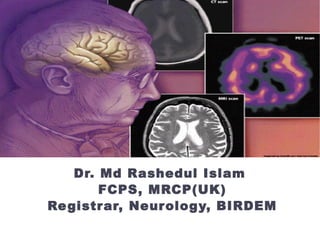
Case Presentation
Dr. Md Rashedul Islam
FCPS, MRCP(UK)
Registrar, Neurology, BIRDEM
A 60 years old diabetic male hailing from
Baridhara,Dhaka got admitted in BIRDEM
General Hospital under department of
Neurology, on 04.05.14 with the complaints of :
• Difficulty in walking for 1 year
• Slurring of speech for 10 months
▫
According to the statement of the patient, he
was reasonably well 1 year back. Then he
developed walking difficulty which was
progressive, associated with problems with
maintaining balance & recurrent history of fall.
It was not associated with low back pain,
tingling of feet, incontinence of urine, head
injury, fever, weight loss.
H/O Present illness
He also gave history of slurring of speech for 10
months which was progressive, monotonous,
hypophonic, indistinct. He had difficulty in
pronouncing consonants but no fatigability,
swallowing difficulty was present. On detailed
query, he gave history of memory disturbance,
behavioral problems, insomnia, clumsiness &
impaired hand writing.
H/O PAST ILLNESS:
Nothing contributory
SOCIOECONOMIC HISTORY:
He belongs to a upper class family
PERSONAL HISTORY:
He is non alcoholic, non smoker.
FAMILY HISTORY
Nothing significant
TREATMENT HISTORY:
Tab. Metformin
Tab. Vit B complex
General examination:
Appearance:
Masked face
Startled expression
General examination:
Built: Overweight(BMI- 27.4 kg/m2)
Decubitus: on choice
Oedema
Anaemia
Jaundice
Cyanosis
Dehydration
Clubbing Absent
Koilonychia
Leukonychia
General examination:
Neck vein: not engorged
Thyroid: not enlarged
Lymph node: not palpable
Skin pigmentation & body hair distribution:
normal
Pulse: 86 b/min
BP: 130/80 mmHg
Temp:98 F
RR: 16 breaths/min
Higher psychic function :
Mild cognitive dysfunction(MMSE- 27/30)
Slowed cognitive processing, sequencing,
planning.
Apathy
Speech: Spastic type of dysarthria
Cranial nerves :
Slow vertical saccades
Vertical gaze palsy was improved with
vestibular ocular reflex & Bell phenomenon
GCS: 15/15
NERVOUS SYSTEM EXAMINATION
Speech
Muscle Rt. UL Lt. UL Rt. LL Lt. LL
Bulk Normal Normal Normal Normal
Tone Increase
d
Increase
d
Increase
d
Increased
Power 4/5 4/5 4/5 4/5
Involunt
ary
moveme
nt
Absent Absent Absent Absent
MOTOR FUNCTION:
ReflexReflex B T S K A Abd. PlantarPlantar
RightRight ++ ++ ++ ++ ++ N FlexorFlexor
LeftLeft ++ ++ ++ ++ ++ N FlexorFlexor
Sensory system:
Pain Temp Touc
h
Vibrati
on
Positi
on
sense
Right upper
limb
N N N N N
Right lower
limb
N N N N N
Left upper
limb
N N N N N
Left lower
limb
N N N N N
• Sign of Meningeal irritation - Absent
• Cerebellar sign : Absent
• Gait – Broad based unstable gait
• Others-
Bradykinesia
Axial rigidity was more pronounced that appendicular
Systemic examinations
Cardiovascular system
Respiratory system:
Alimentary system: no abnormality detected
Genitourinary system:
SALIENT FEATURE
A 60 years old diabetic gentleman presented with
progressive walking difficulty for 1 year with
problems of maintaining balance, recurrent
history of fall. It was not associated with low back
pain, tingling of feet, incontinence of urine. He
also had progressively slurring, monotonous,
hypophonic, indistinct speech with difficulty in
pronouncing consonants but no fatigability.
He also had history of features of dementia,
insomnia, clumsiness & impaired hand writing.
On examination, he had masked face, mild
cognitive impairment, Spastic dysarthria, vertical
gaze palsy & broad based, unstable gait.
Bradykinesia, marked postural instability,
predominant axial rigidity, diminished muscle
power was also evident. Other systemic
examination was normal.
SALIENT FEATURE
Provisional Diagnosis
• Diabetes Mellitus Type 2
• Parkinson-plus syndrome possibly
progressive supranuclear palsy
Differential Diagnosis
• Other Parkinson-plus syndromes
Parkinsonism-dementia complex
Corticobasal degeneration
• Pseudobulbar palsy due to bilateral hemishpere
infarction
Investigations
CBC: Hb % - 14.2 mg/dl
WBC -7000 cu/mm
Neu-65 %
Lymph- 17.8 %
Mono -5.9 %
Eosino- 1.1%
Platelet- 195000
ESR- 20mm in 1st
hour
ALT: 28 iu/L
AST: 32 iu/L
Lipid profile:
TG: 136 mg/dl
T. Chol : 122 mg/dl
LDL: 55 mg/dl
HDL: 40 mg/dl
Liver Function test:
Serum electrolytes
Na: 141 mmol/l
K: 4.8 mmol/l
Cl: 108 mmol/l
HCO3: 23 mmol/l
Renal Function Test
SS. Urea: 21 mg/dl
S. Creatinine: 1.0mg/dl
S. Urea: 32 mg/dl.
Sugar - Nil
Albumin – Nil
Ketone- Nil
Epi. cell: A few /HPF
Pus cell: 1-2 /HPF
RBC: Nil
Urine R/M/E
Chest X ray P/A view:
Normal
ECG: Normal
MRI of Brain: Atrophy
of dorsal midbrain
giving rise to “mouse
ears” appearance
MRI of Brain: Atrophy
of dorsal midbrain
giving rise to “mouse
ears” appearance
MRI of Brain:
Final diagnosis:
• Diabetes Mellitus Type 2
• Progressive supranuclear palsy
Management
• Counseling
• Balanced diet
• Tab Metformin
• Tab. Ropirinole
• Physiotherapy
• Rehabilitation specialist consultation
• Speech therapy
• Consultation with opthalmologist
Follow up
Patient visited us after 2 months with improvement
of postural instability & reduced frequency of falls
Progressive supranuclear palsy
(PSP)
Progressive supranuclear palsy
• Progressive supranuclear palsy (PSP), also
known as Steele-Richardson-Olszewski
syndrome, is a neurodegenerative disease that
affects cognition, eye movements, and posture.
• It was first described as a clinicopathologic
entity in 1964.
Pathologically, PSP is defined by the
accumulation of neurofibrillary
tangles in the brain. Different rates,
localizations, and patterns of the
accumulation of phosphorylated tau
protein may account for the variation
in clinical phenomena seen in
patients with PSP.
Pathology
Bilateral loss of neurons and gliosis in the
periaqueductal gray matter, superior colliculus,
subthalamic nucleus, red nucleus, pallidum, dentate
nucleus, and pretectal and vestibular nuclei, and to
some extent in the oculomotor nucleus.
Etiology
The cause of PSP remains
unknown. Most cases
appear to be sporadic.
Both environmental and
genetic influences have
been postulated.
History
The cardinal manifestations:
• Supranuclear ophthalmoplegia
• Pseudobulbar palsy
• Prominent neck dystonia
• Parkinsonism
• Behavioral, cognitive, and gait disturbances that
cause imbalance
• Frequent falls/impaired postural reflexes
History
• Focal or segmental dystonia in the form of
limb dystonia or blepharospasm
• Micturition disturbances, including urinary
incontinence
• Progressive apraxia of speech, nonfluent
aphasia, or a combination thereof
• Photophobia
Physical examination
• Poor postural reflexes, axial rigidity greater than
appendicular rigidity, and dysarthria
• Absence of cogwheeling or tremor
• Widely based and unstable gait
• Bradykinesia with masked facies and a startled
expression
• Retrocollis may be present
Visual signs
• Supranuclear ophthalmoplegia
• Downgaze typically involved
before upgaze
• Impairment of convergence eye
movements
• Eyelid retraction, eyelid opening
or closing apraxia,
blepharospasm, or lid lag
Diagnostic Considerations
The diagnosis of progressive supranuclear palsy
(PSP) is clinical. The key features typically develop
over time; although the full-blown picture may be
relatively easy to recognize, the early or restricted
cases are much more challenging.
Diagnostic aids
Atrophy of the dorsal
mesencephalon (superior
colliculi, red nuclei) giving
rise to a "mouse ears"
Diagnostic aids
CSF contains both extended and truncated
tau forms, and the truncated-to-extended
ratio is significantly lower in PSP than in
other neurodegenerative disorders
Management
• Treatment of progressive
supranuclear palsy (PSP) is
challenging at best.
• No medication is effective
• Dopamine agonists,
tricyclic antidepressants,
may provide modest
symptomatic improvement.
Management
• Only a few patients
respond to dopaminergic
or anticholinergic drugs,
and responses often are
short-lived and
incomplete.
• Electroconvulsive therapy
(ECT) may ameliorate
motor symptoms in some
patients with PSP.
Management
• Rehabilitation
• Treatment of the sleep
difficulties
• Observing the decline of
these patients and the
limitations of treatment is a
frustrating ordeal for all
involved.
Thank you

Progressive supranuclear palsy presentation

  • 1.
    Case Presentation Dr. MdRashedul Islam FCPS, MRCP(UK) Registrar, Neurology, BIRDEM
  • 2.
    A 60 yearsold diabetic male hailing from Baridhara,Dhaka got admitted in BIRDEM General Hospital under department of Neurology, on 04.05.14 with the complaints of : • Difficulty in walking for 1 year • Slurring of speech for 10 months ▫
  • 3.
    According to thestatement of the patient, he was reasonably well 1 year back. Then he developed walking difficulty which was progressive, associated with problems with maintaining balance & recurrent history of fall. It was not associated with low back pain, tingling of feet, incontinence of urine, head injury, fever, weight loss.
  • 4.
    H/O Present illness Healso gave history of slurring of speech for 10 months which was progressive, monotonous, hypophonic, indistinct. He had difficulty in pronouncing consonants but no fatigability, swallowing difficulty was present. On detailed query, he gave history of memory disturbance, behavioral problems, insomnia, clumsiness & impaired hand writing.
  • 5.
    H/O PAST ILLNESS: Nothingcontributory SOCIOECONOMIC HISTORY: He belongs to a upper class family PERSONAL HISTORY: He is non alcoholic, non smoker.
  • 6.
    FAMILY HISTORY Nothing significant TREATMENTHISTORY: Tab. Metformin Tab. Vit B complex
  • 7.
  • 8.
    General examination: Built: Overweight(BMI-27.4 kg/m2) Decubitus: on choice Oedema Anaemia Jaundice Cyanosis Dehydration Clubbing Absent Koilonychia Leukonychia
  • 9.
    General examination: Neck vein:not engorged Thyroid: not enlarged Lymph node: not palpable Skin pigmentation & body hair distribution: normal Pulse: 86 b/min BP: 130/80 mmHg Temp:98 F RR: 16 breaths/min
  • 10.
    Higher psychic function: Mild cognitive dysfunction(MMSE- 27/30) Slowed cognitive processing, sequencing, planning. Apathy Speech: Spastic type of dysarthria Cranial nerves : Slow vertical saccades Vertical gaze palsy was improved with vestibular ocular reflex & Bell phenomenon GCS: 15/15 NERVOUS SYSTEM EXAMINATION
  • 11.
  • 12.
    Muscle Rt. ULLt. UL Rt. LL Lt. LL Bulk Normal Normal Normal Normal Tone Increase d Increase d Increase d Increased Power 4/5 4/5 4/5 4/5 Involunt ary moveme nt Absent Absent Absent Absent MOTOR FUNCTION:
  • 13.
    ReflexReflex B TS K A Abd. PlantarPlantar RightRight ++ ++ ++ ++ ++ N FlexorFlexor LeftLeft ++ ++ ++ ++ ++ N FlexorFlexor
  • 14.
    Sensory system: Pain TempTouc h Vibrati on Positi on sense Right upper limb N N N N N Right lower limb N N N N N Left upper limb N N N N N Left lower limb N N N N N
  • 15.
    • Sign ofMeningeal irritation - Absent • Cerebellar sign : Absent • Gait – Broad based unstable gait • Others- Bradykinesia Axial rigidity was more pronounced that appendicular
  • 16.
    Systemic examinations Cardiovascular system Respiratorysystem: Alimentary system: no abnormality detected Genitourinary system:
  • 17.
    SALIENT FEATURE A 60years old diabetic gentleman presented with progressive walking difficulty for 1 year with problems of maintaining balance, recurrent history of fall. It was not associated with low back pain, tingling of feet, incontinence of urine. He also had progressively slurring, monotonous, hypophonic, indistinct speech with difficulty in pronouncing consonants but no fatigability.
  • 18.
    He also hadhistory of features of dementia, insomnia, clumsiness & impaired hand writing. On examination, he had masked face, mild cognitive impairment, Spastic dysarthria, vertical gaze palsy & broad based, unstable gait. Bradykinesia, marked postural instability, predominant axial rigidity, diminished muscle power was also evident. Other systemic examination was normal. SALIENT FEATURE
  • 19.
    Provisional Diagnosis • DiabetesMellitus Type 2 • Parkinson-plus syndrome possibly progressive supranuclear palsy
  • 20.
    Differential Diagnosis • OtherParkinson-plus syndromes Parkinsonism-dementia complex Corticobasal degeneration • Pseudobulbar palsy due to bilateral hemishpere infarction
  • 21.
    Investigations CBC: Hb %- 14.2 mg/dl WBC -7000 cu/mm Neu-65 % Lymph- 17.8 % Mono -5.9 % Eosino- 1.1% Platelet- 195000 ESR- 20mm in 1st hour
  • 22.
    ALT: 28 iu/L AST:32 iu/L Lipid profile: TG: 136 mg/dl T. Chol : 122 mg/dl LDL: 55 mg/dl HDL: 40 mg/dl Liver Function test:
  • 23.
    Serum electrolytes Na: 141mmol/l K: 4.8 mmol/l Cl: 108 mmol/l HCO3: 23 mmol/l Renal Function Test SS. Urea: 21 mg/dl S. Creatinine: 1.0mg/dl S. Urea: 32 mg/dl.
  • 24.
    Sugar - Nil Albumin– Nil Ketone- Nil Epi. cell: A few /HPF Pus cell: 1-2 /HPF RBC: Nil Urine R/M/E
  • 25.
    Chest X rayP/A view: Normal
  • 26.
  • 27.
    MRI of Brain:Atrophy of dorsal midbrain giving rise to “mouse ears” appearance
  • 28.
    MRI of Brain:Atrophy of dorsal midbrain giving rise to “mouse ears” appearance
  • 29.
  • 30.
    Final diagnosis: • DiabetesMellitus Type 2 • Progressive supranuclear palsy
  • 31.
    Management • Counseling • Balanceddiet • Tab Metformin • Tab. Ropirinole • Physiotherapy • Rehabilitation specialist consultation • Speech therapy • Consultation with opthalmologist
  • 32.
    Follow up Patient visitedus after 2 months with improvement of postural instability & reduced frequency of falls
  • 33.
  • 34.
    Progressive supranuclear palsy •Progressive supranuclear palsy (PSP), also known as Steele-Richardson-Olszewski syndrome, is a neurodegenerative disease that affects cognition, eye movements, and posture. • It was first described as a clinicopathologic entity in 1964.
  • 35.
    Pathologically, PSP isdefined by the accumulation of neurofibrillary tangles in the brain. Different rates, localizations, and patterns of the accumulation of phosphorylated tau protein may account for the variation in clinical phenomena seen in patients with PSP.
  • 36.
    Pathology Bilateral loss ofneurons and gliosis in the periaqueductal gray matter, superior colliculus, subthalamic nucleus, red nucleus, pallidum, dentate nucleus, and pretectal and vestibular nuclei, and to some extent in the oculomotor nucleus.
  • 37.
    Etiology The cause ofPSP remains unknown. Most cases appear to be sporadic. Both environmental and genetic influences have been postulated.
  • 38.
    History The cardinal manifestations: •Supranuclear ophthalmoplegia • Pseudobulbar palsy • Prominent neck dystonia • Parkinsonism • Behavioral, cognitive, and gait disturbances that cause imbalance • Frequent falls/impaired postural reflexes
  • 39.
    History • Focal orsegmental dystonia in the form of limb dystonia or blepharospasm • Micturition disturbances, including urinary incontinence • Progressive apraxia of speech, nonfluent aphasia, or a combination thereof • Photophobia
  • 40.
    Physical examination • Poorpostural reflexes, axial rigidity greater than appendicular rigidity, and dysarthria • Absence of cogwheeling or tremor • Widely based and unstable gait • Bradykinesia with masked facies and a startled expression • Retrocollis may be present
  • 41.
    Visual signs • Supranuclearophthalmoplegia • Downgaze typically involved before upgaze • Impairment of convergence eye movements • Eyelid retraction, eyelid opening or closing apraxia, blepharospasm, or lid lag
  • 42.
    Diagnostic Considerations The diagnosisof progressive supranuclear palsy (PSP) is clinical. The key features typically develop over time; although the full-blown picture may be relatively easy to recognize, the early or restricted cases are much more challenging.
  • 43.
    Diagnostic aids Atrophy ofthe dorsal mesencephalon (superior colliculi, red nuclei) giving rise to a "mouse ears"
  • 44.
    Diagnostic aids CSF containsboth extended and truncated tau forms, and the truncated-to-extended ratio is significantly lower in PSP than in other neurodegenerative disorders
  • 45.
    Management • Treatment ofprogressive supranuclear palsy (PSP) is challenging at best. • No medication is effective • Dopamine agonists, tricyclic antidepressants, may provide modest symptomatic improvement.
  • 46.
    Management • Only afew patients respond to dopaminergic or anticholinergic drugs, and responses often are short-lived and incomplete. • Electroconvulsive therapy (ECT) may ameliorate motor symptoms in some patients with PSP.
  • 47.
    Management • Rehabilitation • Treatmentof the sleep difficulties • Observing the decline of these patients and the limitations of treatment is a frustrating ordeal for all involved.
  • 48.