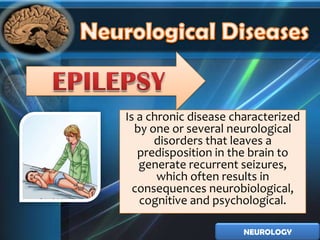
Is a chronic disease characterized
  by one or several neurological
      disorders that leaves a
   predisposition in the brain to
   generate recurrent seizures,
       which often results in
  consequences neurobiological,
   cognitive and psychological.

                       NEUROLOGY
SYMPTOMS
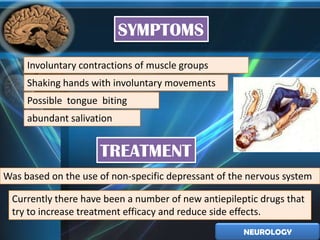
     Involuntary contractions of muscle groups
     Shaking hands with involuntary movements
     Possible tongue biting
     abundant salivation


                     TREATMENT
Was based on the use of non-specific depressant of the nervous system

 Currently there have been a number of new antiepileptic drugs that
 try to increase treatment efficacy and reduce side effects.
                                                     NEUROLOGY
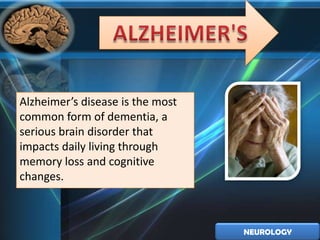
Alzheimer’s disease is the most
common form of dementia, a
serious brain disorder that
impacts daily living through
memory loss and cognitive
changes.


                                  NEUROLOGY
SYMPTOMS
At first, there are small and subtle memory loss, but over time, this deficiency is
becoming more noticeable. and disabling for the individual who will have trouble
performing everyday tasks and simple, and also other more intellectual, such as
speaking, understanding, reading, or writing.


                               TREATMENT
  At present, there is no cure for Alzheimer's disease. However, there are
  medications that can help control your symptoms


  There are four drugs                       Cholinesterase inhibitors slow
  used, called                               the metabolic degradation of
  cholinesterase inhibitors                  acetylcholine

                                                                 NEUROLOGY
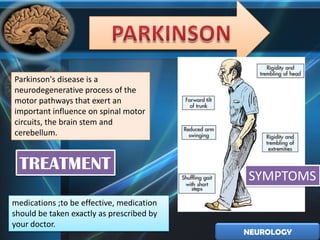
Parkinson's disease is a
neurodegenerative process of the
motor pathways that exert an
important influence on spinal motor
circuits, the brain stem and
cerebellum.


  TREATMENT
                                           SYMPTOMS
medications ;to be effective, medication
should be taken exactly as prescribed by
your doctor.
                                           NEUROLOGY
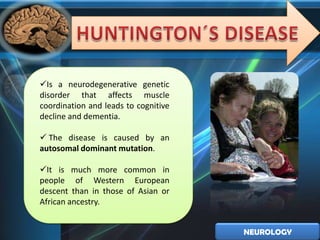
Is a neurodegenerative genetic
disorder that affects muscle
coordination and leads to cognitive
decline and dementia.

 The disease is caused by an
autosomal dominant mutation.

It is much more common in
people of Western European
descent than in those of Asian or
African ancestry.


                                      NEUROLOGY
SYMPTOMS AND SIGNS
   Quick, sudden
jerking movements
       of the
  arms, legs, face     impatience       Irritability
  and other body
       parts

                       Changes in     Disorientation
   Psychosis
                        language       or confusion


                     Loss of memory


                                             NEUROLOGY
TREATMENT


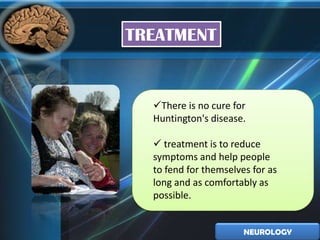
  There is no cure for
  Huntington's disease.

   treatment is to reduce
  symptoms and help people
  to fend for themselves for as
  long and as comfortably as
  possible.


                       NEUROLOGY
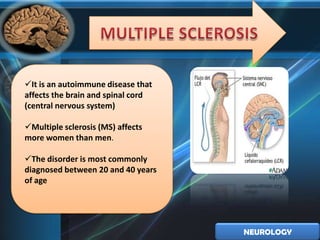
It is an autoimmune disease that
affects the brain and spinal cord
(central nervous system)

Multiple sclerosis (MS) affects
more women than men.

The disorder is most commonly
diagnosed between 20 and 40 years
of age


                                    NEUROLOGY
SYMPTOMS AND SIGNS


Loss of         Muscle       Problems with
balance         spasms          walking

                     uncontrollable
     Double vision     rapid eye
                      movements


                                NEUROLOGY
TREATMENT

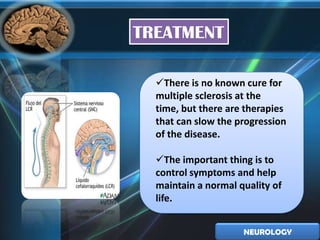
  There is no known cure for
  multiple sclerosis at the
  time, but there are therapies
  that can slow the progression
  of the disease.

  The important thing is to
  control symptoms and help
  maintain a normal quality of
  life.


                     NEUROLOGY
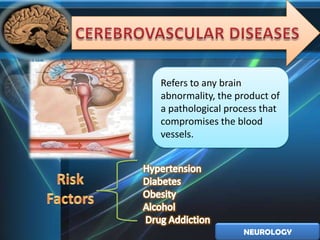
Refers to any brain
abnormality, the product of
a pathological process that
compromises the blood
vessels.


                  NEUROLOGY
SYMPTOMS AND SIGNS


Motor deficit.            Sensory deficit                Dizziness


 Headache         ataxia, incoordinación, temblor   Nausea and vomiting


                                                       NEUROLOGY
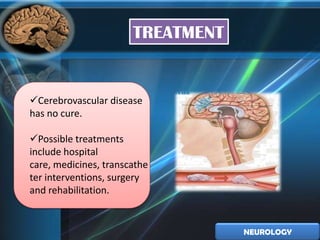
TREATMENT


Cerebrovascular disease
has no cure.

Possible treatments
include hospital
care, medicines, transcathe
ter interventions, surgery
and rehabilitation.


                                   NEUROLOGY
NEUROLOGY
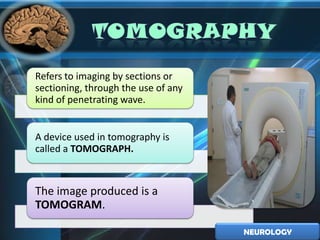
Refers to imaging by sections or
sectioning, through the use of any
kind of penetrating wave.


A device used in tomography is
called a TOMOGRAPH.


The image produced is a
TOMOGRAM.

                                     NEUROLOGY
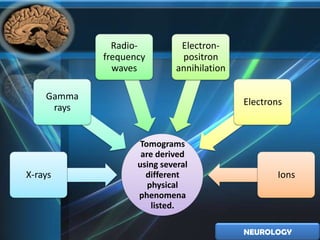
Radio-          Electron-
            frequency         positron
              waves          annihilation

    Gamma
                                            Electrons
     rays


                    Tomograms
                    are derived
                   using several
X-rays               different                      Ions
                      physical
                   phenomena
                       listed.

                                            NEUROLOGY
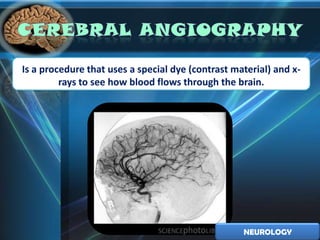
Is a procedure that uses a special dye (contrast material) and x-
         rays to see how blood flows through the brain.


                                                   NEUROLOGY
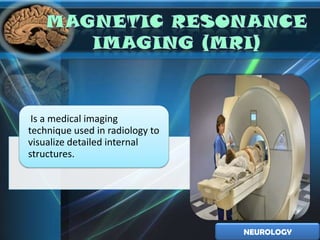
Is a medical imaging
technique used in radiology to
visualize detailed internal
structures.


                                 NEUROLOGY
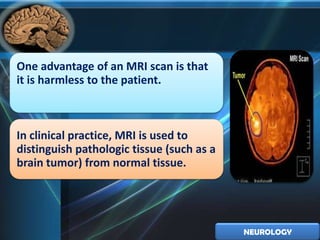
One advantage of an MRI scan is that
it is harmless to the patient.


In clinical practice, MRI is used to
distinguish pathologic tissue (such as a
brain tumor) from normal tissue.


                                           NEUROLOGY
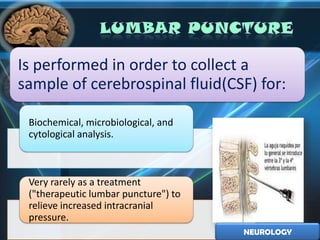
Is performed in order to collect a
sample of cerebrospinal fluid(CSF) for:

 Biochemical, microbiological, and
 cytological analysis.


 Very rarely as a treatment
 ("therapeutic lumbar puncture") to
 relieve increased intracranial
 pressure.
                                      NEUROLOGY
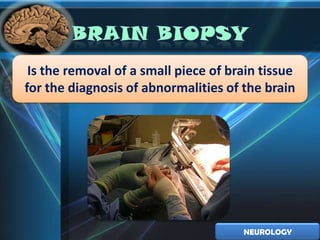
Is the removal of a small piece of brain tissue
for the diagnosis of abnormalities of the brain


                                      NEUROLOGY
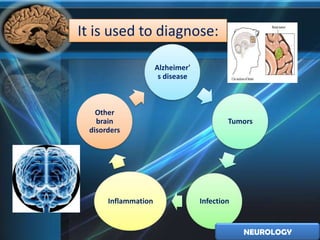
It is used to diagnose:

                     Alzheimer'
                      s disease


   Other
   brain                                  Tumors
 disorders


      Inflammation                Infection


                                              NEUROLOGY
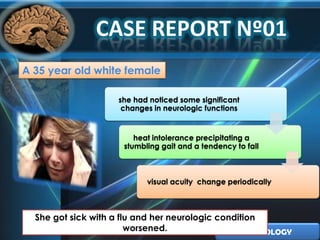
A 35 year old white female

                     she had noticed some significant
                      changes in neurologic functions


                         heat intolerance precipitating a
                      stumbling gait and a tendency to fall


                            visual acuity change periodically


  She got sick with a flu and her neurologic condition
                        worsened.                   NEUROLOGY
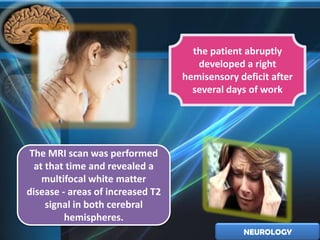
the patient abruptly
                                     developed a right
                                  hemisensory deficit after
                                    several days of work


The MRI scan was performed
  at that time and revealed a
    multifocal white matter
disease - areas of increased T2
     signal in both cerebral
         hemispheres.
                                               NEUROLOGY
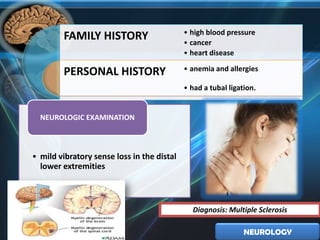
• high blood pressure
        FAMILY HISTORY                      • cancer
                                            • heart disease

        PERSONAL HISTORY                    • anemia and allergies

                                            • had a tubal ligation.


  NEUROLOGIC EXAMINATION


• mild vibratory sense loss in the distal
  lower extremities


                                              Diagnosis: Multiple Sclerosis

                                                               NEUROLOGY
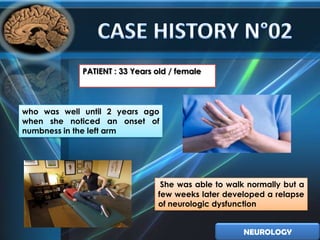
PATIENT : 33 Years old / female


who was well until 2 years ago
when she noticed an onset of
numbness in the left arm


                                 She was able to walk normally but a
                                few weeks later developed a relapse
                                of neurologic dysfunction


                                                     NEUROLOGY
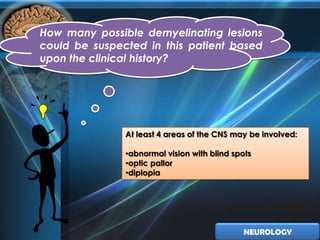
How many possible demyelinating lesions
could be suspected in this patient based
upon the clinical history?


               At least 4 areas of the CNS may be involved:

               •abnormal vision with blind spots
               •optic pallor
               •diplopia


                                              NEUROLOGY
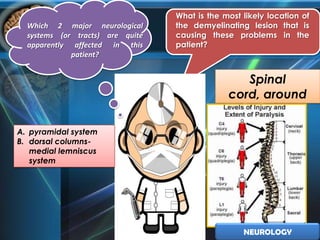
What is the most likely location of
  Which 2 major neurological      the demyelinating lesion that is
  systems (or tracts) are quite   causing these problems in the
  apparently affected in this     patient?
             patient?


                                                  Spinal
                                               cord, around
                                                   T4-T5
A. pyramidal system
B. dorsal columns-
   medial lemniscus
   system


                                                   NEUROLOGY
IN CONCLUSION , WHAT’S THE
MEDICAL DIAGNOSIS FOR THIS
PATIENT ?


                         NEUROLOGY
NEUROLOGY

Neurology

  • 2.
    Is a chronicdisease characterized by one or several neurological disorders that leaves a predisposition in the brain to generate recurrent seizures, which often results in consequences neurobiological, cognitive and psychological. NEUROLOGY
  • 3.
    SYMPTOMS Involuntary contractions of muscle groups Shaking hands with involuntary movements Possible tongue biting abundant salivation TREATMENT Was based on the use of non-specific depressant of the nervous system Currently there have been a number of new antiepileptic drugs that try to increase treatment efficacy and reduce side effects. NEUROLOGY
  • 4.
    Alzheimer’s disease isthe most common form of dementia, a serious brain disorder that impacts daily living through memory loss and cognitive changes. NEUROLOGY
  • 5.
    SYMPTOMS At first, thereare small and subtle memory loss, but over time, this deficiency is becoming more noticeable. and disabling for the individual who will have trouble performing everyday tasks and simple, and also other more intellectual, such as speaking, understanding, reading, or writing. TREATMENT At present, there is no cure for Alzheimer's disease. However, there are medications that can help control your symptoms There are four drugs Cholinesterase inhibitors slow used, called the metabolic degradation of cholinesterase inhibitors acetylcholine NEUROLOGY
  • 6.
    Parkinson's disease isa neurodegenerative process of the motor pathways that exert an important influence on spinal motor circuits, the brain stem and cerebellum. TREATMENT SYMPTOMS medications ;to be effective, medication should be taken exactly as prescribed by your doctor. NEUROLOGY
  • 7.
    Is a neurodegenerativegenetic disorder that affects muscle coordination and leads to cognitive decline and dementia.  The disease is caused by an autosomal dominant mutation. It is much more common in people of Western European descent than in those of Asian or African ancestry. NEUROLOGY
  • 8.
    SYMPTOMS AND SIGNS Quick, sudden jerking movements of the arms, legs, face impatience Irritability and other body parts Changes in Disorientation Psychosis language or confusion Loss of memory NEUROLOGY
  • 9.
    TREATMENT Thereis no cure for Huntington's disease.  treatment is to reduce symptoms and help people to fend for themselves for as long and as comfortably as possible. NEUROLOGY
  • 10.
    It is anautoimmune disease that affects the brain and spinal cord (central nervous system) Multiple sclerosis (MS) affects more women than men. The disorder is most commonly diagnosed between 20 and 40 years of age NEUROLOGY
  • 11.
    SYMPTOMS AND SIGNS Lossof Muscle Problems with balance spasms walking uncontrollable Double vision rapid eye movements NEUROLOGY
  • 12.
    TREATMENT Thereis no known cure for multiple sclerosis at the time, but there are therapies that can slow the progression of the disease. The important thing is to control symptoms and help maintain a normal quality of life. NEUROLOGY
  • 13.
    Refers to anybrain abnormality, the product of a pathological process that compromises the blood vessels. NEUROLOGY
  • 14.
    SYMPTOMS AND SIGNS Motordeficit. Sensory deficit Dizziness Headache ataxia, incoordinación, temblor Nausea and vomiting NEUROLOGY
  • 15.
    TREATMENT Cerebrovascular disease has nocure. Possible treatments include hospital care, medicines, transcathe ter interventions, surgery and rehabilitation. NEUROLOGY
  • 16.
  • 17.
    Refers to imagingby sections or sectioning, through the use of any kind of penetrating wave. A device used in tomography is called a TOMOGRAPH. The image produced is a TOMOGRAM. NEUROLOGY
  • 18.
    Radio- Electron- frequency positron waves annihilation Gamma Electrons rays Tomograms are derived using several X-rays different Ions physical phenomena listed. NEUROLOGY
  • 19.
    Is a procedurethat uses a special dye (contrast material) and x- rays to see how blood flows through the brain. NEUROLOGY
  • 20.
    Is a medicalimaging technique used in radiology to visualize detailed internal structures. NEUROLOGY
  • 21.
    One advantage ofan MRI scan is that it is harmless to the patient. In clinical practice, MRI is used to distinguish pathologic tissue (such as a brain tumor) from normal tissue. NEUROLOGY
  • 22.
    Is performed inorder to collect a sample of cerebrospinal fluid(CSF) for: Biochemical, microbiological, and cytological analysis. Very rarely as a treatment ("therapeutic lumbar puncture") to relieve increased intracranial pressure. NEUROLOGY
  • 23.
    Is the removalof a small piece of brain tissue for the diagnosis of abnormalities of the brain NEUROLOGY
  • 24.
    It is usedto diagnose: Alzheimer' s disease Other brain Tumors disorders Inflammation Infection NEUROLOGY
  • 25.
    A 35 yearold white female she had noticed some significant changes in neurologic functions heat intolerance precipitating a stumbling gait and a tendency to fall visual acuity change periodically She got sick with a flu and her neurologic condition worsened. NEUROLOGY
  • 26.
    the patient abruptly developed a right hemisensory deficit after several days of work The MRI scan was performed at that time and revealed a multifocal white matter disease - areas of increased T2 signal in both cerebral hemispheres. NEUROLOGY
  • 27.
    • high bloodpressure FAMILY HISTORY • cancer • heart disease PERSONAL HISTORY • anemia and allergies • had a tubal ligation. NEUROLOGIC EXAMINATION • mild vibratory sense loss in the distal lower extremities Diagnosis: Multiple Sclerosis NEUROLOGY
  • 28.
    PATIENT : 33Years old / female who was well until 2 years ago when she noticed an onset of numbness in the left arm She was able to walk normally but a few weeks later developed a relapse of neurologic dysfunction NEUROLOGY
  • 29.
    How many possibledemyelinating lesions could be suspected in this patient based upon the clinical history? At least 4 areas of the CNS may be involved: •abnormal vision with blind spots •optic pallor •diplopia NEUROLOGY
  • 30.
    What is themost likely location of Which 2 major neurological the demyelinating lesion that is systems (or tracts) are quite causing these problems in the apparently affected in this patient? patient? Spinal cord, around T4-T5 A. pyramidal system B. dorsal columns- medial lemniscus system NEUROLOGY
  • 31.
    IN CONCLUSION ,WHAT’S THE MEDICAL DIAGNOSIS FOR THIS PATIENT ? NEUROLOGY
  • 32.