Hi... I am Fractionstein.
Did you know that fractions
are not as scary as you might think?
Learn along with me
and you will be an expert
at fractions in no time at all!
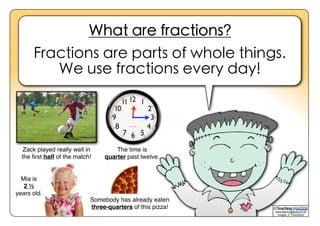
What are fractions?
Fractions are parts of whole things.
We use fractions every day!
The time is
quarter past twelve.
Somebody has already eaten
three-quarters of this pizza!
Zack played really well in
the first half of the match!
Mia is
2 ½
years old.
www.teachingpacks.co.uk
Images: © ThinkStock
©
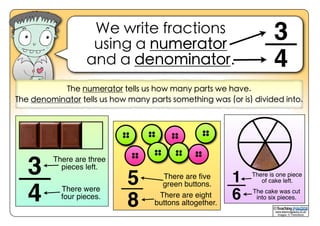
We write fractions
using a numerator
and a denominator.
3
4
The numerator tells us how many parts we have.
The denominator tells us how many parts something was (or is) divided into.
3
4
5
8
There is one piece
of cake left.
There are five
green buttons.
There are eight
buttons altogether.
1
6 The cake was cut
into six pieces.
There are three
pieces left.
There were
four pieces.
www.teachingpacks.co.uk
Images: © ThinkStock
©
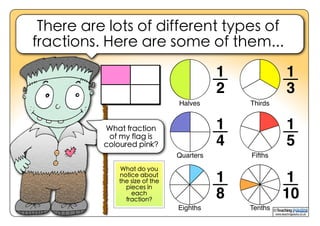
There are lots of different types of
fractions. Here are some of them...
What fraction
of my flag is
coloured pink?
Halves
Quarters
Eighths
Thirds
Fifths
Tenths
www.teachingpacks.co.uk
©
1
2
1
3
1
4
1
5
1
8
1
10
What do you
notice about
the size of the
pieces in
each
fraction?
www.teachingpacks.co.uk
©
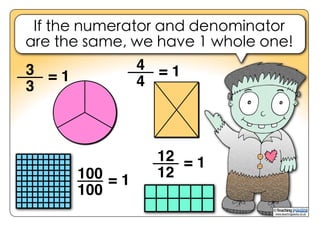
If the numerator and denominator
are the same, we have 1 whole one!
100
100
= 1
12
12
= 1
4
4
= 13
3
= 1
www.teachingpacks.co.uk
©
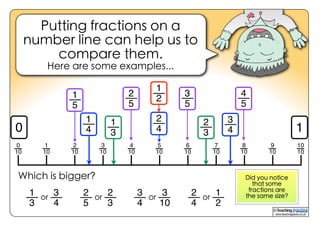
Putting fractions on a
number line can help us to
compare them.
Here are some examples...
Which is bigger?
2
40 1
1
4
3
4
1
2
1
3
2
3
1
10
2
10
3
10
4
10
5
10
6
10
7
10
8
10
9
10
10
10
0
10
1
5
2
5
3
5
4
5
1
3
3
4
or
2
5
2
3
or
3
4
3
10
or
2
4
1
2
or
Did you notice
that some
fractions are
the same size?
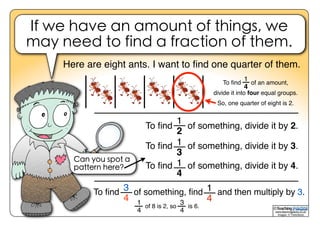
If we have an amount of things, we
may need to find a fraction of them.
Here are eight ants. I want to find one quarter of them.
To find of something, divide it by 2.
To find of something, divide it by 3.
To find of something, divide it by 4.
1
2
1
3
1
4
To find of an amount,
divide it into four equal groups.
So, one quarter of eight is 2.
1
4
Can you spot a
pattern here?
To find of something, find and then multiply by 3.3
4
1
41
4
of 8 is 2, so is 6.
3
4 www.teachingpacks.co.uk
Images: © ThinkStock
©
5
4
1
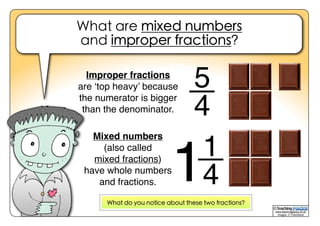
Mixed numbers
(also called
mixed fractions)
have whole numbers
and fractions.
Improper fractions
are ‘top heavy’ because
the numerator is bigger
than the denominator.
What are mixed numbers
and improper fractions?
1
4
What do you notice about these two fractions?
www.teachingpacks.co.uk
Images: © ThinkStock
©
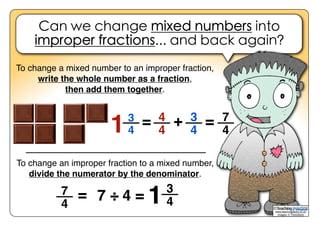
Can we change mixed numbers into
improper fractions... and back again?
www.teachingpacks.co.uk
Images: © ThinkStock
©
To change an improper fraction to a mixed number,
divide the numerator by the denominator.
To change a mixed number to an improper fraction,
write the whole number as a fraction,
then add them together.
4
4
3
4
7
4
+ =13
4
=
7
4
= 7 ÷ 4 =
3
41
www.teachingpacks.co.uk
©
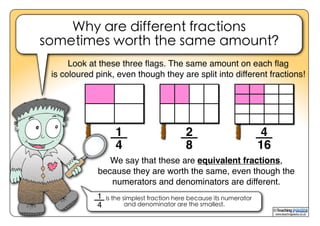
Why are different fractions
sometimes worth the same amount?
Look at these three flags. The same amount on each flag
is coloured pink, even though they are split into different fractions!
1
4
2
8
4
16
We say that these are equivalent fractions,
because they are worth the same, even though the
numerators and denominators are different.
is the simplest fraction here because its numerator
and denominator are the smallest.
1
4
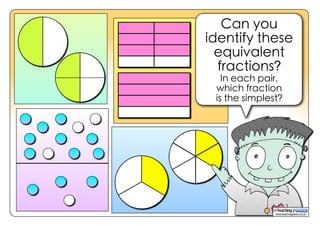
Can you
identify these
equivalent
fractions?
In each pair,
which fraction
is the simplest?
www.teachingpacks.co.uk
©
www.teachingpacks.co.uk
©
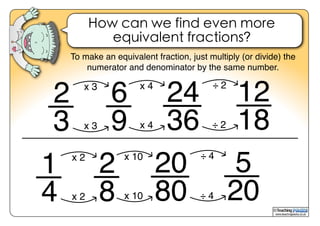
How can we find even more
equivalent fractions?
To make an equivalent fraction, just multiply (or divide) the
numerator and denominator by the same number.
2
3
6
9
24
36
12
18
x 3
x 3
x 4
x 4
÷ 2
÷ 2
1
4
2
8
20
80
5
20
x 2
x 2
x 10
x 10
÷ 4
÷ 4
www.teachingpacks.co.uk
©
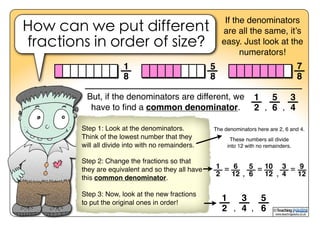
How can we put different
fractions in order of size?
If the denominators
are all the same, it’s
easy. Just look at the
numerators!
1
8
5
8
7
8
But, if the denominators are different, we
have to find a common denominator.
1
2
5
6
3
4
Step 1: Look at the denominators.
Think of the lowest number that they
will all divide into with no remainders.
Step 2: Change the fractions so that
they are equivalent and so they all have
this common denominator.
Step 3: Now, look at the new fractions
to put the original ones in order!
The denominators here are 2, 6 and 4.
These numbers all divide
into 12 with no remainders.
1
2
3
4
5
6
, ,
, ,
3
4
9
12
=5
6
10
12
=1
2
6
12
=
, ,
www.teachingpacks.co.uk
©
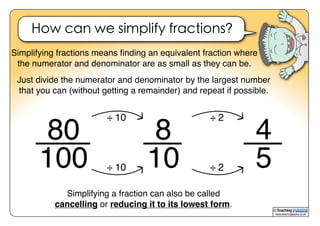
How can we simplify fractions?
Simplifying fractions means finding an equivalent fraction where
the numerator and denominator are as small as they can be.
8
10
÷ 10
÷ 10
Simplifying a fraction can also be called
cancelling or reducing it to its lowest form.
80
100
Just divide the numerator and denominator by the largest number
that you can (without getting a remainder) and repeat if possible.
4
5
÷ 2
÷ 2
www.teachingpacks.co.uk
©
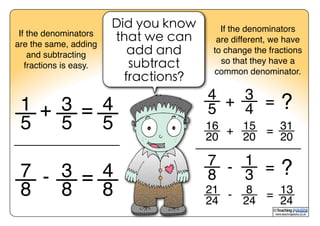
Did you know
that we can
add and
subtract
fractions?
If the denominators
are the same, adding
and subtracting
fractions is easy.
1
5
3
5
4
5
7
8
3
8
4
8
+ =
- =
If the denominators
are different, we have
to change the fractions
so that they have a
common denominator.
?+ =4
5
3
4
31
20
+ =16
20
15
20
?- =7
8
1
3
13
24
- =21
24
8
24
www.teachingpacks.co.uk
©
We can
multiply
and divide
fractions
too!
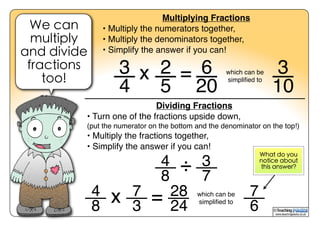
Multiplying Fractions
• Multiply the numerators together,
• Multiply the denominators together,
• Simplify the answer if you can!
3
4
2
5
6
20
x =
Dividing Fractions
• Turn one of the fractions upside down,
(put the numerator on the bottom and the denominator on the top!)
• Multiply the fractions together,
• Simplify the answer if you can!
3
10
which can be
simplified to
4
8
7
3
28
24
x = 7
6
which can be
simplified to
4
8
3
7
÷
What do you
notice about
this answer?
www.teachingpacks.co.uk
©
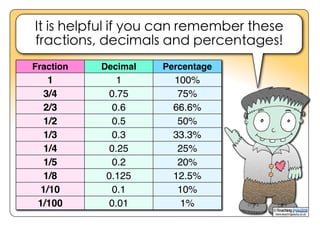
Fraction Decimal Percentage
1 1 100%
3/4 0.75 75%
2/3 0.6 66.6%
1/2 0.5 50%
1/3 0.3 33.3%
1/4 0.25 25%
1/5 0.2 20%
1/8 0.125 12.5%
1/10 0.1 10%
1/100 0.01 1%
It is helpful if you can remember these
fractions, decimals and percentages!

Fractions guide

  • 1.
    Hi... I amFractionstein. Did you know that fractions are not as scary as you might think? Learn along with me and you will be an expert at fractions in no time at all!
  • 2.
    What are fractions? Fractionsare parts of whole things. We use fractions every day! The time is quarter past twelve. Somebody has already eaten three-quarters of this pizza! Zack played really well in the first half of the match! Mia is 2 ½ years old. www.teachingpacks.co.uk Images: © ThinkStock ©
  • 3.
    We write fractions usinga numerator and a denominator. 3 4 The numerator tells us how many parts we have. The denominator tells us how many parts something was (or is) divided into. 3 4 5 8 There is one piece of cake left. There are five green buttons. There are eight buttons altogether. 1 6 The cake was cut into six pieces. There are three pieces left. There were four pieces. www.teachingpacks.co.uk Images: © ThinkStock ©
  • 4.
    There are lotsof different types of fractions. Here are some of them... What fraction of my flag is coloured pink? Halves Quarters Eighths Thirds Fifths Tenths www.teachingpacks.co.uk © 1 2 1 3 1 4 1 5 1 8 1 10 What do you notice about the size of the pieces in each fraction?
  • 5.
    www.teachingpacks.co.uk © If the numeratorand denominator are the same, we have 1 whole one! 100 100 = 1 12 12 = 1 4 4 = 13 3 = 1
  • 6.
    www.teachingpacks.co.uk © Putting fractions ona number line can help us to compare them. Here are some examples... Which is bigger? 2 40 1 1 4 3 4 1 2 1 3 2 3 1 10 2 10 3 10 4 10 5 10 6 10 7 10 8 10 9 10 10 10 0 10 1 5 2 5 3 5 4 5 1 3 3 4 or 2 5 2 3 or 3 4 3 10 or 2 4 1 2 or Did you notice that some fractions are the same size?
  • 7.
    If we havean amount of things, we may need to find a fraction of them. Here are eight ants. I want to find one quarter of them. To find of something, divide it by 2. To find of something, divide it by 3. To find of something, divide it by 4. 1 2 1 3 1 4 To find of an amount, divide it into four equal groups. So, one quarter of eight is 2. 1 4 Can you spot a pattern here? To find of something, find and then multiply by 3.3 4 1 41 4 of 8 is 2, so is 6. 3 4 www.teachingpacks.co.uk Images: © ThinkStock ©
  • 8.
    5 4 1 Mixed numbers (also called mixedfractions) have whole numbers and fractions. Improper fractions are ‘top heavy’ because the numerator is bigger than the denominator. What are mixed numbers and improper fractions? 1 4 What do you notice about these two fractions? www.teachingpacks.co.uk Images: © ThinkStock ©
  • 9.
    Can we changemixed numbers into improper fractions... and back again? www.teachingpacks.co.uk Images: © ThinkStock © To change an improper fraction to a mixed number, divide the numerator by the denominator. To change a mixed number to an improper fraction, write the whole number as a fraction, then add them together. 4 4 3 4 7 4 + =13 4 = 7 4 = 7 ÷ 4 = 3 41
  • 10.
    www.teachingpacks.co.uk © Why are differentfractions sometimes worth the same amount? Look at these three flags. The same amount on each flag is coloured pink, even though they are split into different fractions! 1 4 2 8 4 16 We say that these are equivalent fractions, because they are worth the same, even though the numerators and denominators are different. is the simplest fraction here because its numerator and denominator are the smallest. 1 4
  • 11.
    Can you identify these equivalent fractions? Ineach pair, which fraction is the simplest? www.teachingpacks.co.uk ©
  • 12.
    www.teachingpacks.co.uk © How can wefind even more equivalent fractions? To make an equivalent fraction, just multiply (or divide) the numerator and denominator by the same number. 2 3 6 9 24 36 12 18 x 3 x 3 x 4 x 4 ÷ 2 ÷ 2 1 4 2 8 20 80 5 20 x 2 x 2 x 10 x 10 ÷ 4 ÷ 4
  • 13.
    www.teachingpacks.co.uk © How can weput different fractions in order of size? If the denominators are all the same, it’s easy. Just look at the numerators! 1 8 5 8 7 8 But, if the denominators are different, we have to find a common denominator. 1 2 5 6 3 4 Step 1: Look at the denominators. Think of the lowest number that they will all divide into with no remainders. Step 2: Change the fractions so that they are equivalent and so they all have this common denominator. Step 3: Now, look at the new fractions to put the original ones in order! The denominators here are 2, 6 and 4. These numbers all divide into 12 with no remainders. 1 2 3 4 5 6 , , , , 3 4 9 12 =5 6 10 12 =1 2 6 12 = , ,
  • 14.
    www.teachingpacks.co.uk © How can wesimplify fractions? Simplifying fractions means finding an equivalent fraction where the numerator and denominator are as small as they can be. 8 10 ÷ 10 ÷ 10 Simplifying a fraction can also be called cancelling or reducing it to its lowest form. 80 100 Just divide the numerator and denominator by the largest number that you can (without getting a remainder) and repeat if possible. 4 5 ÷ 2 ÷ 2
  • 15.
    www.teachingpacks.co.uk © Did you know thatwe can add and subtract fractions? If the denominators are the same, adding and subtracting fractions is easy. 1 5 3 5 4 5 7 8 3 8 4 8 + = - = If the denominators are different, we have to change the fractions so that they have a common denominator. ?+ =4 5 3 4 31 20 + =16 20 15 20 ?- =7 8 1 3 13 24 - =21 24 8 24
  • 16.
    www.teachingpacks.co.uk © We can multiply and divide fractions too! MultiplyingFractions • Multiply the numerators together, • Multiply the denominators together, • Simplify the answer if you can! 3 4 2 5 6 20 x = Dividing Fractions • Turn one of the fractions upside down, (put the numerator on the bottom and the denominator on the top!) • Multiply the fractions together, • Simplify the answer if you can! 3 10 which can be simplified to 4 8 7 3 28 24 x = 7 6 which can be simplified to 4 8 3 7 ÷ What do you notice about this answer?
  • 17.
    www.teachingpacks.co.uk © Fraction Decimal Percentage 11 100% 3/4 0.75 75% 2/3 0.6 66.6% 1/2 0.5 50% 1/3 0.3 33.3% 1/4 0.25 25% 1/5 0.2 20% 1/8 0.125 12.5% 1/10 0.1 10% 1/100 0.01 1% It is helpful if you can remember these fractions, decimals and percentages!