Romanesque and Gothic
Art
Romanesque and Gothic are types of European Medieval art and architecture.
The term “Romanesque” was coined in the 19th
century.
It means “in the manner of the Romans” and refers to the influence of ancient
Roman art on European art and architecture from about 1000 – 1200 CE.
Romanesque art is closely followed in time and place by Gothic art.
The term “Gothic” was coined during the Renaissance, around 1550, by early art
historian Giorgio Vasari. He felt that this art was so “monstrous and barbarous”
that it evoked the uncouth Goth tribe that led to the downfall of Rome. This style
in art and architecture lasted from about 1150 – 1375 CE.
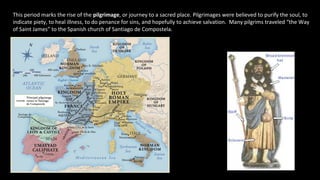
This period marks the rise of the pilgrimage, or journey to a sacred place. Pilgrimages were believed to purify the soul, to
indicate piety, to heal illness, to do penance for sins, and hopefully to achieve salvation. Many pilgrims traveled “the Way
of Saint James” to the Spanish church of Santiago de Compostela.
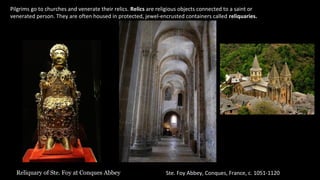
Reliquary of Ste. Foy at Conques Abbey Ste. Foy Abbey, Conques, France, c. 1051-1120
Pilgrims go to churches and venerate their relics. Relics are religious objects connected to a saint or
venerated person. They are often housed in protected, jewel-encrusted containers called reliquaries.
Arm Reliquary, Belgium, c. 1230
"It is not an impure idol that receives the worship
of an oracle or of sacrifice, it is a pious memorial,
before which the faithful heart feels more easily
and more strongly touched by solemnity, and
implores more fervently the powerful intercession
of the saint for its sins.“ – Bernard of Angers, 11th
century
A speaking reliquary is shaped
like the body part that it is said
to contain.
X-ray image showing a human arm bone
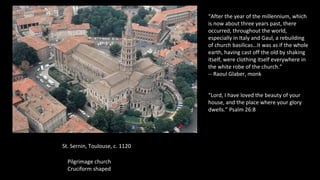
St. Sernin, Toulouse, c. 1120
Pilgrimage church
Cruciform shaped
“After the year of the millennium, which
is now about three years past, there
occurred, throughout the world,
especially in Italy and Gaul, a rebuilding
of church basilicas…It was as if the whole
earth, having cast off the old by shaking
itself, were clothing itself everywhere in
the white robe of the church.”
-- Raoul Glaber, monk
“Lord, I have loved the beauty of your
house, and the place where your glory
dwells.” Psalm 26:8
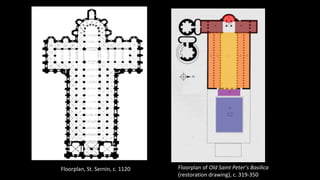
Floorplan, St. Sernin, c. 1120 Floorplan of Old Saint Peter’s Basilica
(restoration drawing), c. 319-350
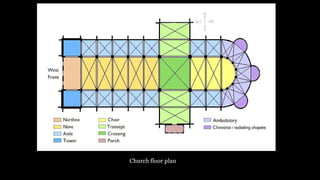
Church floor plan
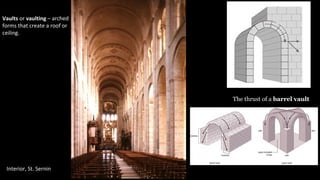
Interior, St. Sernin
The thrust of a barrel vault
Vaults or vaulting – arched
forms that create a roof or
ceiling.
St. Sernin, Toulouse, c. 1120
Pont du Gard, near Nîmes, France, ca. 1-10 CE
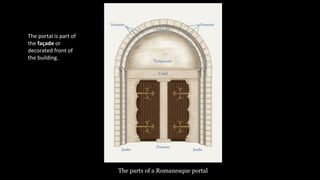
The parts of a Romanesque portal
The portal is part of
the façade or
decorated front of
the building.
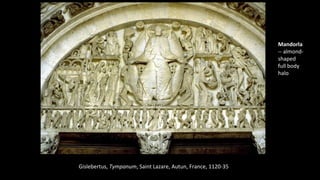
Gislebertus, Tympanum, Saint Lazare, Autun, France, 1120-35
Mandorla
-- almond-
shaped
full body
halo
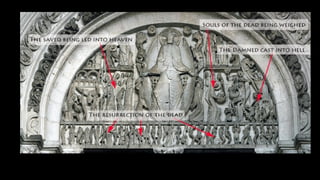
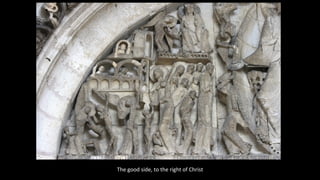
The good side, to the right of Christ
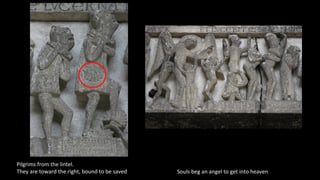
Pilgrims from the lintel.
They are toward the right, bound to be saved Souls beg an angel to get into heaven
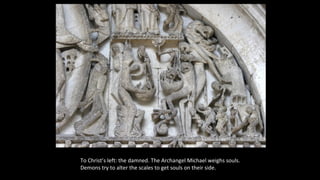
To Christ’s left: the damned. The Archangel Michael weighs souls.
Demons try to alter the scales to get souls on their side.
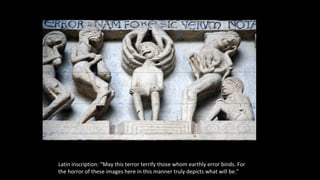
Latin inscription: “May this terror terrify those whom earthly error binds. For
the horror of these images here in this manner truly depicts what will be.”
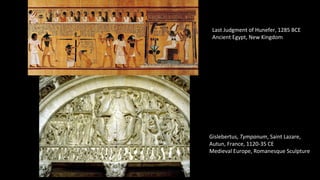
Last Judgment of Hunefer, 1285 BCE
Ancient Egypt, New Kingdom
Gislebertus, Tympanum, Saint Lazare,
Autun, France, 1120-35 CE
Medieval Europe, Romanesque Sculpture
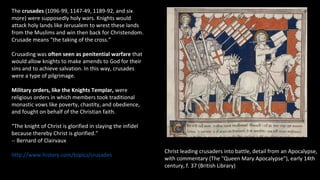
Christ leading crusaders into battle, detail from an Apocalypse,
with commentary (The "Queen Mary Apocalypse"), early 14th
century, f. 37 (British Library)
The crusades (1096-99, 1147-49, 1189-92, and six
more) were supposedly holy wars. Knights would
attack holy lands like Jerusalem to wrest these lands
from the Muslims and win then back for Christendom.
Crusade means “the taking of the cross.”
Crusading was often seen as penitential warfare that
would allow knights to make amends to God for their
sins and to achieve salvation. In this way, crusades
were a type of pilgrimage.
Military orders, like the Knights Templar, were
religious orders in which members took traditional
monastic vows like poverty, chastity, and obedience,
and fought on behalf of the Christian faith.
“The knight of Christ is glorified in slaying the infidel
because thereby Christ is glorified.”
-- Bernard of Clairvaux
http://www.history.com/topics/crusades
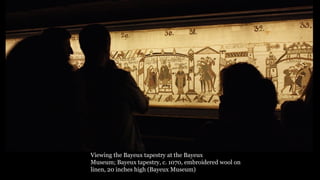
Viewing the Bayeux tapestry at the Bayeux
Museum; Bayeux tapestry, c. 1070, embroidered wool on
linen, 20 inches high (Bayeux Museum)
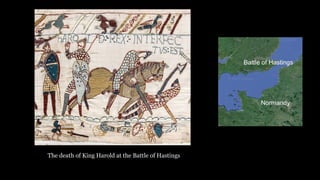
The death of King Harold at the Battle of Hastings
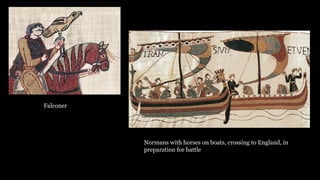
Falconer
Normans with horses on boats, crossing to England, in
preparation for battle
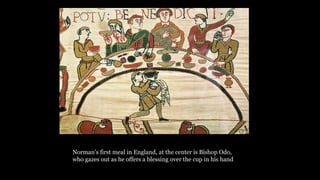
Norman’s first meal in England, at the center is Bishop Odo,
who gazes out as he offers a blessing over the cup in his hand
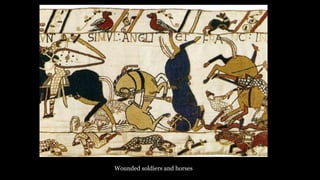
Wounded soldiers and horses
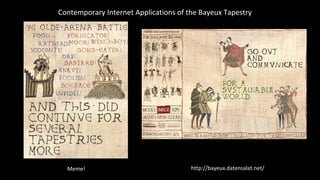
Meme!
Contemporary Internet Applications of the Bayeux Tapestry
http://bayeux.datensalat.net/
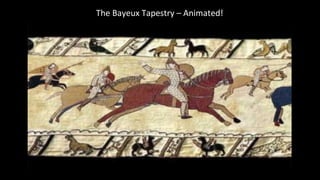
The Bayeux Tapestry – Animated!
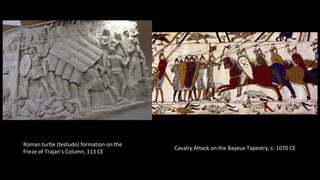
Roman turtle (testudo) formation on the
frieze of Trajan’s Column, 113 CE
Cavalry Attack on the Bayeux Tapestry, c. 1070 CE
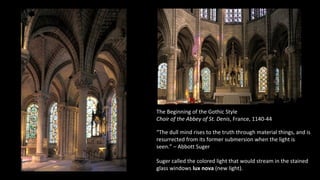
The Beginning of the Gothic Style
Choir of the Abbey of St. Denis, France, 1140-44
“The dull mind rises to the truth through material things, and is
resurrected from its former submersion when the light is
seen.” – Abbott Suger
Suger called the colored light that would stream in the stained
glass windows lux nova (new light).
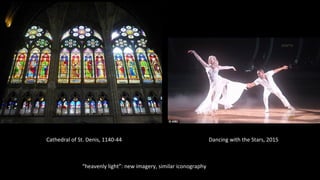
“heavenly light”: new imagery, similar iconography
Cathedral of St. Denis, 1140-44 Dancing with the Stars, 2015
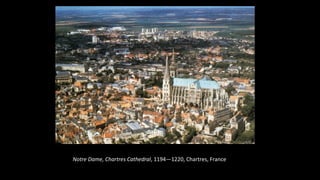
Notre Dame, Chartres Cathedral, 1194—1220, Chartres, France
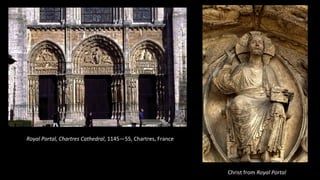
Royal Portal, Chartres Cathedral, 1145—55, Chartres, France
Christ from Royal Portal
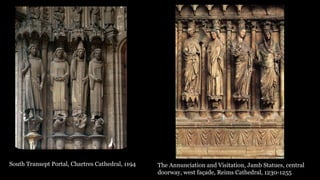
South Transept Portal, Chartres Cathedral, 1194 The Annunciation and Visitation, Jamb Statues, central
doorway, west façade, Reims Cathedral, 1230-1255
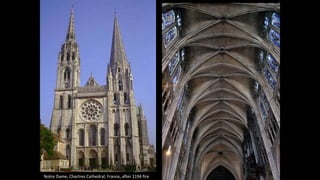
Notre Dame, Chartres Cathedral, France, after 1194 fire
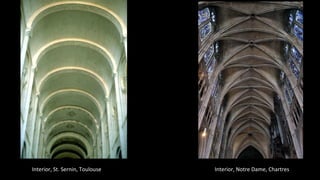
Interior, St. Sernin, Toulouse Interior, Notre Dame, Chartres
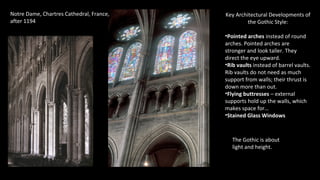
Notre Dame, Chartres Cathedral, France,
after 1194
Key Architectural Developments of
the Gothic Style:
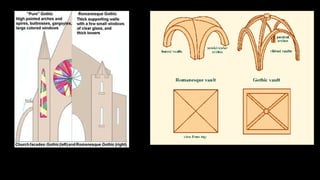
•Pointed arches instead of round
arches. Pointed arches are
stronger and look taller. They
direct the eye upward.
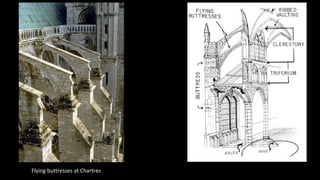
•Rib vaults instead of barrel vaults.
Rib vaults do not need as much
support from walls; their thrust is
down more than out.
•Flying buttresses – external
supports hold up the walls, which
makes space for…
•Stained Glass Windows
The Gothic is about
light and height.
Flying buttresses at Chartres
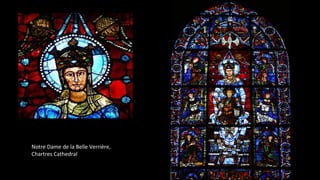
Notre Dame de la Belle Verrière,
Chartres Cathedral
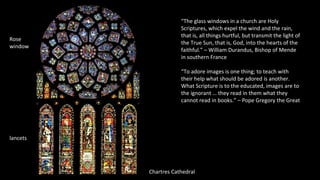
Chartres Cathedral
Rose
window
lancets
“The glass windows in a church are Holy
Scriptures, which expel the wind and the rain,
that is, all things hurtful, but transmit the light of
the True Sun, that is, God, into the hearts of the
faithful.” – William Durandus, Bishop of Mende
in southern France
“To adore images is one thing; to teach with
their help what should be adored is another.
What Scripture is to the educated, images are to
the ignorant … they read in them what they
cannot read in books.” – Pope Gregory the Great
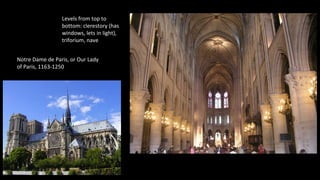
Levels from top to
bottom: clerestory (has
windows, lets in light),
triforium, nave
Notre Dame de Paris, or Our Lady
of Paris, 1163-1250
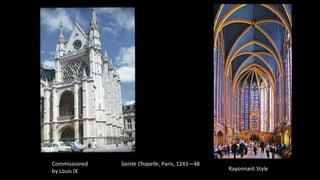
Sainte Chapelle, Paris, 1243—48Commissioned
by Louis IX Rayonnant Style
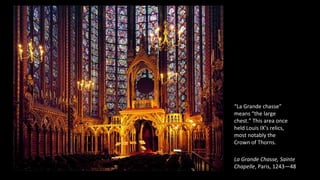
La Grande Chasse, Sainte
Chapelle, Paris, 1243—48
“La Grande chasse”
means “the large
chest.” This area once
held Louis IX’s relics,
most notably the
Crown of Thorns.
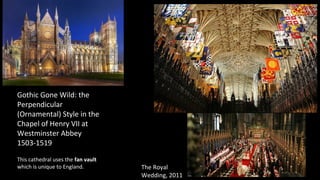
Gothic Gone Wild: the
Perpendicular
(Ornamental) Style in the
Chapel of Henry VII at
Westminster Abbey
1503-1519
The Royal
Wedding, 2011
This cathedral uses the fan vault
which is unique to England.
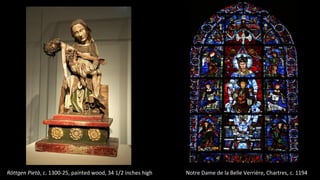
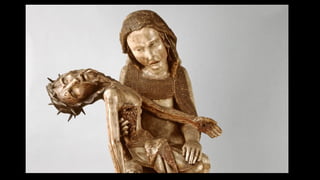
Röttgen Pietà, c. 1300-25, painted wood, 34 1/2 inches high Notre Dame de la Belle Verrière, Chartres, c. 1194
Romanesque and Gothic art

Romanesque and Gothic art

  • 1.
    Romanesque and Gothic Art Romanesqueand Gothic are types of European Medieval art and architecture. The term “Romanesque” was coined in the 19th century. It means “in the manner of the Romans” and refers to the influence of ancient Roman art on European art and architecture from about 1000 – 1200 CE. Romanesque art is closely followed in time and place by Gothic art. The term “Gothic” was coined during the Renaissance, around 1550, by early art historian Giorgio Vasari. He felt that this art was so “monstrous and barbarous” that it evoked the uncouth Goth tribe that led to the downfall of Rome. This style in art and architecture lasted from about 1150 – 1375 CE.
  • 2.
    This period marksthe rise of the pilgrimage, or journey to a sacred place. Pilgrimages were believed to purify the soul, to indicate piety, to heal illness, to do penance for sins, and hopefully to achieve salvation. Many pilgrims traveled “the Way of Saint James” to the Spanish church of Santiago de Compostela.
  • 3.
    Reliquary of Ste.Foy at Conques Abbey Ste. Foy Abbey, Conques, France, c. 1051-1120 Pilgrims go to churches and venerate their relics. Relics are religious objects connected to a saint or venerated person. They are often housed in protected, jewel-encrusted containers called reliquaries.
  • 4.
    Arm Reliquary, Belgium,c. 1230 "It is not an impure idol that receives the worship of an oracle or of sacrifice, it is a pious memorial, before which the faithful heart feels more easily and more strongly touched by solemnity, and implores more fervently the powerful intercession of the saint for its sins.“ – Bernard of Angers, 11th century A speaking reliquary is shaped like the body part that it is said to contain. X-ray image showing a human arm bone
  • 5.
    St. Sernin, Toulouse,c. 1120 Pilgrimage church Cruciform shaped “After the year of the millennium, which is now about three years past, there occurred, throughout the world, especially in Italy and Gaul, a rebuilding of church basilicas…It was as if the whole earth, having cast off the old by shaking itself, were clothing itself everywhere in the white robe of the church.” -- Raoul Glaber, monk “Lord, I have loved the beauty of your house, and the place where your glory dwells.” Psalm 26:8
  • 6.
    Floorplan, St. Sernin,c. 1120 Floorplan of Old Saint Peter’s Basilica (restoration drawing), c. 319-350
  • 7.
  • 8.
    Interior, St. Sernin Thethrust of a barrel vault Vaults or vaulting – arched forms that create a roof or ceiling.
  • 9.
    St. Sernin, Toulouse,c. 1120 Pont du Gard, near Nîmes, France, ca. 1-10 CE
  • 10.
    The parts ofa Romanesque portal The portal is part of the façade or decorated front of the building.
  • 11.
    Gislebertus, Tympanum, SaintLazare, Autun, France, 1120-35 Mandorla -- almond- shaped full body halo
  • 13.
    The good side,to the right of Christ
  • 14.
    Pilgrims from thelintel. They are toward the right, bound to be saved Souls beg an angel to get into heaven
  • 15.
    To Christ’s left:the damned. The Archangel Michael weighs souls. Demons try to alter the scales to get souls on their side.
  • 16.
    Latin inscription: “Maythis terror terrify those whom earthly error binds. For the horror of these images here in this manner truly depicts what will be.”
  • 18.
    Last Judgment ofHunefer, 1285 BCE Ancient Egypt, New Kingdom Gislebertus, Tympanum, Saint Lazare, Autun, France, 1120-35 CE Medieval Europe, Romanesque Sculpture
  • 19.
    Christ leading crusadersinto battle, detail from an Apocalypse, with commentary (The "Queen Mary Apocalypse"), early 14th century, f. 37 (British Library) The crusades (1096-99, 1147-49, 1189-92, and six more) were supposedly holy wars. Knights would attack holy lands like Jerusalem to wrest these lands from the Muslims and win then back for Christendom. Crusade means “the taking of the cross.” Crusading was often seen as penitential warfare that would allow knights to make amends to God for their sins and to achieve salvation. In this way, crusades were a type of pilgrimage. Military orders, like the Knights Templar, were religious orders in which members took traditional monastic vows like poverty, chastity, and obedience, and fought on behalf of the Christian faith. “The knight of Christ is glorified in slaying the infidel because thereby Christ is glorified.” -- Bernard of Clairvaux http://www.history.com/topics/crusades
  • 20.
    Viewing the Bayeuxtapestry at the Bayeux Museum; Bayeux tapestry, c. 1070, embroidered wool on linen, 20 inches high (Bayeux Museum)
  • 21.
    The death ofKing Harold at the Battle of Hastings
  • 22.
    Falconer Normans with horseson boats, crossing to England, in preparation for battle
  • 23.
    Norman’s first mealin England, at the center is Bishop Odo, who gazes out as he offers a blessing over the cup in his hand
  • 24.
  • 25.
    Meme! Contemporary Internet Applicationsof the Bayeux Tapestry http://bayeux.datensalat.net/
  • 26.
    The Bayeux Tapestry– Animated!
  • 27.
    Roman turtle (testudo)formation on the frieze of Trajan’s Column, 113 CE Cavalry Attack on the Bayeux Tapestry, c. 1070 CE
  • 28.
    The Beginning ofthe Gothic Style Choir of the Abbey of St. Denis, France, 1140-44 “The dull mind rises to the truth through material things, and is resurrected from its former submersion when the light is seen.” – Abbott Suger Suger called the colored light that would stream in the stained glass windows lux nova (new light).
  • 29.
    “heavenly light”: newimagery, similar iconography Cathedral of St. Denis, 1140-44 Dancing with the Stars, 2015
  • 30.
    Notre Dame, ChartresCathedral, 1194—1220, Chartres, France
  • 31.
    Royal Portal, ChartresCathedral, 1145—55, Chartres, France Christ from Royal Portal
  • 32.
    South Transept Portal,Chartres Cathedral, 1194 The Annunciation and Visitation, Jamb Statues, central doorway, west façade, Reims Cathedral, 1230-1255
  • 33.
    Notre Dame, ChartresCathedral, France, after 1194 fire
  • 34.
    Interior, St. Sernin,Toulouse Interior, Notre Dame, Chartres
  • 35.
    Notre Dame, ChartresCathedral, France, after 1194 Key Architectural Developments of the Gothic Style: •Pointed arches instead of round arches. Pointed arches are stronger and look taller. They direct the eye upward. •Rib vaults instead of barrel vaults. Rib vaults do not need as much support from walls; their thrust is down more than out. •Flying buttresses – external supports hold up the walls, which makes space for… •Stained Glass Windows The Gothic is about light and height.
  • 37.
  • 38.
    Notre Dame dela Belle Verrière, Chartres Cathedral
  • 39.
    Chartres Cathedral Rose window lancets “The glasswindows in a church are Holy Scriptures, which expel the wind and the rain, that is, all things hurtful, but transmit the light of the True Sun, that is, God, into the hearts of the faithful.” – William Durandus, Bishop of Mende in southern France “To adore images is one thing; to teach with their help what should be adored is another. What Scripture is to the educated, images are to the ignorant … they read in them what they cannot read in books.” – Pope Gregory the Great
  • 40.
    Levels from topto bottom: clerestory (has windows, lets in light), triforium, nave Notre Dame de Paris, or Our Lady of Paris, 1163-1250
  • 41.
    Sainte Chapelle, Paris,1243—48Commissioned by Louis IX Rayonnant Style
  • 42.
    La Grande Chasse,Sainte Chapelle, Paris, 1243—48 “La Grande chasse” means “the large chest.” This area once held Louis IX’s relics, most notably the Crown of Thorns.
  • 43.
    Gothic Gone Wild:the Perpendicular (Ornamental) Style in the Chapel of Henry VII at Westminster Abbey 1503-1519 The Royal Wedding, 2011 This cathedral uses the fan vault which is unique to England.
  • 44.
    Röttgen Pietà, c.1300-25, painted wood, 34 1/2 inches high Notre Dame de la Belle Verrière, Chartres, c. 1194