
Romanesque
Art 431-459 (Ch. 17)
11/18 Warm-Up
• If you had a
cathedral…What
modern-day celebrity or
person of interest would
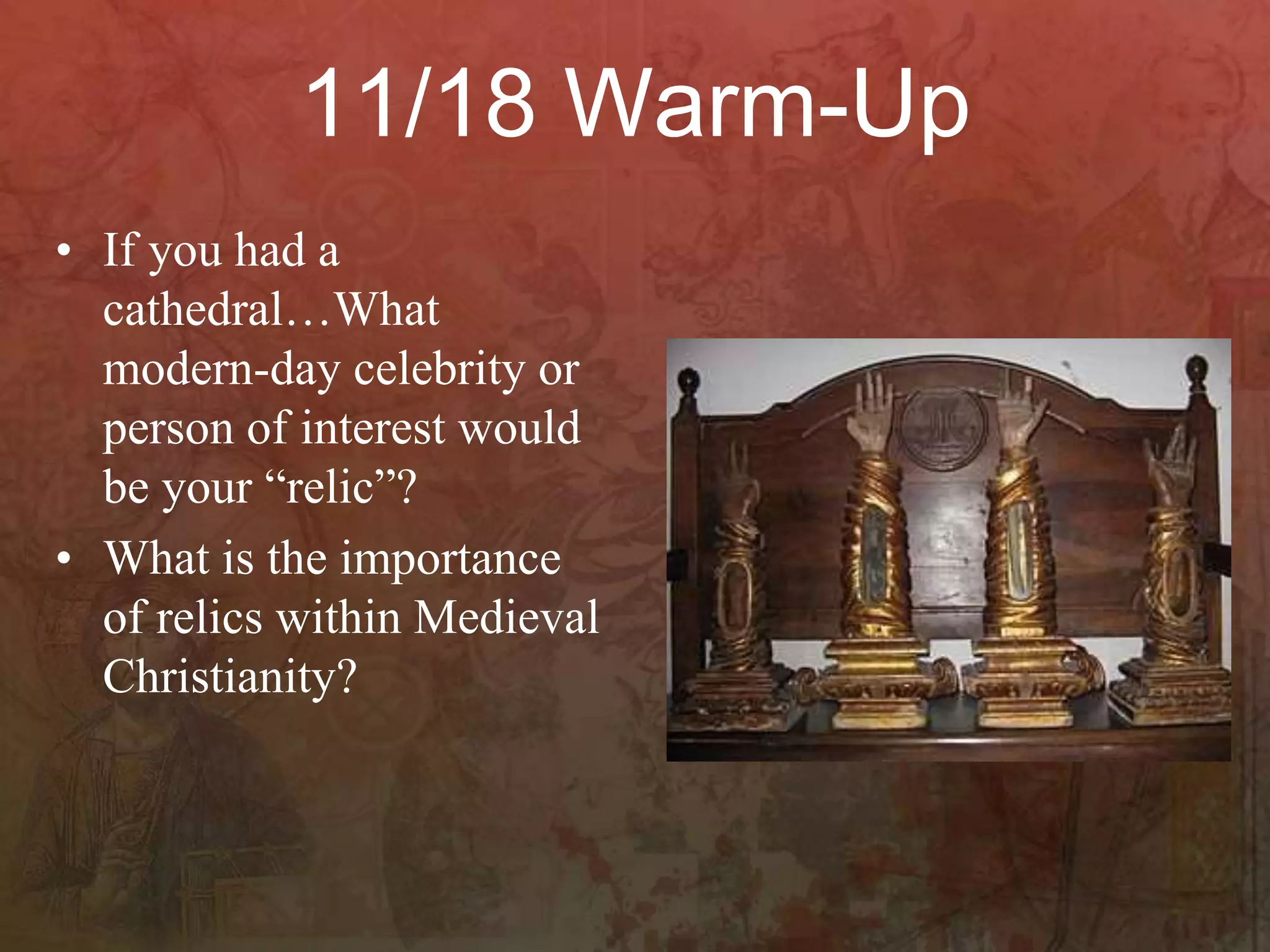
be your “relic”?
• What is the importance
of relics within Medieval
Christianity?
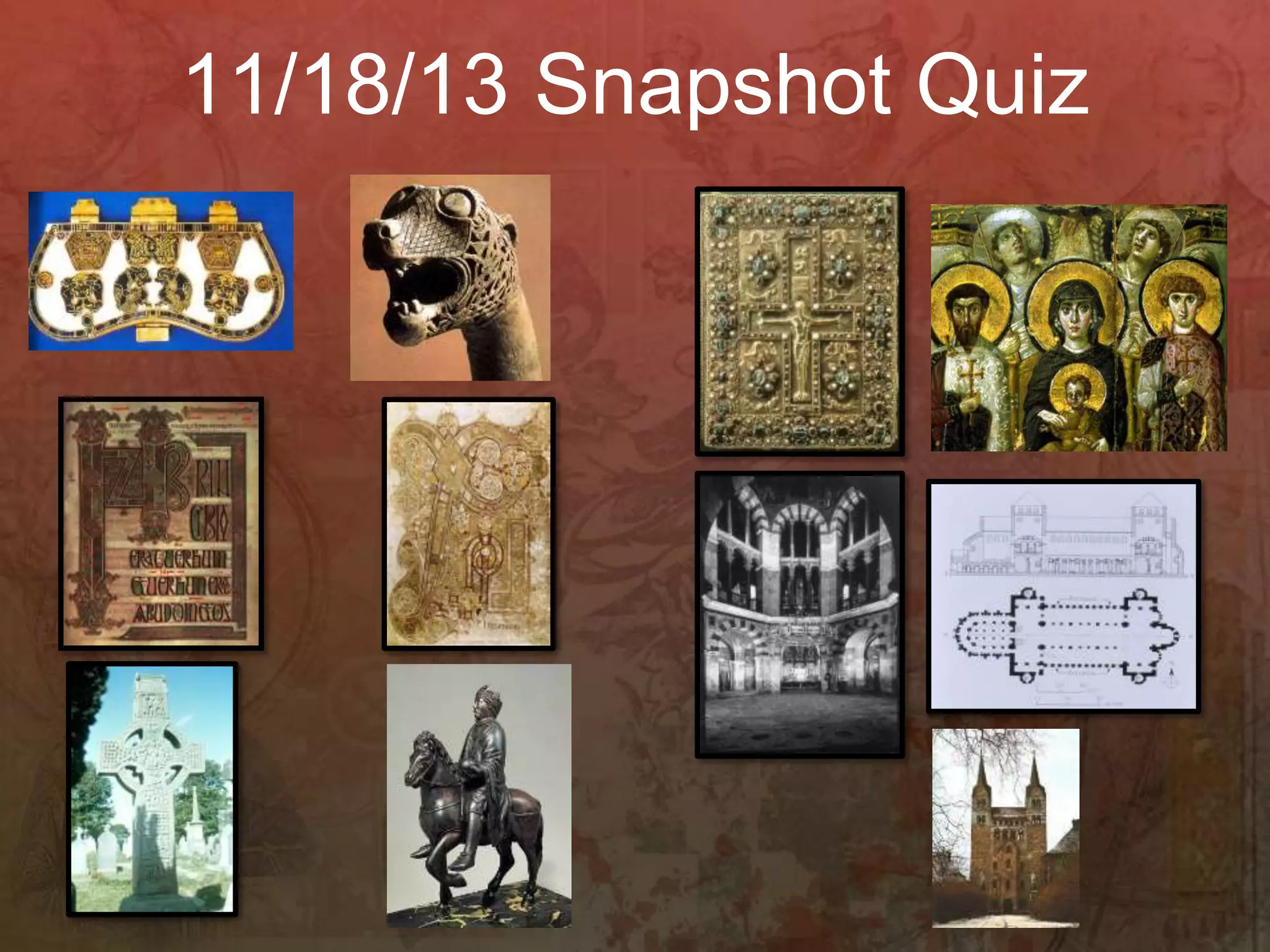
11/18/13 Snapshot Quiz
Romanesque
Architecture
and Sculpture
11th and 12th
Century France
ROMANESQUE ARCHITECTURE 1000 - 1140
The term Romanesque ("Roman-like") was first used to
designate a style of architecture that used Roman arches and
had thick, heavy walls, based upon the basilica. The style is
pervasive throughout Europe.
Arch of Titus 81 AD Plan of a Roman Basilica
• Immense relief that the world had not ended at the
turn of the millennium
• The resurgence of cities and trade
• The emergence of Europe as we know it
• The strengthened authority of the Pope
• The emergence of a middle class and merchant class
• The evolution of the Romance languages
• The peak of feudalism as a political system
The Romanesque Era is marked by:
Nave of St. Savin. Poitou, France c. 1100
• Monasteries housed the relics of saints, and
during the Romanesque period the cult of
relics became a major cultural factor
influencing architecture.
• Devout Christians would undertake long
pilgrimages in order to visit and venerate the
relics of saints and martyrs.
• People traveled widely to visit sites
and see relics because they believed
them to have curative powers.
• The large numbers of travelers created
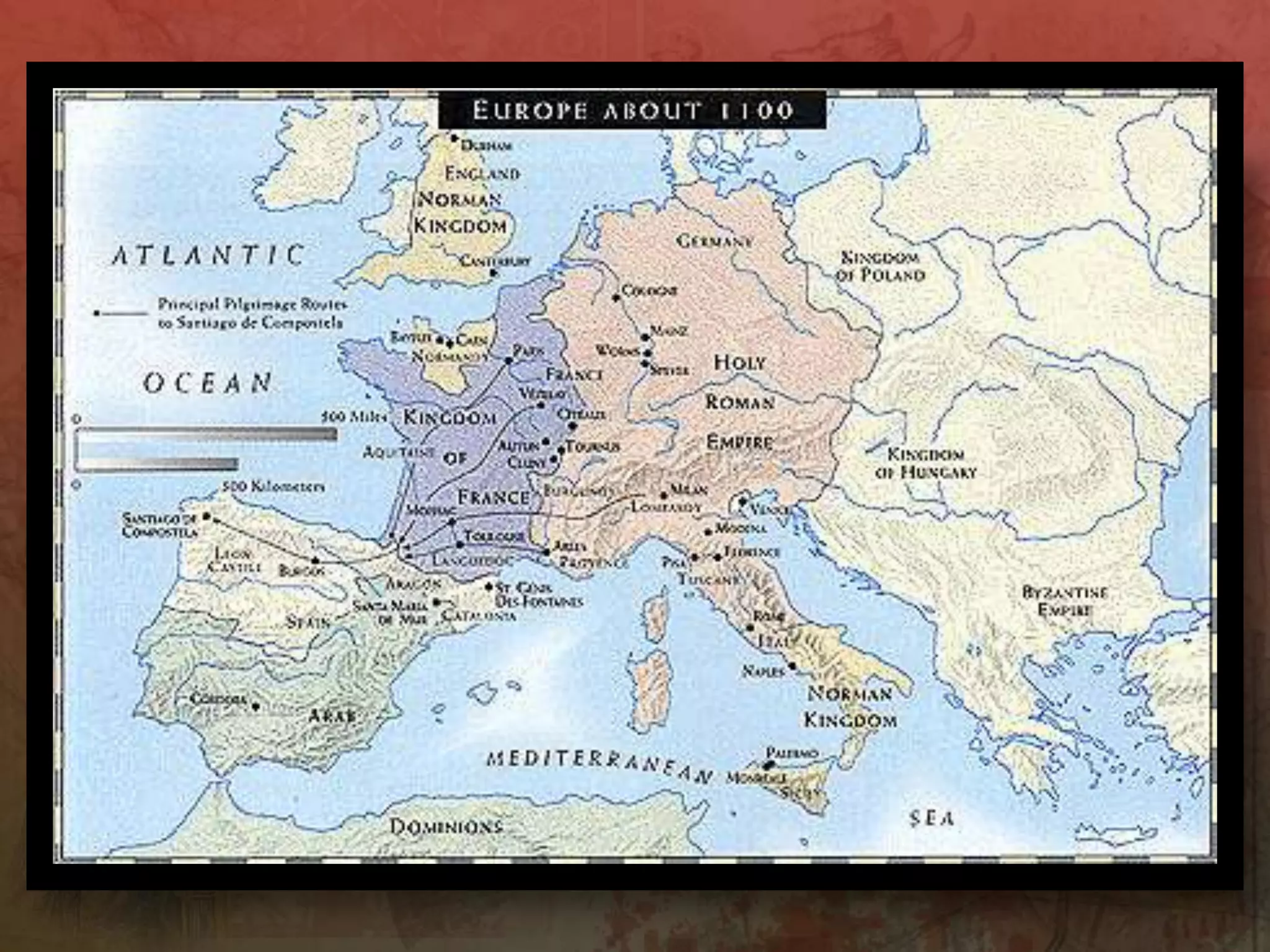
standard routes from one monastery to another:
“Pilgrimage Roads” became routes of
trade/commerce as well as travel.
The Great Age of
Monasteries
Pilgrimage Routes to Santiago de Compostella
• San Sernin, in Toulouse, is a typical
pilgrimage church in the Burgundian
style.
• The floor plan is a Latin cross with
clearly defined parts.
• It is modeled on a basilica plan
modified for large crowds to provide a
large apse.
• The square of the crossing is the
module for the rest of the plan:
½ (crossing square) = 1 (bayside aisle)
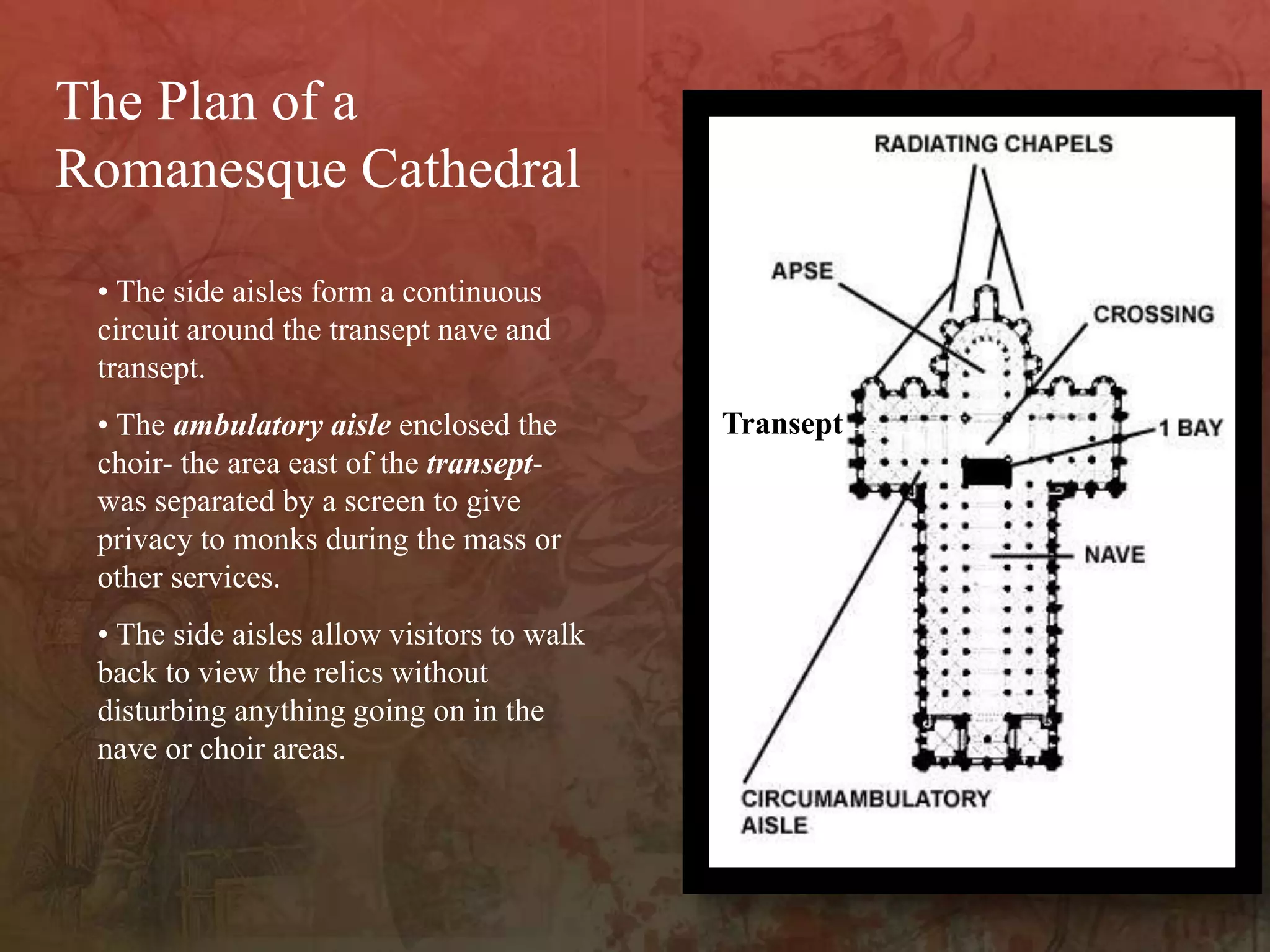
The Plan of a
Romanesque Cathedral
• The side aisles form a continuous
circuit around the transept nave and
transept.
• The ambulatory aisle enclosed the
choir- the area east of the transept-
was separated by a screen to give
privacy to monks during the mass or
other services.
• The side aisles allow visitors to walk
back to view the relics without
disturbing anything going on in the
nave or choir areas.
The Plan of a
Romanesque Cathedral
Transept
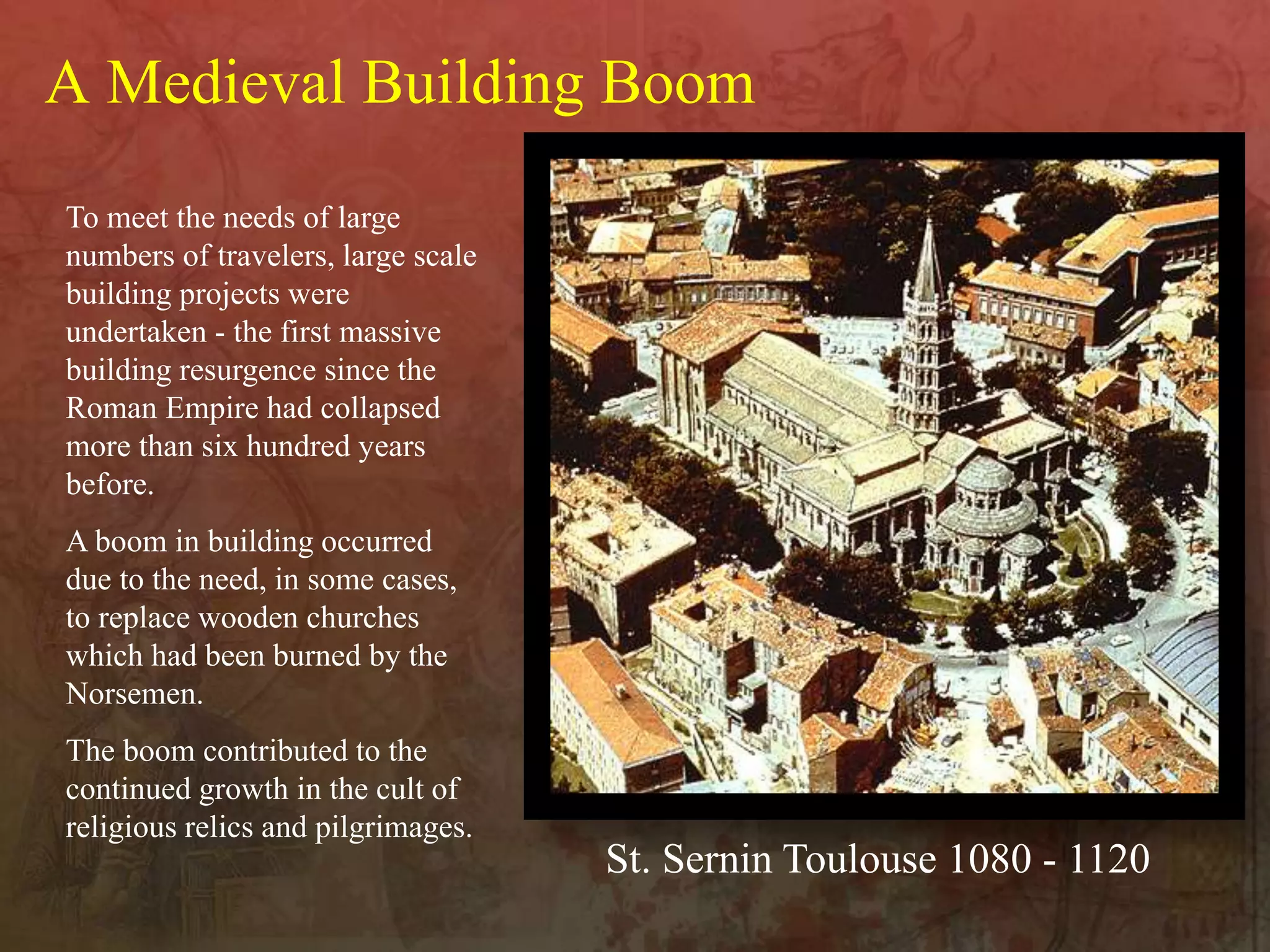
To meet the needs of large
numbers of travelers, large scale
building projects were
undertaken - the first massive
building resurgence since the
Roman Empire had collapsed
more than six hundred years
before.
A boom in building occurred
due to the need, in some cases,
to replace wooden churches
which had been burned by the
Norsemen.
The boom contributed to the
continued growth in the cult of
religious relics and pilgrimages.
St. Sernin Toulouse 1080 - 1120
A Medieval Building Boom
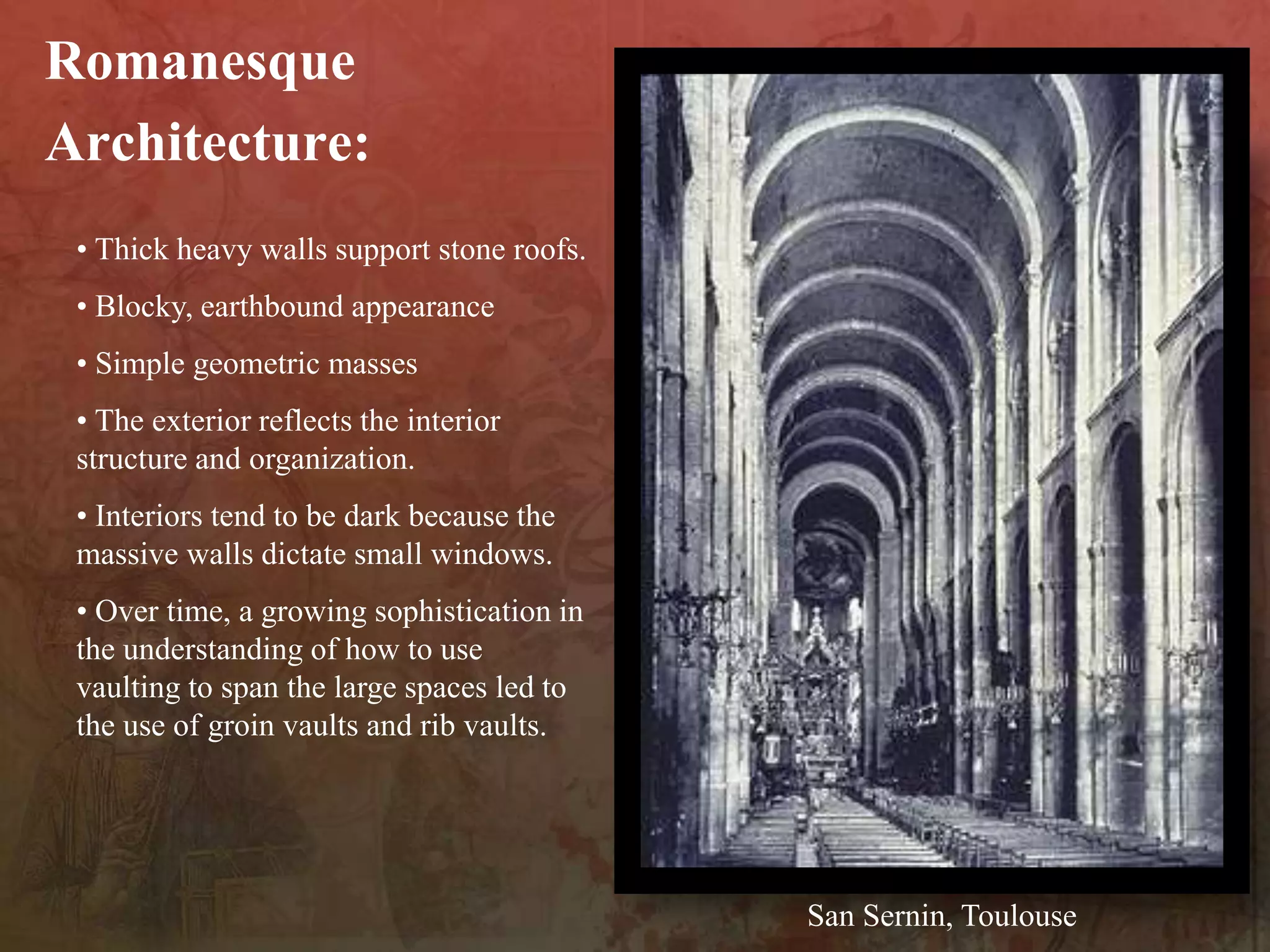
• Thick heavy walls support stone roofs.
• Blocky, earthbound appearance
• Simple geometric masses
• The exterior reflects the interior
structure and organization.
• Interiors tend to be dark because the
massive walls dictate small windows.
• Over time, a growing sophistication in
the understanding of how to use
vaulting to span the large spaces led to
the use of groin vaults and rib vaults.
Romanesque
Architecture:
San Sernin, Toulouse
St. Sernin, looking toward
the altar and apse
• During the Romanesque
period churches were in
the relics business: more
relics= more business=
more donations.
• Each chapel would have
different relics funded by
wealthy donors
Relics: The Attraction
Looking up at the dome in the crossing. Note the massive blocks of
multi-colored stone.
A prominent feature of many Romanesque churches is the addition
of multiple chapels "radiating chapels".
Stone barrel vaults require massive support because they create a
lateral thrust requiring heavy, buttressed walls.
Conques, France, c. 1050-1120
Sainte-Foy
Warm-Up 11/20
• Name 5 details that are going on at least 8 symbols
and what they represent.
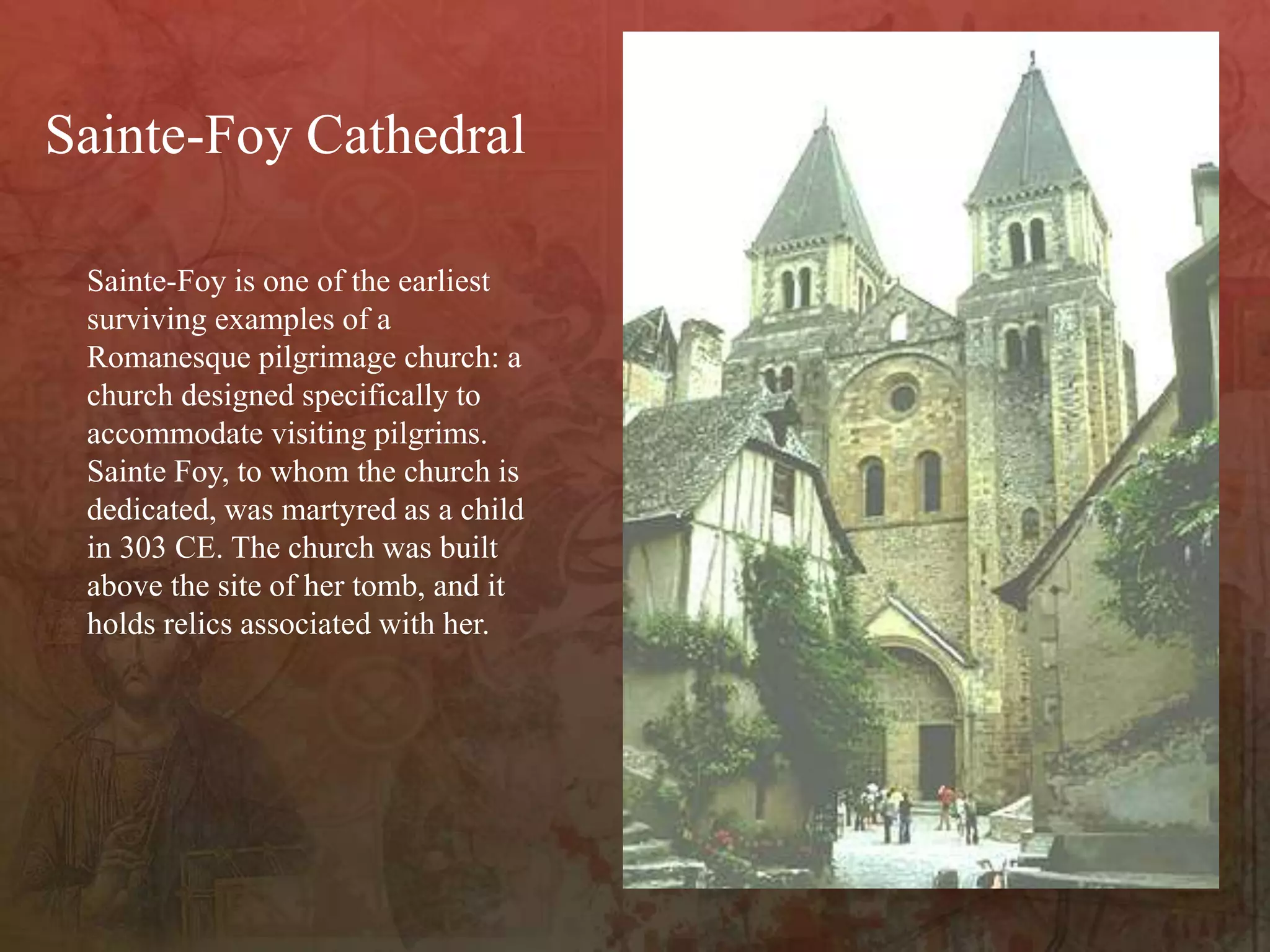
Sainte-Foy is one of the earliest
surviving examples of a
Romanesque pilgrimage church: a
church designed specifically to
accommodate visiting pilgrims.
Sainte Foy, to whom the church is
dedicated, was martyred as a child
in 303 CE. The church was built
above the site of her tomb, and it
holds relics associated with her.
Sainte-Foy Cathedral
You can see from the plan of Sainte-
Foy that it shares much in common
with the plan of St. Sernin. Sainte-
Foy, however, is much shorter in
proportion. It does have radiating
chapels and a circumambulatory
aisle: key characteristics of
pilgrimage churches.
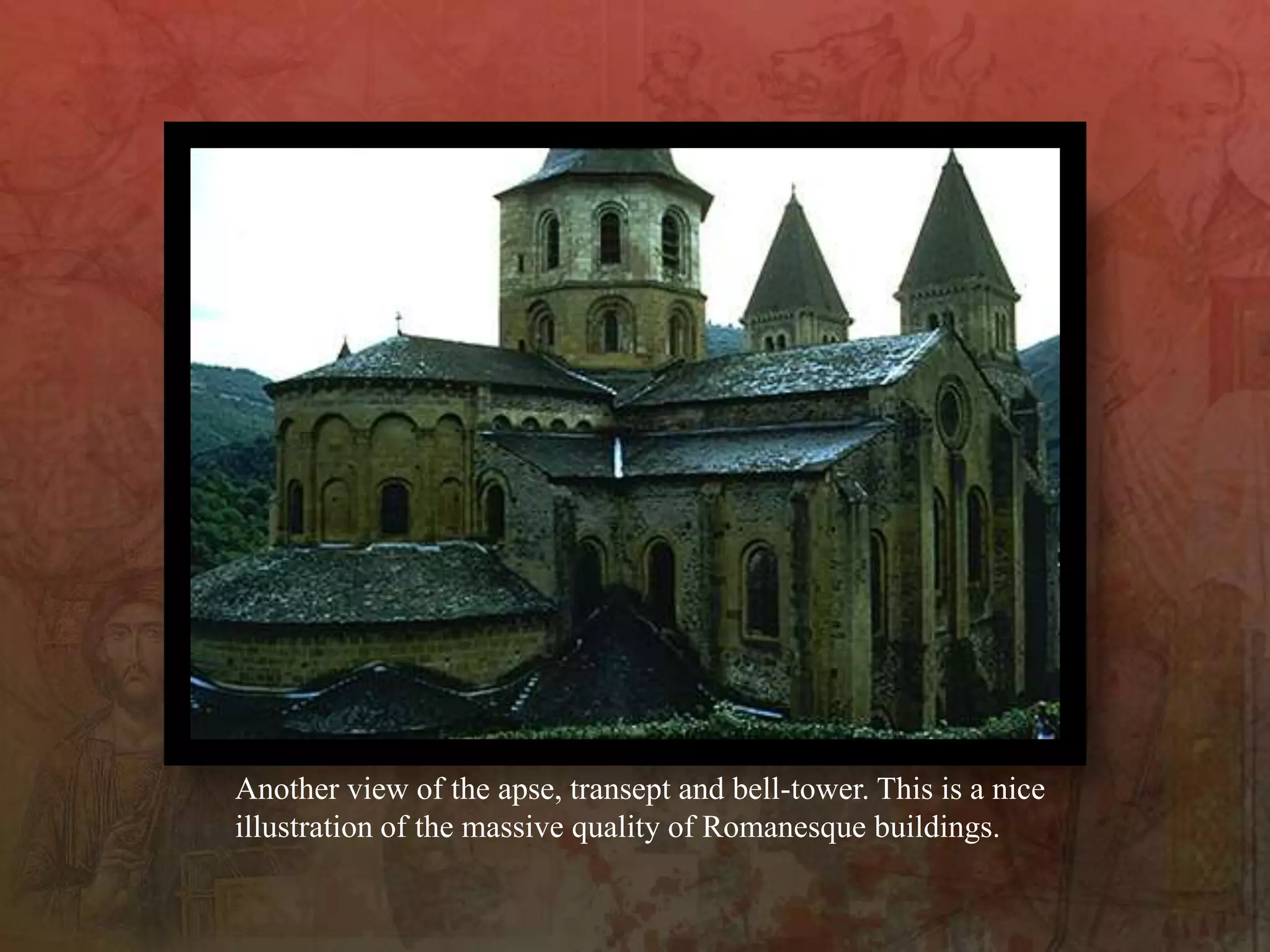
Another view of the apse, transept and bell-tower. This is a nice
illustration of the massive quality of Romanesque buildings.
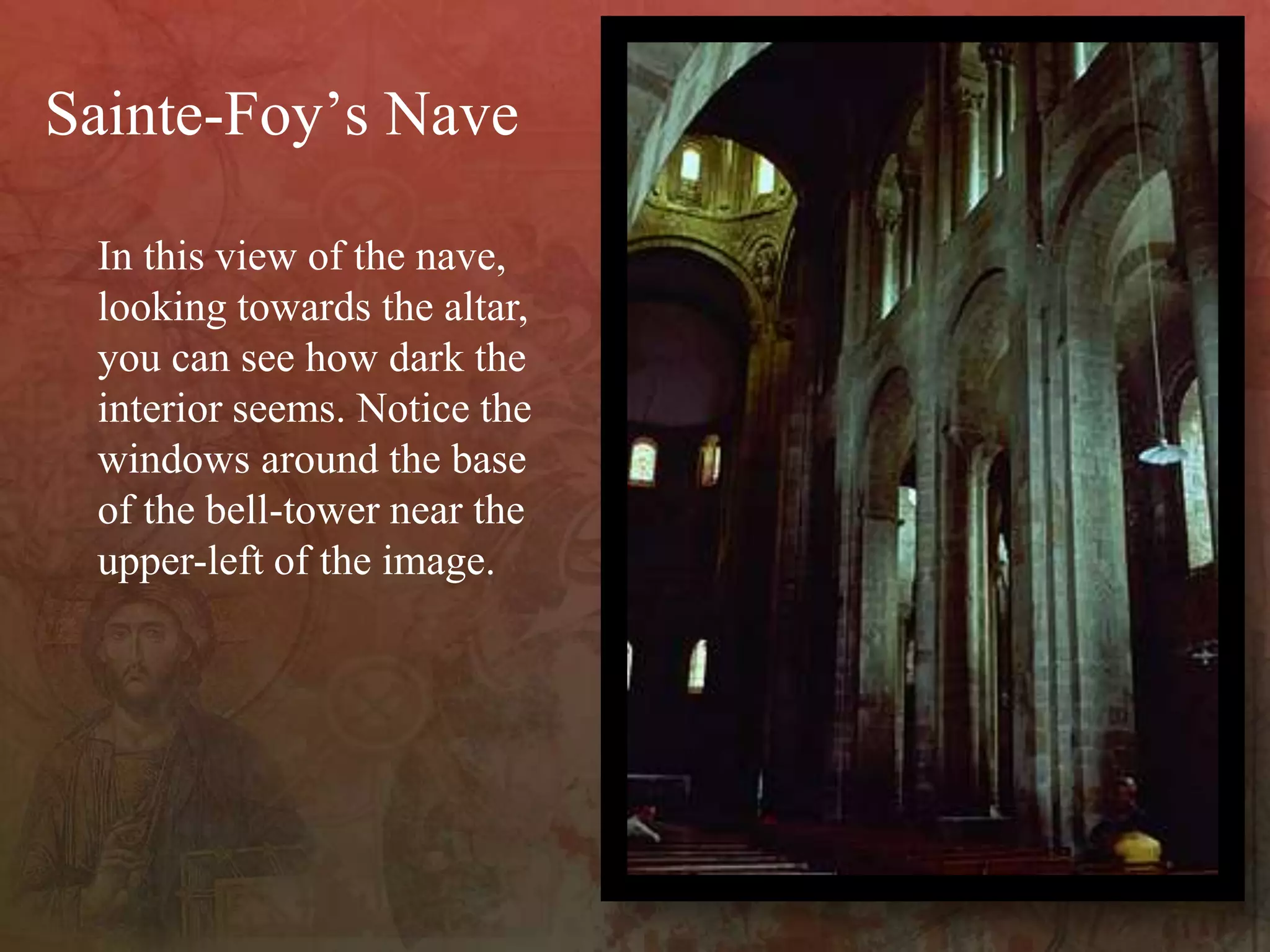
In this view of the nave,
looking towards the altar,
you can see how dark the
interior seems. Notice the
windows around the base
of the bell-tower near the
upper-left of the image.
Sainte-Foy’s Nave
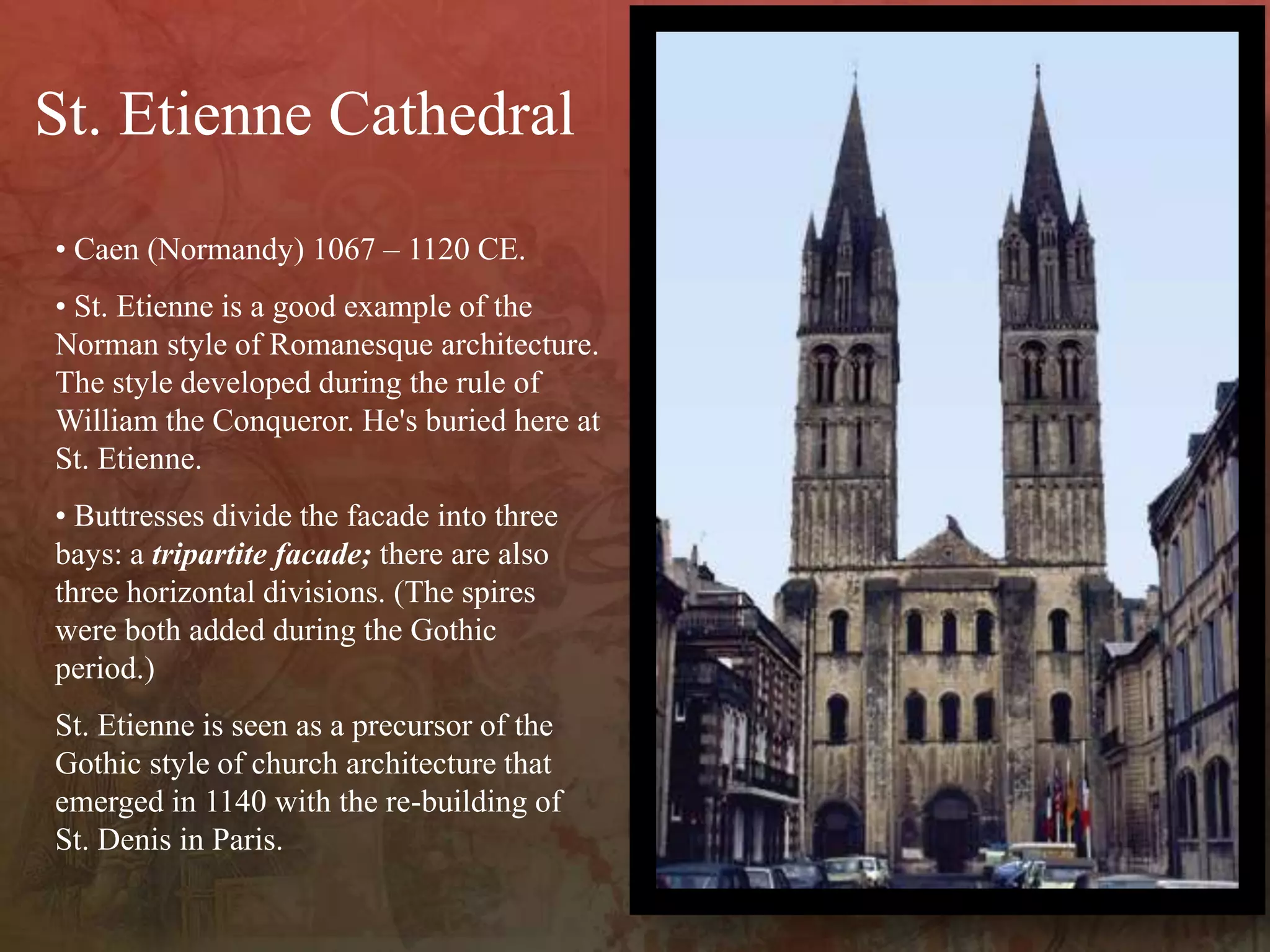
• Caen (Normandy) 1067 – 1120 CE.
• St. Etienne is a good example of the
Norman style of Romanesque architecture.
The style developed during the rule of
William the Conqueror. He's buried here at
St. Etienne.
• Buttresses divide the facade into three
bays: a tripartite facade; there are also
three horizontal divisions. (The spires
were both added during the Gothic
period.)
St. Etienne is seen as a precursor of the
Gothic style of church architecture that
emerged in 1140 with the re-building of
St. Denis in Paris.
St. Etienne Cathedral
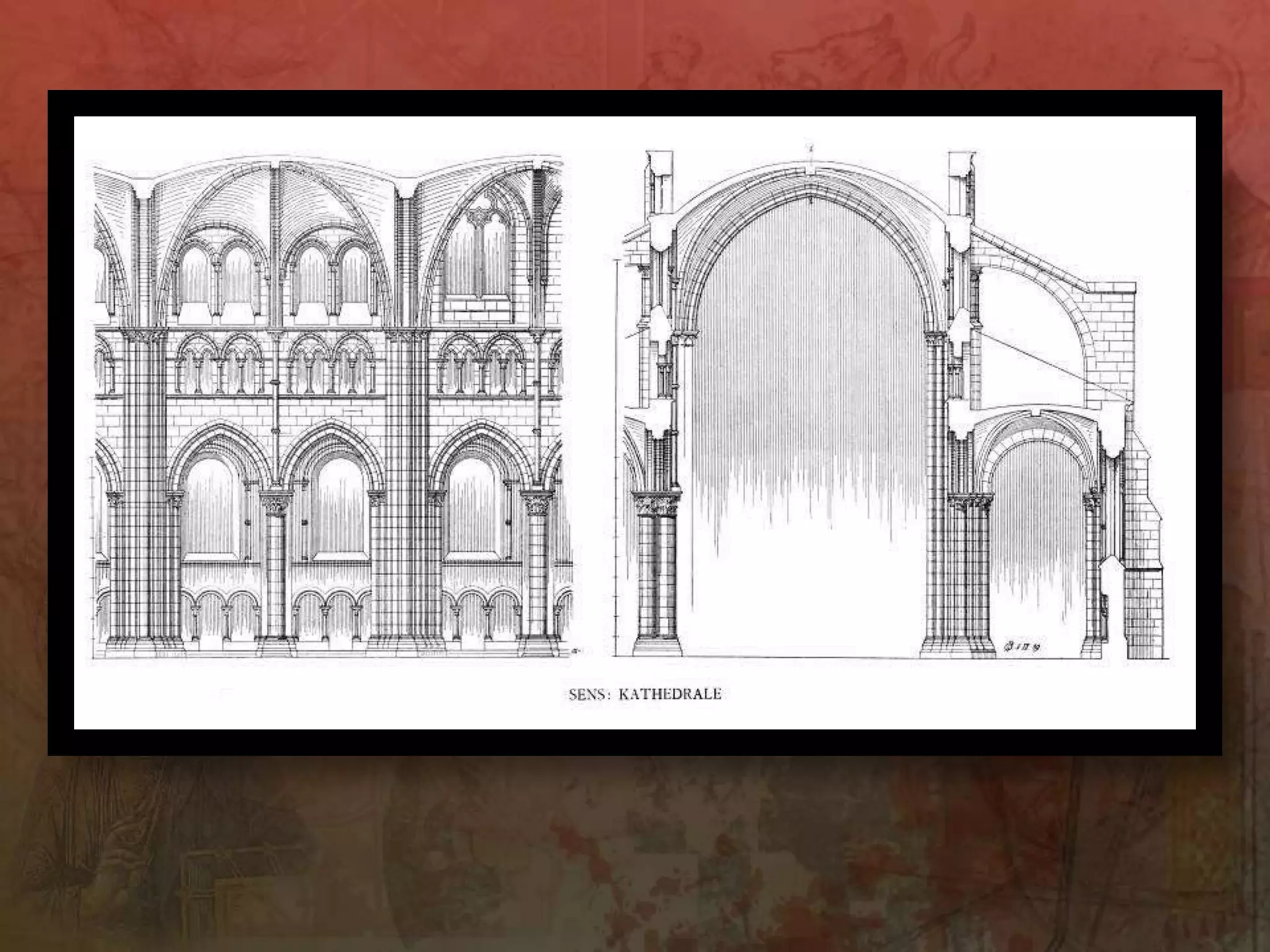
Ribbed groin vaults (or just rib vaults)
replace barrel vaults and allow the addition of
clerestory windows. Rib vaults are groin
vaults reinforced with extra stone ribbing.
These vaults at St. Etienne are some of the
earliest ribbed vaults. They are supported by
large complex piers covered with pilasters
and engaged columns.
St. Etienne’s Vaulting System
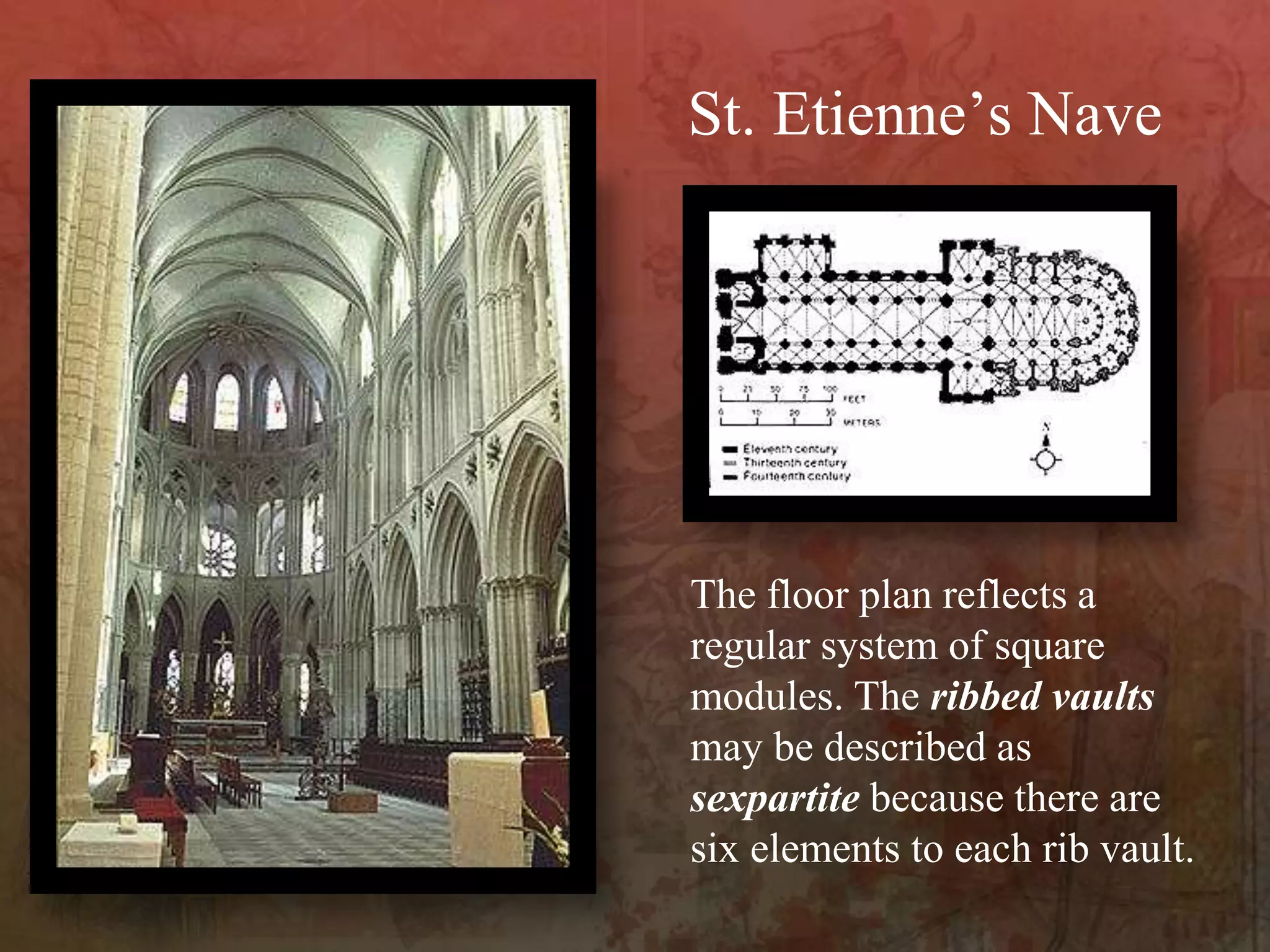
The floor plan reflects a
regular system of square
modules. The ribbed vaults
may be described as
sexpartite because there are
six elements to each rib vault.
St. Etienne’s Nave
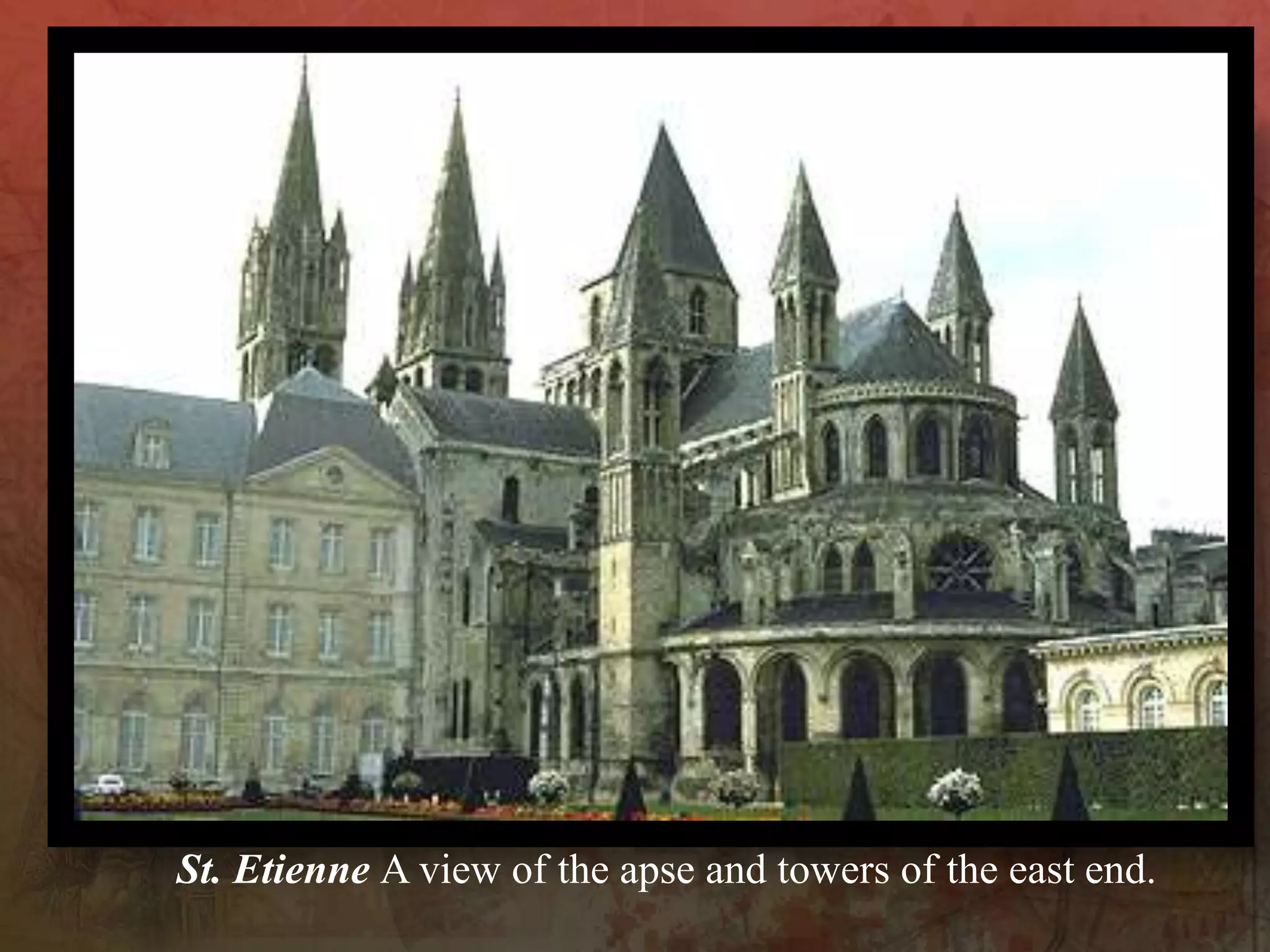
St. Etienne A view of the apse and towers of the east end.
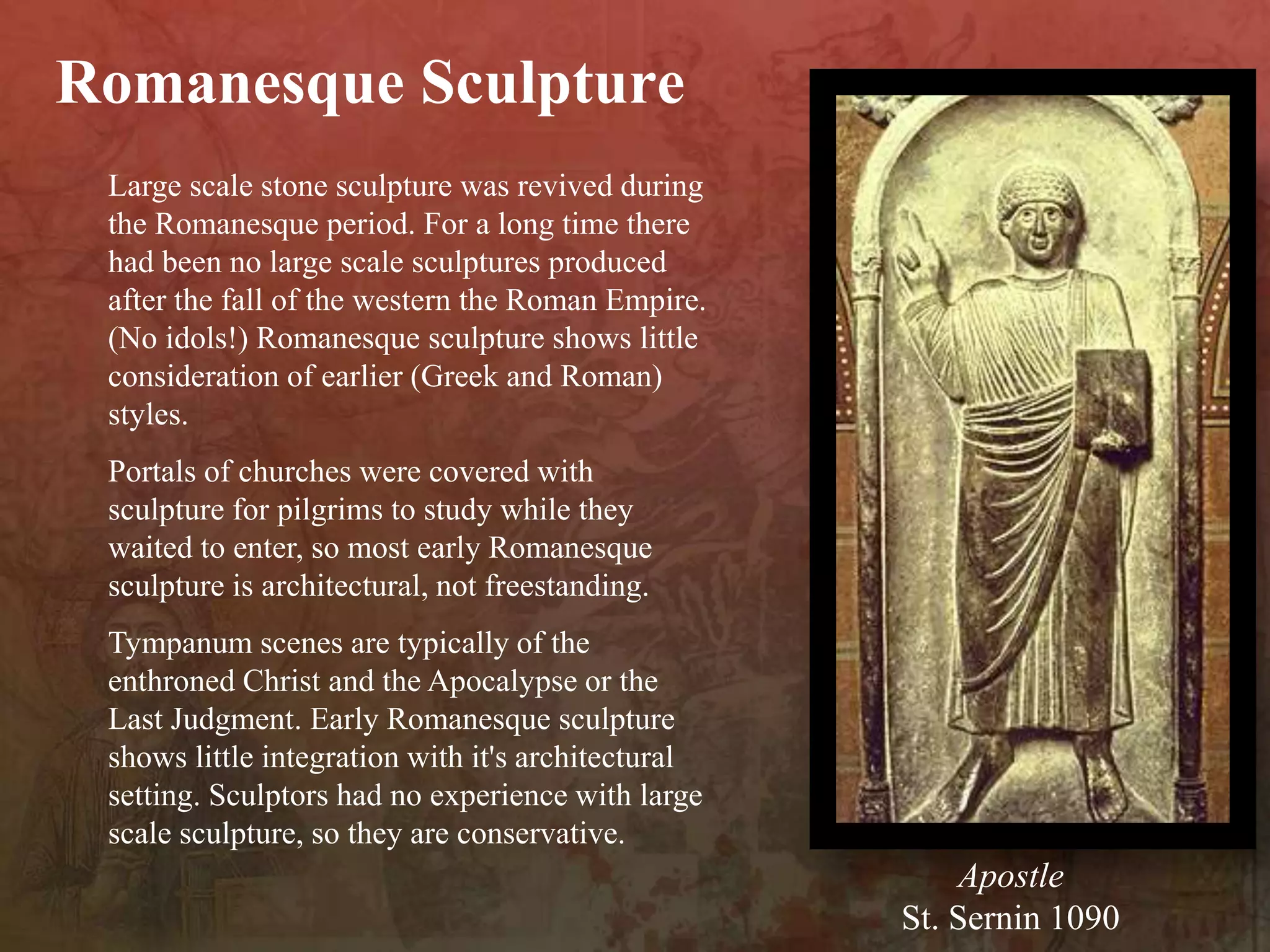
Large scale stone sculpture was revived during
the Romanesque period. For a long time there
had been no large scale sculptures produced
after the fall of the western the Roman Empire.
(No idols!) Romanesque sculpture shows little
consideration of earlier (Greek and Roman)
styles.
Portals of churches were covered with
sculpture for pilgrims to study while they
waited to enter, so most early Romanesque
sculpture is architectural, not freestanding.
Tympanum scenes are typically of the
enthroned Christ and the Apocalypse or the
Last Judgment. Early Romanesque sculpture
shows little integration with it's architectural
setting. Sculptors had no experience with large
scale sculpture, so they are conservative.
Apostle
St. Sernin 1090
Romanesque Sculpture
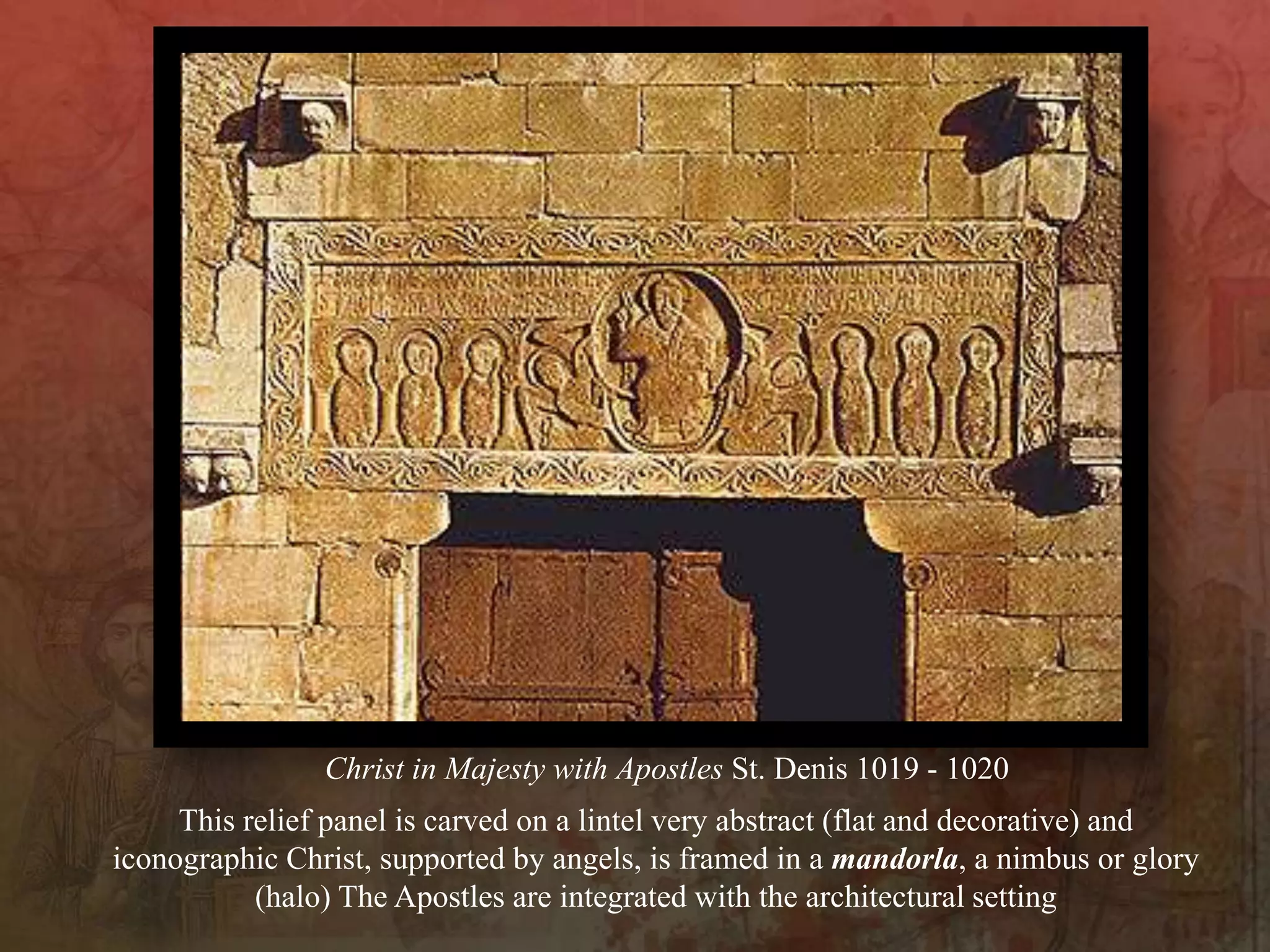
This relief panel is carved on a lintel very abstract (flat and decorative) and
iconographic Christ, supported by angels, is framed in a mandorla, a nimbus or glory
(halo) The Apostles are integrated with the architectural setting
Christ in Majesty with Apostles St. Denis 1019 - 1020
Some of the most notable
sculpture of the Romanesque
period can be found in the
portals of Romanesque
churches.
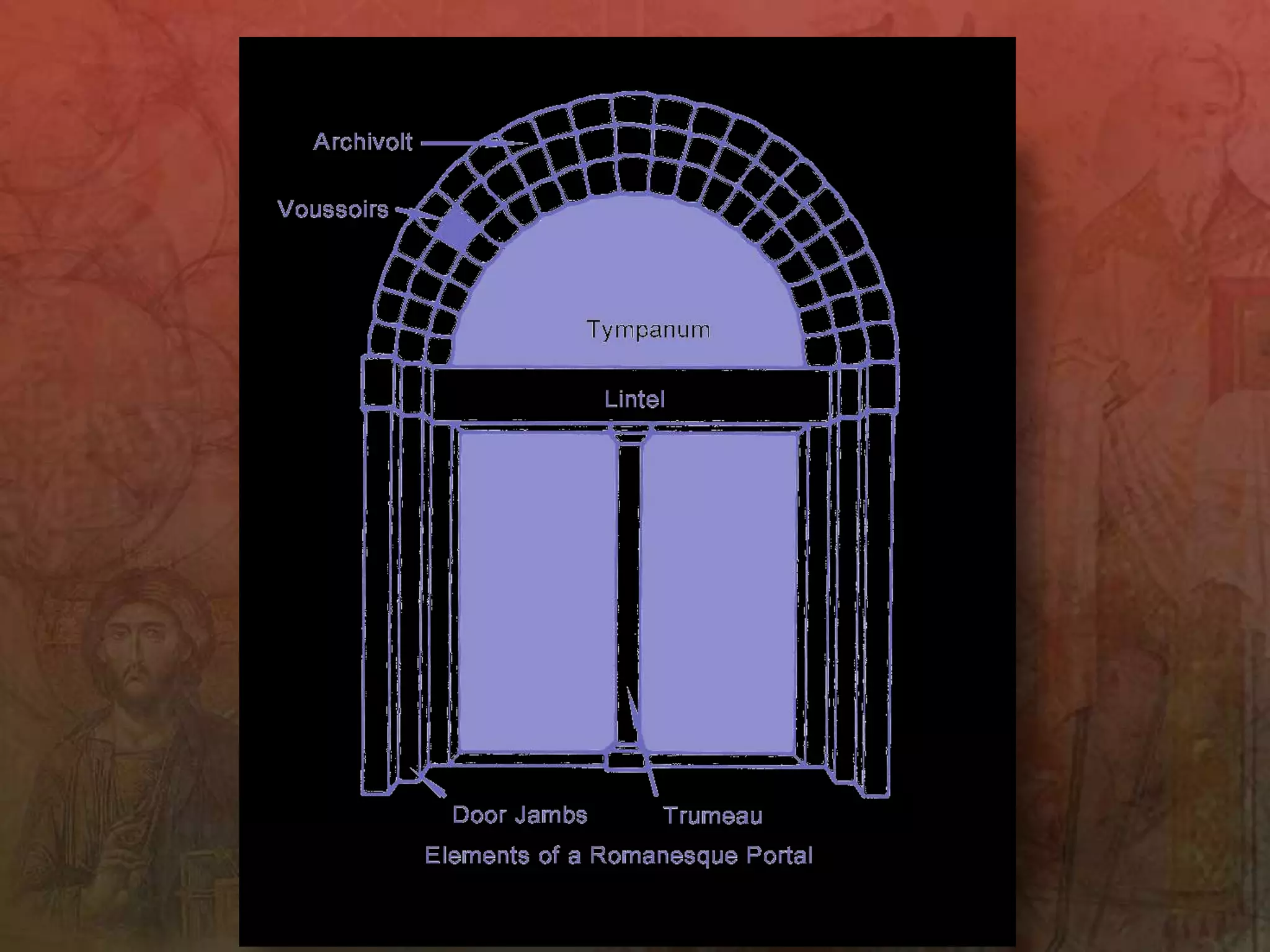
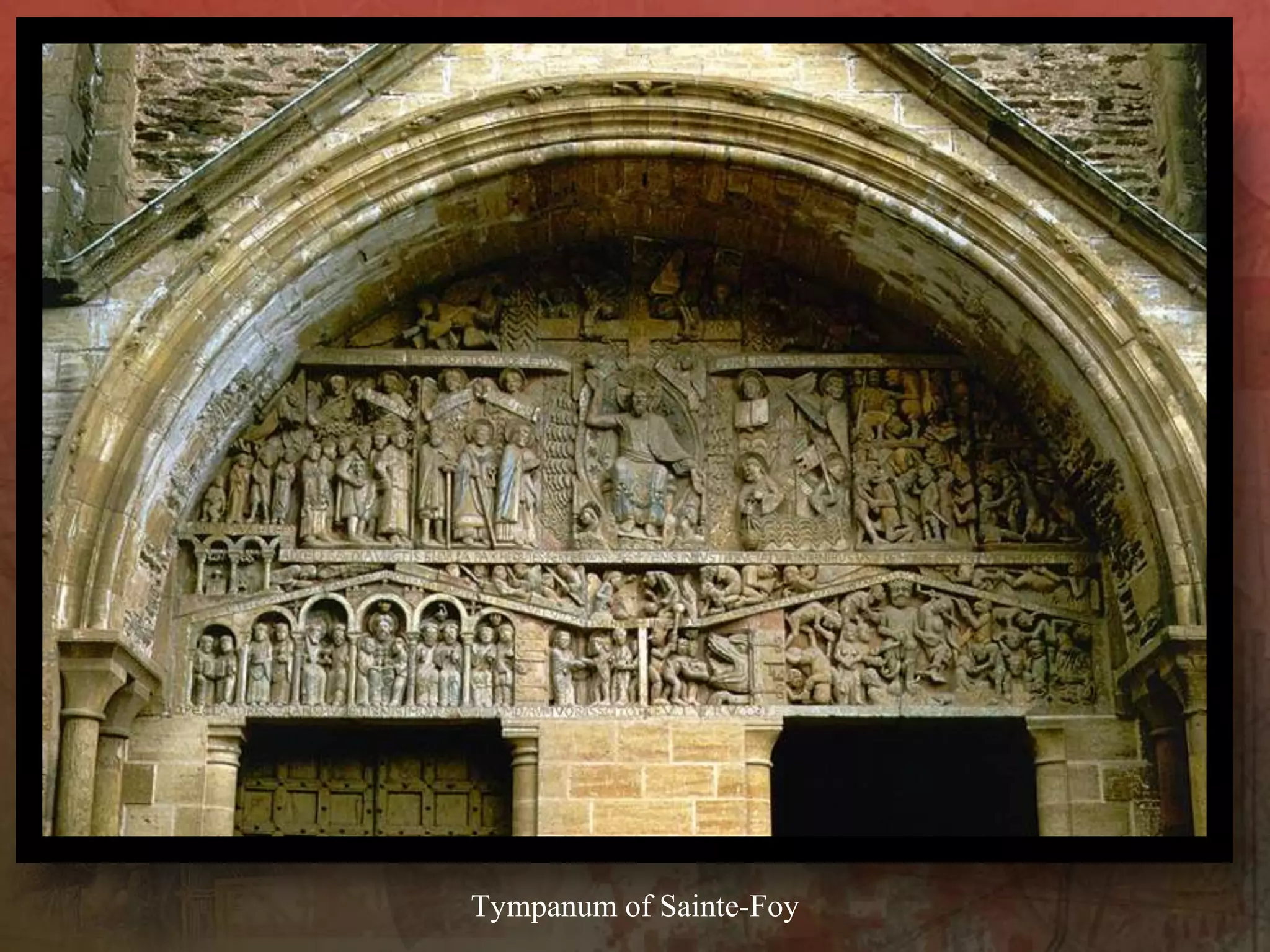
You can see the portal as the
round arch and the semi-
circular tympanum above
the doors here on the facade
of Sainte-Foy.
Sainte-Foy’s Sculpture
Tympanum of Sainte-Foy
Center
On the right side of Christ (your left) are the lucky souls who
have been saved: the elect.
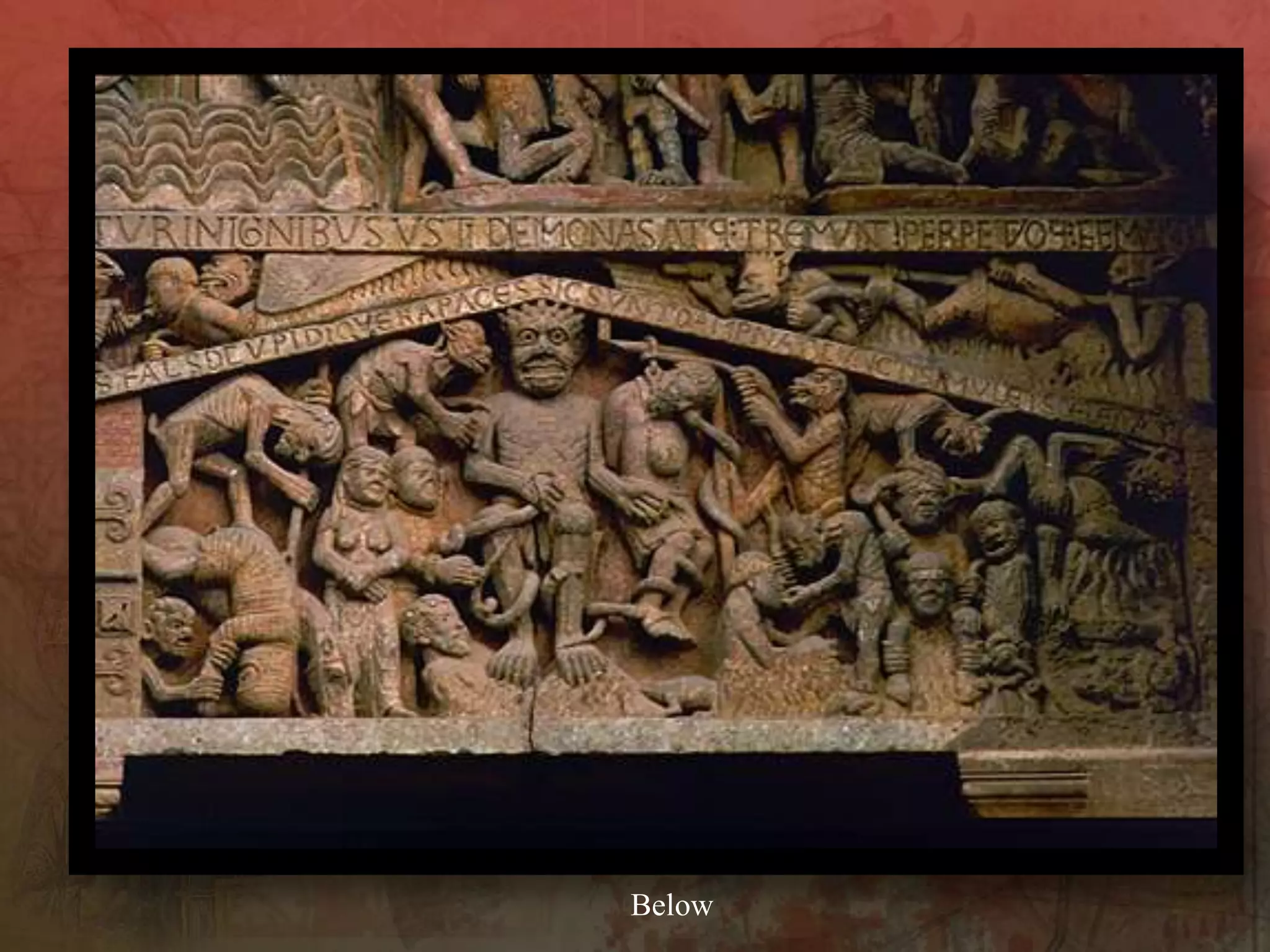
On his left, though, are poor souls being tortured by demons and dragged
off to Hell.
Below
Below
St. Lazare had the relics of
Lazarus, a friend of Christ whom
he raised from the dead. There
was a medieval legend that he had
sailed from the Holy Land to
Marseilles and become the first
bishop of that city.
The Church of
St. Lazare
Autun, France
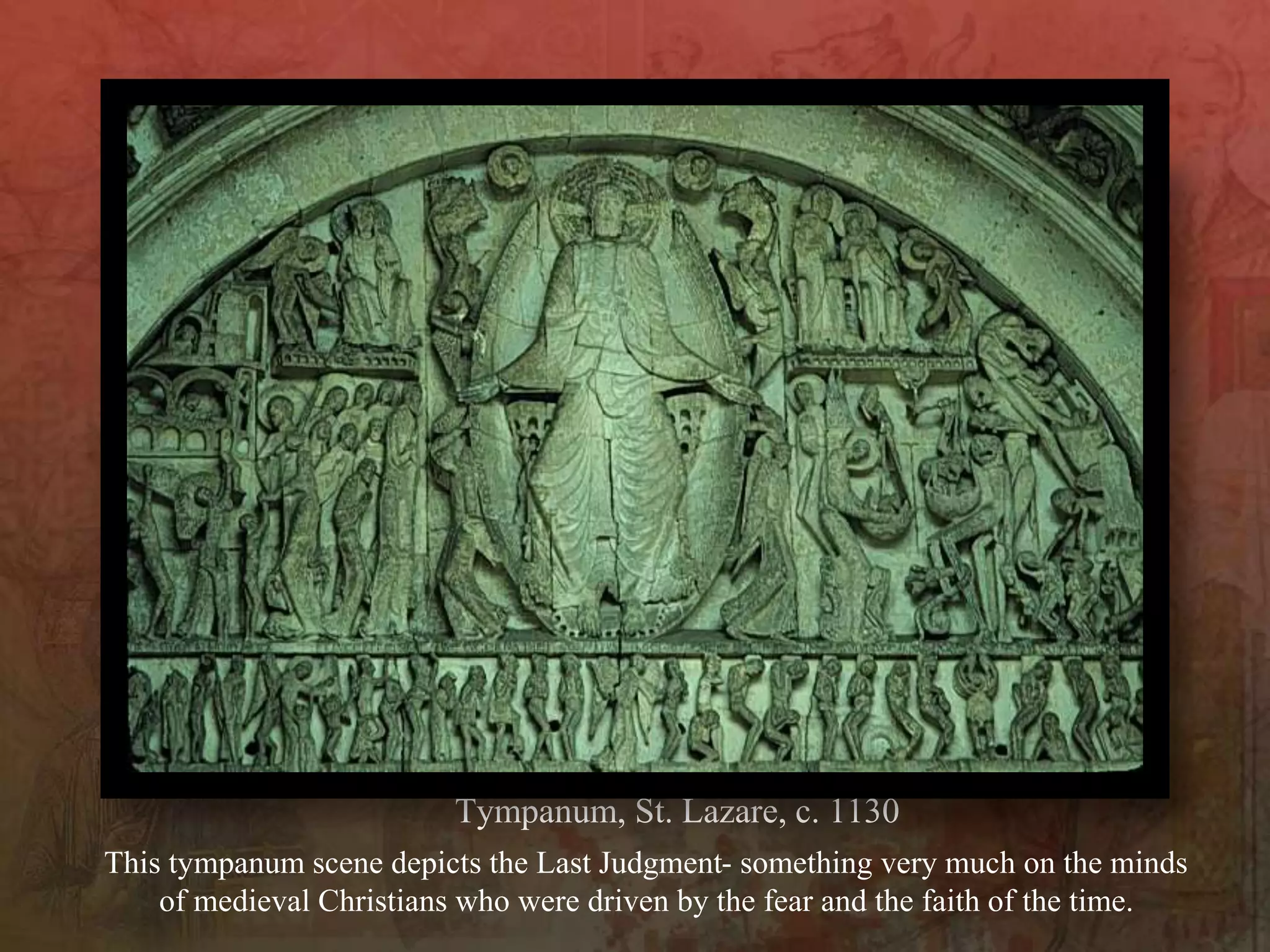
This tympanum scene depicts the Last Judgment- something very much on the minds
of medieval Christians who were driven by the fear and the faith of the time.
Tympanum, St. Lazare, c. 1130
•Angels blow the horns
announcing the Day of Judgment.
•Christ is supposed to look as if
he is sitting! But it seems that the
sculptor had a hard time figuring
out how to represent
foreshortened knees. He is static
and still, removed from the
activity below him.
•Two men at the lower left carry
staffs and bags, identifying them
as pilgrims.
Tympanum, St. Lazare
The Archangel
Michael oversees
the scales.
Tympanum, St. Lazare
•The weighing of souls of
the dead who are lifted
from the earth and fought
over by angels and
demons.
•Notice that the demon
tries to tip the scales
(compare to The Miller in
Chaucer’s tale)
• The condemned are
dragged into hell while
those waiting seek
protection from the
angels.
The inscription reads, “Here let fear strike those whom earthly
error binds, for their fate is shown by the horror of these figures”
The poor souls are agitated and distorted, nothing classical in
their figures at all. The figures are contorted to fit the setting but
also for expressive purposes.
Souls Waiting for Judgment
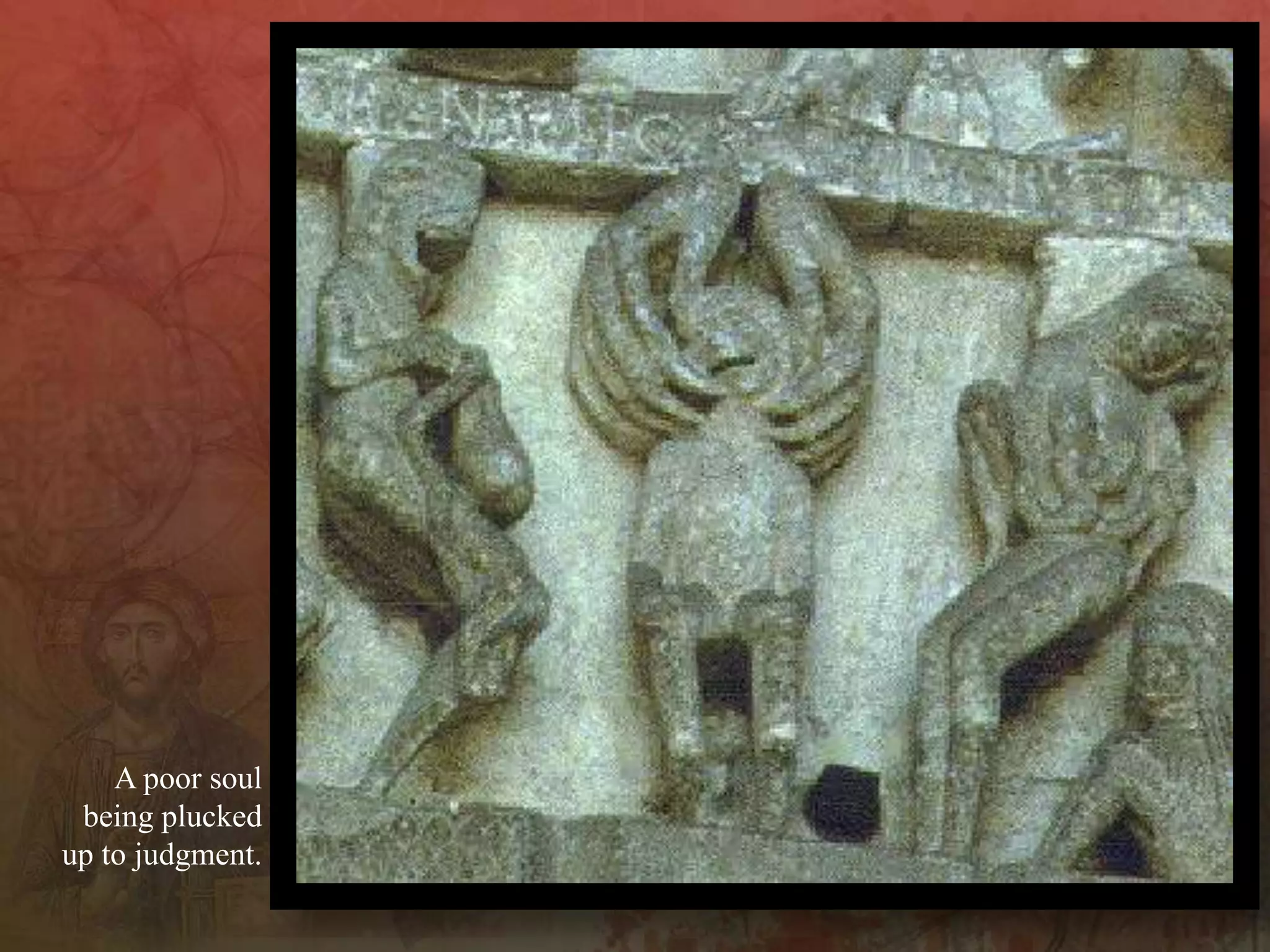
A poor soul
being plucked
up to judgment.
The Launching Point of the
Crusades:
Pope Urban II had intended to
preach about the mission of the
First Crusade here thirty years
before the tympanum was built.
Saint Bernard preached the
Second Crusade here, and in
1190, Richard the Lionhearted
and King Phillip of France set out
on the Third Crusade from
Vezelay
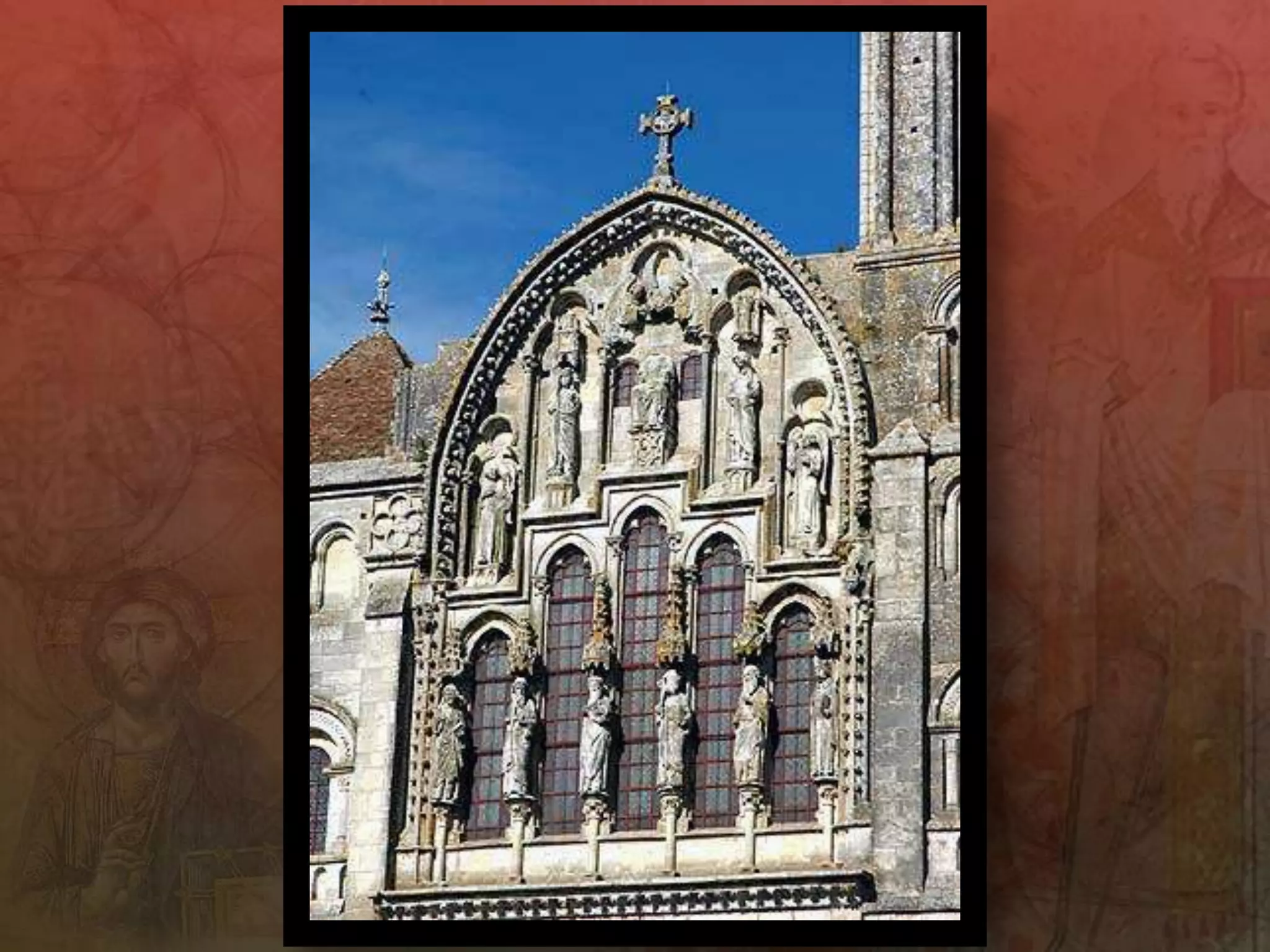
Vezelay, France
1120-32
Vezelay, Nave
Portal fr. the Narthex of St. Madeleine, Vezelay, 1120
Here again we see Christ is enthroned in a manner reminiscent of examples
from Early Christian churches and manuscript paintings. Note the very stylized
figures and drapery and the rays of the holy spirit that emanate from Christ.
10. romanesque ppt
10. romanesque ppt

10. romanesque ppt

  • 1.
  • 2.
    11/18 Warm-Up • Ifyou had a cathedral…What modern-day celebrity or person of interest would be your “relic”? • What is the importance of relics within Medieval Christianity?
  • 3.
  • 5.
  • 8.
    ROMANESQUE ARCHITECTURE 1000- 1140 The term Romanesque ("Roman-like") was first used to designate a style of architecture that used Roman arches and had thick, heavy walls, based upon the basilica. The style is pervasive throughout Europe. Arch of Titus 81 AD Plan of a Roman Basilica
  • 9.
    • Immense reliefthat the world had not ended at the turn of the millennium • The resurgence of cities and trade • The emergence of Europe as we know it • The strengthened authority of the Pope • The emergence of a middle class and merchant class • The evolution of the Romance languages • The peak of feudalism as a political system The Romanesque Era is marked by:
  • 10.
    Nave of St.Savin. Poitou, France c. 1100 • Monasteries housed the relics of saints, and during the Romanesque period the cult of relics became a major cultural factor influencing architecture. • Devout Christians would undertake long pilgrimages in order to visit and venerate the relics of saints and martyrs. • People traveled widely to visit sites and see relics because they believed them to have curative powers. • The large numbers of travelers created standard routes from one monastery to another: “Pilgrimage Roads” became routes of trade/commerce as well as travel. The Great Age of Monasteries
  • 11.
    Pilgrimage Routes toSantiago de Compostella
  • 12.
    • San Sernin,in Toulouse, is a typical pilgrimage church in the Burgundian style. • The floor plan is a Latin cross with clearly defined parts. • It is modeled on a basilica plan modified for large crowds to provide a large apse. • The square of the crossing is the module for the rest of the plan: ½ (crossing square) = 1 (bayside aisle) The Plan of a Romanesque Cathedral
  • 13.
    • The sideaisles form a continuous circuit around the transept nave and transept. • The ambulatory aisle enclosed the choir- the area east of the transept- was separated by a screen to give privacy to monks during the mass or other services. • The side aisles allow visitors to walk back to view the relics without disturbing anything going on in the nave or choir areas. The Plan of a Romanesque Cathedral Transept
  • 14.
    To meet theneeds of large numbers of travelers, large scale building projects were undertaken - the first massive building resurgence since the Roman Empire had collapsed more than six hundred years before. A boom in building occurred due to the need, in some cases, to replace wooden churches which had been burned by the Norsemen. The boom contributed to the continued growth in the cult of religious relics and pilgrimages. St. Sernin Toulouse 1080 - 1120 A Medieval Building Boom
  • 15.
    • Thick heavywalls support stone roofs. • Blocky, earthbound appearance • Simple geometric masses • The exterior reflects the interior structure and organization. • Interiors tend to be dark because the massive walls dictate small windows. • Over time, a growing sophistication in the understanding of how to use vaulting to span the large spaces led to the use of groin vaults and rib vaults. Romanesque Architecture: San Sernin, Toulouse
  • 16.
    St. Sernin, lookingtoward the altar and apse • During the Romanesque period churches were in the relics business: more relics= more business= more donations. • Each chapel would have different relics funded by wealthy donors Relics: The Attraction
  • 17.
    Looking up atthe dome in the crossing. Note the massive blocks of multi-colored stone.
  • 18.
    A prominent featureof many Romanesque churches is the addition of multiple chapels "radiating chapels". Stone barrel vaults require massive support because they create a lateral thrust requiring heavy, buttressed walls.
  • 19.
    Conques, France, c.1050-1120 Sainte-Foy
  • 20.
    Warm-Up 11/20 • Name5 details that are going on at least 8 symbols and what they represent.
  • 21.
    Sainte-Foy is oneof the earliest surviving examples of a Romanesque pilgrimage church: a church designed specifically to accommodate visiting pilgrims. Sainte Foy, to whom the church is dedicated, was martyred as a child in 303 CE. The church was built above the site of her tomb, and it holds relics associated with her. Sainte-Foy Cathedral
  • 22.
    You can seefrom the plan of Sainte- Foy that it shares much in common with the plan of St. Sernin. Sainte- Foy, however, is much shorter in proportion. It does have radiating chapels and a circumambulatory aisle: key characteristics of pilgrimage churches.
  • 23.
    Another view ofthe apse, transept and bell-tower. This is a nice illustration of the massive quality of Romanesque buildings.
  • 24.
    In this viewof the nave, looking towards the altar, you can see how dark the interior seems. Notice the windows around the base of the bell-tower near the upper-left of the image. Sainte-Foy’s Nave
  • 25.
    • Caen (Normandy)1067 – 1120 CE. • St. Etienne is a good example of the Norman style of Romanesque architecture. The style developed during the rule of William the Conqueror. He's buried here at St. Etienne. • Buttresses divide the facade into three bays: a tripartite facade; there are also three horizontal divisions. (The spires were both added during the Gothic period.) St. Etienne is seen as a precursor of the Gothic style of church architecture that emerged in 1140 with the re-building of St. Denis in Paris. St. Etienne Cathedral
  • 26.
    Ribbed groin vaults(or just rib vaults) replace barrel vaults and allow the addition of clerestory windows. Rib vaults are groin vaults reinforced with extra stone ribbing. These vaults at St. Etienne are some of the earliest ribbed vaults. They are supported by large complex piers covered with pilasters and engaged columns. St. Etienne’s Vaulting System
  • 27.
    The floor planreflects a regular system of square modules. The ribbed vaults may be described as sexpartite because there are six elements to each rib vault. St. Etienne’s Nave
  • 29.
    St. Etienne Aview of the apse and towers of the east end.
  • 30.
    Large scale stonesculpture was revived during the Romanesque period. For a long time there had been no large scale sculptures produced after the fall of the western the Roman Empire. (No idols!) Romanesque sculpture shows little consideration of earlier (Greek and Roman) styles. Portals of churches were covered with sculpture for pilgrims to study while they waited to enter, so most early Romanesque sculpture is architectural, not freestanding. Tympanum scenes are typically of the enthroned Christ and the Apocalypse or the Last Judgment. Early Romanesque sculpture shows little integration with it's architectural setting. Sculptors had no experience with large scale sculpture, so they are conservative. Apostle St. Sernin 1090 Romanesque Sculpture
  • 31.
    This relief panelis carved on a lintel very abstract (flat and decorative) and iconographic Christ, supported by angels, is framed in a mandorla, a nimbus or glory (halo) The Apostles are integrated with the architectural setting Christ in Majesty with Apostles St. Denis 1019 - 1020
  • 32.
    Some of themost notable sculpture of the Romanesque period can be found in the portals of Romanesque churches. You can see the portal as the round arch and the semi- circular tympanum above the doors here on the facade of Sainte-Foy. Sainte-Foy’s Sculpture
  • 34.
  • 35.
  • 36.
    On the rightside of Christ (your left) are the lucky souls who have been saved: the elect.
  • 37.
    On his left,though, are poor souls being tortured by demons and dragged off to Hell.
  • 38.
  • 39.
  • 41.
    St. Lazare hadthe relics of Lazarus, a friend of Christ whom he raised from the dead. There was a medieval legend that he had sailed from the Holy Land to Marseilles and become the first bishop of that city. The Church of St. Lazare Autun, France
  • 42.
    This tympanum scenedepicts the Last Judgment- something very much on the minds of medieval Christians who were driven by the fear and the faith of the time. Tympanum, St. Lazare, c. 1130
  • 43.
    •Angels blow thehorns announcing the Day of Judgment. •Christ is supposed to look as if he is sitting! But it seems that the sculptor had a hard time figuring out how to represent foreshortened knees. He is static and still, removed from the activity below him. •Two men at the lower left carry staffs and bags, identifying them as pilgrims. Tympanum, St. Lazare
  • 44.
    The Archangel Michael oversees thescales. Tympanum, St. Lazare
  • 45.
    •The weighing ofsouls of the dead who are lifted from the earth and fought over by angels and demons. •Notice that the demon tries to tip the scales (compare to The Miller in Chaucer’s tale) • The condemned are dragged into hell while those waiting seek protection from the angels.
  • 46.
    The inscription reads,“Here let fear strike those whom earthly error binds, for their fate is shown by the horror of these figures” The poor souls are agitated and distorted, nothing classical in their figures at all. The figures are contorted to fit the setting but also for expressive purposes. Souls Waiting for Judgment
  • 47.
    A poor soul beingplucked up to judgment.
  • 48.
    The Launching Pointof the Crusades: Pope Urban II had intended to preach about the mission of the First Crusade here thirty years before the tympanum was built. Saint Bernard preached the Second Crusade here, and in 1190, Richard the Lionhearted and King Phillip of France set out on the Third Crusade from Vezelay Vezelay, France 1120-32
  • 50.
  • 52.
    Portal fr. theNarthex of St. Madeleine, Vezelay, 1120
  • 53.
    Here again wesee Christ is enthroned in a manner reminiscent of examples from Early Christian churches and manuscript paintings. Note the very stylized figures and drapery and the rays of the holy spirit that emanate from Christ.