JAMA
MASJID
(DELHI)
INTRODUCTION
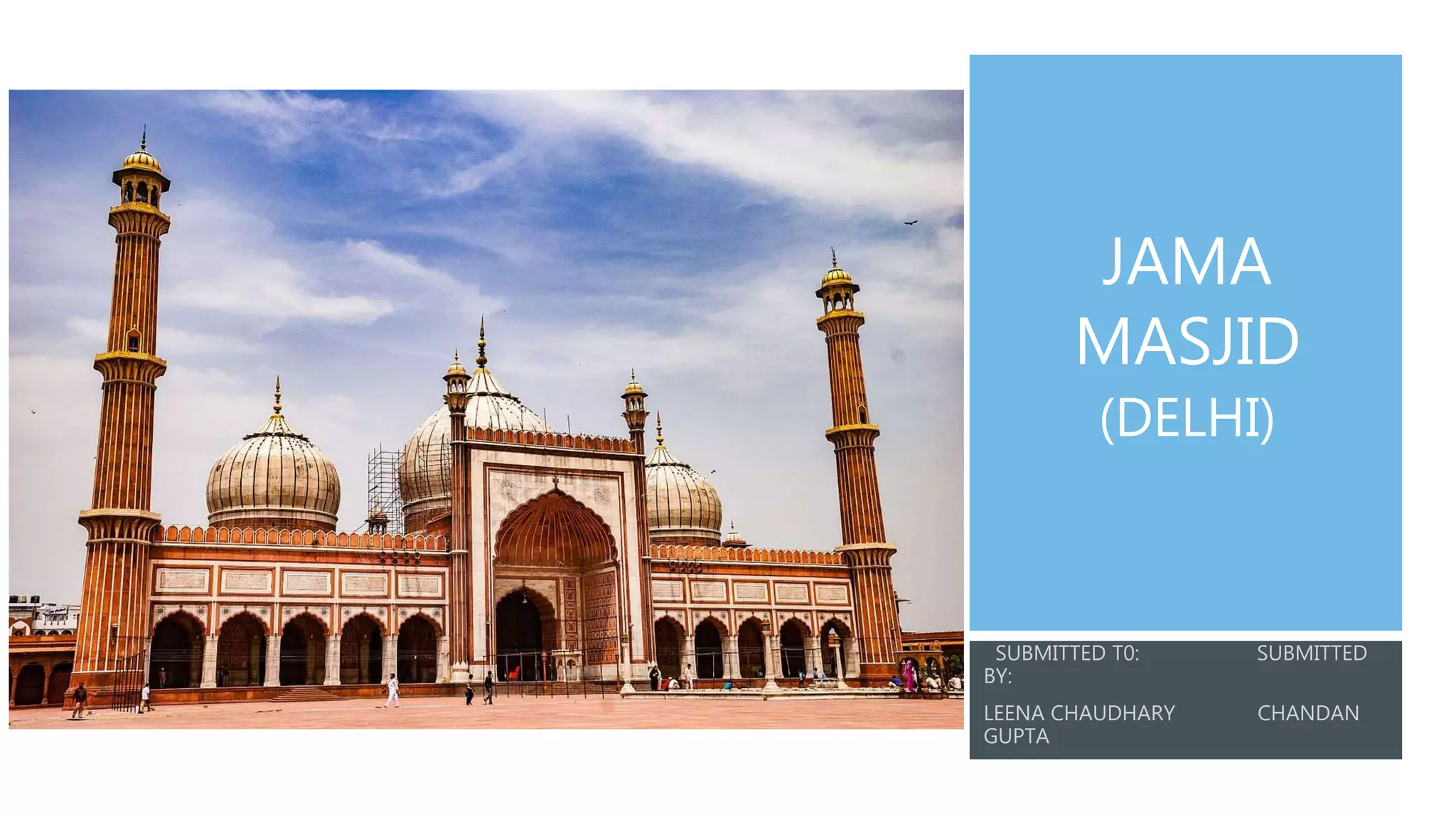
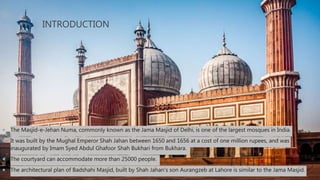
 The Masjid-e-Jehan Numa, commonly known as the Jama Masjid of Delhi, is one of the largest mosques in India.
 It was built by the Mughal Emperor Shah Jahan between 1650 and 1656 at a cost of one million rupees, and was
inaugurated by Imam Syed Abdul Ghafoor Shah Bukhari from Bukhara.
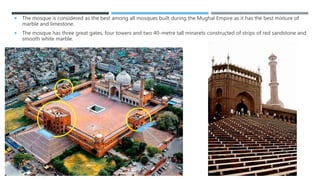
 The courtyard can accommodate more than 25000 people.
 The architectural plan of Badshahi Masjid, built by Shah Jahan's son Aurangzeb at Lahore is similar to the Jama Masjid.
 The mosque is considered as the best among all mosques built during the Mughal Empire as it has the best mixture of
marble and limestone.
 The mosque has three great gates, four towers and two 40-metre tall minarets constructed of strips of red sandstone and
smooth white marble.
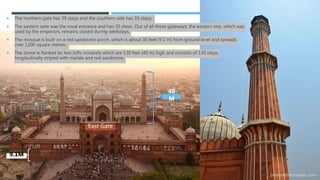
 The northern gate has 39 steps and the southern side has 33 steps.
 The eastern gate was the royal entrance and has 35 steps. Out of all these gateways, the eastern one, which was
used by the emperors, remains closed during weekdays.
 The mosque is built on a red sandstone porch, which is about 30 feet (9.1 m) from ground level and spreads
over 1200 square metres.
 The dome is flanked by two lofty minarets which are 130 feet (40 m) high and consists of 130 steps,
longitudinally striped with marble and red sandstone.
40
M
East Gate
9.1M
 There are three domes on the terrace which are surrounded by the
two minarets.
 The first three storeys of the minarets are made of red sandstone,
the fourth of marble and the fifth of sandstone.
 The mosque is about 261 feet (80 m) long and 90 feet (27 m) wide.
80 m
27m
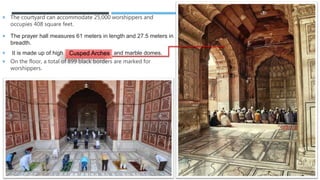
 The courtyard can accommodate 25,000 worshippers and
occupies 408 square feet.
 The prayer hall measures 61 meters in length and 27.5 meters in
breadth.
 It is made up of high and marble domes.
 On the floor, a total of 899 black borders are marked for
worshippers.
Cusped Arches

Jama masjid

  • 1.
  • 2.
    INTRODUCTION  The Masjid-e-JehanNuma, commonly known as the Jama Masjid of Delhi, is one of the largest mosques in India.  It was built by the Mughal Emperor Shah Jahan between 1650 and 1656 at a cost of one million rupees, and was inaugurated by Imam Syed Abdul Ghafoor Shah Bukhari from Bukhara.  The courtyard can accommodate more than 25000 people.  The architectural plan of Badshahi Masjid, built by Shah Jahan's son Aurangzeb at Lahore is similar to the Jama Masjid.
  • 3.
     The mosqueis considered as the best among all mosques built during the Mughal Empire as it has the best mixture of marble and limestone.  The mosque has three great gates, four towers and two 40-metre tall minarets constructed of strips of red sandstone and smooth white marble.
  • 4.
     The northerngate has 39 steps and the southern side has 33 steps.  The eastern gate was the royal entrance and has 35 steps. Out of all these gateways, the eastern one, which was used by the emperors, remains closed during weekdays.  The mosque is built on a red sandstone porch, which is about 30 feet (9.1 m) from ground level and spreads over 1200 square metres.  The dome is flanked by two lofty minarets which are 130 feet (40 m) high and consists of 130 steps, longitudinally striped with marble and red sandstone. 40 M East Gate 9.1M
  • 5.
     There arethree domes on the terrace which are surrounded by the two minarets.  The first three storeys of the minarets are made of red sandstone, the fourth of marble and the fifth of sandstone.  The mosque is about 261 feet (80 m) long and 90 feet (27 m) wide. 80 m 27m
  • 6.
     The courtyardcan accommodate 25,000 worshippers and occupies 408 square feet.  The prayer hall measures 61 meters in length and 27.5 meters in breadth.  It is made up of high and marble domes.  On the floor, a total of 899 black borders are marked for worshippers. Cusped Arches