MODERN ARCHITECTURE
THIS ARTICLE IS ABOUT MODERN MOVEMENT ARCHITECTURE. FOR ARCHITECTURE IN THE PRESENT DAY, SEE CONTEMPORARY
ARCHITECTURE.
CHANDAN GUPTA
chandang9719@gmail.co
m
https://www.slideshare.net/ChandanGu
pta209/
WHAT IS MODERN ARCHITECTURE?
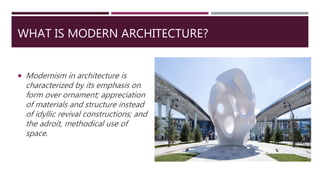
 Modernism in architecture is
characterized by its emphasis on
form over ornament; appreciation
of materials and structure instead
of idyllic revival constructions; and
the adroit, methodical use of
space.
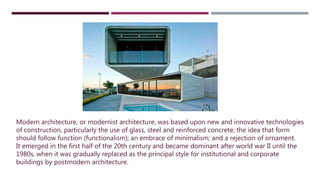
Modern architecture, or modernist architecture, was based upon new and innovative technologies
of construction, particularly the use of glass, steel and reinforced concrete; the idea that form
should follow function (functionalism); an embrace of minimalism; and a rejection of ornament.
It emerged in the first half of the 20th century and became dominant after world war II until the
1980s, when it was gradually replaced as the principal style for institutional and corporate
buildings by postmodern architecture.
FACTS
 Several different styles of modern architecture in the United States developed between 1930 and 1970
such as the International, Expressionist, Brutalist, New Formalist, and Googie movements.
 The roots of modern architecture can be traced to the 1893 Chicago World’s Fair, which was composed
entirely of cutting-edge buildings and cemented the United States’ role as a world leader in art,
architecture, and technology.
 One of the many young architects inspired by the 1893 Chicago World’s Fair was Frank Lloyd Wright, the
leading force in shaping modern American architecture in the 20th century.
 The Bauhaus was a German school of architecture, sculpture, painting, design, and craft, led by Walter
Gropius, in operation from 1919 to 1933 that brought the modern movement to international
prominence.
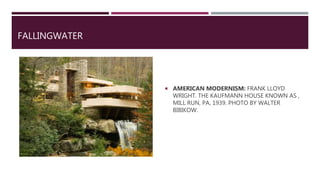
FALLINGWATER
 AMERICAN MODERNISM: FRANK LLOYD
WRIGHT. THE KAUFMANN HOUSE KNOWN AS ,
MILL RUN, PA, 1939. PHOTO BY WALTER
BIBIKOW.
BAUHAUS
 EUROPEAN MODERNISM: WALTER GROPIUS.
EXTERIOR OF THE BAUHAUS, DESSAU, SAXONY-
ANHALT, GERMANY, 1925-1926. PHOTO BY GILI
MERIN.
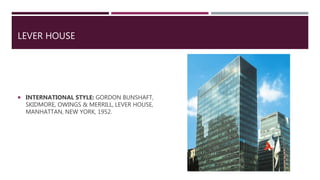
LEVER HOUSE
 INTERNATIONAL STYLE: GORDON BUNSHAFT,
SKIDMORE, OWINGS & MERRILL, LEVER HOUSE,
MANHATTAN, NEW YORK, 1952.
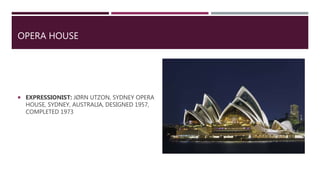
OPERA HOUSE
 EXPRESSIONIST: JØRN UTZON, SYDNEY OPERA
HOUSE, SYDNEY, AUSTRALIA, DESIGNED 1957,
COMPLETED 1973
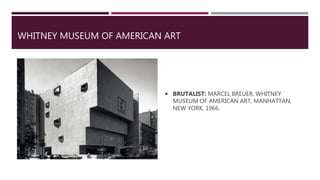
WHITNEY MUSEUM OF AMERICAN ART
 BRUTALIST: MARCEL BREUER, WHITNEY
MUSEUM OF AMERICAN ART, MANHATTAN,
NEW YORK, 1966.
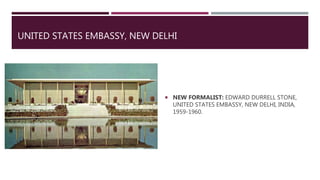
UNITED STATES EMBASSY, NEW DELHI
 NEW FORMALIST: EDWARD DURRELL STONE,
UNITED STATES EMBASSY, NEW DELHI, INDIA,
1959-1960.
TWA FLIGHT CENTER
 GOOGIE: EERO SAARINEN, TWA FLIGHT
CENTER, QUEENS, NEW YORK, 1962.
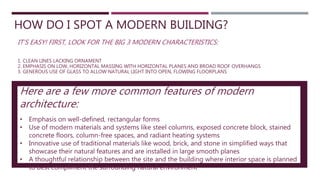
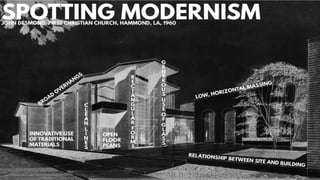
HOW DO I SPOT A MODERN BUILDING?
IT’S EASY! FIRST, LOOK FOR THE BIG 3 MODERN CHARACTERISTICS:
1. CLEAN LINES LACKING ORNAMENT
2. EMPHASIS ON LOW, HORIZONTAL MASSING WITH HORIZONTAL PLANES AND BROAD ROOF OVERHANGS
3. GENEROUS USE OF GLASS TO ALLOW NATURAL LIGHT INTO OPEN, FLOWING FLOORPLANS
Here are a few more common features of modern
architecture:
• Emphasis on well-defined, rectangular forms
• Use of modern materials and systems like steel columns, exposed concrete block, stained
concrete floors, column-free spaces, and radiant heating systems
• Innovative use of traditional materials like wood, brick, and stone in simplified ways that
showcase their natural features and are installed in large smooth planes
• A thoughtful relationship between the site and the building where interior space is planned
to best compliment the surrounding natural environment
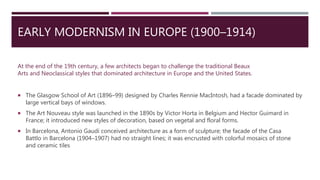
EARLY MODERNISM IN EUROPE (1900–1914)
 The Glasgow School of Art (1896–99) designed by Charles Rennie MacIntosh, had a facade dominated by
large vertical bays of windows.
 The Art Nouveau style was launched in the 1890s by Victor Horta in Belgium and Hector Guimard in
France; it introduced new styles of decoration, based on vegetal and floral forms.
 In Barcelona, Antonio Gaudi conceived architecture as a form of sculpture; the facade of the Casa
Battlo in Barcelona (1904–1907) had no straight lines; it was encrusted with colorful mosaics of stone
and ceramic tiles
At the end of the 19th century, a few architects began to challenge the traditional Beaux
Arts and Neoclassical styles that dominated architecture in Europe and the United States.
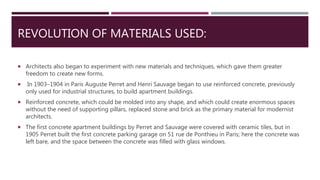
REVOLUTION OF MATERIALS USED:
 Architects also began to experiment with new materials and techniques, which gave them greater
freedom to create new forms.
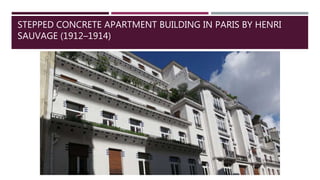
 In 1903–1904 in Paris Auguste Perret and Henri Sauvage began to use reinforced concrete, previously
only used for industrial structures, to build apartment buildings.
 Reinforced concrete, which could be molded into any shape, and which could create enormous spaces
without the need of supporting pillars, replaced stone and brick as the primary material for modernist
architects.
 The first concrete apartment buildings by Perret and Sauvage were covered with ceramic tiles, but in
1905 Perret built the first concrete parking garage on 51 rue de Ponthieu in Paris; here the concrete was
left bare, and the space between the concrete was filled with glass windows.
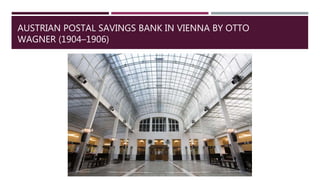
AUSTRIAN POSTAL SAVINGS BANK IN VIENNA BY OTTO
WAGNER (1904–1906)
STEPPED CONCRETE APARTMENT BUILDING IN PARIS BY HENRI
SAUVAGE (1912–1914)
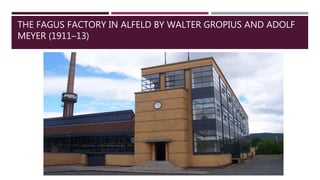
THE FAGUS FACTORY IN ALFELD BY WALTER GROPIUS AND ADOLF
MEYER (1911–13)
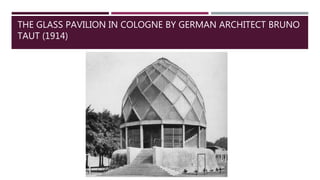
THE GLASS PAVILION IN COLOGNE BY GERMAN ARCHITECT BRUNO
TAUT (1914)
EARLY AMERICAN MODERNISM (1890–1914)
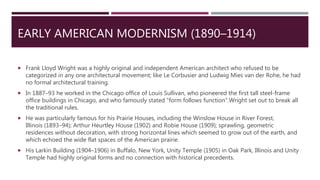
 Frank Lloyd Wright was a highly original and independent American architect who refused to be
categorized in any one architectural movement; like Le Corbusier and Ludwig Mies van der Rohe, he had
no formal architectural training.
 In 1887–93 he worked in the Chicago office of Louis Sullivan, who pioneered the first tall steel-frame
office buildings in Chicago, and who famously stated "form follows function".Wright set out to break all
the traditional rules.
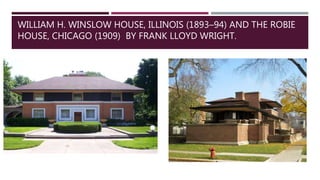
 He was particularly famous for his Prairie Houses, including the Winslow House in River Forest,
Illinois (1893–94); Arthur Heurtley House (1902) and Robie House (1909); sprawling, geometric
residences without decoration, with strong horizontal lines which seemed to grow out of the earth, and
which echoed the wide flat spaces of the American prairie.
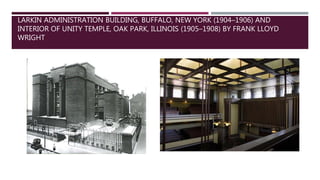
 His Larkin Building (1904–1906) in Buffalo, New York, Unity Temple (1905) in Oak Park, Illinois and Unity
Temple had highly original forms and no connection with historical precedents.
WILLIAM H. WINSLOW HOUSE, ILLINOIS (1893–94) AND THE ROBIE
HOUSE, CHICAGO (1909) BY FRANK LLOYD WRIGHT.
LARKIN ADMINISTRATION BUILDING, BUFFALO, NEW YORK (1904–1906) AND
INTERIOR OF UNITY TEMPLE, OAK PARK, ILLINOIS (1905–1908) BY FRANK LLOYD
WRIGHT
EARLY SKYSCRAPERS
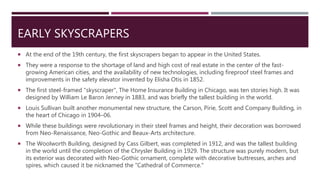
 At the end of the 19th century, the first skyscrapers began to appear in the United States.
 They were a response to the shortage of land and high cost of real estate in the center of the fast-
growing American cities, and the availability of new technologies, including fireproof steel frames and
improvements in the safety elevator invented by Elisha Otis in 1852.
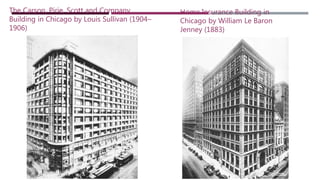
 The first steel-framed "skyscraper", The Home Insurance Building in Chicago, was ten stories high. It was
designed by William Le Baron Jenney in 1883, and was briefly the tallest building in the world.
 Louis Sullivan built another monumental new structure, the Carson, Pirie, Scott and Company Building, in
the heart of Chicago in 1904–06.
 While these buildings were revolutionary in their steel frames and height, their decoration was borrowed
from Neo-Renaissance, Neo-Gothic and Beaux-Arts architecture.
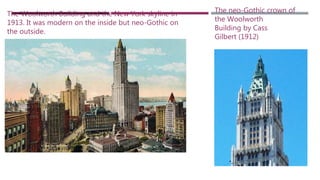
 The Woolworth Building, designed by Cass Gilbert, was completed in 1912, and was the tallest building
in the world until the completion of the Chrysler Building in 1929. The structure was purely modern, but
its exterior was decorated with Neo-Gothic ornament, complete with decorative buttresses, arches and
spires, which caused it be nicknamed the "Cathedral of Commerce."
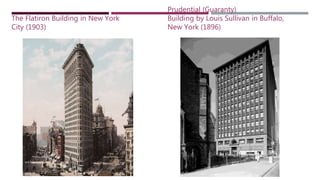
The Flatiron Building in New York
City (1903)
Prudential (Guaranty)
Building by Louis Sullivan in Buffalo,
New York (1896)
The Carson, Pirie, Scott and Company
Building in Chicago by Louis Sullivan (1904–
1906)
Home Insurance Building in
Chicago by William Le Baron
Jenney (1883)
The Woolworth Building and the New York skyline in
1913. It was modern on the inside but neo-Gothic on
the outside.
The neo-Gothic crown of
the Woolworth
Building by Cass
Gilbert (1912)
THANK YOU! CHANDAN GUPTA
https://www.slideshare.net/ChandanGupta209/
chandang9719@gmail.com

Modern architecture

  • 1.
    MODERN ARCHITECTURE THIS ARTICLEIS ABOUT MODERN MOVEMENT ARCHITECTURE. FOR ARCHITECTURE IN THE PRESENT DAY, SEE CONTEMPORARY ARCHITECTURE. CHANDAN GUPTA chandang9719@gmail.co m https://www.slideshare.net/ChandanGu pta209/
  • 2.
    WHAT IS MODERNARCHITECTURE?  Modernism in architecture is characterized by its emphasis on form over ornament; appreciation of materials and structure instead of idyllic revival constructions; and the adroit, methodical use of space.
  • 3.
    Modern architecture, ormodernist architecture, was based upon new and innovative technologies of construction, particularly the use of glass, steel and reinforced concrete; the idea that form should follow function (functionalism); an embrace of minimalism; and a rejection of ornament. It emerged in the first half of the 20th century and became dominant after world war II until the 1980s, when it was gradually replaced as the principal style for institutional and corporate buildings by postmodern architecture.
  • 4.
    FACTS  Several differentstyles of modern architecture in the United States developed between 1930 and 1970 such as the International, Expressionist, Brutalist, New Formalist, and Googie movements.  The roots of modern architecture can be traced to the 1893 Chicago World’s Fair, which was composed entirely of cutting-edge buildings and cemented the United States’ role as a world leader in art, architecture, and technology.  One of the many young architects inspired by the 1893 Chicago World’s Fair was Frank Lloyd Wright, the leading force in shaping modern American architecture in the 20th century.  The Bauhaus was a German school of architecture, sculpture, painting, design, and craft, led by Walter Gropius, in operation from 1919 to 1933 that brought the modern movement to international prominence.
  • 5.
    FALLINGWATER  AMERICAN MODERNISM:FRANK LLOYD WRIGHT. THE KAUFMANN HOUSE KNOWN AS , MILL RUN, PA, 1939. PHOTO BY WALTER BIBIKOW.
  • 6.
    BAUHAUS  EUROPEAN MODERNISM:WALTER GROPIUS. EXTERIOR OF THE BAUHAUS, DESSAU, SAXONY- ANHALT, GERMANY, 1925-1926. PHOTO BY GILI MERIN.
  • 7.
    LEVER HOUSE  INTERNATIONALSTYLE: GORDON BUNSHAFT, SKIDMORE, OWINGS & MERRILL, LEVER HOUSE, MANHATTAN, NEW YORK, 1952.
  • 8.
    OPERA HOUSE  EXPRESSIONIST:JØRN UTZON, SYDNEY OPERA HOUSE, SYDNEY, AUSTRALIA, DESIGNED 1957, COMPLETED 1973
  • 9.
    WHITNEY MUSEUM OFAMERICAN ART  BRUTALIST: MARCEL BREUER, WHITNEY MUSEUM OF AMERICAN ART, MANHATTAN, NEW YORK, 1966.
  • 10.
    UNITED STATES EMBASSY,NEW DELHI  NEW FORMALIST: EDWARD DURRELL STONE, UNITED STATES EMBASSY, NEW DELHI, INDIA, 1959-1960.
  • 11.
    TWA FLIGHT CENTER GOOGIE: EERO SAARINEN, TWA FLIGHT CENTER, QUEENS, NEW YORK, 1962.
  • 12.
    HOW DO ISPOT A MODERN BUILDING? IT’S EASY! FIRST, LOOK FOR THE BIG 3 MODERN CHARACTERISTICS: 1. CLEAN LINES LACKING ORNAMENT 2. EMPHASIS ON LOW, HORIZONTAL MASSING WITH HORIZONTAL PLANES AND BROAD ROOF OVERHANGS 3. GENEROUS USE OF GLASS TO ALLOW NATURAL LIGHT INTO OPEN, FLOWING FLOORPLANS Here are a few more common features of modern architecture: • Emphasis on well-defined, rectangular forms • Use of modern materials and systems like steel columns, exposed concrete block, stained concrete floors, column-free spaces, and radiant heating systems • Innovative use of traditional materials like wood, brick, and stone in simplified ways that showcase their natural features and are installed in large smooth planes • A thoughtful relationship between the site and the building where interior space is planned to best compliment the surrounding natural environment
  • 14.
    EARLY MODERNISM INEUROPE (1900–1914)  The Glasgow School of Art (1896–99) designed by Charles Rennie MacIntosh, had a facade dominated by large vertical bays of windows.  The Art Nouveau style was launched in the 1890s by Victor Horta in Belgium and Hector Guimard in France; it introduced new styles of decoration, based on vegetal and floral forms.  In Barcelona, Antonio Gaudi conceived architecture as a form of sculpture; the facade of the Casa Battlo in Barcelona (1904–1907) had no straight lines; it was encrusted with colorful mosaics of stone and ceramic tiles At the end of the 19th century, a few architects began to challenge the traditional Beaux Arts and Neoclassical styles that dominated architecture in Europe and the United States.
  • 15.
    REVOLUTION OF MATERIALSUSED:  Architects also began to experiment with new materials and techniques, which gave them greater freedom to create new forms.  In 1903–1904 in Paris Auguste Perret and Henri Sauvage began to use reinforced concrete, previously only used for industrial structures, to build apartment buildings.  Reinforced concrete, which could be molded into any shape, and which could create enormous spaces without the need of supporting pillars, replaced stone and brick as the primary material for modernist architects.  The first concrete apartment buildings by Perret and Sauvage were covered with ceramic tiles, but in 1905 Perret built the first concrete parking garage on 51 rue de Ponthieu in Paris; here the concrete was left bare, and the space between the concrete was filled with glass windows.
  • 16.
    AUSTRIAN POSTAL SAVINGSBANK IN VIENNA BY OTTO WAGNER (1904–1906)
  • 17.
    STEPPED CONCRETE APARTMENTBUILDING IN PARIS BY HENRI SAUVAGE (1912–1914)
  • 18.
    THE FAGUS FACTORYIN ALFELD BY WALTER GROPIUS AND ADOLF MEYER (1911–13)
  • 19.
    THE GLASS PAVILIONIN COLOGNE BY GERMAN ARCHITECT BRUNO TAUT (1914)
  • 20.
    EARLY AMERICAN MODERNISM(1890–1914)  Frank Lloyd Wright was a highly original and independent American architect who refused to be categorized in any one architectural movement; like Le Corbusier and Ludwig Mies van der Rohe, he had no formal architectural training.  In 1887–93 he worked in the Chicago office of Louis Sullivan, who pioneered the first tall steel-frame office buildings in Chicago, and who famously stated "form follows function".Wright set out to break all the traditional rules.  He was particularly famous for his Prairie Houses, including the Winslow House in River Forest, Illinois (1893–94); Arthur Heurtley House (1902) and Robie House (1909); sprawling, geometric residences without decoration, with strong horizontal lines which seemed to grow out of the earth, and which echoed the wide flat spaces of the American prairie.  His Larkin Building (1904–1906) in Buffalo, New York, Unity Temple (1905) in Oak Park, Illinois and Unity Temple had highly original forms and no connection with historical precedents.
  • 21.
    WILLIAM H. WINSLOWHOUSE, ILLINOIS (1893–94) AND THE ROBIE HOUSE, CHICAGO (1909) BY FRANK LLOYD WRIGHT.
  • 22.
    LARKIN ADMINISTRATION BUILDING,BUFFALO, NEW YORK (1904–1906) AND INTERIOR OF UNITY TEMPLE, OAK PARK, ILLINOIS (1905–1908) BY FRANK LLOYD WRIGHT
  • 23.
    EARLY SKYSCRAPERS  Atthe end of the 19th century, the first skyscrapers began to appear in the United States.  They were a response to the shortage of land and high cost of real estate in the center of the fast- growing American cities, and the availability of new technologies, including fireproof steel frames and improvements in the safety elevator invented by Elisha Otis in 1852.  The first steel-framed "skyscraper", The Home Insurance Building in Chicago, was ten stories high. It was designed by William Le Baron Jenney in 1883, and was briefly the tallest building in the world.  Louis Sullivan built another monumental new structure, the Carson, Pirie, Scott and Company Building, in the heart of Chicago in 1904–06.  While these buildings were revolutionary in their steel frames and height, their decoration was borrowed from Neo-Renaissance, Neo-Gothic and Beaux-Arts architecture.  The Woolworth Building, designed by Cass Gilbert, was completed in 1912, and was the tallest building in the world until the completion of the Chrysler Building in 1929. The structure was purely modern, but its exterior was decorated with Neo-Gothic ornament, complete with decorative buttresses, arches and spires, which caused it be nicknamed the "Cathedral of Commerce."
  • 24.
    The Flatiron Buildingin New York City (1903) Prudential (Guaranty) Building by Louis Sullivan in Buffalo, New York (1896)
  • 25.
    The Carson, Pirie,Scott and Company Building in Chicago by Louis Sullivan (1904– 1906) Home Insurance Building in Chicago by William Le Baron Jenney (1883)
  • 26.
    The Woolworth Buildingand the New York skyline in 1913. It was modern on the inside but neo-Gothic on the outside. The neo-Gothic crown of the Woolworth Building by Cass Gilbert (1912)
  • 27.
    THANK YOU! CHANDANGUPTA https://www.slideshare.net/ChandanGupta209/ chandang9719@gmail.com