BONE
FRACTURES
TRESFORD MAMBWE
MEDICAL STUDENT
MULUNGUSHI
UNIVERSITY.
OBJECTIVES
Basic principles
Risk factors and Causes
Classifications
Signs and Symptoms
Clinical assessment
Fracture healing
Complications
Management
Tractions
• A fracture (sometimes abbreviated FRX or Fx or Fx or #) is a partial or
complete break in the structural continuity of a bone which may or may
not be involved with soft tissue injury.
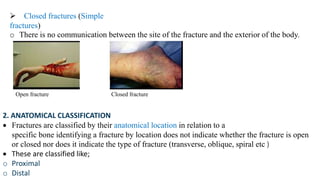
• If the overlying skin remains intact it is a closed (or simple) fracture.
• If the skin or one of the body cavities is breached it is an open (or
compound) fracture, liable to contamination and infection
• Bone is the only tissue in the human body other than the liver that heals
by regeneration instead of scarring.
• For regeneration to occur the bone must be immobilized to allow the
uninterrupted formation of new bone.
BASIC PRINCIPLES OF FRACTURES
RISK FACTORS
• Age and Gender
• Smoking
• Alcohol
• Steroid use
• Rheumatoid arthritis
• Chronic diseases (e.g. Celiac disease, Crohn’s disease, ulcerative colitis and kidney
diseases)
• Diabetes
• Previous fracture
CAUSES
• Physical trauma
• Overuse
• Health conditions that weaken the bones, such as osteoporosis.
CLASSIFICATION
• Classification aims to have a standard interpretation of a fracture for research and clinical
management, tell you the severity of the fracture and how it could have been caused as well
as better management.
• Fractures can be classified according to:
 Clinical classification
 Anatomical site
 Etiology (mechanism of injury)
 Radiological appearance (Radiological pattern of fracture)
 Eponyms
1. Clinical classification
 Fractures are either classified as:
 Open fractures (Compound
fractures)
o There is a wound on the skin surface leading to the site of the fracture i.e. direct
communication exists between the body surface and the fracture, these fractures are liable to
contamination by organisms.
 Closed fractures (Simple
fractures)
o There is no communication between the site of the fracture and the exterior of the body.
Open fracture Closed fracture
2. ANATOMICAL CLASSIFICATION
 Fractures are classified by their anatomical location in relation to a
specific bone identifying a fracture by location does not indicate whether the fracture is open
or closed nor does it indicate the type of fracture (transverse, oblique, spiral etc )
 These are classified like;
o Proximal
o Distal
3. ETIOLOGICAL CLASSIFICATION.
According to etiology fractures are divided into 3 groups:
 Fractures due to sudden Injury (Traumatic #s) Fracture caused by sudden
and excessive force which
may be direct or indirect.
i. Direct force; bone breaks at the point of impact; the soft tissues also are damaged.
ii. Indirect force; bone breaks at a distance from where the force is applied, soft tissue damage
at the fracture site is not inevitable.
 Repetitive stress/ fatigue/stress fracture: occur in the normal bone which is subject to repeated
heavy loading.
 pathological fracture; fractures that occur even with normal stresses because the
bone is diseased making it weak. (e.g. in osteoporosis, osteogenesis imperfecta or Paget’s
disease)
4. RADIOLOGICAL PATTERN.
 This classification is based on the X-ray view of the fracture. It is the description of shape
and pattern as seen on radiographs.
 Pattern indicates:
 Nature of causative violence
 Clue to the easiest method of reduction
 The likely stability of the fragments
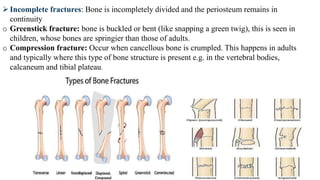
 These patterns fall into 2 well defined groups:
 Complete fractures: Fracture split into two or more fragments. X-ray can help predict
behavior after reduction.
o Transverse fractures: fragments usually remain in place after reduction.
o Oblique fractures: tend to shorten and re-displace even if the bone is splinted
o Spiral fractures: tend to shorten and re-displace even if the bone is splinted
o Impacted fractures: Fragments are jammed tightly together and the fracture line is
indistinct.
o Comminuted fractures: more than two fragments are present, because there is poor
interlocking of the fracture surfaces, these are
often unstable.
Incomplete fractures: Bone is incompletely divided and the periosteum remains in
continuity
o Greenstick fracture: bone is buckled or bent (like snapping a green twig), this is seen in
children, whose bones are springier than those of adults.
o Compression fracture: Occur when cancellous bone is crumpled. This happens in adults
and typically where this type of bone structure is present e.g. in the vertebral bodies,
calcaneum and tibial plateau.
5.EPONYMS
 Traditional classifications often bear the originator’s name based on the people that
first described the fractures, These are ;
Gastilo & Anderson- open tibial fracture
Type 1 - wound < 1 cm, Mild contamination
Type 2 - wound of 1-10 cm, Moderate contamination
Type 3 - wound > 10cm, Severe contamination plus
A. No. periosteal striping
B. With periosteal striping
C. Neurovascular damage
Garden’s classification for fracture neck of femur;
Type1 - Incomplete or impacted #
Media trabecular intact
Vascularity preserved
Type2 - Complete # without displacement
Trabecular aligned
Vascularity preserved
Gartilands’ classification of supracondylar #:
Type 1 - Undisplaced #
Type 2 - Displaced # with intact posterior cortex
Type 3 - Complete displacement #
Weber classification of Ankle #s:
Type A - Below the syndesmosis
Type B - At the syndesmosis
Type C - Above the syndesmosis
Boyd- griffin classification of intertrochanteric #s:
Type1 - Undisplaced #
Type2 - Partially displaced #
Type3 - Reverse #
Type4 - Displaced intertrochanteric # with subtrochanteric extension.
How to describe the fracture
 When describing, the description must include: Clinical classification, Anatomical
classification, Radiological pattern, Displacement.
Example: Closed, transverse fracture of the shaft of the radius with no displacement.
SIGNS AND SYMPTOMS OF FRACTURES
• Symptoms of a broken bone include:
 A visibly out-of-place or misshapen limb or joint
 Swelling, bruising, or bleeding
 Intense pain
 Numbness and tingling
 Broken skin with bone protruding
 Limited mobility or inability to move a limb or put weight on the leg
CLINICAL ASSESSMENT OF FRACTURES
• Involves:
 History
 General examination (general signs)
 Local examination
 HISTORY
 History of injury, followed by inability to use the injured limb but beware! The fracture is not
always at the site of the injury
 Patient’s age and mechanism of injury are important, if a fracture occurs with trivial trauma
suspect a pathological lesion.
 Pain, bruising, and swelling are common symptoms but they do not distinguish a fracture
from a soft tissue injury.
 Deformity is much more suggestive. Always enquire about Symptoms of associated injuries:
pain and swelling elsewhere, numbness or loss of movement, skin pallor or cyanosis, blood in
urine, abdominal pain, difficulty with breathing or transient loss of consciousness.
 Previous injuries: ask about previous injuries or any other musculoskeletal abnormality that
might cause confusion when the X-ray is seen.
 General medical history: Important in preparation for anesthesia or operation.
 GENERAL EXAMINATION
• With the general, the following must be done :
 Follow the ABCs
 During the secondary survey, it will also, be necessary to exclude predisposing causes
(such as Paget’s disease or metastasis).
 General signs (a broken bone is part of a patient). Look for evidence of:
Shock or hemorrhage
Associated damage to the brain, spinal cord or viscera
Predisposing causes .
 LOCAL EXAMINATION
• Look for the following signs:
 Swelling, bruising, deformity
 Deformity; measure and record any:
o Angulation
o Rotation
o Translation
o Shortening
o These may be better assessed on X-ray
• Any compound wounds (i.e. any woundsthat reach to the site of the fracture)
These should be assessed accurately and measured and recorded using the
Gustillo classification (of an open tibial fracture)
• HEALING OF FRACTURE
• Healing begins as soon as the bone is broken, provided the conditions are
favorable and proceeds through several stages.
• The repair of tubular bone has been classified into 5 stages for simplicity:
1. Stage of inflammation and hematoma formation
o Tissue damage and bleeding. (immediate response)
2. Stage of cellular proliferation (subperiosteal and endosteal cells)
o Inflammatory cells appear.
3. Status of callus formation
o Osteoblasts and osteoclasts appear.
o Takes 2-4 weeks
4. Stage of consolidation
o Woven bone replaced by lamellar bone and fracture united.
5. Remodelling
o New formed bone remodelled to resemble
MANAGEMENT OF FRACTURE
• General treatment is the first consideration: treat the patient, not only thefracture.
 First Aid- ABCs
 Treatment of shock
 Treatment of the fracture
Delayed unions and non-unions
Non-unions are fractures that fail to heal, while delayed unions are those that take longer to heal.
Treatments for non-unions and delayed unions include:
•Bone graft: If the fracture does not heal, a surgeon will transplant a natural or synthetic bone to
stimulate the broken bone.
•Stem cell therapy: Stem cell-derived therapies in the healing of bone fractures.
• Treatment of the fracture consists of: Reduction, immobilization and rehabilitation
• Reduction: restoration of the displaced fragments to their anatomical positions.
o Manipulation: to improve the position of the fragments
o Can be open or closed manipulation and traction.
• Immobilization (or Stabilization) (or hold)- keeping the bony fragments in their position
until union occurs.
o Splintage: to hold them together until they unite, meanwhile joint movement and
function must be preserved.
o Fixation can be open or closed.
• Methods of immobilization include:
i. Continuous traction
ii. Splintage
iii. functional bracing
iv. External fixation
v. Internal fixation
• Rehabilitation: should start as soon as possible after injury, aims at maintaining functions
of the uninjured parts, and once fracture is united restoring functions of the injured parts.
• Physiological loading of the bone, so muscle activity and early weight-bearing are
encouraged.
• Benefits of rehabilitation include;
Prevent edema
Prevent joint stiffness
Prevent muscle wasting
Prevent DVT
Enhance fracture healing
Prevent contractures
COMPLICATIONS
• EARLY COMPLICATIONS
 Hemorrhage- may lead to shock (internal or external e.g. # femur-2L, Tibia-1/2L, Pelvis 3-5L)
 Nerve or vascular injury
 Hematoma
 Soft tissue injury e.g. visceral organs, urethra etc.
 Tendon injury
• INTERMEDIATE
 Infection
 Septic wound/ septicemia in compound #s
 Avascular necrosis
 Compartment syndrome
 Joint stiffness
 Volkmann ischemic contractures
 Osteomyelitis
 Fat embolism
 Thromboembolism
• LATE
 Malunion (may lead to late neuropathies e.g. valgus deformity at elbow-an ulcer)
 Non-union
 Delayed union
 Ostathrosis- common and particular #s especially displaced
 Joint instability/deformity
 Post-traumatic atrophy
 Osteochiorosis-harden brittle
 Osteoarthritis
 Shortening of bone
 Intra-articular and peri-articular adhesion
 Hypostatic pneumonia
 DVT
 Pressure sores
TRACTION
• Traction is applied to the limb distal to the fracture so as to exert a continuous pull in the
long axis of the bone, with a counterforce in the opposite direction (to prevent the patient
from being merely dragged along the bed)
• Traction is safe enough, provided it is not excessive and care is taken when inserting the
traction pin. Traction includes:
 Skin traction
 Skeletal traction
SKIN TRACTION
• Skin traction will sustain a pull of no more than 4 or 5kg (has a limit).
• Holland strapping or one-way stretch Elastoplast is stuck to the shaved skin and held on
with a bandage.
• The malleoli are protected by Gamgee tissue and cords or tapes are used for traction.
• It is used for individuals between the ages of 3 and 18 years.
• Indications include:
Fractures: Shaft of the femur (main indication in children)
Other indications in adults
include:
- Intertrochanteric fractures
- Fracture of pelvis
- Unstable Hip dislocation
- Intervertebral disc prolapses
- Upper femoral epiphysis separation
 Extremes of age
Those reacting to pin
Fixed flexion deformity
TYPES OF SKIN TRACTION
 These include:
 Gallows
 Natural
 Boot
 Lateral
 Dunlop (for supracondylar fractures)
ADVANTAGES AND DISADVANTAGES OF SKIN TRACTION
 Advantages:
 Non invasive
 Easy to apply
 Cheap
 Disadvantage
 Has a weight limit: 4-5 kg
 Ischemia if the bandage is too tight
 Allergic reactions to strapping
 Stiffness and contracture formation
COMPLICATIONS OF SKIN TRACTION
EARLY
 Compartment syndrome: Severe progressive pain that responds poorly to analgesics.
 Skin avulsion
 Allergic reaction
INTERMEDIATE
 Gangrene or ischemia
LATE
 Joint stiffness
 Hypostatic pneumonia
 DVT and embolism
 Mal-union, non-union and delayed union with traction that is not properly applied.
SKELETAL TRACTION (PERKINS TRACTION)
• This is a type of skeletal traction with a patient on a Perkins bed (from under
the bed should have springs halfway and hallow on the other half to aid in
exercises) and doing Perkins exercises.
APPLICATION OF PERKINS TRACTION
 Insert pin 2cm distal and 2cm lateral to the tibial tuberosity.
 Apply 1/7 of body weight (Adults) and for each kilogram of weight raise the foot end
the of bed by 4cm.
 This prevents over-traction & hence non-unions.
 Measure both patient’s legs from the anterior superior iliac spine to the tip of the
medial malleoli to make sure they are the same length.
 If necessary, adjust the traction weight and elevation of the foot end of end so as to
let the bone fragments overlap by about 1 cm.
 Check leg length every day for the next 2 weeks and adjust the weight appropriately.
Then check length every 2 weeks.
 Note when assess follow a similar plan to that of skin traction
ADVANTAGES
 Perkins’s exercise helps to:
 Increases blood supply and promotes healing
 Controlled movement and compression of the bone ends encourage union
 Prevents muscle atrophyquadriceps, knee joint stiffness/ contractures
 Prevents DVT, Decubitus ulcers and hypostatic pneumonia
DISADVANTAGES
 Injury to the common peroneal nerve (foot drop)
 Fracture of the tibia at the site of insertion of the pin
 Pin tract infection (Pain, swelling, tenderness, pus), pin traction infection is prevented by:
Daily wound cleaning with proper technique (follow the 3 “S”:
o S- spread the skin from the pin
o S- squeeze towards the pin
o S- swab around the pin making rotatory movements (use spirit swabs)
o Edges of pins are then covered with spirit swabs
INDICATIONS
 Indications:
 Undisplaced incomplete fracture of the neck of the femur and intertrochanteric fractures
 Subtrochanteric fractures in which the contraction of the iliopsoas has not flexed the
upper fragment so much as to bring it seriously out of line.
 All # of the shaft of the femur in patients over 18, with severe STI.
 Supracondylar # in which the lower fragment has not been too severely flexed by the
contraction of the gastrocnemius.
 All condyle # of the femur, except those in which a condyle has rotated completely
COMPLICATIONS
EARLY (During insertion)
 Damage to the common peroneal nerve causes foot drop
 Fat embolism
 # of Tibia at the site of insertion of the pin
 Soft tissue injury
 Haemorrhage
 Hematoma
LATE (During traction)
 Decubitus ulcer (bed sores)
 Pin site infection- osteomyelitis
 Osteoporosis- bone resorption because the patient is bedridden
 Malunion
 Delayed union
 Joint stiffness (ankyloses)
 DVT
References
1. Surgery and clinical skills, Moses Kasevu
2. American Bone health/Fractures, September 28, 2016
3. https://www.medicalnewstoday.com/articles/317726#Recovery
4. https://www.stanfordchildrens.org/en/topic/default?id=fractures-in-children-90-
P02760#
THANK YOU

BONE FRACTURES.pptx

  • 1.
  • 2.
    OBJECTIVES Basic principles Risk factorsand Causes Classifications Signs and Symptoms Clinical assessment Fracture healing Complications Management Tractions
  • 3.
    • A fracture(sometimes abbreviated FRX or Fx or Fx or #) is a partial or complete break in the structural continuity of a bone which may or may not be involved with soft tissue injury. • If the overlying skin remains intact it is a closed (or simple) fracture. • If the skin or one of the body cavities is breached it is an open (or compound) fracture, liable to contamination and infection • Bone is the only tissue in the human body other than the liver that heals by regeneration instead of scarring. • For regeneration to occur the bone must be immobilized to allow the uninterrupted formation of new bone. BASIC PRINCIPLES OF FRACTURES
  • 4.
    RISK FACTORS • Ageand Gender • Smoking • Alcohol • Steroid use • Rheumatoid arthritis • Chronic diseases (e.g. Celiac disease, Crohn’s disease, ulcerative colitis and kidney diseases) • Diabetes • Previous fracture CAUSES • Physical trauma • Overuse • Health conditions that weaken the bones, such as osteoporosis.
  • 5.
    CLASSIFICATION • Classification aimsto have a standard interpretation of a fracture for research and clinical management, tell you the severity of the fracture and how it could have been caused as well as better management. • Fractures can be classified according to:  Clinical classification  Anatomical site  Etiology (mechanism of injury)  Radiological appearance (Radiological pattern of fracture)  Eponyms 1. Clinical classification  Fractures are either classified as:  Open fractures (Compound fractures) o There is a wound on the skin surface leading to the site of the fracture i.e. direct communication exists between the body surface and the fracture, these fractures are liable to contamination by organisms.
  • 6.
     Closed fractures(Simple fractures) o There is no communication between the site of the fracture and the exterior of the body. Open fracture Closed fracture 2. ANATOMICAL CLASSIFICATION  Fractures are classified by their anatomical location in relation to a specific bone identifying a fracture by location does not indicate whether the fracture is open or closed nor does it indicate the type of fracture (transverse, oblique, spiral etc )  These are classified like; o Proximal o Distal
  • 7.
    3. ETIOLOGICAL CLASSIFICATION. Accordingto etiology fractures are divided into 3 groups:  Fractures due to sudden Injury (Traumatic #s) Fracture caused by sudden and excessive force which may be direct or indirect. i. Direct force; bone breaks at the point of impact; the soft tissues also are damaged. ii. Indirect force; bone breaks at a distance from where the force is applied, soft tissue damage at the fracture site is not inevitable.  Repetitive stress/ fatigue/stress fracture: occur in the normal bone which is subject to repeated heavy loading.  pathological fracture; fractures that occur even with normal stresses because the bone is diseased making it weak. (e.g. in osteoporosis, osteogenesis imperfecta or Paget’s disease) 4. RADIOLOGICAL PATTERN.  This classification is based on the X-ray view of the fracture. It is the description of shape and pattern as seen on radiographs.
  • 8.
     Pattern indicates: Nature of causative violence  Clue to the easiest method of reduction  The likely stability of the fragments  These patterns fall into 2 well defined groups:  Complete fractures: Fracture split into two or more fragments. X-ray can help predict behavior after reduction. o Transverse fractures: fragments usually remain in place after reduction. o Oblique fractures: tend to shorten and re-displace even if the bone is splinted o Spiral fractures: tend to shorten and re-displace even if the bone is splinted o Impacted fractures: Fragments are jammed tightly together and the fracture line is indistinct. o Comminuted fractures: more than two fragments are present, because there is poor interlocking of the fracture surfaces, these are often unstable.
  • 9.
    Incomplete fractures: Boneis incompletely divided and the periosteum remains in continuity o Greenstick fracture: bone is buckled or bent (like snapping a green twig), this is seen in children, whose bones are springier than those of adults. o Compression fracture: Occur when cancellous bone is crumpled. This happens in adults and typically where this type of bone structure is present e.g. in the vertebral bodies, calcaneum and tibial plateau.
  • 10.
    5.EPONYMS  Traditional classificationsoften bear the originator’s name based on the people that first described the fractures, These are ; Gastilo & Anderson- open tibial fracture Type 1 - wound < 1 cm, Mild contamination Type 2 - wound of 1-10 cm, Moderate contamination Type 3 - wound > 10cm, Severe contamination plus A. No. periosteal striping B. With periosteal striping C. Neurovascular damage Garden’s classification for fracture neck of femur; Type1 - Incomplete or impacted # Media trabecular intact Vascularity preserved Type2 - Complete # without displacement Trabecular aligned Vascularity preserved
  • 11.
    Gartilands’ classification ofsupracondylar #: Type 1 - Undisplaced # Type 2 - Displaced # with intact posterior cortex Type 3 - Complete displacement # Weber classification of Ankle #s: Type A - Below the syndesmosis Type B - At the syndesmosis Type C - Above the syndesmosis Boyd- griffin classification of intertrochanteric #s: Type1 - Undisplaced # Type2 - Partially displaced # Type3 - Reverse # Type4 - Displaced intertrochanteric # with subtrochanteric extension.
  • 12.
    How to describethe fracture  When describing, the description must include: Clinical classification, Anatomical classification, Radiological pattern, Displacement. Example: Closed, transverse fracture of the shaft of the radius with no displacement. SIGNS AND SYMPTOMS OF FRACTURES • Symptoms of a broken bone include:  A visibly out-of-place or misshapen limb or joint  Swelling, bruising, or bleeding  Intense pain  Numbness and tingling  Broken skin with bone protruding  Limited mobility or inability to move a limb or put weight on the leg
  • 13.
    CLINICAL ASSESSMENT OFFRACTURES • Involves:  History  General examination (general signs)  Local examination  HISTORY  History of injury, followed by inability to use the injured limb but beware! The fracture is not always at the site of the injury  Patient’s age and mechanism of injury are important, if a fracture occurs with trivial trauma suspect a pathological lesion.  Pain, bruising, and swelling are common symptoms but they do not distinguish a fracture from a soft tissue injury.  Deformity is much more suggestive. Always enquire about Symptoms of associated injuries: pain and swelling elsewhere, numbness or loss of movement, skin pallor or cyanosis, blood in urine, abdominal pain, difficulty with breathing or transient loss of consciousness.  Previous injuries: ask about previous injuries or any other musculoskeletal abnormality that might cause confusion when the X-ray is seen.  General medical history: Important in preparation for anesthesia or operation.
  • 14.
     GENERAL EXAMINATION •With the general, the following must be done :  Follow the ABCs  During the secondary survey, it will also, be necessary to exclude predisposing causes (such as Paget’s disease or metastasis).  General signs (a broken bone is part of a patient). Look for evidence of: Shock or hemorrhage Associated damage to the brain, spinal cord or viscera Predisposing causes .  LOCAL EXAMINATION • Look for the following signs:  Swelling, bruising, deformity  Deformity; measure and record any: o Angulation o Rotation
  • 15.
    o Translation o Shortening oThese may be better assessed on X-ray • Any compound wounds (i.e. any woundsthat reach to the site of the fracture) These should be assessed accurately and measured and recorded using the Gustillo classification (of an open tibial fracture) • HEALING OF FRACTURE • Healing begins as soon as the bone is broken, provided the conditions are favorable and proceeds through several stages. • The repair of tubular bone has been classified into 5 stages for simplicity: 1. Stage of inflammation and hematoma formation o Tissue damage and bleeding. (immediate response) 2. Stage of cellular proliferation (subperiosteal and endosteal cells) o Inflammatory cells appear.
  • 16.
    3. Status ofcallus formation o Osteoblasts and osteoclasts appear. o Takes 2-4 weeks 4. Stage of consolidation o Woven bone replaced by lamellar bone and fracture united. 5. Remodelling o New formed bone remodelled to resemble MANAGEMENT OF FRACTURE • General treatment is the first consideration: treat the patient, not only thefracture.  First Aid- ABCs  Treatment of shock  Treatment of the fracture Delayed unions and non-unions Non-unions are fractures that fail to heal, while delayed unions are those that take longer to heal. Treatments for non-unions and delayed unions include: •Bone graft: If the fracture does not heal, a surgeon will transplant a natural or synthetic bone to stimulate the broken bone. •Stem cell therapy: Stem cell-derived therapies in the healing of bone fractures.
  • 17.
    • Treatment ofthe fracture consists of: Reduction, immobilization and rehabilitation • Reduction: restoration of the displaced fragments to their anatomical positions. o Manipulation: to improve the position of the fragments o Can be open or closed manipulation and traction. • Immobilization (or Stabilization) (or hold)- keeping the bony fragments in their position until union occurs. o Splintage: to hold them together until they unite, meanwhile joint movement and function must be preserved. o Fixation can be open or closed. • Methods of immobilization include: i. Continuous traction ii. Splintage iii. functional bracing iv. External fixation v. Internal fixation
  • 18.
    • Rehabilitation: shouldstart as soon as possible after injury, aims at maintaining functions of the uninjured parts, and once fracture is united restoring functions of the injured parts. • Physiological loading of the bone, so muscle activity and early weight-bearing are encouraged. • Benefits of rehabilitation include; Prevent edema Prevent joint stiffness Prevent muscle wasting Prevent DVT Enhance fracture healing Prevent contractures COMPLICATIONS • EARLY COMPLICATIONS  Hemorrhage- may lead to shock (internal or external e.g. # femur-2L, Tibia-1/2L, Pelvis 3-5L)  Nerve or vascular injury  Hematoma  Soft tissue injury e.g. visceral organs, urethra etc.  Tendon injury
  • 19.
    • INTERMEDIATE  Infection Septic wound/ septicemia in compound #s  Avascular necrosis  Compartment syndrome  Joint stiffness  Volkmann ischemic contractures  Osteomyelitis  Fat embolism  Thromboembolism • LATE  Malunion (may lead to late neuropathies e.g. valgus deformity at elbow-an ulcer)  Non-union  Delayed union  Ostathrosis- common and particular #s especially displaced  Joint instability/deformity
  • 20.
     Post-traumatic atrophy Osteochiorosis-harden brittle  Osteoarthritis  Shortening of bone  Intra-articular and peri-articular adhesion  Hypostatic pneumonia  DVT  Pressure sores TRACTION • Traction is applied to the limb distal to the fracture so as to exert a continuous pull in the long axis of the bone, with a counterforce in the opposite direction (to prevent the patient from being merely dragged along the bed) • Traction is safe enough, provided it is not excessive and care is taken when inserting the traction pin. Traction includes:  Skin traction  Skeletal traction
  • 21.
    SKIN TRACTION • Skintraction will sustain a pull of no more than 4 or 5kg (has a limit). • Holland strapping or one-way stretch Elastoplast is stuck to the shaved skin and held on with a bandage. • The malleoli are protected by Gamgee tissue and cords or tapes are used for traction. • It is used for individuals between the ages of 3 and 18 years. • Indications include: Fractures: Shaft of the femur (main indication in children) Other indications in adults include: - Intertrochanteric fractures - Fracture of pelvis - Unstable Hip dislocation - Intervertebral disc prolapses - Upper femoral epiphysis separation  Extremes of age Those reacting to pin Fixed flexion deformity
  • 22.
    TYPES OF SKINTRACTION  These include:  Gallows  Natural  Boot  Lateral  Dunlop (for supracondylar fractures) ADVANTAGES AND DISADVANTAGES OF SKIN TRACTION  Advantages:  Non invasive  Easy to apply  Cheap  Disadvantage  Has a weight limit: 4-5 kg  Ischemia if the bandage is too tight  Allergic reactions to strapping  Stiffness and contracture formation
  • 23.
    COMPLICATIONS OF SKINTRACTION EARLY  Compartment syndrome: Severe progressive pain that responds poorly to analgesics.  Skin avulsion  Allergic reaction INTERMEDIATE  Gangrene or ischemia LATE  Joint stiffness  Hypostatic pneumonia  DVT and embolism  Mal-union, non-union and delayed union with traction that is not properly applied. SKELETAL TRACTION (PERKINS TRACTION) • This is a type of skeletal traction with a patient on a Perkins bed (from under the bed should have springs halfway and hallow on the other half to aid in exercises) and doing Perkins exercises.
  • 24.
    APPLICATION OF PERKINSTRACTION  Insert pin 2cm distal and 2cm lateral to the tibial tuberosity.  Apply 1/7 of body weight (Adults) and for each kilogram of weight raise the foot end the of bed by 4cm.  This prevents over-traction & hence non-unions.  Measure both patient’s legs from the anterior superior iliac spine to the tip of the medial malleoli to make sure they are the same length.  If necessary, adjust the traction weight and elevation of the foot end of end so as to let the bone fragments overlap by about 1 cm.  Check leg length every day for the next 2 weeks and adjust the weight appropriately. Then check length every 2 weeks.  Note when assess follow a similar plan to that of skin traction ADVANTAGES  Perkins’s exercise helps to:  Increases blood supply and promotes healing  Controlled movement and compression of the bone ends encourage union  Prevents muscle atrophyquadriceps, knee joint stiffness/ contractures  Prevents DVT, Decubitus ulcers and hypostatic pneumonia
  • 25.
    DISADVANTAGES  Injury tothe common peroneal nerve (foot drop)  Fracture of the tibia at the site of insertion of the pin  Pin tract infection (Pain, swelling, tenderness, pus), pin traction infection is prevented by: Daily wound cleaning with proper technique (follow the 3 “S”: o S- spread the skin from the pin o S- squeeze towards the pin o S- swab around the pin making rotatory movements (use spirit swabs) o Edges of pins are then covered with spirit swabs INDICATIONS  Indications:  Undisplaced incomplete fracture of the neck of the femur and intertrochanteric fractures  Subtrochanteric fractures in which the contraction of the iliopsoas has not flexed the upper fragment so much as to bring it seriously out of line.  All # of the shaft of the femur in patients over 18, with severe STI.  Supracondylar # in which the lower fragment has not been too severely flexed by the contraction of the gastrocnemius.  All condyle # of the femur, except those in which a condyle has rotated completely
  • 26.
    COMPLICATIONS EARLY (During insertion) Damage to the common peroneal nerve causes foot drop  Fat embolism  # of Tibia at the site of insertion of the pin  Soft tissue injury  Haemorrhage  Hematoma LATE (During traction)  Decubitus ulcer (bed sores)  Pin site infection- osteomyelitis  Osteoporosis- bone resorption because the patient is bedridden  Malunion  Delayed union  Joint stiffness (ankyloses)  DVT
  • 27.
    References 1. Surgery andclinical skills, Moses Kasevu 2. American Bone health/Fractures, September 28, 2016 3. https://www.medicalnewstoday.com/articles/317726#Recovery 4. https://www.stanfordchildrens.org/en/topic/default?id=fractures-in-children-90- P02760#
  • 28.