BY- SHREYA YADAV
NURSING TUTOR
MEDICAL SURGICAL
NURSING
REGENCY INSTITUTE OF
NURSING
MALIGNANT
MELANOMA
MALIGNANT MELANOMA
Melanoma is a very serious form of
skin cancer.
Melanoma is cancer of the
melanocytes.
Melanocytes are located in the
Stratum Basale and produce
melanin.
 When skin is exposed to sunlight,
ETIOLOGY:
 90% of all melanomas are linked to UV radiation. (Sun
exposure)
 8% are due to chromosomal abnormalities
 About 2% are unknown
RISK FACTORS:
Family history of melanoma
Dysplastic nevi (noncancerous, but unusual-
looking moles)
Previous melanoma
Ordinary moles: more than 50
Severe, blistering sunburns
Freckling tendency
Excessive use of tanning beds
Genetic predisposition
TYPES OF MELANOMA
Superficial Spreading Melanoma
- Superficial spreading melanoma is
a type of skin cancer that slowly
grows horizontally across the top
layer of
Nodular Melanoma Nodular -
melanoma is a type of skin cancer.
It's a dangerous form of melanoma
that grows quickly.
 Lentigo Malignant Melanoma -
This is less common, and tends to
affect older people, especially in
parts of the body that have been
exposed to the sun over several
years.
 Acral Lentiginous Malignant -
This is the rarest kind of melanoma.
It usually appears on the palms of
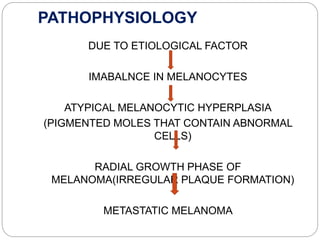
PATHOPHYSIOLOGY
DUE TO ETIOLOGICAL FACTOR
IMABALNCE IN MELANOCYTES
ATYPICAL MELANOCYTIC HYPERPLASIA
(PIGMENTED MOLES THAT CONTAIN ABNORMAL
CELLS)
RADIAL GROWTH PHASE OF
MELANOMA(IRREGULAR PLAQUE FORMATION)
METASTATIC MELANOMA
CLINICAL MANIFESTATION
 Change skin in affected Part
 Skin Sore
 Pain in affected part
 Redness of Affected Area
 Development of Blister in affected Part
WARNING SIGN OF MELANOMA:- (ABCDE)
 A is for Asymmetry: – One half of a mole or birthmark
does not match the other.
 B is for Border: – The edges are irregular.
 C is for Color: – The color is not the same all over and
may include shades of brown or black, or sometimes
with patches of pink, red, white, or blue.
 D is for Diameter: – The spot is larger than 6
millimeters across ,although melanomas can
sometimes be smaller than this.
 E is for Evolving: – The mole is changing in size,
shape, or color.
DIAGNOSTIC EVALUATION:
 History Collection
 Physical Examination
 Blood test
 Skin biopsy
 MRI
 CT Scan
MANAGEMENT
MEDICAL MANAGEMENT:
 Chemotherapy is an aggressive form of chemical
drug therapy meant to destroy rapidly growing cells in
the body( E.g Cisplatine, Temozolomide)
 Radiation Therapy Radiation therapy (also called
radiotherapy) is a cancer treatment that uses high
doses of radiation to kill cancer cells and shrink
tumors.
 Biological Therapy boost immune system to help
body fight cancer.
SURGICAL MANAGEMENT:
. Wide Excision
 Elective lymph node dissection (ELND)
NURSING MANAGEMENT:
Assess the proper history of the patient
Promote nutrition
Educate patient about malenoma
Explain about complications
Provide psychological and emotional support.
Administer prescribed medicine to reduce pain
COMPLICATIONS:
 Wound seroma
 Cellulitis
 Lymphedema

Malignant Melanoma.pptx

  • 1.
    BY- SHREYA YADAV NURSINGTUTOR MEDICAL SURGICAL NURSING REGENCY INSTITUTE OF NURSING MALIGNANT MELANOMA
  • 2.
    MALIGNANT MELANOMA Melanoma isa very serious form of skin cancer. Melanoma is cancer of the melanocytes. Melanocytes are located in the Stratum Basale and produce melanin.  When skin is exposed to sunlight,
  • 3.
    ETIOLOGY:  90% ofall melanomas are linked to UV radiation. (Sun exposure)  8% are due to chromosomal abnormalities  About 2% are unknown RISK FACTORS: Family history of melanoma Dysplastic nevi (noncancerous, but unusual- looking moles) Previous melanoma Ordinary moles: more than 50 Severe, blistering sunburns Freckling tendency Excessive use of tanning beds Genetic predisposition
  • 4.
    TYPES OF MELANOMA SuperficialSpreading Melanoma - Superficial spreading melanoma is a type of skin cancer that slowly grows horizontally across the top layer of Nodular Melanoma Nodular - melanoma is a type of skin cancer. It's a dangerous form of melanoma that grows quickly.
  • 5.
     Lentigo MalignantMelanoma - This is less common, and tends to affect older people, especially in parts of the body that have been exposed to the sun over several years.  Acral Lentiginous Malignant - This is the rarest kind of melanoma. It usually appears on the palms of
  • 6.
    PATHOPHYSIOLOGY DUE TO ETIOLOGICALFACTOR IMABALNCE IN MELANOCYTES ATYPICAL MELANOCYTIC HYPERPLASIA (PIGMENTED MOLES THAT CONTAIN ABNORMAL CELLS) RADIAL GROWTH PHASE OF MELANOMA(IRREGULAR PLAQUE FORMATION) METASTATIC MELANOMA
  • 8.
    CLINICAL MANIFESTATION  Changeskin in affected Part  Skin Sore  Pain in affected part  Redness of Affected Area  Development of Blister in affected Part WARNING SIGN OF MELANOMA:- (ABCDE)  A is for Asymmetry: – One half of a mole or birthmark does not match the other.  B is for Border: – The edges are irregular.  C is for Color: – The color is not the same all over and may include shades of brown or black, or sometimes with patches of pink, red, white, or blue.
  • 9.
     D isfor Diameter: – The spot is larger than 6 millimeters across ,although melanomas can sometimes be smaller than this.  E is for Evolving: – The mole is changing in size, shape, or color. DIAGNOSTIC EVALUATION:  History Collection  Physical Examination  Blood test  Skin biopsy  MRI  CT Scan
  • 10.
    MANAGEMENT MEDICAL MANAGEMENT:  Chemotherapyis an aggressive form of chemical drug therapy meant to destroy rapidly growing cells in the body( E.g Cisplatine, Temozolomide)  Radiation Therapy Radiation therapy (also called radiotherapy) is a cancer treatment that uses high doses of radiation to kill cancer cells and shrink tumors.  Biological Therapy boost immune system to help body fight cancer. SURGICAL MANAGEMENT: . Wide Excision  Elective lymph node dissection (ELND)
  • 11.
    NURSING MANAGEMENT: Assess theproper history of the patient Promote nutrition Educate patient about malenoma Explain about complications Provide psychological and emotional support. Administer prescribed medicine to reduce pain COMPLICATIONS:  Wound seroma  Cellulitis  Lymphedema