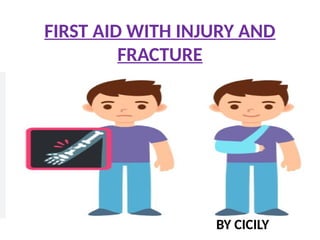
FIRST AID WITH INJURY AND
FRACTURE
BY CICILY
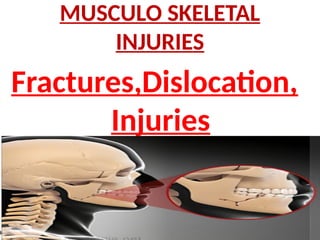
MUSCULO SKELETAL
INJURIES
Fractures,Dislocation,
Injuries
BONES…..
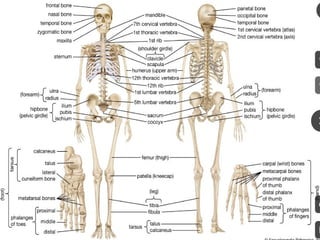
• The adult human skeleton is made up
of 206 bones.
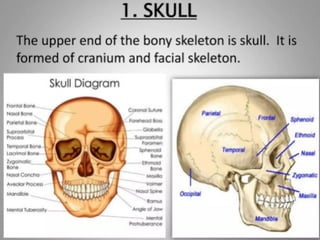
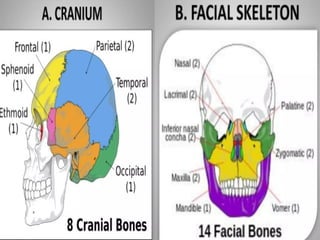
• These include the bones of the skull,
spine (vertebrae), ribs, arms and legs.
• Bones are made of connective tissue
reinforced with calcium and specialised
bone cells.
• Most bones also contain bone marrow,
where blood cells are made.
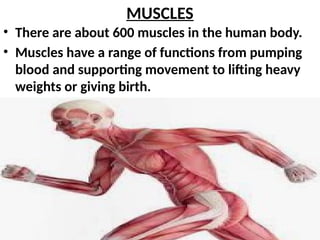
MUSCLES
• There are about 600 muscles in the human body.
• Muscles have a range of functions from pumping
blood and supporting movement to lifting heavy
weights or giving birth.
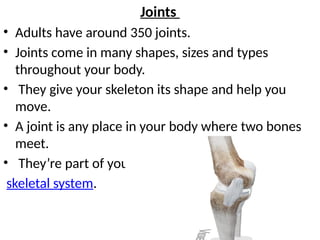
Joints
• Adults have around 350 joints.
• Joints come in many shapes, sizes and types
throughout your body.
• They give your skeleton its shape and help you
move.
• A joint is any place in your body where two bones
meet.
• They’re part of your
skeletal system.
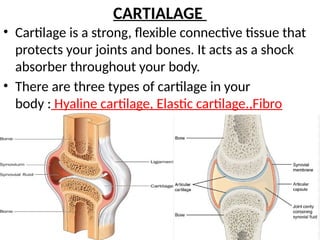
CARTIALAGE
• Cartilage is a strong, flexible connective tissue that
protects your joints and bones. It acts as a shock
absorber throughout your body.
• There are three types of cartilage in your
body : Hyaline cartilage, Elastic cartilage.,Fibro
cartilage
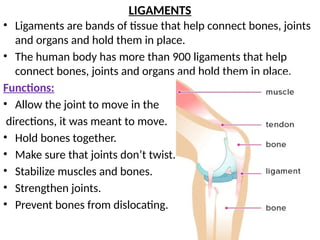
LIGAMENTS
• Ligaments are bands of tissue that help connect bones, joints
and organs and hold them in place.
• The human body has more than 900 ligaments that help
connect bones, joints and organs and hold them in place.
Functions:
• Allow the joint to move in the
directions, it was meant to move.
• Hold bones together.
• Make sure that joints don’t twist.
• Stabilize muscles and bones.
• Strengthen joints.
• Prevent bones from dislocating.
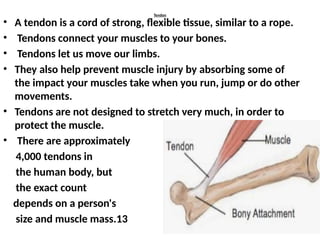
Tendon
• A tendon is a cord of strong, flexible tissue, similar to a rope.
• Tendons connect your muscles to your bones.
• Tendons let us move our limbs.
• They also help prevent muscle injury by absorbing some of
the impact your muscles take when you run, jump or do other
movements.
• Tendons are not designed to stretch very much, in order to
protect the muscle.
• There are approximately
4,000 tendons in
the human body, but
the exact count
depends on a person's
size and muscle mass.13
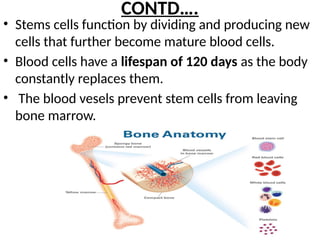
BONE MARROW
• Bone marrow is the soft, fatty tissue inside of the bones in
your body.
• Bone marrow contains cells that produce blood cells and
platelets and it is responsible for making billions of new
blood cells each day.
• There are two types of bone marrow, red bone marrow
(myeloid tissue) and yellow bone marrow (fatty tissue).
• These are augmented with blood vessels and makes over
220 billion blood cells everyday.
• Yellow Bone marrow consists of mesenchymal stem cells
also called marrow stromal cells that helps in production of
cartilage, bone and fat.
• Red Bone marrow consists hematopoietic stems cells and
CONTD….
• Stems cells function by dividing and producing new
cells that further become mature blood cells.
• Blood cells have a lifespan of 120 days as the body
constantly replaces them.
• The blood vesels prevent stem cells from leaving
bone marrow.
INJURIES
• Injury to a bone , a joint,a ligament,
tendon
• Joint injuries involves in dislocation.
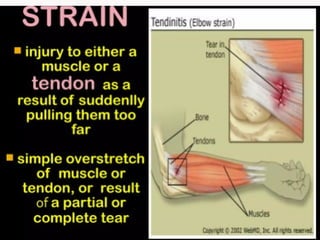
• Tendon muscle tears is known as
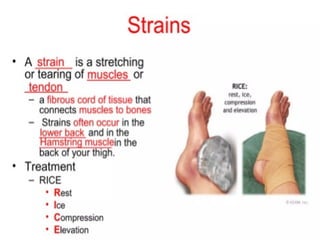
strain.
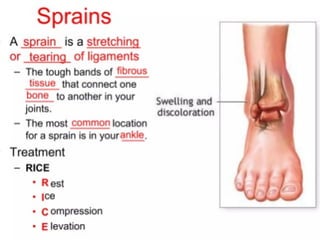
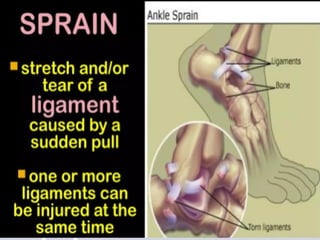
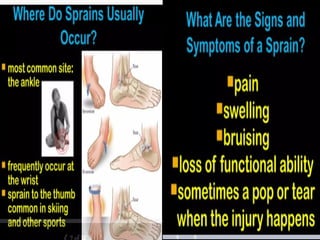
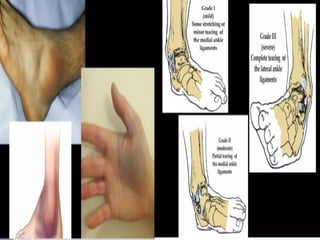
• Ligament is torn is known as sprain .
• It is grouped as sprain ,strain,
dislocation and fracture.
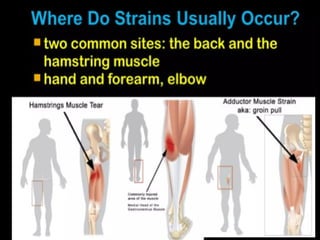
MUSCLE INJURIES
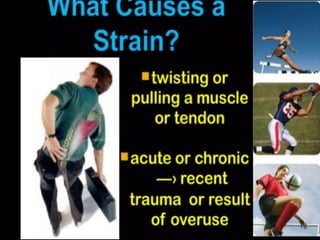
Muscle injuries occur due to
over stretching of muscles because
of sudden exertion and twisting of
any body part. Commonly known
muscle injury is strain.
CAUSES:

Too much physical
exertion
Improper warming up
prior to physical activity
Less flexibility in body
SIGNS AND SYMPTOMS
Severe pain
Swelling
Difficulty to move injured part
Discoloration
Bruising of skin
FIRSTAID FOR MUSCLE INJURIES
• Provide comfortable position and
reassure the victim
• If possible, put frim bandage before
swelling occur.
• After application of bandage, wet it
with cold water and apply it over
injured part to reduce swelling.
• Take the patient to doctor
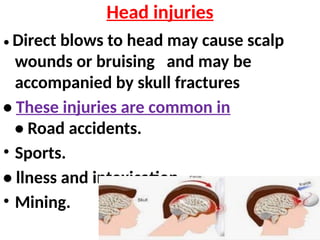
Head injuries
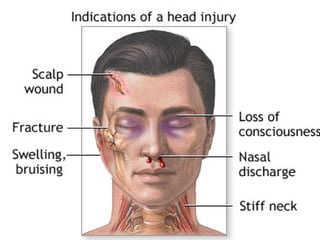
• Direct blows to head may cause scalp
wounds or bruising and may be
accompanied by skull fractures
• These injuries are common in
• Road accidents.
• Sports.
• llness and intoxication.
• Mining.
Types….
Consciousness may be lost; concussion and compression
may occur.
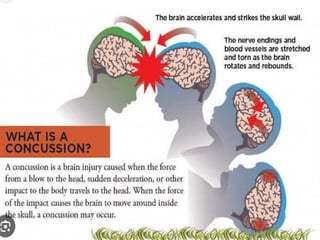
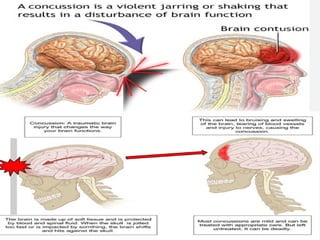
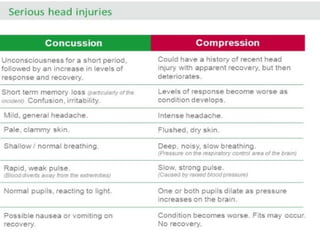
1. Concussion
• In this condition, the temporary disturbance of the brain
occurs.
• It occurs from blow to the head, fall from the height on to the feet
or blow on the jaw.
Symptoms and Signs
-Brief or partial loss of consciousness.
-Breathing may be shall ow.
-Face may be pale.
-Skin may be cold and clammy.
- Rapid and weak pulse.
-Nausea and vomiting.
On recovering conscicusness, he may not remember any events just
before or after the incident. If unconsciousness persists, suspect
compression.
FIRST AID MANAGEMENT
• Stop bleeding from scalp wounds.
• Treat shock.
• Manage as a case of unconsciousness.
• Check breathing, pulse, level of
responsiveness.
• Watch for signs of compression.
• Resuscitation, if required.
• Shift him to hospital.
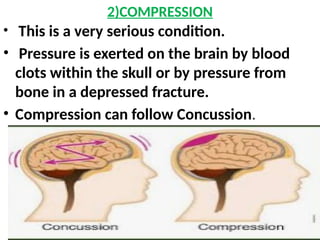
2)COMPRESSION
• This is a very serious condition.
• Pressure is exerted on the brain by blood
clots within the skull or by pressure from
bone in a depressed fracture.
• Compression can follow Concussion.
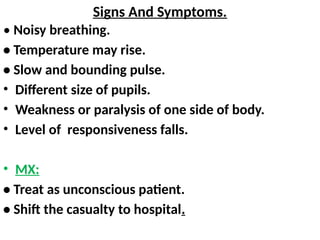
Signs And Symptoms.
• Noisy breathing.
• Temperature may rise.
• Slow and bounding pulse.
• Different size of pupils.
• Weakness or paralysis of one side of body.
• Level of responsiveness falls.
• MX:
• Treat as unconscious patient.
• Shift the casualty to hospital.
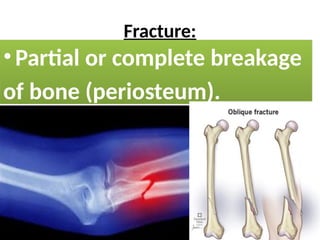
Fracture:
• Partial or complete breakage
of bone (periosteum).
Definition:
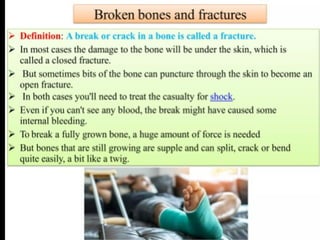
• A fracture is a break in the
continuity of bone.
• A fracture is the partial or
complete breakage of
periosteum(bone).
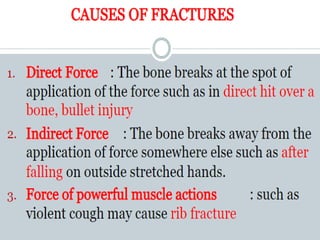
Causes
• DIRECT FORCE:
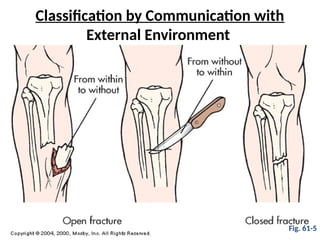
Classification by Communication with
External Environment
Fig. 61-5
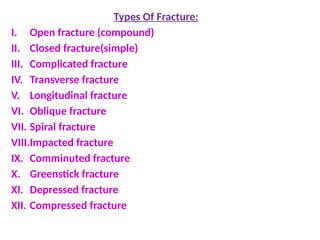
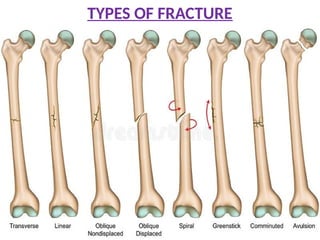
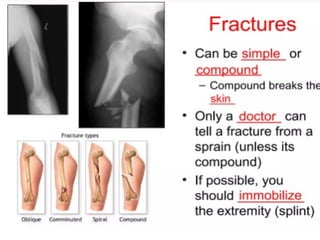
Types Of Fracture:
I. Open fracture (compound)
II. Closed fracture(simple)
III. Complicated fracture
IV. Transverse fracture
V. Longitudinal fracture
VI. Oblique fracture
VII. Spiral fracture
VIII.Impacted fracture
IX. Comminuted fracture
X. Greenstick fracture
XI. Depressed fracture
XII. Compressed fracture
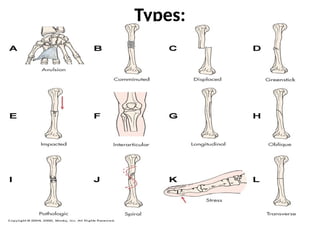
Types:
TYPES OF FRACTURE
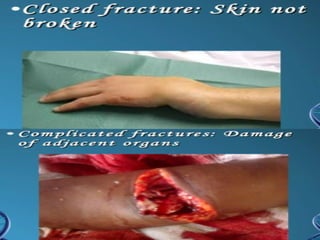
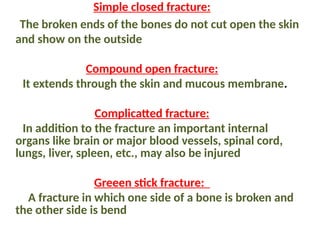
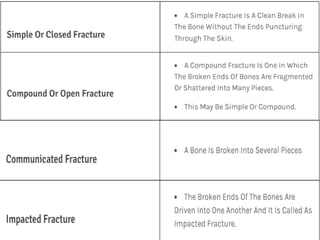
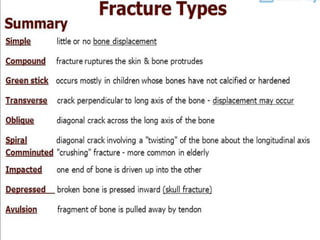
Simple closed fracture:
The broken ends of the bones do not cut open the skin
and show on the outside
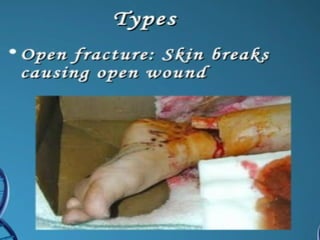
Compound open fracture:
It extends through the skin and mucous membrane.
Complicatted fracture:
In addition to the fracture an important internal
organs like brain or major blood vessels, spinal cord,
lungs, liver, spleen, etc., may also be injured
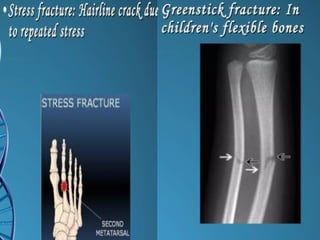
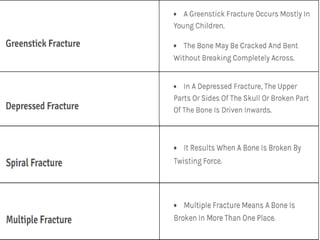
Greeen stick fracture:
A fracture in which one side of a bone is broken and
the other side is bend
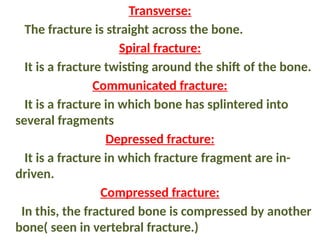
Transverse:
The fracture is straight across the bone.
Spiral fracture:
It is a fracture twisting around the shift of the bone.
Communicated fracture:
It is a fracture in which bone has splintered into
several fragments
Depressed fracture:
It is a fracture in which fracture fragment are in-
driven.
Compressed fracture:
In this, the fractured bone is compressed by another
bone( seen in vertebral fracture.)
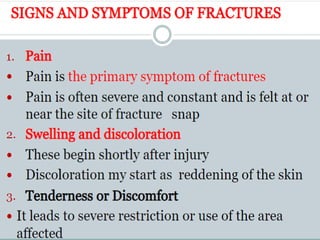
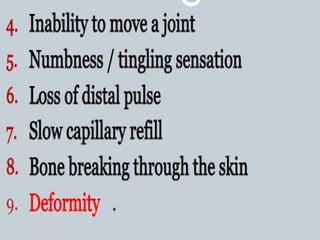
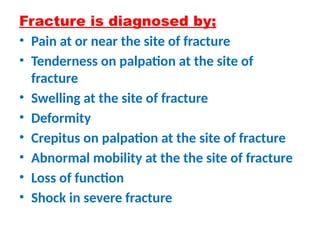
Fracture is diagnosed by;
• Pain at or near the site of fracture
• Tenderness on palpation at the site of
fracture
• Swelling at the site of fracture
• Deformity
• Crepitus on palpation at the site of fracture
• Abnormal mobility at the the site of fracture
• Loss of function
• Shock in severe fracture
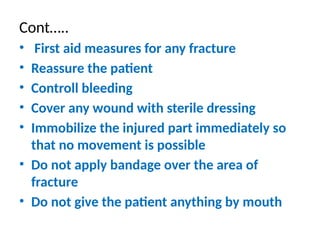
Cont…..
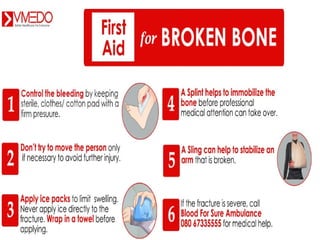
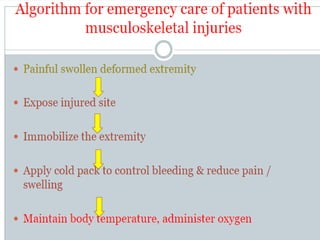
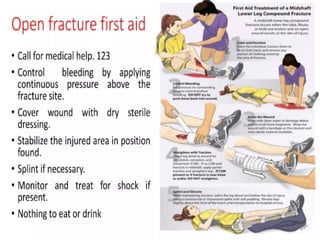
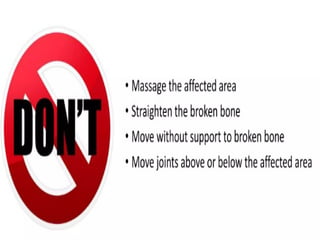
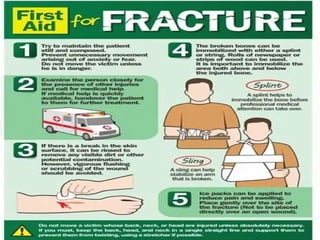
• First aid measures for any fracture
• Reassure the patient
• Controll bleeding
• Cover any wound with sterile dressing
• Immobilize the injured part immediately so
that no movement is possible
• Do not apply bandage over the area of
fracture
• Do not give the patient anything by mouth
Transfer To A Hospital
Fracture Of Skull:
In most cases, the patient becomes unconcious. There
are other features like vomiting, slow pulse rate, paralysis of
limbs, distrubances of eye movbements, speech disorder.
the sign of fracture of the base of skull include flow of
blood; sometimes cerebrospinal fluids comes from nosee ear
or mouth and bleeding around eyes is seen.
First Aid Measures:
Place the patient in supine position. Elevate the head
with pillow under it. Turn the head to one side.
If there is bleeding from ear, turn the head to that side.
If there is wound on the scalp, trim hair around it and cover
the wound with sterile dressing.
FRACTURE OF FACE:
 Cover the wound with clean cloth
 Support the broken lower jaw with a bandage looped
under the jaw and over the top of the head.
 Tilt the head forward over a bowl as blood and fluid
may be falling to the back of the throat
 Keep the airway clean
 Put thepatient in suppine position with head turned
to one side if he is unconcious
 Transport the patient to a hospital.
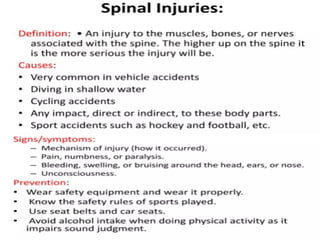
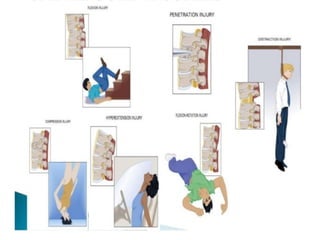
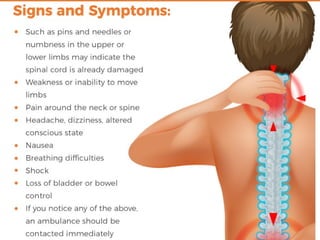
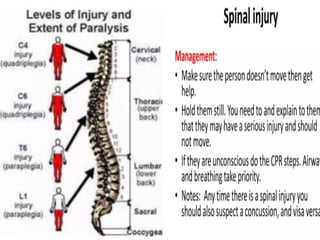
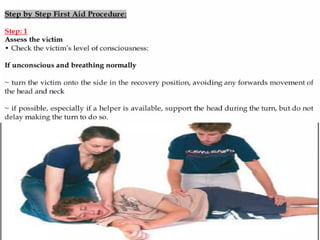
SPINAL FRACTURE:
Paralysis is a complication of spinal fracture.
Check whether the patient can move aides and joints
Check the loss of sensation in the lower limb
Make a patient lie still on a flat surface
Get a doctor immediately
• If a doctor is not available, place a pad between
the patients ankle and bandage the feet together
with figure of eight bandage.
• Place the pad between knees and thighs tie the legs
together using broad bandages.
• Transfer the patient to a hospital.
Humerus fracture:
place a pad of rolled handkerchief towel or small
clothes in the armpit. Lightly tie the arm to the chest.
Bend the elbow and place the hand on the opposite
shoulder and apply a collor and cuff sling.
Fracture of ribs:
It is not complicated, apply two broad bandages round
the chest.
• The centre of the first bandage should be below the
area of pain and the center of second above it.do not
tie knot too tight.
• Support the arm in a large arm sling on the affected
side. Shift the patient to hospital.
Femur Fracture:
Signs And Symptoms:
• Legs appear short
• Pain and swelling over the site of fracture.
• The foot on that side lies flat and turned to the
outer side
• Shock due to internal hemorrhage
First Aid:
 If the shock is present treat for shock
 Make two splints an inner one from the groin to
heel, and outer one from the armpit to the head.
Conti……
 Apply seven board bandages at the following
places;
 Chest below armpit
 At the level of hip joints
 Both ankle and feet
 Both thighs above fracture if the shaft is broken
 Below the fracture including both thighs
 Both legs
 Both knees.
Pelvic Fracture:
This is always the results of direct forces, eg; a
heavy fall. When pelvis is fractured the pelvic
organs, especially the bladder and urinary
passage may injured.
Signs and symptoms,
• Pain in the region of hips and lions increased by
moving and coughing
• Inability to stand
• Internal hemorrage may occur which may be
severe
• Desire to pass urine frequently urine may be
dark in color from blood.
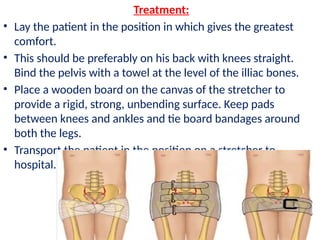
Treatment:
• Lay the patient in the position in which gives the greatest
comfort.
• This should be preferably on his back with knees straight.
Bind the pelvis with a towel at the level of the illiac bones.
• Place a wooden board on the canvas of the stretcher to
provide a rigid, strong, unbending surface. Keep pads
between knees and ankles and tie board bandages around
both the legs.
• Transport the patient in the position on a stretcher to
hospital.
Patella Fracture:
Signs and symptoms;
• Swelling, pain, and sometimes bleeding
• Muscles above the knee which move the knee
become helpless
Firstaid:
 Place the casualty in a fowlers position
 The injured leg should be raised to a comfortable
position’tie the injured limb to the other limb from
thigh to below knee after padding knees
 Apply a board bandage around the upper part of the
thightie the bandage over the broken piece of the
knee cap
Fracture of tibia and fibula:
Signs and symptoms;
• Pain swelling deformity, if both bones broken. If
only fibula is broken only minimal deformity is
observed.
Firstaid;
• The broken limb should be tied to the shound limb,
after proper padding
• Apply bandage at the upper part of the thigh on the
knee, above the fracture and below the fracture.
Shift to hospital
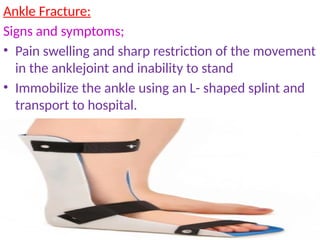
Ankle Fracture:
Signs and symptoms;
• Pain swelling and sharp restriction of the movement
in the anklejoint and inability to stand
• Immobilize the ankle using an L- shaped splint and
transport to hospital.
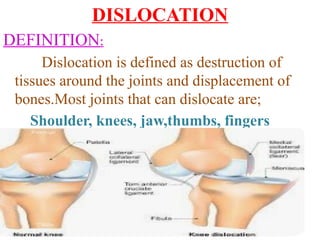
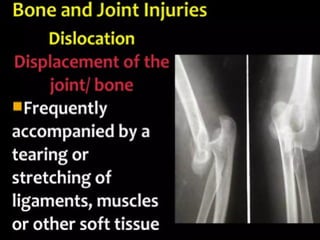
DISLOCATION
DEFINITION:
Dislocation is defined as destruction of
tissues around the joints and displacement of
bones.Most joints that can dislocate are;
Shoulder, knees, jaw,thumbs, fingers
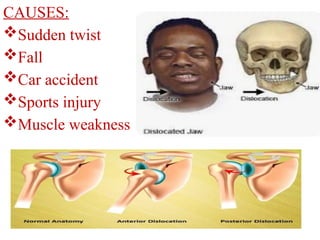
CAUSES:
Sudden twist
Fall
Car accident
Sports injury
Muscle weakness
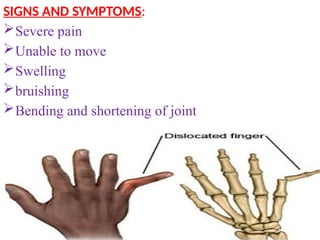
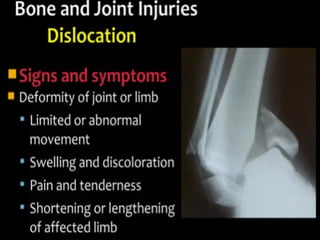
SIGNS AND SYMPTOMS:
Severe pain
Unable to move
Swelling
bruishing
Bending and shortening of joint
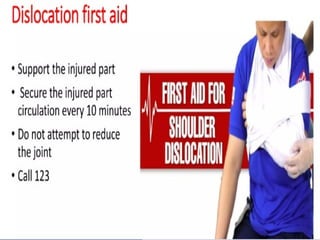
FIRST AID FOR DISLOCATION:
 Ensure the victim stays calm
 Help the victim to hold up dislocated joint
in comfortable position
 By using bandages, to immobilize
 In case of;
• Arm displacement- use sling to support
arm
• Leg injuries- broad fold bandages or
badding must be used
conti………
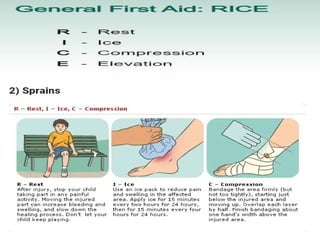
• Use ice pack to reduce pain and
swelling around the joint
• Transport injures person to nearby
hospital at earliest.
first_aid_with_injuries_and_fracture..pptx

first_aid_with_injuries_and_fracture..pptx

  • 1.
    FIRST AID WITHINJURY AND FRACTURE BY CICILY
  • 2.
  • 4.
    BONES….. • The adulthuman skeleton is made up of 206 bones. • These include the bones of the skull, spine (vertebrae), ribs, arms and legs. • Bones are made of connective tissue reinforced with calcium and specialised bone cells. • Most bones also contain bone marrow, where blood cells are made.
  • 5.
    MUSCLES • There areabout 600 muscles in the human body. • Muscles have a range of functions from pumping blood and supporting movement to lifting heavy weights or giving birth.
  • 6.
    Joints • Adults havearound 350 joints. • Joints come in many shapes, sizes and types throughout your body. • They give your skeleton its shape and help you move. • A joint is any place in your body where two bones meet. • They’re part of your skeletal system.
  • 7.
    CARTIALAGE • Cartilage isa strong, flexible connective tissue that protects your joints and bones. It acts as a shock absorber throughout your body. • There are three types of cartilage in your body : Hyaline cartilage, Elastic cartilage.,Fibro cartilage
  • 8.
    LIGAMENTS • Ligaments arebands of tissue that help connect bones, joints and organs and hold them in place. • The human body has more than 900 ligaments that help connect bones, joints and organs and hold them in place. Functions: • Allow the joint to move in the directions, it was meant to move. • Hold bones together. • Make sure that joints don’t twist. • Stabilize muscles and bones. • Strengthen joints. • Prevent bones from dislocating.
  • 9.
    Tendon • A tendonis a cord of strong, flexible tissue, similar to a rope. • Tendons connect your muscles to your bones. • Tendons let us move our limbs. • They also help prevent muscle injury by absorbing some of the impact your muscles take when you run, jump or do other movements. • Tendons are not designed to stretch very much, in order to protect the muscle. • There are approximately 4,000 tendons in the human body, but the exact count depends on a person's size and muscle mass.13
  • 10.
    BONE MARROW • Bonemarrow is the soft, fatty tissue inside of the bones in your body. • Bone marrow contains cells that produce blood cells and platelets and it is responsible for making billions of new blood cells each day. • There are two types of bone marrow, red bone marrow (myeloid tissue) and yellow bone marrow (fatty tissue). • These are augmented with blood vessels and makes over 220 billion blood cells everyday. • Yellow Bone marrow consists of mesenchymal stem cells also called marrow stromal cells that helps in production of cartilage, bone and fat. • Red Bone marrow consists hematopoietic stems cells and
  • 11.
    CONTD…. • Stems cellsfunction by dividing and producing new cells that further become mature blood cells. • Blood cells have a lifespan of 120 days as the body constantly replaces them. • The blood vesels prevent stem cells from leaving bone marrow.
  • 12.
    INJURIES • Injury toa bone , a joint,a ligament, tendon • Joint injuries involves in dislocation. • Tendon muscle tears is known as strain. • Ligament is torn is known as sprain . • It is grouped as sprain ,strain, dislocation and fracture.
  • 13.
    MUSCLE INJURIES Muscle injuriesoccur due to over stretching of muscles because of sudden exertion and twisting of any body part. Commonly known muscle injury is strain.
  • 14.
    CAUSES:  Too much physical exertion Improperwarming up prior to physical activity Less flexibility in body
  • 15.
    SIGNS AND SYMPTOMS Severepain Swelling Difficulty to move injured part Discoloration Bruising of skin
  • 16.
    FIRSTAID FOR MUSCLEINJURIES • Provide comfortable position and reassure the victim • If possible, put frim bandage before swelling occur. • After application of bandage, wet it with cold water and apply it over injured part to reduce swelling. • Take the patient to doctor
  • 19.
    Head injuries • Directblows to head may cause scalp wounds or bruising and may be accompanied by skull fractures • These injuries are common in • Road accidents. • Sports. • llness and intoxication. • Mining.
  • 20.
    Types…. Consciousness may belost; concussion and compression may occur. 1. Concussion • In this condition, the temporary disturbance of the brain occurs. • It occurs from blow to the head, fall from the height on to the feet or blow on the jaw. Symptoms and Signs -Brief or partial loss of consciousness. -Breathing may be shall ow. -Face may be pale. -Skin may be cold and clammy. - Rapid and weak pulse. -Nausea and vomiting. On recovering conscicusness, he may not remember any events just before or after the incident. If unconsciousness persists, suspect compression.
  • 24.
    FIRST AID MANAGEMENT •Stop bleeding from scalp wounds. • Treat shock. • Manage as a case of unconsciousness. • Check breathing, pulse, level of responsiveness. • Watch for signs of compression. • Resuscitation, if required. • Shift him to hospital.
  • 25.
    2)COMPRESSION • This isa very serious condition. • Pressure is exerted on the brain by blood clots within the skull or by pressure from bone in a depressed fracture. • Compression can follow Concussion.
  • 26.
    Signs And Symptoms. •Noisy breathing. • Temperature may rise. • Slow and bounding pulse. • Different size of pupils. • Weakness or paralysis of one side of body. • Level of responsiveness falls. • MX: • Treat as unconscious patient. • Shift the casualty to hospital.
  • 38.
    Fracture: • Partial orcomplete breakage of bone (periosteum).
  • 39.
    Definition: • A fractureis a break in the continuity of bone. • A fracture is the partial or complete breakage of periosteum(bone).
  • 42.
  • 44.
    Classification by Communicationwith External Environment Fig. 61-5
  • 45.
    Types Of Fracture: I.Open fracture (compound) II. Closed fracture(simple) III. Complicated fracture IV. Transverse fracture V. Longitudinal fracture VI. Oblique fracture VII. Spiral fracture VIII.Impacted fracture IX. Comminuted fracture X. Greenstick fracture XI. Depressed fracture XII. Compressed fracture
  • 46.
  • 47.
  • 52.
    Simple closed fracture: Thebroken ends of the bones do not cut open the skin and show on the outside Compound open fracture: It extends through the skin and mucous membrane. Complicatted fracture: In addition to the fracture an important internal organs like brain or major blood vessels, spinal cord, lungs, liver, spleen, etc., may also be injured Greeen stick fracture: A fracture in which one side of a bone is broken and the other side is bend
  • 53.
    Transverse: The fracture isstraight across the bone. Spiral fracture: It is a fracture twisting around the shift of the bone. Communicated fracture: It is a fracture in which bone has splintered into several fragments Depressed fracture: It is a fracture in which fracture fragment are in- driven. Compressed fracture: In this, the fractured bone is compressed by another bone( seen in vertebral fracture.)
  • 59.
    Fracture is diagnosedby; • Pain at or near the site of fracture • Tenderness on palpation at the site of fracture • Swelling at the site of fracture • Deformity • Crepitus on palpation at the site of fracture • Abnormal mobility at the the site of fracture • Loss of function • Shock in severe fracture
  • 60.
    Cont….. • First aidmeasures for any fracture • Reassure the patient • Controll bleeding • Cover any wound with sterile dressing • Immobilize the injured part immediately so that no movement is possible • Do not apply bandage over the area of fracture • Do not give the patient anything by mouth
  • 69.
    Transfer To AHospital Fracture Of Skull: In most cases, the patient becomes unconcious. There are other features like vomiting, slow pulse rate, paralysis of limbs, distrubances of eye movbements, speech disorder. the sign of fracture of the base of skull include flow of blood; sometimes cerebrospinal fluids comes from nosee ear or mouth and bleeding around eyes is seen. First Aid Measures: Place the patient in supine position. Elevate the head with pillow under it. Turn the head to one side. If there is bleeding from ear, turn the head to that side. If there is wound on the scalp, trim hair around it and cover the wound with sterile dressing.
  • 70.
    FRACTURE OF FACE: Cover the wound with clean cloth  Support the broken lower jaw with a bandage looped under the jaw and over the top of the head.  Tilt the head forward over a bowl as blood and fluid may be falling to the back of the throat  Keep the airway clean  Put thepatient in suppine position with head turned to one side if he is unconcious  Transport the patient to a hospital.
  • 71.
    SPINAL FRACTURE: Paralysis isa complication of spinal fracture. Check whether the patient can move aides and joints Check the loss of sensation in the lower limb Make a patient lie still on a flat surface Get a doctor immediately • If a doctor is not available, place a pad between the patients ankle and bandage the feet together with figure of eight bandage. • Place the pad between knees and thighs tie the legs together using broad bandages. • Transfer the patient to a hospital.
  • 72.
    Humerus fracture: place apad of rolled handkerchief towel or small clothes in the armpit. Lightly tie the arm to the chest. Bend the elbow and place the hand on the opposite shoulder and apply a collor and cuff sling. Fracture of ribs: It is not complicated, apply two broad bandages round the chest. • The centre of the first bandage should be below the area of pain and the center of second above it.do not tie knot too tight. • Support the arm in a large arm sling on the affected side. Shift the patient to hospital.
  • 73.
    Femur Fracture: Signs AndSymptoms: • Legs appear short • Pain and swelling over the site of fracture. • The foot on that side lies flat and turned to the outer side • Shock due to internal hemorrhage First Aid:  If the shock is present treat for shock  Make two splints an inner one from the groin to heel, and outer one from the armpit to the head.
  • 74.
    Conti……  Apply sevenboard bandages at the following places;  Chest below armpit  At the level of hip joints  Both ankle and feet  Both thighs above fracture if the shaft is broken  Below the fracture including both thighs  Both legs  Both knees.
  • 75.
    Pelvic Fracture: This isalways the results of direct forces, eg; a heavy fall. When pelvis is fractured the pelvic organs, especially the bladder and urinary passage may injured. Signs and symptoms, • Pain in the region of hips and lions increased by moving and coughing • Inability to stand • Internal hemorrage may occur which may be severe • Desire to pass urine frequently urine may be dark in color from blood.
  • 76.
    Treatment: • Lay thepatient in the position in which gives the greatest comfort. • This should be preferably on his back with knees straight. Bind the pelvis with a towel at the level of the illiac bones. • Place a wooden board on the canvas of the stretcher to provide a rigid, strong, unbending surface. Keep pads between knees and ankles and tie board bandages around both the legs. • Transport the patient in the position on a stretcher to hospital.
  • 77.
    Patella Fracture: Signs andsymptoms; • Swelling, pain, and sometimes bleeding • Muscles above the knee which move the knee become helpless Firstaid:  Place the casualty in a fowlers position  The injured leg should be raised to a comfortable position’tie the injured limb to the other limb from thigh to below knee after padding knees  Apply a board bandage around the upper part of the thightie the bandage over the broken piece of the knee cap
  • 78.
    Fracture of tibiaand fibula: Signs and symptoms; • Pain swelling deformity, if both bones broken. If only fibula is broken only minimal deformity is observed. Firstaid; • The broken limb should be tied to the shound limb, after proper padding • Apply bandage at the upper part of the thigh on the knee, above the fracture and below the fracture. Shift to hospital
  • 79.
    Ankle Fracture: Signs andsymptoms; • Pain swelling and sharp restriction of the movement in the anklejoint and inability to stand • Immobilize the ankle using an L- shaped splint and transport to hospital.
  • 80.
    DISLOCATION DEFINITION: Dislocation is definedas destruction of tissues around the joints and displacement of bones.Most joints that can dislocate are; Shoulder, knees, jaw,thumbs, fingers
  • 81.
  • 82.
    SIGNS AND SYMPTOMS: Severepain Unable to move Swelling bruishing Bending and shortening of joint
  • 86.
    FIRST AID FORDISLOCATION:  Ensure the victim stays calm  Help the victim to hold up dislocated joint in comfortable position  By using bandages, to immobilize  In case of; • Arm displacement- use sling to support arm • Leg injuries- broad fold bandages or badding must be used
  • 87.
    conti……… • Use icepack to reduce pain and swelling around the joint • Transport injures person to nearby hospital at earliest.