IDRC Davos 2010 Contribution to Migration, Displacement and Changing Mobility Patterns – Implications for Risks and Security Focus on Environmentally Induced Migration Dr. Fabrice Renaud Director  a.i. UNU-EHS, Bonn, Germany
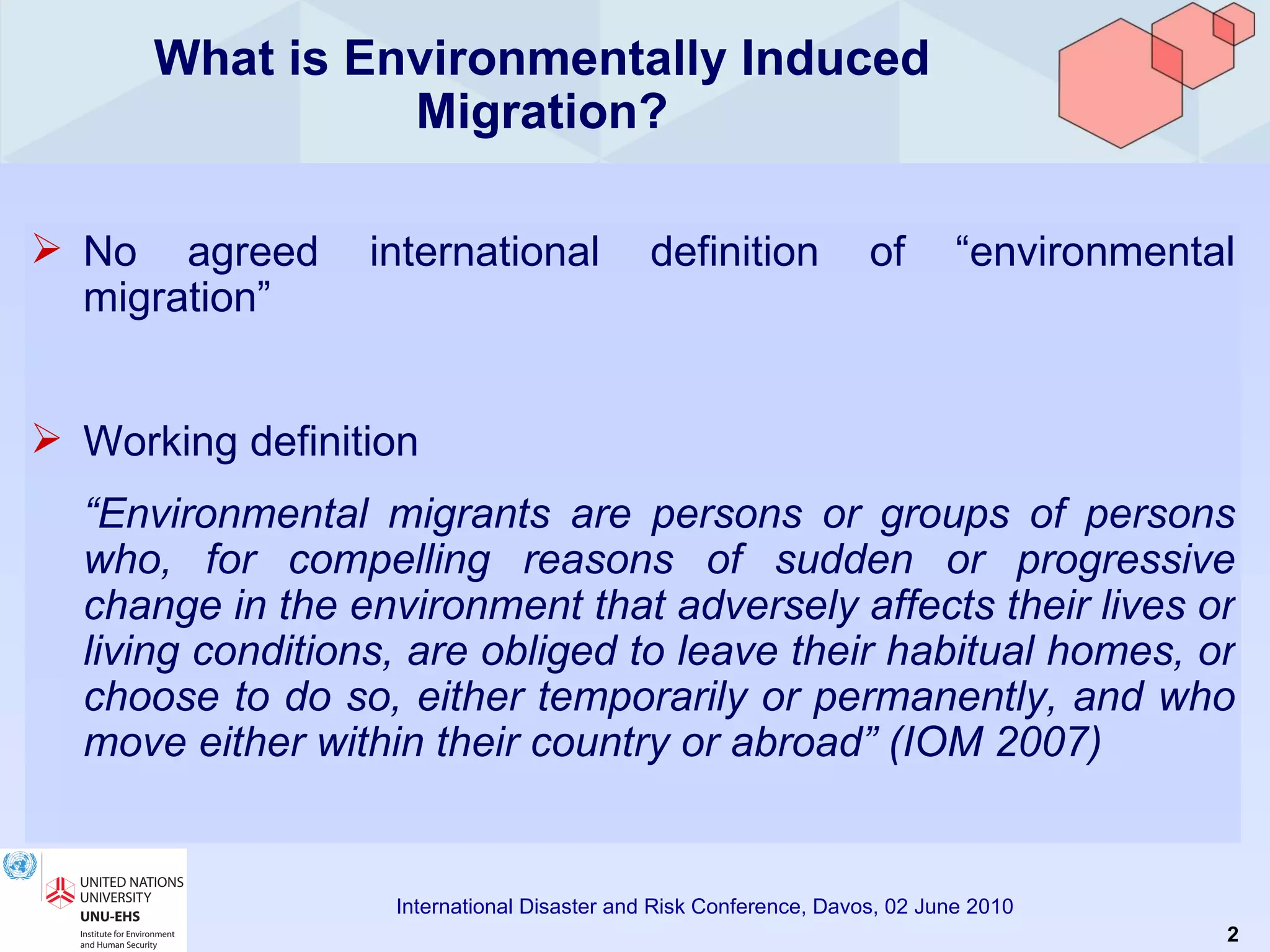
What is Environmentally Induced Migration? No agreed international definition of “environmental migration” Working definition  “ Environmental migrants are persons or groups of persons who, for compelling reasons of sudden or progressive change in the environment that adversely affects their lives or living conditions, are obliged to leave their habitual homes, or choose to do so, either temporarily or permanently, and who move either within their country or abroad” (IOM 2007)
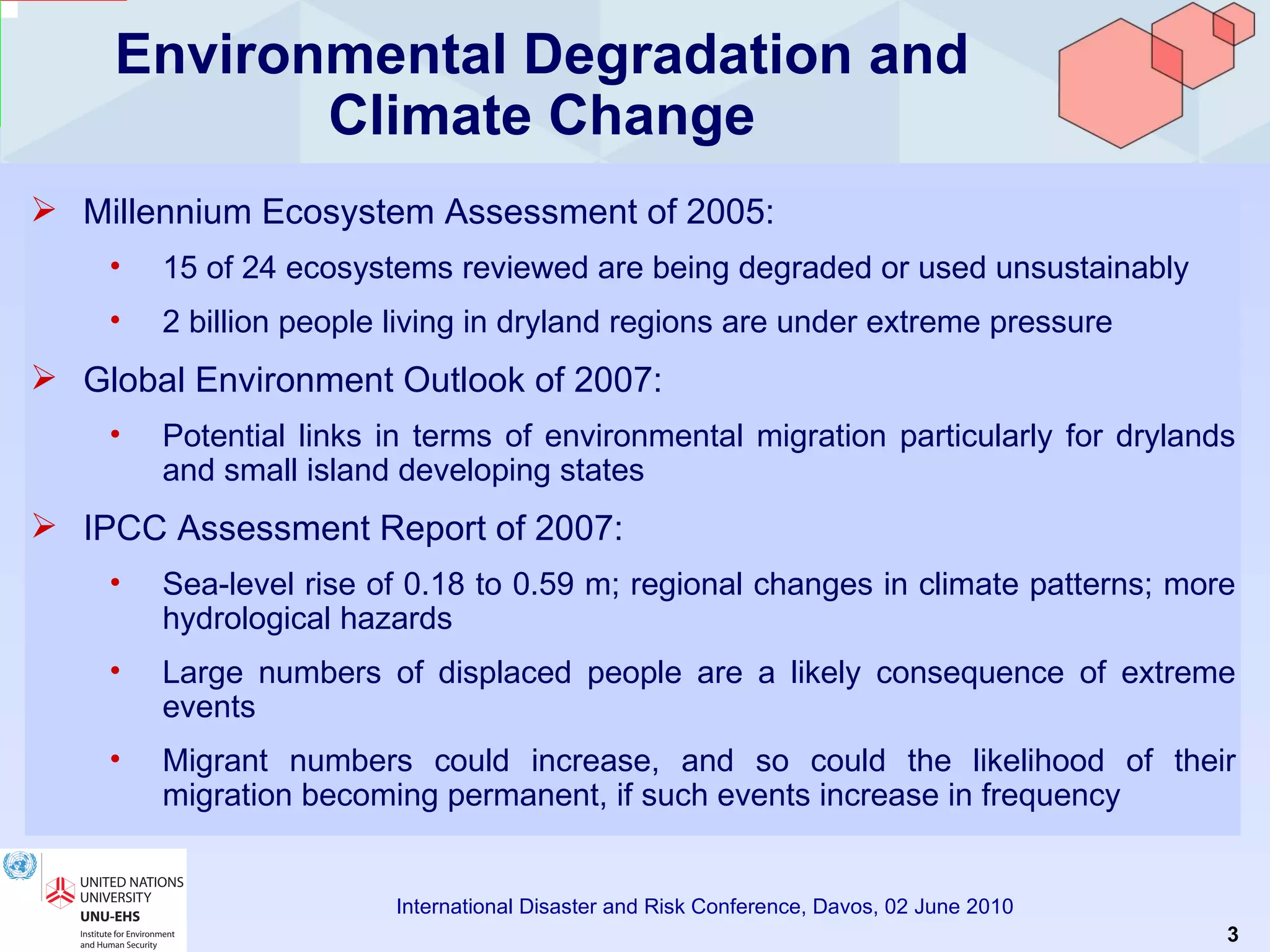
Environmental Degradation and Climate Change Millennium Ecosystem Assessment of 2005: 15 of 24 ecosystems reviewed are being degraded or used unsustainably   2 billion people living in dryland regions are under extreme pressure   Global Environment Outlook  of 2007: Potential links in terms of environmental migration particularly for drylands and small island developing states   IPCC Assessment Report of 2007: Sea-level rise of 0.18 to 0.59 m; regional changes in climate patterns; more hydrological hazards Large numbers of displaced people are a likely consequence of extreme events   Migrant numbers could increase, and so could the likelihood of their migration becoming permanent, if such events increase in frequency
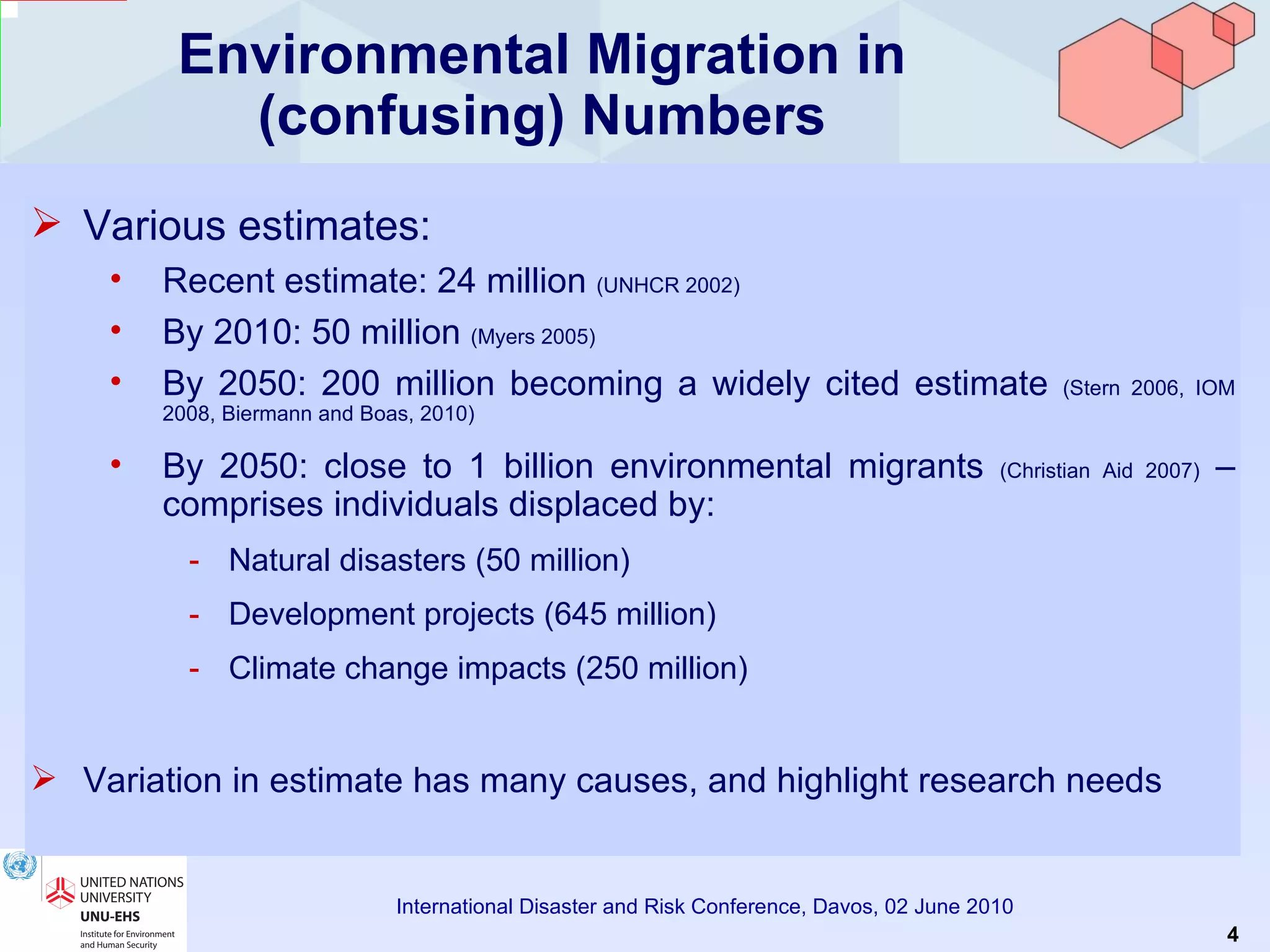
Environmental Migration in (confusing) Numbers Various estimates: Recent estimate: 24 million  (UNHCR 2002) By 2010: 50 million  (Myers 2005) By 2050: 200 million becoming a widely cited estimate  (Stern 2006, IOM 2008, Biermann and Boas, 2010) By 2050: close to 1 billion environmental migrants  (Christian Aid 2007)  – comprises individuals displaced by: Natural disasters (50 million) Development projects (645 million) Climate change impacts (250 million) Variation in estimate has many causes, and highlight research needs
An Issue to be Addressed Need to put emphasis on humanitarian and displacement challenges brought about by climate change Distinction between IDPs and cross-border movements Legal frameworks to deal with IDPs Some cross-border movements not systematically covered by international refugee frameworks Movement scenarios: Hydro-meteorological disasters Set up of restriction zones is high-risk areas Environmental degradation and slow onset hazards “ Sinking” small island states Armed conflicts linked decrease in environmental resources Guterres (2008): Climate change, natural disasters and human displacement: a UNHCR perspective
Some Implications Governance:   Establish and implement a framework that recognises environmental migrants to protect adequately individuals or groups of people displaced by environmental degradation processes Emergency response Plan ressettlement over long time periods (Biermann and Boas, 2010). Help  people to move: Migration can be an effective strategy to manage the risk associated with environmental degradation when done voluntarily and with appropriate planning (Warner, 2010) Proactive approaches. Create alternative livelihoods in situ and opportunities   when in situ adaptation may not be possible (Warner, 2010). Based on: Renaud, Bogardi, Dun, Warner (2007): Intersction No 5, UNU-EHS Bogardi, Warner (2008): Here comes the flood. Nature 3:9-11
Some Implications (cont’d) Awareness/perception:   Rectify the “Northern” bias Stop systematically framing the issue in a “security” context Consider migration as an adaptation strategy and not systematically as failed adaptation Science:   Better understanding between the cause-effects mechanisms (including other push/pull factors) Who migrates, where and when? For creeping processes, identification of crisis tipping points (thresholds) CCEMA: a global partnership Raise policy and public awareness Improve the knowledge base Provide a forum for policy dialogue Based on: Renaud, Bogardi, Dun, Warner (2007): Intersction No 5, UNU-EHS Bogardi, Warner (2008): Here comes the flood. Nature 3:9-11
Thank You for your Attention UNITED NATIONS UNIVERSITY Institute for Environment and Human Security (UNU-EHS) Hermann-Ehlers-Str. 10 D-53113 Bonn, Germany Phone:  ++ 49 (0) 228 815-0200 Fax:  ++ 49 (0) 228 815-0299 E-Mail: renaud@ehs.unu.edu www.ehs.unu.edu

Contribution to Migration, Displacement an Changing Mobiltiy Patterns - Implications for Risks and Security

  • 1.
    IDRC Davos 2010Contribution to Migration, Displacement and Changing Mobility Patterns – Implications for Risks and Security Focus on Environmentally Induced Migration Dr. Fabrice Renaud Director a.i. UNU-EHS, Bonn, Germany
  • 2.
    What is EnvironmentallyInduced Migration? No agreed international definition of “environmental migration” Working definition “ Environmental migrants are persons or groups of persons who, for compelling reasons of sudden or progressive change in the environment that adversely affects their lives or living conditions, are obliged to leave their habitual homes, or choose to do so, either temporarily or permanently, and who move either within their country or abroad” (IOM 2007)
  • 3.
    Environmental Degradation andClimate Change Millennium Ecosystem Assessment of 2005: 15 of 24 ecosystems reviewed are being degraded or used unsustainably 2 billion people living in dryland regions are under extreme pressure Global Environment Outlook of 2007: Potential links in terms of environmental migration particularly for drylands and small island developing states IPCC Assessment Report of 2007: Sea-level rise of 0.18 to 0.59 m; regional changes in climate patterns; more hydrological hazards Large numbers of displaced people are a likely consequence of extreme events Migrant numbers could increase, and so could the likelihood of their migration becoming permanent, if such events increase in frequency
  • 4.
    Environmental Migration in(confusing) Numbers Various estimates: Recent estimate: 24 million (UNHCR 2002) By 2010: 50 million (Myers 2005) By 2050: 200 million becoming a widely cited estimate (Stern 2006, IOM 2008, Biermann and Boas, 2010) By 2050: close to 1 billion environmental migrants (Christian Aid 2007) – comprises individuals displaced by: Natural disasters (50 million) Development projects (645 million) Climate change impacts (250 million) Variation in estimate has many causes, and highlight research needs
  • 5.
    An Issue tobe Addressed Need to put emphasis on humanitarian and displacement challenges brought about by climate change Distinction between IDPs and cross-border movements Legal frameworks to deal with IDPs Some cross-border movements not systematically covered by international refugee frameworks Movement scenarios: Hydro-meteorological disasters Set up of restriction zones is high-risk areas Environmental degradation and slow onset hazards “ Sinking” small island states Armed conflicts linked decrease in environmental resources Guterres (2008): Climate change, natural disasters and human displacement: a UNHCR perspective
  • 6.
    Some Implications Governance: Establish and implement a framework that recognises environmental migrants to protect adequately individuals or groups of people displaced by environmental degradation processes Emergency response Plan ressettlement over long time periods (Biermann and Boas, 2010). Help people to move: Migration can be an effective strategy to manage the risk associated with environmental degradation when done voluntarily and with appropriate planning (Warner, 2010) Proactive approaches. Create alternative livelihoods in situ and opportunities when in situ adaptation may not be possible (Warner, 2010). Based on: Renaud, Bogardi, Dun, Warner (2007): Intersction No 5, UNU-EHS Bogardi, Warner (2008): Here comes the flood. Nature 3:9-11
  • 7.
    Some Implications (cont’d)Awareness/perception: Rectify the “Northern” bias Stop systematically framing the issue in a “security” context Consider migration as an adaptation strategy and not systematically as failed adaptation Science: Better understanding between the cause-effects mechanisms (including other push/pull factors) Who migrates, where and when? For creeping processes, identification of crisis tipping points (thresholds) CCEMA: a global partnership Raise policy and public awareness Improve the knowledge base Provide a forum for policy dialogue Based on: Renaud, Bogardi, Dun, Warner (2007): Intersction No 5, UNU-EHS Bogardi, Warner (2008): Here comes the flood. Nature 3:9-11
  • 8.
    Thank You foryour Attention UNITED NATIONS UNIVERSITY Institute for Environment and Human Security (UNU-EHS) Hermann-Ehlers-Str. 10 D-53113 Bonn, Germany Phone: ++ 49 (0) 228 815-0200 Fax: ++ 49 (0) 228 815-0299 E-Mail: renaud@ehs.unu.edu www.ehs.unu.edu

Editor's Notes

  • #3 This definition s eeks to encompass population movement or displacement: Temporary or permanent; internal or cross-border Regardless of whether voluntary or involuntary Due to sudden or gradual environmental change