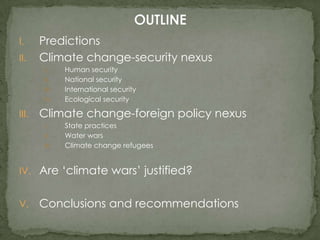
I.
II.

Predictions
Climate change-security nexus
I.
II.
III.
IV.

III.

Human security
National security
International security
Ecological security

Climate change-foreign policy nexus
I.
II.
III.

State practices
Water wars
Climate change refugees

IV. Are ‘climate wars’ justified?
V.

Conclusions and recommendations
Climate Change (CC) &
International Security
 UNSC debates 2007, 2011, UNGA,

2009; UNEP, 2007;UNDP, 2007

 EU, US, UK, Aus, Rus, Fin and Ger.

 Climate change ‘will fuel more

conflicts for decades [Obama,
2009]:

 ARE ‘CLIMATE WARS’ PREDICTIONS

JUSTIFIED, IN LIGHT OF FOREIGN
POLICY PRACTICE?
WHAT WILL HAPPEN

IMPACTS
Rising sea
levels, floods, storms, violent and
volatile weather, famine, water
shortages [e.g. IPCC, 2007; The
Economist, 2010]

 Temps. will rise 1.8 - 4o Celsius by

the end of the century, if not
mitigated [ IPCC, 2007]



Uproot
millions
Economist, 2013]

of

people



Fuel conflicts for decades [Obama, 2009]



Chaos and violence
Economist, 2010]



Threats to sovereignty and territorial
integrity [e.g. MacDonald, 2013]



Threats to human, national, international
and ecological security

[Paskal,

[The

The
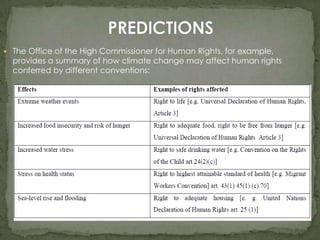
 The Office of the High Commissioner for Human Rights, for example,

provides a summary of how climate change may affect human rights
conferred by different conventions:
undermine human security by

reducing access to, and the quality
of natural resources that are
important to sustain livelihoods
(Barnet & Adger, 2007)
threats to human life and dignity;

and threats to the security of
individuals and communities
[MacDonald, 2013]

challenge state responsibility for

providing security to its population
[ibid]
global inequality and poverty to

build individual and community
preparedness and resilience [Brown
&McLeman, 2009]
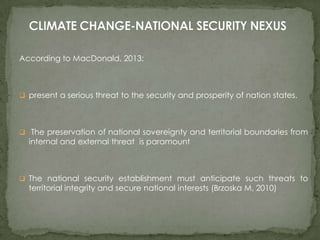
According to MacDonald, 2013:

 present a serious threat to the security and prosperity of nation states.

 The preservation of national sovereignty and territorial boundaries from

internal and external threat is paramount

 The national security establishment must anticipate such threats to

territorial integrity and secure national interests (Brzoska M, 2010)
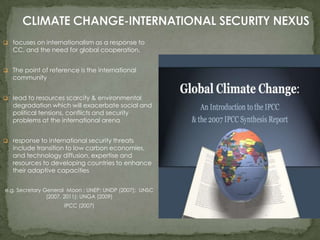
 focuses on internationalism as a response to

CC, and the need for global cooperation.

 The point of reference is the international

community

 lead to resources scarcity & environmental

degradation which will exacerbate social and
political tensions, conflicts and security
problems at the international arena

 response to international security threats

include transition to low carbon economies,
and technology diffusion, expertise and
resources to developing countries to enhance
their adaptive capacities

e.g. Secretary General Moon ; UNEP; UNDP (2007); UNSC
(2007, 2011); UNGA (2009)
IPCC (2007)
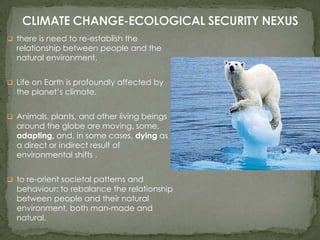
 there is need to re-establish the

relationship between people and the
natural environment.

 Life on Earth is profoundly affected by

the planet’s climate.

 Animals, plants, and other living beings

around the globe are moving, some,
adapting, and, in some cases, dying as
a direct or indirect result of
environmental shifts .

 to re-orient societal patterns and

behaviour: to rebalance the relationship
between people and their natural
environment, both man-made and
natural.
 CC is not only global, but also multidimensional, invisible, unpredictable and

international [Drexhage et al., 2007]
 Military Tool
 Political Tool
 Terrorism
 Development tool

 an issue for preventive diplomacy

 conduct of foreign policy must involve anticipating threshold moments when

latent conflicts may erupt and translate into violence

 impact of climate change is projected to be more pronounced on two main

issues: water and climate refugees [MacDonald, 2013]
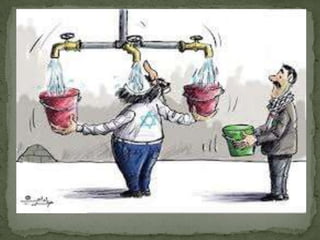
 ‘water wars’ prediction :countries will wage war to safeguard their access to water

resources, especially if there is water scarcity, competitive use and the countries are
enemies due to a wider conflict [Allam, 2003]

 water is scarce , in constant high demand, straddles political boundaries, its

availability fluctuates in space and time, it has no substitute [Wolf, 1998]

 Middle East region has 5% of the world’s population, but only one percent of the

world’s renewable water resources.

 About 60 percent of the available freshwater is in transboundary basins.
 River Nile, Tigris, and Euphrates river valleys are the main sources of water in the

Middle East(SIWI, 2010).

 Despite depleted water resources and growing water demand pushed by population

growth, international relations over water have, if anything, become less tense since
1970 [Allan, 2002]
 Many authors predict that the impact of CC in the near future will

become overwhelming & calls for international law practitioners &
states to formulate policies to deal with CC induced refugees

 especially in fragile states

HOW HAS THE CONDUCT OF FOREIGN POLICY DEALT WITH WATER AND
CLIMATE REFUGEE ISSUES? ARE ‘CLIMATE WARS’ JUSTIFIED?
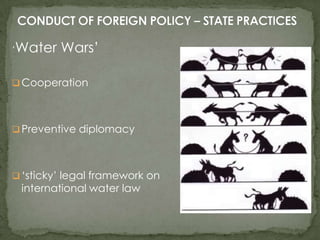
‘Water

Wars’

 Cooperation

 Preventive diplomacy

 ‘sticky’ legal framework on

international water law
Climate Change Refugees:
[Goodwin-Gill. 1996]:

 one must have crossed an international

border;

one must be fleeing persecution;
persecution must be for reasons of race,
religion, nationality, membership of a
particular social group or political
opinion; and
one must be unable or unwilling to the
protection of the country of origin or to

.

return there

 Complementary Protection
 AU & Cartagena Declaration in Latin

America : refugee status can be
granted to people fleeing from ‘events
seriously disturbing the public order’

e.g. Congolese fleeing the eruption of Mount
Nyiragongo in January 2002 sought refuge in
Rwanda
 Trail Smelter Arbitration: United States v

Canada
 ‘Water Wars’ are not justified

 Climate refugees can be managed under current state practices

 The assumptions of CC wars are rhetoric - not grounded in reality

 Climate refugees not covered under current refugee law however,

complimentary protection and humanitarian considerations ensure that
there is protection

 Strengthen refugee law to give explicit protection to CC refugees
Work cited
Alam, U. Z. (2002), Questioning the water wars rationale: a case study of the Indus Waters Treaty. The Geographical Journal, 168:
341–353
Aljazeera, 2012 ‘Risk of Water Wars Rises with scarcity’ Web. 26 Aug. 2012.
http://www.aljazeera.com/indepth/features/2011/06/2011622193147231653.html
Allan, J.A. Hydro-Peace in the Middle East: Why no Water Wars? A Case Study of the Jordan River Basin. SAIS Review vol. XXII
no. 2 (Summer–Fall 2002)
Biermann, F. & Boas, I. 2009. Preparing for a warmer world: Towards a Global Governance to Protect Climate Change Refugees.
Global Environmental Politics.10 (1). pp. 60-88.
‘‘Climate Wars,’’ The Economist, July 8, 2010.
Dyer, G. ‘Climate Wars,’ (Toronto: Random House, 2008);
Goodarzi J. “Water Tensions in the Middle East” Webster Security Forum Conference. 8 February 2013
McAdam, J. 2011. Climate Change Displacement and International Law: Complementary Protection Standards. Legal and
Protection Policy Research Series. Division of International Protection. UNHCR
McDonald M. Discourses of Climate Security. Political Geography Vol. 33, pp. 42-51, 2013
Moon, B. A climate Culprit in Darfur: Washington Post, 16th June 2007.
UNEP. Sudan: Post-conflict Environmental Assessment. Nairobi: UNEP.
UNDP. Fighting Climate Change: Human Solidarity in a Divided World. New York. Palgrave
UNGA. Climate Change and its possible security implications: Report of the Secretary General. New York:
UNGA.

Tertrais, B. “The Climate Wars Myth,” Washington Quarterly, vol. 34, no. 3, Summer 2011, pp. 17–29.
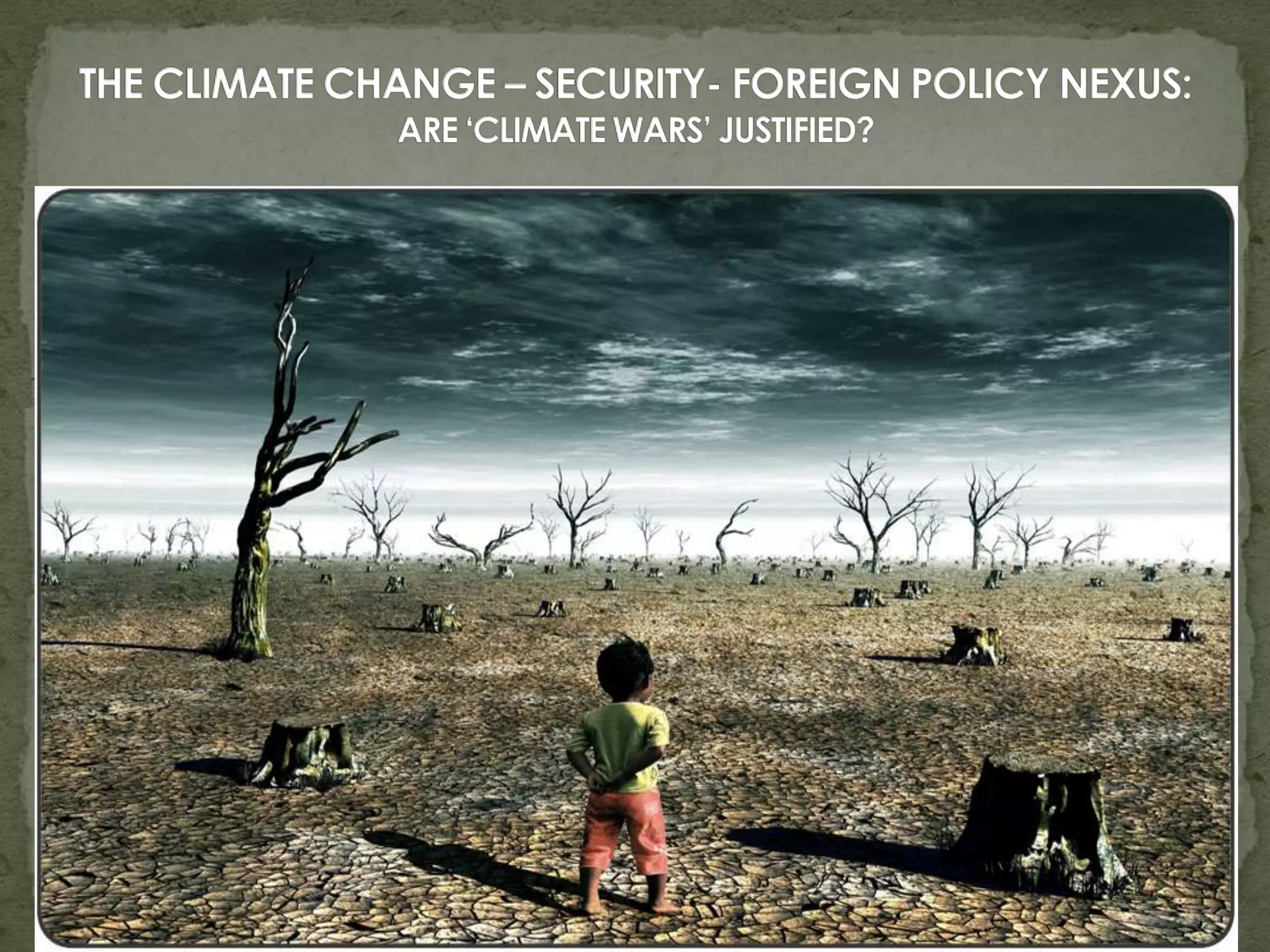
The Climate Change - Foreign Policy Nexus

The Climate Change - Foreign Policy Nexus

  • 2.
    I. II. Predictions Climate change-security nexus I. II. III. IV. III. Humansecurity National security International security Ecological security Climate change-foreign policy nexus I. II. III. State practices Water wars Climate change refugees IV. Are ‘climate wars’ justified? V. Conclusions and recommendations
  • 3.
    Climate Change (CC)& International Security  UNSC debates 2007, 2011, UNGA, 2009; UNEP, 2007;UNDP, 2007  EU, US, UK, Aus, Rus, Fin and Ger.  Climate change ‘will fuel more conflicts for decades [Obama, 2009]:  ARE ‘CLIMATE WARS’ PREDICTIONS JUSTIFIED, IN LIGHT OF FOREIGN POLICY PRACTICE?
  • 4.
    WHAT WILL HAPPEN IMPACTS Risingsea levels, floods, storms, violent and volatile weather, famine, water shortages [e.g. IPCC, 2007; The Economist, 2010]  Temps. will rise 1.8 - 4o Celsius by the end of the century, if not mitigated [ IPCC, 2007]  Uproot millions Economist, 2013] of people  Fuel conflicts for decades [Obama, 2009]  Chaos and violence Economist, 2010]  Threats to sovereignty and territorial integrity [e.g. MacDonald, 2013]  Threats to human, national, international and ecological security [Paskal, [The The
  • 5.
     The Officeof the High Commissioner for Human Rights, for example, provides a summary of how climate change may affect human rights conferred by different conventions:
  • 6.
    undermine human securityby reducing access to, and the quality of natural resources that are important to sustain livelihoods (Barnet & Adger, 2007) threats to human life and dignity; and threats to the security of individuals and communities [MacDonald, 2013] challenge state responsibility for providing security to its population [ibid] global inequality and poverty to build individual and community preparedness and resilience [Brown &McLeman, 2009]
  • 7.
    According to MacDonald,2013:  present a serious threat to the security and prosperity of nation states.  The preservation of national sovereignty and territorial boundaries from internal and external threat is paramount  The national security establishment must anticipate such threats to territorial integrity and secure national interests (Brzoska M, 2010)
  • 8.
     focuses oninternationalism as a response to CC, and the need for global cooperation.  The point of reference is the international community  lead to resources scarcity & environmental degradation which will exacerbate social and political tensions, conflicts and security problems at the international arena  response to international security threats include transition to low carbon economies, and technology diffusion, expertise and resources to developing countries to enhance their adaptive capacities e.g. Secretary General Moon ; UNEP; UNDP (2007); UNSC (2007, 2011); UNGA (2009) IPCC (2007)
  • 9.
     there isneed to re-establish the relationship between people and the natural environment.  Life on Earth is profoundly affected by the planet’s climate.  Animals, plants, and other living beings around the globe are moving, some, adapting, and, in some cases, dying as a direct or indirect result of environmental shifts .  to re-orient societal patterns and behaviour: to rebalance the relationship between people and their natural environment, both man-made and natural.
  • 10.
     CC isnot only global, but also multidimensional, invisible, unpredictable and international [Drexhage et al., 2007]  Military Tool  Political Tool  Terrorism  Development tool  an issue for preventive diplomacy  conduct of foreign policy must involve anticipating threshold moments when latent conflicts may erupt and translate into violence  impact of climate change is projected to be more pronounced on two main issues: water and climate refugees [MacDonald, 2013]
  • 11.
     ‘water wars’prediction :countries will wage war to safeguard their access to water resources, especially if there is water scarcity, competitive use and the countries are enemies due to a wider conflict [Allam, 2003]  water is scarce , in constant high demand, straddles political boundaries, its availability fluctuates in space and time, it has no substitute [Wolf, 1998]  Middle East region has 5% of the world’s population, but only one percent of the world’s renewable water resources.  About 60 percent of the available freshwater is in transboundary basins.  River Nile, Tigris, and Euphrates river valleys are the main sources of water in the Middle East(SIWI, 2010).  Despite depleted water resources and growing water demand pushed by population growth, international relations over water have, if anything, become less tense since 1970 [Allan, 2002]
  • 13.
     Many authorspredict that the impact of CC in the near future will become overwhelming & calls for international law practitioners & states to formulate policies to deal with CC induced refugees  especially in fragile states HOW HAS THE CONDUCT OF FOREIGN POLICY DEALT WITH WATER AND CLIMATE REFUGEE ISSUES? ARE ‘CLIMATE WARS’ JUSTIFIED?
  • 14.
    ‘Water Wars’  Cooperation  Preventivediplomacy  ‘sticky’ legal framework on international water law
  • 15.
    Climate Change Refugees: [Goodwin-Gill.1996]:  one must have crossed an international border; one must be fleeing persecution; persecution must be for reasons of race, religion, nationality, membership of a particular social group or political opinion; and one must be unable or unwilling to the protection of the country of origin or to . return there  Complementary Protection  AU & Cartagena Declaration in Latin America : refugee status can be granted to people fleeing from ‘events seriously disturbing the public order’ e.g. Congolese fleeing the eruption of Mount Nyiragongo in January 2002 sought refuge in Rwanda  Trail Smelter Arbitration: United States v Canada
  • 16.
     ‘Water Wars’are not justified  Climate refugees can be managed under current state practices  The assumptions of CC wars are rhetoric - not grounded in reality  Climate refugees not covered under current refugee law however, complimentary protection and humanitarian considerations ensure that there is protection  Strengthen refugee law to give explicit protection to CC refugees
  • 17.
    Work cited Alam, U.Z. (2002), Questioning the water wars rationale: a case study of the Indus Waters Treaty. The Geographical Journal, 168: 341–353 Aljazeera, 2012 ‘Risk of Water Wars Rises with scarcity’ Web. 26 Aug. 2012. http://www.aljazeera.com/indepth/features/2011/06/2011622193147231653.html Allan, J.A. Hydro-Peace in the Middle East: Why no Water Wars? A Case Study of the Jordan River Basin. SAIS Review vol. XXII no. 2 (Summer–Fall 2002) Biermann, F. & Boas, I. 2009. Preparing for a warmer world: Towards a Global Governance to Protect Climate Change Refugees. Global Environmental Politics.10 (1). pp. 60-88. ‘‘Climate Wars,’’ The Economist, July 8, 2010. Dyer, G. ‘Climate Wars,’ (Toronto: Random House, 2008); Goodarzi J. “Water Tensions in the Middle East” Webster Security Forum Conference. 8 February 2013 McAdam, J. 2011. Climate Change Displacement and International Law: Complementary Protection Standards. Legal and Protection Policy Research Series. Division of International Protection. UNHCR McDonald M. Discourses of Climate Security. Political Geography Vol. 33, pp. 42-51, 2013 Moon, B. A climate Culprit in Darfur: Washington Post, 16th June 2007. UNEP. Sudan: Post-conflict Environmental Assessment. Nairobi: UNEP. UNDP. Fighting Climate Change: Human Solidarity in a Divided World. New York. Palgrave UNGA. Climate Change and its possible security implications: Report of the Secretary General. New York: UNGA. Tertrais, B. “The Climate Wars Myth,” Washington Quarterly, vol. 34, no. 3, Summer 2011, pp. 17–29.