SUSTAINABLE DEVELOPMENT
timeline
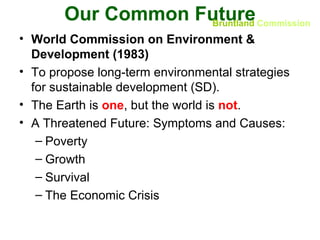
Our Common Future World Commission on Environment & Development (1983) To propose long-term environmental strategies for sustainable development (SD). The Earth is  one , but the world is  not . A Threatened Future: Symptoms and Causes: Poverty Growth Survival The Economic Crisis Bruntland  Commission
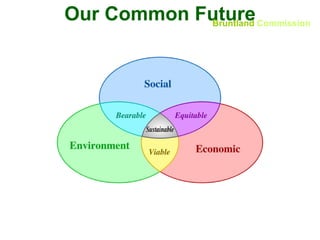
Our Common Future Bruntland  Commission
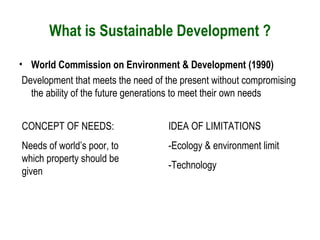
What is Sustainable Development ? World Commission on Environment & Development (1990) Development that meets the need of the present without compromising the ability of the future generations to meet their own needs  CONCEPT OF NEEDS: Needs of world’s poor, to which property should be given IDEA OF LIMITATIONS -Ecology & environment limit -Technology
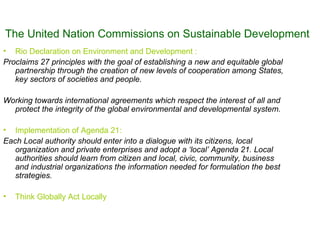
The United Nation Commissions on Sustainable Development   Rio Declaration on Environment and Development : Proclaims 27 principles with the goal of establishing a new and equitable global partnership through the creation of new levels of cooperation among States, key sectors of societies and people. Working towards international agreements which respect the interest of all and protect the integrity of the global environmental and developmental system. Implementation of Agenda 21: Each Local authority should enter into a dialogue with its citizens, local organization and private enterprises and adopt a ‘local’ Agenda 21. Local authorities should learn from citizen and local, civic, community, business and industrial organizations the information needed for formulation the best strategies. Think Globally Act Locally
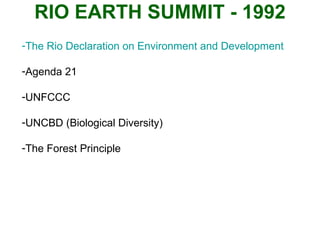
RIO EARTH SUMMIT - 1992 The Rio Declaration on Environment and Development Agenda 21 UNFCCC UNCBD (Biological Diversity) The Forest Principle
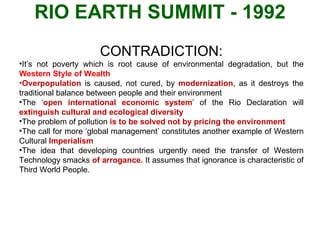
RIO EARTH SUMMIT - 1992 CONTRADICTION: It’s not poverty which is root cause of environmental degradation, but the  Western Style of Wealth Overpopulation  is caused, not cured, by  modernization , as it destroys the traditional balance between people and their environment The ‘ open international economic system ’ of the Rio Declaration will  extinguish cultural and ecological diversity The problem of pollution  is to be solved not by pricing the environment  The call for more ‘global management’ constitutes another example of Western Cultural  Imperialism The idea that developing countries urgently need the transfer of Western Technology smacks  of arrogance.  It assumes that ignorance is characteristic of Third World People.
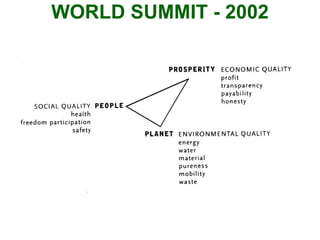
WORLD SUMMIT - 2002
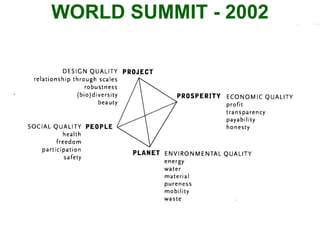
WORLD SUMMIT - 2002
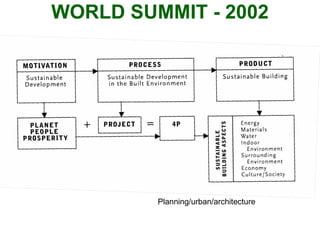
WORLD SUMMIT - 2002 Planning/urban/architecture
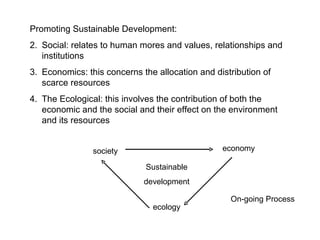
Promoting Sustainable Development: Social: relates to human mores and values, relationships and institutions Economics: this concerns the allocation and distribution of scarce resources The Ecological: this involves the contribution of both the economic and the social and their effect on the environment and its resources society ecology economy Sustainable development On-going Process
Why we need to categorize?
 
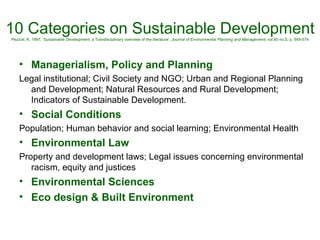
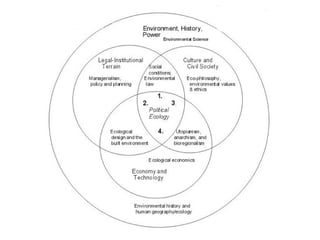
10 Categories on Sustainable Development Pezzoli, K, 1997, ’Sustainable Development: a Trandisciplinary overview of the literature’,  Journal of Environmental Planning and Management , vol.40 no.5, p. 549-574 Managerialism, Policy and Planning Legal institutional; Civil Society and NGO; Urban and Regional Planning and Development; Natural Resources and Rural Development; Indicators of Sustainable Development. Social Conditions Population; Human behavior and social learning; Environmental Health Environmental Law Property and development laws; Legal issues concerning environmental racism, equity and justices Environmental Sciences Eco design & Built Environment
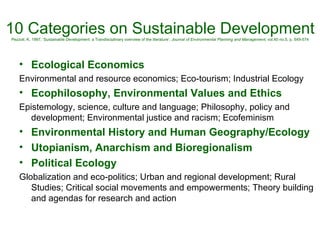
10 Categories on Sustainable Development Pezzoli, K, 1997, ’Sustainable Development: a Trandisciplinary overview of the literature’,  Journal of Environmental Planning and Management , vol.40 no.5, p. 549-574 Ecological Economics Environmental and resource economics; Eco-tourism; Industrial Ecology Ecophilosophy, Environmental Values and Ethics Epistemology, science, culture and language; Philosophy, policy and development; Environmental justice and racism; Ecofeminism Environmental History and Human Geography/Ecology Utopianism, Anarchism and Bioregionalism Political Ecology Globalization and eco-politics; Urban and regional development; Rural Studies; Critical social movements and empowerments; Theory building and agendas for research and action
 
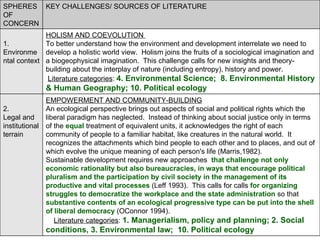
SPHERES OF CONCERN KEY CHALLENGES/ SOURCES OF LITERATURE   1. Environmental context   HOLISM AND COEVOLUTION  To better understand how the environment and development interrelate we need to develop a holistic world view.  Holism joins the fruits of a sociological imagination and a biogeophysical imagination.  This challenge calls for new insights and theory-building about the interplay of nature (including entropy), history and power.       Literature categories :  4. Environmental Science;  8. Environmental History & Human Geography; 10. Political ecology   2.  Legal and institutional terrain     EMPOWERMENT AND COMMUNITY-BUILDING An ecological perspective brings out aspects of social and political rights which the liberal paradigm has neglected.  Instead of thinking about social justice only in terms of the  equal  treatment of equivalent units, it acknowledges the right of each community of people to a familiar habitat, like creatures in the natural world.  It recognizes the attachments which bind people to each other and to places, and out of which evolve the unique meaning of each person's life (Marris,1982).  Sustainable development requires new approaches   that challenge not only economic rationality but also bureaucracies, in ways that encourage political pluralism and the participation by civil society in the management of its productive and vital processes  (Leff 1993).  This calls for calls  for organizing struggles to democratize the workplace and the state administration  so that  substantive contents of an ecological progressive type can be put into the shell of liberal democracy  (OConnor 1994).      Literature categories :  1. Managerialism, policy and planning; 2. Social conditions, 3. Environmental law;  10. Political ecology
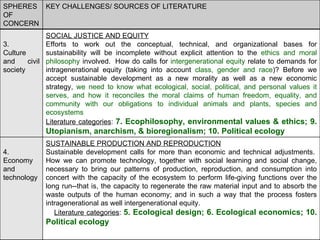
  3. Culture and civil society   SOCIAL JUSTICE AND EQUITY Efforts to work out the conceptual, technical, and organizational bases for sustainability will be incomplete without explicit attention to the  ethics and moral philosophy  involved.  How do calls for  intergenerational equity  relate to demands for intragenerational equity (taking into account  class, gender and race )? Before we accept sustainable development as a new morality as well as a new economic strategy,  we need to know what ecological, social, political, and personal values it serves, and how it reconciles the moral claims of   human freedom, equality, and community with our obligations to individual animals and plants, species and ecosystems Literature categories :  7. Ecophilosophy, environmental values & ethics; 9. Utopianism, anarchism, & bioregionalism; 10. Political ecology   4. Economy and technology   SUSTAINABLE PRODUCTION AND REPRODUCTION Sustainable development calls for more than economic and technical adjustments.  How we can promote technology, together with social learning and social change, necessary to bring our patterns of production, reproduction, and consumption into concert with the capacity of the ecosystem to perform life-giving functions over the long run--that is, the capacity to regenerate the raw material input and to absorb the waste outputs of the human economy; and in such a way that the process fosters intragenerational as well intergenerational equity.      Literature categories :  5. Ecological design; 6. Ecological economics; 10. Political ecology SPHERES OF CONCERN KEY CHALLENGES/ SOURCES OF LITERATURE
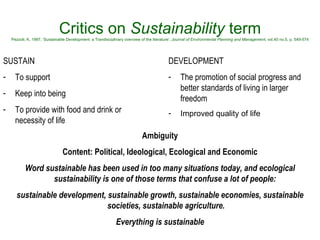
Critics on  Sustainability  term Pezzoli, K, 1997, ’Sustainable Development: a Trandisciplinary overview of the literature’,  Journal of Environmental Planning and Management , vol.40 no.5, p. 549-574 SUSTAIN To support Keep into being To provide with food and drink or necessity of life DEVELOPMENT The promotion of social progress and better standards of living in larger freedom  Improved quality of life  Ambiguity Content: Political, Ideological, Ecological and Economic Word sustainable has been used in too many situations today, and ecological sustainability is one of those terms that confuse a lot of people:  sustainable development, sustainable growth, sustainable economies, sustainable societies, sustainable agriculture. Everything is sustainable

W2 Susdev

  • 1.
  • 2.
  • 3.
    Our Common FutureWorld Commission on Environment & Development (1983) To propose long-term environmental strategies for sustainable development (SD). The Earth is one , but the world is not . A Threatened Future: Symptoms and Causes: Poverty Growth Survival The Economic Crisis Bruntland Commission
  • 4.
    Our Common FutureBruntland Commission
  • 5.
    What is SustainableDevelopment ? World Commission on Environment & Development (1990) Development that meets the need of the present without compromising the ability of the future generations to meet their own needs CONCEPT OF NEEDS: Needs of world’s poor, to which property should be given IDEA OF LIMITATIONS -Ecology & environment limit -Technology
  • 6.
    The United NationCommissions on Sustainable Development Rio Declaration on Environment and Development : Proclaims 27 principles with the goal of establishing a new and equitable global partnership through the creation of new levels of cooperation among States, key sectors of societies and people. Working towards international agreements which respect the interest of all and protect the integrity of the global environmental and developmental system. Implementation of Agenda 21: Each Local authority should enter into a dialogue with its citizens, local organization and private enterprises and adopt a ‘local’ Agenda 21. Local authorities should learn from citizen and local, civic, community, business and industrial organizations the information needed for formulation the best strategies. Think Globally Act Locally
  • 7.
    RIO EARTH SUMMIT- 1992 The Rio Declaration on Environment and Development Agenda 21 UNFCCC UNCBD (Biological Diversity) The Forest Principle
  • 8.
    RIO EARTH SUMMIT- 1992 CONTRADICTION: It’s not poverty which is root cause of environmental degradation, but the Western Style of Wealth Overpopulation is caused, not cured, by modernization , as it destroys the traditional balance between people and their environment The ‘ open international economic system ’ of the Rio Declaration will extinguish cultural and ecological diversity The problem of pollution is to be solved not by pricing the environment The call for more ‘global management’ constitutes another example of Western Cultural Imperialism The idea that developing countries urgently need the transfer of Western Technology smacks of arrogance. It assumes that ignorance is characteristic of Third World People.
  • 9.
  • 10.
  • 11.
    WORLD SUMMIT -2002 Planning/urban/architecture
  • 12.
    Promoting Sustainable Development:Social: relates to human mores and values, relationships and institutions Economics: this concerns the allocation and distribution of scarce resources The Ecological: this involves the contribution of both the economic and the social and their effect on the environment and its resources society ecology economy Sustainable development On-going Process
  • 13.
    Why we needto categorize?
  • 14.
  • 15.
    10 Categories onSustainable Development Pezzoli, K, 1997, ’Sustainable Development: a Trandisciplinary overview of the literature’, Journal of Environmental Planning and Management , vol.40 no.5, p. 549-574 Managerialism, Policy and Planning Legal institutional; Civil Society and NGO; Urban and Regional Planning and Development; Natural Resources and Rural Development; Indicators of Sustainable Development. Social Conditions Population; Human behavior and social learning; Environmental Health Environmental Law Property and development laws; Legal issues concerning environmental racism, equity and justices Environmental Sciences Eco design & Built Environment
  • 16.
    10 Categories onSustainable Development Pezzoli, K, 1997, ’Sustainable Development: a Trandisciplinary overview of the literature’, Journal of Environmental Planning and Management , vol.40 no.5, p. 549-574 Ecological Economics Environmental and resource economics; Eco-tourism; Industrial Ecology Ecophilosophy, Environmental Values and Ethics Epistemology, science, culture and language; Philosophy, policy and development; Environmental justice and racism; Ecofeminism Environmental History and Human Geography/Ecology Utopianism, Anarchism and Bioregionalism Political Ecology Globalization and eco-politics; Urban and regional development; Rural Studies; Critical social movements and empowerments; Theory building and agendas for research and action
  • 17.
  • 18.
    SPHERES OF CONCERNKEY CHALLENGES/ SOURCES OF LITERATURE   1. Environmental context   HOLISM AND COEVOLUTION To better understand how the environment and development interrelate we need to develop a holistic world view.  Holism joins the fruits of a sociological imagination and a biogeophysical imagination.  This challenge calls for new insights and theory-building about the interplay of nature (including entropy), history and power.       Literature categories : 4. Environmental Science;  8. Environmental History & Human Geography; 10. Political ecology   2. Legal and institutional terrain     EMPOWERMENT AND COMMUNITY-BUILDING An ecological perspective brings out aspects of social and political rights which the liberal paradigm has neglected.  Instead of thinking about social justice only in terms of the equal treatment of equivalent units, it acknowledges the right of each community of people to a familiar habitat, like creatures in the natural world.  It recognizes the attachments which bind people to each other and to places, and out of which evolve the unique meaning of each person's life (Marris,1982).  Sustainable development requires new approaches  that challenge not only economic rationality but also bureaucracies, in ways that encourage political pluralism and the participation by civil society in the management of its productive and vital processes (Leff 1993).  This calls for calls for organizing struggles to democratize the workplace and the state administration so that substantive contents of an ecological progressive type can be put into the shell of liberal democracy (OConnor 1994).     Literature categories : 1. Managerialism, policy and planning; 2. Social conditions, 3. Environmental law;  10. Political ecology
  • 19.
      3. Cultureand civil society   SOCIAL JUSTICE AND EQUITY Efforts to work out the conceptual, technical, and organizational bases for sustainability will be incomplete without explicit attention to the ethics and moral philosophy involved.  How do calls for intergenerational equity relate to demands for intragenerational equity (taking into account class, gender and race )? Before we accept sustainable development as a new morality as well as a new economic strategy, we need to know what ecological, social, political, and personal values it serves, and how it reconciles the moral claims of human freedom, equality, and community with our obligations to individual animals and plants, species and ecosystems Literature categories : 7. Ecophilosophy, environmental values & ethics; 9. Utopianism, anarchism, & bioregionalism; 10. Political ecology   4. Economy and technology   SUSTAINABLE PRODUCTION AND REPRODUCTION Sustainable development calls for more than economic and technical adjustments.  How we can promote technology, together with social learning and social change, necessary to bring our patterns of production, reproduction, and consumption into concert with the capacity of the ecosystem to perform life-giving functions over the long run--that is, the capacity to regenerate the raw material input and to absorb the waste outputs of the human economy; and in such a way that the process fosters intragenerational as well intergenerational equity.     Literature categories : 5. Ecological design; 6. Ecological economics; 10. Political ecology SPHERES OF CONCERN KEY CHALLENGES/ SOURCES OF LITERATURE
  • 20.
    Critics on Sustainability term Pezzoli, K, 1997, ’Sustainable Development: a Trandisciplinary overview of the literature’, Journal of Environmental Planning and Management , vol.40 no.5, p. 549-574 SUSTAIN To support Keep into being To provide with food and drink or necessity of life DEVELOPMENT The promotion of social progress and better standards of living in larger freedom Improved quality of life Ambiguity Content: Political, Ideological, Ecological and Economic Word sustainable has been used in too many situations today, and ecological sustainability is one of those terms that confuse a lot of people: sustainable development, sustainable growth, sustainable economies, sustainable societies, sustainable agriculture. Everything is sustainable