ROAD-TRAFFIC MONITORING AND ROUTING;  STOCHASTIC ALGORITHMS FOR  SAFETY AND EFFICIENCY  By  Adeyemi Fowe  Masters Degree Thesis Defence Applied Science Department (Engineering Science and Systems) ‏ University of Arkansas at Little rock. Supervisor Dr. Yupo Chan Professor and Founding Chair Systems Engineering Department University of Arkansas at Little Rock.
The Transportation Problem Image from: http://www.railway-technology.com/projects/bangkok/bangkok3.html The demand on Infrastructure is on the increase,  building more roads will not solve the  problem. Hence the need for ITS (Intelligent Transportation Systems). It involves the application of Algorithms & Mathematical Models in describing  and solving day-to-day transportation  problems. One of the basic need of a driver on  The road is   Fastest Travel Time.
Thesis Outline Problem Description Thesis Contributions ATIS Data Arc Volume Estimation Using Spatial Relationship EM-BS Algorithm Case Study - Col-Glen Road Probability of Incident Risk non-FIFO Routing concept Hu and Chan Algorithm WSDOT Algorithm WSDOT_Risk Algorithm Case Study – Central Arkansas Mini TMC Live Demo Conclusion
ATIS ( Advanced Traveler Information System)
Thesis Outline Problem Description Thesis Contributions ATIS Data Arc Volume Estimation Using Spatial Relationship EM-BS Algorithm Case Study - Col-Glen Road Probability of Incident Risk non-FIFO Routing concept Hu and Chan Algorithm WSDOT Algorithm WSDOT_Risk Algorithm Case Study – Central Arkansas Mini TMC Live Demo Conclusion
Thesis Contributions A new non-FIFO routing algorithm ( WSDOT ) that search for possible wait-times (en-route) in a time-dependent transportation network is developed. (Fall 07) A mathematical model to compute  Time-dependent Incident Probabilities  from historical traffic and incident data. (Fall 08) An extension of WSDOT algorithm to WSDOT-R ( WSDOT-with-Risk ) algorithm which simultaneously minimizes a driver’s exposure to incident risk even as the fastest travel time is desired. (Summer 08) A mathematical  algorithm to estimate traffic volumes  in unknown arcs using partial information from upstream/downstream neighbors and entropy maximization. (Spring 09) Finally this thesis presents the application of all the models, their efficiency, and their performance on a real transportation network. Using the Highway Road of Central Arkansas as a case study, we design and present a prototype demo of a  mini-TMC  (Traffic Management Center). (Spring 08)
Thesis Outline Problem Description Thesis Contributions ATIS Data Arc Volume Estimation Using Spatial Relationship EM-BS Algorithm Case Study - Col-Glen Road Probability of Incident Risk non-FIFO Routing concept Hu and Chan Algorithm WSDOT Algorithm WSDOT_Risk Algorithm Case Study – Central Arkansas Mini TMC Live Demo Conclusion
Data Collection Systems Inductive Loop Sensors Traffic/Surveillance Cameras Aerial Photos CFVD (Cellular Floating Vehicle Data) Video Vehicle Detection Systems
Data is Key to a Functional ATIS Partial Information (incomplete Data) Perfect Information (Complete Data) Static/Persistent Data (Average & non-time dependent). Dynamic Data (Time Dependent)  Real-Time Data (Streaming and Complete Time Dependent Data) Have Need
Thesis Outline Problem Description Thesis Contributions ATIS Data Arc Volume Estimation Using Spatial Relationship EM-BS Algorithm Case Study - Col-Glen Road Probability of Incident Risk non-FIFO Routing concept Hu and Chan Algorithm WSDOT Algorithm WSDOT_Risk Algorithm Case Study – Central Arkansas Mini TMC Live Demo Conclusion
Forecasting
Spatial Relationships In both spatial and temporal Dimensions; Closer by neighbors have tendency to be similar than farther away neighbors.
Arc Volume Estimation
Spatial Matrix First  –Order Spatial Arc Neighbors
Spatial Matrix Second  –Order Spatial Arc Neighbors
Spatial Weights
Spatial Weights
Model Formulation
Model Formulation
Model Formulation
Thesis Outline Problem Description Thesis Contributions ATIS Data Arc Volume Estimation Using Spatial Relationship EM-BS Algorithm Case Study - Col-Glen Road Probability of Incident Risk non-FIFO Routing concept Hu and Chan Algorithm WSDOT Algorithm WSDOT_Risk Algorithm Case Study – Central Arkansas Mini TMC Live Demo Conclusion
Arc Volume Estimate Naïve Solution
Entropy Maximization - Discrete
Entropy Maximization with Binary Search (EMBS)
Complexity Analysis
Thesis Outline Problem Description Thesis Contributions ATIS Data Arc Volume Estimation Using Spatial Relationship EM-BS Algorithm Case Study - Col-Glen Road Probability of Incident Risk non-FIFO Routing concept Hu and Chan Algorithm WSDOT Algorithm WSDOT_Risk Algorithm Case Study – Central Arkansas Mini TMC Live Demo Conclusion
 
Thesis Outline Problem Description Thesis Contributions ATIS Data Arc Volume Estimation Using Spatial Relationship EM-BS Algorithm Sample Computation Case Study - Col-Glen Road Probability of Incident Risk non-FIFO Routing concept Hu and Chan Algorithm WSDOT Algorithm WSDOT_Risk Algorithm Case Study – Central Arkansas Mini TMC Live Demo Conclusion
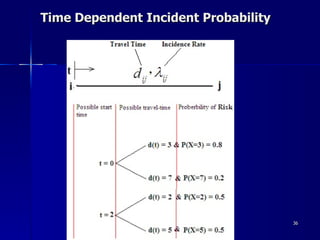
Time Dependent Incident Probability
Fundamental Diagram of Traffic Flow
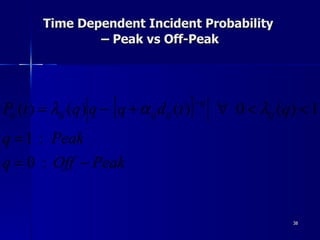
Time Dependent Incident Probability  – Peak vs Off-Peak
Poisson – Time Dependent Probability Model
Thesis Outline Problem Description Thesis Contributions ATIS Data Arc Volume Estimation Using Spatial Relationship EM-BS Algorithm Case Study - Col-Glen Road Probability of Incident Risk non-FIFO Routing concept Hu and Chan Algorithm WSDOT Algorithm WSDOT_Risk Algorithm Case Study – Central Arkansas Mini TMC Live Demo Conclusion
Key Terms Discrete vs Continuous representation of time A system is said to be discrete in time when the total time period T is divided  into smaller periodic segments of time with  integer increments. While a system is said to be continuous in time when point in the time space  has a different value which can be represented by a floating decimal  value of time. FIFO vs non-FIFO FIFO (First In First Out) represents a transportation network which follows; early departure     assured  early arrival. While non-FIFO represents ; early departure     un-assured  early arrival.
Non-FIFO Routing Concept
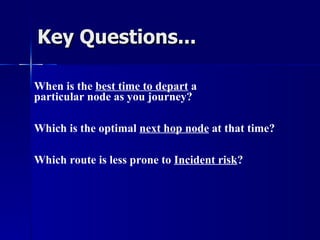
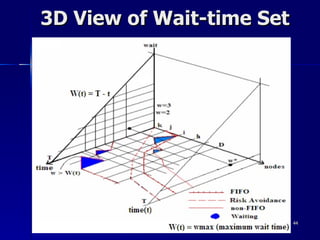
Key Questions... When is the  best time to depart  a  particular node as you journey? Which is the optimal  next hop node  at that time? Which route is less prone to  Incident risk ?
3D View of Wait-time Set
Thesis Outline Problem Description Thesis Contributions ATIS Data Arc Volume Estimation Using Spatial Relationship EM-BS Algorithm Case Study - Col-Glen Road Probability of Incident Risk non-FIFO Routing concept Hu and Chan Algorithm WSDOT Algorithm WSDOT_Risk Algorithm Case Study – Central Arkansas Mini TMC Live Demo Conclusion
Chabini’s DOT (Decrease Order Of Time) Recursion Algorithm    denote the non-negative time required to travel from node j   to node i    denote the total travel time associated with the current shortest path from node  i  to the destination node  D  at time  t.    denote the sets of nodes directly connected to node  D.
Stage Diagram; Wait time Search
Recursive Wait-time Search
Sequential Algorithm
WSDOT with Risk
Thesis Outline Problem Description Thesis Contributions ATIS Data Arc Volume Estimation Using Spatial Relationship EM-BS Algorithm Case Study - Col-Glen Road Probability of Incident Risk non-FIFO Routing concept Hu and Chan Algorithm WSDOT Algorithm WSDOT_Risk Algorithm Case Study – Central Arkansas Mini TMC Live Demo Conclusion
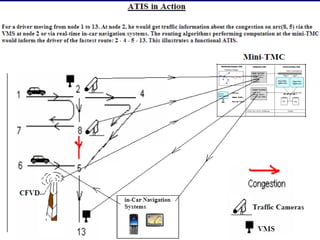
Network Graph
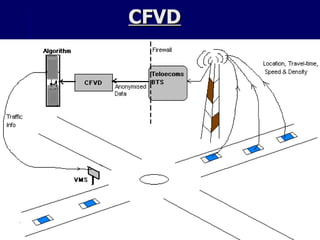
CFVD
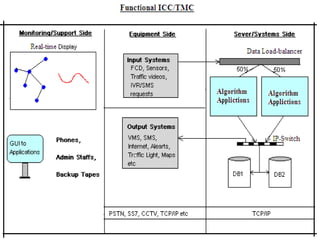
Online Service; A mini-TMC
ITS metaLab miniTMC  Demo http:// syseng.ualr.edu/metalab/research /
 
Conclusion Presented are new concepts that would help power a functional ATIS.  We present a non-FIFO type algorithm WSDOT-Risk which would help drivers get faster travel time and simultaneously avoid incident risks en-route to their destination. We developed mathematical models to compute Incident risk as  a function of time (either peak & off-peak or continuous).  We also discussed the importance of real-time traffic information for an ATIS, should in case there is partial information, traffic information can be estimated in the spatial dimension using upstream and downstream relationship of network arcs. An extension to this could be in the temporal dimension, in which we can forecast some time into the future based on neighboring arcs.
References [1] Dynamic Routing to Minimize Travel Time and Incident Risks (J.Hu and Y.Chan). [2] Chabini, I. A new shortest algorithm for discrete dynamic networks, Proceedings of the 8th IFAC Symposium on Transport System, China, Greece, Jun. 16-17, 1997, pp. 551-556 [3] Chabini, I. Discrete dynamic shortest path problems in transportation application: Complexity and algorithms with optimal run time, Transportation Research Record 1645, 1998, pp. 170-175. [4] Ziliaskopoulos, A. K. and Mahmassani, H. S. Design and implementation of a shortest path algorithm with time-dependent arc costs, Proceedings of 5 th  advanced technology conference, Washington, D. C., 1992, pp.  [5] Ziliaskopoulos, A. K. and Mahmassani, H. S. Time-dependent, shortest-path algorithm for real-time intelligent vehicle highway system applications, Transportation Research Record 1408, 1993, pp 94-100. [6] Chan, Y. Location Transport and Land-Use: Modeling Spatial-Temporal Information. Springer, Berlin – New York, 2005, pp. 506. [7] Farradyne, P. B. et al. Arkansas Statewide Intelligent Transportation Systems (ITS) Strategic Plan, Prepared for Arkansas State Highway & Transportation Department, 2002. [8] Metroplan. Intelligent Transportation System, Central Arkansas Regional Transportation Study, June, 2002. [9] Bellman, R. On a routing problem. Quart. Appl. Mathematics, Vol. 16, 1958, pp. 87-90.

Fowe Thesis Full

  • 1.
    ROAD-TRAFFIC MONITORING ANDROUTING; STOCHASTIC ALGORITHMS FOR SAFETY AND EFFICIENCY By Adeyemi Fowe Masters Degree Thesis Defence Applied Science Department (Engineering Science and Systems) ‏ University of Arkansas at Little rock. Supervisor Dr. Yupo Chan Professor and Founding Chair Systems Engineering Department University of Arkansas at Little Rock.
  • 2.
    The Transportation ProblemImage from: http://www.railway-technology.com/projects/bangkok/bangkok3.html The demand on Infrastructure is on the increase, building more roads will not solve the problem. Hence the need for ITS (Intelligent Transportation Systems). It involves the application of Algorithms & Mathematical Models in describing and solving day-to-day transportation problems. One of the basic need of a driver on The road is Fastest Travel Time.
  • 3.
    Thesis Outline ProblemDescription Thesis Contributions ATIS Data Arc Volume Estimation Using Spatial Relationship EM-BS Algorithm Case Study - Col-Glen Road Probability of Incident Risk non-FIFO Routing concept Hu and Chan Algorithm WSDOT Algorithm WSDOT_Risk Algorithm Case Study – Central Arkansas Mini TMC Live Demo Conclusion
  • 4.
    ATIS ( AdvancedTraveler Information System)
  • 6.
    Thesis Outline ProblemDescription Thesis Contributions ATIS Data Arc Volume Estimation Using Spatial Relationship EM-BS Algorithm Case Study - Col-Glen Road Probability of Incident Risk non-FIFO Routing concept Hu and Chan Algorithm WSDOT Algorithm WSDOT_Risk Algorithm Case Study – Central Arkansas Mini TMC Live Demo Conclusion
  • 7.
    Thesis Contributions Anew non-FIFO routing algorithm ( WSDOT ) that search for possible wait-times (en-route) in a time-dependent transportation network is developed. (Fall 07) A mathematical model to compute Time-dependent Incident Probabilities from historical traffic and incident data. (Fall 08) An extension of WSDOT algorithm to WSDOT-R ( WSDOT-with-Risk ) algorithm which simultaneously minimizes a driver’s exposure to incident risk even as the fastest travel time is desired. (Summer 08) A mathematical algorithm to estimate traffic volumes in unknown arcs using partial information from upstream/downstream neighbors and entropy maximization. (Spring 09) Finally this thesis presents the application of all the models, their efficiency, and their performance on a real transportation network. Using the Highway Road of Central Arkansas as a case study, we design and present a prototype demo of a mini-TMC (Traffic Management Center). (Spring 08)
  • 8.
    Thesis Outline ProblemDescription Thesis Contributions ATIS Data Arc Volume Estimation Using Spatial Relationship EM-BS Algorithm Case Study - Col-Glen Road Probability of Incident Risk non-FIFO Routing concept Hu and Chan Algorithm WSDOT Algorithm WSDOT_Risk Algorithm Case Study – Central Arkansas Mini TMC Live Demo Conclusion
  • 9.
    Data Collection SystemsInductive Loop Sensors Traffic/Surveillance Cameras Aerial Photos CFVD (Cellular Floating Vehicle Data) Video Vehicle Detection Systems
  • 10.
    Data is Keyto a Functional ATIS Partial Information (incomplete Data) Perfect Information (Complete Data) Static/Persistent Data (Average & non-time dependent). Dynamic Data (Time Dependent) Real-Time Data (Streaming and Complete Time Dependent Data) Have Need
  • 11.
    Thesis Outline ProblemDescription Thesis Contributions ATIS Data Arc Volume Estimation Using Spatial Relationship EM-BS Algorithm Case Study - Col-Glen Road Probability of Incident Risk non-FIFO Routing concept Hu and Chan Algorithm WSDOT Algorithm WSDOT_Risk Algorithm Case Study – Central Arkansas Mini TMC Live Demo Conclusion
  • 12.
  • 13.
    Spatial Relationships Inboth spatial and temporal Dimensions; Closer by neighbors have tendency to be similar than farther away neighbors.
  • 14.
  • 15.
    Spatial Matrix First –Order Spatial Arc Neighbors
  • 16.
    Spatial Matrix Second –Order Spatial Arc Neighbors
  • 17.
  • 18.
  • 19.
  • 20.
  • 21.
  • 22.
    Thesis Outline ProblemDescription Thesis Contributions ATIS Data Arc Volume Estimation Using Spatial Relationship EM-BS Algorithm Case Study - Col-Glen Road Probability of Incident Risk non-FIFO Routing concept Hu and Chan Algorithm WSDOT Algorithm WSDOT_Risk Algorithm Case Study – Central Arkansas Mini TMC Live Demo Conclusion
  • 23.
    Arc Volume EstimateNaïve Solution
  • 24.
  • 25.
    Entropy Maximization withBinary Search (EMBS)
  • 26.
    Entropy Maximization withBinary Search (EMBS)
  • 27.
    Entropy Maximization withBinary Search (EMBS)
  • 28.
  • 29.
    Thesis Outline ProblemDescription Thesis Contributions ATIS Data Arc Volume Estimation Using Spatial Relationship EM-BS Algorithm Case Study - Col-Glen Road Probability of Incident Risk non-FIFO Routing concept Hu and Chan Algorithm WSDOT Algorithm WSDOT_Risk Algorithm Case Study – Central Arkansas Mini TMC Live Demo Conclusion
  • 32.
  • 35.
    Thesis Outline ProblemDescription Thesis Contributions ATIS Data Arc Volume Estimation Using Spatial Relationship EM-BS Algorithm Sample Computation Case Study - Col-Glen Road Probability of Incident Risk non-FIFO Routing concept Hu and Chan Algorithm WSDOT Algorithm WSDOT_Risk Algorithm Case Study – Central Arkansas Mini TMC Live Demo Conclusion
  • 36.
  • 37.
  • 38.
    Time Dependent IncidentProbability – Peak vs Off-Peak
  • 39.
    Poisson – TimeDependent Probability Model
  • 40.
    Thesis Outline ProblemDescription Thesis Contributions ATIS Data Arc Volume Estimation Using Spatial Relationship EM-BS Algorithm Case Study - Col-Glen Road Probability of Incident Risk non-FIFO Routing concept Hu and Chan Algorithm WSDOT Algorithm WSDOT_Risk Algorithm Case Study – Central Arkansas Mini TMC Live Demo Conclusion
  • 41.
    Key Terms Discretevs Continuous representation of time A system is said to be discrete in time when the total time period T is divided into smaller periodic segments of time with integer increments. While a system is said to be continuous in time when point in the time space has a different value which can be represented by a floating decimal value of time. FIFO vs non-FIFO FIFO (First In First Out) represents a transportation network which follows; early departure  assured early arrival. While non-FIFO represents ; early departure  un-assured early arrival.
  • 42.
  • 43.
    Key Questions... Whenis the best time to depart a particular node as you journey? Which is the optimal next hop node at that time? Which route is less prone to Incident risk ?
  • 44.
    3D View ofWait-time Set
  • 45.
    Thesis Outline ProblemDescription Thesis Contributions ATIS Data Arc Volume Estimation Using Spatial Relationship EM-BS Algorithm Case Study - Col-Glen Road Probability of Incident Risk non-FIFO Routing concept Hu and Chan Algorithm WSDOT Algorithm WSDOT_Risk Algorithm Case Study – Central Arkansas Mini TMC Live Demo Conclusion
  • 46.
    Chabini’s DOT (DecreaseOrder Of Time) Recursion Algorithm  denote the non-negative time required to travel from node j to node i  denote the total travel time associated with the current shortest path from node i to the destination node D at time t.  denote the sets of nodes directly connected to node D.
  • 47.
  • 48.
  • 49.
  • 50.
  • 51.
    Thesis Outline ProblemDescription Thesis Contributions ATIS Data Arc Volume Estimation Using Spatial Relationship EM-BS Algorithm Case Study - Col-Glen Road Probability of Incident Risk non-FIFO Routing concept Hu and Chan Algorithm WSDOT Algorithm WSDOT_Risk Algorithm Case Study – Central Arkansas Mini TMC Live Demo Conclusion
  • 52.
  • 55.
  • 56.
  • 57.
    ITS metaLab miniTMC Demo http:// syseng.ualr.edu/metalab/research /
  • 58.
  • 59.
    Conclusion Presented arenew concepts that would help power a functional ATIS. We present a non-FIFO type algorithm WSDOT-Risk which would help drivers get faster travel time and simultaneously avoid incident risks en-route to their destination. We developed mathematical models to compute Incident risk as a function of time (either peak & off-peak or continuous). We also discussed the importance of real-time traffic information for an ATIS, should in case there is partial information, traffic information can be estimated in the spatial dimension using upstream and downstream relationship of network arcs. An extension to this could be in the temporal dimension, in which we can forecast some time into the future based on neighboring arcs.
  • 60.
    References [1] DynamicRouting to Minimize Travel Time and Incident Risks (J.Hu and Y.Chan). [2] Chabini, I. A new shortest algorithm for discrete dynamic networks, Proceedings of the 8th IFAC Symposium on Transport System, China, Greece, Jun. 16-17, 1997, pp. 551-556 [3] Chabini, I. Discrete dynamic shortest path problems in transportation application: Complexity and algorithms with optimal run time, Transportation Research Record 1645, 1998, pp. 170-175. [4] Ziliaskopoulos, A. K. and Mahmassani, H. S. Design and implementation of a shortest path algorithm with time-dependent arc costs, Proceedings of 5 th advanced technology conference, Washington, D. C., 1992, pp. [5] Ziliaskopoulos, A. K. and Mahmassani, H. S. Time-dependent, shortest-path algorithm for real-time intelligent vehicle highway system applications, Transportation Research Record 1408, 1993, pp 94-100. [6] Chan, Y. Location Transport and Land-Use: Modeling Spatial-Temporal Information. Springer, Berlin – New York, 2005, pp. 506. [7] Farradyne, P. B. et al. Arkansas Statewide Intelligent Transportation Systems (ITS) Strategic Plan, Prepared for Arkansas State Highway & Transportation Department, 2002. [8] Metroplan. Intelligent Transportation System, Central Arkansas Regional Transportation Study, June, 2002. [9] Bellman, R. On a routing problem. Quart. Appl. Mathematics, Vol. 16, 1958, pp. 87-90.