A Dynamic Macroscopic model integrated into Dynamic
Traffic Assignment: advantages and disadvantages
Martijn Breen & Jordi Casas
Overview
• Motivation
• Model description
• Isolated examples
• Case study
• Conclusion
Motivation
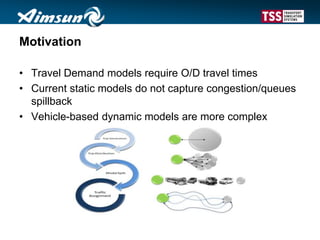
• Travel Demand models require O/D travel times
• Current static models do not capture congestion/queues
spillback
• Vehicle-based dynamic models are more complex
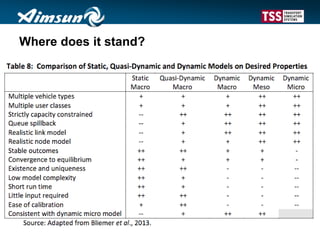
Where does it stand?
Model – Link model
• Continuous flow model
• Conservation equation:
dρ
dt
+
dq
dx
= 0
• Flux rate function:
q = ϕ ρ
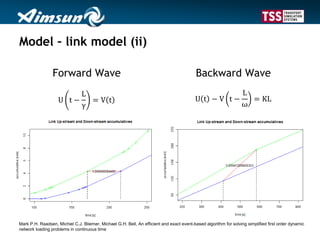
Model – link model (ii)
Forward Wave Backward Wave
U t −
L
γ
= V t U t − V t −
L
ω
= KL
Mark P.H. Raadsen, Michiel C.J. Bliemer, Michael G.H. Bell, An efficient and exact event-based algorithm for solving simplified first order dynamic
network loading problems in continuous time
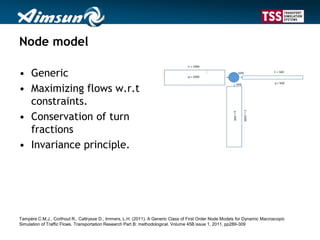
Node model
• Generic
• Maximizing flows w.r.t
constraints.
• Conservation of turn
fractions
• Invariance principle.
Tampère C.M.J., Corthout R., Cattrysse D., Immers, L.H. (2011). A Generic Class of First Order Node Models for Dynamic Macroscopic
Simulation of Traffic Flows. Transportation Research Part B: methodological. Volume 45B issue 1, 2011, pp289-309
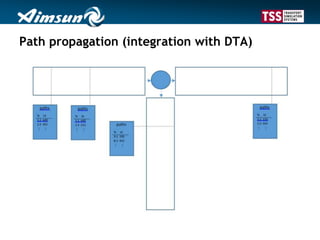
Path propagation (integration with DTA)
MACRO
MESO
MICRO
Static assignment
Dynamic user
equilibrium
or
Stochastic route choice
OD Matrix
Network data base
Pathsand
pathflowsdatabase
Traffic flow representationTraffic assignment
HYBRID
Integration in Dynamic Traffic Assignment
S
Network input / calibration parameters
• Geometry
• Section
– Free flow speed
– Capacity
– Jam density
• Turn
– Capacity
• Traffic lights control plan
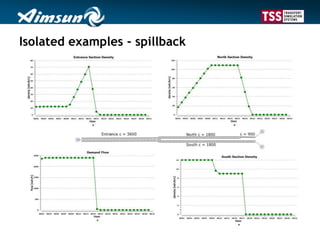
Isolated examples - spillback
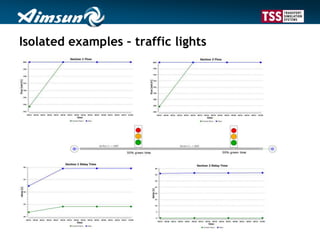
Isolated examples – traffic lights
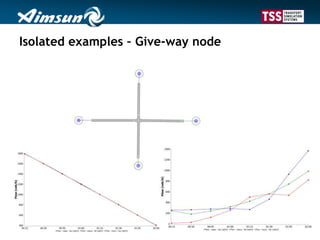
Isolated examples – Give-way node
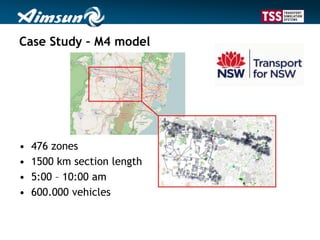
Case Study – M4 model
• 476 zones
• 1500 km section length
• 5:00 – 10:00 am
• 600.000 vehicles
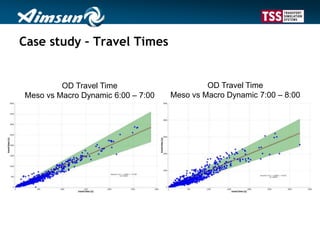
Case study – Travel Times
OD Travel Time
Meso vs Macro Dynamic 6:00 – 7:00
OD Travel Time
Meso vs Macro Dynamic 7:00 – 8:00
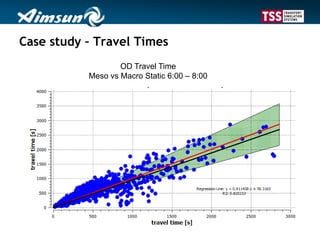
Case study – Travel Times
OD Travel Time
Meso vs Macro Static 6:00 – 8:00
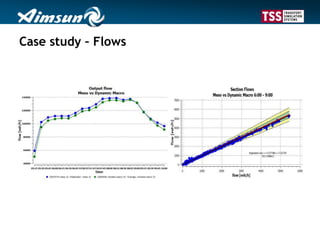
Case study – Flows
Computational performance
Simulator Link actualization
threshold [%]
Network Loading
[seconds]
Mesoscopic n/a 362
Macro dynamic 5 144
Macro dynamic 10 133
Macro dynamic 20 123
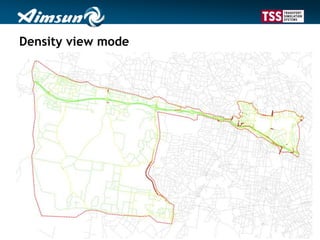
Density view mode
Conclusions
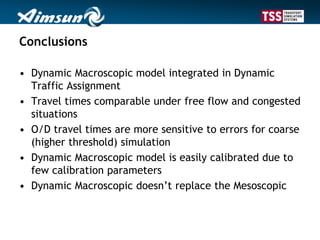
• Dynamic Macroscopic model integrated in Dynamic
Traffic Assignment
• Travel times comparable under free flow and congested
situations
• O/D travel times are more sensitive to errors for coarse
(higher threshold) simulation
• Dynamic Macroscopic model is easily calibrated due to
few calibration parameters
• Dynamic Macroscopic doesn’t replace the Mesoscopic
Future developments
• Improve traffic signal treatment
• Improve computation speed
• Add actions like:
– Metering
– Force turn
– Capacity reduction

A Macroscopic Dynamic model integrated into Dynamic Traffic Assignment: advantages and disadvantages

  • 1.
    A Dynamic Macroscopicmodel integrated into Dynamic Traffic Assignment: advantages and disadvantages Martijn Breen & Jordi Casas
  • 2.
    Overview • Motivation • Modeldescription • Isolated examples • Case study • Conclusion
  • 3.
    Motivation • Travel Demandmodels require O/D travel times • Current static models do not capture congestion/queues spillback • Vehicle-based dynamic models are more complex
  • 4.
  • 5.
    Model – Linkmodel • Continuous flow model • Conservation equation: dρ dt + dq dx = 0 • Flux rate function: q = ϕ ρ
  • 6.
    Model – linkmodel (ii) Forward Wave Backward Wave U t − L γ = V t U t − V t − L ω = KL Mark P.H. Raadsen, Michiel C.J. Bliemer, Michael G.H. Bell, An efficient and exact event-based algorithm for solving simplified first order dynamic network loading problems in continuous time
  • 7.
    Node model • Generic •Maximizing flows w.r.t constraints. • Conservation of turn fractions • Invariance principle. Tampère C.M.J., Corthout R., Cattrysse D., Immers, L.H. (2011). A Generic Class of First Order Node Models for Dynamic Macroscopic Simulation of Traffic Flows. Transportation Research Part B: methodological. Volume 45B issue 1, 2011, pp289-309
  • 8.
  • 9.
    MACRO MESO MICRO Static assignment Dynamic user equilibrium or Stochasticroute choice OD Matrix Network data base Pathsand pathflowsdatabase Traffic flow representationTraffic assignment HYBRID Integration in Dynamic Traffic Assignment S
  • 10.
    Network input /calibration parameters • Geometry • Section – Free flow speed – Capacity – Jam density • Turn – Capacity • Traffic lights control plan
  • 11.
  • 12.
    Isolated examples –traffic lights
  • 13.
    Isolated examples –Give-way node
  • 14.
    Case Study –M4 model • 476 zones • 1500 km section length • 5:00 – 10:00 am • 600.000 vehicles
  • 15.
    Case study –Travel Times OD Travel Time Meso vs Macro Dynamic 6:00 – 7:00 OD Travel Time Meso vs Macro Dynamic 7:00 – 8:00
  • 16.
    Case study –Travel Times OD Travel Time Meso vs Macro Static 6:00 – 8:00
  • 17.
  • 18.
    Computational performance Simulator Linkactualization threshold [%] Network Loading [seconds] Mesoscopic n/a 362 Macro dynamic 5 144 Macro dynamic 10 133 Macro dynamic 20 123
  • 19.
  • 20.
    Conclusions • Dynamic Macroscopicmodel integrated in Dynamic Traffic Assignment • Travel times comparable under free flow and congested situations • O/D travel times are more sensitive to errors for coarse (higher threshold) simulation • Dynamic Macroscopic model is easily calibrated due to few calibration parameters • Dynamic Macroscopic doesn’t replace the Mesoscopic
  • 21.
    Future developments • Improvetraffic signal treatment • Improve computation speed • Add actions like: – Metering – Force turn – Capacity reduction