EFFECT ON TRAFFIC
PARAMETRS
PRESENTED BY
ABHILASH KUMAR
MTECH TRANSPORTATION
REG: 14PCE030
Under the guidance of
Mr Partha Pratim Sarkar
Assistant Professor
NIT AGARTALA
Content
 INTRODUCTION
 LITERATURE REVIEW
 OBJECTIVE
 WORK PLAN
 IMPACT
 REFERNCES
Introduction
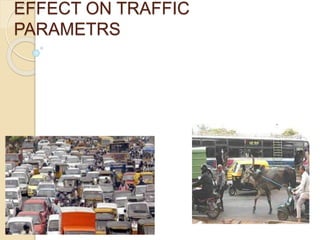
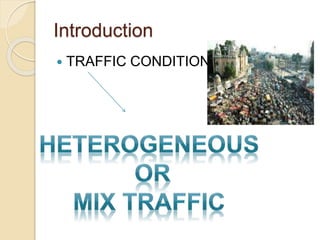
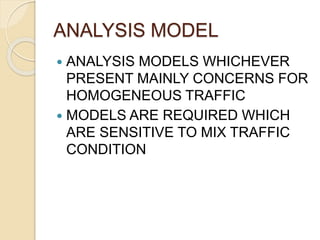
 TRAFFIC CONDITION IN INDIA
INTRODUCTION
 WHAT IS MIX TRAFFIC????
TRAFFIC COMPOSED
OF MOTORISED, NON MOTORISED
,TWO WHEELER AND THREE
WHEELER.
ANALYSIS MODEL
 ANALYSIS MODELS WHICHEVER
PRESENT MAINLY CONCERNS FOR
HOMOGENEOUS TRAFFIC
 MODELS ARE REQUIRED WHICH
ARE SENSITIVE TO MIX TRAFFIC
CONDITION
QUANTIFICATION OF MIX
 Process to find out what is the amount
mix or composition in cellular level in
heterogeneous traffic.Sales
BUS AND
TRUCKS
MTHW
MTW
Bicycle
Cars
TRAFFIC FLOW MODELS
MACROSCOPIC
MICROSCOPIC
MESOSCOPIC
LITERATUTRE REVIEW
 Bains et al. (2012) evaluated the
effect of vehicle composition (heavy
vehicles and light commercial
vehicles) on PCU values at different
volume levels, to a limited extent, on
expressways in India. PCU values
were evaluated using the micro-
simulation model, VISSIM.
 Brooks (2012) Studied on the influence of
roadway width and volume to capacity
ratio on PCU values and statistical
analysis determined that there is a
significant difference in volume of cars
only between homogeneous and
heterogeneous traffic conditions for
various road widths. Hence the PCU
values of heterogeneous traffic are
recommended for the design of traffic
systems over homogeneous traffic
conditions.
 Arasan and Arkatkar (2011) developed a
heterogeneous traffic simulation flow
model using HETEROSIM for this study.
They mainly focused on the finding
capacity as number of vehicle passing a
given section of road or traffic lane per unit
time where several types of vehicles with
widely varying static and dynamic
characteristic are moving.
 Pan and kerali (2007) conducted a
research on the effects of non-motorized
traffic flow on motorized vehicle speeds on
the basis of field observations of vehicle
speeds on Chinese roads. They observed
that there exist a linear relationship
between motorized vehicle speeds and
non-motorized traffic flow under a range of
motorized traffic flow volumes.
 Mallikarjuna and Rao (2006) developed
PCU factors for trucks, buses and two-
wheelers under heterogeneous traffic
conditions prevailing on Indian roads using
modified cellular automata simulation
model. They found that PCU values
decrease with increase in the vehicle’s
proportion in the traffic stream.
OBJECTIVE
 To quantify the mix in the heterogeneous
traffic.
 An attempt will be made to develop traffic
simulation model that will characterize Indian
Traffic condition i.e. heterogeneous traffic and
no lane discipline.
 To study the effect of slow moving vehicle on
the microscopic parameters on transit or para-
transit facility of Agartala , Delhi, Guwahati
and Kolkata on a single lane Urban road.
EQUIPMENTS
 Trazer (Traffic analyzer and
enumerator )
 Video recorder with Tripod
 Storage in Hard drive
 Simulation software MOVSIM, VISSIM.
TRAZER
Real time video processing,real time vehicle
classification,vehicle tracking and
counting,flow statistics,Vehicle flow at a
particular time,velocity of traffic,Extensive
vehicle trajectory log.
WORK PLAN
SELECTION
OF TOPIC
LITERATURE
REVIEW
CARRY OUT
SURVEY
USE OF HD
CAM
FEED DATA
ANALYSE
USING
TRAZERDEVELOP
SIMULATIO
N MODEL
AGARTAL
A
DELHI
GUWAHATI
KOLKATA
Project Impact - Expected outcome
Simulation modeling is an increasingly popular and effective tool for
analyzing a wide variety of dynamical problems which are difficult to be
studied by other means. Usually, these processes are characterized by
the interaction of many system components or entities. The simulation
model will enable proper understanding of heterogeneous traffic flow
characteristics in undivided road for better utilization of transport
infrastructure and effective regulation and control of traffic.
REFERENCES
 Dhamaniya.A and Chandra, S. (2013), “Concept of stream equivalency
factor for heterogeneous traffic on urban arterial roads”, journal of
transportation engineering © asce.
 Sinha, S., Taneerananon, P and Chandra, S. (2013), “A comparative study of
effect of motorcycle volume on capacity of four lane urban roads in India
and Thailand”, Journal of society for transportation and traffic studies, vol.3,
no.4.
 Bains, M.S, Ponnu, B and Arkatkar, S.S. (2012), “Modeling of Traffic Flow on
Indian Expressways using Simulation Technique, Procedia - Social and
Behavioral Sciences”, 475-493.
 Brooks, M.R. (2012), “Acceleration characteristics of vehicles in rural
Pennsylvania”, IJRRAS, vol.12 No.3.
 Brooks, M.R. (2012), “Influence of roadway width and volume to capacity
ratio on PCU values”, Transport problems, vol.5 issue2.
 Arasan, V.T. and Arkatkar, S.S. (2010), “Micro-simulation study of effect of
volume and road width on PCU of vehicles under heterogeneous traffic”,
 Dey, P.P., Chandra, S. and Gangopadhyay, S. (2008), “Simulation of mixed
traffic flow on two-lane roads”, Journal of transportation engineering, Vol.
134, No.9. pp.363-367.
 Pan and Kerali. (2007), “Effects of non-motorized traffic flow on motorized
vehicle speeds on the basis of field observations of vehicle speeds on
Chinese roads”.
 Bang K.L., A. Carlsson and Palgunadi. (1995), “Development of speed-flow
relationship for Indonesia rural roads using empirical data and simulation”,
Transportation Research Board, Washington, D.C, pp. 24-32.
 Mallikarjuna, C. and Rao, R.K. (2006), “Modeling of Passenger Car
Equivalency under Heterogeneous Traffic Conditions”, In Proceedings of
the Research into Practice: 22nd Australian Road Research Board (ARRB)
Conference, pp.1-13.
 Arasan, V.T and koshy, R.Z. (2004), “Simulation of heterogeneous traffic to
derive capacity and service volume standards for urban roads”, pp no.500.
 Roger V. L and Tantiyanugulchai.S. (2004), “Microscopic simulation of traffic
at a suburban interchange”.
mix traffic

mix traffic

  • 1.
  • 2.
    PRESENTED BY ABHILASH KUMAR MTECHTRANSPORTATION REG: 14PCE030 Under the guidance of Mr Partha Pratim Sarkar Assistant Professor NIT AGARTALA
  • 3.
    Content  INTRODUCTION  LITERATUREREVIEW  OBJECTIVE  WORK PLAN  IMPACT  REFERNCES
  • 4.
  • 5.
    INTRODUCTION  WHAT ISMIX TRAFFIC???? TRAFFIC COMPOSED OF MOTORISED, NON MOTORISED ,TWO WHEELER AND THREE WHEELER.
  • 6.
    ANALYSIS MODEL  ANALYSISMODELS WHICHEVER PRESENT MAINLY CONCERNS FOR HOMOGENEOUS TRAFFIC  MODELS ARE REQUIRED WHICH ARE SENSITIVE TO MIX TRAFFIC CONDITION
  • 7.
    QUANTIFICATION OF MIX Process to find out what is the amount mix or composition in cellular level in heterogeneous traffic.Sales BUS AND TRUCKS MTHW MTW Bicycle Cars
  • 8.
  • 9.
    LITERATUTRE REVIEW  Bainset al. (2012) evaluated the effect of vehicle composition (heavy vehicles and light commercial vehicles) on PCU values at different volume levels, to a limited extent, on expressways in India. PCU values were evaluated using the micro- simulation model, VISSIM.
  • 10.
     Brooks (2012)Studied on the influence of roadway width and volume to capacity ratio on PCU values and statistical analysis determined that there is a significant difference in volume of cars only between homogeneous and heterogeneous traffic conditions for various road widths. Hence the PCU values of heterogeneous traffic are recommended for the design of traffic systems over homogeneous traffic conditions.
  • 11.
     Arasan andArkatkar (2011) developed a heterogeneous traffic simulation flow model using HETEROSIM for this study. They mainly focused on the finding capacity as number of vehicle passing a given section of road or traffic lane per unit time where several types of vehicles with widely varying static and dynamic characteristic are moving.
  • 12.
     Pan andkerali (2007) conducted a research on the effects of non-motorized traffic flow on motorized vehicle speeds on the basis of field observations of vehicle speeds on Chinese roads. They observed that there exist a linear relationship between motorized vehicle speeds and non-motorized traffic flow under a range of motorized traffic flow volumes.
  • 13.
     Mallikarjuna andRao (2006) developed PCU factors for trucks, buses and two- wheelers under heterogeneous traffic conditions prevailing on Indian roads using modified cellular automata simulation model. They found that PCU values decrease with increase in the vehicle’s proportion in the traffic stream.
  • 14.
    OBJECTIVE  To quantifythe mix in the heterogeneous traffic.  An attempt will be made to develop traffic simulation model that will characterize Indian Traffic condition i.e. heterogeneous traffic and no lane discipline.  To study the effect of slow moving vehicle on the microscopic parameters on transit or para- transit facility of Agartala , Delhi, Guwahati and Kolkata on a single lane Urban road.
  • 15.
    EQUIPMENTS  Trazer (Trafficanalyzer and enumerator )  Video recorder with Tripod  Storage in Hard drive  Simulation software MOVSIM, VISSIM.
  • 16.
    TRAZER Real time videoprocessing,real time vehicle classification,vehicle tracking and counting,flow statistics,Vehicle flow at a particular time,velocity of traffic,Extensive vehicle trajectory log.
  • 17.
    WORK PLAN SELECTION OF TOPIC LITERATURE REVIEW CARRYOUT SURVEY USE OF HD CAM FEED DATA ANALYSE USING TRAZERDEVELOP SIMULATIO N MODEL AGARTAL A DELHI GUWAHATI KOLKATA
  • 18.
    Project Impact -Expected outcome Simulation modeling is an increasingly popular and effective tool for analyzing a wide variety of dynamical problems which are difficult to be studied by other means. Usually, these processes are characterized by the interaction of many system components or entities. The simulation model will enable proper understanding of heterogeneous traffic flow characteristics in undivided road for better utilization of transport infrastructure and effective regulation and control of traffic.
  • 19.
    REFERENCES  Dhamaniya.A andChandra, S. (2013), “Concept of stream equivalency factor for heterogeneous traffic on urban arterial roads”, journal of transportation engineering © asce.  Sinha, S., Taneerananon, P and Chandra, S. (2013), “A comparative study of effect of motorcycle volume on capacity of four lane urban roads in India and Thailand”, Journal of society for transportation and traffic studies, vol.3, no.4.  Bains, M.S, Ponnu, B and Arkatkar, S.S. (2012), “Modeling of Traffic Flow on Indian Expressways using Simulation Technique, Procedia - Social and Behavioral Sciences”, 475-493.  Brooks, M.R. (2012), “Acceleration characteristics of vehicles in rural Pennsylvania”, IJRRAS, vol.12 No.3.  Brooks, M.R. (2012), “Influence of roadway width and volume to capacity ratio on PCU values”, Transport problems, vol.5 issue2.  Arasan, V.T. and Arkatkar, S.S. (2010), “Micro-simulation study of effect of volume and road width on PCU of vehicles under heterogeneous traffic”,
  • 20.
     Dey, P.P.,Chandra, S. and Gangopadhyay, S. (2008), “Simulation of mixed traffic flow on two-lane roads”, Journal of transportation engineering, Vol. 134, No.9. pp.363-367.  Pan and Kerali. (2007), “Effects of non-motorized traffic flow on motorized vehicle speeds on the basis of field observations of vehicle speeds on Chinese roads”.  Bang K.L., A. Carlsson and Palgunadi. (1995), “Development of speed-flow relationship for Indonesia rural roads using empirical data and simulation”, Transportation Research Board, Washington, D.C, pp. 24-32.  Mallikarjuna, C. and Rao, R.K. (2006), “Modeling of Passenger Car Equivalency under Heterogeneous Traffic Conditions”, In Proceedings of the Research into Practice: 22nd Australian Road Research Board (ARRB) Conference, pp.1-13.  Arasan, V.T and koshy, R.Z. (2004), “Simulation of heterogeneous traffic to derive capacity and service volume standards for urban roads”, pp no.500.  Roger V. L and Tantiyanugulchai.S. (2004), “Microscopic simulation of traffic at a suburban interchange”.