ELECTRONIC BREAK
FORCE DISTRIBUTION
•
•
•
•
•
•
•
•
•
• You’re driving at a safe speed on a moderately busy highway. It has not been snowing for
long, but already the pavement is dusted with snow and becoming slippery. Suddenly,
another motorist signals to enter your lane and makes a sharp veering motion. You are
forced to slam on the brakes to avoid hitting the encroaching vehicle. The weight of your
car is thrust forward from the heavy braking, putting added pressure on the front wheels to
stop the car. Meanwhile, the sudden shift in weight has significantly reduced the amount of
traction available for the back wheels.
• After a few seconds, the back wheels lock completely. You feel the back end of your car start
to fishtail into the lanes on either side of you. Finally, the back-and-forth motion of the rear
of the car overcomes the braking power of the front wheels and you spin around, face-to-
face with oncoming traffic. Situations like this are potentially very dangerous. Electronic
brake-force distribution is a vehicle safety feature that can prevent this kind of event.
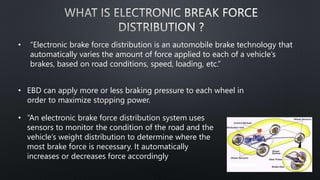
• “Electronic brake force distribution is an automobile brake technology that
automatically varies the amount of force applied to each of a vehicle’s
brakes, based on road conditions, speed, loading, etc.”
• EBD can apply more or less braking pressure to each wheel in
order to maximize stopping power.
• “An electronic brake force distribution system uses
sensors to monitor the condition of the road and the
vehicle’s weight distribution to determine where the
most brake force is necessary. It automatically
increases or decreases force accordingly
• Locked wheels are generally very dangerous because once your wheels lock you
lose all steering power.
• Locked up back wheels not only Increase your risk of fishtailing, but they also
force the front wheels to do all the work with only half of the total braking
force available ( because other half of your brake force is still being applied –
uselessly – to the locked rear wheels )
• This can results in longer stopping distances, Spinning and possibly loss of
control.
• Locking of wheels depends on the weight distribution and the Slip Ratio.
• When the observed angular velocity of the tire does not match
the expected velocity for pure rolling motion, which means there
is sliding between the tire and the road in addition to rolling .This
difference, expressed as a percentage, is called slip ratio
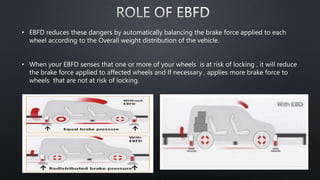
• EBFD reduces these dangers by automatically balancing the brake force applied to each
wheel according to the Overall weight distribution of the vehicle.
• When your EBFD senses that one or more of your wheels is at risk of locking , it will reduce
the brake force applied to affected wheels and If necessary , applies more brake force to
wheels that are not at risk of locking.
1. Speed Sensors – It is Attached to All four wheels that senses
how fast the wheel is rotating .
2. Brake Force Modulators
3. Electronic Control Unit (ECU)
4. Yaw sensor
• EBFD works by monitoring each wheel’s responsiveness to the brake, and then tailoring
the amount of brake-force applied to each wheel.
• In vehicles without EBFD, when you apply the brakes the brake force is evenly distributed
across all four wheels. The danger here is that if, for example , one of your wheels is on ice
and locks up, you lose 25% of your braking power
• On a Vehicle with EBFD , the system would sense that one of the wheels is not braking
properly, and would redistribute the brake force to the unaffected wheels to obtain
optimal braking power. This way, you retain the maximum amount of braking power
possible and reduce the risk of fishtailing or spinning around.
• The ECU is a small computer embedded in the antilock braking system.
It receives input from the speed sensors, calculates the slip ratio of the
wheels, and uses the brake force modulators to apply an appropriate
amount of brake force to keep the slip ratio of each wheel within a
reasonable range.
• So while the ECU and brake modulator serve different purposes, they
are physically combined into one electro-hydraulic unit.
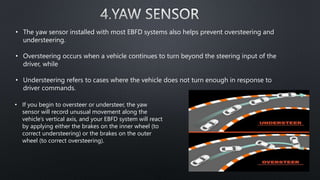
• The yaw sensor installed with most EBFD systems also helps prevent oversteering and
understeering.
• Oversteering occurs when a vehicle continues to turn beyond the steering input of the
driver, while
• Understeering refers to cases where the vehicle does not turn enough in response to
driver commands.
• If you begin to oversteer or understeer, the yaw
sensor will record unusual movement along the
vehicle’s vertical axis, and your EBFD system will react
by applying either the brakes on the inner wheel (to
correct understeering) or the brakes on the outer
wheel (to correct oversteering).
• "The electronic control unit interprets the information from the speed and yaw
"sensors, and then sends commands to the brake-force modulators.
• As per the Road Conditions, Load distribution and Considering speed of a Vehicle, The
brake force modulator modulates the different Brake forces to the each wheel by ECU ,
to minimize the Stopping distance and Efficient Braking
• “Electronic brake-force distribution is often installed with antilock Braking systems
(ABS). ABS installations that are supplemented with Setup react more quickly and deliver
more situation-specific braking commands than older ABS Setups
1. Heavy braking will be more comfortable:
Since braking is more effective with EBFD, your vehicle will stop faster, which will mitigate the effects that
heavy braking has on your own body (i.e., throwing your body forward towards the steering column). “
2. Enhanced overall vehicle safety:
EBFD will help reduce your risk of fishtailing, spinning, oversteering, and understeering. Since braking is
more effective on vehicles with EBFD, you will likely notice a reduction in stopping
distance.”
3. Improved braking predictability:
The way your vehicle brakes constantly changes depending on the condition of the road, the total weight
of the vehicle, and the distribution of weight within the vehicle. By automatically adjusting brake-force to
its optimal distribution, EBFD can help reduce the effects of these
factors and make braking more predictable. “
• Increases the cost of the vehicle.
• Involves the use of an extra sensor and controller which
increases the complexity.
• The electronic devices like the sensor and the controller are
delicate and expensive to repair and maintain.”
• EBFD is likely to be most useful on
1. Front-engine vehicles
• are more likely to experience rear-wheel braking inefficiency during heavy braking because of
the extra weight at the front of the vehicle. EBFD compensates for the weight differences across
the vehicle.
2. SUV’S
• are taller than regular vehicles and therefore have a higher centre of gravity, making them
inherently more unstable and prone to escaping a driver’s control. The yaw sensor in EBFD
helps to correct any potentially dangerous side-to-side motion.
3. Finally, if you are driving a vehicle that is heavily loaded or unevenly loaded, EBFD will sense
the location and amount of extra weight and adjust brake-force accordingly. “
Electronic Brake Force Distribution.pptx

Electronic Brake Force Distribution.pptx

  • 1.
  • 2.
  • 3.
    • You’re drivingat a safe speed on a moderately busy highway. It has not been snowing for long, but already the pavement is dusted with snow and becoming slippery. Suddenly, another motorist signals to enter your lane and makes a sharp veering motion. You are forced to slam on the brakes to avoid hitting the encroaching vehicle. The weight of your car is thrust forward from the heavy braking, putting added pressure on the front wheels to stop the car. Meanwhile, the sudden shift in weight has significantly reduced the amount of traction available for the back wheels. • After a few seconds, the back wheels lock completely. You feel the back end of your car start to fishtail into the lanes on either side of you. Finally, the back-and-forth motion of the rear of the car overcomes the braking power of the front wheels and you spin around, face-to- face with oncoming traffic. Situations like this are potentially very dangerous. Electronic brake-force distribution is a vehicle safety feature that can prevent this kind of event.
  • 4.
    • “Electronic brakeforce distribution is an automobile brake technology that automatically varies the amount of force applied to each of a vehicle’s brakes, based on road conditions, speed, loading, etc.” • EBD can apply more or less braking pressure to each wheel in order to maximize stopping power. • “An electronic brake force distribution system uses sensors to monitor the condition of the road and the vehicle’s weight distribution to determine where the most brake force is necessary. It automatically increases or decreases force accordingly
  • 5.
    • Locked wheelsare generally very dangerous because once your wheels lock you lose all steering power. • Locked up back wheels not only Increase your risk of fishtailing, but they also force the front wheels to do all the work with only half of the total braking force available ( because other half of your brake force is still being applied – uselessly – to the locked rear wheels ) • This can results in longer stopping distances, Spinning and possibly loss of control. • Locking of wheels depends on the weight distribution and the Slip Ratio.
  • 6.
    • When theobserved angular velocity of the tire does not match the expected velocity for pure rolling motion, which means there is sliding between the tire and the road in addition to rolling .This difference, expressed as a percentage, is called slip ratio
  • 8.
    • EBFD reducesthese dangers by automatically balancing the brake force applied to each wheel according to the Overall weight distribution of the vehicle. • When your EBFD senses that one or more of your wheels is at risk of locking , it will reduce the brake force applied to affected wheels and If necessary , applies more brake force to wheels that are not at risk of locking.
  • 9.
    1. Speed Sensors– It is Attached to All four wheels that senses how fast the wheel is rotating . 2. Brake Force Modulators 3. Electronic Control Unit (ECU) 4. Yaw sensor
  • 10.
    • EBFD worksby monitoring each wheel’s responsiveness to the brake, and then tailoring the amount of brake-force applied to each wheel. • In vehicles without EBFD, when you apply the brakes the brake force is evenly distributed across all four wheels. The danger here is that if, for example , one of your wheels is on ice and locks up, you lose 25% of your braking power • On a Vehicle with EBFD , the system would sense that one of the wheels is not braking properly, and would redistribute the brake force to the unaffected wheels to obtain optimal braking power. This way, you retain the maximum amount of braking power possible and reduce the risk of fishtailing or spinning around.
  • 11.
    • The ECUis a small computer embedded in the antilock braking system. It receives input from the speed sensors, calculates the slip ratio of the wheels, and uses the brake force modulators to apply an appropriate amount of brake force to keep the slip ratio of each wheel within a reasonable range. • So while the ECU and brake modulator serve different purposes, they are physically combined into one electro-hydraulic unit.
  • 12.
    • The yawsensor installed with most EBFD systems also helps prevent oversteering and understeering. • Oversteering occurs when a vehicle continues to turn beyond the steering input of the driver, while • Understeering refers to cases where the vehicle does not turn enough in response to driver commands. • If you begin to oversteer or understeer, the yaw sensor will record unusual movement along the vehicle’s vertical axis, and your EBFD system will react by applying either the brakes on the inner wheel (to correct understeering) or the brakes on the outer wheel (to correct oversteering).
  • 13.
    • "The electroniccontrol unit interprets the information from the speed and yaw "sensors, and then sends commands to the brake-force modulators. • As per the Road Conditions, Load distribution and Considering speed of a Vehicle, The brake force modulator modulates the different Brake forces to the each wheel by ECU , to minimize the Stopping distance and Efficient Braking • “Electronic brake-force distribution is often installed with antilock Braking systems (ABS). ABS installations that are supplemented with Setup react more quickly and deliver more situation-specific braking commands than older ABS Setups
  • 15.
    1. Heavy brakingwill be more comfortable: Since braking is more effective with EBFD, your vehicle will stop faster, which will mitigate the effects that heavy braking has on your own body (i.e., throwing your body forward towards the steering column). “ 2. Enhanced overall vehicle safety: EBFD will help reduce your risk of fishtailing, spinning, oversteering, and understeering. Since braking is more effective on vehicles with EBFD, you will likely notice a reduction in stopping distance.” 3. Improved braking predictability: The way your vehicle brakes constantly changes depending on the condition of the road, the total weight of the vehicle, and the distribution of weight within the vehicle. By automatically adjusting brake-force to its optimal distribution, EBFD can help reduce the effects of these factors and make braking more predictable. “
  • 16.
    • Increases thecost of the vehicle. • Involves the use of an extra sensor and controller which increases the complexity. • The electronic devices like the sensor and the controller are delicate and expensive to repair and maintain.”
  • 17.
    • EBFD islikely to be most useful on 1. Front-engine vehicles • are more likely to experience rear-wheel braking inefficiency during heavy braking because of the extra weight at the front of the vehicle. EBFD compensates for the weight differences across the vehicle. 2. SUV’S • are taller than regular vehicles and therefore have a higher centre of gravity, making them inherently more unstable and prone to escaping a driver’s control. The yaw sensor in EBFD helps to correct any potentially dangerous side-to-side motion. 3. Finally, if you are driving a vehicle that is heavily loaded or unevenly loaded, EBFD will sense the location and amount of extra weight and adjust brake-force accordingly. “