Curriculum
evaluation
CHAPTER 6
Curriculum
Evaluation
Curriculum
Evaluation in
the classroom
Purpose of
Evaluation
Classroom
Evaluation at
the school or
school system
level
01 03
02 04
05
Models of
Curriculum
Evaluation
Curriculum Evaluation
In general, evaluation is concerned with giving value or making judgments . Consequently , a
person acts as evaluator when he or she attributes worth or judgment to an object, place, a
process, or a behavior. Usually, evaluation is done using a set of criteria. This enable the evaluation
process to be always objective rather than subjective.
Basically, curriculum evaluation is:
The process of delineating, obtaining, and providing information useful for
making decisions and judgements about curricula (Davis,1980)
The process of examining the goals, rationale, and structure of any
curriculum.(marsh,2004)
The process of assessing the merit and worth of a program of studies, a
course, or a field of study (Print,1993)
The means of determining whether the program is meeting the goals (Bruce
Tuckman, 1985)
The broad and continuous effort to inquire into the effects of utilizing content
and process to meet clearly defined goals.(Doll,1992)
The process of delineating, obtaining’, and providing useful information for
judging decision alternatives(Stufflebeam,1971)
Purpose of evaluation
Purposes of Curriculum Evaluation:
Print(1993) identified several important purposes and functions of evaluation in
school setting:
Essential in providing feedback to learners- provides useful information in
helping the students improve their performance and help teachers identify the
strengths and weaknesses of the learners
Helpful in determining how well learners have achieved the objectives the
curriculum- describes whether the students learned or mastered the desired
outcomes and objectives of the curriculum.
To improve curriculum- the result of the evaluation serves as basis for improving
curriculum and for suggesting innovations to improve learning.
In addition, curriculum evaluation is also useful to administration and teachers in
many different ways. For example:
It helps in shaping academic policies.
It guides in initiating curricular changes and innovations.
It helps school align their curriculum to different curriculum sources and influences.
It determines the level of success of the school’s vision and mission
Curriculum Evaluation in the Classroom
Doll(1997) asserted that classroom in fact could be the first site of
gathering important data that will lead to curriculum evaluation.
Within the classroom, teachers and important can collect data using
several instruments like:
Test results
Anecdotal records
Checklist
Interview guides
Observation guides
Personality inventories
rating scales
IQ TEST
Interest inventories
Teachers play an important role in conducting curriculum evaluation in
the classroom level. They must be guided in gathering data from these
instruments and in interpreting the data. The result of classroom-based
evaluation may help in improving instruction and in the effective
implementation of the curriculum
Curriculum Evaluation at the School or
School System Level
Curriculum evaluation is done mostly at a school or school system
level. This is usually done to evaluate how the curriculum goals are
attained in the macro level. At this level, the following instruments
can be used to gather data for the evaluation of the curriculum:
Opinion polls
Surveys
Focus group discussion
Follow up studies (Graduate tracer studies)
Standard evaluation instruments
Result of district or national test
The schools that gather and analyze data on the implementation of
the curriculum can also do research activities.
Models of curriculum evaluation
Curriculum scholars and curriculum workers have identified various models that can be
used for evaluating curriculum. Each of these models is a product of endless works of
curriculum scholars trying to assess the value of a particular curriculum:
A. Provus’ Discrepancy Evaluation Model
This model for curriculum evaluation was developed by Malcolm Provus(1971)
to evaluate projects under the Elementary-Secondary Education Act in the United
States. Using the taxanomy of program developed by Robert Stake.
Provus’ identified four major stages of conducting curriculum evaluation:
1.Determing programs standards
2. Determing program performances
3.Comparing performance with standard
4.Determining whether a discrepancy exists between performance and standard
B. Tyler’s model of curriculum evaluation:
1. Establishments of goals and objectives
2. Classification of the objectives
3. Definition of the objectives in behavioral terms
4. Identification of situations in which achievement of the objectives
could be shown
5. Selection of criterion of measurement procedures
6. Collection of data about pupil performances
7. Comparison of findings with the stated objectives
The completion of the seven stages will lead to the revision of the
objectives. This evaluation model is a cyclical type of model
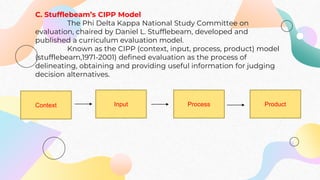
C. Stufflebeam’s CIPP Model
The Phi Delta Kappa National Study Committee on
evaluation, chaired by Daniel L. Stufflebeam, developed and
published a curriculum evaluation model.
Known as the CIPP (context, input, process, product) model
(stufflebeam,1971-2001) defined evaluation as the process of
delineating, obtaining and providing useful information for judging
decision alternatives.
Context Input Process Product
D. Staker’s Congruency Evaluation Model
Robert Stake(1975) claimed that curriculum evaluation is not
complete unless three categories of data are made available. These category of
data are:
1. Antecedants- include data on students and teachers, the curriculum to be
evaluated, and the community context.
2. Transactions- include the allotment;, sequence of steps, social climate, and
communication flow.
3. Outcomes- encompasses students learning in the form of understanding,
skills and values or attitude, as well as the effect of the curriculum on the
teachers, students, and the school.
The data gathered will provide necessary information for the evaluation
process. The term congruency refers to the degree of alignment between what
was desired and what was achieved. Contingency refers to the relationship
between one variable to the other, for example, between the curriculum and
the community context
E. Eisner’s Educational Connoisseurship Model
Elliot Eisner (1985) provide a qualitative way of evaluating a
curriculum. The mode does not have methodical procedures compared with
other evaluation models. Eisner’s model calls for a deeper and wider
observation results of evaluation that are expressed in written form. The results,
however, are not merely descriptions; they provide excellent and accurate
interpretation and appraisal.
Using this models calls for thorough and comprehensive
observations of classroom and school activities in relation to curriculum. It tries
to capture every aspect of curriculum activities including the hidden
curriculum. The emphasis of his model is always on the quality rather than on
the measurable quantity of learning and interaction
THANK
YOU!

PROF ED 7 PPT.pptx

  • 1.
  • 2.
    Curriculum Evaluation Curriculum Evaluation in the classroom Purposeof Evaluation Classroom Evaluation at the school or school system level 01 03 02 04 05 Models of Curriculum Evaluation
  • 3.
    Curriculum Evaluation In general,evaluation is concerned with giving value or making judgments . Consequently , a person acts as evaluator when he or she attributes worth or judgment to an object, place, a process, or a behavior. Usually, evaluation is done using a set of criteria. This enable the evaluation process to be always objective rather than subjective. Basically, curriculum evaluation is: The process of delineating, obtaining, and providing information useful for making decisions and judgements about curricula (Davis,1980) The process of examining the goals, rationale, and structure of any curriculum.(marsh,2004) The process of assessing the merit and worth of a program of studies, a course, or a field of study (Print,1993) The means of determining whether the program is meeting the goals (Bruce Tuckman, 1985) The broad and continuous effort to inquire into the effects of utilizing content and process to meet clearly defined goals.(Doll,1992) The process of delineating, obtaining’, and providing useful information for judging decision alternatives(Stufflebeam,1971)
  • 4.
    Purpose of evaluation Purposesof Curriculum Evaluation: Print(1993) identified several important purposes and functions of evaluation in school setting: Essential in providing feedback to learners- provides useful information in helping the students improve their performance and help teachers identify the strengths and weaknesses of the learners Helpful in determining how well learners have achieved the objectives the curriculum- describes whether the students learned or mastered the desired outcomes and objectives of the curriculum. To improve curriculum- the result of the evaluation serves as basis for improving curriculum and for suggesting innovations to improve learning. In addition, curriculum evaluation is also useful to administration and teachers in many different ways. For example: It helps in shaping academic policies. It guides in initiating curricular changes and innovations. It helps school align their curriculum to different curriculum sources and influences. It determines the level of success of the school’s vision and mission
  • 5.
    Curriculum Evaluation inthe Classroom Doll(1997) asserted that classroom in fact could be the first site of gathering important data that will lead to curriculum evaluation. Within the classroom, teachers and important can collect data using several instruments like: Test results Anecdotal records Checklist Interview guides Observation guides Personality inventories rating scales IQ TEST Interest inventories Teachers play an important role in conducting curriculum evaluation in the classroom level. They must be guided in gathering data from these instruments and in interpreting the data. The result of classroom-based evaluation may help in improving instruction and in the effective implementation of the curriculum
  • 6.
    Curriculum Evaluation atthe School or School System Level Curriculum evaluation is done mostly at a school or school system level. This is usually done to evaluate how the curriculum goals are attained in the macro level. At this level, the following instruments can be used to gather data for the evaluation of the curriculum: Opinion polls Surveys Focus group discussion Follow up studies (Graduate tracer studies) Standard evaluation instruments Result of district or national test The schools that gather and analyze data on the implementation of the curriculum can also do research activities.
  • 7.
    Models of curriculumevaluation Curriculum scholars and curriculum workers have identified various models that can be used for evaluating curriculum. Each of these models is a product of endless works of curriculum scholars trying to assess the value of a particular curriculum: A. Provus’ Discrepancy Evaluation Model This model for curriculum evaluation was developed by Malcolm Provus(1971) to evaluate projects under the Elementary-Secondary Education Act in the United States. Using the taxanomy of program developed by Robert Stake. Provus’ identified four major stages of conducting curriculum evaluation: 1.Determing programs standards 2. Determing program performances 3.Comparing performance with standard 4.Determining whether a discrepancy exists between performance and standard
  • 8.
    B. Tyler’s modelof curriculum evaluation: 1. Establishments of goals and objectives 2. Classification of the objectives 3. Definition of the objectives in behavioral terms 4. Identification of situations in which achievement of the objectives could be shown 5. Selection of criterion of measurement procedures 6. Collection of data about pupil performances 7. Comparison of findings with the stated objectives The completion of the seven stages will lead to the revision of the objectives. This evaluation model is a cyclical type of model
  • 9.
    C. Stufflebeam’s CIPPModel The Phi Delta Kappa National Study Committee on evaluation, chaired by Daniel L. Stufflebeam, developed and published a curriculum evaluation model. Known as the CIPP (context, input, process, product) model (stufflebeam,1971-2001) defined evaluation as the process of delineating, obtaining and providing useful information for judging decision alternatives. Context Input Process Product
  • 10.
    D. Staker’s CongruencyEvaluation Model Robert Stake(1975) claimed that curriculum evaluation is not complete unless three categories of data are made available. These category of data are: 1. Antecedants- include data on students and teachers, the curriculum to be evaluated, and the community context. 2. Transactions- include the allotment;, sequence of steps, social climate, and communication flow. 3. Outcomes- encompasses students learning in the form of understanding, skills and values or attitude, as well as the effect of the curriculum on the teachers, students, and the school. The data gathered will provide necessary information for the evaluation process. The term congruency refers to the degree of alignment between what was desired and what was achieved. Contingency refers to the relationship between one variable to the other, for example, between the curriculum and the community context
  • 11.
    E. Eisner’s EducationalConnoisseurship Model Elliot Eisner (1985) provide a qualitative way of evaluating a curriculum. The mode does not have methodical procedures compared with other evaluation models. Eisner’s model calls for a deeper and wider observation results of evaluation that are expressed in written form. The results, however, are not merely descriptions; they provide excellent and accurate interpretation and appraisal. Using this models calls for thorough and comprehensive observations of classroom and school activities in relation to curriculum. It tries to capture every aspect of curriculum activities including the hidden curriculum. The emphasis of his model is always on the quality rather than on the measurable quantity of learning and interaction
  • 12.